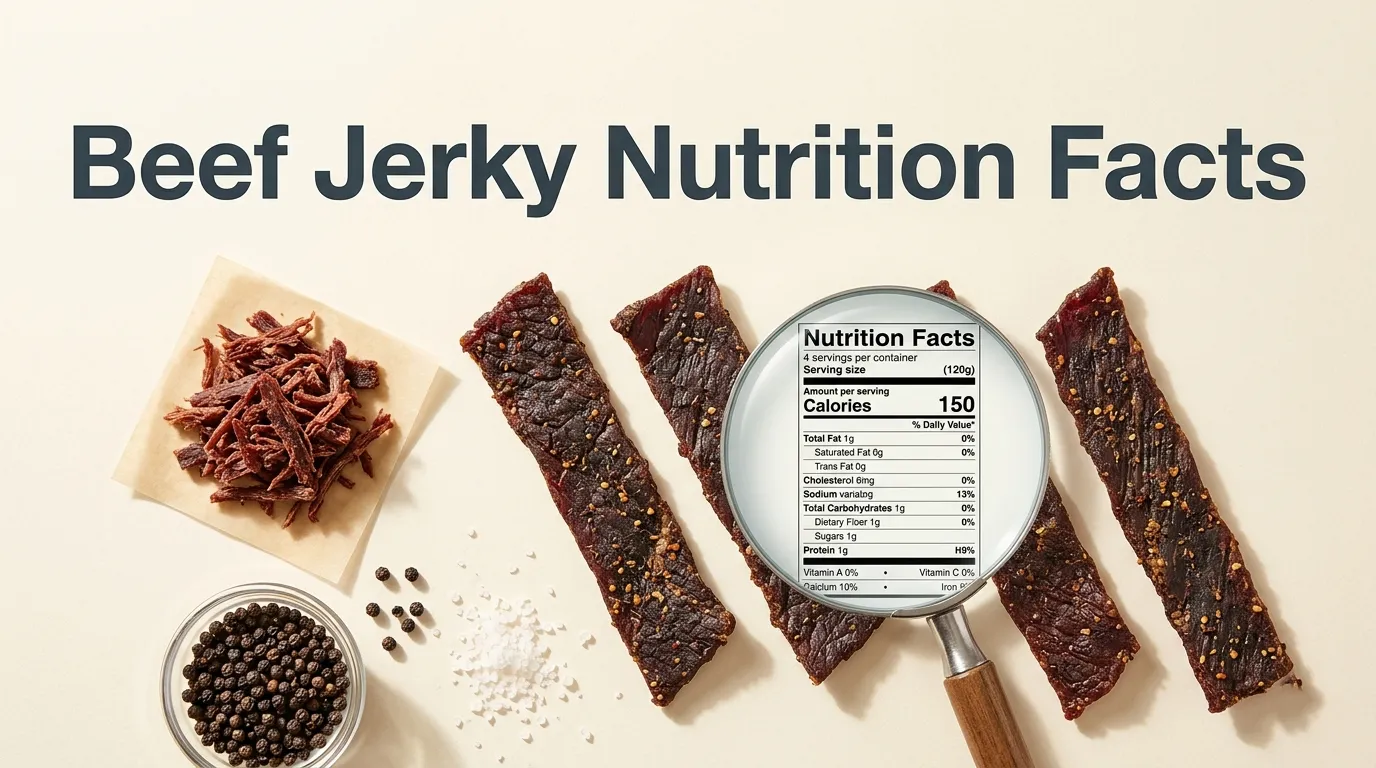
Beef Jerky Nutrition Facts: 2026 Label Reading Guide
Beef jerky nutrition facts start with a standard 1-ounce serving containing approximately 116 calories, 9.4 grams of protein, 7.3 grams of fat, and 3.1 grams of carbohydrates, with notable amounts of iron, zinc, and vitamin B12. The USDA FoodData Central database confirms that jerky is essentially dehydrated beef, meaning all nutrients become roughly three times more concentrated per ounce compared to fresh cooked beef.
That concentration effect explains everything about jerky nutrition. When you remove water from beef, the protein, fat, minerals, and yes, the sodium all condense into a smaller, denser package. The Academy of Nutrition and Dietetics notes that this makes jerky one of the most protein-dense shelf-stable snacks available, but it also means the sodium numbers require attention if you are monitoring salt intake.
You will find a full macronutrient and micronutrient breakdown with specific numbers from the USDA database, a clear explanation of how jerky is made and why that matters for nutrition, direct comparisons between whole-muscle jerky and jerky chew products, and a practical framework for reading jerky labels so you can choose the best option for your goals. No vague claims. Real numbers from named sources.
Beef Jerky Nutrition Facts
Beef jerky nutrition facts, sourced directly from the USDA FoodData Central database for a standard 1-ounce (28-gram) serving of plain beef jerky, include 116 calories, 9.4 grams of protein, 7.3 grams of total fat with 3.1 grams of saturated fat, 3.1 grams of carbohydrates including 2.5 grams of sugars, and 505 milligrams of sodium. This nutritional snapshot represents whole-muscle commercial jerky without additional flavoring glazes.
The numbers shift noticeably across flavor varieties. Teriyaki jerky adds roughly 3 to 5 grams of additional sugar per ounce from the sweet soy-based marinade. Peppered varieties add negligible calories but may increase sodium slightly from additional seasoning. The core protein and fat numbers remain relatively stable across flavors because they come from the beef itself, not the marinade.
The serving size of 1 ounce is worth anchoring on because jerky packages often contain multiple servings. A typical 3-ounce bag from a convenience store contains three standard servings. Eating the whole bag triples every number on the label. Most people consume the entire package in one sitting, which is important context for the sodium and calorie totals that follow in the sections below.
The moisture content of beef jerky, which the USDA Food Safety and Inspection Service regulates at a water activity level below 0.85 for shelf stability, is the nutritional key to understanding the product. Fresh cooked beef is roughly 60 to 65 percent water by weight. Beef jerky is roughly 20 to 25 percent water. This threefold reduction in water content means every other nutrient is approximately three times more concentrated per ounce than in fresh beef.
| Nutrient | Amount Per 1 oz (28g) | % Daily Value | Amount in 3 oz Fresh Cooked Beef |
|---|---|---|---|
| Calories | 116 kcal | 6% | 213 kcal |
| Protein | 9.4 g | 19% | 25 g |
| Total Fat | 7.3 g | 9% | 12 g |
| Saturated Fat | 3.1 g | 16% | 4.5 g |
| Carbohydrates | 3.1 g | 1% | 0 g |
| Sugars | 2.5 g | N/A | 0 g |
| Sodium | 505 mg | 22% | 55 mg |
| Iron | 1.5 mg | 8% | 2.3 mg |
| Zinc | 2.3 mg | 21% | 5.2 mg |
Key Takeaway: Beef jerky is dehydrated beef, and that simple fact explains the entire nutritional profile. Everything is roughly three times more concentrated per ounce than fresh beef, including the sodium.
Beef Jerky Calories Per Serving
Beef jerky calories per serving land at approximately 116 calories for a standard 1-ounce serving of plain whole-muscle jerky, with roughly 56 percent of those calories coming from fat, 33 percent from protein, and 11 percent from carbohydrates. The calorie density is moderate compared to other snack foods.
The math behind those calorie proportions tells the story. Fat provides 9 calories per gram. At 7.3 grams per ounce, fat contributes about 66 calories. Protein provides 4 calories per gram. At 9.4 grams per ounce, protein contributes about 38 calories. Carbohydrates contribute the remaining 12 calories from 3.1 grams. This macronutrient split makes jerky fundamentally a fat-and-protein snack with minimal carbohydrate energy.
Calorie counts vary across brands and styles more than most shoppers realize. A thick-cut artisan jerky with visible marbling may run 130 to 150 calories per ounce because it retains more intramuscular fat. A lean top-round jerky trimmed of external fat before dehydration may come in under 100 calories per ounce. The difference is entirely in the fat content. The protein per ounce stays relatively constant across styles.
For calorie-conscious consumers, the most relevant comparison is to other grab-and-go protein snacks. A standard protein bar delivers 190 to 250 calories for a similar amount of protein. A 2-ounce bag of trail mix with nuts and chocolate runs 250 to 300 calories. A single-serving bag of potato chips at 1.5 ounces delivers 225 calories with minimal protein. Jerky sits in a favorable position for calorie-per-gram-of-protein efficiency among portable snacks.
Quick Tip:
- Plain jerky averages 116 calories per ounce. Flavored varieties like teriyaki or honey BBQ add 10 to 30 calories per ounce from sugar.
- Check the serving size on your bag carefully. A 3-ounce bag eaten in one sitting delivers roughly 350 calories.
- Lean jerky made from top round cuts can run under 100 calories per ounce.
- For calorie-to-protein efficiency, jerky outperforms trail mix, chips, and most protein bars.
Beef Jerky Protein Per Ounce
Beef jerky protein per ounce measures 9.4 grams according to USDA FoodData Central data, making it one of the most protein-dense shelf-stable snacks available. That 9.4 grams represents approximately 19 percent of the Daily Value for protein based on a 50-gram reference intake, concentrated into a food that weighs less than a slice of bread.
The protein in beef jerky is complete protein. It contains all nine essential amino acids in proportions the human body requires for muscle maintenance, immune function, and enzyme production. The biological value of beef protein is high, rated at approximately 80 on a scale where whole egg protein scores 100. Your body can use a large fraction of the protein you eat from jerky for actual tissue needs.
The dehydration process does not damage or denature the protein in any meaningful way. The low, slow drying temperatures used in commercial jerky production, typically 145 to 160 degrees Fahrenheit, are well below the temperatures that would degrade protein quality. What changes is the physical structure. The muscle fibers tighten as water leaves, creating the characteristic chewy texture. The amino acid content remains intact.
For athletes and active individuals tracking protein intake, jerky offers a practical advantage that powders and bars do not. It requires no mixing, no refrigeration, and no preparation. A 3-ounce bag provides about 28 grams of protein, roughly equivalent to a scoop of whey protein powder or a small chicken breast. The trade-off is the sodium, which you will read about in the sodium section below. For a post-workout snack on a hiking trail or a mid-afternoon office protein hit, jerky delivers where shakes cannot.
- Beef jerky provides 9.4 grams of complete protein per ounce.
- The protein contains all nine essential amino acids with high biological value.
- Dehydration does not degrade protein quality or amino acid content.
- A 3-ounce bag equals roughly 28 grams of protein, similar to a chicken breast.
- Jerky protein requires no preparation and is fully shelf-stable.
Key Takeaway: Jerky packs nearly 10 grams of complete, high-quality protein into every ounce. For portable protein density without refrigeration, it has few competitors.
Beef Jerky Carbs and Sugar
Beef jerky carbs and sugar content varies more than any other macronutrient in the product, ranging from near zero in traditional plain jerky to 8 grams or more per ounce in sweet teriyaki or honey-glazed varieties. The USDA database lists plain beef jerky at 3.1 grams of total carbohydrates with 2.5 grams of sugars per ounce, but individual products diverge significantly from this baseline.
The carbohydrate source in jerky comes almost entirely from the marinade and any post-drying glaze, not from the beef itself. Fresh beef contains essentially zero carbohydrates. Any sugar, honey, brown sugar, maple syrup, or fruit juice concentrate listed in the ingredients is added during processing for flavor, not because beef requires sweetening. This makes jerky fundamentally a low-carb food when the manufacturer chooses to keep it that way.
The practical range across common products is wide. Plain or original-flavor jerky typically stays under 3 grams of carbs and 2 grams of sugar per ounce. Black pepper or spicy varieties add minimal carbohydrates. Teriyaki jerky jumps to 5 to 8 grams of sugar per ounce from the sweet soy marinade. Honey BBQ or maple-flavored jerky can push past 8 grams. The label tells the story in seconds if you know to look at the “Total Sugars” and “Added Sugars” lines.
For anyone following a ketogenic diet, jerky can work but requires careful label reading. The standard keto carbohydrate ceiling is 20 to 50 grams of total carbohydrates per day. A 3-ounce bag of plain jerky at roughly 9 grams of carbs and 7.5 grams of sugar fits within most keto macros. The same 3-ounce bag of teriyaki jerky at 18 to 24 grams of sugar consumes half or more of the daily carbohydrate allowance in one snack. The difference between the two products is entirely in the marinade.
| Jerky Style | Carbs per 1 oz | Sugar per 1 oz | Keto Compatible (per 3 oz) |
|---|---|---|---|
| Plain/Original | 2-4 g | 1-3 g | Yes |
| Black Pepper | 2-4 g | 1-3 g | Yes |
| Spicy/Chili | 2-5 g | 1-4 g | Yes (check label) |
| Teriyaki | 5-8 g | 4-8 g | Borderline |
| Honey BBQ | 7-12 g | 6-10 g | No |
| Maple/Brown Sugar | 8-14 g | 7-12 g | No |
Beef Jerky Sodium Content
Beef jerky sodium content averages 505 milligrams per ounce in plain commercial jerky according to the USDA FoodData Central database, representing 22 percent of the American Heart Association’s recommended daily limit of 2,300 milligrams. This is the single most important nutritional number on the jerky label for anyone monitoring blood pressure or sodium intake.
The sodium is present for two reasons, one functional and one culinary. Functionally, salt is a critical component of the preservation process. It reduces water activity by binding free water molecules, making them unavailable for microbial growth. Without adequate salt, jerky would not be shelf-stable at room temperature. The USDA Food Safety and Inspection Service requires specific salt concentrations or equivalent water activity levels for commercial jerky to be sold without refrigeration. Culinarily, salt is the primary flavoring agent that makes dried beef taste like jerky rather than like chewy cardboard.
The sodium range across products is wide enough to matter. Low-sodium jerky products, often labeled as such, can come in at 150 to 250 milligrams of sodium per ounce. The reduction is achieved through potassium chloride substitution, reduced salt in the marinade, or alternative preservation methods. The trade-off is usually in texture and shelf life. Low-sodium jerky tends to be softer and has a shorter shelf-stable window. Premium or artisan brands sometimes run even higher than the USDA average, at 600 to 700 milligrams of sodium per ounce, using salt as their primary flavor driver.
A 3-ounce bag of standard jerky delivers approximately 1,515 milligrams of sodium. For someone eating the whole bag, a common real-world consumption pattern, that is 66 percent of the daily recommended limit in a single snack. This does not make jerky unhealthy. It makes it a food that requires awareness and portion attention. Someone with hypertension, kidney disease, or a physician-prescribed sodium restriction should discuss jerky consumption with their healthcare provider and may want to seek out specifically labeled low-sodium varieties.
Key Takeaway: The sodium in jerky is both a preservative and a flavoring agent. One ounce delivers 22 percent of your daily sodium limit. A whole 3-ounce bag delivers 66 percent. Read the label, know your portion, and low-sodium options exist if you need them.
Beef Jerky Iron Content
Beef jerky iron content measures 1.5 milligrams per ounce according to USDA FoodData Central data, providing 8 percent of the Daily Value for iron based on an 18-milligram reference intake. The iron in jerky is heme iron, the form found in animal muscle tissue that the human body absorbs at roughly 15 to 35 percent efficiency compared to 2 to 20 percent for non-heme iron from plant sources.
Heme iron absorption matters because iron deficiency is the most common nutritional deficiency worldwide, affecting approximately 25 percent of the global population according to the World Health Organization. Women of reproductive age are at particularly high risk due to menstrual iron losses. The form of iron matters as much as the amount. A food with less total iron but in heme form may deliver more usable iron to the body than a food with higher total iron in non-heme form.
The mechanism behind heme iron’s superior absorption involves a specific transporter in the intestinal lining called HCP1 (heme carrier protein 1). This transporter pulls the entire heme molecule, an iron atom caged inside a porphyrin ring, directly into intestinal cells. Non-heme iron requires a separate transport system that is influenced by dietary enhancers like vitamin C and inhibitors like phytates from grains and tannins from tea. Heme iron absorption is largely unaffected by these factors.
For people at risk of iron deficiency, including menstruating women, pregnant individuals, adolescents during growth spurts, and endurance athletes who lose iron through foot-strike hemolysis and sweat, beef jerky provides a practical, portable source of highly absorbable iron. A 3-ounce bag delivers 4.5 milligrams of heme iron, roughly 25 percent of the daily requirement for women and 56 percent for men. Pairing jerky with a vitamin C source, such as a piece of fruit, enhances absorption further, though the heme iron already absorbs well on its own.
- Beef jerky provides 1.5 mg of heme iron per ounce (8% DV).
- Heme iron absorbs at 15-35% efficiency, far higher than plant-based non-heme iron at 2-20%.
- A 3-ounce bag provides 4.5 mg of iron, beneficial for menstruating women and athletes.
- Vitamin C pairing enhances iron absorption further but is not required for heme iron.
- The WHO identifies iron deficiency as the most common global nutritional deficiency.
Beef Jerky Vitamins and Minerals
Beef jerky vitamins and minerals extend well beyond the commonly cited iron and sodium. The USDA FoodData Central database records meaningful amounts of zinc at 2.3 milligrams per ounce (21 percent Daily Value), phosphorus at 81 milligrams (6 percent DV), vitamin B12 at 0.3 micrograms (13 percent DV), niacin at 1.4 milligrams (9 percent DV), and vitamin B6 at 0.1 milligrams (6 percent DV). These numbers reflect the nutrient density of beef muscle tissue concentrated by dehydration.
Zinc is the standout mineral in jerky after sodium and iron. At 2.3 milligrams per ounce, a 3-ounce bag provides nearly 7 milligrams, roughly 64 percent of the daily requirement for men and 88 percent for women. Zinc functions as a cofactor for over 300 enzymes and is central to immune cell development and function. The zinc in beef is highly bioavailable because animal proteins enhance zinc absorption, unlike plant sources where phytates bind zinc and reduce its availability.
Vitamin B12 deserves attention because it is found almost exclusively in animal foods. A single ounce of jerky provides 13 percent of the daily B12 requirement. This vitamin is essential for DNA synthesis, red blood cell formation, and the maintenance of the myelin sheath that insulates nerve cells. Vegans and vegetarians who exclude animal products must supplement B12 or consume fortified foods. For omnivores, jerky provides a practical source in a compact format.
Phosphorus, niacin, and vitamin B6 round out the micronutrient profile at lower but still meaningful levels. Phosphorus works with calcium to build bone mineral density. Niacin participates in over 200 enzymatic reactions related to energy metabolism. Vitamin B6 is required for amino acid metabolism and neurotransmitter synthesis. None of these are at levels that make jerky a primary source, but they contribute to the overall nutrient density that distinguishes whole-food snacks from processed snack foods with empty calories.
| Micronutrient | Per 1 oz | % Daily Value | Function |
|---|---|---|---|
| Zinc | 2.3 mg | 21% | Immune function, enzyme cofactor, wound healing |
| Vitamin B12 | 0.3 mcg | 13% | DNA synthesis, red blood cells, nerve myelin |
| Iron (heme) | 1.5 mg | 8% | Oxygen transport, energy metabolism |
| Niacin (B3) | 1.4 mg | 9% | Energy metabolism, DNA repair |
| Phosphorus | 81 mg | 6% | Bone mineral, cell membranes |
| Vitamin B6 | 0.1 mg | 6% | Amino acid metabolism, neurotransmitters |
| Potassium | 166 mg | 4% | Fluid balance, nerve signaling |
| Magnesium | 14 mg | 3% | Muscle function, enzyme reactions |
Key Takeaway: Jerky is not just protein and sodium. A single ounce delivers meaningful amounts of zinc, B12, iron, and several other minerals. The nutrient density is a genuine nutritional strength when the sodium context is managed.
Beef Jerky Ingredients List
A beef jerky ingredients list on a commercial product label typically begins with beef, followed by water, salt, sugar, and a series of flavoring and preservation agents that may include soy sauce, Worcestershire sauce, monosodium glutamate, hydrolyzed corn protein, yeast extract, liquid smoke, and various spices and spice extracts. The shorter the list, generally, the closer the product is to traditional jerky.
The beef declaration itself matters. “Beef” as the first ingredient means whole-muscle cuts, typically top round, bottom round, or flank steak. “Beef, mechanically separated” or “beef, chopped and formed” indicates a restructured product made from smaller meat pieces pressed together with binders. The USDA requires these distinctions on the label. Whole-muscle jerky has a recognizably fibrous texture when torn. Ground-and-formed jerky has a uniform, sausage-like consistency.
Water appears on jerky ingredient lists because most commercial jerky starts as a wet marinade process. The beef soaks in a solution of water, salt, sugar, and seasonings before drying. The water carries the flavoring agents into the meat. It evaporates during dehydration. The salt stays behind. This is why the sodium is so concentrated in the finished product. The salt dissolved in the marinade water does not evaporate with the water.
The flavoring agents beyond salt and sugar are where ingredient lists vary most. Traditional jerky uses soy sauce and Worcestershire sauce for umami depth. Mass-market jerky may use MSG, hydrolyzed corn protein, and yeast extract to achieve the same savory effect through different chemical routes. Liquid smoke or natural smoke flavor replaces the traditional smoking step in many large-scale operations. Celery powder, used as a natural preservative in “nitrate-free” products, is chemically identical to sodium nitrate in its preservation function, a detail explored in the preservatives section below.
- Beef: First ingredient. Whole-muscle or ground-and-formed determines texture.
- Water: Marinade carrier. Evaporates during drying. Leaves behind salt and flavor.
- Salt: Primary preservative. Reduces water activity for shelf stability.
- Sugar: Browning agent and flavor balancer. Variable amounts by flavor.
- Soy sauce and Worcestershire: Traditional umami sources. May introduce soy, wheat, or fish allergens.
- MSG, hydrolyzed protein, yeast extract: Alternative umami sources. Chemically similar to glutamate.
- Liquid smoke: Industrial replacement for traditional wood smoking.
Beef Jerky Preservatives Nitrates
Beef jerky preservatives, including nitrates and nitrites, function to inhibit Clostridium botulinum growth and maintain the cured meat color consumers expect, but the landscape of how these compounds appear on labels has shifted significantly by 2026. Traditional sodium nitrate and sodium nitrite have been partially replaced by celery powder and cultured celery extract in products labeled “uncured” or “no nitrates added.”
The preservation chemistry is identical regardless of the source. Whether sodium nitrite comes from a laboratory or from concentrated celery powder, the nitrite ion that prevents botulism is the same molecule. Celery powder naturally contains high levels of nitrate, which bacteria in the meat convert to nitrite during processing. The USDA requires products using celery powder to carry the statement “except those naturally occurring in celery powder” on the label. Many consumers misinterpret the “no nitrates added” claim as meaning no nitrates are present, which is chemically inaccurate.
The health concern around nitrates centers on nitrosamine formation. When nitrites encounter amino acids at high temperatures, they can form nitrosamines, some of which the World Health Organization International Agency for Research on Cancer classifies as probable human carcinogens. The relevant question for jerky is whether the low, slow drying temperatures used in production create conditions favorable to nitrosamine formation. Research suggests the risk is lower than in high-heat cooking methods like frying bacon, but the concern has driven some manufacturers to add ascorbic acid (vitamin C) or sodium erythorbate to their formulations, which inhibits nitrosamine formation.
The broader processed meat classification deserves mention. The WHO IARC classifies processed meat as a Group 1 carcinogen based on colorectal cancer evidence, placing jerky in the same category as bacon, ham, and sausage. This classification is about the processing, not the specific preservative used. The risk is associated with regular, high-quantity consumption over decades, not with occasional jerky consumption. The American Institute for Cancer Research recommends limiting processed meat intake rather than eliminating it entirely.
Key Takeaway: “Uncured” and “no nitrates added” jerky uses celery powder instead of synthetic sodium nitrate, but the nitrate chemistry is identical. Both versions serve the same preservation purpose. Read labels with that context.
How Is Beef Jerky Made
How beef jerky is made determines its nutritional profile, and the process starts with lean beef cuts, typically top round or flank steak, sliced against the grain into thin strips, marinated in a salt-and-seasoning solution for 12 to 24 hours, and then dried at low temperatures between 145 and 160 degrees Fahrenheit until the moisture content drops to a water activity below 0.85 for shelf stability.
The meat selection step matters nutritionally. Fat turns rancid over time, which is why traditional jerky uses the leanest cuts available. Top round, also called the inside round, is the industry standard because it combines low fat content with enough structural integrity to slice cleanly into strips. Cuts with more marbling, like brisket or chuck, produce softer, fattier jerky with a shorter shelf life. A jerky made from wagyu brisket might taste luxurious but carries 150 calories per ounce instead of 116 and has a refrigerated shelf life measured in weeks rather than months.
The marinade step is where the sodium, sugar, and flavor profile are locked in. The beef strips soak in a solution that is typically 3 to 8 percent salt by weight, plus sugar, soy sauce, Worcestershire sauce, spices, and liquid smoke depending on the flavor. The meat absorbs the dissolved salt and sugar. When the water evaporates during drying, those solutes stay behind in concentrated form. This is the mechanism that creates the 505 milligrams of sodium per ounce. The salt was in the marinade water. The water left. The salt remained.
The drying step uses commercial dehydrators, smokehouses, or combination oven-dryers. Temperature control is critical. The USDA FSIS requires that jerky reach an internal temperature of 160 degrees Fahrenheit during processing to eliminate E. coli and Salmonella. Home dehydrators often cannot maintain this temperature consistently, which is why homemade jerky recipes include a post-drying oven step. The drying time ranges from 4 to 12 hours depending on slice thickness, humidity, and equipment.
- Beef selection: Lean cuts, primarily top round, sliced against the grain for chewability.
- Marinade: 12-24 hour soak in salt-sugar-spice solution at 3-8% salt concentration.
- Drying: 145-160 degrees F for 4-12 hours until water activity drops below 0.85.
- Post-drying: Cooling and packaging, often with oxygen absorber packets for extended shelf life.
- Safety requirement: Internal temperature must reach 160 degrees F to meet USDA FSIS pathogen control standards.
Homemade vs Store Bought Beef Jerky Nutrition
Homemade beef jerky nutrition differs from store-bought in two consistent ways: lower sodium content and a shorter, fully controllable ingredients list. When you make jerky at home, you decide the salt concentration in the marinade, which typically runs 1 to 3 percent rather than the 3 to 8 percent used in commercial production for maximum shelf stability.
The sodium numbers bear this out directly. A homemade jerky made with a moderate salt marinade can come in at 150 to 250 milligrams of sodium per ounce, compared to the 505-milligram USDA average for commercial jerky. The trade-off is shelf life. Commercial jerky at 505 milligrams of sodium per ounce and a water activity below 0.85 is shelf-stable at room temperature for 12 months or more. Homemade jerky at 200 milligrams of sodium per ounce with slightly higher water activity stays good for about 1 to 2 weeks at room temperature, or 2 to 3 months refrigerated.
The ingredient list difference is even more dramatic. Homemade jerky typically contains beef, soy sauce or salt, maybe some sugar or honey, black pepper, garlic powder, and liquid smoke or actual smoking. That is a list of five to seven recognizable ingredients. A commercial jerky bag may list 15 to 25 ingredients including hydrolyzed proteins, yeast extracts, modified food starches, phosphates, and multiple preservative systems. The nutritional differences between the two go beyond sodium to include the absence of industrial processing aids.
The protein and micronutrient content remains similar between homemade and store-bought because both start from the same raw material: lean beef. A homemade batch using top round delivers roughly the same 9 to 10 grams of protein per ounce and the same iron, zinc, and B12 content. The dehydration process concentrates nutrients regardless of whether it happens in a commercial smokehouse or a home dehydrator. The difference is in what gets added, not what is naturally present.
| Characteristic | Homemade Jerky | Commercial Jerky |
|---|---|---|
| Sodium per ounce | 150-250 mg | 350-700 mg |
| Ingredient count | 5-8 ingredients | 12-25 ingredients |
| Preservatives | Salt only (or none) | Nitrates, BHA, BHT, potassium sorbate |
| Shelf life (room temp) | 1-2 weeks | 12+ months |
| Sugar per ounce | Variable (1-4 g) | Variable (1-12 g) |
| Cost per ounce | $0.80-$1.50 | $1.50-$3.50 |
Key Takeaway: Homemade jerky lets you control sodium and eliminate industrial additives, but the trade-off is a dramatically shorter shelf life. The protein and micronutrients stay the same either way.
Jack Link’s Jerky Chew Nutrition Facts
Jack Link’s jerky chew nutrition facts, based on the brand’s published nutrition information for their shredded jerky chew product line, show a product designed for a different eating experience than traditional whole-muscle strips, with finer shreds, softer texture, and a nutritional profile that reflects the smaller particle size and the ingredient additions required to achieve that format.
Jerky chew is a shredded tobacco-style jerky product packaged in a round can, similar in appearance to moist snuff packaging but containing only beef jerky. The shred size is much finer than traditional jerky strips. The product is designed to be eaten by the pinch rather than in strips. This format change affects the nutritional numbers primarily through ingredient additions needed to maintain the soft, pliable, non-clumping texture of fine shreds.
Jack Link’s original jerky chew contains approximately 80 calories, 7 grams of protein, 2 grams of fat, 6 grams of carbohydrates including 5 grams of sugar, and 330 milligrams of sodium per 1-ounce serving according to the brand’s label data. The carbohydrate and sugar numbers are higher than traditional whole-muscle jerky. The additional sugars, typically from brown sugar, honey, or corn syrup in the ingredient formulation, serve as humectants that keep the fine shreds soft and prevent them from drying into a hard, unpalatable mass in the can.
The sodium content, at 330 milligrams per ounce, is lower than the USDA average for whole-muscle jerky at 505 milligrams. This likely reflects the different preservation requirements of the product. The fine shred format with higher sugar content achieves a water activity level that allows for slightly lower salt while maintaining shelf stability. The trade-off between sodium and sugar is a common formulation decision in processed snack foods. Jerky chew shifts the balance toward sugar for texture reasons.
| Nutrient | Jack Link’s Jerky Chew (1 oz) | Traditional Strip Jerky (1 oz) |
|---|---|---|
| Calories | 80 kcal | 116 kcal |
| Protein | 7 g | 9.4 g |
| Total Fat | 2 g | 7.3 g |
| Carbohydrates | 6 g | 3.1 g |
| Sugars | 5 g | 2.5 g |
| Sodium | 330 mg | 505 mg |
Jerky Chew Nutrition Facts
Jerky chew nutrition facts reflect a product category that is nutritionally distinct from traditional strip jerky, characterized by smaller shred size, softer mouthfeel, lower fat content from the use of leaner meat inputs, higher sugar content for texture maintenance, and a sodium level that varies by brand but generally runs 250 to 400 milligrams per ounce.
The category originated as a smokeless tobacco alternative but has evolved into a standalone snack format. The shreds are typically made from beef that is cooked, shredded, seasoned, and packaged in a moist, pliable state. Unlike traditional jerky which is dried to a water activity below 0.85, jerky chew products often retain slightly higher moisture to maintain the soft texture. This requires a different preservative approach, often relying on a combination of salt, sugar, and sometimes potassium sorbate.
The protein content in jerky chew products generally runs 6 to 8 grams per ounce, slightly lower than whole-muscle jerky at 9 to 10 grams. The difference comes from the higher moisture and sugar content, which dilutes the protein density slightly. The protein itself is still complete beef protein with the same amino acid profile. There is no meaningful difference in protein quality, only in quantity per ounce.
The fat content is consistently lower in jerky chew products compared to traditional jerky. At 1 to 3 grams of fat per ounce versus 5 to 8 grams in strip jerky, the difference reflects the use of very lean beef inputs. The shredding process and the soft texture requirement favor low-fat formulations because fat firms up when cold and can make the shreds feel greasy. For someone prioritizing low-fat snacking, jerky chew offers a genuine nutritional advantage, though the higher sugar content is the offsetting consideration.
- Jerky chew contains 6-8 grams of protein per ounce, slightly less than strip jerky.
- Fat content is lower at 1-3 grams per ounce due to lean meat inputs.
- Sugar content is higher at 4-6 grams per ounce to maintain soft texture.
- Sodium runs 250-400 milligrams per ounce, generally lower than traditional jerky.
- Higher moisture content requires different preservative strategies for shelf stability.
Key Takeaway: Jerky chew trades some protein and fat for more sugar and a softer texture. The nutritional differences reflect the format, not inferior ingredients. Check the sugar line if carbohydrate intake matters to you.
Shredded Beef Jerky Nutrition
Shredded beef jerky nutrition sits between traditional whole-muscle strips and fine jerky chew products on the texture spectrum, with nutritional values that typically run 80 to 100 calories, 7 to 9 grams of protein, 2 to 4 grams of fat, 3 to 6 grams of carbohydrates, and 300 to 450 milligrams of sodium per ounce. The shredded format changes the eating experience and the ingredient requirements without fundamentally altering the nutritional foundation.
Shredded jerky is made from whole-muscle beef that is cooked, pulled apart into strands, seasoned, and dried to a pliable consistency. The shredding step exposes more surface area to seasoning, which can mean more even flavor distribution but also more thorough coating with salt and sugar. The nutritional consequence is that shredded jerky sometimes runs slightly higher in sodium per ounce than sliced jerky because the seasoning adheres to all the exposed surfaces.
The protein quality remains identical to any other beef jerky format. Shredded, sliced, or chewed, the beef protein has the same amino acid profile and the same biological value. The differences are in the non-beef additions. Some shredded jerky products include binding agents like modified food starch or maltodextrin to prevent the shreds from clumping. These additions show up as slightly higher carbohydrate numbers on the label. A clean shredded jerky with only beef, salt, and spices has essentially the same nutrition facts as sliced jerky.
The practical advantage of shredded jerky is portion flexibility. You can eat a pinch or a handful without committing to a full strip. This makes it appealing for trail mix customization, salad topping, or adding to backpacking meals. The disadvantage is that the loose format makes it harder to track how much you have eaten compared to discrete strips. A person absentmindedly eating from a bag of shredded jerky may consume significantly more than the labeled serving size.
- Shredded jerky contains 7-9 grams of protein per ounce, similar to sliced jerky.
- Carbohydrates run 3-6 grams per ounce depending on binder and sugar additions.
- Sodium may be slightly higher than sliced jerky due to increased surface area for seasoning.
- The loose format allows portion flexibility but makes serving size tracking harder.
- Clean-label shredded jerky with minimal ingredients has nearly identical nutrition to sliced jerky.
Is Beef Jerky Healthy for Weight Loss
Is beef jerky healthy for weight loss is a question best answered with a conditional yes: beef jerky can support weight loss as a high-protein, portable snack that delivers satiety with reasonable calories, provided you choose lower-sodium and lower-sugar varieties and account for the serving size rather than eating from the bag without tracking portions.
The protein-to-calorie ratio makes the case. At 9.4 grams of protein for 116 calories, jerky provides roughly 0.08 grams of protein per calorie. For context, a standard protein bar provides about 0.10 grams of protein per calorie. A handful of almonds provides about 0.04. Potato chips provide essentially zero. Jerky lands competitively for a whole-food snack. The protein triggers satiety signals through peptide YY and GLP-1 hormone release, which helps reduce subsequent food intake.
The low carbohydrate content of plain jerky, typically 2 to 4 grams per ounce, means it produces a minimal insulin response. For people whose weight loss strategy involves controlling insulin levels through carbohydrate restriction, jerky fits neatly. The fat content, at 7 grams per ounce with roughly 3 grams of saturated fat, provides additional satiety without being extreme. The Dietary Guidelines for Americans 2020-2025 recommend limiting saturated fat to less than 10 percent of total daily calories, which leaves room for jerky within a balanced intake.
The primary caution for weight loss is behavioral, not nutritional. Jerky is calorie-dense for its volume because dehydration removes the water that would otherwise provide stomach-filling bulk. An ounce of jerky is visually small, roughly the size of two or three strips. It is easy to eat 3 ounces without registering the 350 calories and 1,500 milligrams of sodium consumed. For weight loss, pre-portion jerky into single servings rather than eating from a bulk bag. Pair it with a high-volume, low-calorie food like raw vegetables to add stomach-filling bulk without significant additional calories.
Key Takeaway: Jerky supports weight loss through high protein and reasonable calories, but the lack of water volume means it is easy to overeat. Pre-portion your servings and pair with vegetables for satiety.
Beef Jerky vs Protein Bar Nutrition
Beef jerky and protein bar nutrition differ in ways that make each product suited to different goals. Beef jerky provides whole-food protein with fewer total ingredients, no sugar alcohols, and higher sodium. A protein bar provides more fiber, more total protein per unit, and a softer texture, but typically includes processed protein isolates, sugar alcohols, and a longer ingredient list of binders and emulsifiers.
The numbers line up differently than many people expect. A standard 1-ounce serving of jerky provides 9.4 grams of protein and 116 calories. A standard 60-gram protein bar provides 20 grams of protein and 190 to 250 calories. The protein bar delivers more protein per package, but the jerky delivers slightly better protein per calorie. Neither is inherently superior. The choice depends on context.
The ingredient philosophy separates the two products most clearly. Beef jerky, at its simplest, is beef and salt. A protein bar, even a clean-label one, typically contains protein isolate, a binder like soluble corn fiber or tapioca starch, a sweetener system, a fat source like almond butter or palm oil, flavoring agents, and sometimes coating chocolate. The jerky ingredient list is inherently shorter. For people prioritizing minimally processed foods, jerky aligns better with that goal.
The practical differences matter for real-world use. Jerky requires chewing, which slows consumption and may enhance satiety signaling. Protein bars can be eaten quickly. Jerky is savory, which suits people who do not want a sweet snack. Protein bars are sweet, even the ones not labeled as dessert flavors. Jerky is shelf-stable for months with no special handling. Protein bars can melt in heat, freeze solid in cold, and develop texture changes over time. For a glove box or backpack snack, jerky is more durable.
| Feature | Beef Jerky (1 oz) | Protein Bar (1 bar, ~60g) |
|---|---|---|
| Calories | 116 kcal | 190-250 kcal |
| Protein | 9.4 g | 15-25 g |
| Total Fat | 7.3 g | 7-12 g |
| Carbohydrates | 3.1 g | 15-30 g |
| Sugar | 2.5 g | 1-8 g |
| Fiber | 0.5 g | 5-15 g |
| Sodium | 505 mg | 100-300 mg |
| Ingredient count | 5-15 | 15-35 |
| Sugar alcohols | None | Often present |
Key Takeaway: Jerky and protein bars serve different snacking occasions. Jerky wins on ingredient simplicity and savory satisfaction. Bars win on fiber, total protein per package, and sodium control. Choose based on your priority for that snack.
Frequently Asked Questions About Beef Jerky Nutrition
How many calories are in one serving of beef jerky?
One standard 1-ounce serving of plain beef jerky contains approximately 116 calories according to USDA FoodData Central data.
Calorie counts range from 80 calories for lean, low-fat jerky to 150 calories for thick-cut, well-marbled artisan jerky.
Always check the serving size on your package since many bags contain 2 to 3 servings.
Is beef jerky a good source of protein?
Beef jerky is an excellent source of complete protein, providing 9.4 grams per ounce with all nine essential amino acids.
A 3-ounce bag delivers roughly 28 grams of protein, comparable to a small chicken breast or a scoop of whey protein powder.
The protein has high biological value and survives the dehydration process fully intact.
Why is beef jerky so high in sodium?
Beef jerky is high in sodium because salt serves both as a preservative and a flavoring agent in the dehydration process.
The marinade salt stays behind when water evaporates during drying, concentrating approximately 505 milligrams of sodium into every ounce.
Low-sodium jerky options at 150 to 250 milligrams per ounce exist but trade off some shelf stability and traditional texture.
Does beef jerky have a lot of iron?
Beef jerky contains 1.5 milligrams of heme iron per ounce, providing 8 percent of the Daily Value.
Heme iron from beef absorbs at 15 to 35 percent efficiency, far better than the 2 to 20 percent absorption of non-heme iron from plant foods.
A 3-ounce bag delivers 4.5 milligrams of highly absorbable iron, which is particularly valuable for menstruating women and athletes.
Is beef jerky keto friendly?
Plain beef jerky with 2 to 4 grams of carbohydrates per ounce is compatible with a ketogenic diet.
Teriyaki, honey BBQ, and other sweet-flavored jerky with 7 to 14 grams of sugar per ounce can consume a large portion of the daily keto carbohydrate allowance in a single serving.
Always check the Total Sugars and Added Sugars lines on the label when shopping for keto-compatible jerky.
What is the healthiest type of beef jerky to buy?
The healthiest beef jerky has the shortest ingredient list: beef, salt, and spices with minimal added sugar and no industrial preservatives beyond what salt provides.
Look for jerky made from whole-muscle beef, typically top round, with sodium under 400 milligrams per ounce and sugar under 3 grams per ounce if those are priorities for you.
Brands that use grass-fed beef, avoid nitrates and celery powder, and keep the ingredient count under 10 items generally represent the cleaner end of the category.
Beef jerky is dehydrated beef, and that single fact explains its entire nutritional profile. The protein, the minerals, the sodium all trace back to one process: removing water from muscle meat until it becomes shelf-stable, chewable, and concentrated. Understanding that gives you a framework for reading any jerky label with confidence.
The next time you stand in the snack aisle comparing bags, look past the front-of-package claims. Flip to the nutrition facts panel. Check the serving size. Note the sodium per serving. Scan the sugar line. Count the ingredients. A good jerky will have five to ten ingredients you recognize, sodium you can fit into your day, and sugar that reflects the flavor you chose rather than a surprise you did not.
Jerky is a real food with real nutritional strengths and one clear trade-off. Use it like one, in portions that match your goals, and it earns its place.