
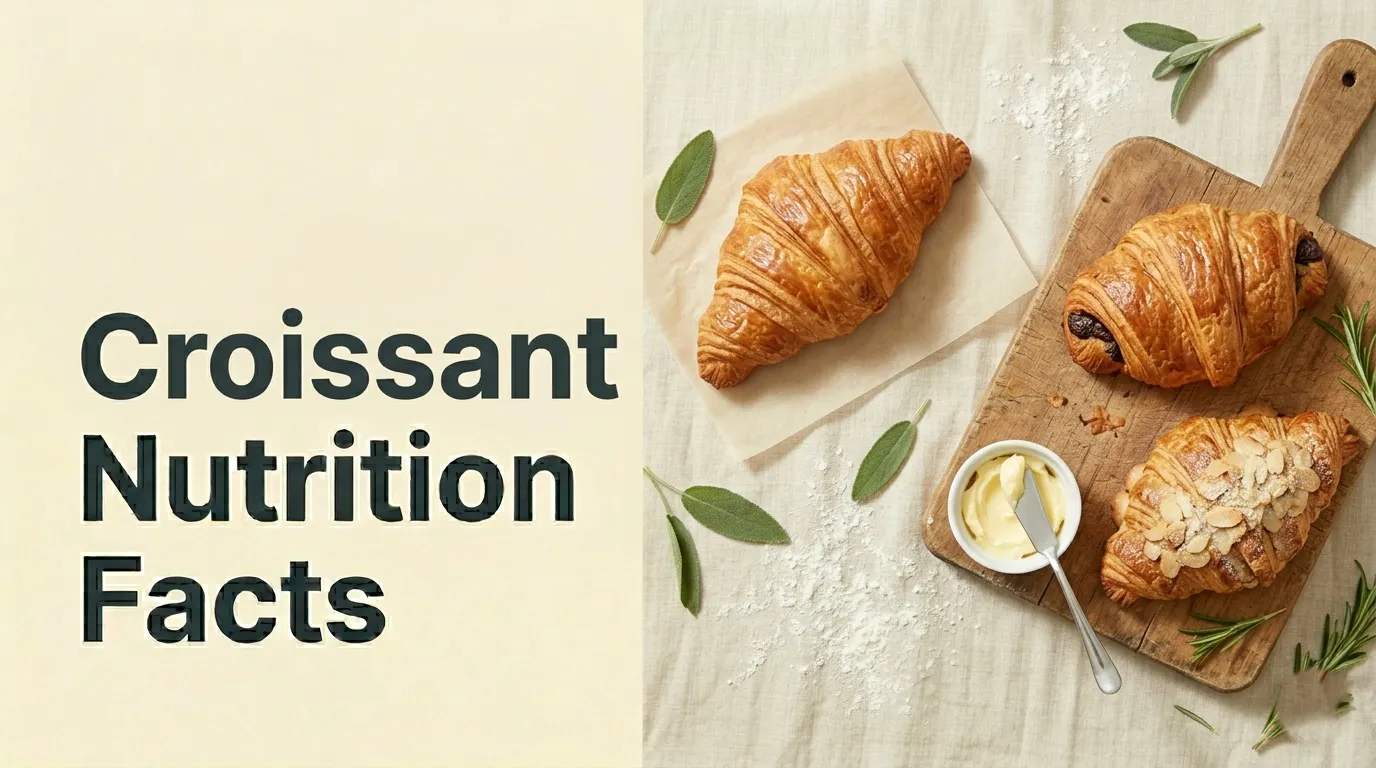
Croissant Nutrition Facts: A Complete Breakdown of Calories, Butter, and Varieties for 2026
A standard medium butter croissant delivers roughly 230 to 270 calories, with the majority of those calories coming from refined white flour and butter. The croissant nutrition facts that surprise most people are the saturated fat content, which hovers around 7 grams per pastry, and the near-total absence of fiber and protein in a food that looks substantial but is nutritionally quite light. One medium croissant provides about 4 to 5 grams of protein, less than you’d get from a single egg.
That same croissant also delivers roughly 30 grams of carbohydrate, almost entirely from refined wheat flour with minimal fiber. The USDA FoodData Central database records that a medium plain croissant contains approximately 1 gram of dietary fiber per serving. For context, the Dietary Guidelines for Americans 2020-2025 recommend 25 to 34 grams of fiber per day depending on age and sex. A croissant breakfast with no fruit, vegetables, or whole grains added contributes almost nothing toward that target.
This article walks you through the complete nutritional profile of croissants, from the classic butter version to chocolate-filled, almond, ham and cheese, and fast-food varieties. You’ll find full macro and micronutrient tables, comparisons to other breakfast pastries, an honest look at what makes croissant dough nutritionally distinct from regular bread, and practical guidance on when and how croissants fit into a balanced eating pattern.
Croissant Nutrition Facts Overview
A croissant is a viennoiserie pastry of French origin made from laminated dough, which consists of alternating layers of yeasted wheat dough and butter created through a process of repeated folding and rolling. The lamination process produces the characteristic flaky, airy texture and rich mouthfeel that distinguishes a croissant from a standard dinner roll or bread slice.

A standard medium plain butter croissant weighs approximately 57 grams, or roughly 2 ounces. The USDA FoodData Central database provides the following nutritional breakdown for a croissant of this size.
| Nutrient | Per Medium Croissant (57g) | % Daily Value |
|---|---|---|
| Calories | 260 kcal | — |
| Total Fat | 14 g | 18% |
| Saturated Fat | 7.5 g | 38% |
| Trans Fat | 0.3 g | — |
| Cholesterol | 38 mg | 13% |
| Sodium | 280 mg | 12% |
| Total Carbohydrate | 30 g | 11% |
| Dietary Fiber | 1 g | 4% |
| Total Sugars | 5 g | — |
| Protein | 4.5 g | 9% |
The macronutrient balance of a croissant reflects its ingredients: roughly 48% of calories from fat, 46% from carbohydrate, and 6% from protein. This is a fat-and-carbohydrate food, not a protein food, and not a food that provides meaningful satiety from either fiber or protein. The butter is what makes it taste good. The refined flour is what gives it structure. Neither provides nutritional staying power.
The saturated fat content at 7.5 grams per croissant represents roughly 38% of the 20-gram daily limit that the Dietary Guidelines for Americans 2020-2025 associate with a 2,000-calorie eating pattern. One croissant uses more than a third of the daily saturated fat budget. Add a butter pat, a latte with whole milk, or a side of bacon, and the saturated fat total climbs quickly.
Key Takeaway: A medium butter croissant delivers 260 calories, 14 grams of fat, and 30 grams of carbohydrate with minimal fiber or protein. The saturated fat at 7.5 grams per pastry uses over a third of the daily recommended limit.
Croissant Calories and Serving Size Guide
The calorie count of a croissant varies by size, and the size variation across bakeries and brands is significant. A mini croissant from a grocery store multipack may weigh only 28 grams and deliver roughly 130 calories. A bakery jumbo croissant can weigh 100 grams or more and deliver 450 to 500 calories. The difference between a mini and a jumbo is the difference between a snack and a meal.
The size categories commonly encountered look like this.
| Croissant Size | Approximate Weight | Approximate Calories |
|---|---|---|
| Mini | 28 g | 130 |
| Small | 42 g | 190 |
| Medium (standard) | 57 g | 260 |
| Large (bakery) | 85 g | 390 |
| Jumbo (café) | 100 g | 460 |
The calorie difference between a medium croissant and a large bakery croissant is roughly 130 calories, about the same as adding a tablespoon of butter on top. If you’re tracking intake and the croissant doesn’t come with a nutrition label, the size is your best guide. A croissant that fits in the palm of your hand with no overhang is likely a medium. A croissant that hangs over the edges of your palm is a large or jumbo.
Filled croissants add calories from the filling. A chocolate croissant (pain au chocolat) adds roughly 50 to 80 calories from the chocolate batons. An almond croissant adds roughly 120 to 160 calories from the almond cream filling and sliced almond topping. A ham and cheese croissant adds roughly 80 to 120 calories from the ham and cheese. The croissant base stays the same. The filling stacks on top.
Croissant Macronutrients: Fat, Carbs, and Protein
The macronutrient profile of a croissant is dominated by fat and refined carbohydrate, with protein a distant third. A medium croissant at 260 calories breaks down to roughly 126 calories from fat, 120 calories from carbohydrate, and 18 calories from protein.
The fat in a croissant is primarily butterfat, which is roughly 62% saturated, 29% monounsaturated, and 4% polyunsaturated. The butter is what creates the flaky layers through lamination. During baking, water in the butter turns to steam and pushes the dough layers apart. The milk solids in the butter brown and contribute to the golden crust. What remains in the finished pastry is the butterfat itself, minus the water that evaporated during baking.
The carbohydrate in a croissant is almost entirely starch from refined wheat flour. A medium croissant contains roughly 5 grams of sugar, some of which is naturally present in the flour and some of which comes from the small amount of sugar added to croissant dough. Croissant dough does contain a modest amount of sugar, typically 5 to 8% of the flour weight, which feeds the yeast and contributes to browning. It’s not an added-sugar-heavy food in its plain form.
The protein at 4.5 grams per medium croissant comes from the gluten in the wheat flour and the milk proteins in the butter. This is a small contribution to daily protein needs. For reference, the Recommended Dietary Allowance for protein is 0.8 grams per kilogram of body weight, which translates to roughly 56 grams per day for a sedentary 154-pound adult. One croissant covers about 8% of that minimum. A croissant breakfast with no additional protein source leaves a significant protein gap that will affect satiety and muscle maintenance if it’s a daily pattern.
Key Takeaway: A croissant gets roughly half its calories from fat and half from carbohydrate. The 4.5 grams of protein per pastry is a minor contribution to daily needs and doesn’t provide meaningful satiety on its own.
Butter Croissant vs. Margarine Croissant Nutrition
Not all croissants are made with butter. Some commercial and grocery store croissants use margarine or a butter-margarine blend instead of pure butter. The nutritional difference is measurable, and it centers on the type of fat, not the total fat quantity.
Butter croissants contain mostly saturated fat from dairy butter, along with small amounts of naturally occurring trans fats from the ruminant source. Margarine croissants, depending on the margarine formulation, may contain less saturated fat but more industrially produced trans fats, though the FDA’s 2018 ban on partially hydrogenated oils in the U.S. has largely eliminated industrial trans fats from margarines sold in American grocery stores.
| Croissant Type (medium, 57g) | Calories | Total Fat | Saturated Fat | Trans Fat |
|---|---|---|---|---|
| Butter Croissant | 260 | 14 g | 7.5 g | 0.3 g |
| Margarine Croissant | 250 | 12 g | 3 g | 0 to 2 g* |
| Whole Wheat Croissant | 240 | 11 g | 5 g | 0.2 g |
*Trans fat content in margarine croissants varies by the specific margarine formulation used.
The calorie difference between butter and margarine croissants is small, roughly 10 calories per medium croissant. The saturated fat difference is larger. A butter croissant at 7.5 grams of saturated fat delivers more than double the saturated fat of a margarine croissant made with a standard vegetable oil margarine.
The trade-off is flavor and texture. Butter croissants have a richer flavor and a more defined flaky texture because butterfat melts at a lower temperature than many margarine fats, which creates better steam-driven layer separation during baking. Margarine croissants are often softer and less distinctly layered. The nutrition advantage of less saturated fat in a margarine croissant comes at the cost of the sensory experience most people want when they eat a croissant.
Whole wheat croissants are uncommon but available at some bakeries. They replace a portion of the refined white flour with whole wheat flour, which adds roughly 1 to 2 grams of fiber per croissant and slightly reduces the total carbohydrate. The butter content is typically the same as a standard butter croissant, so the fat and calorie totals don’t change much.
Chocolate Croissant (Pain au Chocolat) Nutrition
A chocolate croissant, known as pain au chocolat in French, uses the same laminated dough as a plain croissant with the addition of one or two batons of dark or semisweet chocolate placed in the center before rolling. The nutrition profile is similar to a butter croissant with the addition of the chocolate’s fat, sugar, and small amount of antioxidants.
A standard pain au chocolat weighing approximately 65 grams, slightly larger than a plain croissant due to the chocolate addition, contains the following nutritional profile based on USDA data.
| Nutrient | Per Pain au Chocolat (65g) | Per Medium Butter Croissant (57g) |
|---|---|---|
| Calories | 300 | 260 |
| Total Fat | 16 g | 14 g |
| Saturated Fat | 9 g | 7.5 g |
| Total Carbohydrate | 34 g | 30 g |
| Total Sugars | 10 g | 5 g |
| Protein | 5 g | 4.5 g |
The chocolate adds roughly 40 calories, 2 grams of fat, and 5 grams of sugar to the croissant base. The sugar increase is the most meaningful nutritional difference. At 10 grams of total sugar per pastry, a pain au chocolat delivers roughly 2.5 teaspoons of sugar, double the 1.25 teaspoons in a plain croissant.
The chocolate in a pain au chocolat is typically dark or semisweet, which means it contains cocoa solids and cocoa butter along with sugar. The cocoa contributes a small amount of iron, magnesium, and flavanol antioxidants. The amounts are modest because the total chocolate in a pain au chocolat is only about 15 to 20 grams, equivalent to roughly two squares of a chocolate bar. This is a pastry, not a functional food. The antioxidant content is a bonus, not a reason to choose a pain au chocolat.
Almond Croissant Nutrition Facts
An almond croissant is a twice-baked pastry. It starts with a day-old plain croissant that is split, filled with almond cream, and topped with sliced almonds and powdered sugar before being baked again. The almond cream is a mixture of butter, sugar, almond flour, and eggs, essentially a frangipane.
A standard almond croissant weighs approximately 85 to 100 grams, significantly larger than a plain croissant, and contains the following estimated nutritional profile based on ingredient analysis.
| Nutrient | Per Almond Croissant (90g) | Per Medium Butter Croissant (57g) |
|---|---|---|
| Calories | 420 | 260 |
| Total Fat | 24 g | 14 g |
| Saturated Fat | 10 g | 7.5 g |
| Total Carbohydrate | 43 g | 30 g |
| Total Sugars | 16 g | 5 g |
| Protein | 8 g | 4.5 g |
The almond croissant at 420 calories is roughly 160 calories more than a plain butter croissant. The additional calories come from the almond cream, which adds butter, sugar, and almond flour, and from the sliced almonds on top. The protein content at 8 grams is slightly higher than a plain croissant at 4.5 grams due to the almond flour and egg in the frangipane.
The sliced almonds on top do provide a small amount of vitamin E, magnesium, and monounsaturated fat. However, the quantity of almonds on a single croissant is small, roughly 5 to 8 grams, which is less than a tablespoon of sliced almonds. The nutritional contribution of the almonds is real but minor.
Key Takeaway: An almond croissant at 420 calories, 24 grams of fat, and 16 grams of sugar is a dessert-level pastry. It’s roughly 60% more caloric than a plain croissant and delivers three times the sugar.
Ham and Cheese Croissant Nutrition
A ham and cheese croissant is a savory filled pastry that adds protein, sodium, and saturated fat from the ham and cheese to the croissant base. The nutrition profile shifts meaningfully from the plain croissant because the filling contributes animal protein and additional fat.
A standard ham and cheese croissant weighs approximately 100 to 120 grams, depending on the amount of filling, and contains roughly the following nutritional profile based on ingredient analysis.
| Nutrient | Per Ham & Cheese Croissant (110g) | Per Medium Butter Croissant (57g) |
|---|---|---|
| Calories | 380 | 260 |
| Total Fat | 22 g | 14 g |
| Saturated Fat | 11 g | 7.5 g |
| Total Carbohydrate | 28 g | 30 g |
| Protein | 16 g | 4.5 g |
| Sodium | 720 mg | 280 mg |
The protein at 16 grams is the standout nutritional difference. A ham and cheese croissant provides roughly three and a half times the protein of a plain croissant, which makes it a more satiating option for someone eating a croissant as a meal rather than a snack. The protein comes from the ham, which is typically a cured pork product, and the cheese, which is typically Gruyère or Swiss.
The sodium at 720 milligrams is the nutritional trade-off. That’s roughly 31% of the 2,300-milligram daily limit recommended by the Dietary Guidelines for Americans 2020-2025. The sodium comes from the cured ham, the cheese, and the small amount of salt in the croissant dough. A ham and cheese croissant plus a cup of tomato soup or a side of potato chips pushes the meal’s sodium total past 1,200 milligrams, more than half the daily limit.
The carbohydrate content of a ham and cheese croissant at 28 grams is actually slightly lower than a plain croissant at 30 grams because the ham and cheese replace some of the dough volume. This is a minor difference and not nutritionally meaningful on its own.
Fast Food Croissant Nutrition
Fast-food croissants from chains like Burger King, McDonald’s, Starbucks, and Au Bon Pain are typically larger, sweeter, and higher in calories than a standard bakery croissant. The nutritional profile reflects the larger size and, in some cases, a slightly different dough formulation that includes more sugar.
| Fast-Food Croissant | Weight | Calories | Fat | Saturated Fat | Carbs | Protein | Sodium |
|---|---|---|---|---|---|---|---|
| Burger King Croissan’wich (croissant only) | 62 g | 260 | 14 g | 7 g | 30 g | 4 g | 380 mg |
| Starbucks Butter Croissant | 62 g | 280 | 16 g | 9 g | 31 g | 5 g | 320 mg |
| Au Bon Pain Butter Croissant | 70 g | 310 | 18 g | 10 g | 31 g | 5 g | 290 mg |
| Dunkin’ Plain Croissant | 67 g | 300 | 17 g | 9 g | 31 g | 5 g | 340 mg |
| Costco Butter Croissant | 70 g | 310 | 18 g | 10 g | 32 g | 5 g | 300 mg |
The fast-food croissants cluster around 280 to 310 calories, which is 20 to 50 calories more than the USDA reference for a medium croissant. The difference is driven by size. A fast-food croissant is typically 62 to 70 grams, compared to the USDA standard of 57 grams. The slight increase in size adds roughly 5 to 10% more calories across the board.
The breakfast sandwiches built on these croissants add significant calories, fat, and sodium. A Burger King Croissan’wich with sausage, egg, and cheese contains approximately 500 calories, 33 grams of fat, and 1,100 milligrams of sodium. The croissant itself is 260 of those calories. The sausage, egg, and cheese add roughly 240 calories, 19 grams of fat, and 720 milligrams of sodium. A croissant breakfast sandwich is a meal-sized calorie load, not a light breakfast option.
Key Takeaway: Fast-food croissants are typically 280 to 310 calories for the plain version. The breakfast sandwiches built on them can reach 500 calories and 1,100 milligrams of sodium, making them a full meal rather than a light bite.
Croissant vs. Other Breakfast Pastries Nutrition
Croissants occupy a specific place in the breakfast pastry landscape. They’re lower in sugar than muffins, Danishes, and doughnuts but higher in saturated fat than bagels, English muffins, and toast. The nutritional comparison helps clarify where croissants fit when you’re choosing between options.
| Breakfast Pastry (standard size) | Calories | Fat | Saturated Fat | Sugar | Fiber | Protein |
|---|---|---|---|---|---|---|
| Butter Croissant (medium) | 260 | 14 g | 7.5 g | 5 g | 1 g | 4.5 g |
| Blueberry Muffin (medium) | 440 | 18 g | 3 g | 30 g | 1 g | 6 g |
| Cheese Danish | 350 | 20 g | 8 g | 15 g | 1 g | 6 g |
| Glazed Doughnut | 260 | 14 g | 5 g | 15 g | 1 g | 3 g |
| Plain Bagel (medium) | 280 | 1.5 g | 0.3 g | 5 g | 2 g | 11 g |
| English Muffin | 130 | 1 g | 0.2 g | 2 g | 2 g | 5 g |
| Whole Wheat Toast (2 slices) | 160 | 2 g | 0.4 g | 3 g | 5 g | 8 g |
The blueberry muffin at 440 calories and 30 grams of sugar is the highest-calorie and highest-sugar option in the category. The sugar in a standard bakery muffin is roughly equivalent to 7.5 teaspoons. A croissant at 5 grams of sugar is a lower-sugar choice by a wide margin.
The bagel at 280 calories and 1.5 grams of fat is the lowest-fat option besides plain toast. The bagel delivers more protein at 11 grams but minimal fiber unless you choose a whole wheat bagel. The bagel’s calorie total also doesn’t include cream cheese or butter, which add 100 to 200 calories when spread in typical amounts.
Whole wheat toast with two slices at 160 calories and 5 grams of fiber is the nutritionally superior option among the group for fiber content, calorie load, and saturated fat. It’s also the least like a croissant in terms of the eating experience. The comparison is useful for understanding the nutritional trade-offs but may not satisfy the same craving.
Vitamins and Minerals in Croissants
Croissants are not a meaningful source of most vitamins and minerals. The refined white flour used in croissant dough is enriched with B vitamins and iron under FDA regulations, which replaces some of the nutrients lost during the milling process. A medium croissant provides approximately the following micronutrient contributions.
| Micronutrient | Per Medium Croissant (57g) | % Daily Value |
|---|---|---|
| Iron | 1.2 mg | 7% |
| Thiamin (Vitamin B1) | 0.25 mg | 21% |
| Riboflavin (Vitamin B2) | 0.16 mg | 12% |
| Niacin (Vitamin B3) | 1.8 mg | 11% |
| Folate | 55 mcg | 14% |
| Calcium | 25 mg | 2% |
| Vitamin A | 370 IU | 7% |
The B vitamins in a croissant come primarily from the enriched flour. The enrichment process adds thiamin, riboflavin, niacin, and folic acid back to refined flour at levels that approximate or exceed whole wheat flour. The iron content follows the same enrichment pattern. The vitamin A comes from the butter, which is a natural source of preformed vitamin A.
Calcium at 25 milligrams per croissant is a negligible contribution to the 1,000 to 1,200 milligram daily requirement for adults. A croissant with a slice of cheese adds roughly 200 milligrams of calcium. A croissant with butter adds no meaningful calcium.
The micronutrient profile of a croissant is best described as incidental rather than functional. The enriched flour provides a baseline of B vitamins and iron. The butter provides a small amount of vitamin A. The croissant is not a food you eat for vitamins and minerals.
Croissant Ingredients and What They Mean
Croissant dough is made from a short list of ingredients that each serve a specific structural and nutritional role. Understanding what each ingredient contributes helps you read labels and recognize quality differences between products.
The standard croissant dough contains the following essential ingredients.
- Wheat flour: The structural backbone. Refined white flour with moderate protein content, typically 11 to 12% gluten, provides the extensibility and strength needed to hold the laminated layers.
- Butter: The lamination fat. High-fat European-style butter with 82 to 84% butterfat is preferred for its lower water content and better plasticity during rolling.
- Water: Hydrates the flour and activates the yeast. The water content affects dough consistency and final crumb texture.
- Yeast: Leavening agent. Croissant dough is yeasted, which distinguishes it from puff pastry. The yeast produces carbon dioxide that contributes to the rise alongside the steam from the butter.
- Sugar: Yeast food and browning agent. A small amount of sugar feeds the yeast during fermentation and contributes to crust browning through caramelization.
- Salt: Flavor and gluten regulation. Salt strengthens the gluten network and controls yeast activity.
- Milk or milk powder: Flavor and crust color. Milk solids contribute to browning and add a subtle sweetness to the dough.
Packaged croissants often include additional ingredients that extend shelf life and simplify manufacturing. These may include mono and diglycerides as emulsifiers, sodium stearoyl lactylate as a dough conditioner, calcium propionate as a mold inhibitor, and natural or artificial flavors. None of these additives are harmful at the levels used in baked goods. They signal a commercial product designed for shelf stability rather than a bakery product designed for same-day consumption.
Who Should Limit or Avoid Croissants
Certain population groups have specific reasons to moderate or avoid croissants. The concerns are related to the refined carbohydrate, saturated fat, gluten content, and calorie density of the pastry.
People with celiac disease or non-celiac gluten sensitivity must avoid croissants made with wheat flour. Gluten is the protein network that gives croissant dough its extensibility and the laminated layers their structure. Gluten-free croissants are rare because replicating the laminated texture without gluten is technically difficult. Some specialty gluten-free bakeries produce approximations, but they are not widely available and the texture differs from traditional croissants.
People with type 2 diabetes or insulin resistance should be mindful of the refined carbohydrate content. A medium croissant at 30 grams of carbohydrate, almost all from refined flour, digests quickly and raises blood glucose with minimal fiber to slow absorption. Pairing a croissant with protein, such as an egg or a slice of ham, blunts the glucose response somewhat. Eating a croissant alone on an empty stomach produces a sharper glucose spike.
People with elevated LDL cholesterol or a family history of cardiovascular disease should track the saturated fat content. A butter croissant at 7.5 grams of saturated fat uses over a third of the American Heart Association’s recommended daily limit of 13 grams for someone on a 2,000-calorie diet. A daily croissant habit would push saturated fat intake past the recommended range unless the rest of the day’s diet is very low in saturated fat.
People with a milk allergy should check ingredient labels carefully. Butter croissants contain dairy butter. Some commercial croissants use margarine instead, which may or may not contain milk-derived ingredients. A person with a milk allergy should confirm the fat source before eating any croissant they didn’t bake themselves.
Key Takeaway: Croissants are incompatible with celiac disease, challenging for blood sugar management, and high in saturated fat for cardiovascular risk reduction diets. The specific concern depends on the individual health condition.
How to Store Croissants for Freshness
Croissants stale quickly. The laminated layers that make them desirable when fresh work against them during storage because the large surface area of the interior crumb loses moisture rapidly. Proper storage extends the enjoyable window but will never make a day-old croissant taste like a freshly baked one.
Store freshly baked croissants at room temperature in a paper bag or wrapped loosely in parchment for up to 24 hours. Avoid plastic bags for short-term storage because plastic traps moisture and turns the crisp exterior soft and leathery. If the croissant came in a plastic clamshell from a grocery store, remove it and transfer it to a paper bag if you plan to eat it the same day.
Freeze croissants that you won’t eat within 24 hours. Wrap each croissant individually in foil and place in a freezer bag. Frozen croissants keep for up to one month. Reheat frozen croissants in a 350-degree Fahrenheit oven for 8 to 10 minutes, which restores some of the exterior crispness. Microwave reheating works in terms of warming the pastry but produces a soft, steamy texture rather than a crisp one.
Refrigeration is the worst storage option for croissants. The temperature of a refrigerator, roughly 38 degrees Fahrenheit, accelerates starch retrogradation, the process that makes bread go stale faster than at room temperature. A croissant stored in the refrigerator will be noticeably staler after 6 hours than one stored at room temperature.
Frequently Asked Questions About Croissant Nutrition Facts
Are croissants healthy?
Croissants are a pastry made from refined flour and butter, not a health food.
They provide energy from fat and carbohydrate with minimal fiber, protein, or micronutrients.
A croissant fits into a healthy overall eating pattern when eaten occasionally, not daily, and paired with protein and fruit to improve the nutritional balance of the meal.
How many calories are in a croissant from Starbucks?
A Starbucks butter croissant contains 280 calories, 16 grams of fat, and 31 grams of carbohydrate.
This is slightly higher than the USDA reference for a medium croissant at 260 calories due to the Starbucks croissant weighing roughly 62 grams instead of 57 grams.
The Starbucks chocolate croissant contains 300 calories and the almond croissant contains 420 calories.
Is a croissant or bagel better for weight loss?
A plain bagel at 280 calories is similar in calories to a croissant at 260 calories, but the bagel has 1.5 grams of fat compared to the croissant’s 14 grams.
The bagel’s higher protein at 11 grams may provide more satiety than the croissant’s 4.5 grams.
Neither is ideal for weight loss as a daily breakfast. Both are refined carbohydrate foods that digest quickly and may not keep you full for long.
How much sugar is in a croissant?
A medium plain butter croissant contains approximately 5 grams of sugar.
This is roughly 1.25 teaspoons of sugar, most of which is added during dough preparation.
A chocolate croissant contains roughly 10 grams, and an almond croissant contains roughly 16 grams.
Are croissants high in cholesterol?
A medium butter croissant contains approximately 38 milligrams of cholesterol.
Current dietary guidance from the Dietary Guidelines for Americans 2020-2025 does not consider dietary cholesterol a nutrient of concern for the general population.
The saturated fat at 7.5 grams is more relevant to blood cholesterol management than the dietary cholesterol content.
Do croissants have any protein?
A medium butter croissant contains approximately 4.5 grams of protein.
This is a small contribution to daily protein needs, roughly 8% of the 56-gram daily minimum for a sedentary adult.
A ham and cheese croissant provides more protein at roughly 16 grams, making it a more satiating option if you’re eating a croissant as a meal.
The Honest Take on Croissant Nutrition
A croissant is not a breakfast food in the nutritional sense. It’s a pastry that people eat at breakfast because it tastes good with coffee. The 260 calories, 14 grams of fat, and 30 grams of carbohydrate in a medium croissant don’t provide the protein, fiber, or micronutrients that constitute a complete morning meal. What they provide is a brief experience of buttery, flaky pleasure that makes a Tuesday morning feel slightly more civilized.
If you eat croissants, treat them as you would any pastry. Enjoy one with a source of protein, a piece of fruit, and the understanding that this is not your daily fuel. It’s a treat. A Sunday croissant with scrambled eggs and a bowl of berries is a different nutritional proposition than a daily drive-through croissant eaten in the car with nothing else.
You don’t need to switch to whole wheat toast if what you genuinely want is a croissant. But knowing that the croissant leaves your protein, fiber, and satiety needs unmet lets you fill those gaps elsewhere in the meal or the day. That’s what nutrition facts are for. Not to moralize food. To give you the information you need to eat it well.