Gin Nutrition Facts 2026: Calories, Carbs, and Complete Breakdown
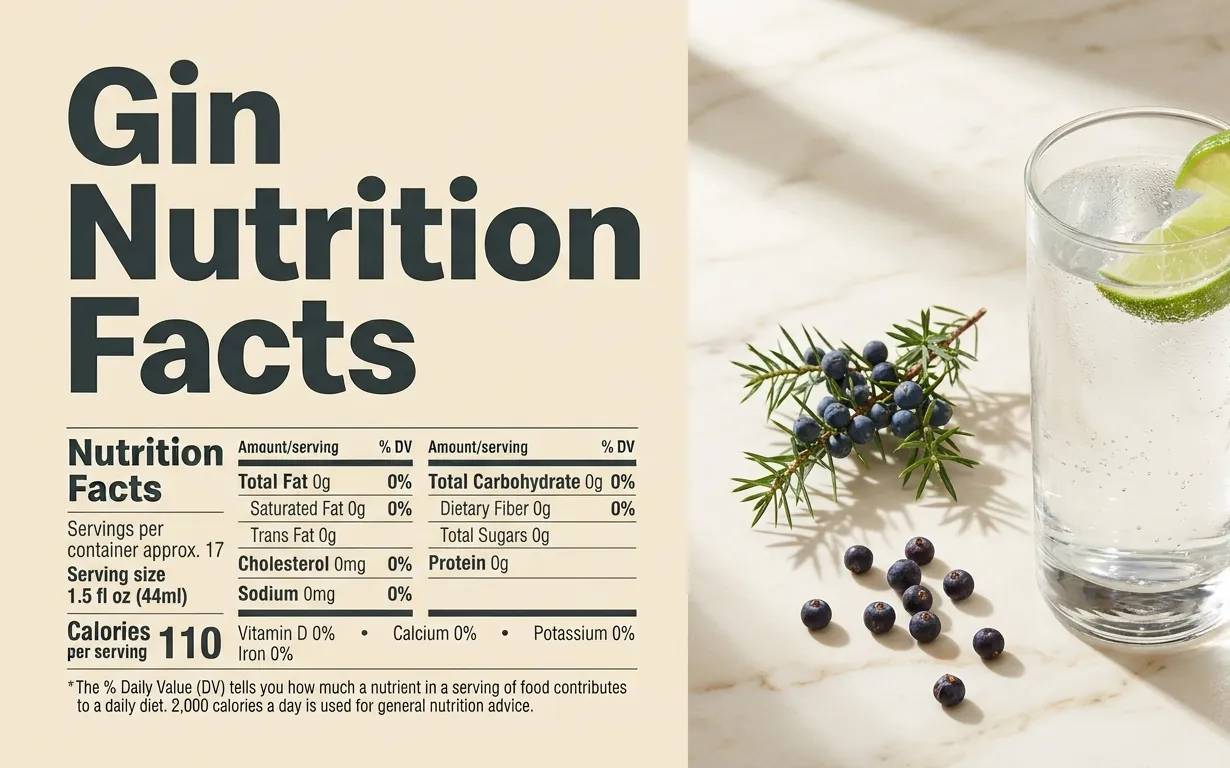
Gin contains 97 calories per standard 1.5-fluid-ounce shot, with zero grams of carbohydrates, zero grams of sugar, and zero grams of protein or fat. The entire caloric load comes from ethanol, which provides 7 calories per gram. For anyone tracking macros, gin registers as a zero across the board except for the alcohol calories, which are metabolized differently from food calories.
The gin nutrition facts change dramatically the moment you add a mixer. Tonic water brings sugar. Vermouth brings additional alcohol, sugar, and calories. The gin itself is nutritionally simple. The drinks people actually make with gin are not. The Dietary Guidelines for Americans 2020-2025 define a standard drink as 1.5 fluid ounces of 80-proof distilled spirits. That single shot represents one drink. A gin and tonic made with 1.5 ounces of gin and 6 ounces of tonic water can contain more calories from the mixer than from the gin.
Here is what this article covers. You will see the exact numbers for gin alone. You will learn how alcohol calories work inside your body, which is different from how food calories work. You will see what happens to the nutrition profile when gin meets tonic, vermouth, soda, or juice. You will get honest answers about gin and keto, gin and weight loss, and whether the botanical compounds in gin have any measurable health effect. And you will learn who should skip the gin entirely based on health status.
Gin Nutrition Facts
A standard 1.5-ounce serving of 80-proof London dry gin contains 97 calories derived entirely from ethanol. There are no carbohydrates, no sugars, no fat, no protein, no fiber, and no measurable micronutrients. The USDA FoodData Central database records gin as a distilled alcoholic beverage with an energy density that comes exclusively from its alcohol content.
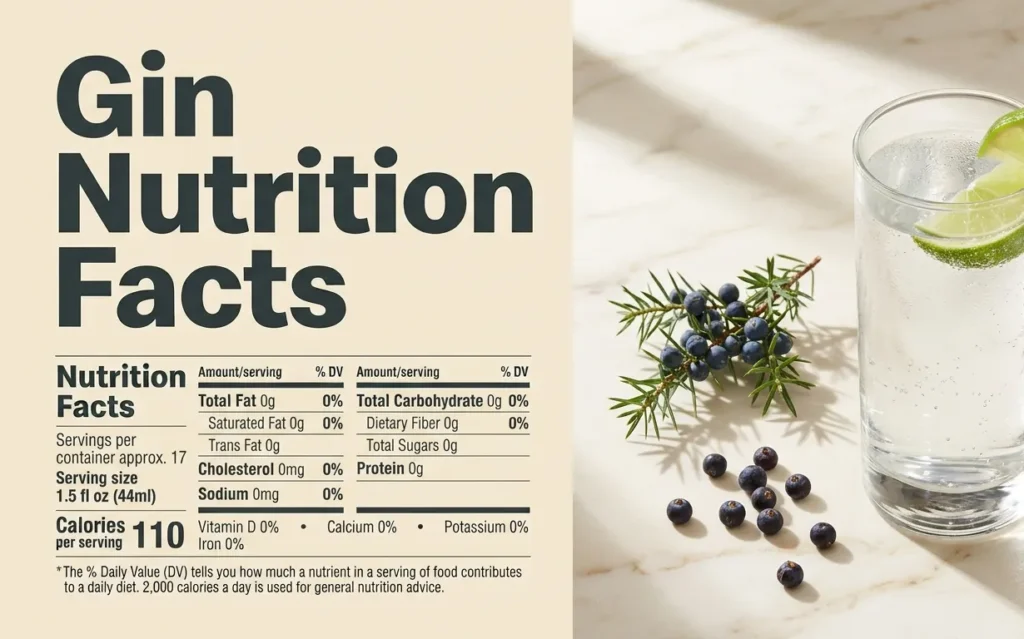
| Nutrient | Amount per 1.5 fl oz (44 ml) | Percent Daily Value |
|---|---|---|
| Calories | 97 kcal | 5% |
| Protein | 0 g | 0% |
| Total Fat | 0 g | 0% |
| Saturated Fat | 0 g | 0% |
| Carbohydrates | 0 g | 0% |
| Dietary Fiber | 0 g | 0% |
| Total Sugars | 0 g | N/A |
| Added Sugars | 0 g | 0% |
| Sodium | 0 mg | 0% |
| Potassium | 0 mg | 0% |
The proof of the gin changes the calorie count. An 80-proof gin is 40 percent alcohol by volume. A 90-proof gin is 45 percent alcohol. A 100-proof gin is 50 percent alcohol. Each increase in proof raises the calorie count proportionally because the ethanol content per ounce increases. A 1.5-ounce shot of 100-proof gin delivers approximately 124 calories. Navy strength gin at 114 proof contains roughly 140 calories per standard shot. These differences are modest per serving but add up across multiple drinks on a night out.
The complete absence of carbohydrates, sugars, and sodium is what makes gin a common choice for people on low-carb or ketogenic diets. A shot of gin, neat or with soda water, adds zero grams to the daily carbohydrate count. That said, this does not make gin a health-promoting beverage. The Dietary Guidelines for Americans are explicit on this point. Adults who do not drink alcohol should not start drinking for health reasons. The absence of carbs does not make the ethanol harmless.
Gin Calories Per Shot
A 1.5-fluid-ounce shot of standard 80-proof gin contains exactly 97 calories. This figure comes from the ethanol content. Ethanol provides 7 calories per gram, which sits between the 4 calories per gram of carbohydrate and protein and the 9 calories per gram of fat. An 80-proof spirit is 40 percent ethanol by volume. The remaining 60 percent is water with trace flavor compounds. The water contributes zero calories.
The math works out as follows. One fluid ounce of 80-proof gin contains approximately 0.4 fluid ounces of pure ethanol. Ethanol weighs roughly 0.79 grams per milliliter. One fluid ounce equals 29.57 milliliters. The ethanol in one ounce weighs about 9.3 grams. At 7 calories per gram, that ounce delivers 65 calories. Multiply by 1.5 for a standard shot and you get 97 calories. This is the standard reference value used by the USDA, the NIH, and all major nutrition databases.
Higher proof means higher calories. The table below shows the calorie difference across common gin proofs for a standard 1.5-ounce shot.
| Gin Proof | ABV | Calories per 1.5 oz Shot |
|---|---|---|
| 80 proof | 40% | 97 |
| 86 proof | 43% | 105 |
| 90 proof | 45% | 110 |
| 94 proof | 47% | 115 |
| 100 proof | 50% | 124 |
| Navy strength (114 proof) | 57% | 140 |
Key Takeaway: Standard 80-proof gin has 97 calories per shot. Higher proof gin adds roughly 3 to 4 calories per proof point per shot. Navy strength gin packs 140 calories in the same 1.5 ounces.
Gin Carbs and Sugar Content
Plain gin contains zero grams of carbohydrates and zero grams of sugar. Distilled spirits are carbohydrate-free because the distillation process separates ethanol and water from the fermented grain mash. Sugars, starches, and proteins from the base grains do not vaporize during distillation. They remain in the still and are discarded. What comes through the condenser is ethanol, water, and volatile aromatic compounds. None of these are carbohydrates.
This zero-carb profile applies to London dry gin, Plymouth gin, Old Tom gin (which may contain a tiny amount of added sugar depending on the brand), and most craft gins. The exception is flavored gins and sloe gins. Sloe gin is a liqueur made by steeping sloe berries in gin and adding sugar. It can contain 7 to 10 grams of sugar per ounce. Flavored gins sometimes include added sweeteners. If the label says “gin liqueur” or the alcohol content is below 37.5 percent ABV, check the nutrition label for sugar content.
The zero-sugar status of standard gin is one reason it appears frequently in diabetes-friendly drinking guidance. The American Diabetes Association notes that distilled spirits contain no carbohydrates and do not directly raise blood glucose. The caution is that alcohol can cause delayed hypoglycemia in people taking insulin or certain diabetes medications. The zero carbs do not eliminate that risk. The liver prioritizes metabolizing alcohol over producing glucose, which can cause blood sugar to drop hours after drinking, particularly overnight.
Is Gin Keto Friendly
Standard gin is keto friendly in the strict macronutrient sense. It contains zero grams of net carbohydrates per serving. A shot of gin with soda water and a squeeze of lime adds nothing to the daily carb count. This is why gin frequently appears on keto-approved alcohol lists published by low-carb nutrition resources.
The macronutrient compatibility does not mean gin supports a ketogenic state. Ethanol metabolism temporarily pauses ketone production. The liver processes alcohol as a priority substrate. While the liver is busy breaking down ethanol into acetaldehyde and then acetate, fatty acid oxidation slows. Ketone body synthesis drops. You remain in ketosis by carbohydrate restriction, but your body runs on acetate from alcohol rather than ketones from fat during the hours your liver is clearing the ethanol. The practical effect for someone on a ketogenic diet is that alcohol calories count toward the daily energy total and temporarily shift fuel utilization away from stored body fat.
The keto-friendly designation also depends entirely on the mixer. A gin and tonic made with standard tonic water can deliver 20 to 25 grams of sugar per drink. That is the entire daily carbohydrate allowance for someone targeting 20 to 30 grams of net carbs on a strict ketogenic diet. Diet tonic water solves the carb problem but introduces artificial sweeteners, which some people on keto prefer to avoid. Soda water is the safest mixer option. It contains zero calories, zero carbs, and zero sweeteners of any kind.
Gin Alcohol Metabolism
The body metabolizes alcohol differently from food macronutrients. When you drink a shot of gin, roughly 20 percent of the ethanol is absorbed through the stomach lining. The remaining 80 percent is absorbed in the small intestine and enters the bloodstream. Unlike carbohydrates, proteins, and fats, ethanol does not require digestion before absorption. It diffuses directly across cell membranes.
The liver is the primary site of alcohol metabolism. The enzyme alcohol dehydrogenase converts ethanol into acetaldehyde, a toxic intermediate compound that damages cells and DNA. Acetaldehyde is classified as a Group 1 carcinogen by the International Agency for Research on Cancer, part of the World Health Organization. A second enzyme, aldehyde dehydrogenase, rapidly converts acetaldehyde into acetate. Acetate is relatively harmless and is eventually broken down into carbon dioxide and water.
The metabolic priority of ethanol has a consequence that matters for weight management. The liver processes alcohol before fat, carbohydrate, or protein. While ethanol is circulating, fatty acid oxidation drops. Your body burns acetate for energy instead of stored body fat. This does not mean the 97 calories from a shot of gin cause more weight gain than 97 calories from bread. It means those calories are handled differently and that regular drinking can reduce the time your body spends in fat-burning mode. The thermic effect of alcohol, the energy cost of metabolizing it, is higher than that of carbohydrate and fat but lower than that of protein.
Key Takeaway: Your liver drops everything to process alcohol first. While it is clearing ethanol, fat burning slows. The 97 calories in a gin shot are real, and the metabolic priority of alcohol has implications for weight management that go beyond the calorie count.
Gin Botanicals and Juniper Berry Compounds
Gin’s defining characteristic is the presence of juniper and other botanical compounds that carry over during distillation. Juniper berries (Juniperus communis) contain terpenes including myrcene, limonene, alpha-pinene, and beta-pinene, along with flavonoids and polyphenolic compounds. These are the same classes of plant bioactives that appear in herbs, spices, and citrus peels. The question is whether any meaningful amount survives distillation and ends up in the glass.
The answer is that trace amounts survive, but not enough to produce a measurable health effect. Distillation involves boiling the fermented mash and condensing the vapors. The volatile aromatic compounds in juniper and other botanicals have boiling points that allow them to vaporize alongside ethanol and water. They come through the condenser and contribute to gin’s flavor and aroma. The concentrations, however, are in parts per million. A 2020 analysis published in the Journal of Agricultural and Food Chemistry found that the total polyphenol content of gin is orders of magnitude lower than that of red wine, tea, or even the raw juniper berries from which it is made.
Juniper berries in their whole form have documented biological activities. Research suggests they possess antimicrobial, antioxidant, and anti-inflammatory properties in laboratory and animal models. The terpene limonene has been studied for its potential anti-cancer properties in cell studies. Myrcene has shown analgesic effects in animal research. None of these findings translate to the trace concentrations present in a shot of gin. Drinking gin for the antioxidants would be like eating a grain of salt for the minerals. The delivery vehicle is ethanol, which is itself a toxin that the liver must process.
Gin vs Vodka Nutrition Comparison
Gin and vodka are nearly identical in their basic nutrition profiles. Both are distilled spirits at roughly 40 percent alcohol by volume. Both contain approximately 97 calories per 1.5-ounce shot. Both have zero carbohydrates, zero sugar, zero fat, and zero protein. On a standard nutrition facts panel, they look indistinguishable.
| Nutrient (per 1.5 oz shot) | Gin (80 proof) | Vodka (80 proof) |
|---|---|---|
| Calories | 97 | 97 |
| Carbohydrates | 0 g | 0 g |
| Sugar | 0 g | 0 g |
| Protein | 0 g | 0 g |
| Fat | 0 g | 0 g |
| Botanical Compounds | Trace terpenes and flavonoids | None |
The difference is in the trace botanical content. Gin is essentially vodka that has been redistilled with juniper berries and other botanicals. Vodka is distilled to a higher proof and filtered to remove congeners, the flavor compounds that give spirits their character. It is intentionally neutral. Gin is intentionally flavored. The botanical compounds in gin provide aroma and taste. They provide no measurable nutritional advantage.
For someone choosing between the two on nutrition grounds alone, there is no meaningful difference. The calories are identical. The carb count is identically zero. The mixer decision matters far more than the spirit decision. A gin and diet tonic is nutritionally equivalent to a vodka and diet tonic. A gin martini has the same calorie load as a vodka martini, assuming the same vermouth ratio. Choose the spirit whose flavor you prefer. The nutrition numbers do not tip the scale either way.
Gin vs Other Spirits Calories
All 80-proof distilled spirits contain approximately the same number of calories per standard shot because the ethanol content is identical. The USDA FoodData Central database confirms this uniformity across spirit categories. The table below shows standard one-shot calorie counts for common spirits at 80 proof.
| Spirit (80 proof, 1.5 oz) | Calories | Carbohydrates | Sugar |
|---|---|---|---|
| Gin | 97 | 0 g | 0 g |
| Vodka | 97 | 0 g | 0 g |
| Whiskey (Bourbon/Scotch) | 97 | 0 g | 0 g |
| Tequila (Blanco) | 97 | 0 g | 0 g |
| Rum (White) | 97 | 0 g | 0 g |
| Brandy | 97 | 0 g | 0 g |
All six spirits clock in at 97 calories per standard shot. The carbohydrate count is zero across the board for unsweetened, unflavored spirits. This uniformity collapses the moment you leave the 80-proof standard. Barrel-aged spirits like bourbon and dark rum can contain trace carbohydrates from the wood compounds extracted during aging, but the amounts are negligible at less than half a gram per shot. Flavored spirits, spiced rums, and liqueurs break the pattern entirely. A shot of coconut rum can contain 7 grams of sugar and 50 additional calories. A shot of coffee liqueur can contain 11 grams of sugar.
The takeaway is that gin sits in a large category of spirits that are functionally interchangeable on basic nutrition numbers. Your choice among them should be based on flavor preference, not on a meaningful calorie or carb difference that does not exist.
Key Takeaway: At 80 proof, gin, vodka, whiskey, tequila, rum, and brandy all have 97 calories and zero carbs per shot. The spirit category does not matter for calorie counting. The proof and the mixer are what change the numbers.
Gin and Tonic Nutrition Facts
A standard gin and tonic made with 1.5 ounces of 80-proof gin and 6 ounces of standard tonic water contains approximately 180 to 200 calories and 20 to 25 grams of sugar. The gin contributes 97 calories and zero sugar. The tonic water contributes the rest. A gin and tonic is not a low-calorie drink. The mixer provides more calories and all of the sugar.
The table below breaks down the gin and tonic’s nutritional profile compared to the gin alone.
| Component | Calories | Sugar | Carbohydrates |
|---|---|---|---|
| Gin (1.5 oz, 80 proof) | 97 | 0 g | 0 g |
| Standard Tonic Water (6 oz) | 83-100 | 20-25 g | 20-25 g |
| Total Gin and Tonic | 180-200 | 20-25 g | 20-25 g |
| Gin and Diet Tonic | 97 | 0 g | 0 g |
The sugar content of standard tonic water is comparable to that of a regular soda. Six ounces of tonic water delivers roughly the same sugar load as six ounces of cola. The bitterness of quinine masks the sweetness, which creates a misleading sensory experience. The drink does not taste as sweet as it is. This is one reason people underestimate the caloric impact of a gin and tonic. The flavor profile reads as crisp and botanical, not sugary. The nutrition label says otherwise.
Diet tonic water eliminates the sugar and brings the drink’s total to 97 calories, the same as the gin alone. The artificial sweeteners used vary by brand. Aspartame, sucralose, and acesulfame potassium are the most common. For someone managing blood sugar or counting carbohydrates, a gin and diet tonic is a genuine low-carb option. A gin and soda with a squeeze of fresh lime achieves the same zero-sugar profile without artificial sweeteners.
Gin Martini Nutrition Facts
A classic gin martini made with 2.5 ounces of gin and 0.5 ounces of dry vermouth contains approximately 195 to 210 calories. The gin contributes about 162 calories. The vermouth adds approximately 20 to 25 calories, along with a small amount of carbohydrate from the wine base. A martini is a higher-calorie drink than a straight shot of gin because it contains more gin plus the vermouth addition.
Dry vermouth is a fortified wine, not a distilled spirit. It contains residual sugar from the winemaking process, typically 1 to 4 grams of sugar per ounce depending on the brand and style. A half-ounce pour of dry vermouth adds roughly 1 to 2 grams of carbohydrate to the martini. This is a trivial amount for most dietary patterns. The extra calories from the larger gin pour are the more meaningful number for someone tracking energy intake.
The dirty martini variant adds olive brine, which contributes sodium but not calories. A tablespoon of olive brine contains roughly 200 to 400 milligrams of sodium and zero calories. The olives themselves add a small number of calories from fat, roughly 10 to 15 calories per olive depending on size. A standard dirty martini with three olives and a splash of brine adds approximately 40 calories and 600 to 1,200 milligrams of sodium. For someone monitoring sodium intake for blood pressure management, the dirty martini is worth noting. The sodium content can exceed half a day’s recommended limit in a single drink.
Gin and Soda Calories
A gin and soda made with 1.5 ounces of 80-proof gin and 4 to 6 ounces of soda water contains exactly 97 calories. Soda water, also called club soda, is carbonated water with added minerals for taste. It contains no calories, no sugar, no carbohydrates, and no artificial sweeteners. The calorie count of a gin and soda is identical to that of a straight shot of gin because soda water adds nothing but hydration and bubbles.
This makes a gin and soda the lowest-calorie gin drink that still includes a mixer. A gin and diet tonic ties it at 97 calories, with the caveat that some people prefer to avoid artificial sweeteners. A gin and soda with a squeeze of fresh lime or lemon juice adds a negligible 2 to 4 calories and a small amount of vitamin C from the citrus. The lime juice also adds a fresh flavor note that complements the botanical profile of the gin without introducing sugar.
Soda water and tonic water are often confused, and the nutritional difference between them is the single most important thing to understand about gin drink calories. Tonic water is a sweetened soft drink that happens to be bitter. Soda water is carbonated water. Substituting soda water for tonic water saves 80 to 100 calories and 20 to 25 grams of sugar per drink. If you drink two gin and tonics at a bar, switching to gin and sodas saves 160 to 200 calories. Over the course of a week with multiple drinking occasions, that substitution alone can tip the caloric balance in a meaningful direction.
Lowest Calorie Gin Drinks
The lowest calorie gin drink is a gin and soda with fresh citrus. It contains 97 calories with zero grams of sugar. A close second is a gin martini made extra dry, with just a rinse of vermouth rather than a full half-ounce pour. An extra-dry gin martini with 2.5 ounces of gin and a vermouth rinse contains approximately 165 calories. The vermouth rinse adds minimal calories while providing the aromatic note that defines a martini.
The table below ranks common gin drinks by total calorie count per standard serving.
| Gin Drink | Standard Recipe | Estimated Calories |
|---|---|---|
| Gin and Soda | 1.5 oz gin + 4-6 oz soda water + lime | 97 |
| Gin and Diet Tonic | 1.5 oz gin + 4-6 oz diet tonic | 97 |
| Gin Martini (extra dry) | 2.5 oz gin + vermouth rinse | 165 |
| Gin Martini (classic) | 2.5 oz gin + 0.5 oz dry vermouth | 195-210 |
| Negroni | 1 oz gin + 1 oz Campari + 1 oz sweet vermouth | 195-210 |
| Gin and Tonic | 1.5 oz gin + 6 oz standard tonic | 180-200 |
| Tom Collins | 1.5 oz gin + lemon juice + sugar + soda | 150-180 |
| Gin Fizz | 1.5 oz gin + lemon juice + sugar + soda + egg white | 180-210 |
| French 75 | 1 oz gin + lemon juice + sugar + champagne | 160-180 |
The drinks that keep calories lowest are those that pair gin with a zero-calorie mixer. Soda water, diet tonic, and sparkling water all fall into this category. The drinks that add sugar, juice, or liqueur climb quickly. A Negroni, while not sweet by taste, contains sweet vermouth and Campari, both of which contribute sugar and calories. The caloric load of a Negroni rivals that of a gin and tonic.
Key Takeaway: A gin and soda is the lowest calorie gin drink at 97 calories. Swapping tonic for soda saves 80 to 100 calories per drink. The mixer, not the gin, is where most of the calories and all of the sugar hide.
Does Gin Have Any Nutritional Value
Gin has no measurable nutritional value in the conventional sense. It provides zero vitamins, zero minerals, zero fiber, zero protein, and zero carbohydrates. The 97 calories per shot are empty calories in the strict nutritional definition of that term. They provide energy without any accompanying nutrients that support bodily functions.
The trace botanical compounds in gin do not change this assessment. The terpenes and flavonoids from juniper and other botanicals are present in parts per million. They contribute flavor and aroma. They do not contribute nutrition in any quantity that affects human physiology. The ethanol that delivers those botanical compounds is classified as a Group 1 carcinogen by the World Health Organization’s International Agency for Research on Cancer. Ethanol and its metabolite acetaldehyde cause DNA damage that increases cancer risk, particularly for cancers of the mouth, throat, esophagus, liver, colon, and breast.
The Dietary Guidelines for Americans 2020-2025 state directly that adults who do not drink alcohol should not start drinking for any reason, including potential health benefits. The guideline also notes that even moderate drinking carries risks. The cancer risk associated with alcohol begins at low levels of consumption and rises with intake. This is not a statement about excessive drinking. It is a statement about any drinking. The potential cardiovascular benefits sometimes attributed to moderate alcohol consumption are increasingly questioned in newer research that controls for confounding lifestyle factors.
Gin and Weight Loss
Gin can fit into a weight loss plan in the narrow sense that it contains no carbohydrates and no sugar. A gin and soda consumed occasionally within a calorie-controlled diet does not inherently derail fat loss. The problem is not the gin itself in a vacuum. It is the context in which people drink it and the downstream effects of alcohol on metabolism and behavior.
Alcohol provides 7 calories per gram with zero satiety. Those calories do not trigger the fullness signals that food calories trigger. A 97-calorie shot of gin does not reduce hunger the way a 97-calorie piece of chicken breast would. This means alcohol calories tend to be additive to daily energy intake rather than substituting for food calories. A study published in the American Journal of Clinical Nutrition found that people who drank alcohol with a meal did not compensate by eating less. The alcohol calories simply added to the meal’s total.
Alcohol also impairs judgment and reduces inhibitions, which can lead to food choices that would not be made sober. The late-night pizza or the extra appetizer ordered with a second round of drinks adds calories far beyond what the gin itself contributed. This is not a nutritional property of gin. It is a behavioral reality of drinking. For weight loss, the most practical approach to gin is to account for its calories in the daily budget and to make the mixer choice deliberately. A gin and soda tells the calorie truth. A gin and tonic hides 100 extra calories in a package that does not taste like it contains them.
Gin and the Dietary Guidelines for Americans
The Dietary Guidelines for Americans 2020-2025 define moderate drinking as up to one drink per day for adult women and up to two drinks per day for adult men. One drink is defined as 1.5 fluid ounces of 80-proof distilled spirits, which is the standard gin shot. Anything above these limits falls into the category of excessive drinking, which carries clearly documented health risks.
The guidelines also state that drinking less is always better for health than drinking more. This is a shift from earlier messaging that suggested moderate drinking might be neutral or even beneficial. The 2020-2025 edition reflects newer research showing that even within the moderate drinking range, the risk of certain cancers increases with each additional drink. The guidelines recommend that adults who do not drink should not start. Pregnant women, people taking medications that interact with alcohol, people with certain medical conditions, and people recovering from alcohol use disorder should not drink at all.
Applying these guidelines to gin means that a single gin and tonic or gin martini counts as one drink. If you are a woman, that is your limit for the day. If you are a man, you have room for a second. A martini made with 2.5 ounces of gin contains about 1.7 standard drinks. A Negroni with equal parts gin, Campari, and sweet vermouth contains about one drink’s worth of alcohol from the gin alone, plus additional alcohol from the other two ingredients. Understanding standard drink sizes is essential for applying the guidelines accurately to real-world pours, which are often larger than the 1.5-ounce standard.
Who Should Avoid Gin
Certain groups should avoid gin entirely based on health status and medical guidance. The list is not about judgment. It is about documented risk. Pregnant women and women trying to conceive should avoid all alcohol because ethanol crosses the placenta and no safe level of prenatal alcohol exposure has been established. Fetal alcohol spectrum disorders are entirely preventable by avoiding alcohol during pregnancy.
People taking medications that interact with alcohol should avoid gin. The list of interacting drugs is long and includes many common prescriptions. Sedatives and sleep medications like benzodiazepines and zolpidem have additive depressant effects with alcohol. Antidepressants, particularly monoamine oxidase inhibitors, can interact dangerously. Certain antibiotics including metronidazole and cephalosporins can trigger a disulfiram-like reaction. Pain medications, both opioids and over-the-counter NSAIDs, carry increased risk of gastrointestinal bleeding and liver damage when combined with alcohol. Anyone taking a daily medication should ask their pharmacist specifically whether alcohol consumption is safe with that drug.
People with alcohol use disorder or a history of it should avoid gin entirely. Abstinence is the standard of care. People with liver disease, including fatty liver disease, hepatitis, and cirrhosis, should avoid all alcohol because the damaged liver cannot metabolize ethanol safely. People with pancreatitis, certain cardiac arrhythmias, gout, and poorly controlled diabetes may also be advised to avoid or strictly limit alcohol. If you have a chronic health condition, ask the physician managing that condition whether alcohol is safe for you at your next appointment. Bring a list of your medications and ask about interactions.
Frequently Asked Questions About Gin Nutrition
How many calories are in a shot of gin?
A standard 1.5-fluid-ounce shot of 80-proof gin contains 97 calories.
The calories come entirely from ethanol, which provides 7 calories per gram.
Higher proof gin contains more calories because the alcohol content per ounce is greater.
Does gin have carbs or sugar?
Plain gin contains zero grams of carbohydrates and zero grams of sugar.
Distillation removes all sugars, starches, and proteins from the spirit.
Flavored gins and sloe gins are exceptions and may contain added sugar.
Is gin healthier than other alcohol?
Gin is not healthier than other spirits in any nutritionally meaningful way.
All 80-proof spirits contain 97 calories and zero carbs per standard shot.
The trace botanical compounds in gin contribute flavor but no measurable health benefit at the concentrations present in the finished spirit.
How many calories in a gin and tonic?
A standard gin and tonic contains 180 to 200 calories per drink.
The gin contributes 97 calories and the 6 ounces of standard tonic water add 80 to 100 calories and 20 to 25 grams of sugar.
A gin and diet tonic contains 97 calories, the same as the gin alone.
Is gin keto friendly?
Standard gin is keto friendly because it contains zero grams of net carbohydrates per shot.
A gin and soda or gin and diet tonic adds no carbohydrates to the daily count.
Alcohol metabolism temporarily pauses ketone production, so while gin does not break ketosis through carbohydrate intake, it does shift fuel utilization away from fat while the liver processes the ethanol.
Does gin make you gain weight?
Gin contributes 97 empty calories per shot that do not trigger satiety signals, which means those calories tend to add to total daily energy intake rather than displace food calories.
Regular consumption of alcohol calories without accounting for them in your daily energy balance can contribute to weight gain over time.
The behavioral effects of alcohol, including reduced inhibitions around food choices, can add further calories beyond what is in the drink itself.
Closing
Gin gives you the nutrition facts upfront. A shot is 97 calories, zero carbs, and zero sugar. The spirit itself is honest about what it contains and what it does not. The complication comes from everything poured alongside it. Tonic water adds sugar and calories that the bitter flavor conceals. A generous martini pour turns one standard drink into nearly two. The mixer decision matters more for your daily numbers than the gin decision ever will.
If you drink gin, a gin and soda with lime is the cleanest delivery system. It adds zero calories to the spirit. It hydrates more than it dehydrates. It gives you the botanical flavor of the gin without burying it in sugar. A diet tonic achieves the same thing if you tolerate artificial sweeteners. A dry martini lands somewhere in the middle, with the vermouth adding a small caloric and carbohydrate cost for the flavor upgrade.
No amount of gin is actively good for your health. The Dietary Guidelines are clear that drinking less is always better than drinking more. But if you are going to pour a drink, knowing that your gin and soda costs you 97 calories and nothing else gives you the information to account for it honestly within your day. That is what nutrition facts are for.