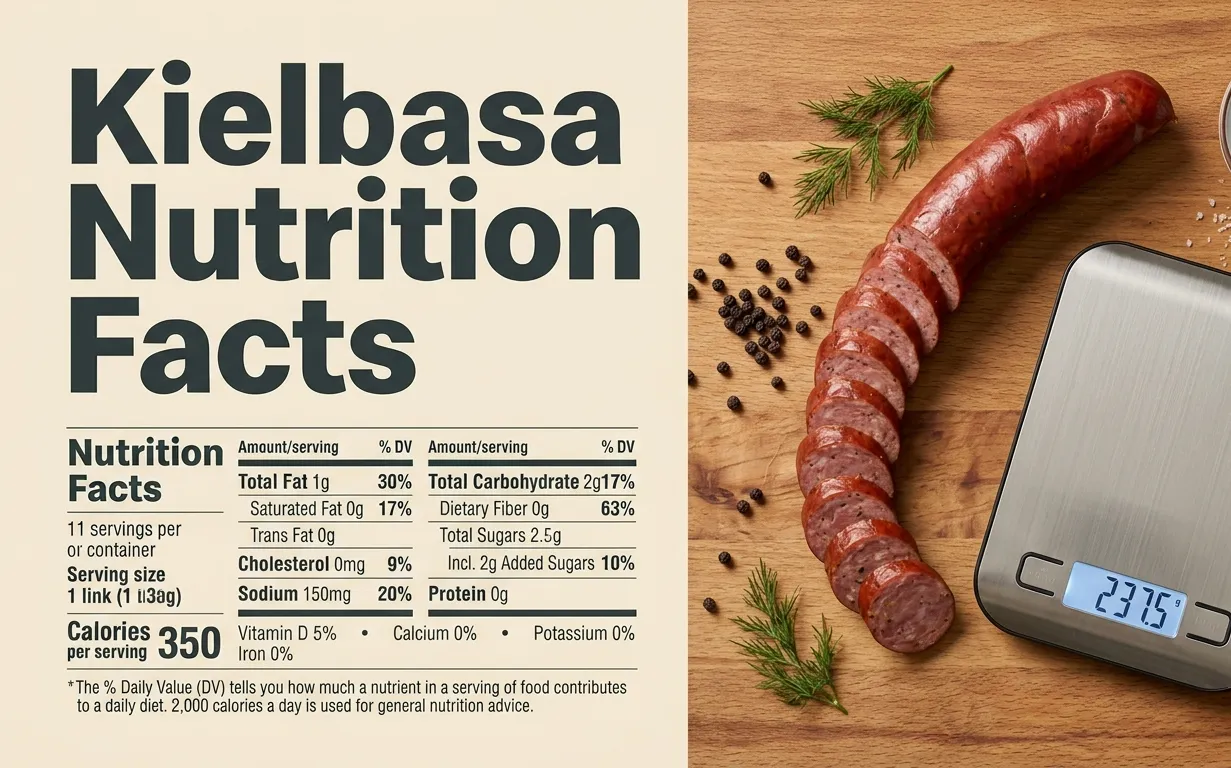
Kielbasa Nutrition Facts 2026: A Complete Data Guide
Kielbasa nutrition facts reveal a food that is calorie-dense, high in protein, and extremely high in saturated fat and sodium, with a standard 2-ounce serving of pork kielbasa providing approximately 180 calories, 15 grams of fat, and 520 milligrams of sodium. This nutritional profile places kielbasa firmly in the category of foods that should be consumed occasionally and in strict moderation. The numbers do not mean you must eliminate it entirely from your diet. They do mean you need to see the full data before you can place it correctly in your eating pattern.
A single smoked pork kielbasa link can deliver nearly a quarter of the American Heart Association’s ideal daily sodium limit of 1,500 milligrams. According to the USDA FoodData Central database, kielbasa is not just high in sodium because of table salt. It is high because it is a cured and processed meat that relies on sodium nitrate for preservation. The World Health Organization’s International Agency for Research on Cancer classified processed meat as a Group 1 carcinogen, a category meaning there is convincing evidence that the agent causes cancer in humans. The specific mechanism involves the conversion of nitrites to nitrosamines during high-heat cooking.
This article breaks down the macros, the differences between pork, beef, and turkey varieties, the exact sodium risk, and the cooking methods that can reduce your exposure to the most harmful compounds. You will leave knowing exactly what you are eating and how to make the safest possible choice if you choose to eat it.
kielbasa nutrition facts
The baseline kielbasa nutrition facts, sourced from the USDA FoodData Central database, apply to a standard smoked pork kielbasa. A 2-ounce serving, which is a guideline portion, contains 180 calories, 15 grams of total fat, 5 grams of saturated fat, 7 grams of protein, and 520 milligrams of sodium. It contains no dietary fiber and 2 grams of carbohydrates.
The macro breakdown by calorie is stark. Fat contributes 135 of the 180 calories, or 75 percent of the total energy. Protein contributes 28 calories, or 15 percent. Carbohydrates contribute 8 calories, or 5 percent. This is not a balanced macronutrient profile. It is a lipid-dominant food matrix that also happens to provide a significant dose of bioavailable animal protein. The protein is complete, containing all essential amino acids, but the trade-off is the fat load that accompanies it.
The micronutrient profile is not a reason to choose kielbasa. A 2-ounce serving provides 0.7 milligrams of iron, which is 4 percent of the Daily Value for men and 2 percent for women. It provides 150 milligrams of potassium, roughly 3 percent of the Adequate Intake. The B vitamin content, particularly vitamin B12, is present at approximately 0.5 micrograms, or 20 percent of the Daily Value. These numbers are not negligible, but they can be obtained from leaner, lower-sodium sources like a lean pork chop or a serving of shellfish.
The data changes significantly when you move from the 2-ounce nutrition label serving to a real-world portion. A whole kielbasa link, which is typically 3 to 4 ounces, contains 270 to 360 calories, 23 to 30 grams of fat, and 780 to 1,040 milligrams of sodium. This is the nutritional reality of what most people actually eat in one sitting.
Key Takeaway: A standard 2-ounce serving of kielbasa is 75 percent fat calories, delivers half a day’s ideal sodium, and provides 7 grams of protein, but a real-world 4-ounce link doubles those numbers.
polish sausage nutrition facts
Polish sausage nutrition facts are synonymous with kielbasa nutrition facts because kielbasa is the Polish word for sausage. The specific nutritional profile of a Polish sausage depends entirely on whether it is made from pork, beef, or a combination, and whether it is fresh, smoked, or dried. The term “polish sausage” in a U.S. grocery store almost always refers to a smoked, pre-cooked ring or link.
A typical smoked Polish pork and beef sausage link provides a nutritional profile similar to a hot dog, but with more heft. The USDA data for a 2-ounce serving of a mixed pork and beef kielbasa shows 180 calories, 15 grams of fat, 6 grams of saturated fat, 7 grams of protein, and 540 milligrams of sodium. The inclusion of beef increases the heme iron content slightly, to approximately 0.9 milligrams per serving, but also typically increases the saturated fat content.
The seasoning profile of Polish sausage does not significantly alter the macros but does contribute bioactive compounds. Garlic, a primary seasoning, contains allicin, a sulfur compound that is activated when the garlic is crushed. However, the processing and cooking of kielbasa degrade most of the volatile allicin. Marjoram and black pepper are also common. While these spices have documented antioxidant properties in vitro, their concentration in the final sausage is too low to claim a health benefit that offsets the sodium and fat.
The casing is another nutritional variable. Natural casings are made from the submucosa of sheep or pig intestines. They are composed of collagen and are entirely edible. They add a negligible amount of protein. Synthetic casings, often made from cellulose or collagen, are also edible but add no nutritional value. The casing does not change the calorie or sodium content of the sausage itself.
kielbasa calories
Kielbasa calorie counts are deceptively high for the volume of food you consume. A 2-ounce serving provides 180 calories, but 2 ounces of sausage is visually unimpressive. It is roughly the length and width of an adult thumb. For a 180-calorie investment, you could instead eat 6 ounces of roasted chicken breast, which would provide 45 grams of protein compared to kielbasa’s 7 grams.
The calorie density of kielbasa is a function of its fat-to-water ratio. Sausage is an emulsion of lean meat, fat, and water. The more fat in the recipe, the more calories per ounce. A traditional pork kielbasa can be 30 to 40 percent fat by weight. For comparison, a lean pork tenderloin is approximately 3 percent fat by weight. The calorie difference is approximately 180 calories for a 2-ounce serving of kielbasa versus 60 calories for the same weight of lean pork.
Cooking method can marginally increase calorie count. Pan-frying kielbasa in butter or oil adds the calories of the cooking fat. A tablespoon of butter adds 100 calories. The sausage is already high in fat and does not require added lipids to cook, but it is a common preparation method. Simmering in water or beer adds no calories. Grilling allows the fat to drip away, slightly reducing the final calorie content, but the difference is modest, perhaps 10 to 15 calories per link.
The type of kielbasa dramatically changes the calorie content. A 2-ounce serving of turkey kielbasa contains approximately 100 calories. A 2-ounce serving of pork kielbasa contains 180 calories. Choosing turkey over pork saves 80 calories per 2 ounces, a 44 percent reduction in energy density. This is the single most effective swap you can make if you want to include kielbasa in a calorie-controlled diet.
kielbasa protein
Kielbasa protein content is 7 grams per 2-ounce serving, which is a moderate amount of complete, high-biological-value animal protein. The protein in kielbasa contains all nine essential amino acids in proportions that support human muscle protein synthesis. However, the protein is packaged with an excess of saturated fat, making it a less efficient protein source than lean meats.
A 7-gram dose of protein is not a primary source for most adults. The Recommended Dietary Allowance for protein is 0.8 grams per kilogram of body weight. For a 180-pound man, this is approximately 65 grams of protein per day. A 2-ounce serving of kielbasa provides 11 percent of this target. To obtain 30 grams of protein from kielbasa, you would need to eat an 8-ounce portion, which would deliver 60 grams of fat and 720 calories. This protein-to-fat ratio is inefficient.
The quality of the protein matrix matters. Pork myofibrillar proteins are highly digestible, with a Protein Digestibility Corrected Amino Acid Score (PDCAAS) approaching 1.0. This means the body absorbs and utilizes the amino acids efficiently. The processing of the meat into a sausage does not significantly reduce this score. The protein in kielbasa is nutritionally equivalent to the protein in a pork chop on a per-gram basis. The difference is the total package.
For athletes or individuals aiming to increase protein intake, kielbasa should not be a staple. The saturated fat content, which contributes to cardiovascular risk, and the sodium content, which contributes to hypertension, make it an occasional food rather than a dietary anchor. Leaner protein sources with the same amino acid profile, like pork tenderloin or chicken breast, provide the muscle-building stimulus without the nutritional liabilities.
kielbasa carbs
Kielbasa carbs are consistently low, with a 2-ounce serving providing approximately 2 grams of total carbohydrates, no dietary fiber, and 1 to 2 grams of sugar. The carbohydrate content comes from added sugars used in the curing process, not from the meat itself. Pork and beef contain zero inherent carbohydrates.
The sugar in kielbasa is added as dextrose or corn syrup solids during processing. It serves as a substrate for the lactic acid-producing bacteria that ferment the sausage if it is a semi-dry or dry variety. In fully cooked, smoked kielbasa, the sugar contributes to flavor, browning, and the Maillard reaction when the sausage is heated. The 2 grams of sugar per serving is nutritionally negligible for a person without diabetes.
The lack of fiber is a defining nutritional characteristic of all animal products. Kielbasa provides zero grams of dietary fiber. A meal built around kielbasa must include fiber from other sources, like sauerkraut, roasted vegetables, or whole-grain mustard on whole-grain bread. The absence of fiber combined with the high fat content slows gastric emptying. This can contribute to a sense of prolonged fullness, but it does so in a way that lacks the colonic health benefits of plant-based fiber.
For a ketogenic or very low-carbohydrate diet, kielbasa is technically compatible. It contains 2 grams of carbs or less per serving. However, the nitrite content and the link between processed meat and colorectal cancer remain concerns that are independent of the carbohydrate content.
Key Takeaway: Kielbasa is a zero-fiber, 2-gram carb food, which makes it compatible with low-carb diets, but you must add a fiber source like sauerkraut to the meal to support normal colonic function.
kielbasa fat content
Kielbasa fat content is the dominant macronutrient, with 15 grams of total fat per 2-ounce serving, of which 5 grams are saturated fat. The fat profile is determined by the cut of pork or beef used in the sausage. Pork shoulder, the traditional cut for kielbasa, is roughly 20 to 25 percent fat by weight.
The type of fat in kielbasa is a mix of monounsaturated, saturated, and polyunsaturated fatty acids. Pork fat is approximately 45 percent monounsaturated, 40 percent saturated, and 15 percent polyunsaturated. The high saturated fat content is the primary concern from a cardiovascular disease risk perspective. The Dietary Guidelines for Americans 2020-2025 recommend that saturated fat account for less than 10 percent of total daily calories. For a 2,000-calorie diet, that is a maximum of 22 grams of saturated fat per day. A single 2-ounce serving of kielbasa delivers 5 grams, or nearly 25 percent of the daily limit.
The American Heart Association is more conservative, recommending that saturated fat account for 5 to 6 percent of total calories, which is approximately 13 grams per day on a 2,000-calorie intake. By this stricter standard, a 2-ounce serving of kielbasa provides nearly 40 percent of the daily saturated fat budget. This is the nutritional reality that forces the conclusion that kielbasa is a sometimes food, not a staple protein.
Different varieties of kielbasa shift this fat profile. Beef kielbasa can be slightly higher in saturated fat, while turkey kielbasa is dramatically lower. A 2-ounce serving of turkey kielbasa contains 6 grams of total fat and 1.5 grams of saturated fat. The type of fat also shifts. The polyunsaturated fat in turkey is higher than in pork, though the absolute amount remains modest.
kielbasa sodium content
Kielbasa sodium content is the single most significant nutritional liability, with a 2-ounce serving providing 520 to 600 milligrams of sodium, representing 23 to 26 percent of the Daily Value. The Chronic Disease Risk Reduction level for sodium, set by the National Academies, is 2,300 milligrams per day.
The sodium in kielbasa is not incidental. It is an integral part of the sausage-making process. Salt extracts myofibrillar proteins from the meat, which bind the meat particles together into the characteristic springy texture of sausage. Without the salt, the sausage would be crumbly and dry. The salt also inhibits the growth of pathogenic bacteria during the smoking and curing process. This makes the sodium functionally non-negotiable for the product to exist in its traditional form.
For someone with hypertension, the sodium load is immediately problematic. The American Heart Association ideal limit is 1,500 milligrams per day, a target that is therapeutically beneficial for blood pressure reduction. A single 2-ounce serving of kielbasa consumes 35 percent of this target. If you eat a 4-ounce link, you have consumed 70 percent of your ideal daily sodium before you have eaten anything else.
There is no such thing as a genuinely low-sodium pork kielbasa. You can reduce the damage by looking for a “lower sodium” version, which typically contains 300 to 400 milligrams of sodium per serving. The FDA defines “low sodium” as 140 milligrams or less per serving, a threshold no traditional kielbasa meets. The only way to reduce the sodium content significantly is to switch to a fresh, uncured sausage that you season yourself, which is a fundamentally different product.
Key Takeaway: The 520 to 600 milligrams of sodium in a tiny 2-ounce serving of kielbasa is a functional requirement of the sausage-making process and represents a quarter of the daily intake limit.
smoked kielbasa nutrition
Smoked kielbasa nutrition is distinct from fresh kielbasa nutrition because the smoking process introduces polycyclic aromatic hydrocarbons (PAHs) and further concentrates the existing nutrients through moisture loss. A 2-ounce serving of smoked kielbasa has a similar macro profile to unsmoked, but the chemical composition includes compounds you need to know about.
Smoking involves exposing the sausage to wood smoke at a temperature typically between 140 and 180 degrees Fahrenheit. The smoke contains phenols, carbonyls, and organic acids that impart flavor, but also PAHs, which are formed when wood is burned incompletely. The International Agency for Research on Cancer classifies several PAHs, including benzo(a)pyrene, as Group 1 carcinogens. The risk is dose-dependent. Occasional consumption of smoked foods is not the same risk as daily consumption.
The smoking process also drives off water. A fresh kielbasa might be 50 percent water by weight, while a smoked kielbasa is 40 to 45 percent water. This means the protein, fat, and sodium are more concentrated per ounce. The calorie density increases slightly. A smoked pork kielbasa link might be 190 calories for 2 ounces, compared to 170 for a fresh-cooked link. The difference is small but consistent.
The color of smoked kielbasa is a clue to its chemical processing. The characteristic reddish-pink color is from the reaction of sodium nitrite with myoglobin in the meat, forming nitrosomyoglobin. If the sausage is also smoked, the color deepens. A brown or gray smoked sausage indicates that the smoking process was done without nitrites, which is less common in commercial products but preferred by some small-scale producers.
fresh kielbasa vs smoked
Fresh kielbasa versus smoked kielbasa represents two different products with distinct nutritional and food safety profiles. Fresh kielbasa is raw, uncured, and unsmoked pork sausage that must be cooked to a safe internal temperature of 160 degrees Fahrenheit before eating. Smoked kielbasa is pre-cooked, cured with sodium nitrite, and exposed to wood smoke.
The nutritional difference is not dramatic in terms of macros. A 2-ounce serving of fresh kielbasa, pan-fried, has approximately 170 calories, 14 grams of fat, and 7 grams of protein. The sodium content can be lower than smoked kielbasa if the sausage is made without sodium nitrite as a curing agent, but it will still contain significant salt for flavor. A fresh kielbasa might contain 400 to 450 milligrams of sodium, compared to 520 to 600 for a smoked version.
The critical difference is the curing agent. Smoked kielbasa almost always contains sodium nitrite. This is what distinguishes a “cured” sausage from an “uncured” one. However, even “uncured” sausages on the market often contain celery powder, which is naturally high in nitrates and performs the same chemical function. The USDA requires such products to be labeled “Uncured, no nitrates or nitrites added except those naturally occurring in celery powder.” The nitrite dose from celery powder is comparable to synthetic sodium nitrite.
Food safety is another differentiator. Fresh kielbasa is a raw meat product and must be handled with the same precautions as raw pork. Cross-contamination in the kitchen is a concern. Smoked kielbasa is fully cooked and can be eaten cold, though it is typically heated. For a pregnant person or someone who is immunocompromised, the pre-cooked smoked kielbasa poses a lower risk of foodborne illness because it does not require handling raw meat.
Key Takeaway: Fresh and smoked kielbasa have similar macros, but smoked contains sodium nitrite as a curing agent and pre-cooked food safety, while fresh requires careful handling and cooking to 160 degrees.
pork kielbasa nutrition
Pork kielbasa nutrition reflects the fatty acid profile of the pig, with a strong dominance of monounsaturated and saturated fats. A 2-ounce serving of pure pork kielbasa from the USDA database contains 180 calories, 15 grams of fat, 5 grams of saturated fat, 7 grams of protein, and 520 milligrams of sodium.
The fat in pork is roughly 47 percent monounsaturated, 41 percent saturated, and 12 percent polyunsaturated. The primary monounsaturated fat is oleic acid, the same fatty acid that dominates olive oil. This is not a health claim. The saturated fat content still dominates the cardiovascular risk equation. The specific saturated fatty acids in pork are palmitic acid, stearic acid, and myristic acid, all of which have been shown to raise LDL cholesterol levels when consumed in excess.
The vitamin and mineral content of pork kielbasa includes thiamin, a B vitamin that is abundant in pork muscle. A 2-ounce serving provides approximately 0.2 milligrams of thiamin, or 15 percent of the Daily Value. Thiamin is a cofactor for enzymes that metabolize carbohydrates. Pork is one of the richest dietary sources of this nutrient, and the sausage processing does not destroy it entirely.
The quality of the pork used in kielbasa is a variable you control by choosing a brand. Mass-produced kielbasa may use mechanically separated pork, a process that strips the remaining meat from bones. The nutritional impact is an increase in calcium content from the pulverized bone fragments, which is not inherently harmful, and a decrease in protein quality. Kielbasa made from whole-muscle pork shoulder has a superior amino acid profile.
beef kielbasa nutrition
Beef kielbasa nutrition differs from pork in its fat composition and micronutrient profile. A 2-ounce serving of all-beef kielbasa contains approximately 190 calories, 16 grams of fat, 6 grams of saturated fat, 7 grams of protein, and 560 milligrams of sodium. Beef kielbasa is slightly higher in saturated fat and total calories than pork kielbasa.
The saturated fat in beef is higher as a percentage of total fat than in pork. Beef tallow is approximately 50 percent saturated, 45 percent monounsaturated, and 5 percent polyunsaturated. The higher saturated fat content translates directly to a stronger LDL cholesterol-raising effect. The American Heart Association specifically recommends limiting red meat intake for this reason.
The micronutrient advantage of beef kielbasa is its iron and zinc content. Beef is a richer source of heme iron than pork. A 2-ounce serving of beef kielbasa contains approximately 1.2 milligrams of iron, compared to 0.7 milligrams in pork. The Daily Value for iron is 18 milligrams, so this is a modest contribution. The zinc content is approximately 2.2 milligrams, or 20 percent of the Daily Value for men and 28 percent for women. Zinc is essential for immune function and wound healing.
The flavor of beef kielbasa is more pronounced than pork, and it is often seasoned more aggressively with garlic and black pepper. The nutritional consequence of the seasoning is the increased sodium content. Beef kielbasa averages 560 milligrams of sodium per serving, the highest of the common varieties. For someone managing hypertension, beef kielbasa is the option that demands the most caution.
turkey kielbasa nutrition facts
Turkey kielbasa nutrition facts represent the most significant departure from the traditional pork and beef versions. A 2-ounce serving of turkey kielbasa contains approximately 100 calories, 6 grams of fat, 1.5 grams of saturated fat, 8 grams of protein, and 450 milligrams of sodium. The calorie reduction is 44 percent compared to pork.
The fat reduction is the primary driver of the calorie savings. Turkey thigh meat, which is used in turkey kielbasa to provide moisture, is naturally lower in total fat and saturated fat than pork shoulder. The ratio of polyunsaturated to saturated fat is more favorable. However, the turkey still requires fat to achieve the proper sausage texture, so it is not a fat-free food.
The protein content of turkey kielbasa is slightly higher than pork, at 8 grams versus 7 grams per 2-ounce serving. This makes turkey kielbasa a better protein-to-calorie ratio. You obtain 1 gram of protein for every 12.5 calories in turkey kielbasa, compared to 1 gram of protein per 26 calories in pork kielbasa. For someone tracking macros, this is a meaningful improvement.
The sodium content remains the persistent weakness. Turkey kielbasa is still a processed meat, and it still requires salt for texture and preservation. The 450 milligrams of sodium per serving is lower than the 520 to 560 milligrams found in pork and beef versions, but it is still 20 percent of the daily limit. A “lower sodium” turkey kielbasa can drop to 350 milligrams per serving, which is the best nutritional option in the category.
Key Takeaway: Turkey kielbasa cuts calories and saturated fat by nearly half while maintaining protein, making it the best macro choice, but sodium remains high at 450 milligrams per serving.
processed meat nutrition
Processed meat nutrition is a public health category as much as a macronutrient one. The World Health Organization defines processed meat as meat that has been transformed through salting, curing, fermentation, smoking, or other processes to enhance flavor or improve preservation. Kielbasa meets every criterion of this definition.
The WHO International Agency for Research on Cancer (IARC) classified processed meat as a Group 1 carcinogen in 2015. This classification is based on convincing evidence from epidemiological studies that processed meat consumption causes colorectal cancer. The IARC working group estimated that each 50-gram portion of processed meat eaten daily increases the risk of colorectal cancer by 18 percent. A 2-ounce serving of kielbasa is 56 grams. The 50-gram threshold is a standard daily portion in the studies reviewed.
The mechanism of carcinogenicity involves the formation of N-nitroso compounds. Sodium nitrite, added to processed meats as a preservative and color fixative, reacts with amines from the meat protein during cooking and digestion to form nitrosamines, many of which are potent carcinogens. The heme iron in red meat also contributes to the endogenous formation of N-nitroso compounds in the gastrointestinal tract. This is a two-hit mechanism that makes both the preservative and the meat itself part of the risk equation.
The Academy of Nutrition and Dietetics does not state that processed meats must be eliminated entirely from the diet, but it recommends limiting intake. The practical translation of the IARC evidence is that processed meat should be an occasional food, not a daily staple. The risk is cumulative and dose-dependent. Eating kielbasa on a holiday is a different level of risk than eating it for breakfast every day.
is kielbasa healthy
Kielbasa is not healthy by any standard nutritional metric, but it can be a component of an overall healthy dietary pattern if consumed rarely, in small portions, and alongside foods that mitigate its nutritional deficiencies. The evidence that processed meat causes cancer makes a blanket “yes” scientifically impossible.
The nutritional case against kielbasa rests on four pillars. The high sodium content directly contributes to hypertension and cardiovascular disease risk. The high saturated fat content raises LDL cholesterol. The processing introduces nitrites and their carcinogenic metabolites. The calorie density is high relative to the satiety and protein it provides. There is no nutrition scientist who would recommend eating kielbasa for its health benefits.
The practical case for occasional inclusion is behavioral. People eat foods for reasons beyond their nutritional profile, including cultural tradition and enjoyment. A diet that eliminates all foods that are suboptimal on paper is difficult to sustain. A registered dietitian will typically advise that processed meats occupy a very small place in the overall diet. If you eat kielbasa once a month at a family barbecue, the cumulative exposure to nitrites and saturated fat is low.
The way you build the meal around the kielbasa matters. Pairing a small portion of kielbasa with a generous serving of sauerkraut, which provides fiber and probiotics, and roasted vegetables creates a meal with a lower glycemic load and a higher nutrient density than kielbasa with white bread and processed cheese. The kielbasa remains what it is. The rest of the plate determines whether the meal is nutritionally redeemable.
kielbasa serving size
The standard kielbasa serving size on a nutrition facts label is 2 ounces, or 56 grams, which is a regulatory convenience that does not reflect how people actually eat this food. A 2-ounce piece of kielbasa is approximately a 2-inch cut from a link. A whole link, depending on the diameter, weighs between 3 and 4 ounces, or 85 to 113 grams.
The difference between the label serving and the real-world serving is the most common error people make when estimating their intake. If you eat a full link of pork kielbasa, you have consumed 1.5 to 2 servings. The nutrition label numbers must be multiplied by 1.5 or 2. That 520 milligrams of sodium becomes 780 to 1,040 milligrams. The 180 calories becomes 270 to 360 calories. The label can be misleading if you do not confirm the number of servings per container or per link.
To portion kielbasa correctly, look at the weight in grams printed on the package. Divide that by the number of links. If the package contains 12 ounces and has 4 links, each link is 3 ounces. You can then cut the link into smaller pieces if you want to stay closer to the 2-ounce serving size. A kitchen scale eliminates the guesswork entirely.
For a meal that includes kielbasa, a 2-ounce portion is enough to provide the flavor and the protein contribution of the sausage without overwhelming the plate with sodium and fat. The rest of the protein on the plate can come from a leaner source like skinless chicken or white fish if you want to increase total protein without the associated fat.
Key Takeaway: The 2-ounce label serving is half the size of a typical link, so multiply the nutrition facts by 1.5 to 2 if you eat the whole sausage.
how to cook kielbasa healthy
To cook kielbasa in a healthier way, choose methods that allow fat to drain away, avoid adding extra cooking fats, and minimize high-heat charring that forms carcinogenic compounds. The three best methods are simmering, grilling, and roasting on a wire rack.
Simmering is the gentlest method. Place the kielbasa in a pan with enough water or beer to cover it halfway. Bring it to a boil, then reduce to a simmer for 10 to 12 minutes. This heats the sausage without driving off all the moisture. It does not add any fat, and it does not char the exterior. The resulting sausage is juicy and evenly cooked. You can then discard the cooking liquid, which will contain some of the rendered fat and sodium.
Grilling kielbasa over indirect heat reduces charring. If you use direct, high heat, the flames will lick the sausage and deposit polycyclic aromatic hydrocarbons on the surface. The char itself contains heterocyclic amines (HCAs), which are mutagenic compounds formed when muscle meat is cooked at high temperatures. Using a lower heat zone and turning the sausage frequently reduces HCA formation.
Pan-frying in a dry non-stick skillet is acceptable. You do not need to add butter or oil. The sausage will render its own fat. Pour off the accumulated fat as it collects in the pan. Do not let the sausage sit in a pool of hot fat while it cooks. This is essentially shallow-frying and adds unnecessary calories.
Boiling and then discarding the water is a technique that can slightly reduce the sodium content. Some of the sodium leaches into the cooking water. The reduction is modest, perhaps 10 to 15 percent, but it is a measurable improvement. The flavor will be milder, which may be a benefit or a drawback depending on your preference.
Frequently Asked Questions About Kielbasa Nutrition
Is kielbasa high in protein or fat?
Kielbasa is higher in fat than protein.
A standard 2-ounce serving of pork kielbasa provides 15 grams of fat and 7 grams of protein.
The majority of its calories, approximately 75 percent, come from fat.
How many calories are in a whole link of kielbasa?
A whole kielbasa link, which typically weighs 3 to 4 ounces, contains between 270 and 360 calories.
This is 1.5 to 2 times the calories listed on the nutrition label for a standard 2-ounce serving.
You should weigh the link or check the package weight to get an exact count.
Why is kielbasa considered processed meat?
Kielbasa is considered processed meat because it has been smoked, cured with sodium nitrite, and salted to enhance flavor and extend shelf life.
The World Health Organization defines these processes as the criteria for processed meat, which is classified as a Group 1 carcinogen.
Does turkey kielbasa have less sodium than pork kielbasa?
Yes, turkey kielbasa contains approximately 450 milligrams of sodium per 2-ounce serving, compared to 520 to 600 milligrams in pork kielbasa.
While it is lower in sodium, it is still a high-sodium food that provides about 20 percent of the daily limit.
You can further reduce the sodium by looking for lower-sodium varieties, which can drop to 350 milligrams.
Is kielbasa bad for your heart?
Yes, eating kielbasa regularly is bad for your heart because its high saturated fat content raises LDL cholesterol and its extremely high sodium content raises blood pressure.
The American Heart Association recommends limiting processed meat and sodium intake to reduce the risk of cardiovascular disease.
An occasional small portion is a different risk than frequent consumption.
What is the healthiest way to cook kielbasa?
The healthiest way to cook kielbasa is to simmer it in water or beer and then discard the liquid, which leaches out some fat and sodium without creating carcinogenic char.
Grilling over indirect heat or roasting on a rack are also good methods because they allow fat to drip away.
You should avoid pan-frying in added fat and direct high-heat charring.
Kielbasa is an honest food that is what it says it is. It is a fatty, salty, smoked sausage. The nutrition data tells the story without ambiguity. A 2-ounce serving delivers a quarter of your daily sodium limit, 25 percent of your saturated fat budget, and a dose of nitrites that places it in a category of foods the WHO says cause cancer. Those are the facts. They are not an opinion.
Your move is to decide what to do with them. If you choose to eat kielbasa, choose the turkey version, keep the portion to 2 ounces, simmer it, and surround it with sauerkraut and vegetables. Eat it on a holiday, not on a Tuesday. You now know exactly what you are eating. That is the point of reading the nutrition facts.