Cookout Nutrition Facts 2026: Full Menu Calories and Macros
Cookout nutrition facts vary widely depending on your food choices, but a typical cookout plate with a burger, one side, and a dessert can deliver between 800 and 1,500 calories. A single cheeseburger with a white bun, a half-cup of mac and cheese, a half-cup of coleslaw, and a brownie can push past 1,000 calories before you add any beverages or condiments.
The USDA FoodData Central database confirms that a standard 4-ounce raw 80/20 ground beef patty alone provides 290 calories and 23 grams of fat. Add a buttered bun, a slice of cheese, condiments, sides, and a dessert and that single plate becomes a meal that supplies over half the daily calories for an average adult on a 2,000-calorie eating pattern. Understanding what each cookout component contributes helps you build a plate you feel good about.
You will find a complete nutritional breakdown of every major cookout food category here. Burgers, hot dogs, grilled chicken, mac and cheese, coleslaw, baked beans, grilled vegetables, condiments, desserts, and milkshakes each get their own section with real numbers sourced from USDA data. You will also learn how grilling methods change nutritional content and which swaps save the most calories without making you feel like you are missing the cookout experience.
Cookout Nutrition Facts
Cookout nutrition facts refer to the full macro and micronutrient profile of foods typically served at outdoor grilling gatherings, including grilled meats, cold side dishes, condiments, and desserts that together form a meal pattern high in protein and fat with significant variation in carbohydrate and sodium content depending on specific choices.
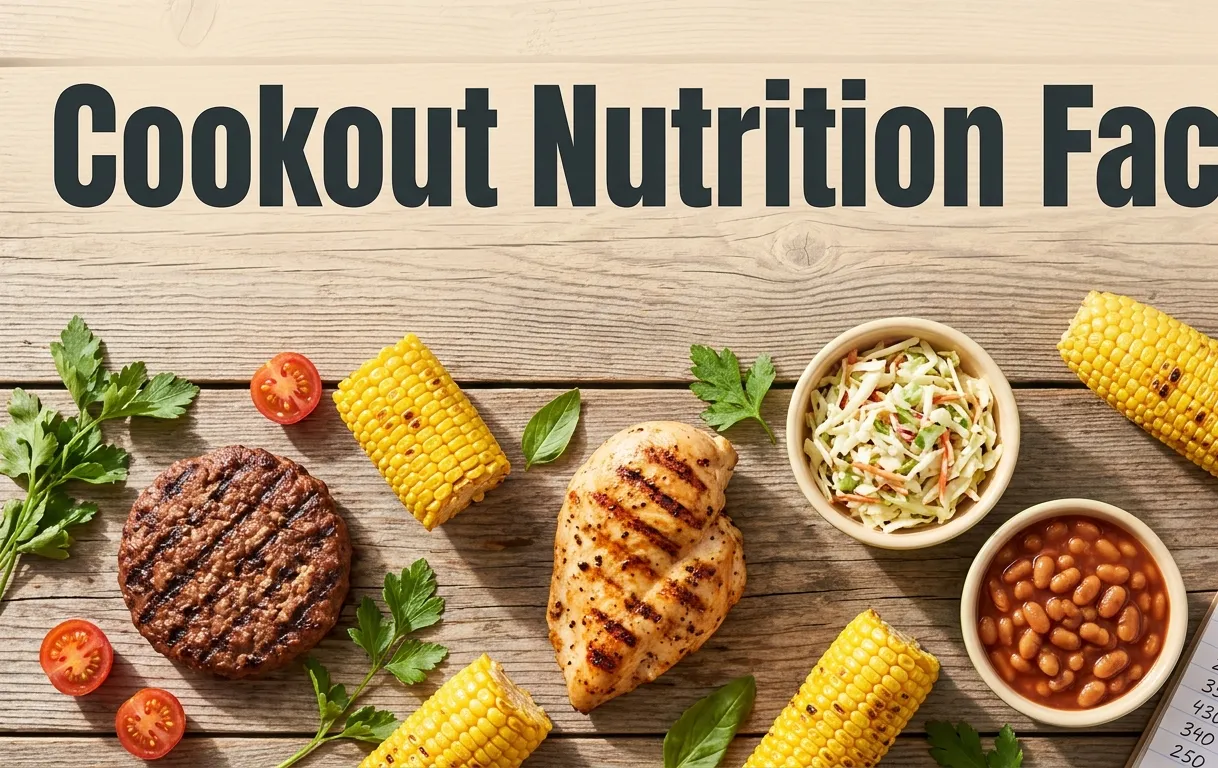
A cookout meal draws from multiple food groups. Protein sources include ground beef patties, hot dogs, chicken pieces, and occasionally fish or plant-based alternatives. Side dishes span creamy salads, baked beans, corn on the cob, chips, and fruit salads. Desserts tend to be sugar-forward: brownies, cookies, pies, and ice cream. Beverages range from water to sweet tea, lemonade, soda, and alcoholic options like beer.
The nutritional pattern that defines a cookout plate is a concentration of calories from fat and refined carbohydrates with a sizable protein portion at the center. This is not inherently problematic. The Dietary Guidelines for Americans 2020-2025 emphasize that overall eating patterns matter more than individual meals. A cookout meal can fit into a healthy eating pattern when you understand the numbers and make intentional choices about portion size, side selection, and frequency of indulgence.
Typical Cookout Plate Nutritional Ranges
| Plate Component | Serving Size | Calorie Range | Dominant Macronutrient |
|---|---|---|---|
| Burger with bun and cheese | 1 assembled burger | 450 to 750 | Fat |
| Hot dog with bun | 1 assembled hot dog | 250 to 350 | Fat |
| Grilled chicken breast | 4 oz cooked | 140 to 180 | Protein |
| Creamy side dish | 1/2 cup | 150 to 350 | Fat |
| Baked beans | 1/2 cup | 160 to 220 | Carbohydrate |
| Dessert item | 1 piece or scoop | 200 to 500 | Sugar/Fat |
| Sweet beverage | 12 oz | 120 to 200 | Sugar |
Cookout Menu Nutrition Facts Breakdown
A cookout menu nutrition facts breakdown organizes individual cookout foods by category so you can evaluate the calorie, fat, protein, carbohydrate, fiber, and sodium content of each option before making your plate choices.
The structure of a cookout menu falls into predictable categories. Main dishes center on grilled proteins. Side dishes split between creamy mayonnaise-based salads, starchy sides, and vegetable options. The condiment bar adds sodium and sugar quickly. Desserts and beverages round out the meal. Understanding the nutritional weight of each category lets you prioritize: spend your calories on the foods you genuinely love and find lighter options for the rest.
The USDA FoodData Central database provides reference values for every standard cookout food. These numbers reflect typical homemade preparation using common recipes. Restaurant cookout meals and pre-packaged deli sides may differ in ingredient quality, added sugar, sodium, and preservative content. Always check package labels or ask about preparation methods when eating at a catered or restaurant cookout.
Complete Cookout Food Category Nutritional Summary
| Food Category | Example Items | Typical Calories Per Serving | Key Nutritional Note |
|---|---|---|---|
| Red meat | Beef burger, steak | 250 to 350 per 4 oz | High in zinc and B12 |
| Processed meat | Hot dogs, sausages | 130 to 200 per frank | High sodium; limit frequency |
| Poultry | Chicken breast, turkey burger | 130 to 200 per 4 oz | Lean protein; lower saturated fat |
| Creamy sides | Mac and cheese, coleslaw, potato salad | 200 to 400 per 1/2 cup | Mayonnaise base adds fat |
| Starchy sides | Baked beans, corn on cob, rolls | 120 to 250 per serving | Watch added sugars in beans |
| Vegetable sides | Grilled vegetables, green salad | 25 to 80 per cup | Lowest calorie density |
| Condiments | Ketchup, mustard, mayo, BBQ sauce | 15 to 90 per tablespoon | Sodium and sugar concentrated |
| Desserts | Brownies, cookies, pie | 200 to 500 per piece | Sugar and butter dominant |
| Beverages | Sweet tea, lemonade, soda, beer | 100 to 200 per 12 oz | Liquid calories add up fast |
Key Takeaway: A cookout plate is a system of choices. The center of the plate, the sides you pick, and the condiments you add each contribute independently. Understanding the numbers for each category lets you assemble a plate that fits your goals.
How Many Calories in a Cookout Meal
A complete cookout meal including a main dish, one side, one dessert, and a beverage contains between 800 and 1,500 calories, with the largest variables being the type of protein chosen, the side dish selection, and whether or not you add cheese, condiments, and alcoholic beverages.
The calorie count of a cookout meal breaks down into four decision points. The main dish contributes 250 to 750 calories depending on whether you choose a hot dog, a chicken breast, or a fully loaded cheeseburger. The side dish adds 150 to 400 calories. Dessert tacks on 200 to 500 calories. A sweetened beverage adds 100 to 200 calories. Condiments can silently contribute 50 to 200 calories across the plate.
Build three representative cookout plates using USDA reference data. A higher-calorie plate might include a cheeseburger on a buttered bun at 650 calories, a half-cup of mac and cheese at 240 calories, a brownie at 250 calories, and 12 ounces of sweet tea at 140 calories. That totals 1,280 calories. A lower-calorie plate with a grilled chicken breast at 160 calories, a half-cup of grilled vegetables at 40 calories, a small dinner roll at 80 calories, and water adds up to 280 calories. The difference between those two plates is 1,000 calories decided entirely by food choice.
Three Cookout Meal Calorie Comparisons
| Meal Component | Higher-Calorie Plate | Moderate Plate | Lower-Calorie Plate |
|---|---|---|---|
| Main dish | Cheeseburger with cheese (650 cal) | Burger no cheese, half bun (380 cal) | Grilled chicken breast (160 cal) |
| Side dish | Mac and cheese 1/2 cup (240 cal) | Baked beans 1/2 cup (190 cal) | Grilled vegetables 1 cup (40 cal) |
| Dessert | Brownie (250 cal) | Small cookie (120 cal) | Watermelon slice (45 cal) |
| Beverage | Sweet tea 12 oz (140 cal) | Light beer 12 oz (100 cal) | Water or unsweetened tea (0 cal) |
| Total | 1,280 calories | 790 calories | 245 calories |
Cookout Burger Nutrition Facts
A standard 4-ounce raw 80/20 ground beef patty, grilled and served on a white hamburger bun with a slice of American cheese, delivers approximately 550 to 650 calories, 35 grams of protein, 35 to 45 grams of fat, and 30 grams of carbohydrate.
The beef patty itself is the primary nutritional driver. According to the USDA FoodData Central database, a 4-ounce raw 80/20 ground beef patty (which yields about 3 ounces cooked) provides 290 calories, 23 grams of protein, 23 grams of fat including 9 grams of saturated fat, and zero carbohydrates. The zinc content reaches 4.5 milligrams, approximately 40 percent of the adult daily value. Vitamin B12 clocks in at 2.1 micrograms, covering nearly 90 percent of the daily requirement.
Leaner ground beef changes the numbers dramatically. A 90/10 ground beef patty of the same size delivers 200 calories, 23 grams of protein, and only 11 grams of fat with 4.5 grams of saturated fat. You save 90 calories and 12 grams of fat with this single swap while keeping the same protein content. The zinc and iron levels drop slightly because these minerals concentrate in the fat portion, but the difference is nutritionally modest.
Burger Patty Nutrition by Fat Percentage (4 oz raw patty)
| Patty Type | Calories | Protein (g) | Total Fat (g) | Saturated Fat (g) | Iron (mg) | Zinc (mg) |
|---|---|---|---|---|---|---|
| 70/30 ground beef | 330 | 20 | 28 | 11 | 2.0 | 4.2 |
| 80/20 ground beef | 290 | 23 | 23 | 9 | 2.2 | 4.5 |
| 85/15 ground beef | 250 | 24 | 17 | 7 | 2.3 | 4.7 |
| 90/10 ground beef | 200 | 23 | 11 | 4.5 | 2.4 | 4.9 |
| 93/7 ground turkey | 170 | 22 | 9 | 2.5 | 1.3 | 2.0 |
| Plant-based burger | 250 | 19 | 18 | 6 | 3.5 (fortified) | Varies |
The bun and cheese add calories from refined carbohydrates and additional saturated fat. A standard white hamburger bun supplies 120 to 150 calories, 21 grams of carbohydrate, and 2 grams of fiber. A slice of American cheese provides 60 to 80 calories, 5 grams of fat, and 200 milligrams of sodium. Toppings like lettuce, tomato, and onion add fewer than 15 calories total while contributing vitamin C and fiber.
Cookout Hot Dog Calories and Nutrition
A standard beef hot dog on a white bun with one tablespoon of ketchup and mustard delivers approximately 280 to 320 calories, 10 grams of protein, 17 grams of fat, and 24 grams of carbohydrate with roughly 700 milligrams of sodium.
The hot dog frank itself is a processed meat product with a nutritional profile that differs from whole-muscle meat. The USDA database records a standard beef frankfurter at 57 grams providing 150 calories, 5 grams of protein, 14 grams of fat including 5 grams of saturated fat, and 1 to 2 grams of carbohydrate from fillers and sugar. Sodium content in a single beef frank ranges from 400 to 550 milligrams depending on brand and formulation.
Turkey and chicken hot dogs offer a lower-fat alternative. A turkey frank of similar size provides 100 to 110 calories, 6 grams of protein, 8 grams of fat, and comparable sodium levels. The trade-off is texture and flavor, which manufacturers compensate for with additional sodium and flavoring agents. Reading labels matters here because the nutritional variation between brands is wider for poultry hot dogs than for beef.
Hot Dog Nutrition Comparison (1 frank, 45-57g)
| Hot Dog Type | Calories | Protein (g) | Total Fat (g) | Saturated Fat (g) | Sodium (mg) |
|---|---|---|---|---|---|
| Beef frank | 150 | 5 | 14 | 5 | 480 |
| Pork frank | 160 | 6 | 14 | 5 | 450 |
| Turkey frank | 100 | 6 | 8 | 2.5 | 420 |
| Chicken frank | 110 | 7 | 9 | 3 | 470 |
| Beef jumbo frank | 220 | 7 | 20 | 8 | 620 |
| Plant-based frank | 130 | 12 | 7 | 1 | 390 |
Key Takeaway: A burger patty’s calorie count is driven by its fat percentage. The leaner the ground beef, the fewer calories and grams of saturated fat per patty while protein remains nearly identical. This is the single highest-impact swap you can make at a cookout.
Grilled Chicken vs Burger Nutrition at a Cookout
Grilled chicken breast is the leanest standard cookout main dish option, with a 4-ounce raw boneless skinless breast delivering 140 to 160 calories and 26 grams of protein with only 3 grams of fat, compared to 290 calories and 23 grams of fat for an 80/20 beef patty of the same raw weight.
The nutritional advantage of grilled chicken extends beyond calorie and fat counts. Chicken breast provides 11 milligrams of niacin, approximately 70 percent of the adult daily value and more than double what a beef patty delivers. Vitamin B6 reaches 0.6 milligrams, and selenium hits 22 micrograms. The trade-off is lower iron and zinc compared to beef. A chicken breast provides about 0.5 milligrams of iron versus 2.2 milligrams in the beef patty. Zinc drops from 4.5 milligrams in beef to about 0.8 milligrams in chicken.
Thigh meat offers a middle ground. A 4-ounce raw boneless skinless chicken thigh provides 180 to 200 calories, 20 grams of protein, and 10 to 12 grams of fat. The higher fat content improves grilling tolerance. Thighs stay juicier over high heat and resist drying out better than breasts. The dark meat also delivers more iron and zinc than breast meat while still staying well below beef burger levels.
The bun and toppings attached to either protein affect the final plate equally. A grilled chicken sandwich with mayo on a white bun can approach 500 calories if dressed heavily. A burger patty served without a bun and topped with grilled onions and mustard lands around 320 calories. The protein choice matters, but the assembly decisions matter just as much.
Nutrition Per 4 oz Raw Cooked Without Added Fat
| Protein | Calories | Protein (g) | Fat (g) | Saturated Fat (g) | Iron (mg) | Zinc (mg) |
|---|---|---|---|---|---|---|
| Chicken breast | 140 | 26 | 3 | 0.8 | 0.5 | 0.8 |
| Chicken thigh | 190 | 20 | 11 | 3 | 0.8 | 1.3 |
| 90/10 beef patty | 200 | 23 | 11 | 4.5 | 2.4 | 4.9 |
| 80/20 beef patty | 290 | 23 | 23 | 9 | 2.2 | 4.5 |
| Turkey burger 93/7 | 170 | 22 | 9 | 2.5 | 1.3 | 2.0 |
| Salmon fillet | 200 | 22 | 12 | 2 | 0.5 | 0.6 |
Cookout Sides Calories Comparison
Cookout side dishes range from 25 calories per half-cup for plain grilled vegetables to 400 calories for heavily dressed mac and cheese or potato salad, making side dish selection the most powerful calorie-control lever on the entire cookout plate.
Mayonnaise-based sides are the calorie-dense outliers on the picnic table. A half-cup of classic potato salad made with mayonnaise and egg provides 250 to 350 calories and 18 to 25 grams of fat. Mac and cheese made with whole milk, butter, and full-fat cheddar clocks in at 240 to 350 calories per half-cup. Coleslaw with a creamy dressing covers the same range. These three sides alone can add 800 calories to a plate with generous scoops.
Starchy sides without heavy dressings offer a middle ground. Baked beans at 160 to 220 calories per half-cup, corn on the cob with a pat of butter at 140 to 180 calories per ear, and a dinner roll at 80 to 120 calories each bring carbohydrates and some fiber without the fat load of creamy sides. Vegetable-based sides like grilled zucchini, peppers, and onions, a simple green salad with vinaigrette, or fresh fruit salad provide bulk and nutrients at 25 to 100 calories per cup.
Cookout Side Dish Calorie and Macro Comparison (1/2 cup unless noted)
| Side Dish | Calories | Fat (g) | Carbs (g) | Protein (g) | Fiber (g) |
|---|---|---|---|---|---|
| Potato salad (mayo-based) | 300 | 22 | 24 | 3 | 2 |
| Mac and cheese | 280 | 16 | 24 | 10 | 1 |
| Creamy coleslaw | 220 | 18 | 14 | 1 | 2 |
| Baked beans | 190 | 1 | 38 | 7 | 6 |
| Corn on the cob (1 ear, buttered) | 160 | 6 | 27 | 4 | 2 |
| Vinegar coleslaw | 60 | 3 | 8 | 1 | 3 |
| Fruit salad (1 cup) | 80 | 0 | 20 | 1 | 3 |
| Grilled vegetables (1 cup) | 45 | 2 | 7 | 2 | 3 |
| Green salad with vinaigrette (1 cup) | 55 | 3 | 5 | 2 | 2 |
Cookout Mac and Cheese Nutrition Facts
One half-cup serving of traditional cookout-style mac and cheese made with whole milk, butter, and cheddar cheese contains 240 to 300 calories, 14 to 18 grams of fat, 22 to 26 grams of carbohydrate, and 9 to 11 grams of protein with 400 to 600 milligrams of sodium.
The nutritional density of mac and cheese comes from its three core ingredients: enriched pasta, full-fat dairy, and butter. The pasta supplies refined carbohydrate with a small amount of B vitamins from enrichment. The cheese and butter contribute saturated fat, calcium, and vitamin A. A half-cup serving provides roughly 200 to 250 milligrams of calcium, about 15 to 20 percent of the adult daily value.
Recipe variations shift the numbers. Mac and cheese made with reduced-fat milk and less butter drops to 180 to 220 calories per half-cup. Versions baked with a breadcrumb topping add 30 to 50 calories and additional refined carbohydrate. Boxed deluxe mac and cheese products often increase sodium to 600 to 800 milligrams per serving due to processed cheese sauce formulations. The USDA FoodData Central database shows that homemade versions generally contain less sodium and fewer preservatives than packaged equivalents.
Individuals monitoring sodium intake should note that mac and cheese is one of the highest-sodium items on a cookout table. A half-cup serving paired with a hot dog and condiments can deliver over 1,500 milligrams of sodium in a single meal, which is more than 65 percent of the 2,300-milligram daily limit recommended by the Dietary Guidelines for Americans.
Mac and Cheese Nutrition by Preparation Style (1/2 cup)
| Style | Calories | Fat (g) | Carbs (g) | Protein (g) | Sodium (mg) |
|---|---|---|---|---|---|
| Homemade full-fat | 280 | 17 | 24 | 10 | 450 |
| Homemade reduced-fat | 200 | 9 | 23 | 10 | 380 |
| Boxed deluxe (prepared) | 310 | 18 | 28 | 9 | 680 |
| Boxed regular (prepared) | 220 | 4 | 39 | 7 | 540 |
| Restaurant-style side | 350 | 22 | 28 | 12 | 620 |
Cookout Coleslaw Nutrition Facts
Coleslaw nutrition facts depend entirely on the dressing type, with creamy mayonnaise-based coleslaw delivering 200 to 250 calories per half-cup and vinegar-based coleslaw providing only 50 to 70 calories for the same portion size while preserving the fiber and vitamin C from cabbage.
Cabbage, the base of all coleslaw, is a cruciferous vegetable with genuine nutritional merits. One cup of shredded raw cabbage provides 22 calories, 2 grams of fiber, 35 milligrams of vitamin C (roughly 40 percent of the daily value), and small amounts of vitamin K and folate. A coleslaw that is mostly cabbage with a light dressing retains these benefits. A coleslaw swimming in mayonnaise dilutes them beneath a layer of fat and calories.
Creamy coleslaw dressing is made from mayonnaise, sugar, vinegar, and seasonings. Two tablespoons of standard mayonnaise contain 180 calories and 20 grams of fat. When a half-cup of creamy coleslaw contains roughly two to three tablespoons of mayonnaise by volume, the math explains the calorie count. Vinegar-based dressings replace most of the mayonnaise with vinegar, a small amount of oil, and seasonings, cutting the calorie count by 70 percent.
Quick Tip: If you are making coleslaw, replace half the mayonnaise with plain Greek yogurt for a version that drops calories by roughly 40 percent while keeping a creamy texture and adding a small protein bump. If you are eating at a cookout, vinegar coleslaw is nearly always the lighter choice and pairs well with richer grilled meats.
Cookout Baked Beans Nutrition Facts
A half-cup serving of traditional cookout baked beans made with navy beans, brown sugar, molasses, and bacon or salt pork contains 180 to 240 calories, 38 grams of carbohydrate including 14 to 18 grams of sugar, 7 grams of protein, and 6 grams of fiber with 400 to 600 milligrams of sodium.
The navy bean base provides the nutritional upside. Navy beans are legumes, meaning they deliver plant protein, soluble fiber, and resistant starch. The 6 grams of fiber in a half-cup serving represents roughly 20 percent of the daily recommended intake. This fiber slows carbohydrate digestion and supports healthy blood sugar responses compared to refined carbohydrate sides. The 7 grams of protein per serving is higher than any other cookout side except mac and cheese.
The added sugar is the trade-off. Traditional baked bean recipes use brown sugar and molasses for that sweet, deep flavor. Canned versions add high fructose corn syrup or sugar to the sauce. The resulting 14 to 18 grams of sugar per half-cup equals 3.5 to 4.5 teaspoons. The American Heart Association recommends limiting added sugars to no more than 36 grams per day for men and 25 grams for women. One serving of baked beans can use half to two-thirds of a woman’s daily added sugar budget.
Homemade baked beans can reduce the sugar load. Replacing half the sweetener with unsweetened applesauce, using a smaller amount of molasses for flavor, or simply cutting the sugar in the recipe produces a less sweet but still satisfying side. Canned baked beans labeled “reduced sugar” typically contain 8 to 10 grams of sugar per half-cup, roughly half the standard version.
Key Takeaway: Side dishes are the hidden calorie engine of the cookout plate. The difference between a half-cup of creamy mac and cheese and a cup of grilled vegetables is 250 calories per serving. That is larger than the calorie gap between a burger and a hot dog. Choose sides first, then build the rest of your plate around that decision.
Grilled Vegetables Nutrition Facts
One cup of mixed grilled vegetables including zucchini, bell peppers, onion, and mushroom brushed with one teaspoon of olive oil contains 60 to 80 calories, 5 grams of fat, 6 to 8 grams of carbohydrate, 3 grams of fiber, and 2 grams of protein with minimal sodium before seasoning.
Grilling vegetables caramelizes their natural sugars and concentrates flavor while preserving most of their micronutrient content. Vitamin C undergoes some heat degradation during grilling, with losses of 20 to 40 percent depending on cooking time and temperature. Potassium, magnesium, and fiber remain stable. Fat-soluble vitamins like vitamin A precursors (beta-carotene in peppers) hold up well and may become more absorbable with the addition of the small amount of oil used for grilling.
The nutritional profile of grilled vegetables changes minimally if they are cooked on the same grill surface as meat. Vegetable cell walls are structured differently from animal protein and do not absorb rendered fat in meaningful amounts. The oil or marinade you add before grilling, not the meat drippings on the grate, determines the final fat content of the vegetables.
Grilled vegetables solve a common cookout problem: plate coverage. A plate with a large portion of grilled vegetables, a protein choice, and a small roll looks full and abundant while staying under 400 calories. The water and fiber volume of the vegetables provides satiety that a plate dominated by dense sides and a burger cannot match on a per-calorie basis.
Grilled Vegetable Nutrition Per Cup
| Vegetable | Calories | Fat (g) | Carbs (g) | Fiber (g) | Notable Micronutrient |
|---|---|---|---|---|---|
| Zucchini and summer squash | 20 | 0.4 | 4 | 1.5 | Vitamin C 22mg |
| Bell pepper (mixed colors) | 30 | 0.3 | 7 | 2.5 | Vitamin C 120mg |
| Onion | 40 | 0.1 | 9 | 1.5 | Quercetin (flavonoid) |
| Portobello mushroom | 25 | 0.4 | 4 | 1.5 | Potassium 350mg |
| Asparagus (1/2 cup) | 25 | 0.2 | 4 | 2 | Vitamin K 45mcg |
| Corn on the cob (1 ear) | 100 | 1.5 | 22 | 2 | Folate 40mcg |
Marinade and Rub Effect on Cookout Nutrition
Marinades and dry rubs add calories, sodium, and sugar to grilled foods in amounts that range from negligible for simple herb-and-vinegar preparations to significant for sugar-heavy barbecue sauces that can add 50 to 100 calories and 10 to 15 grams of sugar per serving.
The nutritional impact of a marinade depends on what stays on the food after cooking. Most of a thin vinegar or citrus-based marinade drips off or evaporates during grilling. The caloric contribution might be 5 to 15 calories per serving. Oil-based marinades leave more behind, especially if the food is not patted dry before grilling. A tablespoon of retained oil-based marinade adds 120 calories and 14 grams of fat.
Dry rubs based on spices and herbs without added sugar add negligible calories. A teaspoon of paprika, garlic powder, onion powder, black pepper, and salt across an entire chicken breast adds fewer than 5 calories and 200 milligrams of sodium. Sugar-based rubs change the math. Two tablespoons of brown sugar-based rub that adheres to ribs or chicken can contribute 50 to 90 calories and 12 to 22 grams of sugar per serving.
Marinating provides a benefit that partially offsets any added calories. Research from the American Institute for Cancer Research has demonstrated that marinating meat for at least 30 minutes before grilling reduces the formation of heterocyclic amines (HCAs) by up to 90 percent. HCAs are compounds formed when muscle meat is cooked at high temperatures and have been associated with increased cancer risk in animal studies. The acid in marinades (vinegar, citrus juice, yogurt) appears to provide this protective effect.
Marinade Nutrition Per Serving (Approximately 2 tablespoons before grilling)
| Marinade Type | Calories Added | Fat (g) | Sodium (mg) | Sugar (g) |
|---|---|---|---|---|
| Vinegar and herb | 10 | 0.5 | 100 | 1 |
| Lemon juice and garlic | 15 | 1 | 50 | 1 |
| Italian dressing (oil-based) | 80 | 8 | 300 | 2 |
| Teriyaki (bottled) | 60 | 0 | 600 | 10 |
| Barbecue sauce (bottled) | 70 | 0 | 400 | 15 |
| Yogurt-based (tandoori style) | 30 | 1 | 150 | 3 |
Cookout Healthy Options Lower Calorie Choices
Lower-calorie cookout options start with lean protein, skip or minimize the bun, load half the plate with grilled vegetables or green salad, choose vinegar-based sides, and use mustard or salsa instead of mayonnaise-based condiments, reducing a typical plate from 1,200 calories to 400 to 500 calories.
Building a lower-calorie cookout plate requires no special recipes. It requires only choosing different items from the same buffet table. A grilled chicken breast or turkey burger patty provides lean protein. Two cups of grilled vegetables and a half-cup of vinegar coleslaw fill the plate with volume at low calorie cost. Mustard, salsa, and hot sauce provide flavor at under 10 calories per tablespoon. Water or unsweetened iced tea finishes the meal with zero added calories.
Portion control on the higher-calorie foods matters more than complete avoidance. A half-burger eaten slowly with a fork, a single small scoop of mac and cheese treated as a garnish rather than the centerpiece, or a single bite of a shared dessert all allow you to experience the foods you enjoy without rebuilding a high-calorie plate. The Dietary Guidelines for Americans emphasize that all foods can fit into a healthy eating pattern when portions and frequency are managed.
Lower-Calorie Cookout Plate Builder
| Plate Component | Higher-Calorie Choice | Lower-Calorie Swap | Calories Saved |
|---|---|---|---|
| Protein | 80/20 cheeseburger on bun (650) | Grilled chicken breast (160) | 490 |
| Side 1 | Mac and cheese 1/2 cup (280) | Grilled vegetables 1 cup (50) | 230 |
| Side 2 | Creamy coleslaw 1/2 cup (220) | Vinegar coleslaw 1/2 cup (60) | 160 |
| Condiment | Mayonnaise 1 tbsp (90) | Mustard 1 tbsp (5) | 85 |
| Beverage | Sweet tea 12 oz (140) | Unsweetened iced tea (0) | 140 |
| Dessert | Brownie (250) | Watermelon 1 cup (45) | 205 |
Key Takeaway: The healthiest cookout strategy is not deprivation. It is deliberate selection. Pick the one indulgent food you genuinely care about and build the rest of the plate around lean protein, vegetables, and lighter sides. You leave satisfied without leaving overstuffed.
Cookout Condiments Nutrition Facts
Cookout condiments range from nearly calorie-free flavor enhancers like mustard and hot sauce at under 5 calories per tablespoon to calorie-dense additions like mayonnaise at 90 calories per tablespoon and barbecue sauce at 35 to 50 calories per tablespoon with added sugar.
The condiment bar is where many cookout meals silently accumulate hundreds of unaccounted calories and a substantial sodium load. A burger dressed with one tablespoon each of ketchup and mayonnaise adds 110 calories and 250 milligrams of sodium. A hot dog with chili and cheese sauce can add 150 calories. Barbecue sauce brushed onto chicken or ribs adds sugar and sodium with every baste.
Mustard stands out as the nutritional winner among standard cookout condiments. A tablespoon of yellow mustard contains 3 to 5 calories, negligible fat and sugar, and a modest amount of sodium (55 milligrams) while delivering strong flavor from turmeric and mustard seed. Vinegar-based hot sauces perform similarly. Salsa provides vegetable-based flavor at roughly 10 calories per two tablespoons with a small fiber and vitamin C bonus.
Cookout Condiment Nutrition Per Tablespoon
| Condiment | Calories | Fat (g) | Sugar (g) | Sodium (mg) |
|---|---|---|---|---|
| Yellow mustard | 3 | 0 | 0 | 55 |
| Dijon mustard | 5 | 0 | 0 | 120 |
| Hot sauce | 2 | 0 | 0 | 100 |
| Salsa | 5 | 0 | 1 | 75 |
| Ketchup | 20 | 0 | 4 | 160 |
| Barbecue sauce | 35 | 0 | 7 | 200 |
| Relish (sweet pickle) | 20 | 0 | 5 | 120 |
| Mayonnaise | 90 | 10 | 0 | 70 |
| Cheese sauce | 45 | 3 | 1 | 230 |
Cookout Dessert Nutrition Facts
Cookout desserts like brownies, cookies, and pie slices deliver 200 to 500 calories per serving, with the calorie count driven primarily by butter, sugar, and refined flour, and provide few micronutrients beyond small amounts of iron from enriched flour and calcium if made with dairy.
Standard cookout dessert offerings are concentrated sources of added sugar and saturated fat. A 2-inch square brownie contains roughly 250 calories, 14 grams of fat, and 20 grams of sugar. A slice of apple pie supplies 350 to 400 calories, 16 grams of fat, and 20 to 25 grams of sugar. Two chocolate chip cookies add 250 to 300 calories. These numbers align with USDA FoodData Central reference data for standard homemade recipes.
Fruit-based desserts offer a lighter path. A cup of watermelon supplies 45 calories and natural sugars with vitamins A and C and the antioxidant lycopene. Grilled peach halves brushed with a small amount of honey deliver a warm, satisfying dessert at roughly 80 calories per peach half. A fruit salad made with whatever summer fruit is available provides variety at 80 to 100 calories per cup.
The choice between skipping dessert entirely and eating fruit is not a nutritional equivalence. The person who genuinely wants a brownie may feel more satisfied eating a small brownie slowly than eating three cups of fruit while feeling deprived. Dessert selection at a cookout works best when it is intentional: either you choose a small portion of the real thing or you genuinely prefer the lighter option.
Cookout Milkshake Calories and Sugar Content
A 12-ounce cookout-style milkshake made with full-fat ice cream and whole milk contains 500 to 700 calories and 50 to 80 grams of sugar, making it one of the most calorie-dense items at any cookout, equivalent to eating a full cheeseburger plus a side dish in a single beverage.
The base ingredients explain the numbers. A cup of vanilla ice cream provides roughly 270 calories, 15 grams of fat, and 25 grams of sugar. Whole milk adds 150 calories and 12 grams of sugar per cup. A 12-ounce milkshake requires roughly 1.5 cups of ice cream and a half-cup of milk, landing at approximately 550 calories before any added syrups, chocolate, or whipped cream. Syrups and toppings can push the total beyond 800 calories.
Smaller sizes help. An 8-ounce milkshake cuts the numbers by roughly one-third. A “mini” or “snack” size at 6 ounces brings the calories into the 250 to 350 range, comparable to a single dessert serving rather than a meal replacement. Sharing a standard milkshake among two or three people is another practical approach that preserves the experience without the full calorie commitment.
The sugar content deserves attention independent of calories. A 12-ounce milkshake with 65 grams of sugar contains over 16 teaspoons of sugar, nearly double the American Heart Association’s daily recommended limit for adults. This sugar arrives in liquid form combined with fat, which delays gastric emptying and can cause digestive discomfort in addition to the metabolic load. For most people, a cookout milkshake is best treated as an occasional indulgence in the smallest available size.
Milkshake Nutrition by Size
| Shake Size | Calories | Total Fat (g) | Sugar (g) | Protein (g) |
|---|---|---|---|---|
| 6 oz (snack) | 280 | 14 | 28 | 6 |
| 8 oz (small) | 370 | 19 | 37 | 8 |
| 12 oz (regular) | 550 | 28 | 56 | 12 |
| 16 oz (large) | 730 | 37 | 74 | 15 |
| 20 oz (extra large) | 910 | 46 | 92 | 18 |
Key Takeaway: Desserts and beverages at a cookout are nutritionally dense enough to double the calorie count of your entire meal. A milkshake adds more calories than a burger. Sweet tea adds sugar without satiety. Pick one indulgence at the end of the meal and keep it small. Your body registers the calories from liquids and desserts just as accurately as it registers the calories from your main plate.
Frequently Asked Questions About Cookout Nutrition Facts
What is the healthiest food to eat at a cookout?
The healthiest cookout plate combines a grilled skinless chicken breast or lean turkey burger patty, a large portion of grilled vegetables, a half-cup of vinegar-based coleslaw, and water or unsweetened iced tea.
This plate provides roughly 350 to 450 calories with 40 grams of lean protein, 8 grams of fiber, and minimal added sugar and saturated fat.
The vegetables supply volume and micronutrients that support satiety without dense calories.
How many calories are in a typical cookout plate?
A typical cookout plate with a cheeseburger on a bun, a half-cup of mac and cheese, a half-cup of creamy coleslaw, and a brownie contains between 1,200 and 1,500 calories.
This represents 60 to 75 percent of the daily caloric intake for an adult on a 2,000-calorie eating pattern.
The same plate built around grilled chicken and vegetable sides drops to roughly 500 to 600 calories.
Are grilled foods healthier than fried foods?
Grilled foods are generally lower in calorie density than fried foods because grilling allows fat to render and drip away from the food rather than being absorbed from cooking oil.
A grilled chicken breast at 140 calories compares to a breaded fried chicken breast at 300 to 400 calories for the same portion size.
Grilling at very high temperatures does produce heterocyclic amines, compounds that can be reduced by marinating meat before cooking.
How do I reduce calories at a cookout?
Reduce cookout calories by choosing lean proteins like chicken breast or turkey burgers, filling half your plate with grilled vegetables or green salad, choosing vinegar-based sides over creamy ones, using mustard instead of mayonnaise, and drinking water or unsweetened beverages.
These swaps can reduce a cookout meal from 1,200 calories to under 500 without eliminating the grilled food experience.
Skip the bun or use only the bottom half to save an additional 80 to 120 calories.
What are the lowest calorie cookout sides?
The lowest calorie cookout sides are grilled vegetables at 45 calories per cup, vinegar-based coleslaw at 60 calories per half-cup, green salad with vinaigrette at 55 calories per cup, and fresh fruit salad at 80 calories per cup.
Mustard, hot sauce, and salsa add flavor to any plate for under 10 calories per tablespoon.
Corn on the cob without butter at 100 calories per ear is a moderate option that provides fiber and a satisfying chew.
Does grilling meat change its nutritional value?
Grilling meat reduces its fat content as rendered fat drips away during cooking, which lowers the total calorie count compared to the raw weight, but the high heat also causes some B vitamin losses, particularly thiamin.
The protein content remains essentially unchanged through grilling.
Compounds called heterocyclic amines form during high-heat grilling, but marinating meat for 30 minutes before cooking reduces their formation by up to 90 percent.
A cookout meal can be a nutritional challenge or a completely reasonable eating choice depending entirely on the decisions you make before you fill your plate. The grilled protein options available at any cookout are inherently leaner than their fried counterparts. The vegetables that can go on a grill retain their micronutrient content while developing a flavor that makes them genuinely enjoyable. The side dishes and desserts simply require you to choose which ones are worth their calorie and sugar content to you personally.
Knowing the numbers removes the guesswork. A burger is always going to be a burger. Mac and cheese is always going to be mac and cheese. They belong at cookouts. The key is not eliminating them. It is eating them intentionally: one indulgent choice per plate, with everything else built from lean protein, vegetables, fruit, and lighter sides.
You now have the complete nutritional map of the cookout table. You know which foods deliver the most satiety per calorie, which condiments add flavor without consequence, and which desserts are worth the splurge. Build your next cookout plate using these numbers and walk away from the picnic table feeling satisfied.