Cheesecake Nutrition Facts: What’s Really in Every Slice (2026)
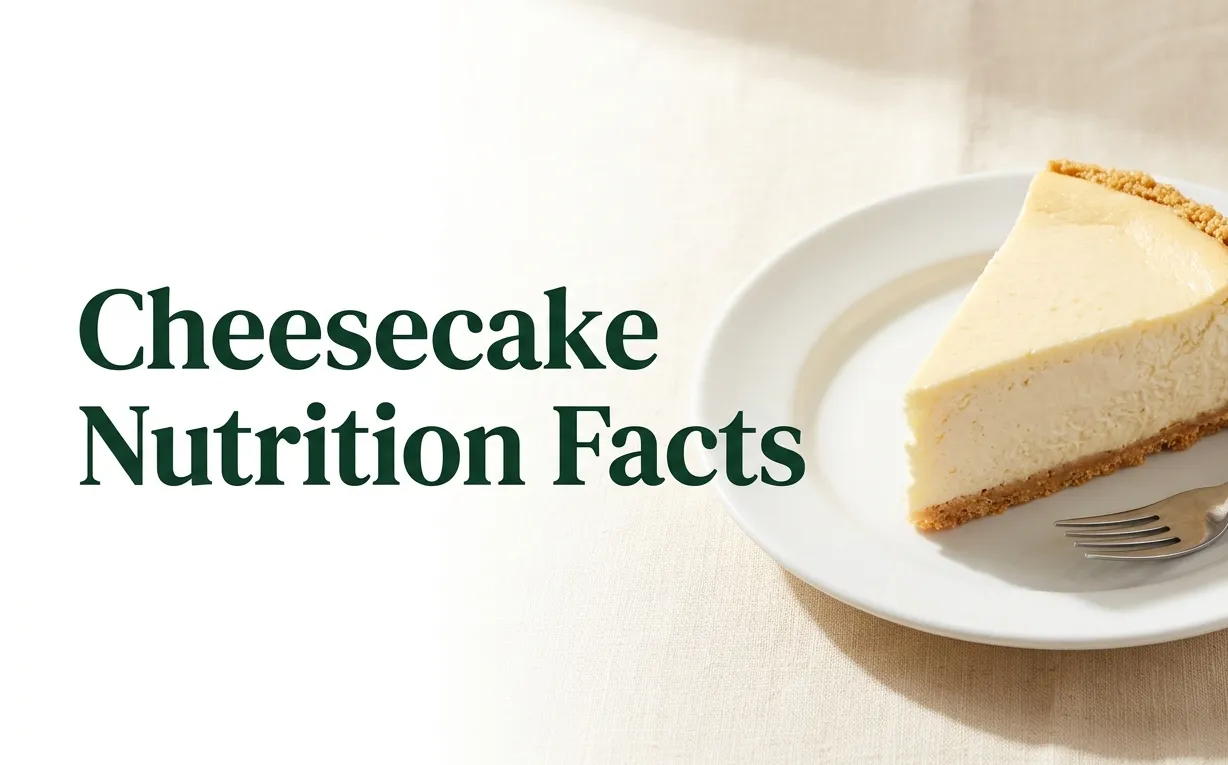
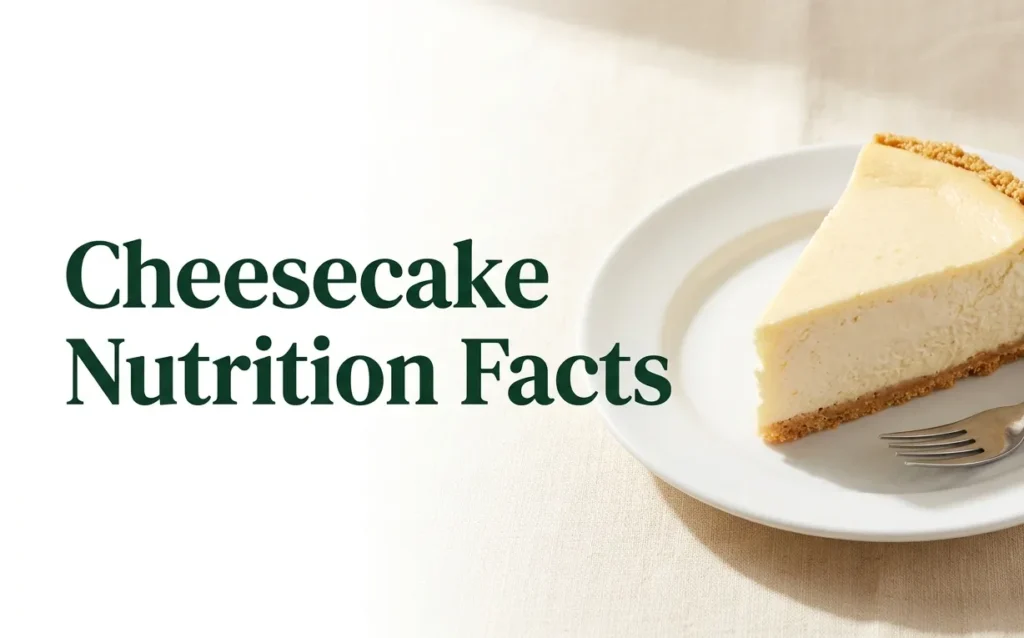
A single 125-gram slice of plain commercially prepared cheesecake contains approximately 321 calories, 22 grams of total fat, and 25 grams of carbohydrates. Cheesecake nutrition facts reveal a dessert that delivers meaningful amounts of calcium, vitamin A, and phosphorus alongside a dense concentration of saturated fat and added sugar that demands honest portion awareness.
The USDA FoodData Central database confirms that a standard slice of cheesecake provides roughly 6% of your daily calcium needs and about 5 grams of protein from its dairy and egg base. Those nutrients are real, but they arrive packaged with roughly 13 grams of saturated fat, which is about 65% of the American Heart Association’s recommended daily limit of 20 grams for someone eating 2,000 calories a day.
You will find a complete breakdown of every macronutrient and micronutrient in the sections ahead, along with direct comparisons between New York style, Japanese soufflé, no-bake, and homemade versions. Each section tells you what the numbers actually mean for your body and how preparation method, serving size, and ingredient choices change the nutritional equation entirely.
Cheesecake Nutrition Facts
A standard 125-gram slice of plain commercially prepared cheesecake provides approximately 321 calories, with fat contributing roughly 62% of those calories, carbohydrates contributing 31%, and protein contributing about 7%. This nutritional fingerprint places cheesecake firmly in the category of energy-dense desserts where fat, not sugar, is the dominant calorie source.
The USDA FoodData Central database records the following complete nutritional profile per 125-gram slice (1/12 of a 9-inch cake) for commercially prepared plain cheesecake:
| Nutrient | Amount per 125g Slice | % Daily Value (2,000-calorie diet) |
|---|---|---|
| Calories | 321 kcal | 16% |
| Total Fat | 22.0g | 28% |
| Saturated Fat | 13.0g | 65% |
| Trans Fat | 0.5g | Not established |
| Cholesterol | 95mg | 32% |
| Sodium | 320mg | 14% |
| Total Carbohydrate | 25.0g | 9% |
| Dietary Fiber | 0.5g | 2% |
| Total Sugars | 20.0g | Not established (includes added) |
| Protein | 5.5g | 11% |
| Calcium | 65mg | 5% |
| Iron | 0.8mg | 4% |
| Potassium | 120mg | 3% |
| Vitamin A | 220 IU (approx.) | 4% |
| Phosphorus | 95mg | 8% |
The numbers shift notably depending on the specific recipe. A cheesecake made with extra egg yolks, full-fat sour cream, and a butter-heavy crust can easily reach 400 to 450 calories per equivalent slice. Understanding exactly what you are eating starts with knowing that “one slice” has no universal definition until you pin it to a specific gram weight and preparation method.
Key Takeaway: A standard 125-gram slice of plain cheesecake delivers 321 calories with fat as the dominant macronutrient, but actual values swing widely based on recipe, brand, and slice thickness.
How Many Calories in a Slice of Cheesecake
A plain commercially prepared cheesecake slice weighing 125 grams contains approximately 321 calories, but the calorie count for a single slice ranges from 200 calories for a Japanese soufflé-style slice to over 800 calories for a restaurant-sized portion from chains like The Cheesecake Factory. The calorie answer depends entirely on which cheesecake you are eating and how large the slice is.
The following table breaks down calorie counts across popular cheesecake types, each based on a standard reference slice:
| Cheesecake Type | Approximate Slice Weight | Calorie Range per Slice |
|---|---|---|
| Plain, commercially prepared | 125g (1/12 of 9-inch cake) | 300 to 350 |
| New York style, dense | 140g | 400 to 520 |
| Japanese soufflé style | 100g | 180 to 220 |
| No-bake, standard recipe | 120g | 340 to 390 |
| The Cheesecake Factory, Original | 250g+ (restaurant portion) | 830 (per company nutrition data) |
| Low-fat, made with Neufchâtel | 125g | 220 to 270 |
| Chocolate marble, commercial | 130g | 370 to 430 |
Restaurant slices create the biggest calorie surprise. The Cheesecake Factory’s Original Cheesecake clocks in at 830 calories per slice, a number that reflects a portion easily two to three times heavier than a standard homemade or grocery-store slice. The 2026 FDA menu labeling rule requires chain restaurants to post calorie counts, so you can check before you order. If the number is not posted, assume a restaurant slice contains at least 500 calories and adjust your day accordingly.
Homemade cheesecake calorie counts vary with your knife. A standard 9-inch cheesecake cut into 12 even slices yields a 125-gram portion. Cut into 8 slices, the same cake jumps to 480 calories per slice. The math is simple and unforgiving.
Cheesecake Carbs
One 125-gram slice of commercially prepared plain cheesecake contains approximately 25 grams of total carbohydrates, of which roughly 20 grams come from sugars and less than 1 gram from dietary fiber. This carb count is moderate compared to many other desserts, but the quality and source of those carbohydrates matter as much as the number.
Cheesecake carbohydrates come from two primary sources. The first is the added sugar in the filling, typically granulated sucrose or sometimes powdered sugar for a smoother texture. The second source is the crust, almost always made from crushed graham crackers or digestive biscuits mixed with butter and sometimes additional sugar. A standard graham cracker crust contributes roughly 10 to 12 grams of carbohydrates per slice, predominantly as refined flour and added sugar.
For people counting net carbs, a plain cheesecake slice lands at about 24.5 grams of net carbohydrates (25g total minus 0.5g fiber). The crust is the main variable. A crustless cheesecake or one made with almond flour instead of graham crackers drops the total carbohydrate count to approximately 8 to 12 grams per slice, with sugars falling to around 6 to 8 grams depending on the sweetener used in the filling. Crustless cheesecake has become a popular option for people following low-carbohydrate or ketogenic dietary patterns who still want a rich dessert.
The glycemic impact of cheesecake is partially blunted by its high fat content. Fat slows gastric emptying, meaning the sugar enters your bloodstream more gradually than it would from a fat-free sugary dessert like sorbet or fruit gelatin. A 2019 study published in the American Journal of Clinical Nutrition found that adding fat to a carbohydrate-rich meal reduced the postprandial glucose peak by approximately 15% to 20% compared to the same carbohydrate load consumed without fat. This does not make cheesecake a blood-sugar-friendly food, but it explains why the insulin response curve looks different from what you would see after eating an equivalent amount of sugar in a low-fat dessert.
Key Takeaway: A slice of cheesecake delivers about 25 grams of carbs with minimal fiber, and removing or swapping the crust is the single most effective way to slash the carbohydrate count without changing the filling.
Cheesecake Protein
A 125-gram slice of plain cheesecake provides roughly 5.5 grams of protein, which is modest but not meaningless for a dessert. The protein comes primarily from the eggs and cream cheese in the filling, with a smaller contribution from the sour cream and any milk solids present in the recipe.
The protein in cheesecake is high-quality animal protein containing all nine essential amino acids. Eggs supply ovalbumin and other highly bioavailable proteins with a Protein Digestibility Corrected Amino Acid Score (PDCAAS) of 1.0, the highest possible rating. Cream cheese contributes casein and whey proteins, the same protein fractions found in milk, though in lower concentrations than you would get from drinking a glass of milk or eating a serving of Greek yogurt.
Five grams of protein is not enough to build a meal around, but it does give cheesecake a slight satiety edge over desserts that are pure fat and sugar with negligible protein. A slice of chocolate cake with frosting often contains 3 to 4 grams of protein. A serving of vanilla ice cream delivers about 2 to 3 grams. Cheesecake’s 5.5 grams put it in the upper tier of dessert protein content, though nowhere near protein-focused alternatives like Greek yogurt parfaits or ricotta-based desserts that can deliver 15 grams or more.
For someone trying to increase their protein intake, cheesecake is not the vehicle. You would need to eat over 600 calories of cheesecake to get 11 grams of protein, a ratio that does not serve most nutrition goals. Compare that to 150 calories of nonfat Greek yogurt providing the same 11 grams of protein, and the opportunity cost becomes clear.
Cheesecake Sugar Content
A 125-gram slice of commercially prepared plain cheesecake contains approximately 20 grams of total sugars, which is equal to 5 teaspoons of sugar. The 2020-2025 Dietary Guidelines for Americans recommend limiting added sugars to less than 10% of daily calories, which translates to no more than 50 grams (about 12 teaspoons) per day for a 2,000-calorie diet. One slice of cheesecake uses up roughly 40% of that daily added sugar allowance.
The sugar in cheesecake filling serves both a sweetening and a structural function. Sucrose crystals disrupt the protein network in the egg and cream cheese mixture during mixing, contributing to a smoother texture after baking. In no-bake cheesecakes, sugar is often combined with a setting agent like gelatin or cornstarch to stabilize the filling. The sugar is not just there for flavor, it affects how the cheesecake sets, slices, and feels on the tongue.
The sugar content varies by preparation method and brand:
| Cheesecake Style | Approximate Sugar per 125g Slice | Teaspoon Equivalent |
|---|---|---|
| Plain, commercially prepared | 20g | 5 tsp |
| New York style, dense | 22g to 26g | 5.5 to 6.5 tsp |
| Japanese soufflé style | 14g to 18g | 3.5 to 4.5 tsp |
| No-bake, standard | 18g to 22g | 4.5 to 5.5 tsp |
| Low-sugar, made with alternative sweetener | 4g to 8g | 1 to 2 tsp |
| The Cheesecake Factory, Original | 58g (per company data) | 14.5 tsp |
The Cheesecake Factory’s 58 grams of sugar per slice is an outlier driven by portion size and recipe formulation. That single slice contains more added sugar than the American Heart Association recommends for an entire day for women (25g) and men (36g).
The sugar in cheesecake is almost entirely added sugar, not naturally occurring sugar like the lactose found in plain milk or yogurt. Cream cheese contains minimal lactose, roughly 1 to 2 grams per ounce, because much of it is drained away during the cheese-making process. The sugar you taste in cheesecake is overwhelmingly sucrose added during preparation.
Key Takeaway: One standard slice of cheesecake delivers about 5 teaspoons of sugar, and restaurant slices can pack over 14 teaspoons; checking the nutrition panel or asking for the calorie and sugar count is the only reliable way to know what you are getting.
Cheesecake Fat Content
A 125-gram slice of plain commercially prepared cheesecake contains approximately 22 grams of total fat, of which 13 grams are saturated fat and 0.5 grams are trans fat. Fat is the dominant macronutrient in cheesecake, contributing roughly 62% of total calories. This fat profile comes directly from the dairy ingredients: cream cheese, sour cream, heavy cream, and the butter in the crust.
The total fat in a slice breaks down as follows:
- Saturated fat: 13g (65% DV based on 20g limit)
- Monounsaturated fat: approximately 6g to 7g
- Polyunsaturated fat: approximately 1g to 1.5g
- Trans fat: 0.5g (naturally occurring from dairy, not partially hydrogenated oil)
- Cholesterol: 95mg
The saturated fat content is the figure that deserves the most attention from a health perspective. The American Heart Association recommends limiting saturated fat to 5% to 6% of total daily calories, which is about 13 grams per day for someone consuming 2,000 calories. One slice of standard cheesecake hits that entire day’s limit in a single serving.
The fat in cheesecake is not nutritionally empty. Dairy fat contains small amounts of conjugated linoleic acid, a fatty acid that some animal and in vitro studies suggest may have anti-carcinogenic properties, though human evidence remains inconclusive. Full-fat dairy also supplies fat-soluble vitamins A, D, E, and K in forms the body can absorb, a bioavailability advantage lost in fat-free versions. The fat matrix in cheesecake also carries the dessert’s flavor compounds, which is why low-fat cheesecakes often taste flat or require additional sugar and thickeners to compensate for the missing richness.
Cheesecake Vitamins and Minerals
Cheesecake provides measurable amounts of calcium, phosphorus, vitamin A, riboflavin, vitamin B12, and selenium, though none in quantities large enough to consider the dessert a significant nutrient source. The vitamins and minerals in cheesecake come almost entirely from its dairy and egg ingredients, making it a real-food source of these micronutrients but an inefficient one relative to its calorie and saturated fat load.
The most nutritionally meaningful micronutrient contributions per 125-gram slice include:
- Calcium: 65mg (5% DV), supporting bone mineralization, muscle contraction, and nerve transmission
- Phosphorus: 95mg (8% DV), working alongside calcium in bone structure and playing a central role in cellular energy production as ATP
- Vitamin A: approximately 220 IU (4% DV), present as preformed retinol from dairy fat, supporting vision, immune function, and epithelial tissue integrity
- Riboflavin (vitamin B2): approximately 0.18mg (10% to 14% DV), essential for energy metabolism as a coenzyme in the electron transport chain
- Vitamin B12: approximately 0.25mcg (4% to 10% DV), required for red blood cell formation, neurological function, and DNA synthesis
- Selenium: approximately 6mcg (8% to 11% DV), functioning as a cofactor for glutathione peroxidase and other antioxidant enzymes
The Academy of Nutrition and Dietetics classifies cheesecake as a “discretionary calorie” food, meaning it provides calories that may be consumed after meeting essential nutrient needs. The vitamin and mineral content is real, but the nutrient density ratio remains poor. To obtain 65mg of calcium from cheesecake, you consume 321 calories and 13 grams of saturated fat. The same 65mg of calcium is available from 60 calories of plain nonfat yogurt or 45 calories of cooked kale, with zero saturated fat.
For people who avoid dairy, the micronutrient profile of cheesecake is a moot point, but for those who include dairy in their diet, the modest vitamin and mineral content is a small nutritional silver lining, not a reason to eat more cheesecake.
Cheesecake Calcium Content
A 125-gram slice of commercially prepared cheesecake supplies approximately 65 milligrams of calcium, which is about 5% of the Daily Value for adults based on a 1,000mg to 1,200mg daily requirement. The calcium in cheesecake comes from the cream cheese, sour cream, and milk solids used in the filling, all of which are dairy products that naturally concentrate calcium during the cheese-making process.
Cream cheese, the primary ingredient in cheesecake, contains roughly 20 to 30 milligrams of calcium per ounce. A standard cheesecake recipe uses 24 to 32 ounces of cream cheese for a 9-inch cake, which contributes the bulk of the calcium in the final product. Sour cream adds another small increment, as do any milk or cream additions. The graham cracker crust provides minimal calcium unless it is made with fortified flour.
The calcium in cheesecake is highly bioavailable because dairy calcium is absorbed at a rate of approximately 30% in the human gastrointestinal tract, significantly better than the 5% to 10% absorption rate of calcium from spinach or other high-oxalate plant sources. The presence of fat in cheesecake does not interfere with calcium absorption. Calcium absorption requires vitamin D, which cheesecake provides only in trace amounts unless the cream cheese was made from vitamin D-fortified milk.
| Food Source (per serving) | Calcium Content | Calories | Calcium per 100 Calories |
|---|---|---|---|
| Cheesecake, 125g slice | 65mg | 321 | 20mg |
| Plain nonfat yogurt, 6 oz | 310mg | 100 | 310mg |
| Cheddar cheese, 1 oz | 200mg | 115 | 174mg |
| Cooked kale, 1 cup | 94mg | 36 | 261mg |
| Fortified almond milk, 1 cup | 450mg | 30 | 1,500mg |
Cheesecake is a calcium-containing food, not a calcium source. Calling it a good source of calcium would require it to provide at least 10% of the Daily Value (100mg) per serving, and it falls well short of that threshold. You can enjoy the calcium that is there while recognizing that cheesecake is dessert, not a bone-health strategy.
Key Takeaway: Cheesecake gives you about 65mg of highly absorbable dairy calcium per slice, but at 321 calories for that modest amount, it ranks near the bottom of efficient calcium sources.
Cheesecake Saturated Fat
A 125-gram slice of plain commercially prepared cheesecake contains approximately 13 grams of saturated fat, which represents about 65% of the American Heart Association’s recommended daily limit of 20 grams for a 2,000-calorie diet. The saturated fat in cheesecake comes almost entirely from the dairy ingredients: cream cheese, butter, sour cream, and heavy cream.
Dairy saturated fat has a specific fatty acid composition that differs from the saturated fat in red meat or tropical oils. Approximately 60% to 70% of the saturated fat in cream cheese and butter is made up of palmitic acid and myristic acid, the two saturated fatty acids most consistently linked to elevated low-density lipoprotein (LDL) cholesterol in controlled feeding studies. A smaller portion consists of stearic acid, which does not appear to raise LDL cholesterol to the same degree, and short-chain fatty acids like butyric acid, which may have neutral or potentially beneficial metabolic effects.
The research on dairy fat and cardiovascular disease has grown more nuanced over the past decade. A 2021 meta-analysis published in the European Journal of Clinical Nutrition found that fermented full-fat dairy products like yogurt and certain cheeses were not associated with increased cardiovascular risk, and some analyses suggested a neutral or slightly protective association. The authors hypothesized that the food matrix of cheese, including its calcium and protein content, may modify how the saturated fat is metabolized. However, cheesecake is not cheese. It is a high-fat, high-sugar, energy-dense dessert that includes butter, cream cheese, and sugar baked together. Extrapolating the neutral findings on hard cheese to cheesecake is not supported by any current evidence.
The 2020-2025 Dietary Guidelines for Americans maintain the recommendation to limit saturated fat to less than 10% of daily calories, and the American Heart Association’s stricter 5% to 6% limit remains the clinical guidance for individuals with elevated LDL cholesterol or existing cardiovascular disease. For anyone in that category, a single slice of standard cheesecake can consume an entire day’s saturated fat allowance.
Is Cheesecake Healthy
Cheesecake is a calorie-dense, high-saturated-fat, high-sugar dessert that provides modest amounts of calcium, protein, and vitamin A but cannot be classified as a health-promoting food by any evidence-based nutritional standard. The question “is cheesecake healthy” is best reframed as “can cheesecake fit into a healthy overall dietary pattern,” and the answer to that is yes, with clear portion limits and frequency awareness.
The Academy of Nutrition and Dietetics and the Dietary Guidelines for Americans both use the concept of “discretionary calories” to describe foods like cheesecake. These are the calories left over after you have met your body’s nutrient needs through whole and minimally processed foods. For most adults on a 2,000-calorie diet, discretionary calories amount to roughly 200 to 300 calories per day, or about 10% to 15% of total intake. A 125-gram slice of cheesecake at 321 calories consumes that entire day’s discretionary budget in one dessert.
The healthfulness conversation changes depending on frequency. Someone who eats one slice of cheesecake once a month at a birthday dinner is facing a completely different nutritional calculus than someone who eats a slice three times a week. For the monthly cheesecake eater, the saturated fat and sugar in that single slice are metabolically insignificant in the context of a full month of eating. For the three-times-a-week cheesecake eater, those slices add up to roughly 39 grams of saturated fat and 60 grams of added sugar per week from cheesecake alone, figures that meaningfully displace more nutrient-dense foods and push saturated fat intake well past recommended limits.
There is no single food that makes or breaks a healthy diet. Cheesecake, eaten occasionally and in a reasonable portion, is compatible with a nutrient-rich overall eating pattern. The key words are “occasionally” and “reasonable portion.”
Key Takeaway: Cheesecake is not a health food, but one reasonable slice eaten occasionally fits within a balanced diet; the problem is frequency and portion size, not the existence of the dessert itself.
New York Cheesecake Nutrition
New York cheesecake is the densest, richest, and most calorie-concentrated version of cheesecake, with a 140-gram slice delivering approximately 400 to 520 calories, 28 to 34 grams of fat, and 18 to 22 grams of saturated fat. This nutritional profile reflects the signature New York style formulation: extra cream cheese, additional egg yolks, heavy cream or sour cream, and a low-temperature, long-bake method that drives off moisture and concentrates the dairy fat and protein.
What distinguishes New York cheesecake nutritionally from standard cheesecake is the cream cheese to egg ratio. Traditional New York recipes call for 32 to 40 ounces of full-fat cream cheese for a 9-inch cake, compared to 24 ounces in a standard recipe, and often include five or six whole eggs plus additional yolks. The higher egg content increases the protein slightly, to approximately 7 to 8 grams per slice, but the fat increase is proportionally much larger.
The New York style baking method also affects the final nutritional density. Baking at 500 degrees Fahrenheit for the first 10 minutes, then dropping to 200 degrees for an hour or more, drives off water content and creates the characteristic dense, velvety texture. A slice of New York cheesecake weighs more (140 to 160 grams versus 125 grams) for the same visual wedge size because less water remains. The result is a slice that packs more calories, more fat, and more saturated fat into what looks like the same amount of food.
| Nutrient | Standard Cheesecake (125g) | New York Cheesecake (140g) |
|---|---|---|
| Calories | 321 | 450 |
| Total Fat | 22g | 32g |
| Saturated Fat | 13g | 20g |
| Protein | 5.5g | 8g |
| Carbohydrates | 25g | 28g |
| Sugars | 20g | 24g |
| Cholesterol | 95mg | 140mg |
If you love New York cheesecake, the smartest move is to cut a thinner slice. Dropping from a 140-gram portion to 100 grams brings the calorie count down to around 320, comparable to a standard slice of regular cheesecake, without any recipe modification.
Japanese Cheesecake Nutrition
Japanese cheesecake, also known as cotton cheesecake or soufflé cheesecake, is the lightest form of cheesecake nutritionally, with a 100-gram slice delivering approximately 180 to 220 calories, 10 to 14 grams of fat, and 4 to 7 grams of saturated fat. This dramatically lower calorie and fat density comes from a completely different preparation method that incorporates whipped egg whites folded into a cream cheese batter, creating an aerated, sponge-like texture.
The nutritional difference between Japanese and Western cheesecakes is driven by ingredient ratios. A standard Japanese cheesecake recipe uses roughly 8 ounces of cream cheese for the same volume that would require 24 to 32 ounces in an American recipe. The fat difference comes primarily from this reduced cream cheese load. Eggs remain a major ingredient, but the whites are separated and whipped to stiff peaks, introducing air rather than additional fat. Cornstarch often replaces some of the flour or crust, further reducing the calorie density.
A comparison of Japanese cheesecake to standard cheesecake highlights the nutritional trade-off:
| Nutrient | Standard Cheesecake (125g) | Japanese Cheesecake (100g) |
|---|---|---|
| Calories | 321 | 200 |
| Total Fat | 22g | 12g |
| Saturated Fat | 13g | 6g |
| Protein | 5.5g | 7g |
| Carbohydrates | 25g | 16g |
| Sugars | 20g | 14g |
| Calcium | 65mg | 55mg |
Japanese cheesecake achieves a higher protein-to-calorie ratio than standard cheesecake because the whipped egg whites boost protein without adding fat. At 7 grams of protein for 200 calories, it delivers roughly 14% of calories from protein, compared to 7% for standard cheesecake. The carbohydrate count is lower largely because Japanese cheesecake often uses less sugar and may omit the crust entirely, relying on a light dusting of powdered sugar or a thin apricot glaze for sweetness.
The trade-off is texture and satiation. Japanese cheesecake is light, airy, and less filling than a dense New York slice. Some people find they eat a larger portion of Japanese cheesecake because it feels less substantial, partially offsetting the per-gram nutritional advantage. The protein bump and the lower saturated fat count are genuine nutritional wins, but the dessert still contains added sugar and should be treated as an occasional indulgence, not a health food.
Key Takeaway: Japanese cheesecake cuts calories and saturated fat by roughly 40% to 50% compared to standard cheesecake by relying on whipped egg whites for volume instead of extra cream cheese, making it the lightest widely available cheesecake option.
No-Bake Cheesecake Nutrition
No-bake cheesecake nutrition varies wildly depending on the setting method and recipe, with a 120-gram slice typically containing 340 to 390 calories, 24 to 28 grams of fat, and 14 to 17 grams of saturated fat. No-bake cheesecakes often contain more fat than baked versions because they rely on heavy cream or cream cheese as the primary structural ingredient without the protein coagulation that baking provides.
No-bake cheesecakes set through one of three mechanisms: gelatin stabilization, cornstarch thickening, or simply chilling a high-fat mixture until it firms. Gelatin-set versions add no significant calories or macronutrients. Cornstarch-thickened versions add approximately 5 to 10 grams of additional carbohydrate per slice. The highest-calorie no-bake versions are those that use whipped heavy cream as the primary aerating agent, which adds saturated fat without adding the protein that eggs would contribute in a baked cheesecake.
The absence of eggs changes the nutritional and food-safety profile of no-bake cheesecake. Baked cheesecakes get 5 to 7 grams of protein per slice from eggs. No-bake versions that omit eggs entirely drop to 3 to 4 grams of protein per slice, and the protein that remains comes almost exclusively from the cream cheese. Baked cheesecakes reach internal temperatures of 150 to 160 degrees Fahrenheit, sufficient to pasteurize any potential salmonella in the eggs. No-bake cheesecakes made with raw eggs carry a food-safety risk unless pasteurized eggs are used, a detail many home recipes fail to specify.
The crust composition is identical between baked and no-bake versions, typically graham cracker crumbs, butter, and sugar. Crust calories and fat are essentially the same. The nutritional difference lives entirely in the filling.
Homemade vs Store-Bought Cheesecake Nutrition
Homemade cheesecake gives you complete control over ingredients, portion size, and nutritional profile, while store-bought and restaurant cheesecakes typically deliver more calories, more sugar, and more saturated fat per slice due to larger default portions and formulations optimized for shelf stability and flavor impact rather than nutritional moderation. The gap between homemade and commercial cheesecake nutrition is driven by three factors: portion size, ingredient quality, and recipe formulation.
Portion size is the biggest differentiator. A homemade cheesecake cut into 12 slices from a standard 9-inch springform pan yields a 125-gram portion. The Cheesecake Factory’s standard slice weighs over 250 grams. Grocery store cheesecakes from the freezer aisle often list their serving size as 1/8 of the cake rather than 1/12, meaning a “standard slice” by their definition is 50% larger than what a home baker might consider a reasonable portion. The nutritional differences between these portions are described in the table below.
| Nutritional Factor | Homemade (125g slice, 1/12 of 9-inch) | Grocery Store Frozen (140g, 1/8 of cake) | The Cheesecake Factory Original (250g+) |
|---|---|---|---|
| Calories | 310 to 350 | 380 to 440 | 830 |
| Total Fat | 20g to 24g | 26g to 30g | 57g |
| Saturated Fat | 12g to 15g | 15g to 18g | 34g |
| Sugar | 18g to 22g | 22g to 28g | 58g |
| Protein | 5g to 7g | 5g to 6g | 12g |
| Ingredient control | Full (you choose everything) | None (read the label) | None (read the menu nutrition panel) |
Ingredient quality is the second major difference. Homemade cheesecake allows you to select full-fat, organic, or grass-fed dairy if those are priorities for you. It also allows you to reduce sugar incrementally, use a nut-based crust, or substitute part of the cream cheese with ricotta or Greek yogurt, modifications that are impossible with a pre-made product. Store-bought cheesecakes often include stabilizers, emulsifiers, and preservatives like carrageenan, modified corn starch, and mono- and diglycerides to maintain texture through freezing and thawing. These additives are generally recognized as safe by the FDA, but they signal a more highly processed product.
Commercial recipe formulations are designed for maximum palatability and shelf life. The sugar and fat levels are calibrated to hit what food scientists call the “bliss point,” the precise ratio of sugar to fat that maximizes consumer appeal. Homemade cheesecake gives you the power to step back from that calibration point.
Key Takeaway: Homemade cheesecake is almost always the better nutritional choice because you control the slice size, the sugar amount, and the ingredient quality; store-bought and restaurant versions win on convenience but lose on portion inflation and formulation designed for maximum indulgence.
Cheesecake Weight Loss
Eating cheesecake while pursuing weight loss is possible if the portion is small, the frequency is low, and the rest of your dietary pattern supports a calorie deficit. Cheesecake is an energy-dense, high-palatability food that can easily derail a calorie deficit if it becomes a regular habit, but a planned, occasional slice does not inherently prevent fat loss.
The calorie math is straightforward. A 321-calorie slice of standard cheesecake represents roughly 15% to 20% of the daily calorie intake for someone aiming for 1,500 to 1,800 calories per day during weight loss. That is a significant allocation for a single food that provides minimal satiety relative to its calorie load. Compare 321 calories of cheesecake to 321 calories of grilled chicken breast with roasted vegetables and quinoa, which would provide roughly 35 grams of protein, 8 grams of fiber, and enough volume to fill a dinner plate. The cheesecake provides 5 grams of protein and half a gram of fiber in a few dense bites.
The satiety problem is the real weight loss challenge with cheesecake. Foods that combine high fat and high sugar with low protein and low fiber tend to override the body’s natural satiety signals. A 2018 study published in Cell Metabolism found that high-fat, high-sugar foods activate the brain’s reward circuitry more powerfully than foods dominant in only one of those macronutrients, and they do so without triggering the gut-brain satiety hormones that signal fullness. This means cheesecake is easy to overeat and does not meaningfully reduce hunger for subsequent meals.
For someone committed to including cheesecake during weight loss, registered dietitians typically recommend three strategies. First, eat a half portion: 60 to 70 grams, roughly half a standard slice, which drops the calorie count to about 160 calories. Second, eat it immediately after a protein-rich, vegetable-heavy meal when you are already full, reducing the likelihood of wanting a second slice. Third, limit frequency to once every two to four weeks so it remains a treat rather than a habit. These strategies preserve the enjoyment without making cheesecake a regular calorie liability.
How to Make Cheesecake Healthier
Making cheesecake healthier involves targeted ingredient swaps that reduce saturated fat, added sugar, and calorie density while preserving the creamy texture and satisfying flavor that make cheesecake worth eating. The most effective modifications attack the three biggest nutritional vulnerabilities: the saturated fat load from cream cheese and heavy cream, the added sugar in the filling, and the refined carbohydrate crust.
The following table organizes ingredient substitutions by their nutritional impact, ranked from highest impact to lowest:
| Standard Ingredient | Healthier Substitute | Nutritional Impact per Slice |
|---|---|---|
| Full-fat cream cheese (32 oz per cake) | Neufchâtel cheese (1/3 less fat) or 50:50 mix cream cheese and Greek yogurt | Saves 40 to 60 calories, 6 to 8g fat, 4 to 5g saturated fat |
| Heavy cream | Evaporated skim milk or whole milk Greek yogurt | Saves 30 to 40 calories, 5 to 6g fat |
| Graham cracker crust (full butter) | Almond flour crust with half the butter, or crustless | Saves 50 to 80 calories, reduces carbs by 10g, increases fiber |
| Granulated sugar (1 cup) | 2/3 cup sugar plus 1/4 tsp stevia extract, or monk fruit sweetener blend | Reduces added sugar by 8 to 12g per slice |
| Full-fat sour cream | Reduced-fat sour cream or plain 2% Greek yogurt | Saves 15 to 20 calories, 2 to 3g fat |
| Whole eggs (5 per cake) | 3 whole eggs plus 4 egg whites | Reduces cholesterol, increases protein by 1 to 2g per slice |
The single highest-impact change is reducing the cream cheese load. A standard cheesecake recipe calls for four 8-ounce blocks of full-fat cream cheese, totaling 32 ounces. Swapping in Neufchâtel cheese for half of that, which contains about 23% less fat than standard cream cheese, cuts roughly 50 calories and 7 grams of fat per slice without noticeably changing the texture for most eaters. Adding a quarter cup of plain 2% Greek yogurt to the filling improves the protein content by about 1 gram per slice and adds a subtle tang that complements the cheesecake flavor.
Sugar reduction requires care because sugar affects texture as well as sweetness. Dropping the sugar by more than 25% in a baked cheesecake can produce a denser, less smooth texture because sugar interferes with egg protein coagulation during baking, contributing to the characteristic silky mouthfeel. Using a sugar-stevia or sugar-monk fruit blend lets you cut the granulated sugar by one-third to one-half while maintaining enough bulk sugar for proper texture.
The crust offers the most dramatic nutritional leverage. A crustless cheesecake, baked in a water bath and served without any base, eliminates 80 to 100 calories, 10 to 12 grams of refined carbohydrates, and 4 to 5 grams of butter-derived saturated fat per slice. An almond flour and oat flour crust with half the butter of a traditional graham cracker crust splits the difference, cutting the carbs by roughly half while adding 2 grams of fiber and some vitamin E from the almonds.
No modification makes cheesecake a health food. The goal is to shift it from an indulgence you feel conflicted about to a dessert you can enjoy with a clear understanding of what is in it and how it fits your day.
Key Takeaway: Swapping half the cream cheese for Neufchâtel, reducing sugar by one-third, and switching to an almond flour crust with half the butter can transform a 400-calorie slice into a roughly 250-calorie slice that still tastes like real cheesecake.
Frequently Asked Questions About Cheesecake Nutrition
How many calories are in a slice of cheesecake from The Cheesecake Factory?
A slice of The Cheesecake Factory Original Cheesecake contains 830 calories, according to the company’s published nutrition information for 2026.
This slice weighs over 250 grams, which is roughly twice the size of a standard homemade slice.
The 830-calorie count includes 57 grams of total fat, 34 grams of saturated fat, and 58 grams of sugar, making it one of the most calorie-dense single-dessert servings available at chain restaurants.
Does cheesecake have any nutritional value?
Cheesecake provides real nutritional value from its dairy and egg ingredients, including approximately 65 milligrams of calcium, 95 milligrams of phosphorus, and small amounts of vitamin A, riboflavin, and vitamin B12 per standard 125-gram slice.
These nutrients are bioavailable and contribute to bone health, energy metabolism, and red blood cell formation.
The nutritional value is modest relative to the 321 calories and 13 grams of saturated fat that accompany it, meaning cheesecake should be considered a treat that happens to contain some nutrients rather than a meaningful nutrient source.
Is cheesecake high in sugar?
Yes, a standard 125-gram slice of commercially prepared cheesecake contains approximately 20 grams of sugar, equivalent to 5 teaspoons.
This represents about 40% of the daily added sugar limit of 50 grams recommended by the Dietary Guidelines for Americans for a 2,000-calorie diet.
Restaurant cheesecake slices can contain significantly more, with The Cheesecake Factory’s Original slice providing 58 grams, which exceeds the entire daily added sugar recommendation.
Can I eat cheesecake if I have high cholesterol?
If you have elevated LDL cholesterol or a history of cardiovascular disease, you should be aware that one slice of cheesecake contains 13 grams of saturated fat, which is the full daily limit recommended by the American Heart Association for someone on a 2,000-calorie diet.
An occasional small portion, such as a half-slice eaten once a month, is unlikely to meaningfully affect your lipid profile in the context of an otherwise saturated-fat-conscious diet.
A registered dietitian or your cardiologist can provide personalized guidance based on your specific lipid panel results, current medications, and overall dietary pattern.
What is the healthiest type of cheesecake?
Japanese soufflé-style cheesecake is generally the healthiest widely available cheesecake type, with approximately 200 calories, 12 grams of fat, and 14 grams of sugar per 100-gram slice.
The lighter nutritional profile comes from whipped egg whites providing volume instead of additional cream cheese, along with lower sugar content and often a thinner or absent crust.
Homemade cheesecakes modified with Neufchâtel cheese, reduced sugar, and an almond flour crust can achieve a similarly favorable nutritional profile with more control over ingredients.
How many carbs are in a slice of cheesecake?
A standard 125-gram slice of plain commercially prepared cheesecake contains approximately 25 grams of total carbohydrates, of which about 20 grams are sugars and less than 1 gram is dietary fiber.
The crust contributes roughly 40% to 50% of the total carbohydrate count.
A crustless cheesecake or one made with an almond flour crust reduces the total carbohydrate count to approximately 8 to 12 grams per slice, making it suitable for people following low-carbohydrate or ketogenic dietary patterns.
The Bottom Line on Cheesecake
Cheesecake is exactly what it looks like: a rich, calorie-dense dessert built on cream cheese, eggs, sugar, and a buttery crust. It delivers real calcium, a few grams of protein, and some fat-soluble vitamins, but it does so alongside a saturated fat and sugar load that demands honest portion awareness.
You do not need to fear cheesecake or remove it from your life. You do need to know what is in it and decide consciously how it fits. A half-slice of Japanese cheesecake after a protein-rich meal once a month is a completely different nutritional proposition than a full restaurant slice twice a week.
If you bake at home, you have the power to change the equation. Swapping in Neufchâtel, cutting the sugar by a third, and using a lighter crust turns a 400-calorie indulgence into a 250-calorie dessert that still satisfies. If you are buying your cheesecake, read the nutrition panel and trust the numbers. They tell you everything you need to know.