Monster Nutrition Facts: Complete 2026 Guide by Product
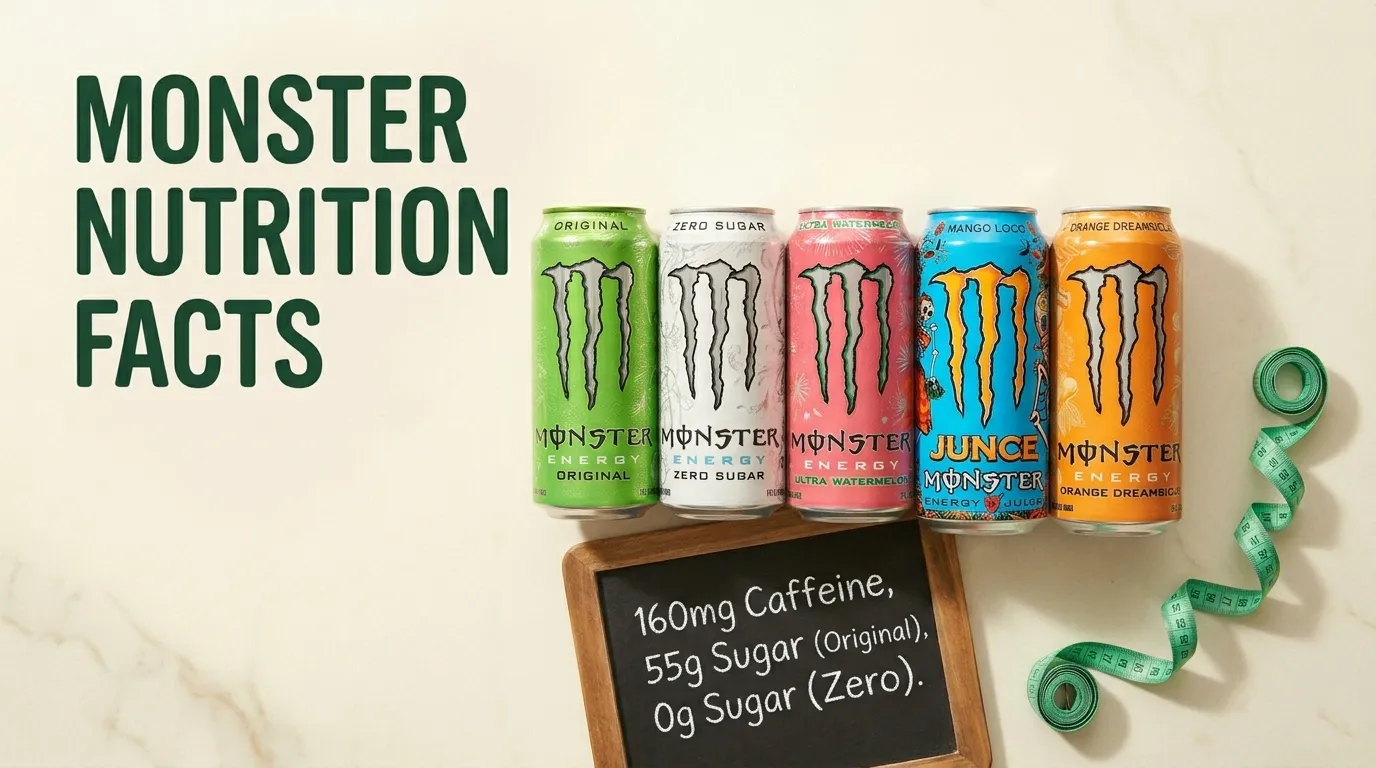
A standard 16 fl oz can of Monster Original contains 237 calories, 55 grams of sugar, and 160 milligrams of caffeine . The full line includes over 15 varieties ranging from zero-sugar options (3 calories per 100ml) to juice-based blends with 60 grams of sugar per can .
According to the Dietary Guidelines for Americans 2025-2030, added sugar should be limited to less than 10% of daily calories — about 50 grams on a 2,000-calorie diet. One can of Monster Original exceeds this entire daily limit. The FDA recommends healthy adults consume no more than 400mg of caffeine daily . One Monster provides 160mg, or 40% of that limit.
This guide breaks down nutrition facts for every major Monster product line, compares caffeine to coffee, explains the “energy blend” ingredients, and provides safety guidance for specific populations.
monster nutrition facts
Monster Energy drinks range from 0 to 60 grams of sugar and 3 to 240 calories per serving depending on the product line. The “energy blend” — a proprietary mix of taurine, ginseng, B vitamins, and caffeine — is consistent across most varieties at approximately 2,500mg per 16 oz can .
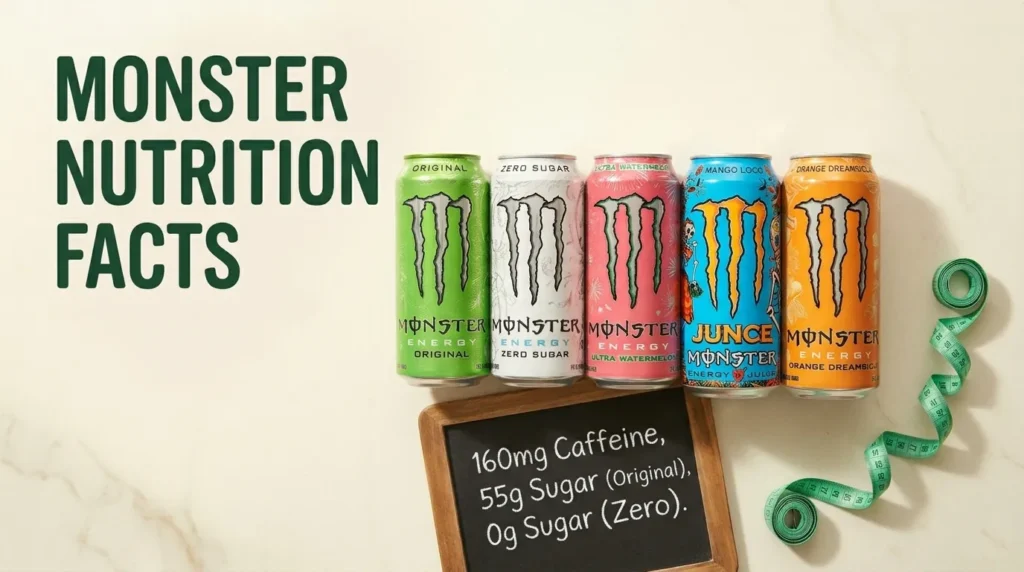
Core Monster product line comparison (per 16 fl oz / 473-500 mL can):
| Product Line | Calories | Sugar (g) | Carbs (g) | Caffeine (mg) | Best For |
|---|---|---|---|---|---|
| Original Green | 237 | 55 | 60 | 160 | Maximum energy boost |
| Zero Sugar | 3 | 0 | 1 | 160 | Sugar-free energy |
| Ultra (Watermelon/Gold) | 10 | 0 | 5-6 | 150-160 | Low-calorie, low-sugar |
| Mango Loco (Juice) | 240 | 60 | 65 | 160 | Fruit flavor with sugar |
| Orange Dreamsicle | 200 | 46 | 50 | Not listed | Real sugar (no HFCS) |
| Ripper (Juice) | 237 | 55 | 60 | 160 | Tropical juice flavor |
Data compiled from manufacturer labels and retail nutrition panels .
All Monster products contain B vitamins (B2, B3, B6, B12) at levels between 200-400% of the Daily Value. These water-soluble vitamins are largely excreted in urine when consumed in excess.
Key Takeaway: Monster nutrition facts vary dramatically by product line. The biggest health consideration is sugar content — some cans contain two to three days’ worth of added sugar in one serving.
monster energy drink calories
Monster energy drink calories range from 3 to 240 calories per can depending on the product line . Zero Sugar and Ultra lines are the lowest-calorie options, while Original and Juice lines are highest.
Calorie breakdown by product line:
| Product Line | Calories per Can | Calories per 100ml | Primary Calorie Source |
|---|---|---|---|
| Zero Sugar | 3 (per 100ml) | 3 | Trace only |
| Ultra (all flavors) | 10-15 | 2-3 | Erythritol (sugar alcohol) |
| Original | 237 | 47 | Sucrose, glucose syrup |
| Orange Dreamsicle | 200 | 42 | Real sugar |
| Mango Loco | 240 | 48 | Sucrose, glucose, fruit juice |
| Ripper | 237 | 47 | Sucrose, glucose syrup |
For perspective, a 237-calorie Monster Original represents approximately 12% of a standard 2,000-calorie daily diet. These calories come entirely from sugar — no protein, no fat, no fiber. They provide a rapid energy spike followed by a crash, without any nutritional value .
The Ultra line achieves its low calorie count through erythritol, a sugar alcohol that provides sweetness without calories . One 473ml can of Ultra Watermelon contains 10 calories total .
Key Takeaway: If you drink Monster for the energy but want to reduce calories, the Ultra or Zero Sugar lines eliminate 200+ calories per can compared to Original.
monster original nutrition facts
Monster Original (the green can) contains 237 calories, 55 grams of sugar, and 160 milligrams of caffeine per 500ml serving . The ingredient list includes carbonated water, sucrose, glucose syrup, taurine (0.4%), panax ginseng root extract (0.08%), L-carnitine L-tartrate (0.04%), caffeine (0.03%), and a B vitamin complex .
Complete nutrition panel for Monster Original (500ml can):
| Nutrient | Amount per Can | % Daily Value (2,000 calorie diet) |
|---|---|---|
| Calories | 237 | 12% |
| Total Fat | 0g | 0% |
| Sodium | 370mg | 16% |
| Total Carbohydrates | 60g | 22% |
| Total Sugars | 55g | 110% |
| Added Sugars | 55g | 110% |
| Protein | 0g | 0% |
| Caffeine | 160mg | 40% (of 400mg FDA limit) |
Vitamin content (per can):
| Vitamin | Amount | % Daily Value |
|---|---|---|
| B2 (Riboflavin) | 6.8mg | 400% |
| B3 (Niacin) | 40mg | 200% |
| B6 (Pyridoxine) | 4mg | 200% |
| B12 (Cyanocobalamin) | 12mcg | 200% |
| B5 (Pantothenic acid) | 20mg | 200% |
Data source: Mayo Clinic Proceedings composition table and Coca-Cola UK product specifications .
The “energy blend” (approximately 2,500mg total) contains taurine, glucuronolactone, inositol, L-carnitine, and panax ginseng . Unlike caffeine, these ingredients lack strong scientific evidence for performance enhancement in healthy individuals.
Key Takeaway: Monster Original delivers high sugar (110% of daily limit) and high caffeine (40% of daily limit) with zero nutritional protein, fat, or fiber. The B vitamins exceed daily requirements by 2-4 times.
monster zero sugar nutrition facts
Monster Zero Sugar contains 3 calories and 0 grams of sugar per 100ml serving . The full 16 oz can contains approximately 5 calories total. Sweeteners include erythritol, sucralose, and acesulfame potassium .
Zero Sugar nutrition panel (per 100ml):
| Nutrient | Amount |
|---|---|
| Calories | 3 |
| Protein | 0g |
| Carbohydrates | 1g |
| Sugar | 0g |
| Fat | 0g |
| Sodium | 83mg |
For a full 500ml can: approximately 15 calories, 5g carbohydrates (from erythritol, a sugar alcohol), 415mg sodium, and 160mg caffeine.
Sweetener breakdown in Zero Sugar:
| Sweetener | Type | Sweetness vs Sugar | Notes |
|---|---|---|---|
| Erythritol | Sugar alcohol | 70% | 0 calories, may cause digestive discomfort in large amounts |
| Sucralose | Artificial | 600x | 0 calories, heat-stable |
| Acesulfame Potassium | Artificial | 200x | 0 calories, bitter aftertaste for some |
Zero Sugar contains the same caffeine (160mg per 16 oz) and B vitamins as the Original version. The “energy blend” ingredients (taurine, ginseng, L-carnitine, inositol) are also present in similar amounts .
For people with diabetes or those monitoring blood sugar, Zero Sugar does not cause glucose spikes. However, some research suggests artificial sweeteners may still trigger insulin responses and maintain sweet cravings.
Quick Tip: If you need the caffeine boost but want to avoid sugar, Zero Sugar is a better choice than Original. But plain black coffee has 0 calories, 0 sweeteners, and similar caffeine (95-160mg per cup).
Key Takeaway: Zero Sugar eliminates the 55g sugar problem of Original but still contains artificial sweeteners and the same 160mg caffeine. It is a better option than Original, not a health drink.
monster ultra nutrition facts
Monster Ultra (formerly called Ultra Zero) contains 10 calories and 0 grams of sugar per 473ml can . The Ultra line includes Watermelon, Gold (pineapple/citrus), Sunrise (orange), Fiesta (mango), and Paradise (kiwi/lime) flavors.
Ultra nutrition panel (per 473ml / 16 oz can):
| Nutrient | Ultra Watermelon | Ultra Gold |
|---|---|---|
| Calories | 10 | 10 |
| Total Carbohydrates | 6g | 5g |
| Sugars | 0g | 0g |
| Sugar Alcohols | Yes (erythritol) | Yes |
| Sodium | 190mg | 220mg |
| Caffeine | Not listed | Not listed (estimated 150mg) |
Ultra ingredient list (Watermelon): Carbonated water, citric acid, erythritol, taurine, natural flavors, sodium citrate, panax ginseng flavor, caffeine, sorbic acid, sucralose, benzoic acid, niacinamide (B3), acesulfame potassium, D-calcium pantothenate (B5), inositol, pyridoxine hydrochloride (B6), vegetable juice (color), Allura Red, cyanocobalamin (B12) .
The Ultra line uses erythritol as the primary sweetener . Erythritol is about 70% as sweet as sugar with minimal calories. Most people tolerate erythritol well, but consuming large amounts (multiple cans daily) may cause bloating, gas, or diarrhea in sensitive individuals.
The caffeine content in Ultra is not explicitly listed on many labels but is comparable to Original (approximately 150-160mg per can based on caffeine’s position in ingredient lists — it appears after ginseng and before sorbic acid, indicating concentration similar to other Monster products).
Key Takeaway: Ultra is the best choice among Monster products for calorie and sugar control — 10 calories and 0 sugar per can. The caffeine and B vitamin content remains similar to Original.
monster juice nutrition facts
Monster Juice (also called Monster Juiced) blends energy drink with real fruit juice. These products contain 30-60 grams of sugar per can and 210-240 calories . Popular Juice flavors include Mango Loco, Pipeline Punch, Pacific Punch, and Ripper.
Juice line nutrition panel:
| Product | Serving Size | Calories | Sugar (g) | Real Juice % |
|---|---|---|---|---|
| Mango Loco | 500ml | 240 | 60 | 6% juice (mango, apple, orange) |
| Ripper | 500ml | 237 | 55 | Fruit juice from concentrate |
| Mango Loco (250ml can) | 250ml | 120 | 30 | 6% juice |
Mango Loco full ingredients: Carbonated water, sucrose, glucose, mango puree (2.5%), acidity regulators (citric acid, sodium citrate, potassium citrate), apple juice concentrate, taurine, flavors, orange juice concentrate, panax ginseng extract, preservatives, caffeine, sucralose, B vitamins, maltodextrin, guava juice concentrate, inositol, natural colors, pineapple and passionfruit juice concentrates, coconut oil, modified starch, salt, glucuronolactone, guarana seed extract .
The “real juice” claim is technically true but misleading — juice content is only 6% of the total volume. The majority of sugar comes from added sucrose and glucose, not fruit. A 500ml can of Mango Loco contains 60g total sugar . For comparison, a 12 oz Coca-Cola has 39g sugar. Monster Juice has 50% more sugar than Coke.
For people who enjoy the taste of juice-based energy drinks, these products are not nutritionally superior to Original. They contain similar or higher sugar levels with negligible real fruit content.
Key Takeaway: Monster Juice products taste like fruit but deliver 60g sugar per can — exceeding the daily added sugar limit by 10g. They are not a “healthier” alternative to Original.
monster java monster calories
Monster Java (also called Java Monster) combines coffee, milk, and Monster’s energy blend. These products contain significantly more calories due to milk and sugar content. A 15 oz (443ml) can of Java Monster contains approximately 240-280 calories and 30-40 grams of sugar, depending on flavor.
Java line estimated nutrition (per 15 oz / 443ml can):
| Flavor | Calories | Sugar (g) | Caffeine (mg) | Notes |
|---|---|---|---|---|
| Mean Bean | 240 | 30 | 160 | Coffee base, milk |
| Loca Moca | 260 | 35 | 160 | Mocha flavor |
| French Vanilla | 250 | 32 | 160 | Vanilla coffee |
| Salted Caramel | 280 | 40 | 160 | Seasonal flavor |
Java Monster ingredients typically include: brewed coffee (water, coffee), reduced fat milk, sugar, cream, natural and artificial flavors, caffeine (added), taurine, panax ginseng, L-carnitine, guarana, and B vitamins.
Unlike Original Monster, Java Monster contains actual milk and coffee. This means:
- Protein: Approximately 5-7g per can (from milk)
- Calcium: Approximately 15-20% DV
- Fat: Approximately 6-8g (from milk and cream)
For people seeking an energy drink with some nutritional value (protein, calcium) rather than empty calories, Java Monster is a marginally better choice than Original. However, the sugar content remains high at 30-40g per can.
Key Takeaway: Java Monster adds coffee and milk to the energy blend, providing some protein and calcium. But at 240-280 calories and 30-40g sugar, it is closer to a dessert coffee than a health drink.
monster energy drink caffeine content
Monster Energy drinks contain approximately 160 milligrams of caffeine per 16 fl oz (473-500ml) can . This represents 40% of the FDA’s recommended daily caffeine limit of 400mg for healthy adults .
Caffeine comparison across products:
| Product | Can Size | Caffeine (mg) | Caffeine per 100ml (mg) |
|---|---|---|---|
| Monster Original | 500ml | 160 | 32 |
| Monster Zero Sugar | 500ml | 160 | 32 |
| Monster Ultra | 473ml | ~150 | 32 |
| Monster Juice | 500ml | 160 | 32 |
| Monster Java | 443ml | 160 | 36 |
| Brewed Coffee (8 oz) | 236ml | 95-165 | 40-70 |
| Espresso (1 shot) | 30ml | 63 | 210 |
| Red Bull (8.4 oz) | 250ml | 80 | 32 |
The caffeine in Monster comes from multiple sources: added anhydrous caffeine, guarana seed extract (a natural source of caffeine similar to coffee beans), and in some products, brewed coffee (Java line) .
For comparison, a 16 oz Starbucks Grande brewed coffee contains approximately 260mg caffeine — 100mg more than Monster. Coffee delivers its caffeine without sugar, artificial sweeteners, or the proprietary energy blend.
The 400mg FDA daily limit is for healthy adults only. Sensitive populations (pregnant women, individuals with heart conditions, people with anxiety disorders) may experience adverse effects at much lower doses. The warning label on Monster products states: “Not recommended for children, pregnant or breastfeeding women or people sensitive to caffeine” .
Key Takeaway: Monster contains 160mg caffeine per can — 40% of the FDA daily limit. One can is safe for most healthy adults, but consuming two or more cans plus coffee could easily exceed 400mg.
monster energy blend ingredients
The Monster “energy blend” is a proprietary mixture of ingredients added to all Monster products. According to the Mayo Clinic Proceedings composition table, the full blend totals approximately 2,500mg per 16 oz can .
Energy blend components (Original Monster):
| Ingredient | Amount per 500ml | Purpose | Evidence Strength |
|---|---|---|---|
| Taurine | 2,000mg | Cell volume regulation, antioxidant | Moderate |
| Glucuronolactone | Not specified | Metabolic intermediate | Low |
| Inositol | 50mg | Cell signaling, mood | Low |
| L-Carnitine | 50mg | Fatty acid transport | Low |
| Panax Ginseng | 50mg | Energy, cognitive function | Low |
| Guarana | 50mg | Natural caffeine source | Moderate (caffeine component) |
Taurine is an amino acid naturally found in meat, fish, and human breast milk. Despite myths, it is not extracted from bull urine or semen. Research suggests taurine may support cardiovascular function and exercise performance, but supplementation in healthy individuals taking adequate dietary taurine (from meat) likely provides minimal additional benefit.
L-Carnitine helps transport fatty acids into mitochondria for energy production. The body produces adequate L-carnitine from dietary amino acids. Research on supplementation for athletic performance shows inconsistent results.
Panax Ginseng has been studied for cognitive function and energy. A 2025 meta-analysis found small improvements in mental fatigue but concluded more high-quality research is needed.
Inositol is involved in cell signaling and serotonin pathways. It occurs naturally in fruits, beans, grains, and nuts. Deficiency is extremely rare, and supplementation in non-deficient individuals lacks evidence for energy benefits.
Key Takeaway: The energy blend ingredients beyond caffeine have weak scientific support for performance enhancement in healthy, well-nourished individuals. Caffeine is responsible for the majority of Monster’s acute energizing effects.
taurine in monster energy drink
Taurine is present in Monster at 2,000mg per 500ml can . This amino acid is naturally abundant in the human body and found in dietary sources like meat, fish, and dairy. Taurine is not extracted from bulls — it is synthesized synthetically for energy drinks.
What taurine does in the body:
| Function | Mechanism |
|---|---|
| Cell volume regulation | Maintains fluid balance in cells |
| Calcium handling | Regulates calcium movement in heart and muscle cells |
| Antioxidant activity | Protects cells from oxidative damage |
| Neurotransmitter modulation | May influence GABA and other neurotransmitter systems |
Research on taurine supplementation has examined potential benefits for heart failure, exercise performance, and metabolic health. A 2024 meta-analysis found that taurine supplementation (1-6g daily) produced small improvements in exercise recovery and reduced markers of muscle damage. However, most participants in these studies were athletes, not general energy drink consumers.
For a person eating a standard omnivorous diet, dietary taurine intake from meat and fish already provides 50-200mg daily. The additional 2,000mg from a Monster represents a pharmacological dose, not a nutritional one. The long-term safety of such high doses from regular energy drink consumption has not been well studied.
The taurine content in Monster does not cause harm in healthy individuals at the 2,000mg level. However, the belief that taurine provides a meaningful energy boost beyond caffeine is not supported by high-quality evidence in non-deficient individuals.
Quick Tip: Do not drink Monster for taurine. Your body produces its own, and you get enough from food. The caffeine is what wakes you up.
Key Takeaway: Taurine at 2,000mg per can is safe but the energizing effects are minimal. Caffeine does the heavy lifting.
B vitamins in monster energy drink
Monster contains high doses of B vitamins at 200-400% of the Daily Value per can . The B vitamins present include riboflavin (B2), niacin (B3), pantothenic acid (B5), pyridoxine (B6), and cyanocobalamin (B12).
B vitamin content in Monster Original (per can):
| Vitamin | Amount | % Daily Value | Function |
|---|---|---|---|
| B2 (Riboflavin) | 6.8mg | 400% | Energy metabolism, antioxidant |
| B3 (Niacin) | 40mg | 200% | DNA repair, energy production |
| B5 (Pantothenic acid) | 20mg | 200% | Fatty acid synthesis |
| B6 (Pyridoxine) | 4mg | 200% | Amino acid metabolism, neurotransmitter synthesis |
| B12 (Cyanocobalamin) | 12mcg | 200% | Red blood cell formation, nerve function |
These B vitamins are water-soluble. The body absorbs what it needs and excretes the rest in urine. Taking more than 100% DV does not provide additional benefit for healthy individuals. Excess B2, for example, turns urine bright yellow — a harmless sign of excretion.
The NIH Office of Dietary Supplements states that B vitamin deficiencies are rare in developed countries with varied diets. For most people eating meat, eggs, dairy, legumes, and whole grains, B vitamin status is adequate. Fortified breakfast cereals alone provide 100% DV of most B vitamins in one serving.
The high B vitamin content in Monster is marketing, not medicine. It provides no health benefit to people with normal nutritional status.
Key Takeaway: Monster delivers 2-4 times the daily requirement of B vitamins. Your body excretes the excess. These vitamins do not provide an “energy boost” unless you were deficient — which most people are not.
monster energy drink sugar content
Monster Original contains 55 grams of sugar per 500ml can — 110% of the daily added sugar limit recommended by the Dietary Guidelines for Americans .
Sugar content comparison across Monster products:
| Product | Can Size | Sugar (g) | % Daily Limit | Teaspoon Equivalent |
|---|---|---|---|---|
| Monster Original | 500ml | 55 | 110% | 13.75 tsp |
| Mango Loco | 500ml | 60 | 120% | 15 tsp |
| Orange Dreamsicle | 500ml | 46 | 92% | 11.5 tsp |
| Ultra (any flavor) | 473ml | 0 | 0% | 0 tsp |
| Zero Sugar | 500ml | 0 | 0% | 0 tsp |
The American Heart Association recommends even stricter limits: 25g (6 tsp) per day for women, 36g (9 tsp) per day for men. One Monster Original provides more than double the AHA limit for women and over 50% more than the limit for men.
Health consequences of high sugar intake:
| Condition | Relationship to Excess Sugar |
|---|---|
| Weight gain | Liquid calories do not trigger satiety signals |
| Type 2 diabetes | Chronic high sugar intake increases insulin resistance |
| Heart disease | High sugar associated with increased triglycerides |
| Dental caries | Sugar feeds cavity-causing bacteria |
| Non-alcoholic fatty liver disease | Fructose (present in sucrose) directly processed by liver |
The sugar in Monster comes from sucrose (table sugar) and glucose syrup . Sucrose is 50% glucose and 50% fructose. Excess fructose is converted to fat in the liver, contributing to fatty liver disease over time.
For someone who drinks one Monster daily, the annual added sugar intake from this single source alone is approximately 44 pounds (20kg) of sugar.
Key Takeaway: The sugar content in regular Monster is the most concerning nutrition fact. One can exceeds the entire daily sugar limit. Zero-sugar versions eliminate this risk entirely.
monster energy drink side effects
Monster Energy drinks can cause side effects primarily related to high caffeine and sugar content. The FDA warns that excessive caffeine consumption may cause insomnia, jitters, anxiety, rapid heart rate, digestive issues, and withdrawal headaches .
Common side effects of Monster consumption:
| Side Effect | Primary Cause | Prevalence |
|---|---|---|
| Jitters/anxiety | Caffeine (160mg) | Common |
| Rapid heartbeat | Caffeine | Uncommon in healthy adults |
| Insomnia | Caffeine (especially late-day consumption) | Common |
| Sugar crash | High sugar (55g) followed by insulin response | Very common with Original |
| Digestive discomfort | Caffeine + sugar alcohols (Zero Sugar/Ultra) | Uncommon |
| Headache (caffeine withdrawal) | Rebound effect when not drinking | Common in daily drinkers |
Serious but rare side effects requiring medical attention:
- Chest pain or pressure
- Irregular heartbeat (arrhythmia)
- Seizures (reported in cases of extreme overconsumption)
- Severe anxiety or panic attacks
A 2023 review in the Journal of the American Heart Association found that energy drink consumption is associated with increased blood pressure and QT interval prolongation (a measure of heart electrical activity). These effects are dose-dependent and more pronounced in individuals with underlying heart conditions.
Individuals at higher risk for side effects:
- People with hypertension or heart disease
- Individuals with anxiety disorders or panic disorder
- Those with caffeine sensitivity (genetic variation in CYP1A2 enzyme)
- People taking certain medications (stimulants, MAOIs, some antidepressants)
- Pregnant women
The warning label on Monster cans advises: “Not recommended for children, pregnant or breastfeeding women or people sensitive to caffeine” .
Key Takeaway: For healthy adults, one Monster is generally safe. For individuals with heart conditions, anxiety disorders, or caffeine sensitivity, the risks are higher. Two or more cans daily substantially increase side effect risk.
is monster energy drink bad for you
Monster Energy is not “bad” for a healthy adult who consumes it occasionally and chooses lower-sugar varieties. But regular consumption — especially of high-sugar versions — carries documented health risks.
Risk assessment by consumption pattern:
| Pattern | Risk Level | Explanation |
|---|---|---|
| One Original can, once per week | Low | 55g sugar occasional use, 160mg caffeine well within limit |
| One Original can, daily | Moderate | 55g sugar daily exceeds AHA limit by 50-100%; dental, metabolic risks |
| One Zero Sugar/Ultra, daily | Low-Moderate | No sugar risk; artificial sweetener and caffeine tolerance concerns |
| Two or more cans daily | High | Exceeds caffeine limit (320mg+), high sugar or sweetener load |
The case against regular Original Monster consumption:
- 55g sugar daily = 20kg sugar annually = 77,000 excess calories from sugar alone
- 160mg caffeine daily is fine; 55g sugar daily is not
- Liquid sugar bypasses satiety signals, contributing to weight gain
- B vitamins provide no benefit beyond adequate status
The case for occasional consumption:
- 160mg caffeine is within safe limits
- Zero Sugar versions eliminate the sugar concern
- B vitamin content is harmless (excess excreted)
- For long drives, night shifts, or intense workouts, a single can may be appropriate
The answer depends entirely on your overall diet, health status, and consumption frequency. A healthy adult having a Zero Sugar Monster once or twice weekly for a late-night study session is very different from an adolescent drinking two Originals daily.
Quick Tip: If you drink Monster regularly, switch to Zero Sugar or Ultra. This eliminates the sugar risk while preserving the caffeine benefit.
Key Takeaway: Monster Original is bad for daily consumption due to 55g sugar. Zero Sugar versions are less concerning. Neither provides health benefits beyond plain coffee — caffeine is the only evidence-backed active ingredient.
monster caffeine vs coffee
Monster contains 160mg caffeine per 16 oz can, while a standard 8 oz cup of brewed coffee contains 95-165mg. Per ounce, coffee has significantly more caffeine — approximately 12mg/oz compared to Monster’s 10mg/oz .
Caffeine comparison: Monster vs Coffee
| Beverage | Serving Size | Caffeine (mg) | Caffeine per oz (mg) | Calories | Sugar (g) |
|---|---|---|---|---|---|
| Monster Original | 16 oz | 160 | 10 | 237 | 55 |
| Monster Zero Sugar | 16 oz | 160 | 10 | 5 | 0 |
| Brewed coffee (black) | 8 oz | 95-165 | 12-20 | 2 | 0 |
| Starbucks Grande coffee | 16 oz | 260 | 16 | 5 | 0 |
| Espresso | 1 oz | 63 | 63 | 3 | 0 |
Why coffee is the better choice for most people:
| Factor | Coffee | Monster |
|---|---|---|
| Calorie control | 0-5 calories per cup (black) | 200+ calories (Original) |
| Sugar content | 0g | 55g (Original) |
| Ingredient transparency | Single ingredient (coffee) | 20+ ingredients |
| Cost per serving | $0.10-0.50 | $2.50-4.00 |
| Additive-free | Yes (if brewed) | No |
| Evidence for health benefits | Strong (antioxidants, reduced mortality) | Limited |
Coffee contains polyphenols and antioxidants (chlorogenic acid, caffeic acid) associated with reduced risk of type 2 diabetes, Parkinson’s disease, and liver conditions in observational studies. Monster’s proprietary energy blend lacks similar long-term safety and efficacy data.
For someone seeking caffeine for alertness, black coffee delivers the same or more caffeine with zero calories, zero sugar, and proven health benefits at a fraction of the cost.
Key Takeaway: Coffee wins against Monster on caffeine per ounce, calories, sugar, cost, and evidence base. Monster only makes sense if you specifically want a sweet, flavored, carbonated caffeine source.
Frequently Asked Questions About Monster Nutrition Facts
How much caffeine is in a Monster energy drink?
Monster contains 160mg of caffeine per 16 fl oz (473-500ml) can. This represents 40% of the FDA’s recommended daily limit of 400mg for healthy adults. For comparison, an 8 oz cup of brewed coffee contains 95-165mg .
Is Monster worse for you than coffee?
Monster Original (55g sugar, 237 calories) is worse for daily consumption than black coffee (0g sugar, 2-5 calories). Monster Zero Sugar eliminates the sugar concern but still contains artificial sweeteners and a proprietary energy blend with weak evidence. Black coffee provides caffeine plus antioxidants without additives .
Can you drink Monster every day?
Healthy adults can drink one Monster Zero Sugar daily without exceeding caffeine limits, but regular Original consumption adds 55g sugar (110% daily limit) and 237 calories. Daily consumption of any energy drink risks caffeine tolerance, dependence, and withdrawal headaches when stopping.
Does Monster Zero Sugar have artificial sweeteners?
Yes. Monster Zero Sugar contains erythritol (sugar alcohol), sucralose, and acesulfame potassium. The Ultra line uses similar sweeteners. These are FDA-approved as GRAS (Generally Recognized as Safe) but may cause digestive discomfort in sensitive individuals .
How much sugar is in a can of Monster?
Monster Original contains 55g of sugar per 500ml can — 110% of the daily added sugar limit. Monster Juice (Mango Loco) contains 60g. The Zero Sugar and Ultra lines contain 0g sugar .
Is Monster bad for your heart?
For healthy adults, one can is not associated with heart problems. However, individuals with hypertension, arrhythmias, or other heart conditions should avoid energy drinks due to caffeine’s effects on blood pressure and heart rate. A 2023 review found energy drinks increase blood pressure and QT interval .
Monster nutrition facts vary dramatically by product line. The original green can delivers 55g sugar — more than the entire daily recommended limit — plus 160mg caffeine and 237 empty calories. The Zero Sugar and Ultra lines eliminate the sugar problem entirely, leaving you with caffeine, B vitamins, and a proprietary energy blend of questionable effectiveness.
If you need caffeine, black coffee is cheaper, calorie-free, antioxidant-rich, and backed by decades of safety data. But if you prefer the sweet, carbonated experience of an energy drink, Zero Sugar or Ultra are far better choices than Original. Just respect the caffeine limit — one can is fine, two is pushing it, and three is dangerous.
Keep your consumption occasional, know your personal caffeine tolerance, and never mix energy drinks with alcohol.