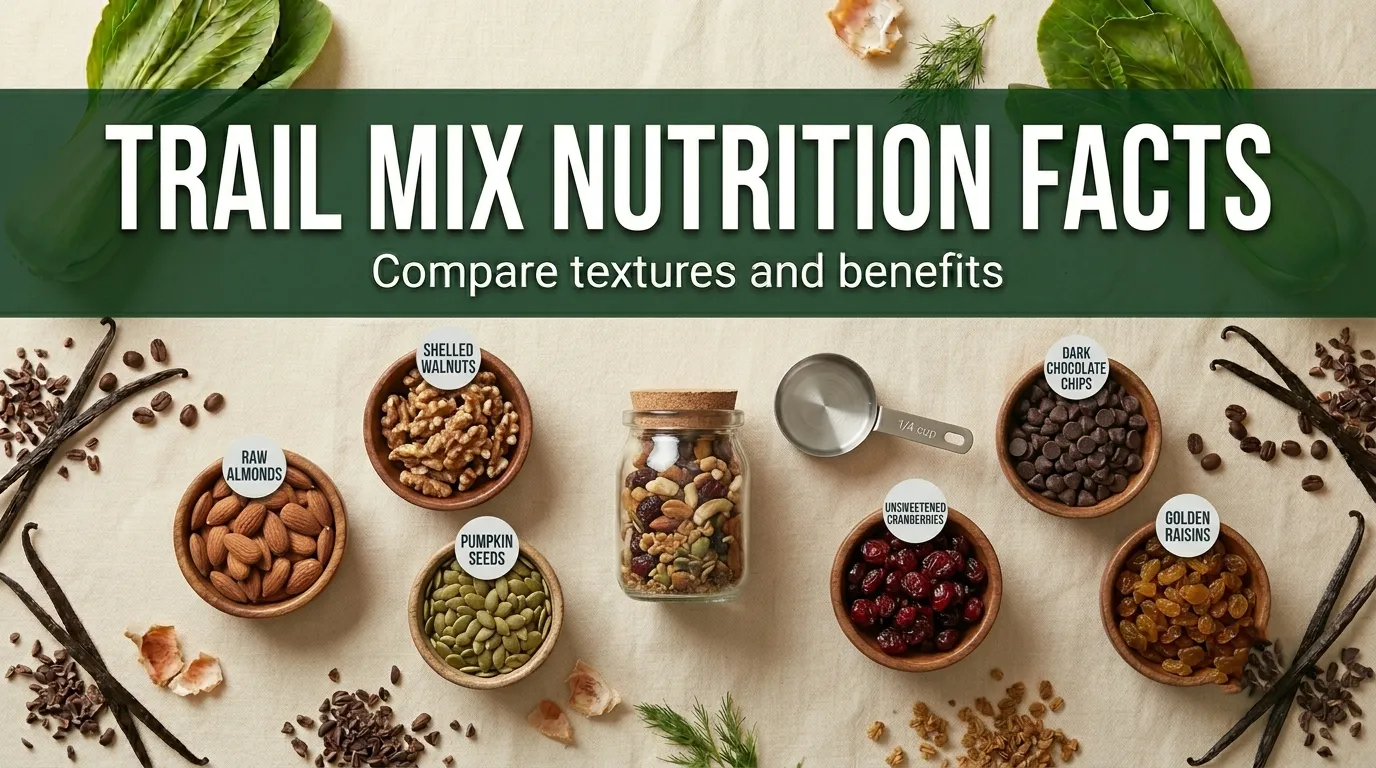
Trail Mix Nutrition Facts: Calories, Nuts, and DIY Guide
Trail mix is a calorie-dense snack that can range from a genuinely healthy blend of nuts and seeds to a candy-coated sugar bomb, and the nutrition facts depend entirely on what’s in the bag. A standard quarter-cup serving of a classic nut, seed, and dried fruit mix contains about 170 to 200 calories, 5 to 7 grams of protein, and 12 to 16 grams of mostly unsaturated fat. These trail mix nutrition facts are a starting point, not a verdict. The mix you choose or build determines whether this is a satiating, nutrient-dense fuel source or a glorified candy bar.
The confusion around trail mix is understandable. The snack was invented as portable, energy-dense fuel for long hikes, and it serves that purpose brilliantly. The USDA FoodData Central database records that a basic mix of peanuts, raisins, and M&Ms packs 693 calories per cup. That’s intentional when you’re burning 4,000 calories a day on a mountain trail. It’s a problem when you’re eating it by the fistful at your desk. The gap between the intended use and the actual use is where the nutritional tension lives.
This article deconstructs trail mix into its four components: nuts, seeds, dried fruit, and chocolate or candy. You’ll see exactly what each ingredient contributes nutritionally, how a standard gorp mix compares to a monster trail mix, and how to read a store-bought label in 10 seconds. You’ll also get a specific ratio and ingredient guide to build your own mix that matches your health goals. Trail mix is not inherently good or bad. It’s a tool. You’re about to learn how to use it correctly.
What Are the Trail Mix Nutrition Facts?
The core trail mix nutrition facts depend on the specific blend, but a standard quarter-cup serving of a classic mix with nuts, seeds, dried fruit, and a small amount of chocolate contains approximately 175 calories, 6 grams of protein, 14 grams of total fat, 14 grams of carbohydrate, 2.5 grams of fiber, and 9 grams of sugar. This profile reflects a mix that is roughly 50 percent nuts and seeds, 30 percent dried fruit, and 20 percent chocolate or candy pieces by volume.
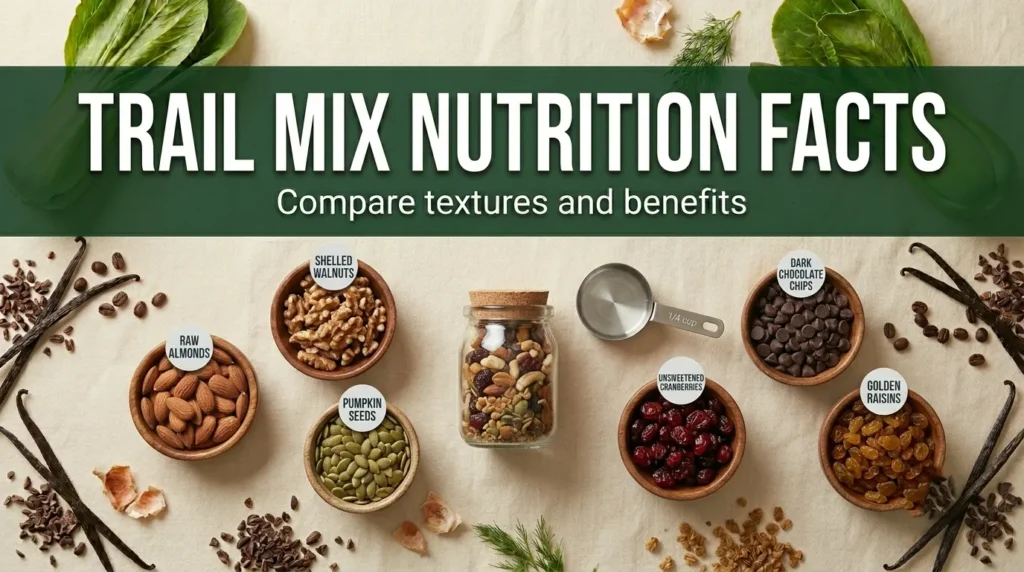
The fat content is predominantly unsaturated. Almonds and walnuts are rich in monounsaturated and polyunsaturated fatty acids, including the omega-3 alpha-linolenic acid. The Dietary Guidelines for Americans 2020-2025 recommend that the majority of dietary fat come from unsaturated sources. Trail mix, when dominated by nuts and seeds, aligns with this recommendation. A quarter-cup serving provides roughly 10 to 12 grams of unsaturated fat and only 2 to 3 grams of saturated fat.
The protein content, at 6 grams per serving, is modest but complete. Nuts and seeds contain all nine essential amino acids, though they are slightly low in lysine. They are not a replacement for animal protein or legumes, but they are a genuine contribution to daily protein intake. The fiber content, at 2.5 grams, is roughly 10 percent of the Daily Value and comes from the nuts, seeds, and fruit skins. This combination of protein, fiber, and unsaturated fat is what gives trail mix its satiating power.
Calories in Trail Mix by Serving Size
The calories in trail mix by serving size are tightly packed: a quarter-cup contains about 170 to 200 calories, a half-cup contains 340 to 400, and a full cup can exceed 700 calories. Trail mix is one of the most calorie-dense snack foods available, rivaling pure nuts and exceeding most granola bars on a per-gram basis. This energy density is a feature for the hiker and a trap for the desk snacker.
A standard serving size on a commercial trail mix bag is typically listed as 1/4 cup or 30 grams. That is a very small amount visually. It fits in the palm of your hand without mounding. Most people who pour trail mix directly from the bag into a bowl, or worse, eat directly from the bag, consume two to three times that amount without realizing it. A casual “handful” of trail mix, depending on hand size, can be half a cup or roughly 350 calories.
| Serving Size | Approximate Calories | Visual Reference |
|---|---|---|
| 1/8 cup (2 tbsp) | 85-100 | A small shot glass |
| 1/4 cup (standard) | 170-200 | Palm of hand, flat |
| 1/2 cup | 340-400 | A cupped handful |
| 1 cup | 680-800 | A full cereal bowl |
The American Heart Association’s guidance on snacking emphasizes portion awareness. Trail mix is not a food to eat from the bag. Pre-portioning it into small containers or reusable bags is the single most effective strategy for preventing unintentional overconsumption. A registered dietitian would tell you that the calories in trail mix are “healthy calories” from nuts and seeds, but they still count toward your daily energy balance.
Key Takeaway: A quarter-cup is the standard serving. A full cup is over 700 calories. Pre-portion your trail mix into small bags and never eat from the bulk bin bag.
Trail Mix Macronutrient and Fat Breakdown
A classic trail mix macronutrient breakdown is approximately 30 percent fat, 10 percent protein, and 60 percent carbohydrate by calorie contribution, with the fat being mostly heart-healthy unsaturated fatty acids. The fat comes from the nuts and seeds. The carbohydrate comes from the dried fruit and any added candy pieces. The protein comes from the nuts and seeds as well.
The fat profile is the nutritional star of trail mix. Almonds provide monounsaturated oleic acid, the same fatty acid that makes olive oil cardioprotective. Walnuts are one of the few plant foods rich in the omega-3 fatty acid alpha-linolenic acid, which the body can partially convert to the long-chain eicosapentaenoic acid and docosahexaenoic acid found in fish. A quarter-cup of walnut-heavy trail mix can provide 1 to 2 grams of alpha-linolenic acid.
| Macronutrient | Per 1/4 Cup (35g) | % of Total Calories |
|---|---|---|
| Total Fat | 14 g | 72% |
| Saturated Fat | 2.5 g | 13% |
| Monounsaturated Fat | 7 g | 36% |
| Polyunsaturated Fat | 4 g | 20% |
| Protein | 6 g | 14% |
| Carbohydrate | 14 g | 32% |
The saturated fat content is naturally occurring from the nuts. It is not the same as the saturated fat in a processed snack cake. Research suggests that the food matrix of whole nuts alters how the body handles the saturated fat, with a 2017 study in the American Journal of Clinical Nutrition finding that nut consumption was not associated with the same increase in LDL cholesterol as saturated fat from animal or processed sources. The phytosterols and fiber in nuts appear to blunt the cholesterol-raising effect.
Trail Mix Micronutrients: Magnesium, Vitamin E, and More
A quarter-cup serving of nut-heavy trail mix delivers meaningful amounts of magnesium, vitamin E as alpha-tocopherol, copper, manganese, and phosphorus. The trail mix micronutrients are concentrated in the nuts and seeds. The dried fruit and chocolate pieces contribute minimal vitamins and minerals relative to their calorie load. This is why the ratio of nuts to candy determines the nutritional quality.
Magnesium is essential for over 300 enzymatic reactions, including ATP energy metabolism, muscle contraction, and neurotransmitter release. The NIH Office of Dietary Supplements states that many adults do not meet the Recommended Dietary Allowance for magnesium, which is 400 to 420 milligrams for men and 310 to 320 milligrams for women. A quarter-cup of trail mix provides 50 to 70 milligrams, or 12 to 17 percent of the Daily Value. This is a genuine dietary contribution.
- Magnesium: 50-70 mg (12-17% DV) — from almonds, cashews, pumpkin seeds
- Vitamin E (alpha-tocopherol): 2-4 mg (13-27% DV) — from almonds, sunflower seeds
- Copper: 0.2-0.3 mg (22-33% DV) — from cashews, sunflower seeds
- Manganese: 0.5-0.8 mg (22-35% DV) — from walnuts, pecans
- Phosphorus: 100-140 mg (8-11% DV) — from all nuts and seeds
Copper is a cofactor for enzymes involved in iron transport and collagen cross-linking. Manganese is required for bone formation and carbohydrate metabolism. These trace minerals are present in nuts and seeds at concentrations that make a small handful nutritionally significant. The dried fruit also contributes potassium and small amounts of iron, though the sugar cost is high relative to the mineral return.
Key Takeaway: The nuts and seeds deliver magnesium, vitamin E, copper, and manganese. The candy pieces deliver nothing. Maximize the nut-to-candy ratio.
Nuts in Trail Mix: Almonds, Walnuts, Cashews Compared
Almonds provide the most vitamin E per gram, walnuts are the richest plant source of omega-3 alpha-linolenic acid, and cashews deliver the most copper and a softer texture that balances the crunch. The nuts in trail mix are not interchangeable. Each nut species has a distinct fatty acid and micronutrient profile, and a well-designed mix uses a blend to cover the nutritional spectrum.
| Nut (1 oz, ~28g) | Calories | Key Fat | Standout Micronutrient |
|---|---|---|---|
| Almonds | 164 | Monounsaturated | Vitamin E (37% DV) |
| Walnuts | 185 | Omega-3 ALA | Manganese (48% DV) |
| Cashews | 157 | Monounsaturated | Copper (69% DV) |
| Pecans | 196 | Monounsaturated | Manganese (56% DV) |
| Peanuts | 161 | Monounsaturated | Niacin (25% DV) |
Peanuts, botanically a legume, are the most affordable nut in trail mix and provide a similar monounsaturated fat profile to almonds with slightly less vitamin E. They are also a source of resveratrol, the polyphenol associated with red wine. Pecans are the most calorie-dense nut, with the highest fat content per gram. They add a buttery flavor but increase the calorie count quickly.
For someone managing specific health goals, the choice of nut matters. A person with high LDL cholesterol might prioritize almonds and walnuts for their proven cholesterol-lowering effects. A 2018 meta-analysis in the Journal of the American Heart Association confirmed that almond consumption is associated with reductions in total and LDL cholesterol. A trail mix built on almonds, walnuts, and pumpkin seeds is a genuinely cardioprotective snack.
Seeds in Trail Mix: Pumpkin, Sunflower, and Chia
Pumpkin seeds are rich in magnesium and zinc, sunflower seeds are an exceptional source of vitamin E, and chia seeds add soluble fiber and a gel-forming property that enhances satiety. The seeds in trail mix are often overlooked as filler, but they are nutritional powerhouses in their own right. They also tend to be less expensive than tree nuts, making them a cost-effective way to boost the nutrient density of a mix.
Pumpkin seeds, or pepitas, contain 150 milligrams of magnesium per ounce, which is 36 percent of the Daily Value. They are also a good source of zinc, providing about 2 milligrams per ounce, or 18 percent of the Daily Value. Zinc is essential for immune cell function and wound healing. Sunflower seeds are the single best nut-and-seed source of vitamin E, with one ounce providing 7.4 milligrams of alpha-tocopherol, or 49 percent of the Daily Value.
- Pumpkin Seeds: High magnesium, zinc, and iron. Crunchy and slightly sweet when roasted.
- Sunflower Seeds: Highest vitamin E of any common seed. Small, disperses well in a mix.
- Chia Seeds: Soluble fiber that absorbs water and forms a gel. Adds omega-3 ALA.
- Hemp Seeds: Soft texture, complete protein with all essential amino acids.
Chia seeds are a unique addition. They contain 10 grams of fiber per ounce, the majority of which is soluble fiber that forms a viscous gel when it contacts water. This gel slows gastric emptying and contributes to a prolonged feeling of fullness. A trail mix with chia seeds and dried fruit, eaten slowly and with a glass of water, is a functional satiety tool.
Key Takeaway: Pumpkin seeds for magnesium, sunflower seeds for vitamin E, chia seeds for fiber. Seeds are not filler. They are the nutritional backbone.
Dried Fruit in Trail Mix: Sugar and Fiber Truth
Dried fruit in trail mix provides natural fruit sugars, fiber, and polyphenols, but it also concentrates the sugar into a much smaller, calorie-dense package and is often coated with added sugar and sulfite preservatives. The dried fruit in trail mix is a double-edged sword. A fresh apricot contains about 4 grams of sugar and fills your hand. A dried apricot contains the same 4 grams of sugar in a bite-sized piece. You can eat ten dried apricots in a minute. You would struggle to eat ten fresh apricots in a sitting.
Raisins are the most common dried fruit in trail mix. A quarter-cup of raisins contains 108 calories and 21 grams of sugar. Dried cranberries are often sweetened with added sugar, as fresh cranberries are too tart to eat dried without sweetening. A quarter-cup of sweetened dried cranberries can contain 29 grams of sugar, of which 26 grams are added sugar. The Dietary Guidelines for Americans recommend limiting added sugar to less than 50 grams per day. Two handfuls of a cranberry-heavy trail mix can approach that limit.
| Dried Fruit (1/4 cup) | Calories | Total Sugar | Added Sugar |
|---|---|---|---|
| Raisins | 108 | 21 g | 0 g |
| Dried Cranberries (sweetened) | 130 | 29 g | 26 g |
| Dried Apricots | 100 | 15 g | 0 g |
| Dried Mango (sweetened) | 120 | 22 g | 18 g |
Sulfites are a preservative used to maintain the bright color of dried apricots, golden raisins, and some dried mango. For most people, sulfites are harmless. For the estimated 3 to 10 percent of people with asthma who are sulfite-sensitive, exposure can trigger bronchospasm. The FDA requires sulfite labeling when levels exceed 10 parts per million. If you are sulfite-sensitive, look for “unsulfured” dried fruit or choose naturally dark raisins and dates.
Chocolate and Candy in Trail Mix: The Calorie Cost
Chocolate chips, M&Ms, yogurt-covered raisins, and peanut butter chips add roughly 70 to 80 calories and 5 to 7 grams of sugar per tablespoon to trail mix, with virtually no vitamins, minerals, or fiber. The chocolate and candy in trail mix are the nutritional cost of making the snack more palatable and indulgent. They are the reason a “monster” trail mix can have more sugar than a candy bar.
A tablespoon of semisweet chocolate chips contains 70 calories and 8 grams of sugar. A tablespoon of M&Ms contains 60 calories and 8 grams of sugar. If a trail mix is 30 percent candy by volume, a quarter-cup serving could contain 2 to 3 tablespoons of candy pieces, adding 140 to 210 calories and 16 to 24 grams of sugar on top of the nuts and fruit. The total sugar count for that serving could exceed 30 grams.
The type of chocolate matters, though the difference is small. Dark chocolate chips with 70 percent cacao content contain slightly less sugar and provide flavanol antioxidants, specifically epicatechin and catechin, which have been associated with improved endothelial function in short-term trials. This is not a health claim for candy in trail mix. It is a note that if you are going to include chocolate, a high-cacao dark chocolate chip is a marginally better choice than milk chocolate or a candy-coated piece with a shellac and carnauba wax coating.
Key Takeaway: Candy pieces are pure sugar and fat calories with zero nutritional return. Even dark chocolate should be a small accent, not a main ingredient.
Standard Gorp vs Monster Trail Mix Nutrition
A standard “gorp” mix of equal parts peanuts, raisins, and a small amount of M&Ms contains about 170 calories and 9 grams of sugar per quarter-cup, while a “monster” trail mix loaded with candy, sweetened fruit, and yogurt chips can exceed 220 calories and 18 grams of sugar for the same serving. The standard gorp vs monster trail mix nutrition comparison is the single most important distinction in the trail mix aisle. The name “trail mix” does not guarantee a healthy product.
Gorp, an acronym for “good old raisins and peanuts,” is the original trail mix formula. It is simple, relatively balanced, and cheap. The peanuts provide protein and monounsaturated fat. The raisins provide carbohydrate, fiber, and iron. A small amount of M&Ms adds a chocolate hit without dominating the mix. The nutritional profile is reasonable. It is not a superfood, but it is a functional snack.
| Nutrient (per 1/4 cup) | Standard Gorp | Monster Trail Mix |
|---|---|---|
| Calories | 170 | 220 |
| Total Fat | 10 g | 13 g |
| Saturated Fat | 2 g | 5 g |
| Total Sugar | 9 g | 18 g |
| Added Sugar | 3 g | 14 g |
| Fiber | 2 g | 1 g |
Monster trail mix brands add peanut butter chips, white chocolate chips, yogurt-covered raisins, and extra salted nuts. The added sugar can approach the 50-gram daily limit in two servings. The saturated fat climbs as palm kernel oil, used in yogurt and white chocolate coatings, replaces the natural nut oils. A registered dietitian reviewing the two labels side by side would categorize gorp as a reasonable snack and the monster mix as a dessert. The ingredient list tells the story in the first five items.
Keto and Paleo Trail Mix Options Compared
Keto trail mix eliminates dried fruit and candy entirely, relying on nuts and seeds with a macadamia nut base for high fat and low net carbohydrates. Paleo trail mix excludes peanuts and refined sugar but includes unsweetened dried fruit and seeds. The keto and paleo trail mix options are both low in processed ingredients, but they serve different metabolic goals.
A keto trail mix must keep net carbohydrates below 5 grams per serving to fit within a 20 to 25-gram daily limit. Macadamia nuts, pecans, and Brazil nuts are the ideal base because they have the highest fat and lowest carbohydrate content of any common nuts. Pumpkin seeds and unsweetened coconut flakes are suitable additions. A quarter-cup of a properly built keto mix contains roughly 200 calories, 20 grams of fat, 4 grams of net carbohydrate, and 4 grams of protein.
| Mix Type | Nuts/Seeds Allowed | Dried Fruit | Sweeteners |
|---|---|---|---|
| Keto | Macadamia, pecan, Brazil nut | None | None or stevia |
| Paleo | All tree nuts, seeds | Unsweetened only | None or honey (if homemade) |
| Standard | All nuts, peanuts | Sweetened or unsweetened | Cane sugar, corn syrup |
Paleo trail mix excludes peanuts, which are a legume, and refined sugar. It can include unsweetened dried apples, coconut flakes, almonds, and pumpkin seeds. A paleo mix is not necessarily low-carb. The dried fruit contributes natural sugar that can add up to 15 grams of carbohydrate per serving. It is, however, free of added sugars and industrial seed oils. The clean ingredient list is the selling point.
Key Takeaway: Keto trail mix is nuts and seeds only, no fruit. Paleo adds unsweetened dried fruit but no peanuts or refined sugar. Both are better than the candy-laden standard.
Is Trail Mix Healthy? An Honest Dietitian Assessment
Trail mix made predominantly from unsalted nuts and seeds with minimal added sugar is a nutrient-dense, satiating snack that supports heart health and provides sustained energy. Trail mix dominated by candy, sweetened fruit, and heavily salted nuts is a high-calorie, high-sugar dessert masquerading as a health food. The question “is trail mix healthy” has a frustrating but accurate answer: it depends entirely on the mix.
A registered dietitian would evaluate trail mix on three criteria. The first is the nut-and-seed to candy ratio. A mix that is at least 70 percent nuts and seeds by volume is a health food. A mix that is less than 50 percent nuts and seeds is a treat. The second criterion is the added sugar content. The label should list less than 6 grams of added sugar per serving. The third criterion is the sodium content. Unsalted or lightly salted nuts keep the sodium below 100 milligrams per serving, while heavily salted mixes can exceed 300 milligrams.
The Academy of Nutrition and Dietetics recognizes nuts and seeds as nutrient-dense foods that fit into a healthy eating pattern. Regular nut consumption is associated with reduced risk of cardiovascular disease in large prospective cohort studies, including the Nurses’ Health Study and the Health Professionals Follow-Up Study. The mechanisms include improvements in lipid profiles, endothelial function, and inflammatory markers. Trail mix, when it is mostly nuts, carries these benefits. When it is mostly candy, it does not.
Trail Mix for Weight Loss: Portion Control Guide
Trail mix can be part of a weight loss plan if it is precisely portioned, built from unsalted nuts and seeds with minimal dried fruit, and used as a planned snack rather than a mindless desk food. The trail mix for weight loss question hinges entirely on portion control. A 170-calorie quarter-cup of nut-heavy mix, eaten intentionally and tracked, is a satiating bridge between meals. A 500-calorie handful grabbed from a bulk bag while walking past the pantry is an unplanned calorie surplus.
The satiety power of nuts is well-documented. A 2014 study in the European Journal of Nutrition found that almond consumption as a mid-morning snack led to lower overall calorie intake at lunch compared to a carbohydrate-based snack of equal calories. The protein, fiber, and fat triad in nuts activates satiety hormones, including cholecystokinin and peptide YY, more effectively than refined carbohydrates do. Trail mix leverages this physiology when it is nut-forward.
To use trail mix for weight loss, follow this sequence:
- Buy or build a mix that is 80 percent unsalted nuts and seeds, 20 percent unsweetened dried fruit, and zero candy.
- Portion the mix into quarter-cup servings in small bags or containers immediately after bringing it home.
- Store the bulk bag out of sight, in a high cabinet or the back of the pantry.
- Track each portion in your food log as a 170 to 200 calorie snack.
- Eat it slowly, one piece at a time, with a glass of water.
Key Takeaway: A pre-portioned quarter-cup of nut-heavy trail mix is a weight loss tool. A handful from an open bag on your desk is a weight gain pattern. Portion control is everything.
Trail Mix and Diabetes: Carbohydrate Awareness
Trail mix can be a suitable snack for someone with diabetes if the carbohydrate content is accounted for, the mix is low in added sugar, and the serving size is controlled. The trail mix and diabetes equation is about carbohydrate awareness. A quarter-cup of a nut-heavy, low-sugar mix contains 12 to 14 grams of carbohydrate, which is roughly the same as a small apple. A candy-heavy mix can contain 25 to 30 grams, which is more like a candy bar.
The fat and protein in the nuts slow the absorption of the carbohydrate from the dried fruit. The glycemic response to trail mix is more gradual than the response to a fat-free, protein-free carbohydrate snack like pretzels or rice cakes. A certified diabetes educator might recommend a nut-based trail mix as a mid-afternoon snack to prevent the late-day blood sugar dip that leads to overeating at dinner. The key is the mix composition.
A person with diabetes should avoid trail mixes that list sugar, corn syrup, or sweetened dried cranberries among the first five ingredients. The label should show added sugar at 5 grams or less per serving. The sodium content should also be monitored, as people with diabetes have an elevated risk of hypertension. Unsalted or lightly salted nuts are the better choice. A physician or endocrinologist managing a patient’s diabetes should be aware of any regular snacking patterns.
How to Read a Trail Mix Nutrition LabelTo read a trail mix nutrition label in 10 seconds, scan the serving size, then look at the added sugar line, the saturated fat line, and the first five ingredients on the ingredient list. Knowing how to read a trail mix nutrition label is the skill that separates a healthy purchase from a marketing trap. The front of the bag says “natural” and “protein-packed.” The back of the bag tells the truth.
The serving size is the first thing to verify. Some brands list a serving as 3 tablespoons or 28 grams. Others list a quarter-cup, which is 4 tablespoons. The difference changes the apparent calorie count. Normalize everything to a quarter-cup for comparison. The added sugar line is the most important number on the panel. If it reads more than 6 grams per serving, the mix has significant sweetener added. The saturated fat line distinguishes a nut-based mix from one with palm kernel oil and chocolate coatings.
The ingredient list is ordered by weight. If the first ingredient is peanuts and the second is raisins, that is a standard gorp. If the first ingredient is milk chocolate candies and the second is peanuts, that is a candy mix. Look for oils in the ingredient list. Nuts roasted in canola or peanut oil add unnecessary calories. Dry-roasted nuts are preferable. Salt appears further down the list. If sea salt is in the top five ingredients, the sodium content per serving will be over 150 milligrams.
How to Build Your Own Healthy Trail Mix
To build your own healthy trail mix, use a ratio of 60 percent unsalted nuts, 20 percent seeds, 15 percent unsweetened or naturally sweet dried fruit, and 5 percent dark chocolate or a fun accent by volume. Learning how to build your own healthy trail mix gives you complete control over every ingredient and the total nutritional profile. The cost per serving is also typically lower than premium store-bought brands.
The process is simple and takes five minutes. Select one nut from each category: a monounsaturated fat source like almonds, an omega-3 source like walnuts, and a protein-dense option like cashews or peanuts. Add a seed for mineral density. Pumpkin seeds for magnesium and zinc, sunflower seeds for vitamin E, or chia seeds for fiber. Choose one dried fruit with no added sugar, such as raisins, unsweetened dried cherries, or unsulfured dried apricots. If you want a chocolate element, use 70 percent cacao dark chocolate chips or cacao nibs, which have zero sugar and a bitter, intense chocolate flavor.
- 60% Nuts: Equal parts almonds, walnuts, and cashews (unsalted, dry-roasted)
- 20% Seeds: Pumpkin seeds and sunflower seeds (unsalted, shelled)
- 15% Fruit: Raisins and unsweetened dried cherries or unsulfured apricots
- 5% Accent: 70% dark chocolate chips or cacao nibs
A quarter-cup of this DIY mix contains approximately 175 calories, 6 grams of protein, 14 grams of unsaturated fat, 3 grams of fiber, and 6 grams of sugar, with zero grams of added sugar if you choose unsweetened fruit. The cost is roughly 60 cents per serving, and you know every ingredient by name.
Key Takeaway: 60-20-15-5 is the ratio. Nuts, seeds, fruit, and a tiny fun accent. Build it yourself for complete nutritional control and lower cost.
Trail Mix vs Protein Bar: A Nutrition Comparison
Trail mix made from whole nuts and seeds is a less processed, whole-food snack with healthy fats and fiber, while a protein bar is a more processed, higher-protein option that is often fortified with vitamins and fiber. The trail mix vs protein bar comparison is not about which is universally better. It is about which tool is right for the specific job.
A protein bar is designed for muscle recovery and convenience. It typically contains 15 to 20 grams of protein from whey, soy, or pea protein isolate, which is significantly more than the 6 grams in trail mix. If your goal is post-workout muscle protein synthesis, the bar is the more effective tool. If your goal is a satiating, whole-food snack with heart-healthy fats and natural micronutrients, trail mix is the better choice.
| Per Serving | Trail Mix (1/4 cup) | Protein Bar (1 bar) |
|---|---|---|
| Calories | 175 | 200-250 |
| Protein | 6 g | 15-20 g |
| Total Fat | 14 g | 7-10 g |
| Carbohydrate | 14 g | 20-25 g |
| Added Sugar | 0-5 g (DIY) | 5-15 g |
| Ingredients | 5-8 whole foods | 20-30, including isolates |
The ingredient list is where trail mix wins on food quality. A homemade trail mix has five to eight single-ingredient foods. A protein bar has soy protein isolate, soluble corn fiber, glycerin, and natural flavors. These are not harmful, but they are not whole foods. A registered dietitian might recommend trail mix as a daily snack and a protein bar as a situational tool for post-workout recovery or travel when whole food is impractical.
Frequently Asked Questions About Trail Mix
How many calories are in a handful of trail mix?
A typical adult handful of trail mix is about half a cup and contains 340 to 400 calories.
A precise quarter-cup serving, which fits flat in your palm, contains 170 to 200 calories.
Eating directly from a large bag almost guarantees consuming two to three servings without realizing it.
Is trail mix good for weight loss?
Yes, when pre-portioned into quarter-cup servings and built from unsalted nuts and seeds with minimal added sugar.
The protein, fiber, and healthy fats in nut-heavy trail mix promote satiety and can reduce overall calorie intake at the next meal.
A trail mix with candy pieces and sweetened fruit works against weight loss due to its high sugar and calorie density.
Can diabetics eat trail mix?
Yes, a person with diabetes can eat a nut-based, low-sugar trail mix as part of a planned snack.
A quarter-cup serving contains about 12 to 14 grams of carbohydrate, which must be accounted for in the meal plan.
Avoid mixes with added sugar, sweetened dried fruit, and candy pieces that push the carbohydrate count over 25 grams per serving.
What is the healthiest type of trail mix?
The healthiest trail mix is one you build yourself with a 60-20-15-5 ratio of unsalted nuts, seeds, unsweetened dried fruit, and a small amount of dark chocolate.
It contains no added sugar, no candy pieces, and no industrial seed oils.
The nuts and seeds deliver magnesium, vitamin E, copper, and heart-healthy unsaturated fats.
Is trail mix keto friendly?
Standard trail mix with dried fruit is not keto friendly due to the carbohydrate content.
A keto trail mix made from only macadamia nuts, pecans, Brazil nuts, and pumpkin seeds can fit a ketogenic diet.
A quarter-cup of a properly built keto mix contains 4 grams of net carbohydrate and 20 grams of fat.
Does trail mix have too much sugar?
A candy-heavy or sweetened-fruit trail mix can contain 18 to 25 grams of sugar per quarter-cup serving, which is high.
A nut-based, unsweetened trail mix contains 5 to 8 grams of sugar, all naturally occurring from nuts and unsweetened dried fruit.
Always check the added sugar line on the nutrition label and aim for less than 6 grams per serving.
Trail mix is not one food. It’s a category that spans from genuinely healthy to candy in a bag with nuts sprinkled in. The nutrition facts you need to care about are the added sugar, the saturated fat, and the nut-to-candy ratio on the ingredient list.
Next time you reach for a bag, flip it over first. If the first ingredient is chocolate and the added sugar is in double digits, put it back. Better yet, spend five minutes this weekend building your own mix with the 60-20-15-5 ratio. You’ll know every ingredient, you’ll save money, and you’ll have a snack that fuels your body exactly the way you intended.