Ritz Crackers Nutrition 2026: Label, Ingredients and Health Facts
Ritz Crackers nutrition facts reveal that five crackers provide 80 calories, 4.5 grams of fat including 1 gram of saturated fat, 10 grams of refined carbohydrates with zero fiber, and 130 milligrams of sodium. The crackers deliver very little protein, no meaningful vitamins or minerals beyond enrichment, and 1 gram of added sugar in a savory snack that doesn’t taste sweet.
The American Heart Association recommends that adults limit sodium to no more than 2,300 milligrams per day with an ideal target of 1,500 milligrams. A single serving of Ritz uses 6 to 9 percent of the upper limit. The issue isn’t one serving. It’s that crackers are easy to overeat, and the sodium, refined carbs, and fat add up fast when you pour from the box rather than counting out five individual crackers.
This guide breaks down every line of the Ritz Crackers nutrition label, explains what each ingredient does and what the FDA says about its safety, compares Ritz Original to Ritz Whole Wheat and to other cracker options, and answers the practical questions about whether Ritz Crackers fit into a weight loss plan, a diabetes eating pattern, or a generally healthy diet. You’ll finish knowing exactly what’s in that iconic red box and whether it belongs in your pantry.
Ritz Crackers Nutrition Facts: The Complete Breakdown
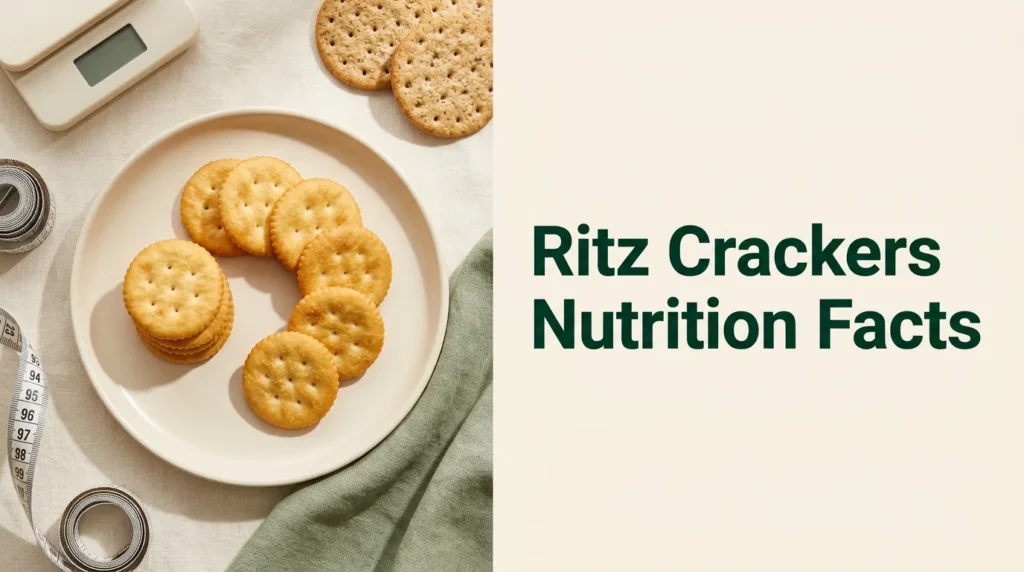
Ritz Crackers nutrition facts per standard serving of five crackers weighing 16 grams include 80 calories, 4.5 grams of total fat, 1 gram of saturated fat, 10 grams of total carbohydrates, zero grams of dietary fiber, 1 gram of total sugars representing added sugars, less than 1 gram of protein, and 130 milligrams of sodium. The micronutrient profile is limited to small amounts of iron, 0.5 milligrams at 3 percent DV, from enriched wheat flour.
The nutritional profile tells a clear story. Calories come primarily from two sources: refined carbohydrates and added fats. The 10 grams of carbohydrates provide 40 calories. The 4.5 grams of fat provide roughly 40 calories. Protein contributes essentially nothing. Fiber contributes literally nothing. The cracker is designed for texture and flavor, not for nutritional density.
The USDA FoodData Central database confirms that processed snack crackers as a category are energy-dense, nutrient-poor foods. They contribute calories, fat, and sodium to the diet while providing minimal amounts of the nutrients that the Dietary Guidelines for Americans 2020-2025 identify as underconsumed by the American population: dietary fiber, calcium, potassium, and vitamin D. Ritz Crackers contain zero grams of fiber, zero percent DV for calcium, zero percent DV for potassium, and zero percent DV for vitamin D.
| Nutrient | Ritz Original (5 crackers, 16g) | % Daily Value | What It Means |
|---|---|---|---|
| Calories | 80 | 4% of 2,000-calorie diet | Moderate for a small snack |
| Total Fat | 4.5g | 6% | Primarily from soybean oil |
| Saturated Fat | 1g | 5% | Moderate per serving |
| Trans Fat | 0g | N/A | See trans fat section below |
| Cholesterol | 0mg | 0% | No animal fats in Original |
| Sodium | 130mg | 6% | 6% of 2,300mg upper limit |
| Total Carbohydrates | 10g | 4% | All refined, no whole grain |
| Dietary Fiber | 0g | 0% | No fiber contribution |
| Total Sugars | 1g | N/A | Added sugar from HFCS |
| Added Sugars | 1g | 2% of 50g limit | Small amount per serving |
| Protein | Less than 1g | 0% | Negligible |
| Iron | 0.5mg | 3% | From enriched flour |
| Potassium | 10mg | 0% | Negligible |
| Calcium | 0mg | 0% | None |
| Vitamin D | 0mcg | 0% | None |
The zero values are as informative as the non-zero values. A food that contributes 80 calories with zero fiber, zero protein, and essentially zero micronutrients adds what nutrition researchers sometimes call “empty calories” to your day. The energy is real. The nutritional contribution beyond energy is minimal. One serving is not a problem. The problem arises when crackers become a significant source of daily calories, displacing foods that provide protein, fiber, vitamins, and minerals.
Ritz Crackers Nutrition Facts Label: How to Read It Correctly
The Ritz Crackers nutrition facts label follows FDA-mandated formatting updated in 2020 to emphasize serving size, calories, and added sugars. The label lists five crackers at 16 grams as one serving, with 80 calories. Total fat appears at 4.5 grams. Sodium appears at 130 milligrams. Added sugars appear at 1 gram. The ingredient list, required by the FDA to be listed in descending order by weight, begins with enriched wheat flour, soybean oil, and sugar.
The FDA nutrition label updates in 2020 made serving sizes more realistic by basing them on what people actually consume rather than what manufacturers recommend. For crackers, the reference amount is 30 grams. Ritz Crackers serving size of 16 grams for five crackers is significantly less than the 30-gram reference. This is legal. It also means that if you eat a 30-gram portion of Ritz, roughly nine to ten crackers, you need to nearly double all the numbers on the label.
Reading the label correctly means checking the serving size first and comparing it to what you actually eat. If you typically grab a handful of crackers, count them. A handful is often 8 to 12 crackers, not 5. At 10 crackers, you consume 160 calories, 9 grams of fat, 260 milligrams of sodium, and 20 grams of refined carbohydrates. The numbers double while the perceived “one serving” feeling doesn’t change because crackers don’t trigger strong satiety signals.
| Serving Size Reality | Crackers | Calories | Fat | Sodium | Carbs |
|---|---|---|---|---|---|
| Label serving | 5 | 80 | 4.5g | 130mg | 10g |
| Typical handful | 10 | 160 | 9g | 260mg | 20g |
| Small snack plate | 15 | 240 | 13.5g | 390mg | 30g |
| With cheese or dip | 10 + toppings | 250+ | 15g+ | 400mg+ | 20g+ |
To read the Ritz Crackers label correctly:
- Look at the serving size first. Five crackers at 16 grams is a small portion. Compare this to your actual intake.
- Check the sodium line. At 130 milligrams per serving, this is a salty snack. Multiply by the number of servings you actually eat.
- Check the added sugars line. The 1 gram is small, but it signals the presence of high fructose corn syrup in a savory food.
- Read the ingredient list. The first three ingredients, enriched flour, soybean oil, and sugar, tell you the cracker is built on refined grain, added fat, and sweetener.
- Check the fiber line. Zero grams means the refined flour has been stripped of the wheat kernel’s bran and germ.
The ingredient label information appears below the nutrition panel and is equally important for understanding what you’re eating. The FDA requires ingredients to be listed by weight. Enriched flour is first, meaning the cracker is mostly refined white flour. Oil is second. Sugar is third. The remaining ingredients each serve processing, preservation, or flavor functions.
Key Takeaway: The Ritz nutrition label is accurate per serving, but the 5-cracker serving is smaller than most people eat, and understanding this discrepancy is essential to knowing what you’re actually consuming.
Ritz Crackers Calories: What 80 Calories Per Serving Means
Ritz Crackers calories at 80 per five-cracker serving represent a moderate calorie contribution for a snack, but the calories come almost entirely from refined carbohydrates and added fat with virtually no protein or fiber to provide satiety. The calorie-to-satiety ratio is poor, meaning 80 calories of Ritz Crackers will satisfy hunger less than 80 calories of almost any whole food.
The 80 calories in a serving of Ritz breaks down to roughly 40 calories from carbohydrates, 40 calories from fat, and essentially zero calories from protein. This macronutrient distribution is common in ultra-processed snack foods. It’s designed for palatability, not satiety. Protein is the most satiating macronutrient. Fiber contributes to fullness by slowing digestion and adding bulk. Ritz provides neither in meaningful amounts.
Compare 80 calories of Ritz Crackers to 80 calories of other snack options. A medium apple provides fiber, water, and chewing resistance that promotes satiety. A handful of almonds provides protein, fiber, and healthy fats that slow gastric emptying. A hard-boiled egg provides protein and fat without refined carbohydrates. Ritz provides rapidly digestible starch and oil on a crispy, low-volume substrate that doesn’t fill your stomach.
| 80-Calorie Snack | Protein | Fiber | Volume | Satiety |
|---|---|---|---|---|
| Ritz Crackers (5) | 0g | 0g | Low | Low |
| Medium apple | 0g | 4.4g | High | Moderate to high |
| Almonds (12-14) | 3g | 1.5g | Low | High |
| Hard-boiled egg (1 large) | 6g | 0g | Moderate | High |
| Plain popcorn (3 cups) | 3g | 3.5g | Very high | High |
| Baby carrots (2 cups) | 2g | 6g | Very high | High |
The calorie density of Ritz Crackers is high relative to their volume. Five crackers weigh 16 grams and provide 80 calories, a calorie density of 5 calories per gram. An apple has a calorie density of roughly 0.5 calories per gram. You can eat 160 grams of apple, a very filling amount, for the same calories as 16 grams of Ritz Crackers. The calorie density difference explains why crackers are easy to overeat and difficult to feel satisfied by.
Ritz Crackers Serving Size: Why 5 Crackers Matters
Ritz Crackers serving size of five crackers at 16 grams is a small portion by any visual standard, and the FDA’s 2020 nutrition label updates were supposed to make serving sizes more realistic, yet this serving remains below the FDA reference amount of 30 grams for crackers. Understanding this discrepancy is essential to understanding what you’re actually eating when you snack on Ritz.
The FDA established reference amounts customarily consumed for food categories to standardize serving sizes across products. For crackers, the reference amount is 30 grams. Ritz Crackers list their serving as 16 grams, roughly half the reference amount. This is compliant with FDA regulations, which allow manufacturers to list a serving size that is less than the reference amount if the product’s characteristics justify it. The practical result is that all the numbers on the label appear lower than they would if the serving size matched the 30-gram reference.
Why does this matter? Because most people do not count out five crackers. Research on portion perception published in the Journal of the Academy of Nutrition and Dietetics has found that people consistently underestimate the amount of snack foods they consume when portion sizes are not pre-portioned. A box of Ritz Crackers contains multiple servings. Eating directly from the box removes the visual cue of the serving size.
| Portion Scenario | Crackers | Calories | Sodium | Fat |
|---|---|---|---|---|
| Label serving | 5 | 80 | 130mg | 4.5g |
| FDA reference amount (30g) | ~9 | 150 | 245mg | 8.5g |
| Small bowl with dip | 12-15 | 190-240 | 310-390mg | 11-14g |
| Half a sleeve | ~20 | 320 | 520mg | 18g |
| Full sleeve | ~40 | 640 | 1,040mg | 36g |
A sleeve of Ritz Crackers, the plastic tray inside the box, contains roughly 40 crackers. Eating a full sleeve in one sitting, which is easy to do while distracted or hungry, provides 640 calories, 36 grams of fat, 1,040 milligrams of sodium, and 80 grams of refined carbohydrates. That’s 45 percent of the daily sodium upper limit, more saturated fat than the AHA recommends for an entire meal, and zero fiber.
The serving size is not a trick. It’s a standardized number that you can use to understand your actual intake if you measure. If you eat Ritz Crackers regularly, counting out five crackers onto a plate rather than eating from the box is the simplest strategy for keeping the nutritional numbers where the label says they are.
Ritz Crackers Carbs: Refined Carbohydrates and Blood Sugar
Ritz Crackers carbs total 10 grams per five-cracker serving, all of which come from refined wheat flour with zero grams of dietary fiber. The carbohydrate source is enriched wheat flour, which has been stripped of the wheat kernel’s bran and germ during processing, leaving primarily the starchy endosperm. This means the carbohydrates digest rapidly and convert to blood glucose quickly.
The glycemic impact of refined wheat flour crackers is well documented in nutrition science. Refined carbohydrates without fiber, fat, or protein to slow gastric emptying produce a rapid blood glucose rise followed by an insulin response. A 2019 study published in the American Journal of Clinical Nutrition confirmed that refined grain products produce glycemic responses comparable to table sugar when matched for carbohydrate content. Five Ritz Crackers with 10 grams of carbohydrates will raise blood glucose similarly to two teaspoons of sugar.
The zero fiber content is significant. The Dietary Guidelines for Americans 2020-2025 identify dietary fiber as an underconsumed nutrient of public health concern and recommend 25 to 30 grams per day for adults. Ritz Crackers contribute nothing to this target. Whole-grain crackers typically provide 2 to 4 grams of fiber per serving. The refining process that gives Ritz their light, crispy texture also removes the fiber that would moderate the carbohydrate absorption.
| Carbohydrate Source (10g carbs) | Fiber | Glycemic Impact | Satiety |
|---|---|---|---|
| Ritz Crackers (5) | 0g | Rapid | Low |
| Whole-grain crackers (5) | 2-3g | Moderate | Moderate |
| Apple (small) | 4g | Slow (fructose + fiber) | High |
| Oatmeal (1/4 cup dry) | 2g | Slow (soluble fiber) | Moderate to high |
| White bread (1/2 slice) | 0g | Rapid | Low |
For people with type 1 diabetes who count carbohydrates for insulin dosing, the 10 grams per five crackers is a predictable number. The challenge is that refined carbohydrates without fat or protein hit the bloodstream quickly, and the insulin may not act fast enough to match the glucose peak. For people with type 2 diabetes or insulin resistance, the rapid glucose absorption from refined flour crackers can produce post-meal blood sugar spikes that are difficult to manage.
A registered dietitian or certified diabetes care and education specialist can help you understand your individual carbohydrate tolerance and whether refined flour crackers fit into your meal plan.
Key Takeaway: Ritz Crackers provide 10 grams of rapidly digesting refined carbohydrates with zero fiber per serving, producing a blood sugar response similar to sugar for the same carbohydrate load.
Ritz Crackers Fat: Saturated, Unsaturated, and What to Know
Ritz Crackers fat content totals 4.5 grams per five-cracker serving, with 1 gram of saturated fat and the remaining 3.5 grams coming from polyunsaturated and monounsaturated fats primarily from soybean oil. The fat profile is predominantly unsaturated, which is nutritionally preferable to saturated fat, but the fat is added to a refined carbohydrate base rather than being part of a whole food matrix.
Soybean oil, the second ingredient on the Ritz label after enriched flour, is the primary fat source. Soybean oil is high in polyunsaturated fat, particularly linoleic acid, an omega-6 fatty acid. The American Heart Association recognizes that replacing saturated fat with polyunsaturated fat reduces cardiovascular disease risk. The fat in Ritz Crackers is not the primary nutritional concern. The combination of fat with refined carbohydrates and sodium in a low-satiety food is the broader issue.
The saturated fat at 1 gram per serving represents 5 percent of the AHA’s recommended daily limit of 20 grams for a 2,000-calorie diet. This is modest. Five crackers do not meaningfully impact saturated fat intake. Eating 20 crackers at 4 grams of saturated fat and 18 grams of total fat is a different nutritional event entirely.
| Fat Type | Per 5 Crackers | Per 15 Crackers | Health Context |
|---|---|---|---|
| Total Fat | 4.5g | 13.5g | 17% of 78g daily target |
| Saturated Fat | 1g | 3g | 5-15% of AHA 20g limit |
| Polyunsaturated Fat | 2g | 6g | Primarily omega-6 from soybean oil |
| Monounsaturated Fat | 1.5g | 4.5g | From soybean and palm oil |
| Trans Fat | 0g (label) | Trace possible | See trans fat section |
The fat in Ritz Crackers serves textural and flavor functions. It makes the crackers crisp and rich-tasting. It provides no direct health benefit beyond being a calorie source and a carrier for fat-soluble flavors. The same fat from a whole-food source like nuts or seeds would come packaged with protein, fiber, vitamins, and minerals. In Ritz, the fat comes packaged with refined starch and salt.
Ritz Crackers Sodium: AHA Limits and What 130mg Contributes
Ritz Crackers sodium content of 130 milligrams per five-cracker serving represents 6 percent of the American Heart Association’s 2,300-milligram daily upper limit and 9 percent of the ideal 1,500-milligram target. The sodium comes from salt, sodium bicarbonate (baking soda), and sodium phosphate compounds in the leavening system.
Sodium is the most significant nutritional concern with Ritz Crackers for most people, not because a single serving is alarming, but because crackers are salty, easy to overeat, and often paired with additional sodium sources like cheese, deli meat, or dips. At five crackers, 130 milligrams of sodium is manageable. At 15 crackers with cheese, the sodium load reaches 500 to 700 milligrams, a meaningful fraction of the daily limit.
The Dietary Guidelines for Americans 2020-2025 identify excessive sodium intake as a major public health concern and recommend limiting sodium to 2,300 milligrams per day. The average American consumes roughly 3,400 milligrams per day. Processed and packaged foods contribute roughly 70 percent of dietary sodium, far more than salt added during cooking or at the table. Ritz Crackers are a processed food that contributes to this pattern.
| Sodium Source | Amount | % of 2,300mg Limit | % of 1,500mg Target |
|---|---|---|---|
| Ritz Crackers (5) | 130mg | 6% | 9% |
| Ritz Crackers (15) | 390mg | 17% | 26% |
| Ritz (5) + cheddar cheese (1 oz) | 310mg | 13% | 21% |
| Ritz (5) + deli turkey (2 slices) | 560mg | 24% | 37% |
| Ritz (5) + peanut butter (1 tbsp) | 190mg | 8% | 13% |
People with hypertension, congestive heart failure, kidney disease, or a physician-prescribed sodium restriction should be particularly aware of cracker sodium content. A serving or two may fit within a restricted budget. Larger portions or frequent consumption can consume the day’s allowance quickly. A cardiologist or registered dietitian can provide individualized sodium guidance based on your specific health status.
Ritz Crackers Sugar Content: Added Sugars in a Savory Cracker
Ritz Crackers sugar content totals 1 gram of added sugar per five-cracker serving, coming from high fructose corn syrup and sugar listed in the ingredient list. The amount is small per serving. The noteworthy fact is that sugar and HFCS are present in a savory cracker at all, reflecting a processed food formulation strategy that uses sweetness to enhance palatability even in non-dessert foods.
The 1 gram of added sugar per serving represents 2 percent of the Dietary Guidelines’ 50-gram daily limit for a 2,000-calorie diet. At five crackers, this is nutritionally negligible. The sugar content becomes more relevant at higher intakes. Fifteen crackers provide 3 grams of added sugar, still modest but unnecessary in a food that isn’t sweet.
High fructose corn syrup appears as the third ingredient in some Ritz formulations, or sugar appears as the third ingredient with HFCS further down the list. The exact sweetener system may vary by production run, but the presence of added sweeteners in a savory cracker is consistent. The function is flavor enhancement, not primary sweetening. Small amounts of sugar balance salt, enhance browning during baking, and contribute to the cracker’s appealing taste profile.
| Sweetener | Ingredient List Position | Function | Per Serving Contribution |
|---|---|---|---|
| Sugar | Typically 3rd | Flavor, browning, texture | ~0.5-1g added sugar |
| High fructose corn syrup | Varies | Flavor, browning | ~0.5-1g added sugar |
The Academy of Nutrition and Dietetics encourages consumers to be aware of added sugars in unexpected food categories. Added sugars appear in breads, crackers, sauces, dressings, and many savory packaged foods. The small amounts in each product accumulate across a day of processed food consumption. If you eat primarily whole foods, the 1 gram of sugar in Ritz Crackers is a rounding error. If your diet includes multiple packaged foods, the cumulative added sugar from savory sources can be surprising.
Ritz Crackers Trans Fat: The Partially Hydrogenated Oil Reality
Ritz Crackers trans fat status is listed as 0 grams per serving on the nutrition label, which is legally accurate under FDA labeling rules that allow trans fat below 0.5 grams per serving to be rounded to zero. The ingredient list has historically included partially hydrogenated oils, the primary source of industrial trans fat. The current formulation status depends on the specific variety and ongoing manufacturer reformulation efforts.
The FDA determined in 2015 that partially hydrogenated oils are not generally recognized as safe and set a compliance deadline of June 2018 for manufacturers to remove them from packaged foods. Major manufacturers including Mondelēz International, the parent company of Ritz, reformulated their products to remove partially hydrogenated oils. The current Ritz Crackers ingredient list should not include partially hydrogenated oils if the product is fully reformulated.
The “0g trans fat” on the label is legally correct but requires understanding the rounding rule. If a serving contains 0.4 grams of trans fat, the label can say 0 grams. For someone eating five crackers, 0.4 grams is a small amount. For someone eating an entire sleeve of crackers, 0.4 grams times eight servings equals 3.2 grams of trans fat, a physiologically meaningful amount. Industrial trans fat is the fat type most strongly linked to cardiovascular disease, with no known safe intake level. The AHA recommends that trans fat intake be as low as possible.
| Trans Fat Source | Status in 2026 | What to Check |
|---|---|---|
| Partially hydrogenated oils | Removed per FDA mandate | Should not appear on ingredient list |
| Naturally occurring trans fat | Trace from oils | Minimal, not a health concern |
| Fully hydrogenated oils | May be present | Not a trans fat source (fully saturated) |
To verify the trans fat status of your Ritz Crackers:
- Read the ingredient list. Partially hydrogenated oil should not appear. If it does, the product was manufactured before the FDA compliance date or uses an exempted ingredient.
- Look at the “Total Fat” line on the nutrition panel. If partially hydrogenated oils are present, trans fat may be listed as 0g but still present below 0.5g.
- Check the manufacturer’s website for reformulation statements. Mondelēz International has publicly committed to PHO removal.
Key Takeaway: Ritz Crackers should be free of partially hydrogenated oils in 2026 due to the FDA ban, but the “0g trans fat” label can mask up to 0.5g per serving, so always check the ingredient list for partially hydrogenated oil.
Ritz Crackers Ingredients: Every Component Explained
Ritz Crackers ingredients for the Original variety include enriched wheat flour, soybean oil, sugar, high fructose corn syrup, salt, leavening (calcium phosphate and baking soda), malted barley flour, soy lecithin, and natural flavor. Each ingredient serves a defined function in the cracker’s structure, texture, flavor, or shelf stability.
Enriched wheat flour is the primary ingredient by weight. It provides the starch and gluten that form the cracker’s structure. The enrichment process adds back B vitamins, thiamine, riboflavin, niacin, and folic acid, and the mineral iron that are lost when whole wheat is refined to white flour. This enrichment is mandatory for refined wheat flour in the United States. The flour provides refined carbohydrate without the fiber and micronutrients of whole wheat.
Soybean oil is the primary fat. It contributes to the cracker’s crisp texture and rich mouthfeel. Soybean oil is a polyunsaturated fat high in omega-6 linoleic acid. It is less stable than saturated fats, which is why antioxidants like tocopherols are sometimes added to prevent rancidity. The oil is not hydrogenated, meaning it remains liquid and contributes unsaturated rather than saturated or trans fats.
| Ingredient | Function | FDA Status | Health Context |
|---|---|---|---|
| Enriched wheat flour | Structure, starch base | Mandatory enrichment | Refined grain, B vitamins added back |
| Soybean oil | Texture, crispness, fat source | GRAS | High in omega-6, unsaturated |
| Sugar | Flavor, browning | GRAS | Added sugar |
| High fructose corn syrup | Sweetness, browning | GRAS | Added sugar |
| Salt | Flavor, gluten strengthening | GRAS | Sodium contributor |
| Calcium phosphate | Leavening acid | GRAS | Calcium source (minimal) |
| Baking soda (sodium bicarbonate) | Leavening base | GRAS | Sodium contributor |
| Malted barley flour | Enzyme for dough conditioning | GRAS | Gluten source, flavor |
| Soy lecithin | Emulsifier, texture | GRAS | Soy allergen |
| Natural flavor | Flavor enhancement | FDA regulated | Proprietary blend |
Sugar and high fructose corn syrup together provide the 1 gram of added sugar per serving. Their primary function is not sweetness at this low level. They contribute to the Maillard browning reaction during baking, which creates the golden color and toasted flavor notes. The sugar also tenderizes the cracker texture by interfering with gluten development.
Ritz Crackers Enriched Flour: What Enrichment Adds and Misses
Ritz Crackers enriched flour is refined wheat flour that has had specific B vitamins and iron added back after the refining process removed the wheat kernel’s bran and germ. The enrichment provides thiamine (vitamin B1), riboflavin (vitamin B2), niacin (vitamin B3), folic acid (vitamin B9), and reduced iron. What enrichment does not restore is the fiber, magnesium, potassium, vitamin E, zinc, and phytochemicals that whole wheat flour naturally contains.
The enrichment of refined wheat flour has been mandatory in the United States since the 1940s, when the policy was implemented to address widespread B-vitamin deficiency diseases including pellagra and beriberi. The policy was a public health success. Deficiency diseases largely disappeared. Enrichment remains a federal requirement for refined wheat flour used in products like Ritz Crackers.
The limitation of enrichment is that it restores only a subset of what refining removes. A whole wheat kernel contains fiber in the bran layer, healthy fats and vitamin E in the germ, and minerals including magnesium, zinc, and potassium throughout. Enrichment adds back thiamine, riboflavin, niacin, folic acid, and iron. It does not add back fiber, magnesium, zinc, potassium, or vitamin E. It does not restore the phytonutrients present in whole wheat.
| Nutrient | Whole Wheat Flour (100g) | Enriched White Flour (100g) | Enriched Restores? |
|---|---|---|---|
| Fiber | 10.7g | 2.7g | No |
| Magnesium | 137mg | 22mg | No |
| Zinc | 2.6mg | 0.7mg | No |
| Potassium | 363mg | 107mg | No |
| Vitamin E | 0.7mg | 0.1mg | No |
| Thiamine (B1) | 0.5mg | 0.8mg | Yes (added) |
| Riboflavin (B2) | 0.2mg | 0.5mg | Yes (added) |
| Niacin (B3) | 5.5mg | 5.9mg | Yes (added) |
| Folic acid (B9) | 44mcg | 154mcg | Yes (added, higher than whole wheat) |
| Iron | 3.9mg | 4.6mg | Yes (added) |
The iron in enriched flour provides the 0.5 milligrams per serving of Ritz Crackers. This is non-heme iron, the plant form of iron that is less absorbable than the heme iron in meat. The bioavailability of non-heme iron can be enhanced by consuming it with a source of vitamin C, such as citrus, bell peppers, or tomatoes. The iron contribution from Ritz is modest, covering 3 percent of the Daily Value per serving.
Ritz Crackers High Fructose Corn Syrup: Why It’s in a Cracker
Ritz Crackers high fructose corn syrup appears in the ingredient list in small amounts, contributing to the 1 gram of added sugar per serving. The HFCS functions primarily as a browning agent during baking and as a subtle flavor enhancer rather than as a primary sweetener. The amount is small, but its presence in a savory cracker surprises consumers who don’t expect sweeteners in crackers.
High fructose corn syrup is a liquid sweetener made from corn starch that has been enzymatically processed to convert some of its glucose into fructose. The FDA recognizes HFCS as generally recognized as safe. The metabolic effects of HFCS are similar to those of sucrose, table sugar, because both contain roughly equal proportions of glucose and fructose. The human body metabolizes HFCS and sugar through the same pathways.
The reason HFCS appears in Ritz Crackers rather than sugar alone is functional. Liquid sweeteners are easier to incorporate into dough uniformly. HFCS contributes to the Maillard browning reaction, which produces the golden-brown color and toasted flavor notes that consumers expect from baked crackers. It also contributes to the cracker’s texture by interfering with gluten development, making the cracker more tender and less tough.
| Sweetener Function | How It Works |
|---|---|
| Maillard browning | Reacts with amino acids during baking to create golden color and toasted flavor |
| Texture modification | Interferes with gluten network, creates tenderness |
| Flavor balance | Subtle sweetness balances salt, enhancing overall palatability |
| Yeast fermentation (if used) | Provides fermentable sugar for leavening |
| Shelf stability | Sugar helps maintain moisture and texture over time |
For most consumers, the 1 gram of added sugar per serving is not a health concern. The concern is the broader pattern. Added sugars appear in 68 percent of packaged foods according to a study published in the Journal of the Academy of Nutrition and Dietetics. The sugar in Ritz is part of a food environment where small amounts of added sweeteners in savory foods contribute to total added sugar intake that exceeds recommendations.
Ritz Crackers Hydrogenated Oil: Current Status and Safety
Ritz Crackers hydrogenated oil status has changed significantly in recent years. Partially hydrogenated oils, the source of industrial trans fat, were determined by the FDA to be not generally recognized as safe, with a compliance deadline for removal set in 2018. Current Ritz formulations should not contain partially hydrogenated oils. Fully hydrogenated oils may appear and are chemically different, containing no trans fat.
The distinction between partially hydrogenated and fully hydrogenated oil is critical for understanding the ingredient label. Partial hydrogenation adds hydrogen atoms to some but not all of the double bonds in polyunsaturated oil, creating trans fats as a byproduct. The FDA’s determination applied specifically to partially hydrogenated oils, not fully hydrogenated oils. Full hydrogenation converts all double bonds to single bonds, creating a fully saturated fat that contains no trans fat.
Soybean oil, the primary fat in Ritz, can be used in its liquid, unhydrogenated form. If “soybean oil” appears without “partially hydrogenated” or “hydrogenated,” it is liquid oil. If “fully hydrogenated soybean oil” appears, it is a solid saturated fat with no trans fat. If “partially hydrogenated soybean oil” appears, the product contains industrial trans fat and was likely manufactured before the FDA compliance deadline.
| Oil Type on Label | Contains Trans Fat? | FDA Status |
|---|---|---|
| Soybean oil | No (liquid oil) | GRAS |
| Fully hydrogenated soybean oil | No (fully saturated) | GRAS |
| Partially hydrogenated soybean oil | Yes | Not GRAS, removed per FDA |
| Palm oil | No (naturally saturated) | GRAS |
The palm oil that appears in some Ritz varieties provides a solid fat without hydrogenation. Palm oil is naturally high in saturated fat, roughly 50 percent, which makes it semi-solid at room temperature and useful for creating crisp, structured crackers without the need for hydrogenation. The use of palm oil in reformulated products is common across the packaged food industry as manufacturers replace partially hydrogenated oils.
Key Takeaway: Ritz Crackers in 2026 should not contain partially hydrogenated oils, but check the ingredient label because any remaining stock with partially hydrogenated oil would indicate an older product or a variety not yet reformulated.
Are Ritz Crackers Healthy: An Honest Nutritional Assessment
Are Ritz Crackers healthy? By the standards of the Dietary Guidelines for Americans 2020-2025, which recommend that grains consumed be at least 50 percent whole grains and that added sugars, saturated fat, and sodium be limited, Ritz Crackers are not a health-promoting food. They are a processed snack made from refined grains, added fat, added sugar, and sodium, providing calories with minimal nutritional contribution. They are not unhealthy in small, occasional servings. They are not healthy as a dietary staple.
The nutritional assessment depends on context. Compared to whole-grain crackers, Ritz provide less fiber, fewer micronutrients, and a less favorable macronutrient profile. Compared to potato chips, Ritz have marginally less fat but similar refined carbohydrate content and comparable sodium. Compared to nuts, Ritz provide inferior protein, fiber, and healthy fat profiles. Compared to fresh vegetables with hummus, Ritz provide fewer nutrients, less fiber, and fewer protective phytochemicals.
The Academy of Nutrition and Dietetics uses the concept of nutrient density to evaluate foods. Nutrient-dense foods provide vitamins, minerals, and other health-promoting components with relatively few calories. Ritz Crackers have low nutrient density. They provide 80 calories with essentially no fiber, protein, or micronutrients beyond the small amount of iron from enrichment.
| Health Criterion | Ritz Crackers Assessment |
|---|---|
| Whole grain content | Zero (refined flour) |
| Fiber content | Zero grams per serving |
| Added sugar | 1g per serving (small but present) |
| Sodium | 130mg per 5 crackers, easy to overeat |
| Saturated fat | 1g per serving (moderate) |
| Protein | Less than 1g (negligible) |
| Micronutrient density | Minimal beyond iron enrichment |
| Satiety | Low (refined carbs, no protein, no fiber) |
| Processing level | Ultra-processed (multiple additives) |
The health verdict on Ritz Crackers is not that they are poison or that five crackers will harm your health. The verdict is that they are a treat food that should not be a primary source of daily calories or a go-to snack. If you enjoy Ritz Crackers, eat them in small portions on occasion, not daily and not by the sleeve. Pair them with protein and fiber-rich toppings like cheese, hummus, or nut butter to improve the overall snack’s nutritional profile and satiety.
Ritz Crackers vs Saltines: Complete Comparison
Ritz Crackers versus saltines compares two popular refined-flour crackers with similar nutritional profiles but different fat content, texture, and ingredient complexity. Saltines are lower in fat and calories but also lower in flavor and richness. Ritz contain more fat from added oil, which gives them their distinctive buttery taste and crisp texture. Neither cracker is a whole-grain product.
Saltines are nutritionally simpler than Ritz. A serving of five saltines typically contains 60 calories, 1.5 grams of fat, 11 grams of carbohydrates, and 130 milligrams of sodium. Ritz contain 80 calories, 4.5 grams of fat, 10 grams of carbohydrates, and 130 milligrams of sodium for the same number of crackers. The calorie difference is entirely from fat. Ritz add soybean oil for richness. Saltines use minimal fat, relying on flour, water, salt, and leavening for their basic cracker structure.
The ingredient lists reflect the difference in product design. Saltines have a shorter ingredient list typically containing enriched wheat flour, water, salt, yeast, and baking soda. Ritz add soybean oil, sugar, high fructose corn syrup, and several additional ingredients for texture and flavor. Saltines are the simpler cracker. Ritz are the more engineered cracker.
| Nutrient (5 crackers) | Ritz Original | Saltines | Difference |
|---|---|---|---|
| Calories | 80 | 60 | +20 for Ritz |
| Total Fat | 4.5g | 1.5g | +3g for Ritz |
| Saturated Fat | 1g | 0g | +1g for Ritz |
| Carbohydrates | 10g | 11g | Comparable |
| Fiber | 0g | 0g | Neither provides fiber |
| Protein | Less than 1g | 1g | Comparable |
| Sodium | 130mg | 130mg | Comparable |
| Sugar | 1g | 0g | +1g for Ritz |
Neither cracker is a whole-grain product. Both are made from enriched wheat flour. Both contain zero fiber. Both contribute sodium and refined carbohydrates to the diet. The choice between them is primarily about taste and fat preference, not nutrition. If you prefer the buttery flavor of Ritz, eat them in moderation. If you prefer plain saltines, you’ll save 20 calories and 3 grams of fat per serving.
Ritz Crackers Whole Wheat Nutrition: Is It a Better Choice?
Ritz Crackers Whole Wheat nutrition offers a modest improvement over Original, primarily through the inclusion of whole wheat flour as the first ingredient rather than enriched white flour. The whole wheat version provides approximately 70 calories, 3 grams of fat, 10 grams of carbohydrates, and 1 to 2 grams of fiber per five-cracker serving. The fiber addition is the meaningful nutritional difference.
Whole wheat Ritz contain whole wheat flour as the primary grain ingredient, which means the bran and germ of the wheat kernel are present. This provides the fiber and additional micronutrients that refined white flour lacks. The fiber content, typically 1 to 2 grams per serving, is modest but represents a nutritional advantage over the zero fiber in Original Ritz. One to two grams of fiber per serving is not a large amount. It is a step in the right direction for a cracker.
The whole wheat version still contains added oil, sugar, salt, and the same processed food characteristics as Original Ritz. It is a better choice than Original in the same way that whole wheat bread is a better choice than white bread. It is not equivalent to whole-food snacks like nuts, seeds, or fresh vegetables. The whole wheat version reduces some of the nutritional liabilities of Original. It does not transform Ritz into a health food.
| Nutrient (5 crackers) | Ritz Original | Ritz Whole Wheat | Whole-Grain Cracker (e.g., Triscuit) |
|---|---|---|---|
| Calories | 80 | 70 | 60-70 |
| Total Fat | 4.5g | 3g | 1.5-2.5g |
| Saturated Fat | 1g | 0.5g | 0-0.5g |
| Carbohydrates | 10g | 10g | 10-11g |
| Fiber | 0g | 1-2g | 3g |
| Protein | Less than 1g | 1g | 2g |
| Sodium | 130mg | 110-130mg | 50-90mg |
| Added Sugar | 1g | 1g | 0g |
| First Ingredient | Enriched wheat flour | Whole wheat flour | Whole grain wheat |
If you enjoy Ritz Crackers and want the better option between Original and Whole Wheat, the Whole Wheat version provides fiber and whole grain benefits that Original lacks. If you are choosing crackers primarily for health and are not attached to the Ritz brand, whole-grain crackers with simpler ingredient lists like Triscuit or Wasa provide more fiber, less fat, and fewer added ingredients.
Key Takeaway: Ritz Whole Wheat is a better choice than Original because it provides 1 to 2 grams of fiber from whole wheat flour, but it remains a processed cracker with added oil and sugar, and simpler whole-grain crackers offer more nutritional benefit.
Frequently Asked Questions About Ritz Crackers Nutrition
How many calories are in a serving of Ritz Crackers?
A serving of Ritz Crackers Original, five crackers at 16 grams, contains 80 calories.
The calories come primarily from refined carbohydrates at 40 calories and added fat at 40 calories, with less than 1 gram of protein contributing essentially no calories.
Most people eat more than five crackers in a sitting, so actual calorie intake from Ritz snacks is typically higher than the label serving.
Are Ritz Crackers healthy for weight loss?
Ritz Crackers are not an ideal weight loss food because they are calorie-dense at 80 calories per five crackers, low in satiety-providing protein and fiber, and easy to overeat.
They can fit into a calorie-controlled diet if you strictly measure your portion to five crackers and account for the calories.
For the same 80 calories, whole-food options like an apple, a handful of almonds, or a hard-boiled egg provide more satiety and better nutritional support for weight management.
Do Ritz Crackers contain trans fat?
The Ritz Crackers nutrition label lists 0 grams of trans fat per serving, which is legally accurate under FDA rules allowing values below 0.5 grams to round to zero.
Partially hydrogenated oils, the primary source of industrial trans fat, were required to be removed from packaged foods by 2018 per FDA mandate, and current Ritz formulations should not contain them.
Always check the ingredient list for partially hydrogenated oil to confirm, as any product still containing it would be an older formulation.
Are Ritz Crackers vegan?
Ritz Crackers Original do not contain milk, eggs, or other animal-derived ingredients in the standard ingredient list and are generally considered vegan by ingredient composition.
The natural flavor listed on the label could theoretically be derived from animal or plant sources, and the manufacturer does not explicitly label Ritz as vegan.
The crackers contain wheat and soy, and may be manufactured in facilities that process milk, so those with strict vegan standards should check directly with the manufacturer.
Can people with diabetes eat Ritz Crackers?
People with diabetes can fit Ritz Crackers into their carbohydrate budget as the 10 grams of carbohydrate per five-cracker serving is a countable amount.
The refined flour and lack of fiber mean the carbohydrates digest rapidly and can spike blood glucose faster than whole-grain, fiber-containing foods with the same carb count.
Pairing Ritz with protein or fat such as cheese or nut butter can slow glucose absorption, and a registered dietitian or diabetes educator can help you determine how crackers fit into your individual meal plan.
What are the main ingredients in Ritz Crackers?
The main ingredients in Ritz Crackers Original are enriched wheat flour, soybean oil, sugar, high fructose corn syrup, salt, leavening agents including calcium phosphate and baking soda, malted barley flour, soy lecithin, and natural flavor.
Enriched wheat flour is the primary ingredient, providing the refined carbohydrate base.
Soybean oil is the primary fat source, contributing to the cracker’s crisp texture and the majority of the 4.5 grams of fat per serving.
Ritz Crackers are exactly what their nutrition label and ingredient list say they are: a processed snack food built on refined wheat flour, soybean oil, sugar, and salt, with a carefully engineered crispy texture and buttery flavor. The 80 calories and 130 milligrams of sodium per five-cracker serving are not alarming in isolation. The problem is that crackers are designed to be easy to eat and hard to stop eating, and the nutritional numbers multiply quickly when you eat them the way most people do.
The better choice in the Ritz product line is the Whole Wheat variety, which at least provides 1 to 2 grams of fiber and whole grain content that Original lacks. The better choice among all crackers is a whole-grain option with a simpler ingredient list and more fiber. The best choice for a snack is a whole food with protein, fiber, or both that fills your stomach and nourishes your body in ways that refined-flour crackers cannot.
If you love Ritz Crackers, eat them occasionally, count out your portion instead of eating from the box, and pair them with something nutrient-dense like cheese, hummus, or fruit. The crackers themselves won’t improve your health. How you fit them into the rest of your eating pattern will determine whether they matter.