Shin Ramen Nutrition Facts: Full 2026 Label Breakdown
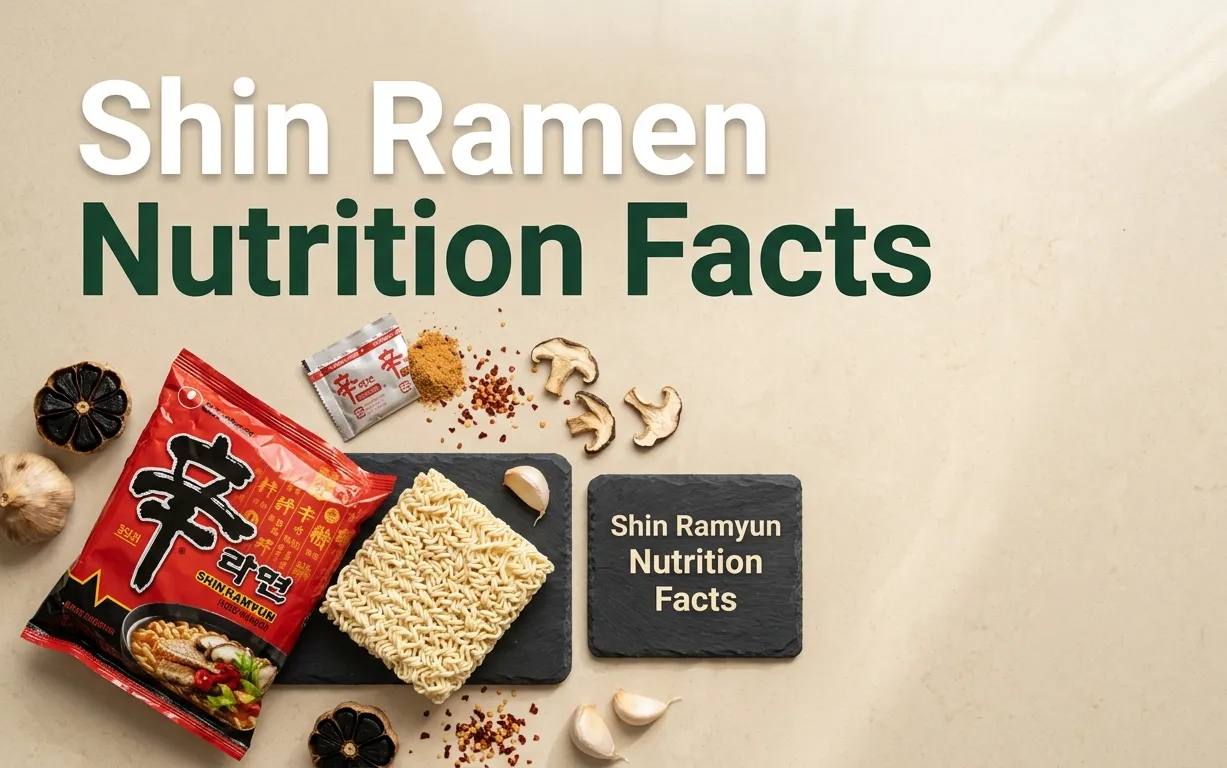
One 120-gram package of Nongshim Shin Ramyun contains 510 calories, 18 grams of total fat, 68 grams of carbohydrates, 13 grams of protein, and 1,980 milligrams of sodium. The shin ramen nutrition facts reveal a product that delivers nearly an entire day’s recommended sodium limit in a single bowl of noodles.
The American Heart Association recommends an upper limit of 2,300 milligrams of sodium per day, with an ideal target of 1,500 milligrams for most adults. One package of Shin Ramen uses 86 percent of the upper limit and exceeds the ideal target by 480 milligrams. That number alone makes this noodle soup a food that demands honest portion awareness and thoughtful consumption habits.
This article walks through every number on the Shin Ramen label, explains exactly what is in the seasoning packet and noodle block, compares the original to the Black and Bowl versions, and gives you specific, quantified strategies to make a bowl of Shin Ramen healthier without turning it into a completely different meal.
Shin Ramen Nutrition Facts
The complete nutrition facts panel for Nongshim Shin Ramyun, based on the 2026 official product label per one 120-gram package, breaks down as follows: 510 calories, 18 grams of total fat including 9 grams of saturated fat and 0 grams of trans fat, 0 milligrams of cholesterol, 1,980 milligrams of sodium, 68 grams of total carbohydrate including 4 grams of dietary fiber and 2 grams of total sugars, and 13 grams of protein. The package makes one bowl of noodle soup after cooking.
The following table organizes every declared nutrient on the official Shin Ramen label:
| Nutrient | Amount per 120g Package | % Daily Value (2,000-calorie diet) |
|---|---|---|
| Calories | 510 | 26% |
| Total Fat | 18g | 23% |
| Saturated Fat | 9g | 45% |
| Trans Fat | 0g | Not established |
| Cholesterol | 0mg | 0% |
| Sodium | 1,980mg | 86% |
| Total Carbohydrate | 68g | 25% |
| Dietary Fiber | 4g | 14% |
| Total Sugars | 2g | Not established |
| Added Sugars | 0g | 0% |
| Protein | 13g | 26% |
| Vitamin D | 0mcg | 0% |
| Calcium | 0mg | 0% |
| Iron | 3.6mg | 20% |
| Potassium | Minimal (not declared) | Not established |
The product contains no added sugars and no cholesterol. The 4 grams of dietary fiber come primarily from the wheat flour noodles and the small amount of dehydrated vegetables in the seasoning packet. The 13 grams of protein is a modest but real contribution, roughly equivalent to two large eggs. The iron content, 20 percent of the Daily Value at 3.6 milligrams, comes from reduced iron added to the enriched wheat flour. Every other vitamin and mineral is either absent or present in negligible amounts.
Key Takeaway: Shin Ramen is an energy-dense, high-sodium, high-carbohydrate food with moderate protein and minimal micronutrient diversity. It is not nutritionally empty but it is nutritionally narrow.
Shin Ramen Calories
One 120-gram package of Shin Ramen contains 510 calories, with the noodle block contributing approximately 380 to 400 of those calories and the seasoning packet contributing the remaining 110 to 130 calories. The calorie breakdown places Shin Ramen at the higher end of the instant ramen category.
The calorie distribution across macronutrients works out as follows. Fat contributes approximately 162 calories (32 percent of total), almost entirely from the palm oil used to deep-fry the noodle block during manufacturing. Carbohydrates contribute approximately 272 calories (53 percent), mostly from the wheat flour noodles. Protein contributes approximately 52 calories (10 percent), from the wheat gluten in the noodles and the small amount of protein in the beef extract and soy-based seasoning ingredients.
A 510-calorie single meal sits in the range of a moderate lunch or a light dinner for someone eating a 2,000-calorie diet with three meals per day. The concern is not the calorie count in isolation. It is what those 510 calories do not provide: no meaningful vitamin A, no vitamin C, no vitamin D, no calcium, and minimal potassium. Calories that arrive without micronutrients leave you fed but not nourished.
The following comparison puts the 510-calorie number in context alongside other common convenience meals:
| Convenience Meal | Serving Size | Calories |
|---|---|---|
| Shin Ramen (original) | 120g package | 510 |
| Kraft Macaroni and Cheese (prepared) | 1 cup (200g) | 350 |
| Frozen pepperoni pizza | 1/3 pizza (150g) | 380 |
| Canned beef chili with beans | 1 cup (250g) | 290 |
| Peanut butter and jelly sandwich | 1 sandwich | 380 |
| Fast food cheeseburger | 1 burger | 350 |
| Frozen chicken pot pie | 1 pie (200g) | 410 |
Shin Ramen is calorie-dense for its physical volume. The 120-gram dry package hydrates to roughly 400 to 500 grams of prepared noodle soup, meaning each gram of prepared ramen carries about 1 to 1.3 calories. A comparable weight of homemade chicken vegetable soup typically carries 0.3 to 0.5 calories per gram.
Shin Ramen Carbs
One package of Shin Ramen contains 68 grams of total carbohydrates, of which 4 grams are dietary fiber and 2 grams are total sugars. The remaining 62 grams are complex carbohydrates from the wheat flour noodle block, primarily in the form of starch that breaks down rapidly into glucose during digestion.
The 68 grams of carbohydrate represent 25 percent of the Daily Value on a 2,000-calorie diet. For someone following a standard diet with 225 to 325 grams of daily carbohydrate, one package of Shin Ramen covers 21 to 30 percent of their daily carbohydrate intake. For someone on a moderate low-carbohydrate diet of 100 to 150 grams per day, one package uses 45 to 68 percent of the full day’s carbohydrate allowance.
The carbohydrate source matters as much as the total count. Shin Ramen noodles are made from enriched wheat flour, which is a refined grain. Refined grains have had the bran and germ removed during milling, stripping away most of the fiber, B vitamins, and minerals. Enrichment adds back a small subset of those nutrients (iron, thiamin, riboflavin, niacin, folic acid) but does not restore the fiber, magnesium, vitamin E, or phytochemicals that whole grains provide.
The Dietary Guidelines for Americans 2020-2025 recommend that at least half of all grain consumption come from whole grains. Shin Ramen noodles, made from refined wheat flour with no whole grain content, do not contribute toward that recommendation. The 4 grams of fiber in the package come primarily from the small amount of dehydrated vegetables and any resistant starch formed during noodle processing, not from intact whole grain fiber.
Shin Ramen Protein
One package of Shin Ramen contains 13 grams of protein, which is a moderate amount for a plant-based meal and represents 26 percent of the Daily Value based on a 50-gram daily reference. The protein comes from two sources: the wheat gluten naturally present in the wheat flour noodles (approximately 9 to 10 grams) and the protein in the seasoning packet from hydrolyzed vegetable protein, soy sauce powder, and beef extract (approximately 3 to 4 grams).
Thirteen grams of protein is not trivial. It is equivalent to the protein in about two large eggs or half a scoop of protein powder. The protein in Shin Ramen is incomplete, however, because it comes almost entirely from wheat and soy, both of which are low in the essential amino acid lysine. Wheat protein has a Protein Digestibility Corrected Amino Acid Score of approximately 0.42, compared to 1.0 for egg or milk protein, meaning it is less efficiently used by the body for tissue repair and muscle protein synthesis.
The practical consequence is that 13 grams of wheat and soy protein in Shin Ramen does not equal 13 grams of animal protein in terms of muscle-building or satiety value. Adding a soft-boiled egg, a handful of cooked chicken or tofu, or a spoonful of edamame to the bowl can push the total protein up to 20 to 25 grams and improve the amino acid profile substantially.
| Protein Source | Amount Added to Ramen | Additional Protein |
|---|---|---|
| Soft-boiled egg (1 large) | 50g | 6g |
| Cooked chicken breast | 75g (about 1/2 cup) | 23g |
| Firm tofu, cubed | 100g (about 1/3 block) | 8g |
| Edamame, shelled | 50g (about 1/3 cup) | 6g |
| Shrimp, cooked | 75g (about 6 medium) | 18g |
| Shin Ramen (no additions) | N/A | 13g |
Key Takeaway: Shin Ramen provides 13 grams of incomplete plant protein, which is enough to count toward your daily total but not enough to make this a high-protein meal. Adding an egg or a handful of chicken transforms it into a genuinely protein-sufficient dish.
Shin Ramen Fat Content
One package of Shin Ramen contains 18 grams of total fat, including 9 grams of saturated fat and 0 grams of trans fat, with no cholesterol. The fat comes almost entirely from the palm oil used to deep-fry the noodle block during the manufacturing process. Instant ramen noodles are typically fried at high temperatures to drive off moisture, and the oil absorbed during frying becomes the primary fat source in the final product.
The 9 grams of saturated fat represent 45 percent of the Daily Value and 45 percent of the 20-gram daily limit recommended by the Dietary Guidelines for Americans 2020-2025 for someone consuming 2,000 calories per day. Palm oil is approximately 50 percent saturated fat, which is why the saturated fat number is so high relative to the total fat number.
The saturated fat in palm oil is composed primarily of palmitic acid, the same saturated fatty acid that predominates in butter and beef fat. A 2019 meta-analysis published in the Journal of the American College of Cardiology found that replacing palmitic acid with unsaturated fats reduced LDL cholesterol and cardiovascular disease risk, while consuming it in excess had the opposite association. The palm oil in Shin Ramen is not hydrogenated, so it contains no artificial trans fat, but its saturated fat content is a relevant consideration for anyone monitoring their saturated fat intake.
The fat content also plays a functional role in the eating experience. The palm oil gives the noodles their characteristic mouthfeel, carries the flavor compounds from the seasoning, and contributes to the satiating quality of the meal. Low-fat instant noodles exist but they have a different texture and are typically air-dried or freeze-dried rather than fried, which changes both the mouthfeel and the cooking time.
Shin Ramen Serving Size
The serving size for Shin Ramen is one full 120-gram package, which includes the noodle block and the seasoning packet. The nutrition facts panel presents all values based on consuming the entire prepared bowl. Nongshim does not provide a half-package serving size on the label, and the product is not packaged in a resealable format.
The single-package serving size is both practical and deceptive. It is practical because most people who open a package of instant ramen consume the entire contents. It is deceptive because the nutrition numbers are for one full package, and a consumer glancing at the label might see 510 calories and think it is reasonable for a meal without realizing that the 1,980 milligrams of sodium attached to that serving size is the real concern.
The serving size also interacts with the way people eat Shin Ramen. Many consumers add ingredients: an egg, sliced vegetables, leftover meat, or a slice of cheese. These additions improve the nutritional profile but also increase the calorie and sodium content beyond what is on the label. Adding a soft-boiled egg (70 calories, 60mg sodium) and a handful of spinach (7 calories, 20mg sodium) pushes the meal to roughly 587 calories. Adding two slices of American cheese adds approximately 120 calories and 400 milligrams of sodium, bringing the total sodium above 2,300 milligrams, the full daily upper limit, in a single meal.
If the package were redesigned with a resealable format and a half-package serving size, a half package would contain 255 calories and 990 milligrams of sodium, which is still a high sodium load but within the range of many canned soups and frozen meals. The single-serving format pushes consumers toward the full sodium load every time they open a package.
Shin Ramen Ingredients
The ingredient list for Nongshim Shin Ramyun, as declared on the official 2026 product packaging, separates the noodle block ingredients from the seasoning packet and the dehydrated vegetable mix. The noodle block contains: enriched wheat flour (wheat flour, niacin, reduced iron, thiamin mononitrate, riboflavin, folic acid), palm oil, potato starch, modified potato starch, salt, and less than two percent of soy lecithin, guar gum, and riboflavin for color. The seasoning packet contains: salt, sugar, monosodium glutamate, hydrolyzed vegetable protein (soy and wheat), soy sauce powder, beef extract, beef fat, red chili pepper, garlic powder, onion powder, black pepper, ginger, disodium guanylate, disodium inosinate, and corn syrup solids. The dehydrated vegetable packet contains: dried mushroom, carrot, scallion, and red chili pepper flakes.
The ingredient list reveals a product built from three distinct components. The noodle block is a deep-fried wheat flour product stabilized with palm oil and emulsifiers. The seasoning packet is a concentrated flavor and sodium delivery system built around salt, sugar, MSG, beef-derived flavor compounds, chili pepper, and flavor enhancers. The vegetable packet is a small garnish of dehydrated aromatics and chili flakes that contribute negligible nutritional value beyond a trace of fiber.
Several ingredients warrant specific attention. TBHQ (tertiary butylhydroquinone) has been reported as a preservative in some instant noodle products, including some Shin Ramen formulations, to stabilize the palm oil. The 2026 label does not prominently feature TBHQ on all product versions, and its status may vary by manufacturing location. Disodium guanylate and disodium inosinate are flavor enhancers that work synergistically with MSG to amplify umami taste. They are not inherently harmful, but their presence signals a highly engineered flavor profile. Hydrolyzed vegetable protein is a source of free glutamic acid, the same compound that gives MSG its umami effect, and it also contributes to the total sodium content.
The ingredient panel confirms that Shin Ramen contains wheat, soy, and milk-derived ingredients. It is not certified gluten-free, not vegan, and not organic. The product is manufactured on equipment that also processes egg, fish, crustacean shellfish, and tree nuts.
Key Takeaway: Shin Ramen’s ingredient list tells the story of a highly processed, flavor-engineered food product in which the noodles, the seasoning, and the vegetable garnish are three separate manufactured components designed for shelf stability, rapid preparation, and intense palatability.
Shin Ramen Sodium Content
One package of Shin Ramen contains 1,980 milligrams of sodium, which is 86 percent of the 2,300-milligram Daily Value used on FDA nutrition labels and 132 percent of the 1,500-milligram ideal daily limit recommended by the American Heart Association. The sodium is concentrated in the seasoning packet, which alone contains approximately 1,400 to 1,600 milligrams, with the remaining 400 to 500 milligrams in the noodle block from salt added to the dough.
The 1,980-milligram figure deserves to be understood in human terms. A teaspoon of table salt weighs approximately 6 grams and contains about 2,300 milligrams of sodium. The sodium in one package of Shin Ramen is roughly equivalent to 0.86 teaspoons of salt, nearly an entire teaspoon, consumed in a single sitting. Most of it is dissolved in the broth, which is why the sodium is so efficiently absorbed.
The body’s acute response to a high-sodium meal involves fluid shifts. When 1,980 milligrams of sodium enters the bloodstream over the course of 30 to 60 minutes, blood osmolality rises. The pituitary gland releases vasopressin to signal the kidneys to conserve water. Fluid moves from the intracellular space to the extracellular space to dilute the sodium. Blood volume increases. Blood pressure rises. For most healthy adults, this response is temporary and the kidneys excrete the excess sodium within 24 to 48 hours. For people with sodium-sensitive hypertension, chronic kidney disease, or congestive heart failure, the blood pressure spike can be more pronounced and longer lasting.
The sodium comparison across common foods and meals puts 1,980 milligrams in stark relief:
| Food or Meal | Serving | Sodium (mg) | % of 2,300mg DV |
|---|---|---|---|
| Shin Ramen (original) | 1 package | 1,980 | 86% |
| Canned chicken noodle soup | 1 can (305g) | 1,200-1,600 | 52-70% |
| Frozen pepperoni pizza | 1/3 pizza | 800-1,100 | 35-48% |
| Fast food cheeseburger meal | 1 burger + medium fries | 1,200-1,500 | 52-65% |
| Homemade chicken vegetable soup | 2 cups | 400-800 | 17-35% |
| Plain baked potato | 1 medium | 15 | <1% |
| Shin Ramen with broth drained | 1 package (broth discarded) | 1,100-1,300 | 48-57% |
The sodium in Shin Ramen is not inherently toxic. It is an essential nutrient. Sodium maintains fluid balance, nerve conduction, and muscle contraction. The concern is the dose and the frequency. One package occasionally is a sodium splurge the body can handle. One package three or four times per week pushes the average daily sodium intake well past recommended limits and may contribute to elevated blood pressure over time.
Shin Ramen MSG Content
Shin Ramen contains monosodium glutamate (MSG), which is listed explicitly on the ingredient panel as “monosodium glutamate” in the seasoning packet. MSG is a flavor enhancer that provides the savory umami taste characteristic of many Asian noodle dishes, and it works synergistically with the disodium guanylate and disodium inosinate that are also present in the seasoning blend.
MSG has been the subject of public concern since the 1960s, when anecdotal reports of “Chinese Restaurant Syndrome” described symptoms like headache, flushing, and numbness after eating MSG-containing foods. Decades of subsequent research, including double-blind placebo-controlled trials, have not consistently replicated these symptoms at typical dietary doses. A 2009 review published in Clinical and Experimental Allergy concluded that MSG at normal dietary levels does not cause adverse reactions in the vast majority of people, though a small subset of individuals may experience transient, mild symptoms when consuming large doses on an empty stomach.
The FDA classifies MSG as “generally recognized as safe” (GRAS), a designation it has maintained for decades. The World Health Organization and the Food and Agriculture Organization’s Joint Expert Committee on Food Additives (JECFA) has also affirmed the safety of MSG at typical consumption levels. The Academy of Nutrition and Dietetics notes that MSG can be a useful tool for reducing overall sodium in recipes because it provides flavor intensity with approximately one-third the sodium of table salt by weight.
The MSG in Shin Ramen is not the ingredient that should command the most attention on the nutrition label. The 1,980 milligrams of sodium, the 9 grams of saturated fat, and the 68 grams of refined carbohydrates each present more significant nutritional concerns for a typical consumer than the MSG content. For the small number of people who experience subjective sensitivity to MSG, the ingredient is labeled and avoidable.
Key Takeaway: Shin Ramen contains MSG, which is FDA-recognized as safe, but the product’s sodium level at 1,980mg per package is the real ingredient of concern, not the MSG.
Is Shin Ramen Healthy
Shin Ramen is not a health food, and a diet in which it is a regular staple will be higher in sodium, higher in refined carbohydrates, higher in saturated fat, and lower in vegetables, fiber, and micronutrient diversity than a diet in which it is an occasional convenience meal. The question “is shin ramen healthy” is best answered by distinguishing between eating it occasionally and eating it routinely.
One bowl of Shin Ramen once or twice a month, in the context of a diet otherwise rich in vegetables, fruits, whole grains, lean proteins, and low-sodium foods, will not measurably harm a healthy adult. The body can handle an acute sodium load. The kidneys excrete the excess. Blood pressure normalizes. The refined carbohydrates are processed. The saturated fat is metabolized. The nutritional downside of a single bowl, in isolation, is minor.
The problem is frequency. A 2017 study published in the Journal of Nutrition found that South Korean adults who consumed instant noodles two or more times per week had a higher prevalence of metabolic syndrome, particularly among women, independent of overall diet quality and physical activity. The study was observational and cannot prove causation, but the association was consistent after adjusting for confounders. A 2014 study in the same journal found a similar association in a different population cohort. The researchers hypothesized that the combination of high sodium, refined carbohydrates, and palm oil, consumed frequently, creates a dietary pattern associated with elevated cardiometabolic risk.
The Academy of Nutrition and Dietetics classifies ultra-processed convenience foods like instant ramen as foods to consume “less often” rather than foods to eliminate entirely. The key distinction is between a food that is unhealthy and a dietary pattern that is unhealthy. Shin Ramen is not poison. Eating it every day, or even three times a week, is a pattern that crowds out more nutrient-dense foods and pushes sodium and refined carbohydrate intake past recommended limits consistently. Eating it occasionally, as one meal among many in a varied diet, is a different nutritional proposition entirely.
Shin Ramen Black Nutrition
Shin Ramyun Black is the premium version of the original Shin Ramen, and its 2026 nutrition panel shows 550 calories, 20 grams of total fat, 72 grams of carbohydrates, 15 grams of protein, and 1,760 milligrams of sodium per 134-gram package. The Black version adds a garlic and beef bone broth flavor packet that increases the calorie and fat content slightly while reducing the sodium compared to the original.
The following table compares the original Shin Ramen to Shin Ramyun Black per package:
| Nutrient | Shin Ramen Original (120g) | Shin Ramyun Black (134g) |
|---|---|---|
| Calories | 510 | 550 |
| Total Fat | 18g | 20g |
| Saturated Fat | 9g | 10g |
| Sodium | 1,980mg | 1,760mg |
| Total Carbs | 68g | 72g |
| Protein | 13g | 15g |
The Black version’s slightly lower sodium count (220 milligrams less than the original) is notable, though it still provides 77 percent of the 2,300-milligram daily limit. The additional protein comes from the bone broth powder and the larger dehydrated vegetable packet, which includes more mushroom and garlic flake than the original. The Black version also typically includes a separate packet of garlic oil that contributes to the higher fat count.
Shin Ramyun Black is marginally more nutrient-dense than the original because of the bone broth addition, which provides small amounts of collagen-derived amino acids and minerals not present in the standard beef extract used in the original. Neither product qualifies as a health food, but the Black version’s lower sodium and slightly higher protein make it a marginally better choice on nutrition facts alone. The price premium for Black over the original typically runs 20 to 30 percent, making the nutritional upgrade an expensive one on a per-nutrient basis.
Shin Ramen Bowl vs Package Nutrition
Shin Ramen Bowl, the microwaveable cup version, contains 460 calories, 16 grams of total fat, 62 grams of carbohydrates, 12 grams of protein, and 1,880 milligrams of sodium per 108-gram bowl. The Bowl version has a slightly smaller serving size than the package version, which accounts for the lower calorie and macronutrient counts, but the sodium is nearly identical, meaning the Bowl is even more sodium-dense per gram of food than the package version.
The nutritional comparison between the three Shin Ramen formats reveals that serving size, not formulation, drives most of the calorie and macronutrient differences:
| Nutrient | Package (120g) | Bowl (108g) | Black Package (134g) |
|---|---|---|---|
| Calories | 510 | 460 | 550 |
| Total Fat | 18g | 16g | 20g |
| Sodium | 1,980mg | 1,880mg | 1,760mg |
| Total Carbs | 68g | 62g | 72g |
| Protein | 13g | 12g | 15g |
| Sodium per 100g | 1,650mg | 1,740mg | 1,313mg |
The Bowl is the most sodium-dense format per 100 grams at 1,740 milligrams of sodium per 100 grams. The Black package is the least sodium-dense at 1,313 milligrams per 100 grams, reflecting the larger proportion of ingredients that are not salt (the garlic oil packet, the larger vegetable packet, and the bone broth powder). The Bowl’s higher sodium density is partly a function of format: the seasoning is pre-mixed with the noodles, and the cup format requires a flavor intensity that works with the shorter steep time of microwave preparation.
The Bowl also has a different noodle texture, typically thinner and designed to hydrate in a microwave with hot water rather than boil on a stovetop. The thinner noodles absorb water differently and may result in a slightly different glycemic response, though no published research specifically compares the glycemic index of Shin Ramen Bowl versus package noodles.
Key Takeaway: Shin Ramen Bowl has fewer total calories than the package version simply because it is smaller, but it is more sodium-dense per gram of food. The Black package has the best sodium-to-calorie ratio of the three formats.
Instant Ramen Nutrition Facts
Instant ramen as a food category is characterized by high sodium, high refined carbohydrates, moderate saturated fat, low fiber, and low micronutrient density across virtually all brands and formulations. The nutritional uniformity exists because the basic manufacturing process is consistent: wheat flour noodles are deep-fried in palm oil, dried, and packaged with a high-sodium seasoning packet and a small amount of dehydrated vegetables.
The Harvard T.H. Chan School of Public Health identifies instant noodles as an ultra-processed food associated with higher risks of metabolic syndrome, elevated blood pressure, and weight gain when consumed regularly. The processing method, the refined flour base, the palm oil, and the sodium concentration all contribute to this classification.
Nutritional comparison across major instant ramen brands in 2026:
| Brand and Flavor | Calories | Total Fat | Sodium | Protein |
|---|---|---|---|---|
| Shin Ramyun (original) | 510 | 18g | 1,980mg | 13g |
| Maruchan Ramen (chicken) | 380 | 14g | 1,560mg | 8g |
| Nissin Top Ramen (chicken) | 380 | 14g | 1,620mg | 8g |
| Samyang Buldak (spicy chicken) | 530 | 19g | 1,210mg | 14g |
| Nissin Cup Noodles (chicken) | 300 | 12g | 1,190mg | 6g |
| Indomie Mi Goreng (fried noodles) | 410 | 17g | 1,050mg | 8g |
Shin Ramen has the highest sodium content of any major instant noodle brand in this comparison, at 1,980 milligrams. Samyang Buldak, despite its intense spice level, has a lower sodium count at 1,210 milligrams because its heat comes from capsaicin-rich chili extract rather than salt. Indomie Mi Goreng, a fried noodle that is drained rather than served as soup, has the lowest sodium at 1,050 milligrams because much of the seasoning clings to the noodles rather than dissolving into a broth that is fully consumed.
Shin Ramen vs Other Ramen Nutrition
Shin Ramen’s nutritional profile, at 510 calories and 1,980 milligrams of sodium per package, places it at the upper end of the calorie and sodium ranges for the instant ramen category, with sodium content that exceeds every other major brand in the comparison. The product’s distinguishing nutritional characteristic is not its calorie count, which is comparable to other premium instant noodle brands, but its sodium density.
The comparison table above shows that Shin Ramen contains approximately 400 milligrams more sodium than Maruchan and Nissin Top Ramen chicken flavors, and roughly 700 to 900 milligrams more than the Indomie and Cup Noodles options. The 1,980-milligram figure is a function of the concentrated beef broth seasoning, which relies on salt, hydrolyzed vegetable protein, soy sauce powder, and flavor enhancers to create a rich, savory broth that coats the noodles.
Compared to a homemade Korean ramen bowl made with fresh wheat noodles, low-sodium beef or chicken broth, gochujang, fresh garlic and ginger, a soft-boiled egg, and mixed vegetables, the nutritional gap is large. A homemade version contains approximately 400 to 500 calories and 800 to 1,200 milligrams of sodium, depending on the broth and the amount of gochujang used. It also provides more protein (from the egg and any added meat or tofu), more fiber (from the vegetables), and a broader spectrum of vitamins and minerals from fresh ingredients.
The homemade version takes 20 to 30 minutes to prepare. The Shin Ramen package takes four minutes. The nutritional trade-off is the price of that convenience. Shin Ramen is engineered to taste intensely good, to cook in boiling water, and to sit on a shelf for months. A homemade bowl is none of those things, and its nutritional profile reflects the difference.
Key Takeaway: Shin Ramen has the highest sodium content of any major instant ramen brand at 1,980mg, and its nutritional gap versus a homemade Korean ramen bowl is wide enough that the homemade version delivers a meaningfully different nutritional experience.
How to Make Shin Ramen Healthier
Making Shin Ramen healthier does not mean turning it into a different food. It means making a handful of deliberate additions and modifications that improve the macronutrient balance, reduce the effective sodium dose, and add micronutrients, all while keeping the spicy, savory bowl you actually want to eat.
The five most effective modifications, ranked by nutritional impact:
1. Drain the broth. The seasoning packet dissolves primarily into the liquid. By draining most or all of the broth before eating, you can reduce the sodium you consume by approximately 30 to 40 percent, from roughly 1,980 milligrams to an estimated 1,200 to 1,400 milligrams. The noodles absorb some seasoning during cooking, so the flavor remains, but the sodium load drops meaningfully. This single change turns Shin Ramen from a sodium bomb into a sodium-moderate meal.
2. Add a protein source. A soft-boiled egg (6 grams protein, 70 calories), half a cup of cooked chicken (23 grams protein, 120 calories), half a block of cubed firm tofu (8 grams protein, 70 calories), or six medium shrimp (18 grams protein, 80 calories) transforms the protein profile from 13 grams of incomplete plant protein to 20 to 36 grams of higher-quality protein. The added protein increases satiety and slows the glycemic response to the refined wheat noodles.
3. Add a generous handful of vegetables. Fresh or frozen spinach, bok choy, shredded carrot, bean sprouts, sliced mushrooms, or broccoli added during the last minute of cooking add volume, fiber, vitamin C, vitamin K, potassium, and various phytochemicals without meaningfully increasing the calorie count. A full cup of fresh spinach wilts down to almost nothing and adds approximately 7 calories, 0.7 grams of fiber, and significant amounts of vitamin A and vitamin K.
4. Use half the seasoning packet. Cutting the seasoning packet in half reduces the sodium by roughly 700 to 800 milligrams, bringing the total sodium to approximately 1,200 milligrams. The flavor will be less intense, but the added protein and vegetables from the modifications above compensate with their own flavors. The remaining half packet can be stored in a sealed container for a future use.
5. Replace some of the cooking water with low-sodium broth. Cooking the noodles in half water and half low-sodium chicken or vegetable broth adds flavor depth without adding significant sodium, making the half-packet seasoning trick more palatable.
A modified Shin Ramen bowl using all five strategies might look like this: noodles cooked with half the seasoning packet in a mix of water and low-sodium broth, most broth drained, topped with a soft-boiled egg, a handful of spinach wilted in at the end, and a few slices of cooked chicken breast. That bowl would contain approximately 400 to 450 calories, 25 to 30 grams of protein, 6 to 8 grams of fiber, and roughly 1,200 milligrams of sodium. The original package delivers 510 calories, 13 grams of protein, 4 grams of fiber, and 1,980 milligrams of sodium. The difference is not small.
Shin Ramen Weight Loss
Eating Shin Ramen while pursuing weight loss is possible if the portion is controlled, the frequency is low, and the overall daily calorie intake supports a deficit, but the food is not optimized for satiety or nutrient density, which makes it a challenging fit for a weight loss eating plan. The 510 calories in one package can fit into a calorie deficit of 1,500 to 2,000 calories per day, but the meal itself will not keep you full for long compared to an equal-calorie meal built around protein, fiber, and whole foods.
The satiety problem is the central issue with Shin Ramen for weight loss. A 510-calorie meal of grilled chicken breast, quinoa, and roasted vegetables provides roughly 40 grams of protein, 10 grams of fiber, and enough volume to fill a dinner plate. That meal will produce meaningful satiety for several hours. A 510-calorie bowl of Shin Ramen provides 13 grams of incomplete protein, 4 grams of fiber, and a high glycemic load that triggers an insulin response followed by a blood sugar drop that can stimulate hunger within two to three hours.
The sodium content adds a separate weight loss complication. At 1,980 milligrams, one bowl of Shin Ramen can cause temporary water retention of one to three pounds in sodium-sensitive individuals. This water weight is not fat gain, but it shows up on the scale and can be demoralizing for someone tracking their weight daily. The water weight resolves within 24 to 48 hours as the kidneys excrete the excess sodium, assuming adequate hydration and no additional high-sodium meals.
For someone committed to including Shin Ramen during weight loss, a registered dietitian would likely suggest three strategies. First, use the modifications from the previous section: drain the broth, add protein and vegetables, and consider using half the seasoning packet. These changes improve the satiety-to-calorie ratio and reduce the sodium-related water retention. Second, eat Shin Ramen earlier in the day rather than as a late dinner, because the high carbohydrate load can interfere with sleep quality, and poor sleep is a risk factor for weight regain. Third, limit frequency to once per week or less so it remains a planned treat rather than a default convenience meal.
Key Takeaway: Shin Ramen can fit into a weight loss calorie budget but it is a low-satiety, high-sodium food that can cause temporary water retention and does not support the protein and fiber goals that make calorie deficits sustainable. Modifying the bowl and limiting frequency are the strategies that make it work.