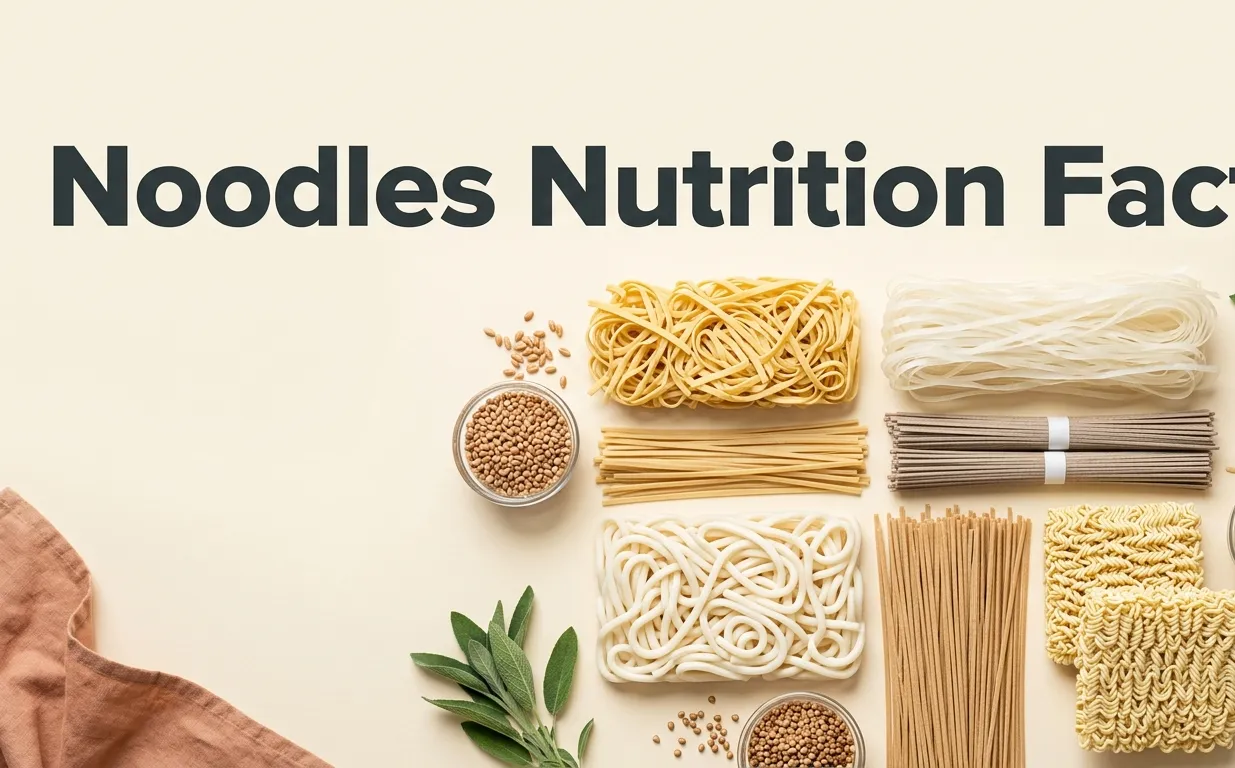
Noodles Nutrition Facts 2026: Types, Carbs, and Health Choices
Noodles nutrition facts vary enormously depending on the flour, egg content, and processing method used, making blanket statements about noodles nearly useless for anyone trying to eat well. A cup of enriched egg noodles delivers B vitamins, iron, and selenium alongside 40 grams of carbohydrate, while the same volume of buckwheat soba noodles offers a completely different nutrient package including the antioxidant rutin and higher fiber with a lower glycemic response. You are not eating “noodles” as a single food category. You are eating a specific grain formulation, and the distinction matters for your blood sugar, your satiety, and your long-term dietary pattern quality.
The USDA FoodData Central database confirms that cooked refined wheat noodles, egg noodles, rice noodles, and buckwheat noodles all land between 190 and 230 calories per cup with 38 to 44 grams of carbohydrate, but their fiber, protein, and micronutrient profiles diverge sharply. The Dietary Guidelines for Americans 2020-2025 recommend making half your grain choices whole grain, a guideline that applies directly to noodle selection and one that most restaurant noodle dishes ignore completely. Understanding what each noodle type actually brings to the bowl turns a confusing grocery aisle into a series of informed decisions.
This article walks you through every major noodle type with specific USDA-sourced numbers, explains the glycemic index differences that matter for blood sugar management, breaks down the resistant starch trick that changes how your body handles noodle carbohydrates, and gives you a clear ranking of the healthiest noodle choices you can make today. No vague claims about noodles being good or bad. Just the specific nutrition science, the comparison numbers, and the practical takeaway for your next meal.
Noodles Nutrition Facts
Noodles nutrition facts describe a category of staple foods made primarily from unleavened dough composed of grain flour, water, and often eggs or salt, then shaped and cooked by boiling. The USDA FoodData Central database provides the reference data for all major noodle types, revealing that a standard 1-cup serving of cooked enriched noodles typically provides 190 to 230 calories, 38 to 44 grams of carbohydrate, 6 to 10 grams of protein, and 1 to 5 grams of fiber depending on the grain and egg content. Refined wheat noodles undergo enrichment, a process regulated by the FDA, which replaces thiamin, riboflavin, niacin, folic acid, and iron lost during flour processing.
The nutritional value of noodles sits primarily in their carbohydrate content, which provides accessible energy, and in the enrichment package that makes refined noodles a meaningful source of B vitamins in the American food supply. Folic acid fortification of enriched grain products, including noodles, began in 1998 as a public health measure to reduce neural tube defects in newborns, and the CDC credits this program with a 35 percent reduction in these birth defects. A single cup of enriched egg noodles delivers 115 micrograms of dietary folate equivalents, roughly 29 percent of the 400-microgram daily requirement for adults.
The downside of refined noodles is what they lack. They contain minimal fiber unless made from whole grains, negligible fat beyond what egg noodles contribute, and a sodium content that depends almost entirely on whether the cooking water or sauce is salted. Plain boiled noodles contain less than 5 milligrams of sodium per cup. The sodium arrives with the seasoning packet, the soy sauce, or the stir-fry sauce added later, which is why the noodle itself is rarely the problem in a high-sodium diet.
Noodles Calories and Carbs
Noodles calories and carbs form the primary nutritional consideration for most people, with a standard 1-cup serving of cooked refined wheat or egg noodles providing approximately 220 calories and 40 grams of carbohydrate. That carbohydrate load represents roughly 15 percent of the 300-gram daily value used in FDA nutrition labeling, meaning a generous bowl of noodles can deliver half a day’s carbohydrate in a single sitting depending on portion size. The calorie and carbohydrate numbers shift modestly across noodle types, as shown in the table below.
The carbohydrate in noodles is predominantly starch, specifically amylose and amylopectin arranged in granules that gelatinize during boiling. This gelatinization makes the starch rapidly digestible, which is why freshly boiled soft noodles produce a quick blood glucose rise. Cooking time matters here. Al dente noodles, those cooked until firm rather than soft, retain a more intact starch granule structure that slows enzymatic digestion compared to overcooked noodles. The calorie count does not change, but the metabolic response does.
Portion distortion is the biggest calorie trap with noodles. Restaurant noodle dishes frequently serve two to three cups of cooked noodles in a single bowl, doubling or tripling the standard 1-cup nutrition label reference. A bowl of ramen, pad thai, or lo mein can easily deliver 400 to 600 calories from the noodles alone before adding oil, protein, or sauce. Measuring noodles at home with a measuring cup, at least the first few times, builds the portion awareness that prevents unintentional carbohydrate overload.
| Noodle Type (1 cup cooked) | Calories | Carbs (g) | Fiber (g) | Protein (g) |
|---|---|---|---|---|
| Enriched egg noodles | 221 | 40.3 | 1.9 | 7.3 |
| Rice noodles | 192 | 43.8 | 1.0 | 1.8 |
| Soba noodles (buckwheat) | 198 | 40.2 | 2.5 | 8.1 |
| Whole wheat noodles | 210 | 43.0 | 5.0 | 8.3 |
| Udon noodles | 200 | 42.0 | 1.5 | 7.0 |
| Ramen noodles (plain, no packet) | 190 | 38.0 | 1.0 | 6.5 |
Key Takeaway: A standard cup of most noodle types delivers roughly 200 to 220 calories and 40 grams of carbohydrate, but the fiber and protein differences between refined and whole-grain varieties change how your body responds to that carbohydrate load.
Noodles Protein Content
Noodles protein content ranges from a low of roughly 2 grams per cup in rice noodles to a high of 8 to 10 grams in egg noodles, whole wheat noodles, and soba noodles, making certain noodle types modestly useful for daily protein accumulation. Wheat-based noodles get their protein from gluten, the composite of gliadin and glutenin proteins that gives dough its elastic structure. Egg noodles add the protein contribution of whole eggs, boosting the total by about 1 to 3 grams per cup compared to egg-free wheat noodles.
The protein quality in wheat noodles is limited by the amino acid profile of wheat, which is low in lysine. This means wheat noodle protein should not be counted as a primary protein source in the way meat, eggs, dairy, or soy would be. Soba noodles, made from buckwheat, offer a somewhat superior amino acid profile. Buckwheat contains more lysine than wheat and provides a more balanced essential amino acid distribution, making soba protein marginally more usable for tissue synthesis than refined wheat noodle protein.
Rice noodles sit at the bottom of the noodle protein hierarchy. Made from white rice flour and water, they contain roughly 1.8 grams of protein per cup, offering minimal nutritional contribution beyond carbohydrate energy. This matters for anyone eating noodle-based meals without a protein topping. A bowl of plain rice noodles with vegetables is essentially a carbohydrate-only meal with negligible satiety protein. Adding tofu, edamame, egg, chicken, or shrimp transforms the nutritional completeness of the dish. The noodle type determines the protein starting point, but the toppings determine whether the meal meets your total protein needs.
- Egg noodles: 7.3g protein per cup — wheat gluten plus whole egg contribution
- Whole wheat noodles: 8.3g protein per cup — higher protein retention from intact wheat germ
- Soba noodles: 8.1g protein per cup — buckwheat protein with better lysine profile
- Udon noodles: 7.0g protein per cup — wheat flour protein, no egg
- Ramen noodles: 6.5g protein per cup — refined wheat flour, no egg
- Rice noodles: 1.8g protein per cup — minimal protein, essentially pure starch
Egg Noodles Nutrition
Egg noodles nutrition reflects the addition of whole eggs or egg yolks to wheat flour dough, increasing the fat, protein, and cholesterol content compared to standard wheat pasta while also enriching the noodle with choline and additional B vitamins. The USDA FoodData Central database records a 1-cup serving of cooked enriched egg noodles at 221 calories, 7.3 grams of protein, 3.3 grams of fat, 40.3 grams of carbohydrate, and 1.9 grams of fiber. The cholesterol content registers at 46 milligrams per cup, a number that concerned nutrition guidance in previous decades but sits comfortably within the current Dietary Guidelines for Americans 2020-2025 framework that no longer sets a numerical limit on dietary cholesterol.
The enrichment package in commercial egg noodles is a public health success hiding in plain sight. Enriched egg noodles are fortified with thiamin (vitamin B1), riboflavin (vitamin B2), niacin (vitamin B3), folic acid, and iron in amounts specified by the FDA’s standards of identity for enriched flour products. A single cup delivers 115 micrograms of folate, 0.3 milligrams of thiamin, 0.2 milligrams of riboflavin, 2.5 milligrams of niacin, and 2.4 milligrams of iron. For someone eating a standard American diet that includes refined grain products, egg noodles contribute non-negligible amounts of these micronutrients that are often inadequately consumed from whole food sources alone.
The fat in egg noodles comes primarily from the egg yolk, which adds unsaturated fatty acids, phospholipids, and choline. Choline, though not classified as a vitamin, is an essential nutrient recognized by the NIH for its role in methylation, cell membrane structure, and neurotransmitter synthesis. The Adequate Intake for choline is 550 milligrams per day for men and 425 milligrams for women. A cup of egg noodles contributes roughly 25 to 30 milligrams of choline, not a primary source but a meaningful addition when combined with eggs, meat, and cruciferous vegetables across the day.
Rice Noodles Nutrition
Rice noodles nutrition centers on pure refined carbohydrate with minimal protein, fiber, or micronutrients unless the manufacturer has enriched the rice flour, which is uncommon in the United States. A 1-cup serving of cooked rice noodles provides 192 calories, 43.8 grams of carbohydrate, 1.8 grams of protein, 0.3 grams of fat, and 1.0 gram of fiber according to USDA FoodData Central data. Rice noodles are essentially polished white rice in noodle form, retaining the starch and calories while losing the bran and germ where most of rice’s nutrients reside.
Rice noodles are naturally gluten-free, which positions them as a safe noodle option for the estimated 1 percent of the population with celiac disease and the larger population with non-celiac gluten sensitivity. This gluten-free status is the primary nutritional reason to choose rice noodles over wheat noodles. Rice noodles do not offer a nutritional advantage over wheat noodles for anyone who tolerates gluten. The protein content is the lowest of any major noodle type, the fiber is negligible, and the micronutrient profile is essentially blank unless the product is fortified.
The glycemic response to rice noodles tends to be rapid and high because the starch in rice flour gelatinizes quickly during cooking and digests efficiently. For someone managing postprandial blood glucose, plain rice noodles paired with vegetables and a low-fat protein source can work if portions are controlled, but the same noodles in a large restaurant portion with a sugary sauce become a significant glycemic challenge. The American Diabetes Association emphasizes that the overall meal composition and portion size matter more than the individual food, but rice noodles as the carbohydrate base leave less room for error than higher-fiber noodle alternatives.
Key Takeaway: Rice noodles are a gluten-free noodle with a clean ingredient list but minimal nutritional value beyond carbohydrate energy, making them best paired with protein, vegetables, and fat to slow digestion and improve satiety.
Soba Noodles Nutrition
Soba noodles nutrition stands apart from other noodle types because soba is made from buckwheat flour, either alone or blended with wheat flour, delivering a unique nutrient package that includes higher protein quality, more fiber, and bioactive compounds not found in wheat or rice noodles. A 1-cup serving of cooked 100-percent buckwheat soba noodles provides approximately 198 calories, 40.2 grams of carbohydrate, 8.1 grams of protein, 0.8 grams of fat, and 2.5 grams of fiber based on USDA FoodData Central composite data. The protein in buckwheat contains a more balanced essential amino acid profile than wheat, with particularly higher lysine content.
Buckwheat contains rutin, a flavonoid glycoside that research published in the Journal of Agricultural and Food Chemistry has identified as having vasoprotective and antioxidant properties. Rutin strengthens capillary walls and reduces vascular permeability, effects that have generated interest in buckwheat consumption for vascular health, though human outcome studies remain limited. Soba noodles also provide D-chiro-inositol, a compound studied for its potential role in insulin signaling, particularly in research on buckwheat consumption and type 2 diabetes management.
The practical distinction with soba noodles is the buckwheat-to-wheat ratio. Many commercial soba noodles, particularly inexpensive ones, contain 60 percent or more wheat flour with buckwheat flour making up the remainder. These wheat-dominant soba noodles lose much of the nutritional distinction that makes soba valuable. A label that reads “buckwheat flour” as the first ingredient and lists no wheat flour indicates a more nutritionally authentic product. Pure buckwheat soba noodles are also gluten-free, though cross-contamination is common in facilities that process wheat, so anyone with celiac disease must look for certified gluten-free soba specifically.
Udon Noodles Nutrition
Udon noodles nutrition reflects their simple ingredient composition: wheat flour, water, and salt, producing a thick, chewy noodle with a nutritional profile almost identical to plain refined wheat pasta. A 1-cup serving of cooked udon noodles provides approximately 200 calories, 42 grams of carbohydrate, 7 grams of protein, 0.5 grams of fat, and 1.5 grams of fiber. The sodium content of the noodle itself is low, typically under 10 milligrams per cup, because the salt used in udon dough largely dissolves into the cooking water.
Udon noodles are not typically enriched in the way egg noodles and standard pasta are in the United States. Traditional Japanese udon production does not include the addition of B vitamins or iron, meaning udon noodles purchased from Asian grocery stores or served in Japanese restaurants may lack the folic acid and iron that domestically produced enriched egg noodles provide. This distinction matters for anyone relying on enriched grain products as a meaningful part of their micronutrient intake, particularly pregnant people for whom folic acid intake is actively monitored to prevent neural tube defects.
The thick, chewy texture of udon comes from the gluten network developed through kneading and resting the dough, and this texture has a satiety advantage that the nutrition numbers alone do not capture. Foods that require more chewing tend to slow eating pace and increase oral sensory exposure, both of which contribute to earlier satiety signaling. A bowl of udon noodle soup with vegetables and a protein source is a satisfying meal that, despite its refined carbohydrate base, provides volume and eating duration that can support portion control better than a rapidly consumed bowl of thin rice noodles.
Whole Wheat Noodles Nutrition
Whole wheat noodles nutrition represents a measurable step up from refined noodles across fiber, micronutrient density, and glycemic impact. A 1-cup serving of cooked whole wheat noodles provides approximately 210 calories, 43 grams of carbohydrate, 8.3 grams of protein, 1.5 grams of fat, and 5 grams of fiber. The Dietary Guidelines for Americans 2020-2025 recommend that at least half of all grain servings come from whole grains, and choosing whole wheat noodles over refined noodles is one direct way to shift that ratio.
The fiber in whole wheat noodles includes both insoluble fiber from the bran layer, which adds bulk to stool and supports digestive regularity, and soluble fiber, which forms a gel in the small intestine that slows glucose absorption and binds cholesterol metabolites. The American Heart Association recognizes increased whole grain intake as part of a dietary pattern that reduces cardiovascular disease risk, and the 5 grams of fiber per cup in whole wheat noodles contributes meaningfully toward the 25 to 38 grams per day recommended for adults.
Whole wheat noodles retain the germ fraction of the wheat kernel, which contains vitamin E, B vitamins, magnesium, zinc, and phytochemicals that are stripped away when wheat is refined into white flour. The magnesium content in whole wheat noodles, approximately 40 milligrams per cup compared to roughly 15 milligrams in refined noodles, supports over 300 enzymatic reactions including those involved in glucose metabolism and blood pressure regulation. The trade-off is texture and taste. Whole wheat noodles are denser and nuttier, and they do not disappear into a sauce the way refined noodles do. For people transitioning from white noodles, a 50-50 blend of whole wheat and refined noodles eases the palate adjustment while still improving the nutritional profile.
Key Takeaway: Whole wheat noodles triple the fiber and double the magnesium of refined noodles while delivering the same calorie count, making them the single most impactful swap for improving the nutritional quality of a noodle-based meal.
Ramen Noodles Nutrition Facts
Ramen noodles nutrition facts describe a product that is fundamentally different from other noodles due to the alkaline salts, known as kansui, used in the dough, and the deep-frying process used in instant ramen manufacturing. A 1-cup serving of cooked plain ramen noodles without the seasoning packet provides approximately 190 calories, 38 grams of carbohydrate, 6.5 grams of protein, and 1 gram of fiber. The defining nutritional characteristic of instant ramen is the seasoning packet, which alone can contain 1,500 to 2,000 milligrams of sodium, pushing a single bowl of prepared ramen toward or past the 2,300-milligram daily sodium limit recommended by the American Heart Association.
The alkaline salts in ramen dough, typically sodium carbonate and potassium carbonate, give ramen its characteristic springy texture and slight yellow color. These salts also increase the sodium content of the noodle itself, even before the seasoning packet. Plain cooked ramen noodles contain roughly 100 to 150 milligrams of sodium per cup, higher than other unsalted boiled noodles. The deep-frying step in instant ramen production, used to dehydrate the noodle block for rapid rehydration, adds roughly 7 to 10 grams of fat per serving, predominantly from palm oil or other vegetable oils.
Instant ramen’s nutritional problems are not in the noodle itself but in the total package: the seasoning salt, the frying fat, and the near-total absence of vegetables, protein, and fiber in the typical consumption pattern. A person eating instant ramen as a meal gets a large dose of refined carbohydrate, saturated fat, and sodium with almost no micronutrient return. Discarding half the seasoning packet, adding a soft-boiled egg, a handful of spinach, and a few slices of lean protein transforms the nutritional profile from a public health concern into a reasonably balanced meal. The noodle block is the vehicle. The toppings and the sodium load are the nutrition story.
Noodles Glycemic Index
Noodles glycemic index values range from low for soba and al dente whole wheat noodles to moderate or high for overcooked rice noodles and soft refined wheat noodles, with preparation method often mattering as much as noodle type. The glycemic index, or GI, ranks carbohydrate-containing foods on a scale of 0 to 100 based on how quickly they raise blood glucose compared to pure glucose. The American Diabetes Association notes that lower-GI foods produce a slower, more gradual blood glucose rise that may help with glycemic management when used as part of an overall carbohydrate-controlled eating plan.
Soba noodles made from 100 percent buckwheat flour generally produce a lower glycemic response than refined wheat noodles due to buckwheat’s higher fiber content, higher protein, and the presence of compounds that may slow carbohydrate digestion. Whole wheat noodles cooked al dente also produce a moderate glycemic response. Refined rice noodles and soft-cooked egg noodles tend to produce a faster blood glucose rise. The table below provides the general GI ranges for common noodle types, though individual blood glucose responses vary based on the person, the meal composition, and the specific cooking method.
The concept of glycemic load, which multiplies the GI by the grams of carbohydrate in a serving and divides by 100, provides a more practical number. A cup of soba noodles with a GI of 55 and 40 grams of carbohydrate has a glycemic load of approximately 22, which is moderate. The same calculation for a restaurant bowl of rice noodles at a GI of 70 and 70 grams of carbohydrate in a large portion yields a glycemic load of 49, which is high and more likely to produce a sharp insulin response. Portion size is the multiplier that turns a moderate-GI food into a high-glycemic-load meal.
| Noodle Type | Glycemic Index (GI) | Glycemic Load (per cup) |
|---|---|---|
| Soba noodles (100% buckwheat) | 50-55 (low-moderate) | ~20 |
| Whole wheat noodles (al dente) | 45-55 (low-moderate) | ~20 |
| Udon noodles | 55-65 (moderate) | ~25 |
| Egg noodles (enriched, soft) | 60-70 (moderate) | ~27 |
| Rice noodles | 65-75 (moderate-high) | ~30 |
| Instant ramen noodles | 65-75 (moderate-high) | ~27 |
Are Noodles Healthy
Are noodles healthy depends on the noodle type, the portion size, what you pair them with, and whether you are comparing them to whole intact grains or to other refined carbohydrate sources. Whole wheat noodles and 100-percent buckwheat soba noodles sit firmly in the “generally supportive of health” category when eaten in reasonable portions as part of a dietary pattern that includes vegetables, lean protein, and healthy fats. The 5 grams of fiber in whole wheat noodles and the rutin in soba provide benefits beyond simple energy provision.
Enriched refined noodles exist in a middle ground. They are not nutritionally empty. The B vitamins and iron added through enrichment make a genuine contribution to micronutrient intake, particularly for populations whose diets rely heavily on refined grain products. A cup of enriched egg noodles provides measurable thiamin, riboflavin, niacin, folate, and iron in amounts that help meet daily requirements. Refined noodles are not a health food in the way quinoa or lentils are, but they are not junk food either. They are a staple carbohydrate source with a modest enrichment-backed micronutrient contribution.
Instant ramen with the full seasoning packet lands at the “limit this” end of the spectrum, not because noodles are inherently problematic but because the combination of refined flour, fried noodle block, and extreme sodium load creates a product that works against cardiovascular and metabolic health goals when eaten regularly. Healthiness is not a property of noodles. It is a property of noodle choice, noodle portion, and noodle context. A cup of soba in miso broth with tofu and greens is a healthy meal. A supersized bowl of instant ramen with the entire flavor packet is a sodium and saturated fat delivery system. Same category, completely different health equation.
Noodles for Weight Loss
Noodles for weight loss work when portion control, noodle type selection, and meal composition align to produce satiety on fewer total calories than the person would otherwise consume. The protein and fiber content of the noodle matters for this equation because both nutrients slow gastric emptying and trigger satiety hormones including peptide YY and GLP-1. Whole wheat noodles at 5 grams of fiber per cup and soba noodles at 2.5 grams of fiber and 8 grams of protein per cup outperform rice noodles at 1 gram of fiber and 2 grams of protein for the same calorie load.
The volume eating principle applies powerfully to noodles in broth-based dishes. A bowl of noodle soup with plenty of vegetables and a clear broth provides eating volume and eating duration that signal fullness to the brain before calorie intake climbs too high. A 2018 study published in the British Journal of Nutrition found that soup preloads reduced total meal energy intake compared to solid meals, an effect partly mediated by slower gastric emptying and increased gastric distension signaling. A noodle soup with measured noodles, abundant vegetables, and lean protein uses this physiology to create a satisfying, calorie-controlled meal.
The practical strategy for including noodles during weight loss is to make noodles the minority component of the bowl rather than the base. Fill half the bowl with vegetables and protein, then add a half-cup to one cup of noodles rather than the reverse. This maintains the eating experience and satisfaction of noodle-based meals while reducing the calorie and carbohydrate density. Cooking noodles al dente and cooling them before reheating adds a resistant starch benefit that further reduces the metabolizable calorie content, which the next section explains in detail.
Key Takeaway: Noodles fit into a weight loss eating pattern when they occupy a measured, minority share of the bowl alongside ample vegetables and protein, with whole wheat and soba noodles providing more satiety per calorie than refined rice or egg noodles.
Are Noodles Good for Diabetics
Are noodles good for diabetics requires a nuanced answer that considers noodle type, portion size, meal composition, and individual blood glucose response patterns. The American Diabetes Association does not prohibit any specific food for people with diabetes. It recommends an individualized carbohydrate intake pattern that maintains blood glucose within target ranges, and it recognizes that the total carbohydrate amount at a meal has a greater effect on blood glucose than the specific carbohydrate source.
Whole wheat noodles and buckwheat soba noodles offer advantages for glycemic management. Their fiber content slows gastric emptying, and the intact starch granule structure in al dente cooked noodles resists rapid enzymatic digestion. A small study published in the Journal of the American College of Nutrition found that buckwheat noodles produced a lower postprandial glucose and insulin response than refined wheat noodles when matched for carbohydrate content, an effect attributed to buckwheat’s fiber, protein, and D-chiro-inositol content. The portion still matters. A cup of any noodle delivers roughly 40 grams of carbohydrate, which represents a significant portion of a meal’s carbohydrate budget for someone using the plate method or carbohydrate counting.
Rice noodles and soft-cooked refined noodles present a greater glycemic challenge and should be eaten in smaller, less frequent portions by someone with diabetes unless paired with substantial protein, fat, and fiber to slow absorption. The order in which foods are eaten within a meal also influences postprandial glucose. Eating protein, vegetables, and fat before the noodle portion produces a lower glucose peak than eating the noodles first, an effect demonstrated in research from Weill Cornell Medical College and applicable to anyone aiming to blunt a post-meal glucose spike. A person with diabetes who wants to eat noodles should work with a registered dietitian or certified diabetes care and education specialist to determine the appropriate portion and meal composition for their individual glycemic response.
Stir-Fried Noodles Nutrition
Stir-fried noodles nutrition adds a significant fat and calorie layer to the base noodle profile because noodles absorb cooking oil readily during high-heat wok cooking. A standard 1-cup serving of stir-fried noodles prepared with 1 tablespoon of vegetable oil delivers approximately 290 to 320 calories, 42 grams of carbohydrate, 12 to 14 grams of fat, and 7 grams of protein, compared to roughly 200 to 220 calories for the same noodles boiled and drained. The oil absorption is the variable that transforms a moderate-calorie carbohydrate base into a calorie-dense meal component.
The oil quality and quantity in stir-fried noodle dishes vary enormously between home cooking and restaurant preparation. Restaurant wok cooking uses more oil, often 2 to 3 tablespoons per serving, because the high heat and large wok surface area require enough oil to prevent sticking and to achieve the rapid heat transfer that defines stir-fry texture. That quantity of oil adds 240 to 360 calories from fat alone to the dish, independent of the noodle base. Soy sauce, hoisin, oyster sauce, and other stir-fry sauces add sodium and sugar. A restaurant plate of chicken lo mein can deliver 800 to 1,200 calories and 2,000 to 3,000 milligrams of sodium in a single entrée.
Home stir-fried noodles can be a reasonable meal when you control the oil quantity, sauce ingredients, and vegetable-to-noodle ratio. A nonstick wok or large skillet allows adequate heat transfer with half the oil of a traditional carbon steel wok. Measuring 1 teaspoon of oil per serving, using low-sodium soy sauce or coconut aminos, and loading the pan with bell peppers, broccoli, snap peas, carrots, and mushrooms before adding a half-cup of cooked noodles creates a stir-fry that delivers the eating experience without the calorie and sodium overload. The noodle is the supporting actor, not the lead.
Resistant Starch Noodles
Resistant starch noodles refer to a preparation technique, not a specific noodle variety, that changes the digestibility of the starch in cooked and cooled noodles, reducing the effective calorie and glycemic impact. When starchy foods like wheat noodles, rice noodles, or potatoes are cooked and then cooled, some of the gelatinized starch undergoes retrogradation, a process where the starch molecules reorganize into a crystalline structure that resists digestion by human enzymes in the small intestine. This type 3 resistant starch passes into the large intestine where gut bacteria ferment it into short-chain fatty acids.
The practical implication for noodle eaters is measurable. A 2014 study published in the American Journal of Clinical Nutrition found that consuming cooked and cooled pasta reduced the postprandial blood glucose response by approximately 20 to 30 percent compared to freshly cooked hot pasta with the same carbohydrate content. The effect applies to noodles as well, particularly wheat-based noodles where the amylose content is high enough to form stable resistant starch crystals upon cooling. Reheating the cooled noodles does not eliminate the resistant starch fraction. The crystalline structure partially survives reheating, meaning a batch-cooked, refrigerated, and reheated noodle dish retains some of the resistant starch benefit.
To maximize resistant starch in noodles:
- Cook noodles in boiling water until al dente, slightly firmer than you would normally eat them.
- Drain, rinse briefly with cool water to halt cooking, and spread on a tray to cool completely.
- Refrigerate the noodles for at least 4 hours, preferably overnight, to allow full starch retrogradation.
- Reheat gently in a microwave or by quick stir-frying and serve. The noodles will have a slightly firmer texture and a lower effective glycemic impact.
This technique works with wheat noodles, egg noodles, rice noodles, and soba noodles, though the resistant starch yield is highest with higher-amylose wheat varieties and whole grain noodles where the fiber matrix provides additional digestion resistance.
Key Takeaway: Cooking noodles, cooling them in the refrigerator for at least four hours, and reheating them before eating can reduce the blood glucose response by roughly 20 to 30 percent without changing the food you are eating, a practical trick that costs nothing and requires no new ingredients.
Noodles vs Rice Nutrition
Noodles vs rice nutrition pits two global staple carbohydrates against each other with differences in protein, fiber, glycemic response, and micronutrient profile depending on which specific noodle and which specific rice are compared. A 1-cup serving of cooked enriched egg noodles provides 221 calories, 40.3 grams of carbohydrate, 7.3 grams of protein, and 1.9 grams of fiber. A 1-cup serving of cooked white rice provides 205 calories, 44.5 grams of carbohydrate, 4.3 grams of protein, and 0.6 grams of fiber. Noodles generally offer more protein and fiber per calorie than white rice, though brown rice closes the gap with 3.5 grams of fiber per cup.
The enrichment factor gives refined noodles an edge over unenriched white rice in B-vitamin and iron content. Enriched noodles contain added folic acid, thiamin, riboflavin, niacin, and iron at levels specified by FDA standards. White rice sold in the United States is often enriched as well, but the enrichment levels and the specific nutrients added differ by product. Brown rice, like whole wheat noodles, contains its natural germ and bran nutrients without needing enrichment, including magnesium, selenium, and B vitamins in their naturally occurring forms.
Choosing between noodles and rice for a given meal is less important than the overall dietary pattern, the portion size, and what accompanies the carbohydrate. Both noodles and rice serve as neutral carbohydrate bases that absorb the flavors of sauces, proteins, and vegetables. A plate of noodles with vegetables and grilled chicken is nutritionally comparable to a bowl of rice with the same toppings. The carbohydrate type matters less than the carbohydrate quantity and the company it keeps.
| Nutrient (per 1 cup cooked) | Egg Noodles (enriched) | White Rice | Brown Rice | Whole Wheat Noodles |
|---|---|---|---|---|
| Calories | 221 | 205 | 218 | 210 |
| Carbs (g) | 40.3 | 44.5 | 45.8 | 43.0 |
| Protein (g) | 7.3 | 4.3 | 5.0 | 8.3 |
| Fiber (g) | 1.9 | 0.6 | 3.5 | 5.0 |
| Iron (mg) | 2.4 | 1.9 | 0.8 | 1.5 |
| Folate (mcg) | 115 | 110 | 10 | 15 |
Healthiest Noodles to Eat
Healthiest noodles to eat ranks noodle types based on fiber content, protein quality, micronutrient density, glycemic impact, and ingredient simplicity, providing a clear hierarchy for anyone standing in a grocery aisle or ordering from a menu. The ranking that follows comes from the nutritional data explored throughout this article and reflects the consensus of dietary guidelines and clinical research on grain-based carbohydrate quality.
100-percent buckwheat soba noodles claim the top position. They combine 8 grams of protein with a favorable amino acid profile, 2.5 grams of fiber, a low-to-moderate glycemic index, and the unique bioactive compound rutin. The ingredient list on a pure soba package contains two items: buckwheat flour and water. The caveat is that many commercial soba noodles blend in wheat flour, so label reading is non-negotiable. Whole wheat noodles follow closely with 5 grams of fiber per cup, 8 grams of protein, and retention of the wheat germ’s magnesium, zinc, and vitamin E. They are widely available, generally affordable, and substitute one-for-one in any noodle recipe.
Enriched egg noodles occupy the middle tier. They provide B vitamins and iron through fortification, modest protein from eggs, and a familiar texture that makes them an accessible choice for people not ready to switch to whole grain noodles. Udon noodles and rice noodles sit at the lower end of the healthiness ranking, not because they are harmful but because they offer minimal fiber, modest protein, and no enrichment in most cases. They are carbohydrate delivery vehicles without the nutritional extras that distinguish higher-ranked options. Instant ramen with the seasoning packet falls to the bottom due to its sodium load and frying fat, a product best treated as occasional convenience food rather than a dietary staple.
Quick Tip:
- Look for “100% buckwheat flour” as the first and only flour ingredient on soba noodle packages to get the full nutritional benefit.
- Blend whole wheat and refined noodles 50-50 for a transitional swap that keeps the texture familiar while doubling the fiber.
- Ignore “vegetable noodles” made from refined flour with spinach or tomato powder added for color. They are nutritionally identical to refined noodles.
Key Takeaway: The healthiest noodle is 100-percent buckwheat soba for its fiber, protein, rutin, and lower glycemic impact, followed by whole wheat noodles, with enriched egg noodles as a reasonable middle option and instant ramen as a once-in-a-while food rather than a staple.
Frequently Asked Questions About Noodles Nutrition Facts
How many calories are in a cup of cooked noodles?
A 1-cup serving of most cooked noodles provides between 190 and 230 calories depending on the type.
Egg noodles sit at the higher end at 221 calories per cup while rice noodles and ramen noodles land closer to 190 to 192 calories per cup.
The calorie difference between noodle types is modest, and the sauce, oil, and toppings contribute far more to the total meal calorie count than the noodle choice itself.
Are egg noodles healthier than regular pasta?
Egg noodles and regular refined pasta are nutritionally similar, with egg noodles providing slightly more protein and fat due to the egg content and a comparable enrichment package of B vitamins and iron.
The egg addition contributes choline and modest amounts of vitamin D and vitamin B12 not found in egg-free pasta.
Neither egg noodles nor refined pasta offer significant fiber, so the health comparison between them is less important than choosing a whole grain version of either option.
Do noodles have any nutritional value?
Yes, noodles have nutritional value, particularly enriched noodles which provide meaningful amounts of thiamin, riboflavin, niacin, folic acid, and iron through FDA-regulated fortification.
Whole wheat noodles add 5 grams of fiber, magnesium, and zinc that refined noodles lack.
Noodles are not empty calories when they come from enriched or whole grain flours, though their primary nutritional contribution remains carbohydrate energy.
What is the healthiest type of noodle to eat?
100-percent buckwheat soba noodles are the healthiest noodle choice due to their balanced protein profile, 2.5 grams of fiber, lower glycemic index, and the presence of the antioxidant rutin.
Whole wheat noodles follow closely with 5 grams of fiber per cup and retention of wheat germ nutrients.
Check soba noodle labels carefully because many brands blend buckwheat with refined wheat flour, reducing the nutritional advantage.
Can I eat noodles and still lose weight?
Yes, you can eat noodles during weight loss by keeping portions to 1 cup cooked, choosing whole wheat or soba noodles for higher fiber and satiety, and filling half your bowl with vegetables and lean protein.
The total calorie deficit determines weight loss, not any single food’s presence or absence.
Noodles in broth-based soups and stir-fries with measured oil provide satisfying volume for the calorie cost.
What are noodles made of?
Most noodles are made from unleavened dough consisting of grain flour, water, and sometimes eggs or salt, which is rolled, cut, and boiled.
Wheat flour is the most common base, with egg noodles adding whole eggs, rice noodles using rice flour, soba noodles using buckwheat flour, and udon noodles using wheat flour and salted water.
Ramen noodles differ by including alkaline salts called kansui that give them their springy texture and characteristic yellow color.
Noodles are not one food with one nutritional profile. They are a category that spans from fiber-rich whole wheat and protein-balanced buckwheat soba to rapidly digested rice noodles and sodium-heavy instant ramen. The noodle you choose, the portion you pour into the pot, and what you pile on top of it matter far more than whether noodles as a category are good or bad.
Look for 100-percent buckwheat soba noodles or whole wheat noodles as your defaults. Cook them al dente. Cool and reheat them when you can for the resistant starch advantage. Fill your bowl with vegetables and protein first, then add a measured cup of noodles. If enriched egg noodles are what your family eats and enjoys, they provide genuine B-vitamin and iron value within a balanced plate.
Instant ramen with the full packet is the one noodle product that deserves genuine caution, not because of the noodle but because of the sodium and saturated fat that arrive with it. Ditch half the seasoning, add a soft-boiled egg and a handful of greens, and you have transformed a nutritional problem into a reasonable meal. The noodle is never the whole story.