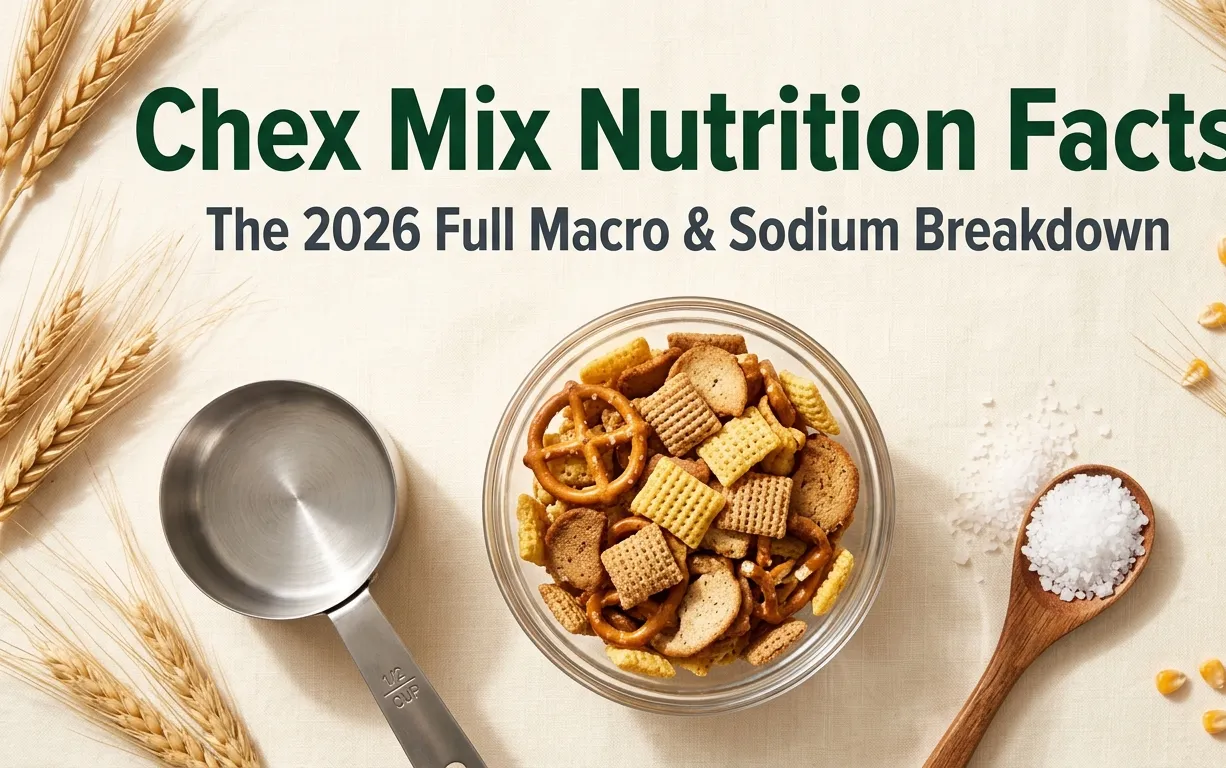
Chex Mix Nutrition Facts 2026: Full Macro and Sodium Breakdown
A standard 1/2 cup serving of Chex Mix Traditional contains 120 calories, 21 grams of carbohydrate, 250 milligrams of sodium, and 2 grams of protein, which places it squarely in the category of processed snack foods that provide quick energy but minimal nutritional density relative to their calorie and sodium load. The numbers on the label tell a specific story about what you are eating, and whether that story works for your diet depends on which numbers you are watching most closely.
The American Heart Association recommends that adults limit sodium intake to no more than 2,300 milligrams per day, with an ideal limit of 1,500 milligrams for individuals with high blood pressure or other cardiovascular risk factors. A single 1/2 cup serving of Chex Mix Traditional uses about 11 percent of the 2,300 mg limit. Most people consume closer to a full cup or more in one sitting, which doubles the sodium hit and occupies a larger chunk of the daily sodium budget than most snackers realize.
This article breaks down every line on the Chex Mix nutrition facts panel, explains what the numbers mean for your daily eating pattern, compares all the major varieties side by side, and gives you practical alternatives if you love the salty crunch but want something that works better for your health goals.
Chex Mix Nutrition Facts
The complete nutrition facts panel for Chex Mix Traditional, based on a 1/2 cup serving weighing 29 grams, is sourced from the USDA FoodData Central database and the official General Mills product labeling. Every number on the panel reflects the multi-grain cereal, pretzel, and seasoned cracker composition that defines this product.

The full macro and micro breakdown per serving is presented in the table below:
| Nutrient | Amount per 1/2 cup (29g) | % Daily Value |
|---|---|---|
| Calories | 120 | — |
| Total Fat | 3.5g | 4% |
| Saturated Fat | 0.5g | 3% |
| Trans Fat | 0g | — |
| Cholesterol | 0mg | 0% |
| Sodium | 250mg | 11% |
| Total Carbohydrate | 21g | 8% |
| Dietary Fiber | 1g | 4% |
| Total Sugars | 2g | — |
| Added Sugars | less than 1g | 1% |
| Protein | 2g | — |
| Iron | 0.7mg | 4% |
| Thiamin | — | 4% |
| Riboflavin | — | 2% |
| Niacin | — | 4% |
| Folic Acid | — | 2% |
The micronutrient contributions come from the enriched flour used in the Chex cereal pieces and pretzels. Enrichment is a process where thiamin, riboflavin, niacin, folic acid, and iron are added back to refined wheat flour after processing removes the naturally occurring vitamins and minerals found in the whole grain. The resulting percentages represent modest contributions to daily needs and do not compensate for the sodium and refined carbohydrate content.
The Dietary Guidelines for Americans 2020-2025 classify foods like Chex Mix as items that should be consumed in limited quantities because they contribute calories, sodium, and refined carbohydrates without providing meaningful amounts of the nutrients that many Americans underconsume, including dietary fiber, potassium, calcium, and vitamin D. A food that delivers 11 percent of your daily sodium budget but only 4 percent of your daily fiber needs is not pulling its nutritional weight.
Key Takeaway: Chex Mix Traditional delivers 120 calories and 250 mg of sodium per half-cup with only modest B-vitamin and iron contributions from enriched flour, making it a food that provides energy and salt without much nutritional depth.
Chex Mix Calories
A 1/2 cup serving of Chex Mix Traditional contains 120 calories, but the more realistic consumption for most snackers is a full cup, which delivers 240 calories and represents the caloric equivalent of a small meal without the satiety that solid food with protein and fiber would provide. The calorie density of this product comes primarily from refined carbohydrates and added oils rather than from filling nutrients.
The calorie breakdown by macronutrient shows that carbohydrates contribute approximately 84 calories or 70 percent of the total, fat contributes about 32 calories or 27 percent, and protein contributes about 8 calories or 7 percent. This distribution is typical of grain-based snack foods where refined flour and vegetable oil are the primary ingredients. The calories from fat come from the soybean, canola, or palm oil used in the seasoning blend and in the baking process for the pretzels and crackers.
Empty calories, a term used in the Dietary Guidelines for Americans, refers to calories from added sugars and solid fats that provide energy without accompanying nutritional benefits. Chex Mix Traditional does not contain meaningful added sugar, but the refined grain calories and the oil-based fat calories fit the empty calorie description because they displace opportunities to consume nutrient-dense foods. Someone who snacks on 240 calories of Chex Mix in the afternoon has consumed calories that could have come from an apple with peanut butter, which would provide fiber, healthy fat, potassium, and lasting satiety.
For weight management, the practical concern with calorie-dense snack foods like Chex Mix is not the food itself but the portion creep that occurs when eating directly from the bag. A 2022 study published in the journal Appetite found that people who consumed snacks directly from multi-serving packages ate an average of 34 percent more than those who portioned out a single serving onto a plate or into a bowl. The study reinforces what portion control research has shown for years: the package size strongly influences consumption volume regardless of hunger level.
Key Takeaway: At 240 calories for a typical one-cup handful, Chex Mix uses a meaningful portion of the daily calorie budget without providing the fullness signals that help regulate intake naturally.
Chex Mix Carbs
A 1/2 cup serving of Chex Mix Traditional contains 21 grams of total carbohydrate, of which only 1 gram is dietary fiber, resulting in 20 grams of net carbohydrate that the body digests and absorbs rapidly. This carbohydrate profile reflects the product’s foundation of refined wheat flour, corn flour, and rice flour with minimal whole grain content.
The carbohydrate sources in Chex Mix Traditional include enriched wheat flour in the pretzels and cracker pieces, whole grain corn and degermed yellow corn flour in the corn Chex pieces, and rice flour in the rice Chex pieces. The variety of grain sources gives the product its signature mix of textures and shapes, but the refining process strips away the bran and germ from most of these grains. The bran contains fiber. The germ contains healthy fats and additional micronutrients. What remains after refining is the starchy endosperm, which digests quickly into glucose.
The glycemic impact of a food made primarily from refined grains is higher than that of the same calories from intact whole grains. A 2021 review in the journal Nutrients examined the glycemic response to various snack foods and found that refined grain snacks produced blood glucose spikes approximately 40 percent higher than whole grain alternatives matched for calorie content. The rapid digestion of refined carbohydrates triggers a sharper insulin release from the pancreas, which can contribute to rebound hunger and overeating at the next meal.
For individuals with diabetes, prediabetes, or insulin resistance, the 20 grams of net carbohydrate per half-cup serving requires consideration within their total meal and snack carbohydrate budget. The American Diabetes Association emphasizes that total carbohydrate intake matters more than the specific source for blood glucose management, but the rapid absorption rate of refined grains means the glucose from Chex Mix enters the bloodstream faster than the same grams of carbohydrate from beans, lentils, or steel-cut oatmeal.
Key Takeaway: The 20 grams of net carbs per serving come mostly from refined grain flours that digest quickly and provide minimal fiber, which is why Chex Mix is not a filling snack despite its calorie density.
Chex Mix Sodium
A 1/2 cup serving of Chex Mix Traditional contains 250 milligrams of sodium, which represents 11 percent of the American Heart Association’s recommended daily limit of 2,300 milligrams for healthy adults. For the estimated 47 percent of American adults with hypertension according to the CDC, the AHA recommends an ideal limit of 1,500 milligrams per day, against which this single serving uses nearly 17 percent of the entire daily allowance.
The sodium in Chex Mix comes from multiple sources in the ingredient list. Salt is added directly. Monosodium glutamate contributes both sodium and the savory umami flavor that characterizes the product. Hydrolyzed soy protein, yeast extract, and baking soda in the pretzel and cracker components add additional sodium. This multi-source sodium delivery system makes it difficult to identify a single ingredient responsible for the saltiness because the product is engineered to deliver a consistent flavor experience from several sodium-containing compounds working together.
Sodium intake from processed snack foods is a known contributor to the average American sodium consumption of approximately 3,400 milligrams per day, which exceeds the AHA limit by nearly 50 percent. The Dietary Guidelines for Americans 2020-2025 identify snack foods, mixed dishes, and restaurant meals as the primary drivers of excess sodium in the American diet. A person who snacks on a full cup of Chex Mix and eats a frozen dinner for lunch has likely consumed more than half of their daily sodium allowance before dinner even begins.
The health implications of chronic high sodium intake are well-documented. The AHA states that excess sodium consumption is associated with elevated blood pressure, which increases the risk of heart disease, stroke, and kidney disease. The relationship is dose-dependent, meaning each incremental increase in sodium intake corresponds to a measurable increase in blood pressure across populations. Reducing sodium intake from the current average of 3,400 mg toward the recommended 2,300 mg would yield population-level reductions in cardiovascular disease incidence.
Chex Mix Protein
A 1/2 cup serving of Chex Mix Traditional contains 2 grams of protein, which contributes approximately 4 percent of the Daily Value and represents a negligible contribution to daily protein needs for adults. The protein comes primarily from the wheat gluten in the flour used for the pretzels and cracker pieces, with small additional contributions from the corn and rice flours.
The Academy of Nutrition and Dietetics recommends that adults consume 0.8 grams of protein per kilogram of body weight as a minimum, which translates to approximately 56 grams per day for a 70-kilogram adult. At 2 grams per serving, Chex Mix provides less than 4 percent of that requirement. A person would need to consume 14 cups of Chex Mix, totaling over 1,600 calories and 3,500 milligrams of sodium, to meet their daily protein needs through this food alone, which illustrates how poorly suited processed snack foods are as protein sources.
The low protein content matters for satiety. Protein is the most satiating macronutrient, and snacks that contain meaningful protein reduce hunger and subsequent food intake more effectively than snacks that are predominantly carbohydrate. A 2023 study in the Journal of Nutrition found that afternoon snacks containing at least 10 grams of protein led to a 15 percent reduction in calories consumed at the following meal compared to snacks matched for calories but containing only 2 to 3 grams of protein.
Snack foods like Chex Mix that combine refined carbohydrates with minimal protein create a satiety gap. The calories enter the body, the blood glucose rises, the insulin responds, but the brain’s hunger signaling receives only a weak satiety signal because the protein content is insufficient to trigger the full cascade of appetite-regulating hormones like peptide YY and cholecystokinin. This mismatch between calorie density and satiety potential is one reason processed snack foods are easy to overconsume.
Key Takeaway: With just 2 grams of protein per serving, Chex Mix provides almost no meaningful contribution to daily protein needs or to the satiety signals that help you feel satisfied after eating.
Chex Mix Sugar Content
Chex Mix Traditional contains 2 grams of total sugar per 1/2 cup serving, with less than 1 gram classified as added sugar. The savory varieties of Chex Mix are not significant sources of sugar, which distinguishes them from sweet snack mixes and many other processed snack foods that rely on sugar for flavor.
The small amount of sugar in the Traditional variety comes primarily from dextrose and corn syrup solids used in the seasoning blend to balance the salt and enhance browning during the baking process. These sugars are listed toward the end of the ingredient statement, indicating they are present in small quantities relative to the grain and oil ingredients. The savory flavor profile of Traditional Chex Mix relies on salt, MSG, and yeast extracts rather than sugar for its taste appeal.
This low sugar content is a nutritional positive relative to many competing snack foods. A comparison of popular snack items shows that Chex Mix Traditional contains far less sugar than granola bars, flavored popcorn, sweet trail mixes, and even some brands of crackers that add sugar to enhance browning and flavor. The FDA considers foods with less than 1 gram of added sugar per serving to meet the criteria for low added sugar content.
However, the absence of sugar does not make the product a health food. The sodium, refined carbohydrates, and low fiber and protein content remain the nutritional considerations that matter. Savory snacks with low sugar can be deceptively positioned as healthier options when the real nutritional liability is the sodium and refined grain content, not the sugar. Consumers who focus exclusively on sugar avoidance may overlook the sodium and refined carbohydrate content that affects cardiovascular and metabolic health through different mechanisms.
Key Takeaway: Chex Mix Traditional is genuinely low in sugar with less than 1 gram of added sugar per serving, but this benefit is offset by the sodium and refined carbohydrate content that are the product’s real nutritional considerations.
Chex Mix Ingredients
The ingredient list for Chex Mix Traditional, as published by General Mills on the product packaging, includes whole wheat, degermed yellow corn meal, enriched flour, vegetable oil, rye flour, salt, sugar, monosodium glutamate, yeast, hydrolyzed soy protein, and various seasoning compounds. Understanding what each category of ingredient does in the product helps make sense of the nutrition numbers.
The grain ingredients form the structural base. Whole wheat provides the wheat Chex pieces. Degermed yellow corn meal forms the corn Chex pieces. Enriched flour, which is wheat flour with added thiamin, riboflavin, niacin, folic acid, and iron, makes up the pretzels and some of the cracker pieces. Rye flour creates the distinctive rye chips that many consumers consider the highlight of the mix. Each grain brings a different texture and flavor profile, and the combination creates the varied eating experience that defines the product.
The fat sources include soybean oil, canola oil, and palm oil. These vegetable oils are used in the baking process and in the seasoning blend to carry fat-soluble flavors and create the crispy texture. The small amount of saturated fat, 0.5 grams per serving, comes primarily from the palm oil. The 2020-2025 Dietary Guidelines for Americans recommend that saturated fat account for less than 10 percent of total daily calories, and the amount in a serving of Chex Mix is modest.
The seasoning system is where the sodium accumulates. Salt is the primary sodium source. Monosodium glutamate provides umami depth and contributes additional sodium. Hydrolyzed soy protein adds savory flavor and more sodium. Yeast extract, a natural source of glutamates, enhances the overall savory profile. Onion powder and garlic powder round out the seasoning. This combination of sodium sources is designed to create a flavor that is difficult to replicate with salt alone, which is why simply choosing a “low sodium” version or rinsing the product does not fully address the sodium concern.
Key Takeaway: The ingredient list reveals a product built from refined grains, vegetable oils, and a multi-source sodium delivery system that together create the addictive savory crunch that makes portion control genuinely difficult.
Chex Mix Serving Size
The serving size for Chex Mix Traditional is 1/2 cup, which weighs 29 grams and contains approximately 15 to 18 individual pieces of cereal, pretzels, and rye chips depending on the exact mix in each bag. This serving size is determined by the FDA’s Reference Amounts Customarily Consumed regulations, which establish the standard serving size for snack mixes at 30 grams based on national food consumption survey data.
Most consumers who open a bag of Chex Mix do not measure out 1/2 cup into a bowl. A 2023 study published in the journal Appetite found that when people were given a standard-size bag of snack mix and asked to pour themselves a typical portion, the average serving was 1.4 cups, nearly three times the labeled serving size. At 1.4 cups, the calorie count jumps from 120 to approximately 336 calories, and the sodium increases from 250 milligrams to 700 milligrams, which is 30 percent of the daily AHA sodium limit.
The disconnect between labeled serving size and actual consumption is not unique to Chex Mix and is not an attempt by the manufacturer to deceive consumers. It reflects a regulatory system where serving sizes are based on aggregate consumption data that may not represent how any individual person actually eats the product. The FDA updated serving size regulations in 2016 to better reflect actual consumption patterns, and for many food categories the serving sizes increased, but the update did not perfectly align every product’s serving size with real-world eating behavior.
Practical portion control for snack foods requires tools. Pouring the snack into a small bowl or onto a plate rather than eating directly from the bag creates a visual stopping point that the bag alone does not provide. Pre-portioning an entire bag into small containers or snack-sized bags when you first open it eliminates the constant decision-making that leads to overconsumption. These strategies are recommended by registered dietitians not because the food is forbidden but because the food is specifically engineered to be difficult to stop eating once you start.
Is Chex Mix Healthy
Chex Mix is not a health food and should be classified as an occasional indulgence rather than a regular dietary staple, primarily because of its sodium content, refined grain base, and low fiber and protein profile relative to its calorie density. The question “is it healthy” is less useful than asking “how does it fit into the rest of my diet,” because no single food determines the healthfulness of an overall eating pattern.
The Dietary Guidelines for Americans 2020-2025 provide a framework for evaluating where foods like Chex Mix fit. The guidelines state that approximately 85 percent of daily calories should come from nutrient-dense foods that provide vitamins, minerals, fiber, and other beneficial compounds. The remaining 15 percent, about 250 to 350 calories on a 2,000 calorie diet, is available for added sugars, saturated fat, and foods that provide enjoyment but limited nutritional value. Within this framework, a 1/2 cup serving of Chex Mix at 120 calories can fit into the discretionary calorie allowance as long as the rest of the day’s eating is nutrient-dense.
A registered dietitian would likely classify Chex Mix as a “sometimes food” that can be included in a balanced diet when portion size is controlled and the rest of the day’s sodium and refined carbohydrate intake is considered. The key variable is frequency. Someone who snacks on Chex Mix once or twice a week as part of an otherwise vegetable-rich, whole-food dietary pattern is making a different nutritional choice from someone who eats several servings daily alongside a diet already high in processed foods and sodium.
The alternative framing that nutrition professionals use is the 80/20 principle: aim for nutrient-dense, minimally processed foods about 80 percent of the time, and allow flexibility for foods that provide enjoyment but less nutritional value the other 20 percent. Within this framework, Chex Mix falls into the 20 percent category, not because it is forbidden but because it does not contribute meaningfully to meeting daily nutrient needs while it does contribute meaningfully to sodium and refined carbohydrate intake.
Key Takeaway: Chex Mix fits best as an occasional snack within a mostly whole-food diet, and it becomes a nutritional liability only when portion sizes and frequency of consumption exceed what the discretionary calorie budget can reasonably accommodate.
Chex Mix Varieties Nutrition Comparison
General Mills produces multiple Chex Mix varieties, and the nutritional profiles differ based on the seasoning type, inclusion of additional ingredients like cheese powder or nuts, and the specific grain blend used in each formulation. Comparing the major varieties side by side reveals meaningful nutritional differences that can guide consumer choice.
The table below compares the standard nutrition facts for four popular Chex Mix varieties, all based on a 1/2 cup serving size as stated on each product’s label:
| Nutrient | Traditional | Cheddar | Bold Party Blend | Max’d Buffalo |
|---|---|---|---|---|
| Calories | 120 | 130 | 130 | 140 |
| Total Fat | 3.5g | 4g | 4g | 5g |
| Sodium | 250mg | 280mg | 290mg | 340mg |
| Total Carbs | 21g | 20g | 21g | 19g |
| Protein | 2g | 2g | 2g | 2g |
The Cheddar variety adds cheese powder, which increases the fat and sodium content slightly while the carbohydrate count remains similar to Traditional. The cheese seasoning contains milk-derived ingredients, which adds an allergen consideration for individuals with dairy sensitivity.
Bold Party Blend incorporates a spicier, more intense seasoning mix that drives the sodium up to 290 milligrams per serving. This variety also tends to include a higher proportion of the intensely seasoned cracker pieces and fewer of the plainer cereal components, which changes the eating experience and may affect how quickly a person reaches for another handful.
Max’d Buffalo represents the most calorically dense and sodium-heavy option in the lineup. At 340 milligrams of sodium per half-cup serving, it uses nearly 15 percent of the AHA daily sodium limit and over 22 percent of the 1,500 milligram recommendation for individuals with hypertension.
Key Takeaway: The Traditional variety is the lowest in calories and sodium among the major Chex Mix varieties, and consumers who want the flavor experience with the least nutritional impact should choose Traditional or measure their portions carefully with the more intensely seasoned options.
Chex Mix Traditional Nutrition
Chex Mix Traditional, the original variety that started the product line, remains the nutritional baseline against which all other Chex Mix products can be compared. Its formulation includes the classic combination of corn Chex, wheat Chex, rice Chex, pretzels, rye chips, and the signature seasoned salt and MSG seasoning blend.
The grain diversity in Traditional Chex Mix means the product contains multiple types of refined flour, each with slightly different carbohydrate absorption characteristics. Wheat flour provides gluten, which gives the pretzels and crackers their structure and chew. Corn flour provides a sweeter, softer crunch in the corn Chex pieces. Rice flour creates the lightest, crispiest texture in the rice Chex. Rye flour produces the dense, crunchy rye chips. This variety of grain sources creates an eating experience that changes with each handful, which is part of the product’s enduring appeal.
The nutritional trade-offs in the Traditional variety are straightforward. You get a salty, crunchy, savory snack that provides quick energy from refined carbohydrates with a small amount of protein and fiber. You also get 11 percent of your daily sodium budget in a half-cup serving that provides only 120 calories and minimal satiety. For most people, this trade-off is acceptable on an occasional basis and problematic only when the product becomes a daily habit or when portion sizes exceed the labeled serving.
The Traditional variety has remained essentially unchanged in its nutritional profile since the product’s introduction, which is notable in an era where many processed foods have been reformulated to reduce sodium or increase whole grain content. General Mills has introduced lower-sodium versions and whole grain claims on some Chex cereal products, but the Traditional Chex Mix formulation has not undergone a nutrition-focused reformulation that would alter its core numbers.
Chex Mix Cheddar Nutrition
Chex Mix Cheddar contains 130 calories, 4 grams of total fat, and 280 milligrams of sodium per 1/2 cup serving, making it slightly higher in calories, fat, and sodium than the Traditional variety. The difference comes entirely from the addition of cheddar cheese powder and the oil used to adhere it to the cereal and pretzel pieces.
The cheese powder in Cheddar Chex Mix is made from whey, cheddar cheese, milkfat, salt, and natural flavor. These dairy-derived ingredients add the recognizable cheddar taste but also introduce milk allergens, saturated fat from the cheese and butter components, and additional sodium beyond what the Traditional seasoning blend provides. The 0.5 grams of saturated fat in the Traditional variety increases to approximately 0.5 to 1 gram in the Cheddar variety depending on the exact formulation.
Cheese-flavored snacks as a category tend to be higher in sodium than their plain or salted counterparts. The cheese powder requires salt to bring out the cheese flavor, and the combination of the base seasoning blend plus the cheese seasoning creates a cumulative sodium effect that pushes the total higher than either seasoning system would produce alone. The 280 milligrams of sodium in Cheddar Chex Mix is 12 percent higher than the 250 milligrams in Traditional.
Consumers who prefer the cheddar flavor but want to manage sodium intake might consider alternating between the Cheddar and Traditional varieties or mixing the two together to reduce the average sodium per serving. This approach preserves the cheese flavor experience while cutting the sodium by about 15 percent compared to eating Cheddar alone.
Key Takeaway: Cheddar Chex Mix adds cheese powder that increases the calorie, fat, and sodium content, and the 280 milligrams of sodium per serving makes portion control important for anyone monitoring their salt intake.
Chex Mix Bold Party Blend Nutrition
Chex Mix Bold Party Blend delivers 130 calories and 290 milligrams of sodium per 1/2 cup serving, with an intensified seasoning profile that makes it the second-highest sodium option in the standard Chex Mix lineup. The “bold” designation refers to the heavier application of seasoning and the inclusion of spicier flavor notes.
The seasoning system in Bold Party Blend includes the standard salt, MSG, and yeast extract base found in Traditional, plus additional spices, garlic powder, onion powder, and natural smoke flavor that create a more intense taste. The heavier seasoning application directly increases the sodium content. Each piece in the Bold Party Blend carries more surface seasoning than its Traditional counterpart, which means the sodium is more concentrated and the flavor is more intense.
Flavor intensity can affect consumption behavior. A 2023 study in the journal Food Quality and Preference found that more intensely flavored snack foods were consumed in smaller quantities per sitting than milder versions because the flavor saturation point was reached more quickly. This suggests that a person might eat less Bold Party Blend than Traditional in a single sitting, which would offset some of the per-serving sodium difference. However, this effect varies by individual, and the study’s controlled conditions may not perfectly translate to casual at-home snacking.
The Bold Party Blend also tends to include a different mix of pieces than Traditional. The proportion of heavily seasoned cracker pieces and rye chips is higher, while the plainer cereal pieces are reduced. This changes the average sodium per piece and means that even a small handful may contain more sodium than the same volume of Traditional because each piece is individually saltier.
Homemade Chex Mix Nutrition
Homemade Chex Mix allows for full control over the ingredient list, which means the nutritional profile can be significantly improved compared to the store-bought version without sacrificing the satisfying crunch and savory flavor that make the snack appealing. A homemade version can reduce sodium by 40 to 60 percent, increase fiber and healthy fat content, and eliminate MSG entirely.
The table below compares a standard homemade Chex Mix recipe to the store-bought Traditional version:
| Nutrient | Store-Bought Traditional | Homemade Version |
|---|---|---|
| Calories per 1/2 cup | 120 | 130 |
| Sodium | 250mg | 100-140mg |
| Total Fat | 3.5g | 5g (from olive oil and nuts) |
| Fiber | 1g | 2-3g |
| Protein | 2g | 3-4g |
| MSG | Present | None |
The homemade version achieves a better nutritional profile through several substitutions. Using unsalted or lightly salted nuts adds protein, healthy monounsaturated fat, and fiber that improve satiety. Replacing the standard seasoning packet with a mixture of garlic powder, onion powder, smoked paprika, and a measured amount of salt eliminates the MSG and hydrolyzed protein while allowing the cook to control the exact sodium level. Baking with olive oil instead of soybean or palm oil improves the fatty acid profile.
The sodium reduction in homemade Chex Mix is the most meaningful nutritional improvement. A recipe that uses unsalted nuts, unsalted pretzels, and a controlled amount of added salt can produce a finished product with 100 to 140 milligrams of sodium per serving, roughly half the store-bought amount. For someone who eats Chex Mix regularly, this sodium difference accumulates to thousands of milligrams over weeks and months.
The trade-off for the nutritional improvement is preparation time. Homemade Chex Mix requires measuring, mixing, and baking for approximately one hour with occasional stirring. The result is a fresher, more customizable snack, but the convenience factor of opening a bag cannot be replicated. For people who want both convenience and better nutrition, pre-portioning the homemade version into individual containers after baking provides grab-and-go access comparable to the store-bought product.
Key Takeaway: Homemade Chex Mix cuts the sodium roughly in half while adding fiber and protein from nuts, and the one-hour baking investment pays off in a snack that delivers the same flavors with better nutritional numbers.
Chex Mix vs Other Snacks
Chex Mix Traditional occupies a middle ground in the snack food landscape. It is lower in sugar than granola bars and sweet trail mixes. It is higher in sodium than plain popcorn or unsalted nuts. It is calorically comparable to potato chips but provides slightly more variety in texture and flavor. Evaluating it against common alternatives helps consumers make informed trade-offs.
| Snack Food (1 oz serving) | Calories | Sodium | Sugar | Fiber |
|---|---|---|---|---|
| Chex Mix Traditional | 120 | 250mg | 2g | 1g |
| Potato Chips (plain) | 150 | 150mg | 0g | 1g |
| Pretzels (hard, salted) | 110 | 350mg | 1g | 1g |
| Tortilla Chips (plain) | 140 | 120mg | 0g | 2g |
| Popcorn (air-popped, no salt) | 110 | 0mg | 0g | 4g |
| Trail Mix (with chocolate) | 160 | 40mg | 14g | 2g |
Chex Mix has less sodium than salted pretzels but more than plain potato chips. It has far less sugar than trail mix but none of the protein and healthy fat that nuts provide. Popcorn outperforms Chex Mix on fiber and sodium, particularly when air-popped and seasoned at home rather than purchased pre-seasoned. The comparison reinforces that no single snack food is optimal across all nutritional dimensions, and the best choice depends on which nutritional metric matters most to the individual consumer.
The variety of textures and shapes in Chex Mix provides a sensory experience that homogeneous snacks like chips or pretzels do not. This sensory variety can increase satisfaction per calorie, which may paradoxically lead to eating less of a mixed snack than a uniform one. A 2022 study in Appetite found that snack mixes with varied textures were rated as more satisfying than uniform snacks, though total consumption was similar between conditions.
Key Takeaway: Chex Mix is not uniquely unhealthy among snack foods, but it is higher in sodium than several common alternatives and lower in fiber than popcorn or nuts, making it a middle-of-the-pack choice that works best when the rest of the day’s sodium is kept in check.
Chex Mix Gluten Free
Chex Mix Traditional is not gluten free because it contains wheat, rye, and barley-derived ingredients, all of which are gluten-containing grains. The Celiac Disease Foundation identifies wheat, rye, and barley as the three grains that people with celiac disease must strictly avoid, and Traditional Chex Mix contains wheat flour, whole wheat, and rye flour as primary ingredients.
However, General Mills produces a gluten-free Chex Mix variety that uses only corn Chex and rice Chex cereal pieces combined with gluten-free pretzels and seasonings. The gluten-free version eliminates the wheat Chex, rye chips, and standard pretzels that make Traditional Chex Mix unsafe for individuals with celiac disease or non-celiac gluten sensitivity. The packaging for this variety is clearly labeled with a gluten-free claim that is regulated by the FDA, which requires products labeled gluten-free to contain less than 20 parts per million of gluten.
The nutritional profile of the gluten-free version is similar to Traditional, with approximately 120 to 130 calories per serving and comparable sodium levels. The primary difference is the grain composition, which eliminates wheat and rye in favor of corn and rice. Corn and rice are naturally gluten-free grains that provide the same crunchy texture without triggering an immune response in people with celiac disease.
Cross-contamination during manufacturing is a concern for any gluten-free product produced in a facility that also processes wheat. General Mills states its gluten-free Chex products are produced in facilities with allergen control programs designed to prevent cross-contact, but consumers with extreme sensitivity should verify current manufacturing practices directly with the company or choose products made in dedicated gluten-free facilities.
Key Takeaway: Traditional Chex Mix contains wheat and rye and is not suitable for anyone with celiac disease, but General Mills produces a dedicated gluten-free version that uses corn and rice Chex pieces with gluten-free pretzels.
Chex Mix Allergy Information
Chex Mix Traditional contains wheat, soy, and milk ingredients as declared allergens per the FDA’s Food Allergen Labeling and Consumer Protection Act requirements. The product label also carries advisory statements about potential peanut, tree nut, and egg content due to shared manufacturing equipment. Consumers with food allergies must read the specific variety’s label each time they purchase because formulations and manufacturing locations can change.
Wheat is the most prominent allergen in Chex Mix Traditional. It appears as whole wheat, enriched wheat flour, and wheat-based pretzels. For the estimated 1 percent of the population with wheat allergy and the additional 1 percent with celiac disease who react to wheat gluten, Chex Mix Traditional is unsafe in any amount. Wheat allergy triggers an IgE-mediated immune response that can range from mild hives to life-threatening anaphylaxis.
Soy is present in the form of soybean oil, hydrolyzed soy protein, and soy lecithin used in the seasoning blend and as a processing aid. The FDA requires soy to be declared as a major food allergen, and it is clearly listed on the Chex Mix ingredient statement. Soy oil is generally considered safe for most individuals with soy allergy because the refining process removes the protein that triggers the allergic reaction, but the hydrolyzed soy protein retains allergenic potential and is the primary concern for soy-allergic consumers.
Milk ingredients appear primarily in the cheese-flavored varieties like Cheddar Chex Mix, where whey, cheddar cheese, and milkfat are used. The Traditional variety may contain trace milk from shared equipment or from butter oil used in the seasoning blend, which is why milk is listed in the allergen statement for varieties that do not obviously contain cheese.
Sodium in Snack Foods Comparison
The sodium content of Chex Mix Traditional at 250 milligrams per half-cup serving places it in the upper third of common snack foods when ranked by sodium density. Understanding where it falls relative to other popular snacks helps consumers make informed sodium budgeting decisions across their daily eating pattern.
The table below compares sodium per typical serving across common snack categories:
| Snack Food | Serving Size | Sodium (mg) | % of 2,300 mg Limit |
|---|---|---|---|
| Popcorn (plain, air-popped) | 3 cups | 0-5mg | 0% |
| Mixed Nuts (unsalted) | 1/4 cup | 0-5mg | 0% |
| Rice Cakes (plain) | 2 cakes | 0-10mg | 0% |
| Tortilla Chips (plain) | 1 oz | 120mg | 5% |
| Potato Chips (plain) | 1 oz | 150mg | 7% |
| Chex Mix Traditional | 1/2 cup | 250mg | 11% |
| Pretzels (salted) | 1 oz | 350mg | 15% |
| Instant Ramen Noodles | 1 package | 1,500mg | 65% |
Chex Mix falls between potato chips and pretzels on the sodium spectrum. It has about 65 percent more sodium per serving than plain potato chips and about 30 percent less than salted pretzels. The comparison to unsalted nuts and air-popped popcorn illustrates the sodium premium that comes with processed, pre-seasoned snack foods. The jump from under 5 milligrams of sodium to 250 milligrams is entirely a function of added salt and seasoning, not an inherent property of the grain ingredients.
For consumers who want to reduce sodium intake without eliminating savory snacks entirely, the data points toward several strategies. Unsalted or lightly salted nuts provide crunch, healthy fat, and protein with minimal sodium. Air-popped popcorn allows the consumer to control the exact salt level. Choosing plain potato chips or tortilla chips over seasoned mixes reduces sodium by 30 to 40 percent per serving.
Frequently Asked Questions About Chex Mix Nutrition
How many calories are in a cup of Chex Mix?
A full cup of Chex Mix Traditional contains 240 calories because the standard serving size is 1/2 cup with 120 calories.
Most people consume closer to 1 to 1.5 cups in a sitting, which means the actual calorie intake from Chex Mix snacking is often 240 to 360 calories rather than the 120 listed on the label.
Measuring a serving into a bowl rather than eating from the bag is the simplest way to keep the calorie count accurate.
Is Chex Mix high in sodium compared to other snacks?
Chex Mix Traditional contains 250 milligrams of sodium per half-cup serving, which is higher than plain potato chips at 150 milligrams per ounce but lower than salted pretzels at 350 milligrams per ounce.
The sodium comes from salt, monosodium glutamate, hydrolyzed soy protein, and yeast extract working together as a multi-source seasoning system.
Anyone monitoring blood pressure should note that a typical one-cup serving provides 500 milligrams of sodium, which is 22 percent of the American Heart Association’s 2,300 milligram daily limit.
Does Chex Mix have any nutritional value or is it just empty calories?
Chex Mix Traditional provides small amounts of B vitamins and iron from the enriched flour used in the cereal and pretzel pieces, including thiamin, riboflavin, niacin, and folic acid at 2 to 4 percent of the Daily Value each.
These micronutrient contributions are modest and do not compensate for the refined carbohydrate base, the sodium content, and the low fiber and protein that characterize the product.
A food that provides 11 percent of your daily sodium budget but only 4 percent of your daily iron and fiber needs falls closer to empty calories than to nutrient-dense calories.
Can I eat Chex Mix on a low-carb diet?
Chex Mix Traditional contains 21 grams of carbohydrate per half-cup serving with only 1 gram of fiber, making it incompatible with most low-carbohydrate and ketogenic diets.
A single serving consumes nearly the entire daily carbohydrate allowance on a strict keto diet that typically limits intake to 20 to 50 grams per day.
People following moderate low-carb diets of 100 to 150 grams daily could fit a half-cup serving into their plan if the rest of the day’s carbohydrates are carefully managed.
Is Chex Mix Traditional gluten free?
No, Chex Mix Traditional is not gluten free because it contains wheat flour, whole wheat, and rye flour as primary ingredients.
The wheat Chex pieces, standard pretzels, and rye chips all contain gluten, and even trace amounts can trigger symptoms in people with celiac disease.
General Mills produces a separate gluten-free Chex Mix variety made with corn and rice Chex pieces and gluten-free pretzels, which is clearly labeled on the package.
What is the healthiest way to enjoy Chex Mix?
The healthiest way to enjoy Chex Mix is to portion a half-cup serving into a small bowl rather than eating directly from the bag, which prevents the portion creep that leads to consuming 300 to 400 calories without realizing it.
Pairing the snack with a source of protein, such as a cheese stick or a handful of almonds, improves the overall satiety of the snack and reduces the likelihood of overeating.
Making a homemade version with unsalted nuts, olive oil instead of soybean oil, and a measured amount of salt can cut the sodium by roughly half while adding fiber and healthy fats.
Chex Mix delivers a salty, crunchy, satisfying snack experience that has made it a pantry staple for decades, and its nutritional numbers tell a story of a food that works best when treated as an occasional indulgence rather than a daily habit. The 120 calories and 250 milligrams of sodium per half-cup serving are modest on paper, but the reality of how most people consume this product pushes those numbers into territory that requires more careful accounting within the rest of the day’s eating.
If Chex Mix is a snack you genuinely enjoy and do not want to give up, the single most impactful change you can make is measuring your portion instead of eating from the bag. Pour a half-cup into a bowl, put the bag back in the pantry, and eat that serving mindfully. You will get the flavor and crunch you want with none of the accidental overconsumption that turns an innocent snack into a sodium and calorie load you did not intend.
For the days when you want something with a similar flavor profile but better nutritional numbers, the homemade version with nuts, olive oil, and controlled salt gives you full control over what goes into your body. That recipe takes an hour of your time, but it rewards you with a snack that proves salty and crunchy does not have to mean sodium-laden and nutritionally empty.