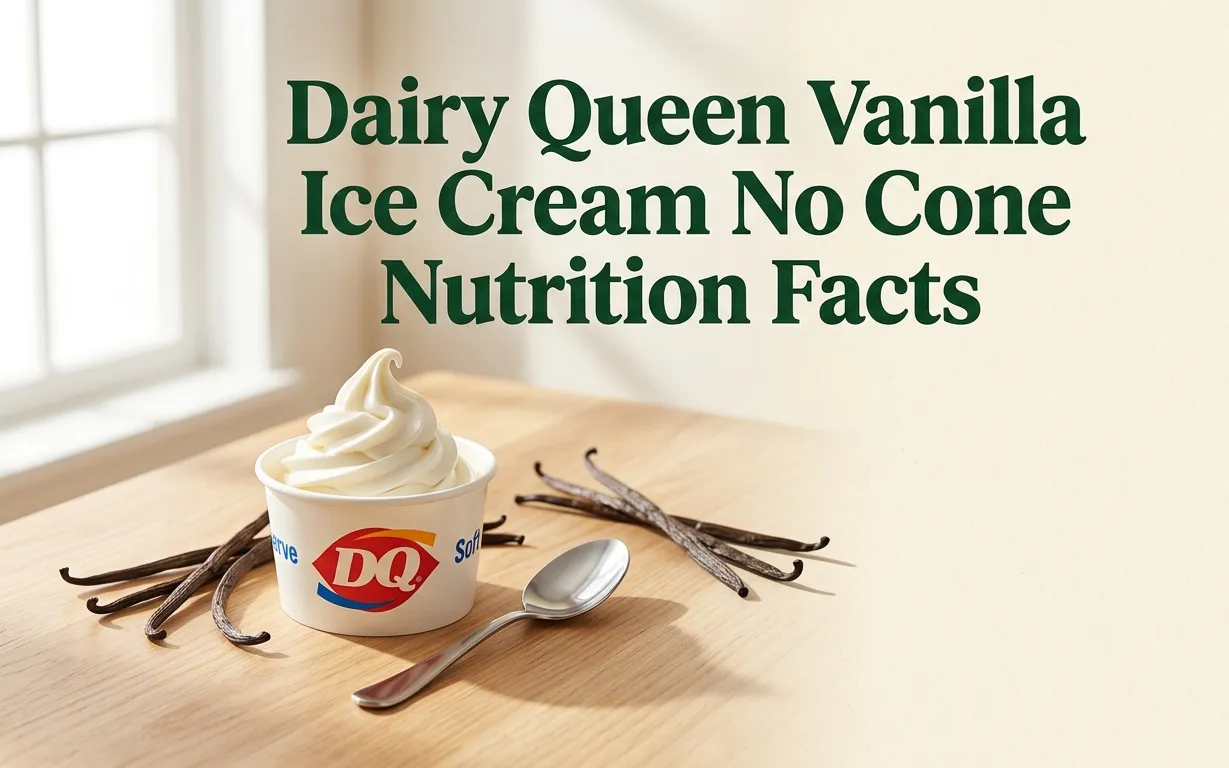
Dairy Queen Vanilla Ice Cream No Cone Nutrition Facts (2026)
A small Dairy Queen vanilla soft serve in a cup with no cone delivers exactly 230 calories, 12 grams of total fat, 22 grams of carbohydrates, 18 grams of sugar, and 5 grams of protein per 5-ounce serving. You save roughly 25 to 45 calories and 4 to 7 grams of carbohydrates compared to ordering the same small serving in a standard cone. That one decision at the speaker box quietly strips out a processed carbohydrate vehicle you probably were not thinking much about anyway.
The Dietary Guidelines for Americans 2020-2025 recommend that adults limit added sugars to less than 50 grams per day and saturated fat to under 20 grams, both based on a 2,000-calorie diet. A single small vanilla cup uses up 14 grams of added sugar and 8 grams of saturated fat, a combined hit that places this treat firmly in the “occasional dessert” category by any reasonable nutritional standard. DQ soft serve is not health food, and it was never supposed to be. What matters is knowing the actual numbers so your decision is informed, not impulsive.
This article walks you through every size option, the full ingredient list, the sugar breakdown by cup size, allergen details, and how a plain vanilla cup stacks up against a cone and against Dairy Queen’s famous Blizzard. You will find the specific numbers you need to log this treat accurately, compare it honestly, and decide for yourself whether it fits your day.
Dairy Queen Soft Serve Nutrition Facts
Dairy Queen soft serve nutrition facts vary predictably across the three standard cup sizes: small, medium, and large, with calorie totals ranging from 230 to 560 and fat content climbing from 12 grams to 29 grams depending on the portion you choose. The soft serve formula remains identical across all three sizes. The only variable is the weight of the product the employee pumps into your cup.
Dairy Queen classifies their vanilla soft serve as a reduced-fat ice cream according to the FDA’s standards of identity for frozen desserts. That classification requires a minimum milkfat content below 10 percent, and DQ’s formula lands at 5 percent milkfat by weight. This distinction matters because it places the product in a different regulatory category than premium ice creams, which pack 14 to 18 percent milkfat by volume. A 5-ounce small cup of DQ vanilla soft serve contains 12 grams of total fat, which is far from negligible but sits below what a same-size scoop of Häagen-Dazs vanilla would deliver, typically 17 to 20 grams of fat per equivalent serving.
The protein content is modest but real. Each small cup provides 5 grams of complete dairy protein, meaning it contains all nine essential amino acids in proportions your body can use for tissue maintenance. That protein comes from the nonfat milk and milkfat components of the base mix. It is not enough to call this a protein snack, but it does give the soft serve a slight satiety edge over a purely sugar-based frozen treat like a slushie or an Italian ice.
| Nutrient | Small Cup (5 oz) | Medium Cup (8 oz) | Large Cup (12 oz) |
|---|---|---|---|
| Calories | 230 | 370 | 560 |
| Total Fat | 12 g | 19 g | 29 g |
| Saturated Fat | 8 g | 12 g | 18 g |
| Cholesterol | 40 mg | 65 mg | 100 mg |
| Sodium | 80 mg | 130 mg | 200 mg |
| Total Carbohydrates | 22 g | 35 g | 53 g |
| Dietary Fiber | 0 g | 0 g | 0 g |
| Total Sugars | 18 g | 28 g | 43 g |
| Added Sugars | 14 g | 22 g | 34 g |
| Protein | 5 g | 7 g | 11 g |
| Calcium | 150 mg (10% DV) | 240 mg (20% DV) | 370 mg (30% DV) |
| Vitamin D | 0.8 mcg (4% DV) | 1.3 mcg (6% DV) | 2 mcg (10% DV) |
| Potassium | 220 mg (4% DV) | 350 mg (8% DV) | 540 mg (12% DV) |
DQ Vanilla Soft Serve Cup Calories
A DQ vanilla soft serve cup ranges from 230 calories for a small to 370 calories for a medium and 560 calories for a large when served plain with no toppings and no cone. These calorie counts come directly from Dairy Queen’s official published nutrition information, which the company updates periodically and makes available in-store and on their website as of 2026.
The calorie jump from small to large more than doubles your intake even though a large is only a little over twice the weight. A small weighs roughly 5 ounces. A large weighs 12 ounces. That is 2.4 times the weight for 2.4 times the calories, which tracks linearly. The practical insight is simpler than the math: ordering a medium instead of a large saves you 190 calories, which is roughly equivalent to a 20-minute brisk walk for a 155-pound adult. Ordering a small instead of a medium saves 140 calories, about the same as a single slice of bread with butter.
Calorie density is another useful lens. DQ vanilla soft serve contains approximately 46 calories per ounce. For comparison, a standard 14-ounce Blizzard, depending on the mix-ins, can easily hit 90 to 110 calories per ounce. The vanilla cup, even the large, is calorically thinner than almost any Blizzard on the menu. That fact alone makes it the lowest-calorie frozen dessert option at Dairy Queen by a considerable margin, assuming you skip add-ons.
Key Takeaway: A small vanilla cup runs 230 calories, a medium 370, and a large 560, and scaling down by one size saves you a meaningful 140 to 190 calories without changing what you are eating.
DQ Soft Serve Macros
DQ soft serve macros, meaning the breakdown of calories from protein, carbohydrates, and fat, tilt heavily toward fat and sugar with a small protein contribution that varies modestly by serving size. In a small vanilla cup, fat provides approximately 47 percent of total calories, carbohydrates provide 38 percent, and protein provides 9 percent. Those proportions stay roughly consistent across sizes because the base formula does not change.
The saturated fat number deserves a close look because it represents 8 of the 12 total fat grams in a small cup. That is 40 percent of the American Heart Association’s recommended daily saturated fat limit of 20 grams for someone eating 2,000 calories. For a medium cup, saturated fat hits 12 grams, which is 60 percent of the daily limit. These are not “hidden” numbers buried in fine print. They are the central reason nutrition professionals classify soft serve as a treat rather than a staple.
Carbohydrates in DQ vanilla soft serve come almost entirely from sugar, specifically a combination of added sugars from corn syrup and naturally occurring lactose from milk. There is zero dietary fiber. Zero starch to slow digestion. This nutrient profile means blood glucose response after eating soft serve is relatively rapid. For someone without metabolic concerns, the body handles this easily. For someone with insulin resistance or diabetes, the lack of any buffering fiber or complex carbohydrate makes careful portioning essential.
Protein, at 5 grams per small cup, is a footnote, not a feature. You could get the same 5 grams from half a cup of plain Greek yogurt, and you would also get calcium and probiotics without the 14 grams of added sugar. The protein in DQ soft serve does contribute some satiety, but not enough to fundamentally change how you classify this food. Think of it as a pleasant bonus, not a reason to eat ice cream.
- Small cup (230 cal): 47% fat, 38% carbs, 9% protein
- Medium cup (370 cal): 46% fat, 38% carbs, 8% protein
- Large cup (560 cal): 47% fat, 38% carbs, 8% protein
- Saturated fat accounts for approximately 62 to 67% of total fat across all sizes.
- Added sugars account for roughly 78% of total sugars; the remaining 22% is naturally occurring lactose from milk.
- Zero fiber across all sizes means the carbohydrate load hits the bloodstream relatively quickly.
Small DQ Vanilla Cup Calories
A small DQ vanilla cup contains 230 calories with no cone, no toppings, and no modifications. This is the smallest standard size Dairy Queen offers for soft serve served in a cup, and it represents the lowest-calorie frozen dessert option on the entire DQ menu when ordered plain.
Weighing approximately 5 ounces, the small cup is slightly larger than a standard tennis ball in volume. For many adults, this portion size provides a satisfying dessert experience without pushing a single snack past 10 percent of a 2,000-calorie daily budget. At 230 calories, it sits in the same caloric neighborhood as a medium apple with a tablespoon of peanut butter or two small chocolate chip cookies. The nutritional profile is obviously different. The point is the calorie count alone does not make this an unreasonable choice.
One practical detail worth knowing: Dairy Queen locations are independently operated, and portion sizes can vary slightly from store to store. The 230-calorie figure represents the corporate standard. In the real world, a heavy-handed employee might give you closer to 6 or 6.5 ounces, which would push the calorie count toward 280 or 300. This variation is usually modest, but it matters if you are tracking tightly. Ordering a “small cup, light fill” is not a standard request and may confuse the staff. The better strategy is simply to use the published 230-calorie number as a close approximation and accept a 10 to 15 percent margin in either direction.
| Small DQ Vanilla Cup | Amount |
|---|---|
| Serving Weight | 5 oz (approximately 142 g) |
| Calories | 230 |
| Total Fat | 12 g |
| Saturated Fat | 8 g |
| Total Carbohydrates | 22 g |
| Total Sugars | 18 g |
| Added Sugars | 14 g |
| Protein | 5 g |
| Sodium | 80 mg |
| Cholesterol | 40 mg |
| Calcium | 150 mg (10% DV) |
Medium Dairy Queen Vanilla Cup Nutrition
A medium Dairy Queen vanilla cup delivers 370 calories, 19 grams of total fat, 12 grams of saturated fat, 35 grams of carbohydrates, 28 grams of total sugars, and 7 grams of protein per 8-ounce serving. This size represents a noticeable caloric step up from the small, adding 140 calories and roughly 60 percent more fat and sugar in a single jump.
The medium cup is where portion awareness becomes genuinely important if you are tracking intake for weight management or blood sugar control. At 28 grams of total sugar, this single cup delivers more sugar than a standard 12-ounce can of Coca-Cola, which contains approximately 39 grams in a full 12 ounces but 28 grams in an 8-ounce pour. The soft serve and the soda are not nutritionally equivalent. The soft serve provides protein, calcium, and fat that blunt the glycemic response somewhat compared to liquid sugar alone. Still, the sugar load is objectively high for one item.
The saturated fat count of 12 grams in the medium cup represents 60 percent of the American Heart Association’s daily 20-gram limit for someone on a 2,000-calorie diet. If your breakfast included buttered toast and your dinner will include a cheeseburger, adding this medium soft serve to the day could push your total saturated fat intake well past recommendations. This is not alarmism. It is arithmetic. The numbers are the numbers, and they stack up fast.
The medium cup is often perceived as the “default” size because it sits in the middle of the lineup and feels like a reasonable portion. From a calorie and sugar standpoint, it is closer to a full dessert than a small treat, and treating it as such makes nutritional sense. If you genuinely want a medium, own it as your chosen dessert for the day and build the rest of your intake around it.
Quick Tip:
- A medium cup has more sugar than an 8-ounce pour of full-sugar soda. Log it accordingly.
- If a medium is your normal order, dropping to a small saves 140 calories and 10 grams of sugar.
- Ask for a small in a medium cup if you want the visual fullness without the extra calories.
Key Takeaway: The medium vanilla cup packs 370 calories and 28 grams of sugar, placing it firmly in “full dessert” territory rather than “small treat.”
Large DQ Vanilla Cup Nutrition Facts
A large Dairy Queen vanilla cup contains 560 calories, 29 grams of total fat, 18 grams of saturated fat, 53 grams of total carbohydrates, 43 grams of total sugars, and 11 grams of protein per 12-ounce serving. This is a substantial dessert by any standard, delivering more calories than a Dairy Queen cheeseburger, which clocks in at approximately 400 calories.
The saturated fat in a large vanilla cup hits 18 grams, which is 90 percent of the daily limit the American Heart Association recommends. That is not inherently dangerous for a healthy person eating this once every few weeks. It becomes a nutritional consideration if Dairy Queen visits are frequent or if saturated fat is already high in your baseline diet. Saturated fat intake is consistently linked to elevated LDL cholesterol in controlled feeding studies, and the cumulative load across a day matters more than any single food.
Sugar in the large cup reaches 43 grams, of which roughly 34 grams are added sugars. The Dietary Guidelines for Americans 2020-2025 recommend capping added sugars at 50 grams per day for a 2,000-calorie diet. One large DQ vanilla cup uses 68 percent of that allowance in about 10 minutes of eating. If your overall diet is low in added sugar the rest of the day, this can fit. If you also had a flavored yogurt at breakfast and ketchup on your fries at lunch, you are likely sailing past the target.
The protein at 11 grams is a small silver lining but not a redeemer. That protein does slow gastric emptying slightly compared to a sugar-only dessert, which helps moderate the blood sugar spike. Anyone with type 1 or type 2 diabetes will still need to account for 53 grams of carbohydrate with no fiber buffer, and insulin or medication adjustments should be planned accordingly. A registered dietitian or certified diabetes care and education specialist can help calculate an appropriate insulin-to-carbohydrate ratio for a treat like this.
Dairy Queen Vanilla Soft Serve Ingredients
Dairy Queen vanilla soft serve is built from a liquid base mix that includes milkfat, nonfat milk, sugar, corn syrup, whey, and a specific set of stabilizers and emulsifiers that give the product its signature smooth, pipeable texture. The full ingredient list, as published by International Dairy Queen Inc. in 2026, reads: milkfat and nonfat milk, sugar, corn syrup, whey, mono- and diglycerides, artificial flavor, carrageenan, and guar gum. This is a frozen dairy dessert, not a minimalist whole-food product. The ingredient list reflects industrial manufacturing at scale.
Mono- and diglycerides function as emulsifiers, allowing the milkfat to disperse evenly through the water-based components rather than separating into an oily layer. They are synthesized from fatty acids and glycerol and are among the most common food additives in frozen desserts globally. Carrageenan, extracted from red seaweed, thickens the mix and prevents large ice crystals from forming during storage and transport. It is what keeps soft serve creamy rather than crunchy after days in the freezer. Guar gum, derived from guar beans, provides additional viscosity control and stabilizes the foam structure created when air is whipped into the mix during the freezing process.
None of these ingredients are uniquely concerning in the amounts present in a single serving. Carrageenan has been the subject of some controversy in animal studies regarding gastrointestinal inflammation, but the FDA continues to classify it as Generally Recognized as Safe for food use at current levels. The World Health Organization’s Joint Expert Committee on Food Additives has also reviewed carrageenan and affirmed its safety in food applications. If you have a known sensitivity to carrageenan or prefer to avoid it, DQ soft serve is not the treat for you. Homemade ice cream with cream, sugar, and vanilla extract is the obvious alternative.
The “artificial flavor” listing refers to the vanilla flavor compound used to give the soft serve its characteristic taste. Dairy Queen does not publicly disclose the specific flavoring agent, but it is distinct from pure vanilla extract. The soft serve does not contain egg yolks, which is why DQ vanilla is not labeled as “frozen custard” and has a lower fat percentage and lighter mouthfeel than custard-style ice creams.
Dairy Queen Vanilla Cup Sugar Content
A small Dairy Queen vanilla cup contains 18 grams of total sugar, of which 14 grams are added sugars and approximately 4 grams are the naturally occurring milk sugar lactose. That 14-gram added sugar figure sits just below the amount in a single Reese’s Peanut Butter Cup two-pack, which contains roughly 16 grams of added sugar. Context helps, but the number is what it is: not trivial, not catastrophic.
The medium cup steps up to 28 grams of total sugar with 22 grams of added sugar, and the large reaches 43 grams of total sugar with 34 grams of added sugar. These are not numbers you guess at. They come from Dairy Queen’s official 2026 nutrition data. The sugar source in the soft serve is a combination of liquid corn syrup and granulated sugar, which gives the product its sweetness, depresses the freezing point for a softer texture, and contributes to the mouthfeel. The lactose is incidental, arriving passively with the milk components.
For perspective on the added sugar numbers, the American Heart Association recommends an even stricter limit than the Dietary Guidelines: no more than 25 grams of added sugar per day for women and no more than 36 grams for men. A medium DQ vanilla cup with 22 grams of added sugar hits 88 percent of the stricter women’s limit and 61 percent of the men’s limit. This is helpful framing if you are actively reducing added sugar for metabolic health or on a physician’s recommendation.
One practical way to think about the sugar in a large cup: 34 grams of added sugar is equivalent to eight and a half standard sugar packets of the type you see on a coffee shop counter. Picture emptying eight packets into a bowl. That visual usually makes the decision about size feel more concrete than a number on a nutrition panel. You might still order the large. But you will not be surprised by what is in it.
- Small cup: 18 g total sugar (14 g added)
- Medium cup: 28 g total sugar (22 g added)
- Large cup: 43 g total sugar (34 g added)
- AHA women’s daily added sugar limit: 25 g
- AHA men’s daily added sugar limit: 36 g
- Dietary Guidelines added sugar limit (2,000 cal diet): 50 g
Key Takeaway: A medium DQ vanilla cup uses 88 percent of the AHA’s daily added sugar limit for women, so size your order accordingly if sugar is a priority in your tracking.
Dairy Queen Soft Serve Allergens
Dairy Queen vanilla soft serve contains milk as a primary allergen and may contain soy, wheat, egg, and tree nuts due to shared equipment and manufacturing cross-contact. The milk allergen is intrinsic to the product. There is no dairy-free version of DQ vanilla soft serve, and no amount of requesting will produce one because the base mix itself is milk-based.
For individuals with a diagnosed milk allergy, specifically an IgE-mediated allergy to casein or whey proteins, Dairy Queen vanilla soft serve is not safe to consume. This is not a “small amount might be okay” situation. The milk proteins are structurally intact and present in the final frozen product. The same warning applies to anyone with galactosemia, a rare genetic disorder where the body cannot metabolize galactose, the simple sugar that combines with glucose to form lactose. Lactose is present in the soft serve, and metabolism of lactose releases galactose into the bloodstream.
The “may contain” statements for soy, wheat, egg, and tree nuts reflect the reality of a busy franchise kitchen environment. Soft serve is dispensed from a dedicated machine, but the surrounding prep areas handle Blizzard mix-ins, cone batter, and baked goods that contain these allergens. Cross-contact risk is real and is not zero. If you have a severe anaphylactic allergy to any of these secondary allergens, the safest choice is to ask the specific location about their equipment-cleaning and handling protocols or, more conservatively, to skip the soft serve altogether.
Dairy Queen does not label its vanilla soft serve as certified gluten free, even though the soft serve itself contains no wheat, barley, rye, or malt-derived ingredients. The risk is environmental cross-contact. For someone with celiac disease, the level of risk tolerance is personal, but the absence of a gluten-free claim means the company is not guaranteeing the product meets the FDA’s 20 parts per million gluten-free threshold.
| Allergen | Status in DQ Vanilla Soft Serve |
|---|---|
| Milk | Present (primary ingredient; casein and whey proteins intact) |
| Soy | May contain (cross-contact risk; shared facility) |
| Wheat / Gluten | May contain (cross-contact risk; soft serve base is wheat-free but environment is not) |
| Egg | May contain (cross-contact risk; not a formula ingredient) |
| Peanuts | May contain (cross-contact risk varies by location; ask in-store) |
| Tree Nuts | May contain (cross-contact risk; Blizzard nut mix-ins present in environment) |
DQ Vanilla Cone vs Cup Nutrition
Ordering a DQ vanilla soft serve in a cup instead of a cone saves you between 25 and 45 calories and 4 to 7 grams of carbohydrates, depending on the cone type the location uses. A small classic cone from Dairy Queen contains approximately 260 calories compared to the 230-calorie small cup. The difference is small enough that, nutritionally speaking, it almost does not matter for a single occasion. Accumulated over a summer of weekly DQ visits, 30 calories per visit adds up to roughly 360 calories saved over 12 trips, which is modest.
The cone itself is made from a batter containing enriched wheat flour, sugar, and a small amount of fat, then baked into the familiar rigid wafer shape. It contributes roughly 25 to 30 calories for a standard small cone and roughly 40 to 45 calories for a waffle cone. The carbohydrate contribution is almost entirely refined starch and a small amount of sugar, with no fiber and no meaningful micronutrients. The cone is functionally inert nutritionally. It adds crisp texture and makes the ice cream portable, and in exchange, you get a small bump in calories and refined carbs.
Choosing the cup also removes the structural pressure to eat faster. A cone drips. A cup does not. The behavioral effect is subtle but real. You might linger over a cup longer, and some research on eating rate suggests that slower consumption can enhance satisfaction per calorie consumed. This is speculative in the context of soft serve specifically, but the principle is broadly supported in satiety research.
For someone counting carbohydrates for diabetes management, the cup simplifies the math. You know exactly what you are getting without estimating whether the cone adds 4 or 7 grams of carbohydrate depending on its exact size and thickness. That precision might matter more to you than the calorie difference. A certified diabetes care and education specialist can confirm individualized carbohydrate counting targets, but the rule of thumb is that the cup removes one variable from the equation.
| Small Size, Vanilla Soft Serve | Calories | Total Carbs | Sugars |
|---|---|---|---|
| Cup (no cone) | 230 | 22 g | 18 g |
| Classic Cone | 260 | 27 g | 20 g |
| Waffle Cone | 270 | 29 g | 21 g |
Dairy Queen Blizzard Nutrition Facts
Dairy Queen Blizzard nutrition facts vary wildly depending on the specific flavor, size, and mix-in density, with even a small Blizzard often exceeding 600 calories and a large Blizzard easily crossing the 1,200-calorie mark. The Blizzard is built on a vanilla soft serve base that is then blended with candy pieces, cookie dough chunks, chocolate sauce, brownie bits, or fruit syrups. The base alone is not the problem. The mix-ins are where the calorie and sugar counts detonate.
The Blizzard base is essentially the same vanilla soft serve formula analyzed throughout this article, but the blending process incorporates less air and packs more product into the cup because the heavy mix-ins compress the soft serve rather than sitting on top. A small Blizzard weighs significantly more than a small vanilla cup even though both are labeled “small.” The weight difference translates directly into calorie density. A small Oreo Blizzard, for instance, is reported to contain approximately 630 calories, 25 grams of fat, and 83 grams of carbohydrates. That is nearly three times the calories of a small plain vanilla cup in the same container family.
Understanding this comparison clarifies why the plain vanilla cup is the most calorie-controlled item on the frozen menu. The Blizzard is an engineered indulgence, delicious and intentionally extreme. The plain soft serve cup is just ice cream in a cup. They serve different purposes and different cravings. The nutrition facts reflect that distance honestly.
- Small Oreo Blizzard: approximately 630 cal, 83 g carbs, 60 g sugar
- Medium Oreo Blizzard: approximately 830 cal, 110 g carbs, 78 g sugar
- Large Oreo Blizzard: approximately 1,260 cal, 169 g carbs, 120 g sugar
- A small plain vanilla cup: 230 cal, 22 g carbs, 18 g sugar
- Ratio: A small Oreo Blizzard contains roughly 2.7 times the calories and 3.7 times the sugar of a small vanilla cup.
Key Takeaway: A small Blizzard easily triples the calorie and sugar load of a small vanilla cup because the mix-ins compress the soft serve and add dense, high-sugar ingredients.
Blizzard Nutrition Facts
Blizzard nutrition facts, viewed broadly across the menu rather than flavor by flavor, follow a consistent pattern: the soft serve base contributes roughly 200 to 300 calories in a small, and the mix-ins pile on an additional 300 to 500 calories depending on what is being crushed into the cup. Candy-based Blizzards, like M&M’s, Reese’s, and Butterfinger, cluster at the high end of the range. Fruit-based Blizzards, like strawberry or pineapple, tend to sit slightly lower because fruit purees and syrups are less calorie-dense than chocolate-coated candies.
The Royal Blizzard line, which adds a thick core of fudge or caramel running through the center of the cup, further escalates the numbers. A small Royal Oreo Blizzard adds roughly 80 to 100 calories above the standard Oreo version because the fudge center is pure concentrated sugar and fat. These are products designed for maximal hedonic impact, not for nutritional moderation, and the nutrition facts panels confirm it plainly.
From a macronutrient perspective, Blizzards are high-fat, high-carbohydrate, moderate-protein items. The fat comes from both the milkfat in the soft serve and the added fats in chocolate, peanut butter, and cookie components. The carbohydrates come from the sugar in the soft serve plus the sugars and starches in the mix-ins. Protein tends to hover around 10 to 15 grams in a small and 20 to 25 grams in a large, which is enough to be nutritionally notable but nowhere near enough to offset the overall energy density.
If you are choosing between a Blizzard and a plain vanilla cup, the nutritional difference is not subtle. It is categorical. The vanilla cup is a treat. The Blizzard is a meal’s worth of energy in a cup, and for some flavors, a large meal at that. The key is matching the choice to the context: a Blizzard on a day when you skipped lunch and walked 15,000 steps lands differently than a Blizzard at the end of a sedentary day with three full meals already eaten.
Small Blizzard Nutrition Facts
Small Blizzard nutrition facts reveal that even the smallest listed size on the menu generally contains between 550 and 750 calories, with the exact number depending heavily on the chosen flavor. A small is not a small treat in energy terms. It is a substantial caloric event that can represent 30 to 40 percent of a 2,000-calorie daily budget. The word “small” on the DQ menu refers to the physical cup diameter, not the energy content relative to daily needs.
Consider three popular small Blizzard flavors. A small Reese’s Peanut Butter Cup Blizzard contains roughly 690 calories, 35 grams of fat, and 79 grams of carbohydrates. A small Butterfinger Blizzard hits approximately 660 calories, 24 grams of fat, and 94 grams of carbohydrates. A small Strawberry Blizzard, the lightest of the bunch due to the fruit base, still comes in at roughly 550 calories, 16 grams of fat, and 88 grams of carbohydrates. Compare any of these to the 230-calorie small vanilla cup, and the scale of the difference becomes stark.
Portion size labeling in fast-food and quick-service restaurants has been shown in consumer research to influence perception independent of actual energy content. The word “small” implies a restrained choice, and at DQ, that implication is misleading when applied to Blizzards. The small Blizzard is a full dessert. The mini size, available for some flavors at certain locations, drops the calorie count closer to 350 to 450 and is a more genuinely restrained option for someone who wants the flavor variety without the full energy load.
- Small Reese’s Peanut Butter Cup Blizzard: ~690 cal, 35 g fat, 79 g carbs
- Small Butterfinger Blizzard: ~660 cal, 24 g fat, 94 g carbs
- Small Strawberry Blizzard: ~550 cal, 16 g fat, 88 g carbs
- Small Vanilla Cup (no cone, no mix-ins): 230 cal, 12 g fat, 22 g carbs
- The small vanilla cup is the only frozen DQ item under 250 calories.
Dairy Queen Vanilla Cup Weight Watchers Points
A small Dairy Queen vanilla cup with no cone calculates to approximately 8 to 10 Weight Watchers Points depending on the specific Weight Watchers plan iteration you are following, while a medium lands around 13 to 15 Points and a large settles in the 19 to 22 Point range. Weight Watchers periodically updates its point algorithms, so verifying the exact value against your current plan’s calculator is the most accurate approach. These estimates are based on the 2025-2026 Points system as commonly referenced in user-generated tracking databases.
Weight Watchers points are calculated from a proprietary formula that weights calories, saturated fat, added sugar, and protein differently, penalizing foods that are high in sugar and saturated fat while rewarding foods with protein and fiber. DQ vanilla soft serve takes a hit on the sugar and saturated fat side and gets minimal credit for its modest protein. The result is a point value that places it in the category of a “planned indulgence,” something you can absolutely fit into a weekly points budget if you track it and adjust elsewhere.
For someone on Weight Watchers who wants the lowest-point frozen Dairy Queen option, a small vanilla cup is the undisputed winner. A small vanilla cone comes in slightly higher, around 10 to 12 Points, due to the cone’s additional carbohydrates. A small Blizzard, by contrast, typically exceeds 20 Points per serving. The vanilla cup is not zero points and never will be, but it is the most mathematically efficient way to satisfy an ice cream craving inside the DQ menu.
| DQ Item | Estimated Weight Watchers Points (2025-2026 system) |
|---|---|
| Small Vanilla Cup (230 cal) | 8 to 10 Points |
| Medium Vanilla Cup (370 cal) | 13 to 15 Points |
| Large Vanilla Cup (560 cal) | 19 to 22 Points |
| Small Classic Cone (260 cal) | 10 to 12 Points |
| Small Oreo Blizzard (~630 cal) | 22 to 26 Points |
Key Takeaway: A small DQ vanilla cup is the lowest-point frozen dessert on the entire Dairy Queen menu, landing around 8 to 10 Weight Watchers Points compared to 22 to 26 for a small Blizzard.
How to Order DQ Vanilla No Cone
Ordering a DQ vanilla soft serve without a cone is done by walking up to the counter or pulling up to the drive-thru speaker and asking specifically for a “vanilla soft serve in a cup” with whatever size you want. You do not need to order a cone and then request the cone be removed or replaced. The cup option exists as its own menu item at every Dairy Queen location.
The phrasing that works most reliably is direct: “I’d like a small vanilla soft serve in a cup, please.” No explanation is required. The employee understands this as a standard order. Some locations may ring it in as a “vanilla cone, no cone” for inventory tracking purposes, but the cup will arrive with exactly what you ordered and nothing else. If you want to be certain nothing else ends up in the cup, you can add “plain, no toppings” to the request. This clarifies that you do not want the staff to drizzle chocolate syrup on top, a step that occasionally happens out of habit or assumed kindness.
Drive-thru ordering can introduce communication friction. Speak clearly. Confirm the size at the speaker. Check your order at the window before driving away. If a cone is handed to you instead of a cup, politely point out the mistake, and it will be corrected. The cup is both the healthier and less messy choice for eating in a car, so you are already choosing the more practical format.
Mobile ordering through the Dairy Queen app, where available, often lists the vanilla soft serve cup explicitly as a separate menu item. The app interface bypasses the potential for verbal miscommunication and lets you see the calorie count on screen before you finalize the order. If you are tracking nutrition carefully, the app is your most accurate tool.
- In-store: “Small vanilla soft serve in a cup, plain, please.”
- Drive-thru: “Small vanilla cup, no toppings.”
- Mobile app: Select “Vanilla Soft Serve Cup” from the Treats or Cones menu section.
- If you want a smaller portion than a small: Some locations will honor a request for a “kid’s size” or “sample cup,” but this is not a standardized menu item and availability varies by franchise.
Frequently Asked Questions About Dairy Queen Vanilla Cup Nutrition
How many calories in a small Dairy Queen vanilla ice cream cup with no cone?
A small Dairy Queen vanilla soft serve cup with no cone contains 230 calories.
The serving weighs approximately 5 ounces.
This is the lowest-calorie frozen dessert option on the standard Dairy Queen menu.
Is Dairy Queen vanilla soft serve gluten free?
Dairy Queen vanilla soft serve does not contain wheat, barley, rye, or malt ingredients in its formula.
However, Dairy Queen does not label the soft serve as certified gluten free due to potential cross-contact with gluten-containing products in the kitchen environment.
Individuals with celiac disease should ask about specific location practices and assess their personal risk tolerance.
How much sugar is in a Dairy Queen vanilla soft serve cup?
A small cup contains 18 grams of total sugar, with 14 grams from added sugars and 4 grams from naturally occurring lactose.
A medium cup contains 28 grams of total sugar, with 22 grams added.
A large cup contains 43 grams of total sugar, with 34 grams added.
Can people with diabetes eat Dairy Queen vanilla soft serve?
People with diabetes can eat Dairy Queen vanilla soft serve if they account for the carbohydrate content in their meal planning or insulin dosing.
A small cup contains 22 grams of carbohydrate with no fiber, which will raise blood glucose relatively quickly.
A registered dietitian or certified diabetes care and education specialist can help determine how this treat fits into an individual diabetes management plan.
What is the difference between DQ soft serve and their Blizzard base?
The base soft serve used in a plain vanilla cup and the base used in a Blizzard are the same vanilla soft serve formula.
The nutritional difference arises entirely from the Blizzard mix-ins, which add candy, cookies, syrups, and other dense, high-calorie ingredients that are blended into the soft serve.
A plain vanilla cup is the soft serve base served alone with no additions.
Is Dairy Queen soft serve healthier without the cone?
Dairy Queen soft serve is slightly lower in calories and carbohydrates when ordered in a cup without the cone, saving roughly 25 to 45 calories and 4 to 7 grams of carbs.
The cone itself adds refined flour and a small amount of sugar with no meaningful micronutrients.
The nutritional difference is modest for a single occasion but adds up if you visit DQ regularly.
Closing
A Dairy Queen vanilla soft serve in a cup, no cone, is a straightforward treat with transparent numbers. At 230 calories for a small, it sits in a reasonable range for an occasional dessert and remains the single most calorie-conscious frozen option on the entire DQ menu. You are not being fooled by hidden ingredients. You are not accidentally consuming a meal’s worth of calories. You are eating vanilla soft serve, and now you know exactly what is in it.
The practical move is sizing down. If your habit is a medium, try a small next time and see if it satisfies the craving. That single shift saves 140 calories and 10 grams of sugar without changing what you are eating. If a Blizzard is your usual, swapping it for a small vanilla cup even once a week cuts thousands of calories from your monthly total without requiring any willpower beyond the moment of ordering. You are not giving up Dairy Queen. You are just ordering the thing that leaves you feeling better afterward.
Walk up to the counter, say “small vanilla cup, plain,” and enjoy it knowing every number on the panel and every ingredient behind it. That is the whole goal. You have the facts. The decision is yours.