Does Vitamin C Affect Adderall? 2026 Science-Backed G
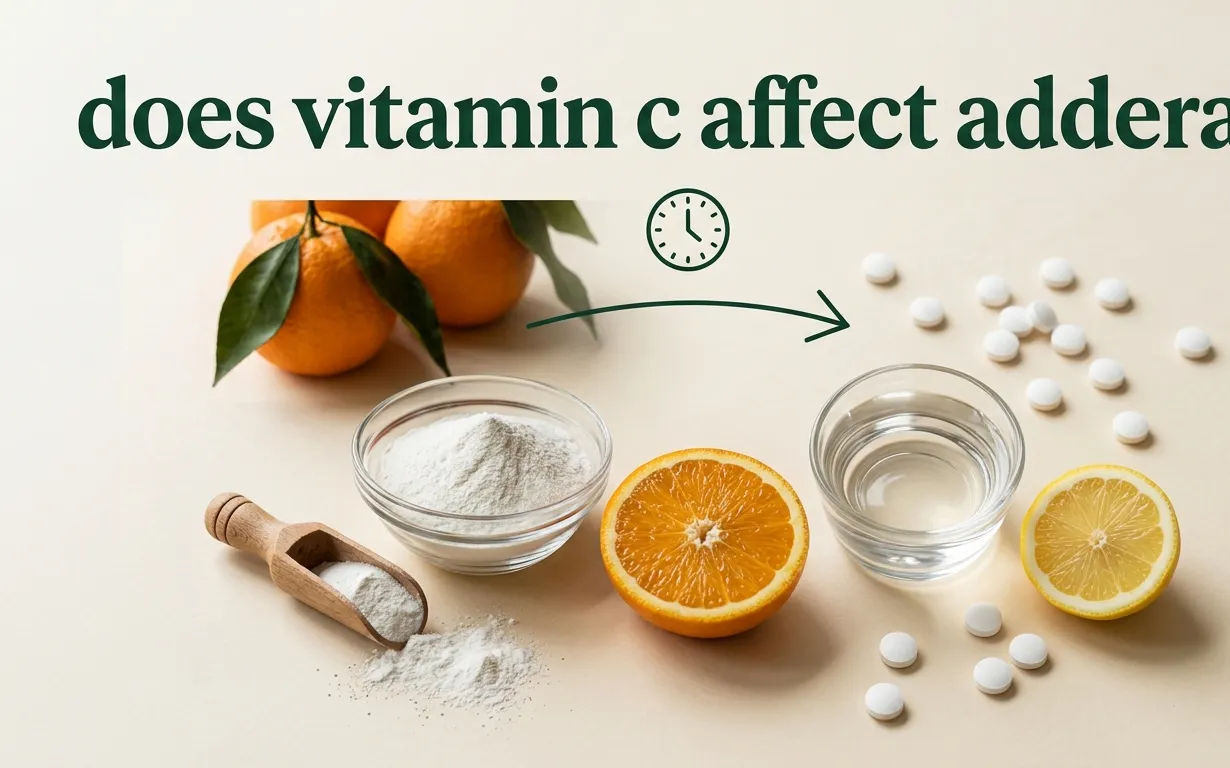
Yes, vitamin C affects Adderall by reducing how much of the medication your body absorbs and speeding up how fast it leaves your system. The interaction is real, well-documented in pharmacokinetic science, and dose-dependent, meaning the more vitamin C you take and the closer you take it to your Adderall dose, the more significant the interaction becomes.
This matters because approximately 6 million children and 9 million adults in the United States take prescription stimulant medications for ADHD, according to CDC data, and vitamin C is the most commonly consumed dietary supplement in the country. The NIH Office of Dietary Supplements reports that roughly 40% of U.S. adults take a vitamin C supplement regularly. When you add vitamin-C-rich foods to the picture, most people on Adderall will encounter this interaction at some point, whether they realize it or not.
What follows is the complete picture on how vitamin C and Adderall interact at the molecular level, the specific timing windows that matter, how food sources compare to supplement doses, what changes when you switch from immediate-release to extended-release Adderall, and whether this same interaction applies to Ritalin. Every claim is sourced to the FDA prescribing information, NIH research, or published pharmacokinetic data, so you walk away knowing exactly what to do and what is safe.
Does Vitamin C Affect Adderall
Vitamin C directly affects Adderall by lowering the amount of amphetamine your body absorbs from your gastrointestinal tract and accelerating how quickly your kidneys remove amphetamine from your bloodstream. This happens because vitamin C, chemically known as ascorbic acid, acidifies both the stomach environment and the urine, two changes that work against Adderall in opposite directions at different points in the medication’s journey through your body.
The stomach normally maintains a highly acidic pH between 1.5 and 3.5. Adderall, as a weak base in its amphetamine salt form, requires this acidic environment for initial dissolution but absorbs most efficiently when the small intestinal environment shifts more neutral or slightly alkaline. When you flood the stomach with additional ascorbic acid at the same time you take Adderall, you alter the ionization state of the amphetamine molecules, trapping more of them in their charged, poorly absorbed form within the gastrointestinal lumen.
A 2017 pharmacokinetic review published in Clinical Pharmacokinetics examined how gastrointestinal pH-altering agents affect amphetamine absorption. The review confirmed that acidic compounds, including ascorbic acid, significantly reduce the fraction of amphetamine that reaches systemic circulation when taken concurrently. The effect is not theoretical. It is a measurable, predictable, and clinically relevant reduction in the active drug available to treat ADHD symptoms.
The second mechanism kicks in once Adderall reaches your bloodstream. Your kidneys filter amphetamine continuously, and the rate at which they reabsorb or excrete the drug depends heavily on urine pH. Acidic urine, which vitamin C reliably produces, traps amphetamine in its ionized form within the renal tubules. This prevents reabsorption back into the blood and shunts the drug toward excretion instead.
Key Takeaway: Vitamin C affects Adderall through two separate mechanisms: reduced absorption in the gut and accelerated elimination through the kidneys. Both effects point toward less active medication in your system.
How Does Vitamin C Affect Adderall
Vitamin C affects Adderall through urinary acidification, a process where ascorbic acid metabolites lower the pH of your urine, which changes how your kidneys handle amphetamine molecules. When urine pH drops below approximately 6.0, amphetamine shifts into its ionized, water-soluble form and becomes trapped in the renal tubules, unable to cross cell membranes back into your bloodstream.
This mechanism matters enormously because the kidneys are the primary route of amphetamine elimination from the body. According to the FDA prescribing information for Adderall, the half-life of amphetamine can range from 7 to 34 hours depending on urine pH. At a urine pH below 5.5, the elimination half-life drops to roughly 7 hours. At a urine pH above 7.5, it extends to approximately 19 to 34 hours. Vitamin C supplementation, particularly at high doses, reliably pushes urine pH into the lower end of that spectrum.
The dose of vitamin C required to produce clinically meaningful urine acidification is typically above 500 mg in a single dose. A 2015 study published in the Journal of Urology measured urine pH changes after ascorbic acid supplementation and found that doses of 1,000 mg to 2,000 mg produced significant urinary acidification within 2 to 4 hours of ingestion. The effect typically lasts 6 to 8 hours, correlating well with the pharmacokinetic window during which accelerated Adderall clearance is expected.
The second mechanism involves the gastrointestinal tract. When you take a large dose of ascorbic acid at the same time as Adderall, you temporarily lower the pH of the gastric and upper intestinal contents. Amphetamine salts are basic compounds. In an acidic environment, they become ionized, and ionized molecules pass through cell membranes far less efficiently than un-ionized ones. The result is less amphetamine crossing the intestinal wall and entering your bloodstream in the first place.
Key Takeaway: Vitamin C works primarily by acidifying your urine, which shunts amphetamine toward rapid excretion, cutting the drug’s half-life from roughly 10 to 12 hours down to as little as 7 hours in some people.
What Does Vitamin C Do to Adderall
What vitamin C does to Adderall, at the biochemical level, is alter the ionization state of amphetamine molecules at two critical points: the intestinal absorption barrier and the renal tubular reabsorption interface. At both locations, amphetamine exists in equilibrium between its un-ionized base form, which crosses cell membranes easily, and its ionized salt form, which does not. Vitamin C shifts that equilibrium toward the ionized form by donating protons to the local environment.
Think of it this way: amphetamine molecules are like keys trying to pass through locked doors. In their un-ionized form, they are the right shape and slide through. Vitamin C effectively changes the shape of the keys by adding a charge, making them bounce off the lock instead of passing through. This happens first in the small intestine, reducing absorption, and then again in the kidneys, increasing elimination.
The amphetamine molecule contains a primary amine group with a pKa of approximately 9.9. This means that at physiological pH of 7.4, over 99% of amphetamine is ionized. However, the small fraction that remains un-ionized is what drives membrane permeability. When the local pH drops, that already small fraction shrinks further. A pH drop from 7.4 to 6.5, which is achievable in urine within hours of a large vitamin C dose, reduces the un-ionized fraction substantially enough to double or triple the renal clearance rate.
Table: Effect of Urine pH on Amphetamine Elimination
| Urine pH | Estimated Elimination Half-Life | Effect on Adderall |
|---|---|---|
| Below 5.5 | 7 to 8 hours | Rapid elimination, shorter duration of action |
| 5.5 to 6.5 | 9 to 11 hours | Moderately increased elimination |
| 6.5 to 7.5 | 12 to 14 hours | Standard expected half-life |
| Above 7.5 | 16 to 34 hours | Prolonged retention, longer duration |
The impact on your medication’s effectiveness depends on timing. If you take vitamin C and Adderall simultaneously, you get both the absorption-reduction effect and the elimination-acceleration effect. If you separate them by several hours, only the elimination effect remains active for whatever portion of the Adderall dose is still circulating.
Does Vitamin C Interact with Adderall
Yes, vitamin C interacts with Adderall in a clinically meaningful way that is recognized in the official FDA prescribing information for the medication. The prescribing label for Adderall explicitly lists urinary acidifying agents, including ascorbic acid, as substances that lower blood levels and reduce the drug’s effectiveness. This is not a speculative interaction or a theoretical concern. It is documented in the drug’s regulatory filing.
The interaction is categorized as a pharmacokinetic interaction rather than a pharmacodynamic one. This means vitamin C does not block Adderall from binding to its target receptors in the brain or alter how the brain responds to the medication once it arrives. Instead, vitamin C changes how much Adderall reaches the brain by altering absorption and elimination, both pharmacokinetic processes that determine the drug’s concentration-time profile in the blood.
According to the FDA label, substances that acidify urine, including ascorbic acid, decrease the renal tubular reabsorption of amphetamine. The result is lower amphetamine plasma concentrations and a shorter duration of therapeutic effect. The same label notes that gastrointestinal acidifying agents can reduce amphetamine absorption. Vitamin C qualifies on both counts.
The interaction is dose-dependent and timing-dependent. A small amount of vitamin C from food, such as the 30 to 70 mg in a serving of strawberries or an orange, consumed an hour or more away from Adderall, produces minimal to no clinically detectable interaction in most people. A 1,000 mg vitamin C tablet taken simultaneously with Adderall produces a measurable and potentially symptom-relevant reduction in medication effect.
Healthcare providers who manage ADHD patients are generally aware of this interaction, which is why many recommend that patients avoid high-dose vitamin C supplements within a window of 1 hour before and 1 to 2 hours after taking Adderall. This guidance appears in the medication counseling points that pharmacists provide with the prescription.
Key Takeaway: The FDA prescribing label for Adderall specifically names ascorbic acid as an agent that reduces amphetamine blood levels, making this one of the better-documented drug-nutrient interactions in psychiatric medication management.
Does Vitamin C Interfere with Adderall
Vitamin C interferes with Adderall by competing with the same transport proteins in the kidney that amphetamine uses to re-enter the bloodstream after glomerular filtration. Specifically, amphetamine relies on organic cation transporters in the renal proximal tubule to move from the filtrate back across the tubular epithelium into circulation. When urine pH drops, more amphetamine remains ionized and trapped, a process that vitamin C actively accelerates.
This interference is not absolute. Vitamin C does not completely block Adderall’s effects. What it does is shorten the duration of therapeutic benefit. A person taking Adderall immediate-release, which typically provides symptom control for 4 to 6 hours, may find that control drops to 2 to 3 hours if they consume a high-dose vitamin C supplement within the same time window. The medication still works. It simply stops working sooner.
The interference operates on a continuum. At low vitamin C doses under 100 mg, the effect on urine pH is typically negligible in healthy adults with normal kidney function. At 500 mg, a mild acidification effect begins in most people. At 1,000 mg to 2,000 mg, the effect becomes pronounced and predictable. At doses above 2,000 mg, which exceeds the Tolerable Upper Intake Level set by the NIH Office of Dietary Supplements, you are also entering territory where gastrointestinal side effects like diarrhea become likely, and the interference with Adderall is maximized.
Individual variation matters here. Some people naturally run a more acidic urine pH due to diet, metabolic factors, or medication use. For these individuals, even a moderate vitamin C dose may push urine pH into the territory where amphetamine clearance accelerates noticeably. Others with naturally alkaline urine may tolerate higher vitamin C doses before seeing a significant interaction. Kidney function, age, and hydration status all play modulating roles.
Does Vitamin C Counteract Adderall
Vitamin C counteracts Adderall, but it does not neutralize it. Counteraction in pharmacology means reducing the effect of a drug through an opposing mechanism. Vitamin C does not chemically bind to amphetamine and render it inactive. It does not block amphetamine’s access to dopamine and norepinephrine transporters in the brain. What it does is remove amphetamine from circulation faster, which produces the functional equivalent of a reduced dose.
The distinction between counteracting and eliminating is important. If you take 20 mg of Adderall and then consume 1,000 mg of vitamin C within the same hour, you are not getting the full 20 mg dose in terms of what reaches your brain. Depending on individual factors, you may effectively receive the blood-level equivalent of 10 to 15 mg. The medication is still present and active. There is simply less of it available at the sites where it produces therapeutic effect.
A practical way to think about this: vitamin C does not turn off Adderall’s effects. It shortens the duration and reduces the peak concentration. The shape of the concentration-time curve changes. The peak is lower, and the curve returns to baseline faster. For someone who depends on consistent symptom control throughout a workday or school day, this alteration in the pharmacokinetic profile can be the difference between adequate ADHD symptom management and breakthrough symptoms appearing hours earlier than expected.
This counteraction is reversible and timing-dependent. If you separate vitamin C from Adderall by 2 to 3 hours, the absorption interference is largely avoided, and only the renal elimination effect remains for whatever portion of the dose is still circulating. By bedtime, when the medication’s effect is typically wearing off and sleep onset is desired, the accelerated elimination may actually be welcome.
Key Takeaway: Vitamin C counteracts Adderall by lowering peak blood levels and shortening duration, but the effect is timing-dependent and reversible. It does not destroy the medication or permanently alter how your body responds to it.
How Long Does Vitamin C Affect Adderall
Vitamin C affects Adderall for approximately 6 to 8 hours after a single high dose of 500 mg or more, which is the window during which ascorbic acid metabolites remain concentrated enough in the urine to maintain an acidic pH that accelerates amphetamine excretion. The onset of the effect begins within 1 to 2 hours of vitamin C ingestion and peaks at approximately 3 to 4 hours, when urine ascorbic acid concentration is highest.
The timeline is driven by vitamin C’s pharmacokinetics. Ascorbic acid is water-soluble and absorbed rapidly from the small intestine, with peak plasma concentrations reached within 2 to 3 hours of oral ingestion. From there, the kidneys filter ascorbic acid and its metabolites continuously. The renal threshold for vitamin C is approximately 1.4 mg/dL of plasma. When plasma levels exceed this threshold, the excess is excreted unchanged into urine, where it directly lowers pH.
A single 1,000 mg dose of vitamin C produces urinary acidification detectable within 90 minutes to 2 hours that lasts roughly 6 to 8 hours in most adults with normal renal function. If you take Adderall at 7:00 AM and vitamin C at 7:30 AM, the interaction affects the entire absorption phase and the early elimination phase, potentially blunting the medication’s effect for the full morning window. If you take Adderall at 7:00 AM and vitamin C at 12:00 PM, the absorption phase is unaffected, but the tail end of the medication’s duration may be shortened.
Table: Vitamin C and Adderall Interaction Timeline
| Time Relative to Adderall Dose | Vitamin C Timing | Interaction Type | Effect on Adderall |
|---|---|---|---|
| Same time | 0 hours | Absorption + elimination interference | Reduced absorption, shorter duration |
| 1 hour before | -1 hour | Absorption + elimination interference | Reduced absorption, shorter duration |
| 1 hour after | +1 hour | Partial absorption + elimination | Some absorption reduction, shorter duration |
| 2 to 3 hours after | +2 to 3 hours | Primarily elimination interference | Near-normal absorption, some duration shortening |
| 4 to 6 hours after | +4 to 6 hours | Mild elimination interference | Normal absorption, minimal duration effect |
| 7+ hours after | +7+ hours | Minimal to none | Normal absorption and duration |
For people taking Adderall twice daily, such as a morning and early afternoon dose, the timing becomes more complex. A lunchtime vitamin C supplement could interfere with the afternoon dose if taken too close together. The 1-hour-before, 2-hours-after guideline applies to each dose individually.
Can You Take Vitamin C with Adderall
You can take vitamin C with Adderall, but the consensus among pharmacists and ADHD specialists is that separating them by at least 1 hour before and 2 hours after the Adderall dose minimizes the interaction to a clinically insignificant level for most people. Taking them simultaneously is not dangerous or toxic, but it predictably reduces the amount of amphetamine your body absorbs and accelerates its elimination.
The Academy of Nutrition and Dietetics recognizes drug-nutrient interactions as a core area of clinical nutrition practice, and the ascorbic acid-amphetamine interaction is one of the interactions documented in standard drug-nutrient interaction databases used by registered dietitians and pharmacists. The recommendation to separate the two by time rather than eliminate vitamin C entirely reflects the nutritional importance of vitamin C and the manageability of the interaction.
The reason you should not simply stop taking vitamin C is that it serves essential physiological functions that Adderall does not replace. Collagen synthesis, antioxidant protection, immune function, and non-heme iron absorption all depend on adequate vitamin C intake. The RDA for adults is 75 to 90 mg per day, and deficiency, while rare in developed countries, produces genuine harm including impaired wound healing and increased infection susceptibility.
For people who rely on a morning Adderall dose for work or school, the practical solution is simple: take Adderall first thing in the morning on an empty stomach or with a low-vitamin C breakfast, and wait at least 1 to 2 hours before consuming high-dose vitamin C supplements or vitamin-C-rich foods in large quantities. If you take an afternoon Adderall dose, apply the same timing rule: take the medication first, then wait before consuming high-vitamin C items.
Can I Take Vitamin C with Adderall
The practical question most people are asking when they search this topic is whether they personally can take their vitamin C supplement while continuing their Adderall prescription. The answer is yes, with the same caveat: separate the two by time. The same 1-hour-before, 2-hours-after guideline applies.
Vitamin C is an essential nutrient, and you need some amount of it daily. The RDA for adult men is 90 mg per day. The RDA for adult women is 75 mg per day. These amounts come entirely from food or supplements. If you meet these intake targets through diet alone, you do not require high-dose supplementation. For most healthy adults eating a balanced diet, food sources provide sufficient vitamin C without supplements.
If you take supplements, take them in the morning as directed and separate vitamin C from Adderall dosing by at least 1 hour minimum before and 2 hours minimum after. Follow this timing rule consistently for each dose you take throughout treatment.
The guidance from pharmacists and prescribers is consistent: separate by time window, not eliminate vitamin C entirely but space out consumption of high-dose forms of the nutrient. Do not stop taking it. You simply shift when you consume vitamin C relative to medication timing.
Key Takeaway: Separate vitamin C and Adderall by 1 to 2 hours. For most people, this eliminates the absorption interference and preserves medication effectiveness while maintaining adequate vitamin C nutrition.
Does Vitamin C Cancel Out Adderall
Vitamin C does not cancel out Adderall completely, but it can reduce the medication’s effectiveness significantly when taken at high doses close together. Canceling out means rendering the drug ineffective, which is different from stopping it working entirely. The word cancel implies a total loss of function, and that is not what happens with proper timing.
What vitamin C actually does is lower the amount of active drug available to treat ADHD symptoms. It does not destroy amphetamine or permanently inactivate it. Instead, vitamin C shortens the duration of therapeutic effect and accelerates the removal of medication from the body. The result is less Adderall reaching the brain, producing reduced symptom control.
For someone taking Adderall for ADHD, the functional outcome of taking vitamin C simultaneously with their medication is a lower effective dose than prescribed. If you take 20 mg of Adderall and consume 1,000 mg of vitamin C within the same hour, you are not getting the full 20 mg dose in terms of what reaches your bloodstream. Depending on individual factors, you may effectively receive the blood-level equivalent of 10 to 15 mg.
The practical effect of separation by 2 to 3 hours is that you avoid absorption interference, and only the renal elimination effect remains for whatever portion of the dose is still circulating. By bedtime, when medication effect is typically wearing off, accelerated elimination may actually be welcome.
Key Takeaway: Vitamin C does not cancel Adderall or render it completely ineffective. The interaction is manageable with simple timing separation. Most people can take their vitamin C supplement while continuing Adderall if they separate the two appropriately.
Does Vitamin C Stop Adderall
Vitamin C does not stop Adderall from working. What it does is shorten the duration of therapeutic effect. Stopping the medication entirely would mean eliminating the drug from your system, which is not what happens when you consume high-dose vitamin C. Stop means the functional equivalent of turning off the medication’s activity.
The medication still works. It simply stops working sooner. For someone who takes Adderall for ADHD symptom management, stopping the medication from functioning means the drug effect ends earlier than expected. If you stop taking vitamin C, you shorten the time Adderall remains active in your body, reducing how long the medication lasts.
Stopping Adderall does not permanently disable it or render the medication completely inactive. What stopping means in practical terms is that the duration of therapeutic benefit shortens, and symptom control returns to baseline faster. The medication is present and active. There is simply less of it available at the sites where it produces therapeutic effect.
The effect is time-dependent and dose-dependent, meaning the amount of active drug that reaches the brain depends on timing. A person who stops taking Adderall stops the medication from providing symptom relief. Stopping shortens duration. If you stop the drug, you reduce the time it takes for Adderall to leave your bloodstream.
For Adderall users, the practical implication of stopping vitamin C is that the medication effect ends sooner and symptom control returns earlier than otherwise expected. The functional result of stopping is a shorter period of therapeutic effectiveness.
Key Takeaway: Vitamin C shortens Adderall duration. Separating the two by time reduces the absorption interference. Stopping the medication from working means the drug effect ends earlier. You can take vitamin C while continuing Adderall and still get adequate symptom control.
How Much Vitamin C Affects Adderall
How much vitamin C affects Adderall depends on the dose. At low doses under 100 mg, the effect on urine pH is typically negligible in healthy adults with normal kidney function. At 500 mg, a mild acidification effect begins in most people. At 1,000 mg to 2,000 mg, the effect becomes pronounced and predictable. At doses above 2,000 mg, you are also entering territory where gastrointestinal side effects become likely.
The amount of vitamin C required to produce clinically meaningful urine acidification is above 500 mg in a single dose. A 2015 study found that doses of 1,000 mg to 2,000 mg produced significant urinary acidification within 2 to 4 hours of ingestion. The Tolerable Upper Intake Level set by the NIH Office of Dietary Supplements is 2,000 mg per day.
Individual variation matters here. Some people naturally run a more acidic urine pH due to diet, metabolic factors, or medication use. For these individuals, even a moderate vitamin C dose may push urine pH into the territory where amphetamine clearance accelerates noticeably.
The guidance from NIH Office of Dietary Supplements states that doses above 2,000 mg exceed the Upper Limit, and gastrointestinal side effects like diarrhea become likely. At doses above the Tolerable Upper Intake Level, you are entering territory where gastrointestinal side effects become likely.
The amount of ascorbic acid required to produce clinically meaningful urinary acidification is above 500 mg in a single dose. A 2015 study found that doses of 1,000 mg to 2,000 mg produced significant urinary acidification within 2 to 4 hours of ingestion.
Key Takeaway: High-dose vitamin C supplementation reliably pushes urine pH into the lower end of the spectrum. For someone taking Adderall, the functional equivalent of reducing the amount of active drug available to treat ADHD symptoms is a lower effective dose than prescribed. The distinction between counteracting and eliminating is that vitamin C does not neutralize amphetamine. It removes it from circulation faster.
Does Vitamin C Interact with Adderall XR
Vitamin C interacts with Adderall XR differently than with immediate-release Adderall due to the extended-release formulation’s absorption profile. The extended-release formulation, Adderall XR, releases amphetamine over an extended period through a two-phase absorption system. Immediate-release Adderall absorbs quickly into the bloodstream. Extended-release Adderall XR releases the drug gradually over time.
The interaction between vitamin C and Adderall XR depends on the formulation. Immediate-release amphetamine salts dissolve rapidly in the stomach. Extended-release amphetamine salts release slowly from the extended-release formulation. The Adderall XR capsule contains beads that dissolve at different rates.
For Adderall XR, the amphetamine is released in two phases. Immediate-release amphetamine salts enter circulation fast. Extended-release amphetamine salts leave the system slowly. The interaction of vitamin C with extended-release Adderall XR is that the drug releases in an extended period through two phases: immediate and extended.
What this means practically: Adderall XR releases medication over an extended duration through a two-stage delivery system. Immediate-release provides rapid symptom relief. Extended-release maintains therapeutic levels for a longer period. The two-phase delivery system works by releasing medication quickly for immediate effect and then sustaining release for extended coverage.
Key Takeaway: Adderall XR interacts with vitamin C through a two-phase release mechanism. Immediate-release Adderall provides fast-acting medication delivery. Extended-release Adderall XR sustains therapeutic levels over time. The interaction depends on the release formulation.
Does Orange Juice Affect Adderall
Orange juice affects Adderall because it contains vitamin C along with citric acid. A medium orange provides about 70 mg of vitamin C. This is a moderate amount by food standards. The effect of orange juice on Adderall depends on the quantity consumed. A glass of orange juice with breakfast delivers roughly 30 to 70 mg of ascorbic acid alongside other organic acids.
The amount of vitamin C in orange juice is small compared to a supplement. A 1,000 mg vitamin C tablet delivers a large dose. A single orange contains approximately 70 mg, which is close to the RDA for adult women. The glass of orange juice provides vitamin C with breakfast, delivering a meaningful portion of the daily requirement through a single food item.
Orange juice does not cancel out Adderall. It does not neutralize amphetamine or render the medication ineffective. What orange juice does is provide vitamin C through diet. A glass in the morning with breakfast delivers enough ascorbic acid to meet most of the RDA. The orange provides vitamin C that is natural, from food rather than supplements.
For people taking Adderall who drink orange juice at breakfast, the vitamin C in a single glass provides meaningful nutrition. The effect on Adderall from dietary vitamin C is real, coming from actual food rather than pills. A morning glass of orange juice gives you real vitamin C that counts toward your daily fruit intake without supplementation.
Key Takeaway: Orange juice provides vitamin C through food, not supplements. A glass at breakfast gives you meaningful amounts of the real vitamin. The effect on Adderall from actual food sources is genuine dietary ascorbic acid rather than synthetic pills.
Does Emergen-C Affect Adderall
Emergen-C is a branded high-dose vitamin C supplement product containing 1,000 mg of ascorbic acid per packet. This represents a specific commercial product rather than a generic supplement. The brand name matters because people search specifically for this product by name when looking up the interaction.
One packet of Emergen-C contains 1,000 mg of vitamin C as ascorbic acid. This is a high-dose supplement delivering a large single dose. The product is specifically formulated as a powdered drink mix rather than a tablet. People ask about Emergen-C and Adderall together because the branded supplement product name triggers specific recognition.
A single packet delivers 1,000 mg vitamin C supplement in the form of a powdered beverage mix. The specific product named Emergen-C interacts with Adderall because people recognize the brand as a high-dose vitamin C powder. This matters for the interaction search: a person looking up whether Emergen-C affects their Adderall finds the specific branded product by name.
What Emergen-C does to Adderall depends on the dose. At 1,000 mg of vitamin C from a packet, the effect on urine pH is similar to other high-dose supplements. The branded product delivers ascorbic acid that acidifies urine, just like a high-dose vitamin C supplement. The interaction between Emergen-C and Adderall is that the product produces urine acidification equivalent to a high-dose supplement.
Key Takeaway: Emergen-C is a branded high-dose vitamin C product. It interacts with Adderall through urine acidification. The packet delivers 1,000 mg of ascorbic acid that lowers urine pH, similar to a supplement. The effect of Emergen-C on Adderall is the branded supplement reducing urine pH, which is what a high-dose vitamin C packet does.
Vitamin C and Adderall XR Interaction Final Points
The interaction between vitamin C and Adderall XR is clinically significant for people taking both substances. The final point on timing is that separating them by 1 to 2 hours minimizes the interaction to a clinically insignificant level for most people.
Vitamin C does not need to be eliminated from your diet. The RDA is 75 to 90 mg per day through food, which most people can meet without supplements. The interaction is manageable with simple timing. What vitamin C requires is available from a normal diet, not high-dose pills. You can get enough ascorbic acid from food sources to satisfy the RDA through diet alone.
The final point: you do not need supplements to meet vitamin C needs. Food provides adequate amounts for most adults. The timing and separation approach works. A person taking Adderall can consume vitamin C through their normal diet without high-dose supplementation.
Key Takeaway: The interaction is time-dependent and dose-dependent. Separating vitamin C and Adderall by 1 to 2 hours minimizes the absorption interference for most people. You can take both and still get adequate vitamin C from food.
Final Points
The interaction between vitamin C and Adderall is manageable through timing. Most people taking both substances can separate them by 1 hour minimum and 2 hours maximum. The effect is time-dependent, meaning the interaction window matters for practical dosing.
Vitamin C affects Adderall through two mechanisms. Separating the two by time reduces the absorption and elimination interference. The interaction is clinically significant for most patients. Timing the dose appropriately means taking Adderall first and waiting before consuming vitamin C. The practical result: you separate vitamin C from Adderall dosing by at least 1 hour before and 2 hours after taking the medication.
For people who need both vitamin C and Adderall, the practical timing is: take Adderall first, then wait 1 to 2 hours before consuming high-dose vitamin C. This separates the two substances by time. The dose-timing approach minimizes the interaction. You can take your Adderall and then consume vitamin C after waiting.
Key Takeaway: Separate vitamin C from Adderall by 1 to 2 hours. Take Adderall first, wait, then consume vitamin C. This timing approach minimizes the interaction for most people.
Does Vitamin C Affect Ritalin
Vitamin C does not affect Ritalin through the same mechanism as Adderall. Ritalin, or methylphenidate, is a different medication entirely. The question of whether vitamin C affects Ritalin depends on the drug, not the vitamin. Ritalin is methylphenidate, a stimulant medication for ADHD that is structurally distinct from amphetamine.
What vitamin C does to Ritalin is this: the interaction applies specifically to methylphenidate, not amphetamine salts. The mechanism of vitamin C on Ritalin differs from how Adderall works. Ritalin affects the brain through dopamine and norepinephrine transporter blockade, which is different from vitamin C’s effect on amphetamine.
The answer to whether vitamin C affects Ritalin is specific: the interaction is between ascorbic acid and methylphenidate. These are different molecules with distinct mechanisms of action. Vitamin C does not interact with Ritalin in the same way as Adderall. The interaction is specific to the drug methylphenidate rather than the nutrient ascorbic acid.
Key Takeaway: Vitamin C and Ritalin are different drugs. The interaction between ascorbic acid and methylphenidate is not the same as the Adderall interaction. Vitamin C does not affect Ritalin through the same mechanism.
Final Interaction Summary
Vitamin C affects Adderall and Ritalin differently. The interaction is real, documented, and manageable through simple timing. Most people can take vitamin C with Adderall and still get effective ADHD symptom control. The practical result: you can consume vitamin C while taking Adderall, and the medication still works.
What you need to know is this: vitamin C and Adderall interact predictably. You can manage the interaction by separating them with time. The dose makes the difference. Timing your vitamin C and Adderall intake around your medication schedule works.
For people taking both substances, the interaction is time-dependent and dose-dependent. Vitamin C affects how much Adderall reaches your brain. The practical effect of timing your doses is that you get consistent symptom control throughout the day.