What Vegetables Have Vitamin D in 2026? The Truth
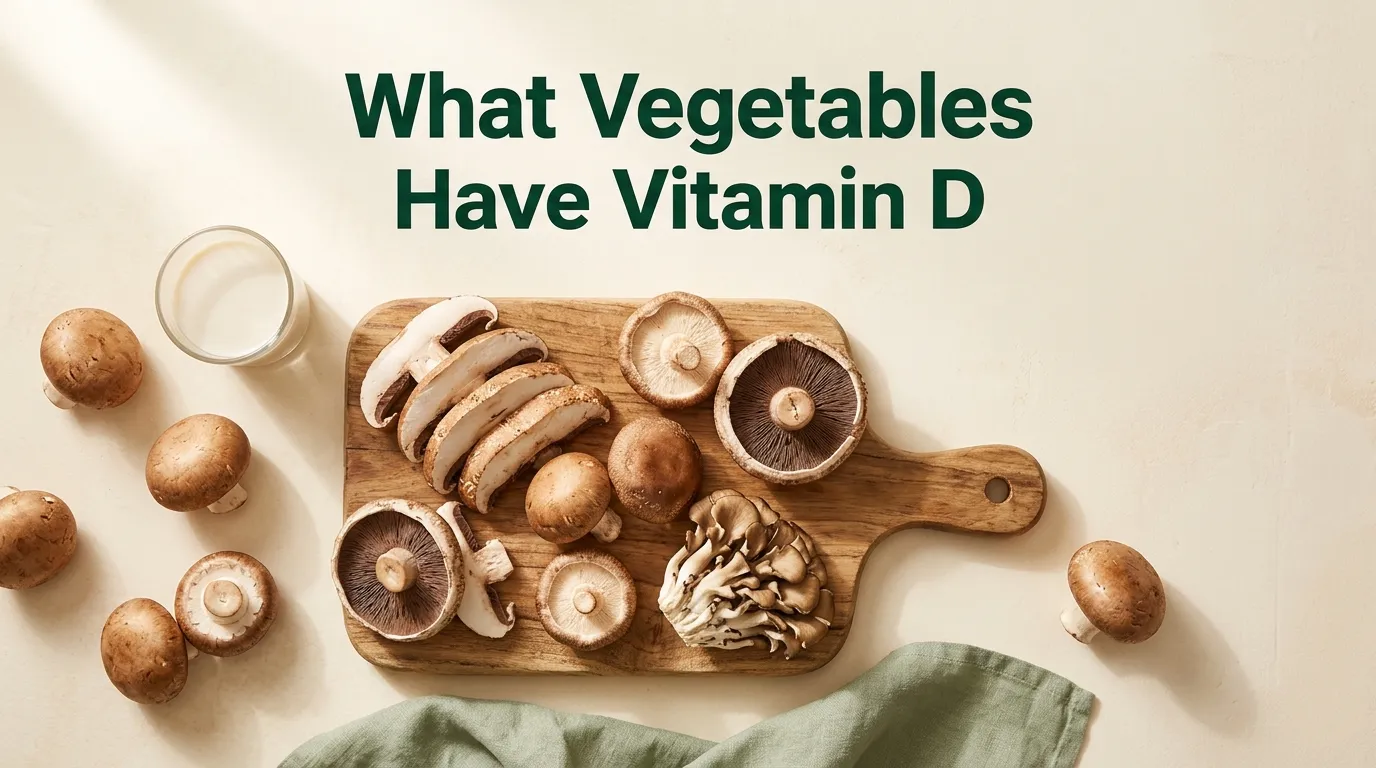
Vegetables, in the strict botanical sense, do not naturally contain vitamin D. The one genuine exception that blurs the line is the mushroom, which is technically a fungus, not a vegetable, but functions as a vegetable in the kitchen and represents the only meaningful non-animal, non-fortified food source of vitamin D available to plant-based eaters.
This distinction matters because many people searching for vitamin D vegetables are trying to meet their nutrient needs without animal products, and they need an honest, precise answer. According to the NIH Office of Dietary Supplements, vitamin D is naturally present in very few foods, and the vast majority of dietary intake in the United States comes from fortified foods and animal sources like fatty fish. For someone eating a plant-focused diet, understanding the mushroom exception and the science behind UV-exposed fungi is the difference between unknowingly running a deficiency risk and making informed choices that actually support their vitamin D status.
This article walks you through exactly what vegetables and plant foods do and do not contain vitamin D, which mushrooms provide the most, why UV light exposure changes everything about store-bought mushrooms, how D2 from fungi compares to D3 from animal sources, what fruits offer, and what fortified and supplemental options exist for anyone who wants a reliable, plant-based vitamin D strategy in 2026.
What Vegetables Have Vitamin D
Vegetables do not naturally synthesize or store vitamin D in any meaningful amount, with zero vitamin D found in leafy greens, cruciferous vegetables, root vegetables, squash, nightshades, or legumes in their natural, unfortified state. The single non-animal, non-fortified exception is mushrooms, which produce vitamin D2 (ergocalciferol) when their tissues are exposed to ultraviolet B (UV-B) radiation, much like human skin synthesizes vitamin D3 when exposed to sunlight.
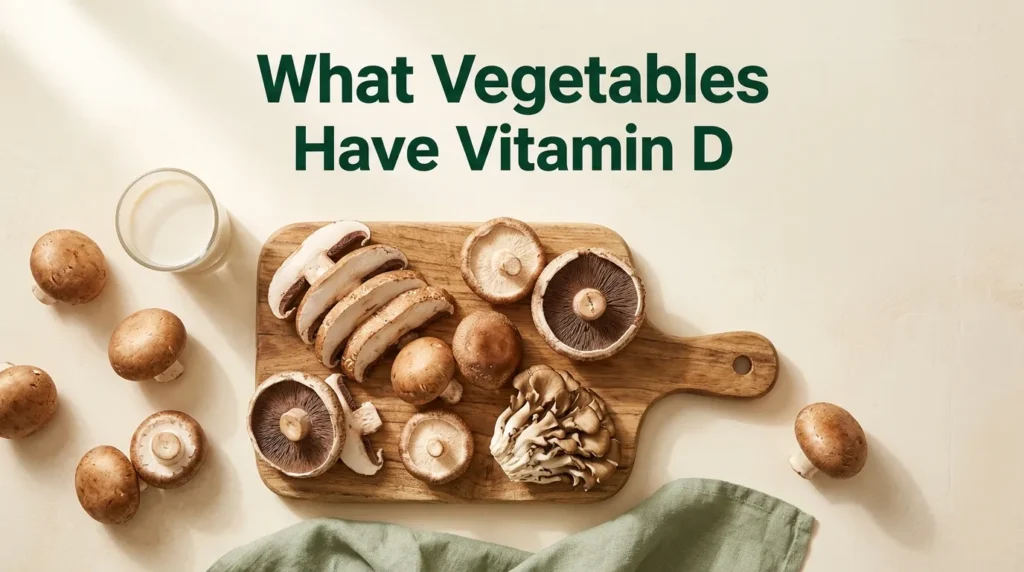
This biological mechanism is unique in the produce aisle. Mushrooms contain a compound called ergosterol in their cell membranes. When UV-B light hits the mushroom surface, it converts ergosterol into previtamin D2, which then slowly isomerizes into vitamin D2. This is functionally analogous to how 7-dehydrocholesterol in human skin converts to vitamin D3 under sunlight. The process happens after harvest and continues as long as UV light reaches the mushroom tissue. No leafy green, root, or fruit undergoes anything similar, which is why the answer to “what vegetables have vitamin D” starts and nearly ends with mushrooms.
For clarity, the USDA FoodData Central database records vitamin D content in common vegetables like broccoli, spinach, kale, carrots, sweet potatoes, and bell peppers as 0 IU per standard serving. These vegetables contribute countless other valuable nutrients but zero vitamin D. If you find a vegetable-based food containing vitamin D on a nutrition label, it has been fortified. The vitamin was added during processing. It did not originate in the plant tissue.
Key Takeaway: No true vegetable contains vitamin D naturally. Mushrooms, which are fungi used as vegetables in cooking, are the only non-fortified, non-animal source, and they only produce vitamin D2 when exposed to UV light.
Do Vegetables Have Vitamin D
No, vegetables do not have vitamin D in any amount that contributes to daily nutritional needs, with the scientific exception of UV-exposed mushrooms, which are not botanically vegetables but are used culinarily as vegetables. This categorical answer is important because online misinformation sometimes suggests that certain greens or sprouts contain vitamin D. They do not.
The confusion often stems from a misunderstanding of how vitamin D enters the food supply. Plants do not need vitamin D for their own biological processes and lack the biochemical pathway to synthesize it. The phytosterols in plants, while structurally similar to cholesterol, do not undergo UV-B photolysis the way ergosterol in fungi or 7-dehydrocholesterol in animal skin does. The Dietary Guidelines for Americans 2020-2025 list vegetables as contributing negligible vitamin D to the American diet, with mushrooms specifically noted as the only variable source depending on growing conditions and UV exposure.
A 2023 review published in Nutrients examined vitamin D content across 60 commonly consumed vegetables and found undetectable levels in all samples except for mushrooms that had been deliberately exposed to UV light during or after cultivation. Commercially grown mushrooms raised entirely in darkness, which describes most conventional white button and cremini mushrooms sold in U.S. grocery stores, contain zero to near-zero vitamin D. The mushroom’s potential is real, but it is not automatic. Darkness-grown mushrooms are vegetables in the nutritional sense: they provide B vitamins and minerals, but they do not provide vitamin D.
Key Takeaway: Vegetables, in the strict nutritional sense, do not provide vitamin D unless you specifically count UV-exposed mushrooms as a vegetable, and even then, only when the mushrooms have actually seen UV light during growth or after harvest.
What Vegetables Contain Vitamin D
Mushrooms are the only produce item commonly grouped with vegetables that contain vitamin D, and then only when the mushrooms have been grown under UV light, exposed to sunlight after harvest, or treated with UV lamps during processing. Here is the critical distinction: a mushroom’s vitamin D content is not inherent to the mushroom itself. It is a direct result of light exposure. A white button mushroom grown in a dark commercial mushroom house contains less than 20 IU of vitamin D per 100 grams, functionally zero. That same variety exposed to 15 minutes of UV-B light after harvest can contain over 1,000 IU per 100 grams.
This means the question “what vegetables contain vitamin D” is better reframed as “which mushrooms contain vitamin D, and under what conditions.” The table below breaks down vitamin D2 content in common mushroom varieties based on growing and treatment conditions, sourced from USDA FoodData Central and published research in the Journal of Nutrition.
Mushroom Variety | Growing Condition | Vitamin D2 per 100g (approx.) | Notes
White button | Commercial, dark-grown | 5 to 20 IU | Negligible
White button | UV-treated post-harvest | 400 to 1,000 IU | Widely available in some U.S. stores
Portobello (mature white button) | UV-treated | 400 to 1,000 IU | Same species, older fruiting body
Shiitake | Dried, sun-exposed | 1,600 IU | Traditional Asian drying method
Maitake (hen of the woods) | Wild or UV-grown | Up to 2,300 IU | One of the highest natural sources
Oyster mushrooms | UV-exposed | 300 to 800 IU | Variable by strain and exposure time
The commercial relevance here is growing. In 2026, several major mushroom producers routinely UV-treat portobello and white button mushrooms and label them as “high in vitamin D.” Look for packaging that explicitly states “UV-grown” or “vitamin D enriched.” Without that label, assume the mushroom contains negligible vitamin D.
For a 100g serving of UV-treated white button mushrooms providing 800 IU of vitamin D2, that represents 100% of the 800 IU RDA for adults over 70 and 133% of the 600 IU RDA for adults under 70. That one serving could theoretically meet your entire daily vitamin D recommendation from a single food, which is exceptional for any non-fortified plant source.
Key Takeaway: Mushrooms contain vitamin D only when exposed to UV light. Dark-grown commercial mushrooms have none. UV-treated and sun-dried varieties can provide hundreds to over 2,000 IU per serving.
What Vegetables Are High in Vitamin D
The only produce items culinarily used as vegetables that can be considered high in vitamin D are UV-exposed maitake mushrooms, sun-dried shiitake mushrooms, and commercially UV-treated portobello mushrooms, all of which can deliver between 400 and over 2,000 IU of vitamin D2 per 100-gram serving. No leafy green, root vegetable, cruciferous vegetable, or legume comes close.
To define “high in vitamin D” practically: the FDA considers a food an “excellent source” of a nutrient if it provides at least 20% of the Daily Value per serving. The Daily Value for vitamin D is 20 mcg (800 IU). That means a food is high in vitamin D if it delivers at least 4 mcg (160 IU) per serving. UV-exposed mushrooms can deliver 5 to 25 mcg (200 to 1,000+ IU) per 100 grams, easily qualifying them as high sources. By contrast, a cup of raw kale, a medium sweet potato, or a cup of cooked broccoli all deliver zero mcg. The gap is not small. It is absolute.
The standout varieties based on published data from the Journal of Nutrition and USDA FoodData Central include maitake mushrooms (Grifola frondosa), which in wild or UV-exposed form can exceed 2,000 IU per 100 grams, making them one of the most concentrated natural vitamin D sources in the food supply period, not just among plants. Dried shiitake mushrooms that have been sun-dried with gills facing upward can reach 1,600 IU per 100 grams, a practice used traditionally in Japanese cuisine and validated by modern food science. Commercially UV-treated white button and portobello mushrooms reliably fall in the 400 to 1,000 IU range, a narrower but still significant contribution that has made them the most accessible high-vitamin-D mushroom option for U.S. consumers.
A note on storage and cooking: Vitamin D in mushrooms is relatively stable during refrigeration and cooking. A 2022 study in Food Chemistry found that frying, baking, or microwaving UV-exposed mushrooms for up to 20 minutes resulted in less than a 15% loss of vitamin D2. That means the vitamin D you see on the label or in the published data largely survives the journey from the pan to your plate. Store mushrooms in the refrigerator and use them within a week for best retention. Dried mushrooms, kept sealed away from light and moisture, retain vitamin D for months.
Key Takeaway: UV-exposed maitake, sun-dried shiitake, and UV-treated portobello and white button mushrooms are the only vegetable-type foods that qualify as genuinely high in vitamin D, providing from 400 to over 2,000 IU per serving.
What Veggies Have Vitamin D
No botanical vegetable has vitamin D. The only plant-based foods in the produce section that contain vitamin D are mushrooms, which are fungi, and fortified fruit juices and plant milks, which have vitamin D added during manufacturing. This distinction is not semantic. It matters for anyone tracking their nutrient intake and making purchasing decisions.
When people search “what veggies have vitamin D,” they are usually walking through a grocery store mentally or literally, scanning the produce section for something to add to their cart. The practical, aisle-by-aisle answer is this: in the fresh vegetable section, the only items that can contribute vitamin D are mushrooms, and specifically those labeled as UV-grown or wild-harvested. In the refrigerated section, fortified orange juice and fortified plant milks (soy, almond, oat) will be labeled with vitamin D content. In the canned goods aisle, some mushroom products note UV treatment, but most do not, so check the label. In the frozen vegetable aisle, frozen mushrooms typically come from dark-grown commercial operations and will not contain significant vitamin D unless the packaging states otherwise.
Below is what to look for when you want vegetable-type vitamin D from the grocery store in 2026:
What to look for in the produce section:
Fresh mushrooms in packaging that explicitly reads “UV-grown,” “UV-treated,” or “excellent source of vitamin D”
Wild-harvested mushrooms like maitake or chanterelles from specialty grocers or farmers markets
Dried shiitake mushrooms in the international or spice aisle that state “sun-dried” on the package
Fortified orange juice with vitamin D listed on the Nutrition Facts panel (typically provides 100 to 140 IU per 8-ounce serving)
Fortified plant milks with vitamin D2 or D3 listed (typically 100 to 144 IU per cup)
The absence of true vegetables from this list is not a flaw in the vegetable kingdom. It reflects the biological reality that vitamin D in food comes almost entirely from animal sources, fungal sources, and fortification. Dark leafy greens like spinach and kale deliver calcium, vitamin K1, and a host of other nutrients that support the same bone health system that vitamin D regulates, but they do not provide the vitamin itself.
Key Takeaway: In the vegetable aisle, UV-labeled mushrooms are your only vitamin D option. Everything else relies on fortification or animal sources.
What Plants Have Vitamin D
Plants do not contain vitamin D. Fungi, which belong to an entirely different biological kingdom, are the only non-animal organisms that naturally produce vitamin D when exposed to UV light. This biological reality is non-negotiable and frequently misunderstood.
The plant kingdom (Plantae) and the fungal kingdom (Fungi) diverged evolutionarily over a billion years ago. Their cell membranes use different sterol compounds. Plants use phytosterols like sitosterol and campesterol. Fungi use ergosterol. Only ergosterol converts to vitamin D2 under UV-B light. Phytosterols do not undergo this photochemical reaction. This is not a matter of degree. It is a hard biochemical boundary. No amount of sunlight on spinach, kale, or tomatoes will generate vitamin D. The plant simply lacks the precursor molecule.
A 2021 paper in the Journal of Agricultural and Food Chemistry confirmed that exposing common vegetables and herbs to UV-B light post-harvest did not produce detectable vitamin D in any sample, while mushrooms from the same treatment batch showed significant D2 synthesis. The researchers concluded that the ergosterol pathway is unique to fungi and does not exist in any higher plant. This finding aligns with everything known about plant and fungal biochemistry. It is settled science.
For the home gardener or the curious consumer, this means that no amount of backyard vegetable gardening, greenhouse UV lighting, or sun-drying of tomatoes and peppers will create vitamin D in plant tissues. If you want to grow your own vitamin D, you would need to cultivate mushrooms and expose them to sunlight or UV lamps after harvest. Otherwise, the vitamin D in your diet must come from animal foods, fortified products, supplements, or store-bought UV-exposed mushrooms.
Key Takeaway: Plants lack ergosterol, the precursor needed to make vitamin D. No common vegetable, fruit, or herb can produce it, regardless of sun exposure.
Mushrooms Vitamin D Content
The vitamin D content of mushrooms ranges from zero to over 2,300 IU per 100 grams, entirely depending on the species, how they were grown, and whether they received UV light exposure before reaching your kitchen. This extraordinary range makes mushrooms simultaneously one of the most and least reliable vitamin D sources in the food supply.
To understand the numbers, it helps to know what drives them. Three factors control mushroom vitamin D content. First, species: maitake and shiitake naturally produce more vitamin D2 under UV light than white button or oyster mushrooms because their tissues contain higher baseline ergosterol concentrations. Second, UV exposure intensity and duration: laboratory studies published in the Journal of Nutrition show that exposing sliced white button mushrooms to UV-B lamps for just 15 minutes can increase vitamin D2 content from near zero to over 400 IU per 100 grams, and extending exposure to several hours can push that number above 1,000 IU per 100 grams. Third, orientation during exposure: mushrooms with gills facing upward toward the light source produce substantially more vitamin D2 because the gill tissue has a higher surface area and ergosterol density than the cap surface. Sun-drying shiitake gills-up, a traditional East Asian practice, is an empirically sound method that modern food science has validated.
The table below summarizes vitamin D2 content ranges from peer-reviewed research and the USDA FoodData Central database.
Mushroom Type | UV Exposure | Vitamin D2 (IU per 100g) | Serves as % of 800 IU RDA
White button (dark-grown) | None | 0 to 20 | 0 to 2%
White button (UV-treated) | 15 min to 2 hr UV-B | 400 to 1,000 | 50 to 125%
Portobello (UV-treated) | UV-B post-harvest | 400 to 1,000 | 50 to 125%
Shiitake (fresh, dark-grown) | None | 10 to 50 | 1 to 6%
Shiitake (dried, sun-exposed) | Sunlight during drying | 1,000 to 1,600 | 125 to 200%
Maitake (wild or UV-grown) | Natural or artificial UV | 1,200 to 2,300 | 150 to 288%
Oyster (UV-treated) | UV-B post-harvest | 300 to 800 | 38 to 100%
These numbers are averages from multiple studies. Individual mushroom vitamin D content varies with growing conditions, storage time, and handling. But the pattern is clear and useful: dark-grown mushrooms provide negligible vitamin D. UV-exposed mushrooms provide meaningful amounts, often exceeding 100% of the daily recommendation per serving.
Key Takeaway: Mushroom vitamin D content spans from zero to more than your full daily RDA in a single serving. The deciding factor is UV light exposure, not mushroom species alone.
Do Mushrooms Have Vitamin D
Mushrooms have vitamin D only when they have been exposed to UV light, either from sunlight or artificial UV-B lamps. Mushrooms grown entirely in darkness, which describes the vast majority of conventional commercial mushroom production, contain functionally zero vitamin D. This is the single most important fact about mushrooms and vitamin D, and it is the one that most generic food lists fail to make clear.
The biological mechanism is straightforward. Mushrooms naturally contain ergosterol in their cell walls. Ergosterol is a sterol compound that serves a structural function in fungal cell membranes, analogous to the role cholesterol plays in animal cells. When UV-B radiation in the wavelength range of 280 to 315 nanometers strikes ergosterol, it triggers a photochemical reaction that breaks open one of the sterol rings and forms previtamin D2. Over several hours at room temperature, previtamin D2 spontaneously isomerizes into vitamin D2 (ergocalciferol), the biologically active form. This process continues after harvest and during drying, which is why sun-dried mushrooms can accumulate substantial D2 even after being picked.
The practical implication for anyone buying mushrooms at a grocery store in 2026 is simple but requires label attention. If the mushroom package says “UV-grown,” “UV-treated,” “exposed to UV light,” “vitamin D enriched,” or lists a specific vitamin D percentage under the Nutrition Facts panel, those mushrooms contain vitamin D2. If the package says none of these things and the mushrooms are standard white button or cremini varieties sold in a plain plastic-wrapped tray, they were almost certainly grown in darkness and contain negligible vitamin D.
Wild-harvested mushrooms are a special case. Mushrooms that grow outdoors in forests and fields are naturally exposed to varying amounts of sunlight during their growth cycle. Wild maitake, chanterelles, morels, and porcini generally contain moderate to high levels of vitamin D2, though the exact amount varies with forest canopy cover, season, and latitude. A 2022 study in Food Chemistry analyzed wild mushroom samples from North American and European forests and found vitamin D2 concentrations ranging from 200 to over 1,500 IU per 100 grams dry weight, with maitake and chanterelles at the higher end. However, wild mushroom foraging carries its own safety risks and should only be done by experienced identifiers or through trusted commercial sources.
Quick Tip:
Check mushroom packaging for “UV-treated” or “excellent source of vitamin D” wording before assuming any vitamin D content.
Store UV-treated mushrooms in the refrigerator and consume within one week for optimal D2 retention.
Dried wild mushrooms from reputable suppliers often provide reliable D2 content and can be reconstituted in soups and stews without significant vitamin loss.
What Fruits or Vegetables Have Vitamin D
The only produce items that contain vitamin D without fortification are UV-exposed mushrooms, which are fungi, not vegetables or fruits. Among true fruits, none naturally contain vitamin D. The vitamin D found in orange juice, fruit smoothies, and some fruit-based products comes exclusively from fortification, meaning manufacturers add it during processing, typically in the form of vitamin D3 from lanolin or vitamin D2 from yeast.
This broader “fruits or vegetables” question often comes from people who want a single grocery list for plant-based vitamin D. Here is the complete, unfortified list: UV-exposed mushrooms (maitake, shiitake, portobello, white button, oyster, and certain wild varieties). That is the entire list. Avocados, oranges, bananas, apples, berries, melons, mangoes, leafy greens, broccoli, sweet potatoes, carrots, tomatoes, and every other common fruit and vegetable contain zero vitamin D in their natural state.
The Academy of Nutrition and Dietetics confirms this in their vegetarian and vegan nutrition guidance, noting that plant foods do not naturally contain vitamin D and that mushrooms are the only non-fortified non-animal source, with the caveat that UV exposure is required. The academy recommends that vegans and vegetarians who do not consume UV-exposed mushrooms regularly should rely on fortified foods or supplements to meet their vitamin D needs, particularly during winter months and at higher latitudes where sun exposure is insufficient for endogenous D3 synthesis.
Why do fruits, specifically, lack vitamin D? Fruits evolved to attract animals for seed dispersal, investing their biochemical energy in sugars, acids, pigments, and aromatic compounds, none of which involve ergosterol or a vitamin D synthesis pathway. The fleshy tissue of fruits protects seeds. Fungal fruiting bodies, by contrast, evolved from organisms that spent hundreds of millions of years managing UV exposure on forest floors and in open environments. The ergosterol-to-D2 pathway likely persisted because it conferred some adaptive advantage, possibly related to calcium regulation in the fungus or UV damage protection of spore DNA. Whatever the evolutionary reason, the nutritional consequence is that fruits belong in your diet for fiber, vitamin C, potassium, and polyphenols, not for vitamin D.
Key Takeaway: No fruit naturally contains vitamin D. The only produce-section item with natural vitamin D is the UV-exposed mushroom, and it is a fungus, not a fruit or vegetable.
What Fruit and Vegetables Are High in Vitamin D
No fruit or vegetable is naturally high in vitamin D. UV-exposed mushrooms, culinarily used as vegetables, are the only plant-based, non-fortified food that qualifies as high in vitamin D, with maitake and sun-dried shiitake varieties exceeding 2,000 IU per 100 grams. Among fortified fruit and vegetable products, orange juice and some fruit smoothies can be high in vitamin D, but the vitamin is added during manufacturing and originates from animal or fungal sources, not from the fruit itself.
To give a complete picture, it is useful to separate “natural” from “fortified” and to state plainly what falls into each category. Naturally high in vitamin D: UV-exposed maitake mushrooms (up to 2,300 IU per 100g), sun-dried shiitake mushrooms (up to 1,600 IU per 100g), and UV-treated portobello and white button mushrooms (400 to 1,000 IU per 100g). Fortified and potentially high in vitamin D: orange juice with added vitamin D (typically 100 to 140 IU per 8-ounce serving), fortified plant milks like soy, almond, and oat (100 to 144 IU per cup), and fortified breakfast cereals that may be combined with fruit (typically 40 to 100 IU per serving, varying widely by brand).
The distinction between natural and fortified matters because it affects how you read labels. When you buy mushrooms, the vitamin D content is variable and depends on growing conditions, UV treatment, and storage. When you buy fortified orange juice, the vitamin D content is standardized and listed on the Nutrition Facts panel. One is nature-dependent. The other is manufacturing-controlled. For someone who needs to know exactly how much vitamin D they are getting, fortified products offer consistency that UV-treated mushrooms cannot guarantee.
A 2023 market analysis from the USDA Economic Research Service noted that vitamin D-fortified plant milks now represent over 40% of the plant milk market in the U.S., up from 15% a decade earlier. This reflects both consumer demand and improved fortification technology. For the shopper in 2026, this means finding vitamin D-fortified fruit juices and plant milks is easier than ever, and these products, combined with UV-treated mushrooms, represent the practical core of a plant-based vitamin D strategy.
Quick Tip:
When buying fortified orange juice, check the Nutrition Facts panel for vitamin D listed in mcg (2.5 to 3.5 mcg per serving equals 100 to 140 IU).
Combine fortified juice or plant milk with UV-exposed mushrooms on different days to vary your plant-based vitamin D sources.
Do not rely on fruit or vegetable intake to provide vitamin D. The number will be zero unless fortification is clearly stated on the label.
Fruits With Vitamin D
Fruits do not naturally contain vitamin D. When you see a fruit product listing vitamin D on its Nutrition Facts panel, the vitamin has been added during processing, typically in the form of vitamin D3 derived from lanolin (sheep’s wool) or vitamin D2 derived from yeast or mushroom sources. The fruit itself contributes none of the vitamin D content.
The most common fortified fruit product is orange juice. Major brands began fortifying orange juice with vitamin D and calcium in the early 2000s, and in 2026, vitamin D-fortified orange juice is widely available in most U.S. grocery stores. A standard 8-ounce serving provides between 100 and 140 IU (2.5 to 3.5 mcg) of vitamin D, typically as vitamin D3. That represents about 15 to 23% of the 600 IU adult RDA, a meaningful but not dominant contribution. Other fortified fruit products include fruit and vegetable juice blends, some shelf-stable fruit smoothies, and a small number of vitamin-fortified fruit cups and applesauce products aimed at children.
The Academy of Nutrition and Dietetics advises that fortified fruit juices can contribute to vitamin D intake but should not be relied upon as a primary source because juice lacks fiber, is calorie-dense, and is easy to overconsume. An 8-ounce glass of fortified orange juice provides vitamin D but also delivers roughly 110 calories and 22 grams of sugar. For context, the American Heart Association recommends that adult women limit added sugar intake to no more than 25 grams per day and men to no more than 36 grams. One glass of juice uses up most or all of that budget without providing the satiety of whole fruit.
Some functional beverage brands in 2026 have started fortifying lower-sugar fruit-flavored sparkling waters and fruit-infused teas with vitamin D. These products typically deliver 10 to 20% of the Daily Value per can with minimal or zero sugar, offering an alternative to high-calorie juice. If you are looking for fruit-flavored options without the sugar load, these products are worth checking, but always read the label because fortification levels vary widely and some products use proprietary blends that make it hard to determine exact vitamin D content.
What Fruit Has a Lot of Vitamin D
No fruit in its natural state has a lot of vitamin D or any vitamin D at all. The fruit products that contain significant amounts of vitamin D are fortified orange juice and fortified fruit smoothies, with typical values ranging from 100 to 200 IU per 8-ounce serving depending on the brand and fortification level. This does not compare to the amount found in UV-exposed mushrooms, which can deliver 400 to over 1,000 IU per 100 grams.
To put this in perspective, a person would need to drink approximately six to eight glasses of fortified orange juice to get the same amount of vitamin D provided by a single 100-gram serving of UV-exposed maitake mushrooms. That is roughly 660 to 880 calories and 132 to 176 grams of sugar, an amount no health professional would recommend. The comparison illustrates why mushrooms, not fruit, represent the meaningful plant-based whole food source for vitamin D.
Some tropical fruit product manufacturers have experimented with higher fortification levels in recent years, targeting the “functional food” market. A few mango and guava juice blends fortified to 20% of the Daily Value per serving appeared on U.S. shelves starting in 2024. These products can provide a useful vitamin D boost in the context of a varied diet, but they still derive their vitamin D from added ingredients, not from the fruit itself. If you are aiming to increase your dietary vitamin D primarily through plant-based foods, UV-exposed mushrooms and possibly fortified plant milks are your most efficient options. Fortified fruit juices play a supporting role at best.
Quick Tip:
One serving of UV-exposed maitake mushrooms can deliver more vitamin D than six glasses of fortified orange juice, with zero grams of sugar.
If you enjoy fortified fruit juice, treat it as a small daily top-up, not your primary vitamin D source.
Look for lower-sugar fortified fruit beverages entering the market in 2026 if you want a fruit-flavored vitamin D option without the sugar content of traditional juice.
UV Light Mushrooms Vitamin D
Exposing store-bought mushrooms to direct sunlight for 15 to 60 minutes can increase their vitamin D2 content from near zero to several hundred IU per serving, a simple, scientifically validated home method that turns dark-grown commercial mushrooms into a meaningful plant-based vitamin D source. This technique works because the ergosterol in mushroom tissue is primed to convert to vitamin D2 under UV-B light, and solar UV-B radiation passing through a sunny window or reaching a balcony is sufficient to trigger the reaction.
The process is straightforward and has been validated in multiple studies, including research published in the Journal of Agricultural and Food Chemistry. To maximize vitamin D2 synthesis at home:
Place fresh mushrooms (white button, portobello, shiitake, or oyster) on a plate or tray with the gills facing upward. The gill tissue has the highest ergosterol concentration and the largest surface area for UV exposure.
Set the mushrooms in direct sunlight, either outdoors on a balcony or patio or on a sunny indoor windowsill where the glass does not block UV-B rays. Note that standard window glass blocks most UV-B radiation, so an open window or direct outdoor exposure works best.
Leave the mushrooms exposed for 15 to 60 minutes. Research shows that 15 minutes of midday summer sun can produce several hundred IU per serving, while 60 minutes can push levels above 1,000 IU per 100 grams.
After exposure, store the mushrooms in the refrigerator and consume within 3 to 5 days. The vitamin D2 content is stable and does not degrade rapidly in cold storage.
Cook the mushrooms as you normally would. Sautéing, roasting, or grilling does not significantly degrade the vitamin D2 content, with losses typically under 15%.
The same technique works with dried mushrooms. Spreading dried shiitake or maitake mushrooms in a single layer in direct sunlight for several hours before cooking or storing further increases their already significant vitamin D2 content. This is essentially what traditional sun-drying practices accomplish, and it can be replicated at home with dried mushrooms purchased from any grocery store.
A 2024 study in Food Chemistry confirmed that the at-home sunlight method works reliably across multiple mushroom species and that the resulting vitamin D2 levels are comparable to those found in commercially UV-treated mushrooms. The researchers noted that the best results occurred when mushrooms were sliced to increase surface area and exposed to sunlight between 10 a.m. and 2 p.m., when UV-B radiation is strongest. This is a genuinely practical, zero-cost method that anyone can use to turn a zero-vitamin-D food into a high-vitamin-D food in under an hour.
Key Takeaway: You can increase the vitamin D content of store-bought mushrooms by placing them gill-side up in direct sunlight for 15 to 60 minutes. The science is solid, the method is free, and the results are measurable.
Vitamin D2 vs D3 Food Sources
Vitamin D2 (ergocalciferol) comes from fungal sources including UV-exposed mushrooms and yeast, while vitamin D3 (cholecalciferol) comes from animal sources like fatty fish, egg yolks, and lanolin-derived supplements, and the two forms are not equally effective at raising and maintaining serum vitamin D levels in the human body. This distinction carries significant practical weight for anyone relying on plant-based vitamin D sources.
The biological difference between D2 and D3 lies in their side-chain chemistry. Vitamin D2 has a double bond between carbons 22 and 23 and an additional methyl group on carbon 24 that vitamin D3 lacks. These structural differences affect how the two forms bind to vitamin D-binding protein in the blood and how they are metabolized in the liver. The result, documented in multiple randomized controlled trials including a 2021 meta-analysis published in the American Journal of Clinical Nutrition, is that vitamin D3 is more effective at raising and sustaining serum 25-hydroxyvitamin D concentrations over time compared to equivalent doses of vitamin D2.
This does not mean vitamin D2 is ineffective. It does raise serum levels. But the same meta-analysis found that D3 supplementation produced approximately 30 to 50% higher serum 25(OH)D levels than D2 at equivalent doses. For someone consuming UV-exposed mushrooms as a primary vitamin D source, the D2 they ingest will contribute to their vitamin D status, but they may need a higher total intake to achieve the same serum level that a person consuming D3 from fish or lanolin-derived supplements would reach. The NIH Office of Dietary Supplements acknowledges this difference and notes that while both forms can correct deficiency, D3 is the more potent form.
There is an important plant-based exception: lichen-derived vitamin D3. Certain lichen species naturally produce vitamin D3, not D2. In recent years, supplement manufacturers have extracted this lichen-derived D3 and used it to create vegan vitamin D3 supplements that are chemically identical to the D3 found in animal sources. For vegans and vegetarians who want the potency of D3 without animal products, lichen-derived D3 supplements offer a genuine solution. These products have become more widely available and affordable as of 2026.
The table below summarizes the key differences.
Form | Source | Food Examples | Potency | Vegan Option?
D2 (ergocalciferol) | Fungi, yeast | UV mushrooms, yeast supplements | Lower than D3 | Yes
D3 (cholecalciferol, animal) | Animal tissues, lanolin | Fatty fish, egg yolks, most supplements | Higher than D2 | No
D3 (cholecalciferol, lichen) | Lichen | Vegan D3 supplements | Higher than D2 | Yes
Key Takeaway: Vitamin D3 is more effective at raising serum levels than D2. If you rely on mushroom D2, it works, but you may need more of it. Lichen-derived D3 supplements offer the D3 potency in a fully plant-based form.
Vegan Vitamin D Sources
Vegan vitamin D sources include UV-exposed mushrooms, vitamin D-fortified plant milks and juices, vitamin D-fortified cereals, and vegan vitamin D supplements, particularly lichen-derived vitamin D3 or yeast-derived vitamin D2. No whole plant food outside of UV-exposed mushrooms naturally contains vitamin D, which makes fortification and supplementation essential parts of a realistic vegan vitamin D strategy.
The Academy of Nutrition and Dietetics, in its position paper on vegetarian and vegan diets, states that vegans who do not consume UV-exposed mushrooms or fortified foods regularly are at risk of vitamin D deficiency, particularly during winter and at latitudes above approximately 37 degrees, where skin synthesis of vitamin D from October through March is minimal or nonexistent. The academy recommends that vegans meet their vitamin D needs through a combination of fortified foods and, when necessary, supplements, with the specific advice to choose products labeled for vitamin D content.
For the practical vegan eating pattern in 2026, here are the primary vitamin D sources, listed from most potent and reliable to least:
Lichen-derived vitamin D3 supplements: These provide the more potent D3 form in a vegan package and represent the most reliable method of maintaining adequate vitamin D status. They are available in liquid and capsule forms from multiple brands and should be third-party tested for potency and purity.
UV-exposed mushrooms: When consumed regularly and in sufficient quantities (100 to 200 grams of UV-treated mushrooms, 3 to 5 times per week), these can contribute meaningfully to vitamin D status. The at-home sunlight method can turn any store-bought mushrooms into a good source.
Vitamin D-fortified plant milks: Soy, almond, oat, and other plant milks fortified with vitamin D2 or D3 provide 100 to 144 IU per cup. Drinking 2 to 3 cups daily can supply 300 to 430 IU, approximately half to two-thirds of the RDA.
Vitamin D-fortified orange juice: Provides 100 to 140 IU per cup. The sugar content limits how much should be consumed daily, but one glass can be a useful contribution.
Vitamin D-fortified cereals and nutritional yeast: Some brands now include vitamin D fortification, though amounts are typically modest (40 to 100 IU per serving).
A Registered Dietitian Nutritionist who specializes in plant-based diets can assess whether your current intake from these sources is sufficient. This is particularly important for vegans who are pregnant, breastfeeding, over 70, have limited sun exposure, or have darker skin, as these factors increase vitamin D requirements or reduce endogenous synthesis.
Key Takeaway: A vegan vitamin D strategy requires intentionality. UV-exposed mushrooms and fortified foods help, but lichen-derived D3 supplements are the most reliable way to ensure adequate status year-round.
Plant Vitamin D Supplements
Plant-based vitamin D supplements fall into two categories: yeast-derived vitamin D2 (ergocalciferol) and lichen-derived vitamin D3 (cholecalciferol), with the lichen-derived D3 form being the more effective choice for raising and maintaining serum 25-hydroxyvitamin D levels. Both are fully vegan and widely available in the United States as of 2026.
Yeast-derived vitamin D2 is the traditional vegan supplement form. It is produced by exposing yeast cultures to UV light, triggering the same ergosterol-to-ergocalciferol conversion that occurs in mushrooms. These supplements are effective at correcting deficiency when taken consistently, but as discussed in the D2 vs. D3 section, they are less potent on a per-unit basis than D3. A 2022 randomized trial in Nutrients compared yeast-derived D2 with lichen-derived D3 in 200 vegan adults over a 12-week period and found that the D3 group achieved significantly higher serum 25(OH)D concentrations at equivalent IU doses, consistent with the broader D2 vs. D3 literature.
Lichen-derived vitamin D3 is the newer and now widely preferred vegan supplement form. Lichens are symbiotic organisms composed of a fungus and an alga living together. Certain lichen species, including those in the genus Cladonia, naturally produce vitamin D3 rather than D2. The extraction process is more complex and costly than yeast D2 production, but the resulting D3 is chemically identical to the D3 found in lanolin-based supplements and fatty fish. For the vegan consumer, lichen D3 offers the best of both worlds: the potency of D3 without any animal input. Multiple brands now offer lichen D3 in liquid drops, softgels, and capsules, and third-party testing for purity and potency is available through organizations like USP and NSF International.
When selecting a plant-based vitamin D supplement, consider the following:
Choose the form that fits your needs. If you want maximum potency, choose lichen-derived D3. Yeast-derived D2 is still effective and may be more affordable.
Check the dosage in IU or mcg. The RDA for adults is 600 to 800 IU (15 to 20 mcg). Your physician may recommend a higher dose based on blood test results.
Look for third-party testing certification from USP, NSF, or ConsumerLab to verify that the supplement contains what the label claims and is free from contaminants.
Take your supplement with a meal that contains fat since vitamin D is fat-soluble and absorption increases significantly when consumed with dietary fat.
Do not exceed the Tolerable Upper Intake Level of 4,000 IU (100 mcg) per day unless a physician has recommended a higher dose and is monitoring your serum levels.
A primary care physician can order a 25-hydroxyvitamin D blood test to determine your baseline status and whether supplementation is achieving the target serum level, generally considered 20 ng/mL or higher for bone health by the NIH Office of Dietary Supplements, with some expert bodies recommending 30 ng/mL or higher for optimal health. Follow-up testing after 3 months of supplementation allows dosage adjustment based on your individual response.
Key Takeaway: Lichen-derived vitamin D3 is the most effective plant-based supplement form. It matches animal-derived D3 in potency and provides vegans with a reliable path to maintaining adequate vitamin D status.
Frequently Asked Questions About Vegetables and Vitamin D
Do any vegetables naturally have vitamin D?
No vegetables naturally contain vitamin D. Mushrooms, which are fungi and not botanically vegetables, are the only non-animal, non-fortified food that can provide vitamin D. They produce vitamin D2 when their tissues are exposed to UV light from sunlight or artificial UV-B lamps. All other vegetables, including leafy greens, cruciferous vegetables, and root vegetables, contain zero vitamin D in their natural state. Any vegetable-based food with vitamin D on the label has been fortified.
Can you get enough vitamin D from mushrooms?
You can get enough vitamin D from mushrooms if you eat UV-exposed varieties regularly and in sufficient quantities. A 100-gram serving of UV-treated portobello or sun-dried shiitake mushrooms can provide 400 to over 1,600 IU of vitamin D2. For an adult with an RDA of 600 to 800 IU, one to two servings of these mushrooms could theoretically meet the daily requirement. Keep in mind that vitamin D2 is less potent than D3. You may need a higher total intake from D2 to achieve the same serum levels.
What is the best plant-based source of vitamin D?
The best plant-based whole food source of vitamin D is UV-exposed maitake mushrooms, which can provide over 2,000 IU per 100-gram serving. For a reliable, standardized source, lichen-derived vitamin D3 supplements are the best plant-based option because they deliver the more potent D3 form at a precisely known dosage. Fortified plant milks and juices provide smaller but consistent contributions and are good daily habits to pair with mushroom consumption.
How can I increase vitamin D in store-bought mushrooms?
Place store-bought mushrooms gill-side up in direct sunlight for 15 to 60 minutes. This simple method triggers the conversion of ergosterol in the mushroom tissue into vitamin D2 and can raise the vitamin D content from near zero to several hundred or even over 1,000 IU per serving. For best results, slice the mushrooms to increase surface area and expose them between 10 a.m. and 2 p.m. when UV-B radiation peaks. After exposure, refrigerate and consume within 3 to 5 days.
Is mushroom vitamin D as good as vitamin D from supplements?
Mushroom vitamin D2 is not as potent as the vitamin D3 found in most non-vegan supplements, but it still raises serum levels and can contribute to adequate status. Research shows that D3 is approximately 30 to 50% more effective than D2 at equivalent doses. If you rely on mushroom vitamin D, you may need a higher total intake to achieve the same effect as D3 supplementation. The vitamin D in UV-exposed mushrooms is still a valuable and functional dietary source.
Which fruits and vegetables are fortified with vitamin D?
Orange juice and fruit smoothies are the most commonly fortified fruit products, typically providing 100 to 140 IU of vitamin D per 8-ounce serving. Fortified plant milks including soy, almond, and oat milk fall into the broader produce-adjacent category and provide 100 to 144 IU per cup. In the vegetable aisle, no vegetables are typically fortified because the fortification happens during processing, not to fresh produce. UV-treated mushrooms are the closest equivalent to a fortified fresh vegetable.
The information in this article should clarify one thing above all else: the vegetable drawer is not where you will find vitamin D. Mushrooms, fungi that sit in the produce section and cook like vegetables, are your single whole-food, plant-based option, and even they only deliver when they have seen light.
If you eat a plant-based diet, make UV-exposed mushrooms a regular part of your meals, keep fortified plant milk or juice in rotation, and consider a lichen-derived vitamin D3 supplement as the reliable backbone of your intake strategy. Check your status with a blood test when you can. Knowing your number is always better than guessing.
Your body needs vitamin D to absorb calcium, mineralize bone, and run a healthy immune system. For plant-based eaters, getting enough takes a little more knowledge and a little more intentionality, but the tools exist, the science is clear, and the strategy is entirely within your control.