Donut Nutrition Facts: 2026 Complete Macro & Sugar Guide
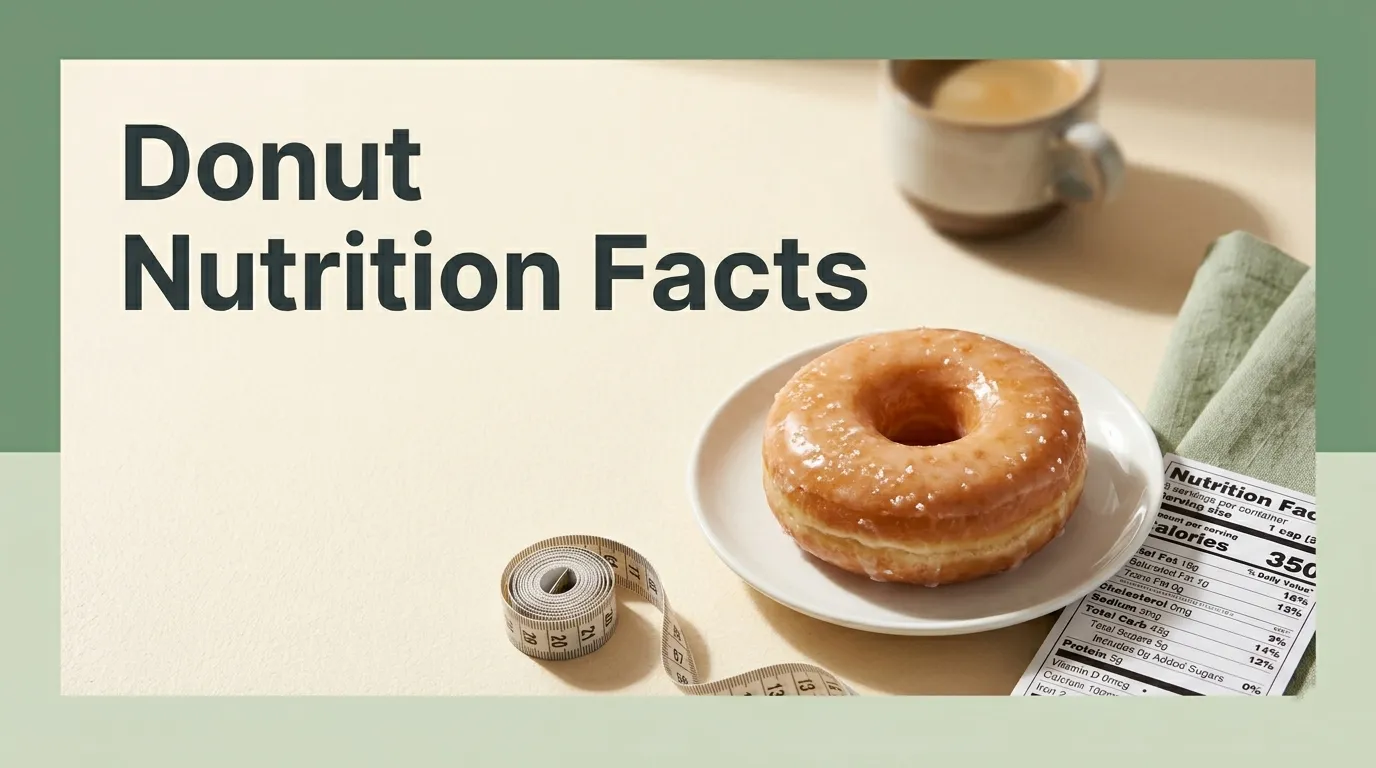
A standard medium glazed yeast-raised donut weighing approximately 60 to 70 grams contains 260 to 280 calories, 14 grams of fat including 5 to 7 grams of saturated fat, 31 grams of total carbohydrates with 14 to 16 grams of added sugars, and 4 grams of protein. The USDA FoodData Central database, which is the source for the nutrition facts panels you see on food tracking apps and restaurant menus, records these values for the most commonly consumed donut type in the United States.
The nutritional profile of a donut is not a mystery, and it is not a secret. It is a straightforward consequence of what a donut is made of. Refined wheat flour provides the carbohydrate base and the small amount of protein. The fat comes predominantly from the frying oil absorbed during cooking, which typically adds 10 to 15 grams of pure fat to the finished product. The sugar comes from the glaze, which is a simple mixture of powdered sugar and liquid that sets into a thin, sweet shell. There is no hidden ingredient. There is no nutritional surprise. A donut delivers exactly what its ingredient list promises.
This article is not here to tell you that donuts are secretly healthy or that you should feel guilty about eating one. Neither claim is honest, and neither is nutritionally useful. What this article will do is give you the actual numbers for multiple donut types from the USDA database, explain how the frying process changes the nutritional math, show you the difference between yeast-raised and cake donuts that no one tells you about in the drive-through, and answer the real questions about sugar, saturated fat, allergens, and what happens to your blood sugar after you eat a donut. You will walk away knowing exactly what you are eating and how to think about it in the context of the rest of your day.
Donut Nutrition Facts
The complete donut nutrition facts for a standard medium glazed yeast-raised donut per the USDA FoodData Central database are 269 calories, 14.3 grams total fat, 5.7 grams saturated fat, 0.3 grams trans fat, 23 milligrams cholesterol, 237 milligrams sodium, 31.2 grams total carbohydrate, 0.7 grams dietary fiber, 14.6 grams total sugars, and 4.0 grams protein. The micronutrient profile is minimal, with the only nutrients reaching 5 percent or more of the Daily Value being iron at 1.2 milligrams, thiamin at 0.13 milligrams, riboflavin at 0.11 milligrams, niacin at 1.2 milligrams, and folate at 42 micrograms DFE, all of which come from the enriched wheat flour rather than any inherently nutritious donut ingredient.
The enrichment of wheat flour is a public health measure, not a donut-specific benefit. Since 1941, the FDA has required that refined wheat flour be enriched with thiamin, riboflavin, niacin, and iron, and folic acid was added to the enrichment standard in 1998 to reduce neural tube defects. When you see B vitamins and iron on a donut nutrition label, you are seeing the residue of this enrichment policy. The same B vitamins would be present in any food made with enriched flour, including white bread, crackers, and pasta. The donut is not providing these nutrients. The flour is. The distinction matters because it prevents the misleading conclusion that a donut is a meaningful source of vitamins.
The sodium content is worth noting. A single glazed donut contains approximately 237 milligrams of sodium, which is 10 percent of the 2,300 milligram Daily Value. This sodium comes from salt added to the dough and from leavening agents including sodium bicarbonate and sodium acid pyrophosphate. The amount in one donut is not alarming in isolation, but it contributes meaningfully to daily sodium intake if other meals that day also contain processed foods. Two donuts and a coffee represent no sodium concern for most people. A breakfast of donuts followed by a processed lunch and a restaurant dinner can easily push total daily sodium above 3,000 milligrams without the eater ever adding salt from a shaker.
Doughnuts Nutrition Facts
The spelling difference between “donut” and “doughnut” changes nothing about the nutritional content, and both words refer to the same category of fried dough confections with identical macro and micronutrient profiles determined entirely by the specific type, size, and preparation method of the product, not by the spelling on the box. The USDA FoodData Central database uses the spelling “doughnuts” as its primary entry, and every nutrient value in that database applies equally regardless of how the word appears on a restaurant menu or a grocery store package.
The reason both spellings exist is historical, not nutritional. “Doughnut” is the original spelling, appearing in Washington Irving’s writing in 1809. “Donut” is a simplified American spelling that gained widespread adoption in the mid-20th century, accelerated by the Dunkin’ Donuts brand name that launched in 1950. The two words refer to the exact same food with the exact same nutritional properties. A “doughnut nutrition facts” search and a “donut nutrition facts” search are seeking the same information, and the databases that provide that information use the same entries for both queries.
Regional and brand differences matter far more than spelling differences. A doughnut from a grocery store bakery may use a different frying oil, a different glaze formula, and a different dough hydration than one from a national chain, producing a different final nutritional profile even for the same style. The USDA values represent a composite average of commercially available products. Any individual donut from a specific bakery will vary from the database average by 10 to 20 percent in either direction. This variability is inherent to fried foods made from biological ingredients in real kitchens, not manufactured to pharmaceutical precision.
When you look up nutrition facts for a doughnut on a food tracking application, the entry you select matters as much as the food you eat. An entry labeled “doughnut, glazed, yeast-raised” is referencing the USDA standard at approximately 269 calories. An entry labeled “donut, glazed, large” may be a user-submitted entry for a bakery product weighing 100 grams or more with correspondingly higher values. An entry for a specific brand reflects that brand’s proprietary recipe. Matching the database entry to what you actually ate requires knowing not just that you ate a donut, but what type, what size, and ideally what brand.
Donut Calories and Macros
The calorie and macronutrient content of a donut is determined primarily by its weight, its dough type, and the amount and type of fat absorbed during frying, with yeast-raised donuts typically ranging from 240 to 300 calories for a medium ring, cake donuts ranging from 290 to 380 calories for the same size, and filled or frosted varieties adding 50 to 150 additional calories from the filling or topping. The macronutrient breakdown consistently shows fat and carbohydrate as the dominant energy sources, with protein making up a small fraction of total calories.
The calorie math of a donut is simple to deconstruct. A yeast-raised donut at 270 calories with 14 grams of fat, 31 grams of carbs, and 4 grams of protein gets its energy as follows: 126 calories from fat, 124 calories from carbohydrate, and 16 calories from protein. This is a near-even split between fat and carbohydrate, with protein contributing almost nothing. This balance makes a donut a high-energy, low-satiety food. Fat and refined carbohydrate both digest quickly, and the absence of fiber and the minimal protein mean the calories hit the bloodstream fast without triggering the satiety signals that fiber and protein would provide.
Cake donuts shift the balance slightly toward fat. A standard old-fashioned cake donut weighs more than a yeast donut, typically 70 to 85 grams versus 60 to 70 grams, and absorbs more oil during frying due to the denser crumb structure. The result is a donut with 310 calories, 18 grams of fat, 34 grams of carbohydrate, and 4 grams of protein. The extra 40 calories and 4 grams of fat relative to a yeast donut come entirely from the additional oil absorption during frying. The dough itself is nutritionally similar before it hits the fryer.
Filled and specialty donuts break the calorie scale in ways that matter for anyone tracking intake. A Boston cream donut, filled with pastry cream and topped with chocolate, weighs 90 to 110 grams and delivers 350 to 420 calories, 18 to 22 grams of fat, 42 to 50 grams of carbohydrate, and 5 to 6 grams of protein. A jelly-filled donut adds 50 to 80 calories of sugary fruit filling. An apple fritter, which is essentially a donut with extra surface area for oil absorption and a heavy glaze coating, routinely exceeds 400 calories and can approach 500 calories for a large bakery version. The calories add up not because any ingredient is surprising but because the weight of the finished product keeps increasing with each addition.
| Donut Type | Typical Weight | Calories | Total Fat | Carbohydrates | Protein |
|---|---|---|---|---|---|
| Glazed yeast ring | 60 to 70g | 260 to 280 | 14g | 31g | 4g |
| Glazed cake ring | 70 to 85g | 290 to 320 | 18g | 34g | 4g |
| Old-fashioned cake | 75 to 90g | 310 to 380 | 19g | 36g | 4g |
| Boston cream filled | 90 to 110g | 350 to 420 | 20g | 45g | 5g |
| Apple fritter | 100 to 130g | 400 to 500 | 22g | 52g | 5g |
Key Takeaway: The 80-calorie range among donut types at the same shop is entirely real and entirely determined by whether the donut is yeast or cake, plain or filled, and how long it spent in the fryer absorbing oil.
Glazed Donut Nutrition Facts
A glazed yeast-raised donut from a standard commercial recipe contains 269 calories, 14.3 grams of total fat, 5.7 grams of saturated fat, 0.3 grams of trans fat, 31.2 grams of total carbohydrate, 14.6 grams of sugar, and 4.0 grams of protein, according to the USDA FoodData Central database entry for “Doughnuts, yeast-leavened, glazed, enriched.” This single donut represents roughly 13 percent of a 2,000-calorie daily intake and uses 28 percent of the American Heart Association’s recommended daily limit of 50 grams of added sugar.
The glaze is the primary source of sugar, contributing approximately 8 to 10 grams of the total sugar content. The remaining 4 to 6 grams of sugar come from the dough itself, where a small amount of sugar is added to feed the yeast, provide browning through the Maillard reaction, and contribute to the tender crumb texture. The glaze is functionally a simple syrup made from powdered sugar and a small amount of liquid, milk, water, or corn syrup, that is applied while the donut is still warm. The liquid evaporates or absorbs, leaving behind a thin layer of pure sugar that crystallizes into the characteristic shiny, slightly crackly surface.
The trans fat content of commercial glazed donuts has decreased substantially since the FDA’s 2015 determination that partially hydrogenated oils are no longer Generally Recognized As Safe. As of the 2018 compliance date and the January 2020 final deadline for removing partially hydrogenated oils from manufactured foods, the primary source of trans fat in donuts has been eliminated. The USDA database still records 0.3 grams of trans fat per glazed donut, which reflects data collected before the full implementation of the ban and the small amounts of naturally occurring trans fat found in refined vegetable oils. Current commercial donuts from major chains using non-hydrogenated oils contain less than 0.5 grams of trans fat per serving, the threshold below which the FDA permits a zero-gram label claim.
A glazed donut from a national chain will differ from the USDA composite. Krispy Kreme’s Original Glazed donut is listed at 190 calories, 11 grams of fat, 22 grams of carbohydrate, and 10 grams of sugar for a 49-gram serving. Dunkin’s Glazed Donut is listed at 240 calories, 11 grams of fat, 33 grams of carbohydrate, and 13 grams of sugar for a 57-gram serving. The differences reflect variations in recipe, dough hydration, proofing time, frying time, and glaze thickness that are proprietary to each brand. The USDA average sits between these two at a slightly heavier weight, which is appropriate for a national composite.
Yeast Donut vs Cake Donut Nutrition
Yeast-raised donuts contain fewer calories and less fat than cake donuts of equivalent size because yeast leavening creates an airy, open crumb structure that absorbs less frying oil than the dense, fine crumb of chemically leavened cake donuts. The average yeast donut at 60 to 70 grams delivers 260 to 280 calories and 14 grams of fat. The average cake donut at 70 to 85 grams delivers 290 to 380 calories and 18 to 19 grams of fat. The difference of 30 to 100 calories and 4 to 5 grams of fat per donut is entirely attributable to oil absorption during frying.
The structural difference that determines oil absorption begins in the mixing bowl. Yeast donut dough is hydrated, elastic, and develops a gluten network during proofing. The yeast produces carbon dioxide gas that inflates the dough into a network of interconnected air pockets separated by thin gluten walls. When the donut enters the hot oil, the water in the dough rapidly converts to steam, the gas cells expand further, and the starch gelatinizes to set the structure. The thin walls and open cell structure limit the surface area available for oil to cling to after the donut is removed from the fryer.
Cake donut batter is chemically leavened with baking powder or baking soda, mixed minimally to avoid gluten development, and produces a dense, fine-crumbed structure with many small, evenly distributed air cells rather than large, interconnected pockets. When this batter enters the fryer, the dense structure provides more surface area for oil to adhere to and absorb into. The absence of a strong gluten network means the structure is more friable, and the small air cells trap oil more effectively than the open channels of a yeast donut. Think of a yeast donut as a sponge with large holes that drains easily and a cake donut as a dense paper towel that holds onto oil.
The calorie difference has practical implications if you eat donuts regularly. Choosing a glazed yeast donut over an old-fashioned cake donut saves approximately 60 to 100 calories per donut. Over a year of weekly donut consumption, that is 3,000 to 5,000 calories, roughly a pound of body weight worth of energy, simply from choosing a different donut style. The difference is not transformative, and it does not make donuts a health food, but it demonstrates that within the category of “eating a donut,” there are choices with measurably different nutritional outcomes.
Key Takeaway: If you are choosing between donut types and want the lower-calorie option, pick the yeast-raised glazed ring over the cake donut every time, because the yeast structure physically traps less frying oil in the finished product.
Baked vs Fried Donut Nutrition
Baked donuts contain significantly fewer calories and less fat than fried donuts, with a typical baked glazed donut providing 160 to 200 calories and 5 to 8 grams of fat compared to 260 to 280 calories and 14 grams of fat for its fried counterpart, because the baking process eliminates the oil absorption that accounts for approximately 10 to 14 grams of pure fat in a fried donut. The calorie savings is approximately 80 to 100 calories per donut, entirely from the fat not absorbed during cooking.
The nutritional trade-off is texture. Frying is not merely a cooking method for donuts. It is the process that creates the characteristic crisp exterior, tender interior, and the particular mouthfeel that people associate with a donut. Baking a donut dough or batter produces a product that is structurally more like a small cake or a muffin top than a traditional donut. The exterior does not develop the same thin, crisp shell because the Maillard reaction and starch gelatinization occur differently in the 350-degree dry heat of an oven than in 350-degree oil. The interior is cakier and less tender because there is no oil to shorten the gluten strands and coat the starch granules.
Home-baked donuts made from commercial mixes or from-scratch recipes allow control over the ingredients that commercial donuts do not. A home baker can substitute whole wheat flour for a portion of the refined flour, adding approximately 2 to 3 grams of fiber per donut. The added sugar can be reduced from the standard 15 grams to 8 to 10 grams without rendering the donut unpalatable, though the texture and browning will change. The fat source can be butter or a liquid oil rather than the palm or soy shortening used in commercial frying. These changes do not turn a baked donut into a nutritious food, but they shift the nutritional profile meaningfully in a direction that aligns better with the Dietary Guidelines for Americans’ recommendations for whole grain intake and added sugar limitation.
The caveat is that a “baked donut” at a commercial chain or grocery store is not necessarily what a home baker would recognize as baked. Some commercial products labeled as baked donuts are still partially fried or are manufactured using a hybrid process that involves spraying the formed dough with oil before baking to simulate the fried texture. Reading the ingredient list and the nutrition facts panel is the only way to confirm that a commercially baked donut actually delivers the fat and calorie reduction that the term implies.
Donut Saturated Fat Content
A standard glazed yeast donut contains 5 to 7 grams of saturated fat, which represents 23 to 32 percent of the 22-gram daily saturated fat limit recommended by the American Heart Association for a 2,000-calorie diet, and this saturated fat comes predominantly from the frying oil, with palm oil and palm kernel oil being the most common saturated fat sources in commercial donut frying. The saturated fat content is not trivial for a single food item and is the nutrient most likely to concern someone monitoring their cardiovascular health.
The saturated fat in a donut is a direct function of the frying oil’s fatty acid profile. Palm oil, the most common commercial donut frying oil, is approximately 49 percent saturated fat, 40 percent monounsaturated fat, and 11 percent polyunsaturated fat. Soybean oil, used by some manufacturers, is approximately 16 percent saturated, 23 percent monounsaturated, and 58 percent polyunsaturated. A donut fried in palm oil will have roughly three times the saturated fat content of a donut fried in soybean oil, all else equal. The frying medium is the single largest determinant of the saturated fat number on the label.
The FDA requires that saturated fat be listed on the nutrition facts panel, but the regulation does not require manufacturers to list the type of oil used for frying on the nutrition facts panel itself. That information appears in the ingredient list, where “palm oil,” “soybean oil,” “vegetable oil shortening,” or a similar term must appear. For a consumer trying to assess saturated fat intake, the ingredient list is more informative than the nutrition facts panel alone because it reveals the source of the saturated fat and indicates whether the product is likely to contain trace trans fats from refined oils.
The Dietary Guidelines for Americans 2020-2025 recommend limiting saturated fat to less than 10 percent of total daily calories, which at 2,000 calories equals 22 grams. A single glazed donut at 5 to 7 grams of saturated fat uses roughly a quarter of that allowance. For someone who also consumes butter, cheese, meat, or other saturated fat sources during the day, the donut’s contribution is not negligible. It is a real fraction of the daily budget that requires accounting for elsewhere if saturated fat intake is being managed.
Donut Sugar Content Grams
A standard glazed yeast donut contains 14 to 16 grams of total sugar, all of which qualifies as added sugar under the FDA’s updated nutrition labeling definition, representing 28 to 32 percent of the 50-gram daily added sugar limit recommended by the American Heart Association for a 2,000-calorie diet. The sugar content of a donut is concentrated almost entirely in the glaze, with a smaller amount in the dough, and varies by donut type, with frosted, filled, and crumb-topped varieties containing 20 to 35 grams of sugar per donut.
The FDA’s 2016 update to the nutrition facts label, which became mandatory in 2020 for large manufacturers and 2021 for smaller ones, requires that “added sugars” be listed separately from total sugars. For a donut, the distinction between total and added sugar is straightforward. Essentially all of the sugar in a glazed donut is added during manufacturing. The dough contains a small amount of sugar for yeast fermentation and browning, and the glaze is almost entirely powdered sugar with a small amount of liquid. There is no intrinsic sugar in a donut from fruit or dairy in standard formulations. A label listing 15 grams of total sugar and 15 grams of added sugar is typical and accurate.
The sugar content increases rapidly as the donut becomes more elaborate. A chocolate-frosted yeast donut contains 18 to 22 grams of sugar. A maple-frosted donut with a bacon topping may contain 22 to 28 grams. A jelly-filled donut contains 20 to 28 grams. An apple fritter with a heavy glaze coating and cinnamon-sugar throughout the dough can contain 28 to 35 grams of sugar, which is 56 to 70 percent of the daily added sugar limit in a single item. The sugar adds up not incrementally but multiplicatively as each component of the donut contributes its own sugar load.
The practical implication for anyone monitoring added sugar intake is that donut type selection matters as much as donut consumption frequency. Eating one glazed yeast donut uses 28 percent of the daily added sugar budget. Eating one apple fritter uses up to 70 percent. Both are a single donut. Both are a single breakfast choice. The difference in added sugar between them is roughly 15 to 20 grams, equivalent to 4 to 5 teaspoons of granulated sugar.
What Oil Are Donuts Fried In
Commercial donuts are fried predominantly in palm oil, soybean oil, or a blend of vegetable oils formulated for high-heat stability, with palm oil being the most common choice for large-scale donut production due to its high smoke point, its solid-at-room-temperature consistency that creates the characteristic donut mouthfeel, and its resistance to oxidation and rancidity during the extended high-heat cycles of commercial frying. The specific oil used by a particular manufacturer or chain is disclosed on the ingredient statement of packaged products and is often available on the company’s website for restaurant-served items.
Palm oil’s dominance in the donut industry is a functional decision, not a nutritional one. Donut frying requires oil that can maintain its chemical integrity at temperatures between 350 and 375 degrees Fahrenheit for hours of continuous operation, across multiple batches of dough, with moisture constantly being introduced from the dough and particulate matter accumulating from the glaze and crumbs. Palm oil’s fatty acid profile, with roughly equal proportions of saturated and unsaturated fats, provides oxidative stability that polyunsaturated oils like soybean or canola cannot match without partial hydrogenation, which has been largely eliminated from the food supply.
The oil that fries a donut becomes a structural component of the finished product. During frying, water in the dough vaporizes and escapes as steam, and the voids left behind fill with oil through capillary action. A donut gains 10 to 15 grams of oil during a standard 60 to 90-second fry. That oil is now inside the donut, not on the surface. It cannot be blotted off or removed. When you eat a donut, you are eating 10 to 15 grams of whatever oil the manufacturer chose for frying, with that oil’s full fatty acid profile absorbed into the dough matrix.
The freshness of the frying oil matters for more than taste. Oil that has been used for extended periods without filtering and turnover develops higher levels of free fatty acids, polar compounds, and oxidized lipids. These compounds are not listed on nutrition facts panels. They are not allergens. They are not regulated individually. But they are present in the food in proportion to how well the fryer is maintained. A donut from a shop that changes and filters its oil frequently is nutritionally different from a donut fried in degraded oil, even if the calorie and macronutrient numbers are identical.
Donut Ingredients and Allergens
A standard commercial glazed donut contains enriched wheat flour, water, sugar, palm or soybean oil, yeast, eggs, milk solids, salt, and leavening agents, and this ingredient profile makes donuts a carrier of four of the FDA’s nine major food allergens: wheat, egg, milk, and soy. The allergen profile means that a donut is incompatible with several common dietary restrictions and medical dietary requirements, and the manufacturing environment in most donut shops means that cross-contact with tree nuts and peanuts is possible even in donuts that do not contain them as named ingredients.
The wheat in a donut is present in the form of refined enriched wheat flour, which contains gluten. A donut is absolutely not a gluten-free food, and the gluten is not removable or substitutable in a way that preserves the donut structure. Gluten provides the elastic network that traps yeast-produced gas and creates the airy crumb of a yeast donut. Gluten-free donuts exist as a specialty product, but they are nutritionally and texturally distinct from wheat-based donuts, typically relying on rice flour, tapioca starch, and xanthan gum to approximate the structure that wheat gluten would provide.
Eggs and milk function as tenderizers, emulsifiers, and browning agents in donut dough. The egg yolk’s lecithin emulsifies the fat into the dough, creating a finer, more uniform crumb. The milk proteins and lactose contribute to the Maillard browning reaction, producing the golden-brown crust. Egg-free and dairy-free donuts exist in the marketplace, particularly in the vegan donut category, but a standard commercial donut from a conventional bakery or chain should be assumed to contain egg and milk unless explicitly labeled otherwise.
Soy is present in most commercial donuts in the form of soybean oil or soy lecithin used in the manufacturing process. Even when the primary frying oil is palm oil, soy lecithin may appear in the ingredient list as an emulsifier in the dough or the glaze. Soy allergy presents a particular challenge with donuts because soy oil is pervasive in commercial baking and frying environments, and the shared fryer oil means that even a donut made with non-soy ingredients may have soy protein residue if the fryer previously fried soy-containing products.
Quick Tip:
If you have a food allergy, do not rely on the front of the donut display case for allergen information. Ask to see the ingredient documentation for the specific donut you are buying. The person behind the counter may not know whether the frying oil is soybean or palm oil. The ingredient binder or the manufacturer’s website has the legally required allergen information. A donut shop that cannot produce an ingredient list for its products is not a safe purchase for someone with an anaphylactic food allergy.
Are Donuts Healthy
Donuts are not a health-promoting food, and no credible nutrition professional describes them as such, but they can fit into an overall healthy dietary pattern when consumed occasionally, in reasonable portions, and with the understanding that they displace more nutrient-dense food choices in that meal and that day. The question “are donuts healthy” usually means “am I making a mistake by eating this,” and the answer depends entirely on frequency, portion, and what the rest of your diet looks like.
A donut’s nutritional liabilities are real and well-documented. It delivers 260 to 380 calories with minimal fiber, 4 grams of protein insufficient for satiety, 14 to 19 grams of fat heavily weighted toward saturated fat, and 14 to 30 grams of added sugar that provides no nutritional benefit beyond energy. The micronutrient content is trivial. The energy density is high relative to satiety. These are the characteristics of a food that the Dietary Guidelines for Americans would categorize as providing mostly empty calories.
The context in which a donut is eaten determines its nutritional impact as much as the donut itself. A donut eaten in place of a balanced breakfast, providing no protein, no fiber, and a rapid glycemic load, will leave most people hungry again within 90 minutes and more likely to overeat at lunch. A donut eaten as a planned treat after a balanced meal that included protein, fiber, and vegetables has a different metabolic and behavioral impact. The donut is the same. The eating pattern around it is different.
The Academy of Nutrition and Dietetics’ position on total diet and overall eating pattern provides the framework that applies here. Individual foods are not good or bad in isolation. What matters is the totality of choices over time. A person who eats a generally nutrient-dense diet, meets their fruit and vegetable targets, gets adequate fiber, and limits saturated fat and added sugar across most meals is not harming their health by eating a donut once or twice a week. A person whose diet is built around refined grains, added sugar, and saturated fat, and who eats donuts regularly as part of that pattern, is consuming a diet that the research consistently associates with poor health outcomes.
Key Takeaway: Donuts are not healthy, and you already knew that before reading this article. What matters is whether they are a daily staple or an occasional treat, because the dietary pattern over weeks and months determines health outcomes, not the nutritional content of a single donut eaten on a Saturday morning.
Donut Glycemic Index
A glazed yeast donut has an estimated glycemic index of approximately 70 to 75, placing it in the high glycemic index category alongside white bread and table sugar, because refined wheat flour and sugar both digest rapidly to glucose in the small intestine and the donut’s fat content, while substantial, is not enough to meaningfully slow gastric emptying or glucose absorption. The glycemic load of a standard glazed donut, which accounts for both the glycemic index and the actual carbohydrate portion size, is approximately 22 to 24, which is also considered high.
The glycemic index is a measure of how quickly a food raises blood glucose relative to pure glucose, which is assigned a value of 100. The fat in a donut would theoretically slow glucose absorption, and in some high-fat, high-carbohydrate foods, the glycemic index is lower than expected because fat delays gastric emptying. A donut’s fat content of 14 grams is enough to provide some slowing, but the carbohydrate is predominantly in the form of refined flour and sugar, both of which digest rapidly once they reach the small intestine. The net effect is a glycemic index that is slightly lower than pure glucose but still firmly in the high range.
The glycemic load, calculated as the glycemic index multiplied by the grams of carbohydrate in a serving and divided by 100, provides a more useful number for predicting the actual blood glucose response. A glazed donut with 31 grams of carbohydrate and an estimated glycemic index of 75 has a glycemic load of approximately 23, which is comparable to a 12-ounce can of regular soda or two slices of white bread. This glycemic load represents a substantial glucose challenge, particularly when the donut is consumed on an empty stomach without protein or fiber to further slow digestion.
The individual variation in glycemic response is wide. Two people eating identical donuts from the same box can have blood glucose responses that differ by 30 to 50 percent. The gut microbiome, prior meal composition, time of day, insulin sensitivity status, and even the order in which foods are eaten all influence the actual blood glucose curve. The glycemic index is a population average, not a personal prediction. For someone with prediabetes or diabetes, the best way to know what a donut does to their blood glucose is to check it with a glucose meter at 60 and 120 minutes after eating, because the population estimate cannot account for individual metabolism.
Donut and Blood Sugar Spike
Eating a glazed donut on an empty stomach causes a rapid rise in blood glucose that typically peaks 45 to 90 minutes after consumption, driven by the combination of refined wheat flour and added sugar that together deliver 31 grams of rapidly digestible carbohydrate with minimal fiber or protein to slow absorption. For a person with normal insulin sensitivity, the blood glucose peak may reach 140 to 160 mg/dL before returning to baseline within 2 to 3 hours. For a person with insulin resistance or type 2 diabetes, the peak can be higher and the return to baseline slower.
The physiology of the donut-induced glucose spike is straightforward. The carbohydrate in the donut is predominantly starch from refined flour and simple sugars from the glaze. Both are broken down by amylase and disaccharidase enzymes in the small intestine into glucose, fructose, and galactose. The glucose and galactose are actively transported into the bloodstream. The fructose is passively absorbed and converted to glucose in the liver. Within 30 to 60 minutes of eating, a flood of monosaccharides enters the portal circulation, and the pancreas responds with an insulin surge to move that glucose into muscle, liver, and fat tissue.
The post-donut glucose crash that many people experience as fatigue, irritability, or renewed hunger 90 to 120 minutes after eating is a physiological response to the rapid decline in blood glucose that follows the insulin peak. When a large glucose load enters the bloodstream rapidly, the pancreas often overcompensates with insulin, driving glucose below baseline before the counter-regulatory hormones glucagon, cortisol, and epinephrine can restore equilibrium. This reactive hypoglycemia is not dangerous in healthy individuals, but it is uncomfortable and drives the cycle of craving another high-carbohydrate snack a few hours after the first one.
Pairing a donut with protein, fiber, and healthy fat reduces the blood sugar spike. Eating a donut immediately after a meal that contained eggs, vegetables, or legumes produces a lower and slower glucose curve than eating the same donut on an empty stomach. A 2024 study published in the Journal of Nutrition demonstrated that consuming a high-glycemic-index food 30 minutes after a meal containing 20 grams of protein and 10 grams of fiber reduced the peak glucose excursion by 35 percent compared to consuming the same food in a fasted state. The donut is the same. The eating pattern around it changes the physiological response.
Frequently Asked Questions About Donut Nutrition
How many calories are in a glazed donut from Dunkin or Krispy Kreme?
A Krispy Kreme Original Glazed donut contains 190 calories per 49-gram donut. A Dunkin Glazed Donut contains 240 calories per 57-gram donut. The calorie difference between these two specific products reflects Krispy Kreme’s lighter, airier yeast dough and slightly smaller serving size rather than a fundamentally different ingredient profile.
Are cake donuts healthier than yeast donuts?
No, cake donuts are not healthier than yeast donuts. Cake donuts consistently contain more calories and more fat than yeast donuts of equivalent size because their denser crumb structure absorbs more frying oil. A typical cake donut at 310 calories and 18 grams of fat compares unfavorably to a yeast glazed donut at 269 calories and 14 grams of fat.
Do baked donuts have fewer calories than fried donuts?
Yes, baked donuts contain fewer calories and less fat than fried donuts because they absorb no oil during cooking. A baked glazed donut typically provides 160 to 200 calories and 5 to 8 grams of fat compared to 260 to 280 calories and 14 grams of fat for a fried glazed donut. The calorie savings of 80 to 100 calories per donut comes entirely from the fat not absorbed during baking.
How much sugar is in a standard glazed donut?
A standard glazed yeast donut contains 14 to 16 grams of sugar, representing approximately 28 to 32 percent of the American Heart Association’s 50-gram daily added sugar limit. The sugar is concentrated in the glaze coating. The dough itself contains only a small amount of sugar for yeast fermentation and browning.
Can people with diabetes eat donuts?
People with diabetes can eat donuts if they account for the 31 grams of carbohydrate and 15 grams of sugar in their meal planning and insulin dosing, but donuts are a high glycemic index food that will predictably raise blood glucose. Eating a donut with protein and fiber, such as alongside eggs or after a balanced meal, reduces the glucose spike compared to eating a donut alone on an empty stomach. A registered dietitian or certified diabetes care and education specialist can provide personalized guidance on incorporating occasional treats.
What allergens are in a typical donut?
A typical commercial donut contains wheat, egg, milk, and soy, which are four of the nine major FDA-recognized food allergens. Tree nuts and peanuts may be present through cross-contact in the manufacturing environment even when not listed as ingredients. People with food allergies should request the manufacturer’s ingredient documentation rather than relying on visual inspection of the product.
A donut is a fried piece of enriched flour dough covered in sugar, and its nutrition facts reflect exactly that reality. The 269 calories, 14 grams of fat, and 15 grams of sugar in a glazed yeast donut are not a secret and not a surprise. They are the predictable nutritional output of a predictable set of ingredients. Understanding those numbers does not mean you cannot eat donuts. It means you can eat them with your eyes open, knowing what you are consuming and how it fits into the rest of your day.
The practical distinctions that matter are the ones you can use the next time you are standing in front of a donut case. A yeast donut has fewer calories than a cake donut. A glazed donut has less sugar than a frosted or filled donut. A standard ring has fewer calories than an apple fritter by a margin of 100 to 200 calories. None of these choices make donuts a healthy food, but they give you control over which donut you eat and what it costs you nutritionally.
If you track your food intake, log the donut honestly at the weight and type you actually ate. If you manage your blood sugar, eat the donut with protein and fiber rather than on an empty stomach. If you have food allergies, check the ingredient binder, not the display case. What you know about a donut’s nutrition facts gives you the ability to fit it into your diet intentionally rather than accidentally.