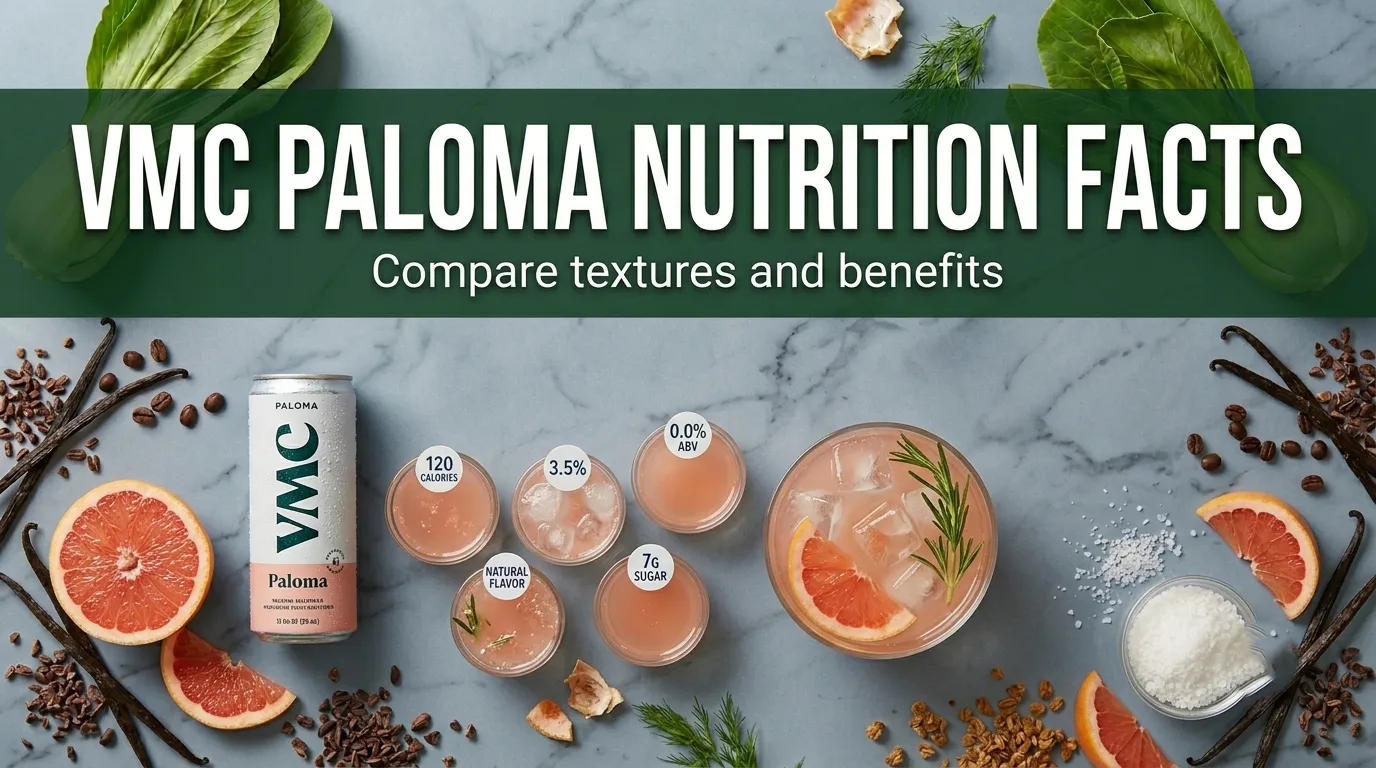
VMC Paloma Nutrition Facts: Sugar, Carbs, and Alcohol Guide
A 12-ounce can of VMC Paloma contains approximately 170 to 180 calories and 13 to 15 grams of sugar, placing it in the middle range of ready-to-drink canned cocktails for both metrics. These vmc paloma nutrition facts mean that one can delivers about half of the American Heart Association’s recommended daily added sugar limit for women and over a third for men. It’s a convenient cocktail, but it’s not a free food, and understanding the numbers is how you decide if it fits your day.
The Paloma is having a moment. Canned versions have surged in popularity as a tequila-based alternative to vodka sodas and malt-based hard seltzers. The Nutrition Facts panel on a can of VMC tells a story that goes beyond the calorie count. It reveals how the drink was sweetened, whether real grapefruit juice is present, and how the alcohol content stacks up against a standard drink. The Dietary Guidelines for Americans 2020-2025 state that if alcohol is consumed, it should be in moderation, defined as one drink per day for women and two for men. A single 12-ounce VMC Paloma at roughly 5.5 to 6 percent alcohol by volume counts as roughly 1.3 to 1.5 standard drinks.
This article breaks down the full nutritional profile of the VMC Paloma and compares it directly to a classic homemade Paloma, other popular canned cocktails, and hard seltzers. You’ll learn how alcohol calories are metabolized differently than food calories, why the sugar content matters for keto and diabetes, and how to navigate the canned cocktail aisle with a nutritionist’s eye.
What Are the VMC Paloma Nutrition Facts?
The core vmc paloma nutrition facts for a standard 12-ounce can include approximately 170 to 180 calories, 0 grams of fat, 0 grams of protein, 14 to 16 grams of total carbohydrate, and 13 to 15 grams of sugar. This nutritional profile reflects a beverage made with tequila or a tequila-based spirit, grapefruit flavoring which may include real juice or natural flavors, carbonated water, and a sweetener such as cane sugar or agave nectar.
The calorie distribution in a VMC Paloma is entirely from two sources: alcohol and sugar. Alcohol provides approximately 7 calories per gram. Sugar provides 4 calories per gram. If the can contains 14 grams of sugar, that accounts for 56 of the total calories. The remaining 114 to 124 calories come from the alcohol itself. There is zero nutritional contribution from fat, protein, or fiber. This is the definition of what nutrition scientists call “empty calories,” energy without essential accompanying nutrients.
Understanding this profile matters because liquid calories, especially from alcohol, do not trigger the same satiety signals as solid food. A study published in the American Journal of Clinical Nutrition found that energy consumed as a beverage is poorly compensated for at subsequent meals. You won’t eat less dinner because you had a Paloma. The calories stack additively on top of your daily food intake. This is the primary reason that alcohol consumption can slow or stall weight loss progress even when the calorie count of the drink itself seems manageable.
VMC Paloma Calories and Serving Size
One 12-ounce can of VMC Paloma is a single serving, delivering the full 170 to 180 calories and all the sugar and alcohol in one package. The vmc paloma calories and serving size are reported per can, not per 8-ounce glass or some smaller fraction. This is honest labeling, but it also means that if you drink two cans on a warm evening, you have consumed 340 to 360 calories and 26 to 30 grams of added sugar before eating a single bite of food.
A standard drink in the United States is defined by the NIH National Institute on Alcohol Abuse and Alcoholism as 14 grams of pure ethanol. This is roughly equivalent to 12 ounces of 5 percent alcohol by volume beer, 5 ounces of 12 percent wine, or 1.5 ounces of 40 percent distilled spirits. A 12-ounce VMC Paloma at 5.5 to 6 percent ABV contains slightly more than one standard drink’s worth of alcohol. It is close enough that counting it as one drink for moderation purposes is reasonable, but it’s a slightly generous pour.
For a calorie counter, context matters. A 180-calorie beverage represents about 9 percent of a 2,000-calorie daily intake. That is a significant allocation for something with zero nutritional return. A person maintaining their weight can accommodate this as a discretionary treat. A person actively trying to lose weight on a 1,500-calorie budget will find that one Paloma consumes 12 percent of their entire daily allowance. The math is straightforward. The decision is personal.
Key Takeaway: One can is one serving and roughly 1.3 standard drinks. Two cans push you past the moderate drinking guideline and deliver over 300 calories of empty energy.
VMC Paloma Sugar and Carbohydrate Breakdown
A VMC Paloma contains 13 to 15 grams of sugar per 12-ounce can, which is equivalent to approximately 3 to 3.75 teaspoons of granulated sugar. The vmc paloma sugar and carbohydrate breakdown is important because the American Heart Association recommends that women consume no more than 25 grams of added sugar per day and men no more than 36 grams. One can of VMC Paloma uses up more than half of the daily added sugar budget for a woman.
The source of the sugar matters. If VMC uses real grapefruit juice concentrate, a portion of the sugar is the natural fructose and glucose found in the fruit. If the primary sweetener is added cane sugar or agave nectar, all of the sugar qualifies as added sugar under the FDA’s updated Nutrition Facts label rules. The FDA now requires a separate line for added sugar on packaged food labels. If the VMC Paloma label lists “Total Sugars 14g” and “Includes 12g Added Sugars,” you know that only 2 grams came from the fruit itself. This distinction, while metabolically subtle for the average person, tells you how much of the sweetness is formulation versus nature.
Carbohydrate-conscious consumers should note that sugar is a carbohydrate. The 14 to 16 grams of total carbohydrate per can is almost entirely sugar. There is no starch and no fiber in a cocktail. For someone counting total daily carbohydrates on a moderate low-carb plan of 100 grams per day, one Paloma is 14 to 16 percent of the allotment. For someone on a strict ketogenic diet of 20 grams per day, it’s an immediate non-starter, a point addressed in the keto section below.
VMC Paloma Full Ingredient List Analysis
A typical VMC Paloma ingredient list includes carbonated water, tequila or neutral spirit with tequila flavor, cane sugar or agave nectar, grapefruit juice concentrate or natural grapefruit flavor, citric acid, sodium citrate, and natural flavors. The vmc paloma full ingredient list analysis reveals a product that is closer to a grapefruit soda with alcohol than to the simple fresh cocktail it emulates.
Carbonated water is the primary ingredient, which is neutral and harmless. The alcohol source, whether a true blanco tequila or a malt base with tequila flavor, significantly affects the production method and tax classification of the product but has minimal impact on the calorie and sugar counts. The sweetener, whether cane sugar or agave, is metabolically almost identical in the context of a beverage. The marketing term “agave sweetened” implies a health halo, but agave nectar is a refined sweetener with a higher fructose content than cane sugar. Fructose is metabolized primarily by the liver and, in excess, is a more potent driver of hepatic lipogenesis than glucose.
Citric acid provides the tartness that balances the sweetness. Sodium citrate is a buffering agent that smooths the acidity and adds a tiny amount of sodium. Natural flavors is a catch-all term regulated by the FDA to mean flavor compounds derived from plant or animal sources. The presence of natural flavors does not inherently make a product healthier, nor does it mean it is unsafe. It means the exact flavor profile is a proprietary blend. For someone who prioritizes ingredient transparency, the homemade Paloma is the obvious winner.
Key Takeaway: The VMC Paloma is a grapefruit soda with alcohol. The ingredient list is cleaner than some competitors, but it is still a sweetened processed beverage.
How Alcohol Calories Work in Canned Cocktails
Alcohol calories in canned cocktails are metabolized before any other fuel source, temporarily halting fat oxidation and prioritizing the breakdown of ethanol by the liver enzyme alcohol dehydrogenase. Understanding how alcohol calories work in canned cocktails explains why a 180-calorie drink can have a larger metabolic impact than 180 calories of food. Your body cannot store alcohol. It treats ethanol as a toxin that must be cleared immediately.
The metabolic pathway for alcohol is straightforward and rigid. Once ethanol enters the bloodstream from the stomach and small intestine, the liver converts it to acetaldehyde, a toxic intermediate, via alcohol dehydrogenase. Acetaldehyde is then converted to acetate by aldehyde dehydrogenase. Acetate enters the bloodstream and can be used as a fuel source by muscles and other tissues. While this is happening, the liver downregulates the oxidation of fatty acids. Your body is burning acetate from the tequila instead of body fat. The calories count, but so does the metabolic switch.
This is different from how sugar is metabolized. The sugar in the Paloma triggers an insulin response that shuttles glucose into cells. The alcohol simultaneously and independently suppresses fatty acid oxidation. The combination of refined carbohydrate and alcohol creates a metabolic environment that is not supportive of fat loss, regardless of the total calorie count. This is not a reason to never drink a Paloma. It is a reason to understand that the timing and frequency of consumption affect body composition outcomes beyond what the label numbers alone predict.
VMC Paloma vs Classic Paloma Nutrition Comparison
A classic homemade Paloma made with 1.5 ounces of blanco tequila, 4 ounces of fresh-squeezed grapefruit juice, soda water, and lime juice contains approximately 130 calories and 8 grams of sugar, with the sugar coming entirely from the fruit. The vmc paloma vs classic paloma nutrition comparison shows that the homemade version is lower in both calories and sugar and contains genuine fruit micronutrients like vitamin C and the bioflavonoid naringin.
The classic Paloma is one of the most nutritionally sound cocktails in existence. Grapefruit juice is a whole food with documented health interactions. The compound naringin gives grapefruit its bitter edge and is responsible for the well-known grapefruit-drug interaction with certain statins, calcium channel blockers, and psychiatric medications. The FDA requires a warning on grapefruit juice regarding this interaction. The VMC Paloma, which may use natural grapefruit flavor rather than significant amounts of real juice, likely contains far less naringin.
| Per Serving | VMC Paloma | Classic Homemade Paloma |
|---|---|---|
| Serving Size | 12 oz can | 1.5 oz tequila + 4 oz juice + soda |
| Calories | ~175 | ~130 |
| Total Sugar | ~14g | ~8g |
| Added Sugar | ~12g | 0g |
| Vitamin C | Trace | ~60mg (67% DV) |
| Alcohol | ~1.3 standard drinks | 1 standard drink |
The homemade version wins on every nutritional metric. You control the sweetness, the quality of the tequila, and the source of the grapefruit. The VMC wins on convenience. The tradeoff is clear. For a backyard barbecue where you are mixing drinks for 10 people, the canned version is a practical choice. For a mindful evening cocktail where nutrition is a priority, the homemade version is superior.
Key Takeaway: The classic fresh Paloma is lower in calories and sugar, and contains real vitamin C. The canned version trades nutrition for convenience.
VMC Paloma vs Other Canned Cocktails
The VMC Paloma sits in the middle of the canned cocktail sugar spectrum, with less sugar than a flavored malt beverage like a Mike’s Hard Lemonade but more sugar than a hard seltzer like White Claw or a ranch water. The vmc paloma vs other canned cocktails comparison helps you see where your choice lands relative to the alternatives on the shelf.
Hard seltzers have set the low-calorie, low-sugar standard at approximately 100 calories and 2 grams of sugar per 12-ounce can. They achieve this by using fermented cane sugar and natural flavors with no juice. Traditional flavored malt beverages and “alcopops” can contain 30 to 40 grams of sugar per can. The VMC Paloma, at 14 grams of sugar, is closer to the seltzer end of the spectrum than the alcopop end, which is a favorable position.
| Canned Cocktail (12 oz) | Calories | Sugar (g) | ABV |
|---|---|---|---|
| VMC Paloma | ~175 | 14 | 5.5% |
| White Claw Hard Seltzer | 100 | 2 | 5% |
| Classic Ranch Water | 90 | 0 | 5% |
| Cutwater Tequila Paloma | 220 | 23 | 7% |
| Mike’s Harder Lemonade | 220 | 30 | 8% |
Ranch water is the leanest ready-to-drink tequila cocktail available. It consists of tequila, carbonated water, lime, and salt, with no sugar at all. If calories and sugar are your primary concern and you want a canned tequila cocktail, a ranch water is the better choice. The VMC Paloma is for the person who wants the sweet, tart, grapefruit-forward flavor profile and is willing to pay the sugar cost for it.
Is VMC Paloma Keto Friendly?
A VMC Paloma is not keto friendly at 14 to 16 grams of carbohydrate per can, as this single serving consumes 70 to 80 percent of the daily 20-gram carbohydrate limit of a strict ketogenic diet. The question “is vmc paloma keto friendly” has a straightforward answer, but it comes with a workaround. If you are following a targeted or cyclical ketogenic approach and have room in your carb budget from an intentional adjustment, you could technically fit one can in. For the standard daily ketogenic protocol, it is a no.
The sugar in the Paloma comes from sources that raise blood glucose and require an insulin response. Sucrose, cane sugar, and agave are all rapidly digested carbohydrates. The body cannot shunt these sugars into muscle glycogen without exiting ketosis for a period. For a person using a continuous ketone monitor, the effect is visible and immediate. The alcohol itself does not spike glucose and may even cause a transient dip in blood sugar as the liver prioritizes ethanol metabolism, but the 14 grams of sugar counteract this and provide a carbohydrate load.
The keto workaround is the classic homemade Paloma. A keto Paloma uses 1.5 ounces of reposado tequila, 4 ounces of diet grapefruit soda sweetened with sucralose or stevia, a squeeze of fresh lime, and a salted rim. This version contains approximately 97 calories, 0 grams of sugar, and 0 grams of net carbohydrate. It is fully compatible with a ketogenic state. If you love the Paloma flavor profile and are committed to keto, you need to make it yourself or seek out a sugar-free canned version.
Key Takeaway: VMC Paloma is not keto. A homemade version with diet grapefruit soda and fresh lime is. Choose accordingly.
VMC Paloma and Diabetes: What You Should Know
A VMC Paloma contains 14 grams of rapidly absorbed sugar and alcohol, a combination that can cause an initial blood glucose rise followed by a delayed drop hours later, creating a complex and potentially risky glycemic situation for someone with diabetes. The vmc paloma and diabetes discussion requires a level of clinical seriousness that goes beyond casual wellness advice.
Alcohol has a biphasic effect on blood glucose. In the first hour after drinking, the sugar in a Paloma will raise blood glucose, similar to any sweetened beverage. Over the subsequent hours, however, alcohol suppresses hepatic gluconeogenesis, the liver’s production of new glucose. This can cause hypoglycemia, particularly overnight, and is especially dangerous for people taking insulin or sulfonylureas. The American Diabetes Association states that alcohol should be consumed with food and that blood glucose should be monitored more frequently when drinking.
A certified diabetes educator would advise a patient with well-managed type 2 diabetes who chooses to drink a Paloma to consume it alongside a meal containing protein and fat, to limit consumption to one can, and to check their blood glucose before bed. For a person with type 1 diabetes or anyone on insulin therapy, the calculus is more complex and requires direct medical guidance. The grapefruit interaction is another layer. If you take a statin medication for cholesterol, which many people with type 2 diabetes do, grapefruit can inhibit the CYP3A4 enzyme that metabolizes atorvastatin, simvastatin, and lovastatin, leading to higher serum drug levels. A registered dietitian and a pharmacist should both be consulted.
Alcohol and Hydration: How Palomas Affect Fluid Balance
Alcohol is a diuretic that inhibits vasopressin, causing increased urine output and a net loss of fluid, meaning a canned Paloma will hydrate you less effectively than plain water and can contribute to dehydration if consumed without additional water. The alcohol and hydration dynamic is a physiological certainty. For every gram of alcohol you consume, your kidneys excrete approximately 10 milliliters of additional urine.
The 12-ounce volume of a VMC Paloma gives the illusion of hydration. You are drinking a can of liquid. The reality is that the ethanol in the drink blocks the action of antidiuretic hormone on the kidney’s collecting ducts. The water in the can is excreted, along with additional body water, at a rate that exceeds what you took in. The more concentrated the alcohol, the greater the diuretic effect. The Paloma, at 5.5 percent ABV, is dilute enough that the net dehydrating effect is mild compared to a shot of straight tequila, but it is still a net negative for fluid balance.
Practical hydration guidance for a person drinking a Paloma is to drink a full 8-ounce glass of water for every can. If you are in a hot environment, at altitude, or exercising, the dehydrating effect of alcohol is amplified. The sodium in the Paloma, likely around 10 to 30 milligrams from the sodium citrate, is negligible for rehydration purposes and does not offset the alcohol-induced fluid loss. This is not a sports drink. It is a net dehydrator.
Key Takeaway: One Paloma, one glass of water. Repeat. Alcohol does not hydrate you, and the 12 ounces of liquid in the can does not count toward your daily water goal.
VMC Paloma and Weight Loss: The Honest Truth
The vmc paloma and weight loss relationship is straightforward: the 170 to 180 calories per can add to your daily total without providing satiety, and the alcohol temporarily suppresses fat oxidation, making weight loss slower and more difficult. The honest truth is that alcohol is not compatible with an aggressive fat loss phase. It is, however, compatible with maintenance and slow, sustainable weight loss when consumed in moderation and accounted for.
The caloric math is simple. If you are maintaining a 500-calorie daily deficit and you add a VMC Paloma, you have reduced that deficit to 320 calories. A deficit of 500 calories per day leads to roughly one pound of fat loss per week. A deficit of 320 leads to a slower pace. The difference is not just the calories. The metabolic suppression of fat oxidation, the increased likelihood of snacking after drinking, and the reduced sleep quality from alcohol all conspire against weight loss.
A practical strategy for someone who wants to include a Paloma occasionally while losing weight is to pre-log it. Enter the 175 calories into your tracker in the morning. Adjust your intake of added fats or carbohydrates at dinner to accommodate it. Pair the drink with a high-protein, high-fiber meal to slow absorption. Limit it to one can, one or two nights per week. This is the difference between planned indulgence and unplanned calorie leakage.
VMC Paloma Gluten Free and Allergen Status
VMC Paloma is inherently gluten free because it is made with a tequila-based or agave-based alcohol source, and tequila is derived from the agave plant, which contains no gluten. The vmc paloma gluten free status is reassuring for anyone with celiac disease or non-celiac gluten sensitivity. The distillation process for tequila removes any potential gluten peptide if cross-contamination from grain facilities were a concern, though most tequila distilleries do not process grains.
The allergen status is generally clean. The ingredients, carbonated water, tequila, sugar, grapefruit flavor, citric acid, and natural flavors, do not contain the FDA Big 8 allergens: milk, eggs, fish, shellfish, tree nuts, peanuts, wheat, and soy. There are no sulfites declared unless the product specifically uses sulfited grapefruit juice concentrate. A person with a specific grapefruit allergy, which is rare but exists, must obviously avoid it. The cross-contamination risk depends on the co-packing facility where the cans are filled. The package labeling will contain a “Contains:” statement if any allergens are present.
For a consumer with celiac disease navigating the canned cocktail aisle, hard seltzers and tequila-based canned cocktails are almost always safe. Malt-based canned cocktails, including many flavored hard teas and lemonades, are not gluten free because they are fermented from barley. The VMC Paloma, as a tequila-based product, is in the safe category.
Key Takeaway: The VMC Paloma is gluten free and free from the major allergens. Always check the can for the official “Contains” statement.
How to Read a Canned Cocktail Nutrition Label
To read a canned cocktail nutrition label, focus on four lines: serving size, total carbohydrate, total sugars, and the added sugars line directly beneath it, then compare the alcohol by volume to understand the standard drink count. Knowing how to read a canned cocktail nutrition label takes you from a passive consumer to an informed decision-maker in about 10 seconds. The marketing on the front of the can is often misleading.
A canned cocktail may boast “Made with Real Grapefruit” on the front. Flip the can. If the added sugars line reads 12 grams and the grapefruit juice concentrate is listed below the sugar on the ingredient list, you know the primary flavor and sweetness is from added sugar with a splash of juice for label claim. If the added sugars line reads 0 grams, you know the sweetness is entirely from the fruit or from a non-nutritive sweetener. The ingredients are listed in descending order by weight. If sugar or agave nectar is the second or third ingredient, it is a sugar-sweetened beverage.
The alcohol by volume tells you the concentration. Multiply the ABV by the fluid ounces to get a rough sense of the alcohol load. A 12-ounce can at 5 percent ABV is 0.6 ounces of pure alcohol, close to a standard drink. A 12-ounce can at 8 percent ABV is nearly 1.6 standard drinks. The label won’t tell you this. You have to do the math. A registered dietitian teaching label literacy would circle the serving size, the added sugar, and the ABV as the three data points that predict how a canned cocktail will affect your body.
Lower Sugar Canned Cocktail Alternatives
The best lower sugar canned cocktail alternatives to a VMC Paloma are hard seltzers like White Claw at 2 grams of sugar, tequila sodas like a ranch water at 0 grams of sugar, and spirit-forward canned cocktails sweetened with stevia or monk fruit. The lower sugar canned cocktail alternatives are growing rapidly as consumer demand shifts. The market in 2026 has more options than ever.
- Ranch Water (Tequila, Soda, Lime): 0g sugar, ~90 calories
- Classic Hard Seltzer: 2g sugar, ~100 calories
- Tequila Soda with Natural Flavor: 0g sugar, ~95 calories
- Low-Sugar Margarita (Stevia Sweetened): 1g sugar, ~110 calories
- Vodka Mule (Unsweetened): 0g sugar, ~120 calories
If you love the Paloma specifically, the simplest alternative is to make your own. Fresh grapefruit, tequila, and soda water. You know every ingredient. You control the sweetness. If you need the convenience of a can, look for a brand that uses fresh grapefruit juice and no added sugar. They exist, and the nutrition label tells the story immediately. A Paloma with 0 grams of added sugar and 5 grams of total sugar is a grapefruit juice-based product. A Paloma with 14 grams of sugar and 12 grams of added sugar is a cane sugar-sweetened product that happens to taste like grapefruit. The difference is on the back of the can.
Key Takeaway: Hard seltzers and ranch waters are the zero-sugar winners. If you want a canned Paloma specifically, find one with 0 grams of added sugar on the label.
How to Fit Alcohol into a Healthy Eating Pattern
The Dietary Guidelines for Americans state that if alcohol is consumed, it should be in moderation, defined as one drink per day for women and two for men, and it is not recommended to begin drinking for health reasons. Learning how to fit alcohol into a healthy eating pattern means planning for it, not reacting to it. You treat the Paloma as a discretionary calorie allocation, the same way you would treat a dessert.
Practical steps to integrate a canned cocktail into a healthy week follow a logical sequence:
- Decide on your drinking days in advance. Spontaneity is the enemy of moderation.
- Pre-log the can into your calorie or macro tracker at the beginning of the day.
- Adjust your dinner by reducing an equivalent amount of added fat or refined starch to make room for the 175 liquid calories.
- Drink a full glass of water alongside the Paloma. Alternate sips if it helps slow the pace.
- Close the kitchen after the drink. Alcohol lowers inhibitions and makes late-night snacking more likely.
The Academy of Nutrition and Dietetics frames alcohol as a social lubricant, not a health food. It is acceptable in moderation for adults who choose to drink. It is not recommended for pregnant women, people taking medications that interact with alcohol, those with a history of alcohol use disorder, or individuals managing certain medical conditions like pancreatitis or advanced liver disease. A single VMC Paloma on a Friday evening with dinner is a conscious choice that fits within these guidelines. It is the second and third cans, the mindless drinking, and the skipped meals that follow that turn a moderate indulgence into a health liability.
Frequently Asked Questions About VMC Paloma
How many calories are in a VMC Paloma?
A 12-ounce can of VMC Paloma contains approximately 170 to 180 calories.
These calories come entirely from alcohol and sugar, with zero from protein, fiber, or fat.
This represents about 9 percent of a standard 2,000-calorie daily intake.
Is VMC Paloma low carb?
No, VMC Paloma is not low carb at 14 to 16 grams of carbohydrate per can.
All of the carbohydrates come from sugar, and most of that is added sugar.
A strict ketogenic or very low-carb diet cannot accommodate a full can.
Does VMC Paloma contain real grapefruit?
VMC Paloma likely contains grapefruit juice concentrate or natural grapefruit flavor, depending on the specific formulation.
Check the ingredient list on the can for “grapefruit juice concentrate” versus “natural grapefruit flavor.”
Even with real juice, the primary sweetener is typically cane sugar or agave nectar, not the fruit alone.
Is VMC Paloma gluten free?
Yes, VMC Paloma is gluten free because it is made with a tequila or agave-based alcohol.
Tequila is distilled from the agave plant and contains no gluten.
Always confirm by reading the allergen statement on the can.
Can you drink VMC Paloma on a diet?
Yes, you can include it in a calorie deficit if you plan for it and account for the 175 calories.
Pre-log the drink and reduce an equivalent amount of discretionary calories elsewhere.
One can, one or two nights per week, will not derail a well-planned diet.
How much alcohol is in a VMC Paloma?
A VMC Paloma typically has an alcohol by volume of 5.5 to 6 percent.
A 12-ounce can at this ABV contains approximately 1.3 to 1.5 standard drinks.
This is slightly more than the definition of a single standard drink in the United States.
The VMC Paloma is a well-made canned cocktail that delivers the tequila-grapefruit experience with moderate calories and sugar compared to the broader category. It is not a health drink. It is an indulgence that you can plan for and enjoy as part of a consciously designed eating pattern.
If sugar and keto compatibility matter most to you, the ranch water or a homemade fresh Paloma is your better choice. If you value convenience and a balanced sweet-tart flavor, the VMC can holds its own. Next time you pick one up, flip the can over first. The back label tells you what the front label only suggests. You now know exactly what to look for.