McRib Nutrition Facts 2026: Full Ingredient and Health Breakdown
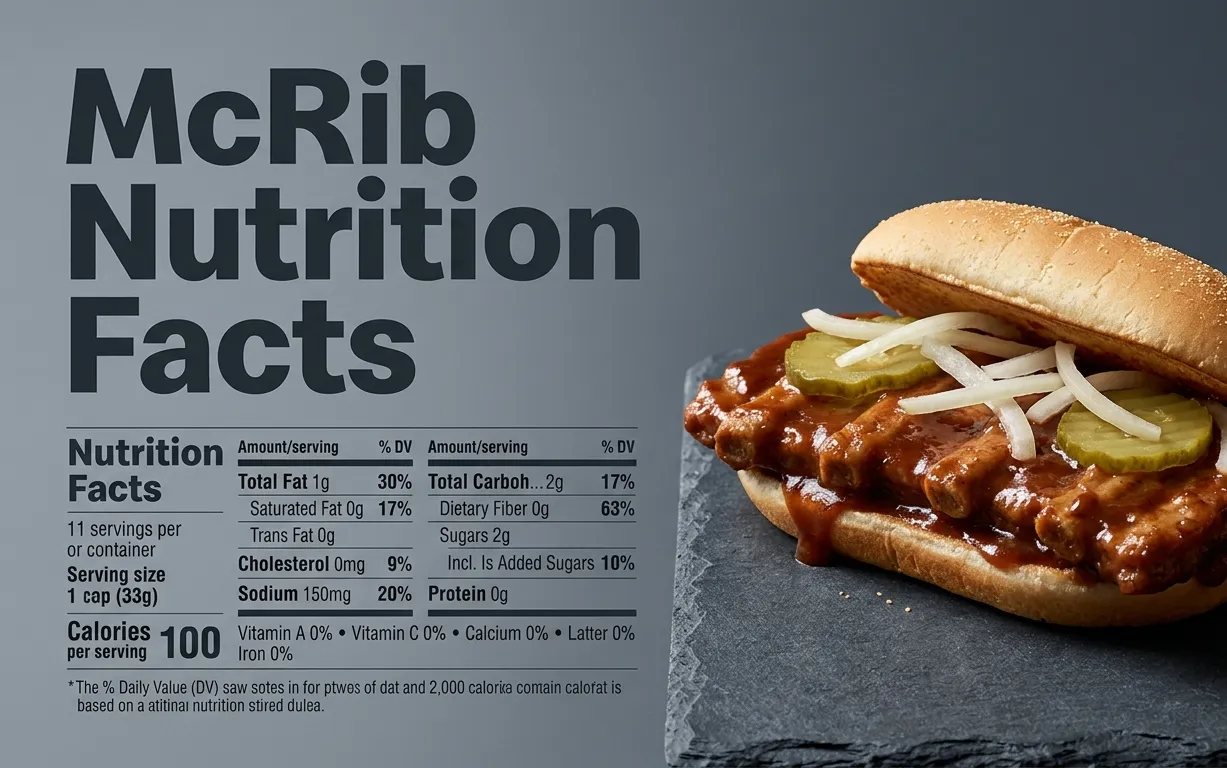
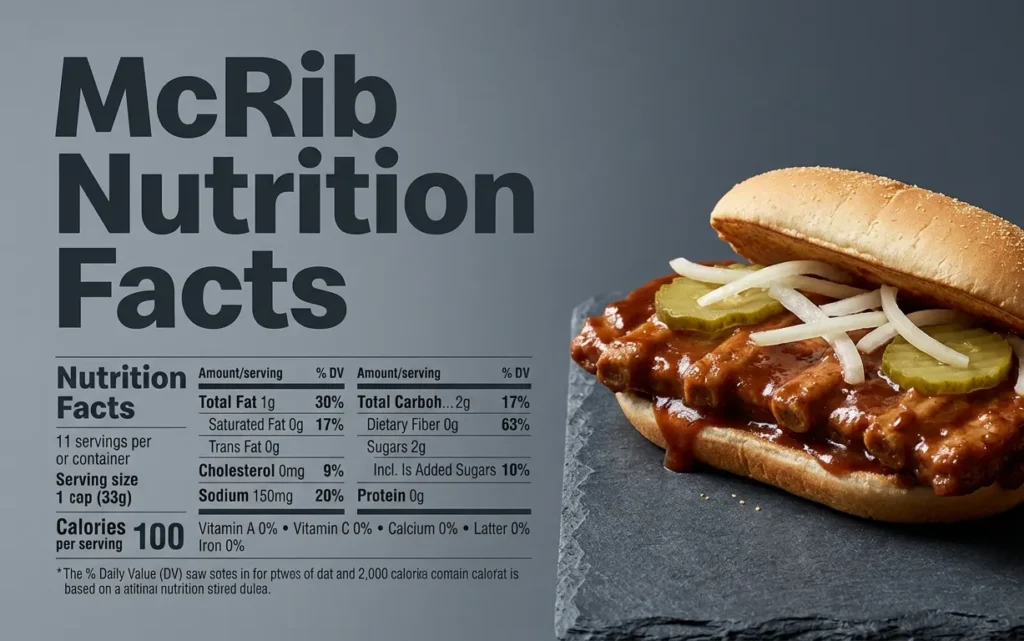
The McDonald’s McRib sandwich contains 480 calories, 25 grams of protein, 22 grams of total fat (including 8 grams of saturated fat), and 890 milligrams of sodium per serving. The mcrib nutrition facts reveal a sandwich that delivers more than a third of the daily sodium limit and nearly 40 percent of the saturated fat recommendation in a single item.
This is not a health food. It does not pretend to be one. The McRib is a limited-time fast-food sandwich built on a restructured pork patty, drenched in barbecue sauce, topped with pickles and onions, and served on a steamed enriched white flour roll. The Dietary Guidelines for Americans 2020-2025 recommend limiting sodium to 2,300 milligrams per day and saturated fat to less than 10 percent of daily calories. One McRib uses 39 percent of your sodium budget and 36 percent of your saturated fat limit on a 2,000-calorie diet before you eat anything else all day.
Here is what this article does that the standard nutrition facts page does not. You will see every number. You will also learn what each ingredient actually is, why it is in the sandwich, what research says about the additives and preservatives, how the McRib compares to other fast-food items, and exactly what the rest of your day should look like if you choose to eat one. No lectures. No fear-mongering. Just the facts with context that helps you make your own decision.
McRib Nutrition Facts
The complete nutritional breakdown of one McRib sandwich, as published by McDonald’s and verified against the USDA FoodData Central database standards, is presented below. The serving size is one sandwich weighing approximately 209 grams.
| Nutrient | Amount per McRib | Percent Daily Value (2,000 cal diet) |
|---|---|---|
| Calories | 480 kcal | 24% |
| Total Fat | 22 g | 28% |
| Saturated Fat | 8 g | 40% |
| Trans Fat | 0.5 g | N/A |
| Cholesterol | 80 mg | 27% |
| Sodium | 890 mg | 39% |
| Total Carbohydrates | 45 g | 16% |
| Dietary Fiber | 2 g | 7% |
| Total Sugars | 12 g | N/A |
| Added Sugars | 10 g | 20% |
| Protein | 25 g | 50% |
| Iron | 2.5 mg | 14% |
| Calcium | 80 mg | 6% |
| Potassium | 380 mg | 8% |
The Daily Value percentages reveal the pattern immediately. Saturated fat, sodium, and cholesterol all hit above 25 percent of the daily recommendation in one sandwich. Fiber, calcium, and potassium sit at 10 percent or less. This is an inverted nutritional profile: heavy on the components most people need to limit, light on the components most people under-consume. The Dietary Guidelines for Americans 2020-2025 identify fiber, calcium, and potassium as nutrients of public health concern precisely because intake is too low across the population.
The protein number looks respectable at 25 grams. Half the daily value for protein sounds good on a label. The context is that you are getting that protein alongside 22 grams of fat, 890 milligrams of sodium, and a bun made from enriched flour that offers minimal fiber. The same 25 grams of protein from a grilled chicken breast with a side of vegetables would arrive with less than a third of the sodium and saturated fat.
McRib Calories and Macros
The McRib’s 480 calories break down into a macronutrient ratio of approximately 41 percent fat, 38 percent carbohydrate, and 21 percent protein. This means nearly half of all calories in the sandwich come from fat. That ratio is not inherently problematic in a single meal. What makes it worth noting is the type of fat and the company it keeps.
The 22 grams of total fat come primarily from the pork patty and the bun, which contains soybean oil. Pork shoulder, the cut used in the McRib, is naturally marbled with fat. The restructuring process adds further fat for binding and mouthfeel. The bun formula includes oil for softness and shelf stability. Eight grams of the total fat are saturated. The American Heart Association recommends limiting saturated fat to no more than 13 grams per day for most adults on a 2,000-calorie diet for cardiovascular health. One sandwich uses more than 60 percent of that limit.
Carbohydrates total 45 grams, which is moderate for a sandwich. Twelve grams are sugar, and 10 of those grams are added sugars as defined by the FDA. The added sugar comes almost entirely from the barbecue sauce, which lists high fructose corn syrup and corn syrup as primary ingredients. The Dietary Guidelines for Americans set the added sugar limit at no more than 50 grams per day. One McRib takes 20 percent of that budget. Protein at 25 grams is the redeeming macronutrient number, though the protein quality is affected by the processing, which is discussed in a later section.
Key Takeaway: The McRib gets 41 percent of its calories from fat, delivers over half the daily saturated fat limit, and uses a fifth of the daily added sugar allowance. The 25 grams of protein are the best number on the label.
McRib Ingredients List Explained
The official McDonald’s ingredient list for the McRib runs long. Breaking it down component by component reveals what each item actually is. This is not scare-mongering. These ingredients are FDA-approved for their stated purposes. The question is whether you want them in your food at all, and with what frequency.
McRib Pork Patty: Pork, water, salt, dextrose, preservatives (BHA, propyl gallic acid, citric acid). The patty is made from restructured pork shoulder. Restructured means the meat is ground, mixed with water, salt, dextrose, and preservatives, then pressed into a rib-shaped mold. Dextrose is a simple sugar added for flavor and browning. BHA (butylated hydroxyanisole) is an antioxidant preservative that prevents fats from going rancid. Propyl gallic acid and citric acid work alongside BHA as preservative synergists.
McRib Bun: Enriched flour (wheat flour, malted barley flour, niacin, reduced iron, thiamine mononitrate, riboflavin, folic acid), water, sugar, yeast, soybean oil, wheat gluten, salt, dough conditioners (monoglycerides, sodium stearoyl lactylate, azodicarbonamide, datem, enzymes), calcium sulfate, calcium propionate. The enriched flour means B vitamins and iron are added back after processing strips them from the whole grain. The dough conditioners create the soft, squishy texture. Azodicarbonamide is a dough conditioner and bleaching agent approved in the US but banned in the European Union and Australia. Its breakdown product, semicarbazide, raised safety concerns in animal studies, leading to the EU ban, though the FDA maintains it is safe at current usage levels.
McRib Sauce: Water, high fructose corn syrup, tomato paste, corn syrup, distilled vinegar, molasses, natural smoke flavor, modified food starch, salt, sugar, spices, soybean oil, xanthan gum, caramel color, dehydrated onion, garlic powder, potassium sorbate, sodium benzoate. High fructose corn syrup and corn syrup appear as separate ingredients, both contributing to the sugar content. Modified food starch thickens the sauce. Xanthan gum is a stabilizer. Potassium sorbate and sodium benzoate are preservatives that inhibit mold and yeast growth in the sauce.
McRib Sodium Content and Health Risks
One McRib sandwich contains 890 milligrams of sodium, which is 39 percent of the FDA Daily Value and a substantial portion of the 2,300-milligram limit recommended by the Dietary Guidelines for Americans 2020-2025. The American Heart Association goes further and recommends an ideal limit of 1,500 milligrams per day for most adults, a threshold that one McRib clears by more than halfway.
Sodium in the McRib comes from multiple sources. The pork patty contains added salt. The barbecue sauce is seasoned with salt, and the preservatives sodium benzoate and potassium sorbate contribute additional sodium ions. The bun includes salt and sodium stearoyl lactylate. The pickles are salt-cured. You are eating sodium from at least five different ingredient sources in one sandwich. This is not unusual in processed food. It is how salt becomes invisibly embedded across the food supply.
Excess dietary sodium increases blood pressure through a well-established mechanism. High sodium intake pulls water into the bloodstream, increasing blood volume. The heart pumps harder against the larger volume, and the pressure against arterial walls rises. Over time, this contributes to hypertension, a primary risk factor for heart attack and stroke. The Centers for Disease Control and Prevention estimates that nearly half of American adults have hypertension. For someone in that group, a single 890-milligram sodium hit from one sandwich represents a measurable portion of what needs to be reduced for blood pressure control.
McRib Saturated Fat and Trans Fat
The McRib contains 8 grams of saturated fat and 0.5 grams of trans fat. The saturated fat alone is 40 percent of the Daily Value and more than 60 percent of the American Heart Association’s recommended daily limit for heart health. The trans fat number, while appearing small at half a gram, is not zero. Partial gram amounts of trans fat occur naturally in pork fat, though the industrial processing of the soybean oil in the bun may also contribute trace amounts.
Saturated fat raises LDL cholesterol. The mechanism involves the liver’s LDL receptors. When saturated fat intake is high, the liver produces fewer LDL receptors, which means less LDL cholesterol is cleared from the bloodstream. LDL particles remain in circulation longer and are more likely to lodge in arterial walls, contributing to plaque formation. This is a direct, measurable pathway from dietary saturated fat to cardiovascular disease risk. The Dietary Guidelines for Americans recommend that saturated fat contribute less than 10 percent of daily calories, which works out to roughly 22 grams on a 2,000-calorie diet.
Trans fat is worse. Even small amounts measurably raise LDL cholesterol while simultaneously lowering HDL cholesterol, the protective form. The FDA effectively banned artificial trans fats from the US food supply in 2018, but naturally occurring trans fats from animal products and trace amounts from processing can still appear. The World Health Organization has called for the global elimination of industrially produced trans fats. The 0.5 grams in a McRib is a small number, but the evidence on trans fat suggests there is no safe threshold. Any amount increases cardiovascular risk.
Key Takeaway: The saturated fat in one McRib exceeds 60 percent of the American Heart Association’s ideal daily limit. The 0.5 grams of trans fat is small but not harmless, given that no safe intake level for trans fat has been established.
McRib Sugar Content
The McRib contains 12 grams of total sugar, of which 10 grams are added sugars as defined by the FDA. This represents 20 percent of the daily added sugar limit of 50 grams set by the Dietary Guidelines for Americans 2020-2025. The American Heart Association recommends an even stricter limit: no more than 36 grams of added sugar per day for men and 25 grams for women. Against that standard, one McRib uses 28 to 40 percent of the daily allowance.
The added sugar in a McRib comes primarily from the barbecue sauce, which lists high fructose corn syrup and corn syrup among its top ingredients. The pork patty also contains dextrose, a simple sugar added for browning and flavor. The bun contains sugar in its dough formula. These three sources of sugar, combined in one product, illustrate how added sugars accumulate in processed foods without any of them tasting overtly sweet.
High fructose corn syrup is chemically similar to table sugar, containing roughly 55 percent fructose and 45 percent glucose. The metabolic concern with high intake of added sugars, regardless of type, is that they contribute calories without nutrients, promote insulin resistance when consumed chronically and in excess, and are associated with weight gain, type 2 diabetes, and fatty liver disease in observational research. A single McRib does not cause any of these conditions. The cumulative effect of regularly eating foods with multiple hidden sugar sources is what drives metabolic disease risk at the population level.
McRib Protein Quality
The McRib provides 25 grams of protein, derived almost entirely from the restructured pork shoulder patty. Pork shoulder is a naturally protein-rich cut. A 100-gram serving of roasted pork shoulder provides roughly 25 to 27 grams of complete protein containing all nine essential amino acids. The protein in the McRib patty is real and bioavailable. Your body will use it for muscle repair, enzyme production, and immune function.
The processing does not destroy the protein. Restructuring, which involves grinding the pork shoulder and pressing it into a mold, changes the physical structure of the meat but does not denature the protein in a way that renders it unusable. The cooking process denatures proteins, which is exactly what happens when you grill a pork chop at home. Denaturation is part of digestion. It unfolds the protein chains so digestive enzymes can access them.
The issue with McRib protein is not the protein itself. It is everything that comes packaged with it. You are consuming 25 grams of protein alongside 8 grams of saturated fat, 890 milligrams of sodium, and a collection of preservatives and processing aids. Compare this to 25 grams of protein from a grilled pork chop with a side of steamed vegetables. The protein is identical in amino acid composition. The company it keeps could not be more different. The pork chop arrives with less than 3 grams of saturated fat, no added sugar, and sodium you control at the salt shaker.
McRib Additives and Preservatives
The McRib contains several food additives that serve functional roles in preserving shelf life, maintaining texture, and preventing spoilage. Each one is FDA-approved for its intended use. The question is whether you are comfortable eating them, and with what regularity.
| Additive | Function in McRib | Regulatory Status |
|---|---|---|
| BHA (Butylated Hydroxyanisole) | Antioxidant preservative in pork patty | FDA approved; listed as “reasonably anticipated to be a human carcinogen” by the National Toxicology Program based on animal studies at high doses |
| TBHQ (Tertiary Butylhydroquinone) | Antioxidant preservative in frying oil | FDA approved at 0.02% of oil content; higher doses associated with adverse effects in animal studies |
| Azodicarbonamide | Dough conditioner in bun | FDA approved; banned in EU and Australia; breakdown product semicarbazide raised concerns in animal studies |
| Sodium Phosphates | Emulsifier and moisture retention in pork patty | FDA GRAS (Generally Recognized As Safe); excessive dietary phosphate intake linked to cardiovascular risk in people with kidney disease |
| Caramel Color | Colorant in barbecue sauce | FDA approved; Class III and IV caramel colors contain 4-MEI, a potential carcinogen formed during manufacturing |
| Polysorbate 80 | Emulsifier in pickles and bun | FDA GRAS; some animal studies suggest it may alter gut microbiota at high doses |
| Potassium Sorbate | Preservative in barbecue sauce | FDA GRAS; inhibits mold and yeast growth |
| Sodium Benzoate | Preservative in barbecue sauce | FDA GRAS; can form benzene, a carcinogen, when combined with ascorbic acid under certain conditions |
The purpose of listing these is not to imply that one sandwich will harm you. It will not. The dose matters. BHA is added at concentrations far below the levels used in the animal studies that raised concern. The FDA reviews additive safety based on estimated daily intake across the population. The concern that nutrition researchers and food safety advocates raise is about cumulative lifetime exposure from multiple processed food sources, not from any single sandwich eaten occasionally.
Key Takeaway: Every additive in a McRib is FDA-approved at current levels. Several are banned in other countries. None are dangerous in a single sandwich. The cumulative effect of eating multiple processed foods containing these same additives every day is what warrants caution.
Is the McRib Healthy
The McRib is not a healthy food by any standard nutritional criteria. It is high in saturated fat, high in sodium, contains added sugars, provides minimal fiber, and includes multiple industrial food additives. It delivers 480 calories with a nutritional profile that skews heavily toward the components the Dietary Guidelines for Americans recommend limiting.
That said, labeling a single food as “healthy” or “unhealthy” misses the point of how dietary patterns actually work. Health is determined by the overall eating pattern, not by any one sandwich. A person who eats a McRib once during its limited availability window and otherwise consumes a diet rich in vegetables, fruits, whole grains, lean proteins, and legumes is not undermining their health. The sandwich is a deliberate indulgence in an otherwise nutrient-dense diet.
The problem arises when fast-food meals like the McRib become the default rather than the exception. The Dietary Guidelines for Americans state that the average American consumes too much sodium, saturated fat, and added sugar, and too little fiber, potassium, and calcium. A McRib is a case study in that nutritional imbalance. It is not the cause. It is one item in a food environment that makes this pattern easy to fall into without ever thinking about it.
McRib vs Big Mac Nutrition Comparison
Comparing the McRib to the Big Mac puts both sandwiches in context. The Big Mac is the standard fast-food benchmark. People know it. Comparing the McRib against it gives a clearer picture of where this limited-time item lands.
| Nutrient | McRib | Big Mac |
|---|---|---|
| Calories | 480 | 550 |
| Total Fat | 22 g | 30 g |
| Saturated Fat | 8 g | 10 g |
| Trans Fat | 0.5 g | 1 g |
| Sodium | 890 mg | 1,010 mg |
| Carbohydrates | 45 g | 45 g |
| Sugar | 12 g | 9 g |
| Protein | 25 g | 25 g |
| Fiber | 2 g | 3 g |
The McRib has fewer calories, less total fat, less saturated fat, and less sodium than a Big Mac. The sugar content is higher due to the barbecue sauce. The protein is identical. On the raw numbers, the McRib is marginally better than the Big Mac on calories, fat, and sodium. It is not a healthy sandwich. It is a slightly less unhealthy sandwich than the most famous fast-food burger in the world.
This comparison exposes something about fast-food nutrition that surprises people. The differences between menu items are often smaller than expected. Both sandwiches sit in the same general nutritional range. Choosing one over the other saves 70 calories and 120 milligrams of sodium. That is not nothing. It is also not a nutrition strategy. The real upgrade is not which fast-food sandwich you choose. It is how often you choose any of them at all.
McRib Processed Pork and Health
The McRib patty is made from processed pork. In 2015, the International Agency for Research on Cancer (IARC), part of the World Health Organization, classified processed meat as a Group 1 carcinogen, meaning there is sufficient evidence that processed meat causes cancer in humans. The evidence is strongest for colorectal cancer.
The McRib patty qualifies as processed meat because it has been salted, restructured, and treated with preservatives. The IARC classification does not distinguish between bacon, sausage, deli meat, and restructured pork patties. The risk is associated with processed meat as a category, and the mechanism is believed to involve the formation of N-nitroso compounds and polycyclic aromatic hydrocarbons during processing and cooking.
The IARC estimates that each 50-gram daily portion of processed meat increases colorectal cancer risk by approximately 18 percent. The McRib pork patty weighs roughly 100 grams before cooking. This does not mean eating one McRib increases your cancer risk by 18 percent. The risk increase is associated with daily consumption over years. An occasional McRib during its limited-time window does not meaningfully shift lifetime processed meat intake for most people. If you eat processed meat regularly, multiple times per week, the McRib becomes part of a pattern that the WHO has flagged. If you eat it once or twice a year, the exposure is trivial.
Key Takeaway: The WHO classifies processed meat, including the restructured pork in a McRib, as a carcinogen based on evidence for colorectal cancer. The risk is dose-dependent and associated with regular, long-term intake, not occasional consumption.
McRib Calories Without Sauce
Removing the barbecue sauce from a McRib reduces the calorie count by approximately 40 to 50 calories, bringing the total from 480 to roughly 430 to 440 calories. The sugar content drops by approximately 6 to 8 grams, and the sodium decreases by roughly 100 to 120 milligrams.
The sauce contributes most of the added sugar and a meaningful portion of the sodium. It is primarily high fructose corn syrup, corn syrup, tomato paste, and vinegar, with preservatives and spices. Stripping it away removes the ingredient layer that contains the most added sugar and a portion of the sodium.
Requesting a McRib without sauce changes the eating experience. The pork patty loses the dominant flavor note. What remains is a relatively plain pork sandwich with pickles and onions on a soft enriched roll. The texture is the same. The nutritional profile improves incrementally. Saving 50 calories and 6 grams of sugar is a modest win that does not transform the sandwich into health food. It shifts the numbers slightly in a better direction. If you are eating a McRib for the flavor experience, losing the sauce defeats the purpose for many people. If you are eating it because it is the only option available and you want to minimize the damage, asking for light sauce or sauce on the side gives you control over how much you consume.
McRib Bun and Carbohydrate Breakdown
The McRib bun is a homestyle roll made from enriched wheat flour, sugar, soybean oil, and a suite of dough conditioners. It provides 45 grams of total carbohydrate, of which only 2 grams are dietary fiber. The remaining 43 grams are digestible carbohydrates that enter the bloodstream as glucose.
Enriched flour is wheat flour that has been stripped of the bran and germ during milling, removing the fiber, B vitamins, and minerals naturally present in the whole grain. Manufacturers then add back a specific set of nutrients: niacin, reduced iron, thiamin mononitrate, riboflavin, and folic acid. This is enrichment. It replaces some of what processing removed, but not all of it. The fiber is gone. The magnesium, zinc, and vitamin E present in whole wheat are not added back. The protein quality shifts.
The bun contributes minimal nutritional value beyond calories and the replaced B vitamins. It is soft, slightly sweet, and structurally designed to hold the pork patty without disintegrating under the barbecue sauce. The dough conditioners, including monoglycerides, sodium stearoyl lactylate, and azodicarbonamide, create a consistent crumb structure and extend shelf life. For someone with type 2 diabetes or insulin resistance, the 45 grams of carbohydrate, mostly low-fiber refined starch, will raise blood glucose more than a whole-grain bun would. Pairing the sandwich with additional protein or fiber cannot undo the bun’s effect, but it can slow the absorption of the carbohydrate load.
What Happens When You Eat a McRib
Eating a McRib sets off a series of normal digestive and metabolic responses that the body handles without difficulty in a healthy person. The sandwich enters the stomach, where digestion begins. The 22 grams of fat slow gastric emptying, which means you feel full for longer than you would from a lower-fat meal with the same calories. The 45 grams of carbohydrate raise blood glucose, prompting the pancreas to release insulin to shuttle that glucose into cells.
The 890 milligrams of sodium increase blood volume as water moves into the bloodstream to balance the sodium concentration. Blood pressure rises slightly and temporarily in response. The kidneys respond by excreting more sodium and water over the next several hours. In a person with healthy kidneys and normal blood pressure, this process works seamlessly. In a person with hypertension, heart failure, or kidney disease, the sodium load places measurable strain on a system that already has limited capacity to compensate.
The processed pork patty is digested like any other meat protein. The stomach acid and pepsin begin breaking down the protein into peptides. Pancreatic enzymes in the small intestine finish the job into amino acids, which are absorbed and transported to cells for use. The additives and preservatives, present in milligram or microgram amounts, are metabolized by the liver and excreted. None of this is toxic or dangerous in a single meal for an otherwise healthy person. The concern with these compounds is cumulative and long-term, not acute.
How Often Can You Eat a McRib
There is no official guideline for how often you can eat a McRib. The answer depends on the rest of your diet and your health status. For a healthy adult who eats a diet rich in vegetables, fruits, whole grains, lean proteins, and legumes, eating a McRib once or twice during its limited availability window is a minor dietary deviation with no measurable health consequence.
The problem emerges when fast-food meals displace nutrient-dense food regularly. If you eat a McRib once a week, you are consuming a significant amount of sodium, saturated fat, and added sugar from this single meal every seven days. If the rest of your diet is already high in processed foods, the McRib adds to a cumulative load that exceeds dietary recommendations. The Academy of Nutrition and Dietetics emphasizes that overall dietary pattern matters more than any individual food. A McRib fits into a healthy dietary pattern only as an occasional indulgence, not as a regular meal.
For people with hypertension, heart disease, kidney disease, or type 2 diabetes, the calculation is different. The sodium load from one sandwich may exceed what a physician or registered dietitian has recommended for a full meal. The carbohydrate count matters for insulin dosing decisions. In these cases, the question is not abstract. It involves your specific lab numbers, your blood pressure readings, and the dietary limits your healthcare provider has set. A registered dietitian can review your full eating pattern and tell you exactly how often, if ever, a meal like the McRib fits your plan.
Key Takeaway: A McRib once or twice during its limited-time run is a minor deviation for a healthy person. Eating it weekly or making fast-food meals a habit shifts the overall dietary pattern in the wrong direction.
How to Make a Healthier McRib at Home
You can make a sandwich at home that captures the McRib experience with a dramatically better nutritional profile. The keys are using whole pork, making your own sauce, and choosing a whole-grain bun. The flavor is similar. The sodium drops by more than half. The fiber increases. The additives disappear.
How to build a better McRib at home:
- Slow-cook a 3-pound pork shoulder with salt, pepper, smoked paprika, garlic powder, and onion powder until tender enough to shred. This takes about 6 to 8 hours on low in a slow cooker or 3 to 4 hours in a 300-degree oven.
- Make the sauce by combining tomato paste, apple cider vinegar, a small amount of molasses or maple syrup, smoked paprika, garlic powder, onion powder, and a dash of hot sauce. Simmer for 10 minutes. This sauce has a fraction of the sugar and none of the preservatives of the McRib sauce.
- Form the shredded pork into a patty shape and pan-sear it briefly in a small amount of oil to create the crispy edges that define the McRib texture.
- Toast a whole-grain hoagie roll or sandwich bun. Whole grains add fiber, magnesium, and zinc that the enriched white bun lacks.
- Assemble with dill pickle slices and raw or lightly pickled onion slices. Add sauce to taste.
The homemade version provides similar protein, less saturated fat, roughly half the sodium, more fiber, and zero industrial additives. The sugar content drops from 12 grams to about 5 to 6 grams, almost entirely from the small amount of molasses or maple syrup in the sauce. You control the salt. You control the sweetness. The pork shoulder is a whole cut, not restructured, and contains no BHA, TBHQ, or sodium phosphates.
Frequently Asked Questions About McRib Nutrition
How many calories are in a McRib?
A McDonald’s McRib sandwich contains 480 calories per serving.
This is based on the standard sandwich as served, including the pork patty, barbecue sauce, pickles, onions, and homestyle bun.
Removing the sauce reduces the calorie count by roughly 40 to 50 calories.
What are the ingredients in a McRib?
The McRib consists of a restructured pork patty, barbecue sauce, dill pickles, sliced onions, and a homestyle enriched flour bun.
The pork patty contains pork, water, salt, dextrose, and preservatives including BHA and propyl gallic acid.
The sauce contains high fructose corn syrup, corn syrup, tomato paste, vinegar, molasses, and additional preservatives.
How much sodium is in a McRib sandwich?
A McRib contains 890 milligrams of sodium, which is 39 percent of the daily value.
This sodium comes from the pork patty, the barbecue sauce, the pickles, and the bun.
The American Heart Association recommends an ideal limit of 1,500 milligrams per day for most adults.
Is the McRib healthy for you?
The McRib is not healthy by standard nutritional criteria due to its high sodium, saturated fat, added sugar, and processed ingredient content.
It can fit into a healthy dietary pattern as an occasional indulgence for people without underlying health conditions.
Regular consumption contributes to exceeding the sodium, saturated fat, and added sugar limits recommended by the Dietary Guidelines for Americans.
Does the McRib have trans fat?
The McRib contains 0.5 grams of trans fat per serving.
This comes from naturally occurring trans fats in pork and trace amounts from the processing oils used in the bun.
Even small amounts of trans fat raise LDL cholesterol and lower HDL cholesterol, and the World Health Organization has called for its elimination from the global food supply.
What is the McRib patty made of?
The McRib patty is made from restructured pork shoulder.
Restructured means the pork is ground, mixed with water, salt, dextrose, and preservatives, then pressed into a rib-shaped mold.
It is classified as processed meat, which the World Health Organization lists as a Group 1 carcinogen based on evidence linking regular, long-term processed meat intake to colorectal cancer.
Closing
The McRib nutrition facts tell a clear story. The sandwich delivers 480 calories, 22 grams of fat, 890 milligrams of sodium, and 12 grams of sugar with a list of industrial additives that serve functional purposes but offer zero nutritional benefit. This is a food built for taste, texture, and shelf stability. It was never designed to be health-promoting, and it is not.
The practical takeaway is not that you must avoid this sandwich at all costs. It is that you should know exactly what you are eating and make the decision with your eyes open. A McRib eaten once or twice during its limited run, within the context of an otherwise nutrient-dense diet, does not move the needle on your health. Eating fast-food meals that look like this multiple times per week, over months and years, does.
If you love the flavor, make the homemade version. You will get the same pork-shoulder richness, the same tangy-sweet sauce, and the same pickle-onion crunch without the sodium phosphates, the BHA, the azodicarbonamide, and the 39 percent of your daily sodium in one sitting. That is a sandwich you can feel genuinely good about eating more than once a year.