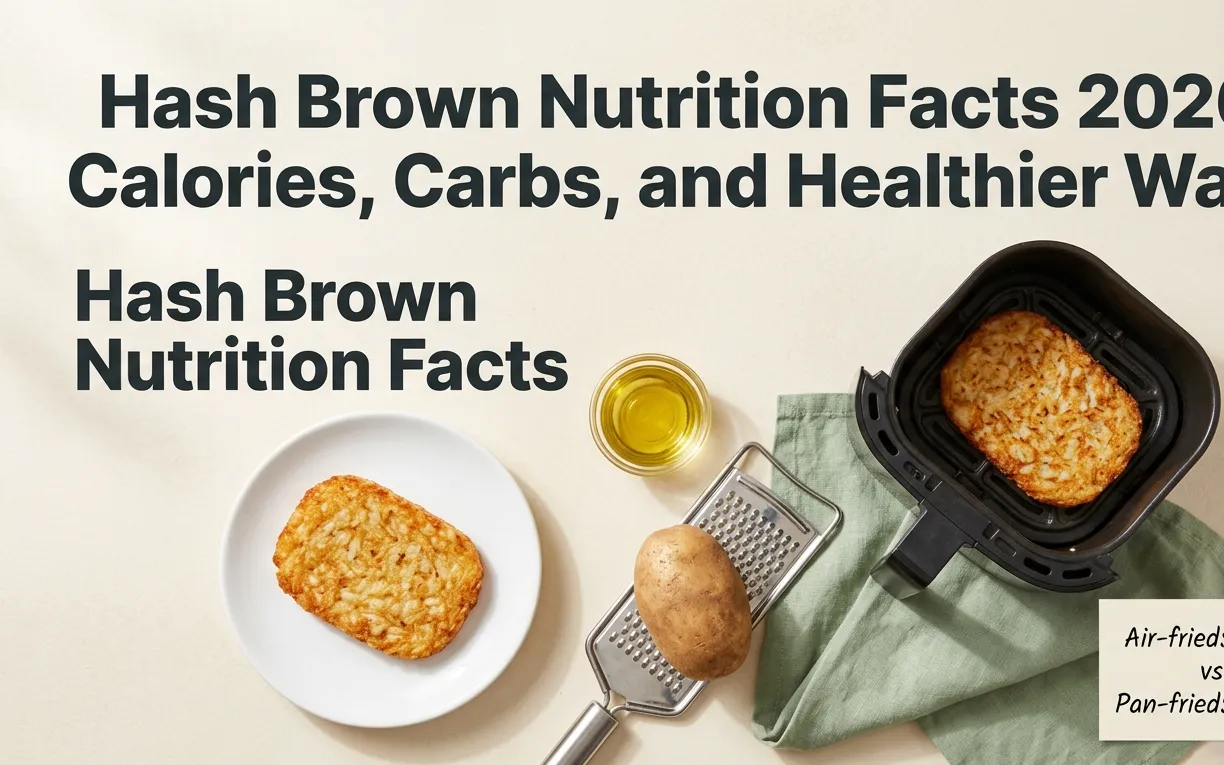
Hash Brown Nutrition Facts 2026: Calories, Carbs, and Healthier Ways
Hash brown nutrition facts vary dramatically based on preparation method, with a single pan-fried patty delivering 120 to 150 calories and an air-fried patty coming in closer to 90 to 110 calories for the same serving size. The difference comes almost entirely from oil absorption during cooking.
The USDA FoodData Central database records that raw shredded potato contains roughly 70 calories per 100 grams with less than 1 gram of fat. The moment you introduce cooking oil, those numbers climb. A typical pan-fried hash brown patty absorbs 1 to 2 teaspoons of oil, adding 40 to 80 calories and 5 to 10 grams of fat to the final product. Understanding exactly how those numbers shift between cooking methods, frozen brands, and restaurant versions is what turns a vague guess into an informed breakfast choice.
What follows is a complete nutritional map of hash browns in every form you are likely to encounter. You will see calorie counts, carbohydrate and fat breakdowns, ingredient explanations, cooking method comparisons, frozen brand analyses, restaurant nutrition facts, and practical guidance on the lowest-calorie, lowest-fat way to prepare hash browns at home.
Hash Brown Nutrition Facts
Hash brown nutrition facts describe the macro and micronutrient content of shredded or formed potato that has been cooked with oil or fat until browned and crispy, typically delivering between 100 and 200 calories per serving with the majority of calories coming from fat and carbohydrate.
The potato itself is a whole food with a respectable nutritional foundation. A medium russet potato contains potassium at roughly 620 milligrams, vitamin C at 17 milligrams, and vitamin B6 at 0.4 milligrams, along with small amounts of magnesium and phosphorus. The carbohydrate content sits around 26 grams with 2 grams of fiber and minimal fat. When that potato is shredded, formed, and fried, the carbohydrate and fiber remain while the fat content multiplies.
The Dietary Guidelines for Americans 2020-2025 place potatoes in the starchy vegetable category and recommend that adults consume 4 to 6 cups of starchy vegetables per week depending on calorie needs. Hash browns can fit within that allocation. The concern with hash browns is not the potato. It is the added fat and sodium that turn a whole food into a calorie-dense processed product. A single patty can deliver 15 to 25 percent of the daily sodium limit of 2,300 milligrams recommended by the American Heart Association.
Basic Hash Brown Nutrition by Form (per serving, cooked)
| Hash Brown Form | Serving Size | Calories | Fat (g) | Carbs (g) | Protein (g) | Fiber (g) |
|---|---|---|---|---|---|---|
| Shredded, pan-fried | 1 cup | 160 | 10 | 16 | 2 | 2 |
| Patty, pan-fried | 1 patty (65g) | 140 | 9 | 14 | 1.5 | 1.5 |
| Patty, deep-fried | 1 patty (65g) | 190 | 14 | 15 | 1.5 | 1.5 |
| Shredded, air-fried | 1 cup | 100 | 4 | 14 | 2 | 2 |
| Diced breakfast potatoes | 1/2 cup | 90 | 3 | 14 | 1.5 | 1.5 |
Hash Brown Calories Per Serving
A standard 65-gram pan-fried hash brown patty contains 130 to 150 calories, with the exact count determined by how much oil is used during cooking and whether the patty is commercially frozen or made fresh at home.
The calorie spread in hash browns is wider than most people realize. A deep-fried restaurant patty can reach 200 calories. An air-fried patty made with a light spray of oil can land at 100 calories or below. That is a 100-calorie difference per patty, which adds up to 700 calories across a week of daily hash brown breakfasts. The difference equals roughly the calories in an entire additional patty every two days.
Frozen hash brown patties list their uncooked nutritional values on the package, but the cooking instructions typically call for pan-frying in oil. The printed calorie count may not reflect what you actually eat unless you measure the oil you add. A package that says “130 calories per patty” might mean 130 calories as packaged, before you fry it in a tablespoon of oil that adds 120 calories to the pan. How much of that oil ends up on your plate depends on cooking technique, patty surface area, and whether you blot the finished patty on paper towels.
Hash Brown Carbs and Fat Content
A standard pan-fried hash brown patty contains 14 to 16 grams of carbohydrate and 8 to 10 grams of fat, with the carbohydrate coming entirely from potato starch and the fat coming almost entirely from cooking oil absorbed during preparation.
The 14 to 16 grams of carbohydrate in a hash brown patty represents roughly one carbohydrate exchange in diabetes meal planning. The American Diabetes Association uses 15 grams of carbohydrate as one serving for carbohydrate counting. A single hash brown patty fits neatly into that framework for a person who includes carbohydrates in their breakfast.
The fat content tells a more complicated story. The potato itself contributes less than half a gram of fat. Everything else comes from the cooking medium. The type of oil matters for the fatty acid profile. Hash browns fried in butter deliver saturated fat at roughly 5 grams per patty. Hash browns fried in canola or avocado oil shift the fat profile toward monounsaturated fats. The total fat grams may be identical, but the health implications differ. The Dietary Guidelines for Americans recommend limiting saturated fat to less than 10 percent of total daily calories, which is about 22 grams on a 2,000-calorie diet. A single butter-fried patty uses roughly 25 percent of that daily saturated fat budget.
Hash Brown Patty Macronutrient Breakdown (65g patty, pan-fried in oil)
| Nutrient | Amount | Percentage of Patty Weight |
|---|---|---|
| Water | 35g | 54% |
| Carbohydrate | 15g | 23% |
| Fat | 9g | 14% |
| Protein | 1.5g | 2% |
| Fiber | 1.5g | 2% |
| Other (ash, minerals) | 3g | 5% |
Key Takeaway: A hash brown patty is roughly 55 percent water, 23 percent carbohydrate, and 14 percent fat by weight. The fat content is almost entirely from cooking oil, not the potato. That means you control the fat grams by choosing how much oil you use and which cooking method you select.
Hash Brown Ingredients What Is Inside
Commercially prepared hash browns contain shredded or ground potatoes, vegetable oil, salt, and sometimes dextrose, modified food starch, or sodium acid pyrophosphate as processing aids, with ingredient lists growing longer as the product moves from fresh to frozen to restaurant-prepared.
The simplest hash browns contain one ingredient: potato. Freshly shredded russet potato, squeezed dry and cooked in a small amount of oil, is the homemade ideal. Frozen hash browns add more. A typical frozen shredded hash brown package lists potatoes, vegetable oil (soybean, canola, or palm), salt, dextrose, and sodium acid pyrophosphate to prevent discoloration. The dextrose adds a small amount of sugar, typically less than 1 gram per serving, and helps the potatoes brown evenly.
Patty-style frozen hash browns often include modified food starch or potato starch as a binder to hold the patty shape. Some brands add onion powder or garlic powder for flavor. Restaurant hash browns may include additional ingredients: McDonald’s lists natural beef flavoring in their hash browns, which contains hydrolyzed wheat and hydrolyzed milk, making them unsuitable for individuals with wheat or dairy allergies despite the potato base being allergen-free on its own.
Hash browns labeled “simply potatoes” or “fresh” in the refrigerated section typically have the shortest ingredient lists. Potatoes, oil, salt, and perhaps one preservative. Frozen patties with “crispy” or “extra crispy” on the label tend to have more added oil in the formulation, which shows up in the higher fat content on the nutrition panel.
Common Hash Brown Additive and Ingredient Guide
| Ingredient | Purpose | Found In |
|---|---|---|
| Dextrose | Promotes even browning | Most frozen hash browns |
| Sodium acid pyrophosphate | Prevents gray discoloration | Frozen shredded hash browns |
| Modified food starch | Binds patty shape | Patty-style frozen products |
| Natural flavor | Enhances savory taste | Restaurant and premium brands |
| Citric acid | Preservative and color protection | Some refrigerated brands |
| Xanthan gum | Texture and binding agent | Some gluten-free patty formulations |
Frozen Hash Brown Nutrition Facts
Frozen hash brown nutrition facts printed on the package reflect the uncooked product as sold, which typically contains 60 to 90 calories and 2 to 5 grams of fat per serving before any additional cooking oil is introduced.
The nutrition panel on a bag of frozen hash browns tells only part of the story. Ore-Ida shredded hash browns list 60 calories and 0 grams of fat per 3-ounce serving (85 grams) in the frozen state. The fine print often notes that the product is “partially fried” or “contains oil,” which accounts for the small amount of fat present before you cook them. When you pan-fry that serving in a tablespoon of vegetable oil, you add roughly 120 calories and 14 grams of fat to the total. The final plate delivers approximately 180 calories and 14 grams of fat. The number you need for dietary tracking is the cooked number, not the frozen package number.
Simply Potatoes shredded hash browns from the refrigerated section list 80 calories per 2/3 cup serving with 3.5 grams of fat. These are fresh, never frozen, and the fat comes from vegetable oil added during processing. The ingredient list is shorter than most frozen options. Trader Joe’s hash brown patties list 120 calories and 6 grams of fat per patty in the frozen state, with cooking instructions that call for pan-frying in additional oil. The gap between the package number and the final plate number narrows with patties because they are more thoroughly pre-fried during manufacturing.
Frozen Hash Brown Brand Nutrition Comparison (per serving, uncooked as packaged)
| Brand | Form | Serving Size | Calories | Fat (g) | Sodium (mg) | Notable |
|---|---|---|---|---|---|---|
| Ore-Ida | Shredded | 3 oz (85g) | 60 | 0 | 30 | Add oil for cooking |
| Simply Potatoes | Shredded | 2/3 cup (80g) | 80 | 3.5 | 35 | Refrigerated, not frozen |
| Trader Joe’s | Patty | 1 patty (65g) | 120 | 6 | 250 | Pre-fried; cook from frozen |
| McCain | Patty | 1 patty (64g) | 130 | 7 | 220 | Available in foodservice packs |
| Great Value (Walmart) | Shredded | 3 oz (85g) | 70 | 0.5 | 40 | Budget option; add oil for cooking |
Homemade Hash Brown Nutrition Facts
Homemade hash browns made from one medium russet potato, one teaspoon of canola oil, and a pinch of salt contain approximately 140 calories, 5 grams of fat, 22 grams of carbohydrate, 2 grams of protein, and 3 grams of fiber per serving, giving you full control over the oil type and quantity.
The nutritional advantage of homemade hash browns is absolute control over every ingredient. You decide the potato variety. Russets produce the crispiest exterior because of their high starch and low moisture content. Yukon Golds give a creamier interior with a slightly lower glycemic response. You decide the oil. You decide the salt level. The standard homemade preparation starts with one medium russet potato (roughly 150 grams raw), shredded, rinsed, and squeezed completely dry in a kitchen towel. The shredding and squeezing step removes surface starch and excess water, both of which interfere with crispiness.
The oil you choose sets the fatty acid profile. A teaspoon of avocado oil adds 40 calories and 4.5 grams of predominantly monounsaturated fat. A teaspoon of butter adds 34 calories and 4 grams of saturated fat. The difference is small per serving but reflects a broader dietary pattern choice. You can also reduce the oil further by using a well-seasoned cast iron pan, which requires less oil to prevent sticking, or by using an oil spray that delivers roughly 5 to 10 calories per spritz instead of 40 calories per teaspoon.
Shredded Hash Brown Nutrition Facts
Shredded hash browns made from fresh potatoes contain 100 to 160 calories per cup when pan-fried, with the shredded form absorbing slightly more oil per gram of potato than patty forms because of increased surface area exposure.
The physics of shredding explains the nutritional difference. When you shred a potato, you create hundreds of thin strands with significant total surface area. More surface area means more contact with cooking oil. A cup of packed shredded potato has roughly twice the exposed surface area of a smooth patty of equal weight. That shredded texture also creates more edges that brown and crisp, which is the desirable texture that makes hash browns appealing but also the mechanism that traps oil between strands.
Loose shreds versus tightly packed shreds matter for oil absorption. Hash browns spread loosely in the pan absorb less oil because the shreds cook more quickly and seal their exterior faster. Hash browns pressed into a dense layer in the pan take longer to cook through and remain in contact with oil for more time. The cooking technique matters as much as the form. A thin layer of shreds flipped once absorbs less oil than a thick pile stirred repeatedly, which breaks the developing crust and exposes fresh potato surface to oil repeatedly.
Hash Brown Patty Nutrition Facts
A standard 65-gram frozen hash brown patty, pan-fried in a tablespoon of oil, delivers 140 to 180 calories, 9 to 14 grams of fat, 14 to 16 grams of carbohydrate, and 1 to 2 grams of protein, with the patty’s dense formed structure absorbing less oil than loose shredded hash browns per gram of weight.
The patty form offers a counterintuitive nutritional advantage. Patties are compressed, which reduces internal surface area and limits oil penetration during cooking. The exterior browns and crisps while the interior steams. The result is a product where the oil stays mostly on the surface rather than permeating throughout. Blotting a finished patty with paper towel removes surface oil effectively. The same blotting technique on shredded hash browns is less effective because oil has infiltrated between individual shreds.
The patty’s disadvantage is sodium. Frozen hash brown patties are pre-salted during manufacturing. A single patty can contain 200 to 400 milligrams of sodium before you add any salt at the table. Freshly made shredded hash browns salted by you at the stove can stay under 100 milligrams of sodium per serving. For anyone tracking sodium intake, the patty versus shred decision matters.
Shredded vs. Patty Hash Brown Comparison (per 65g cooked serving, pan-fried)
| Feature | Shredded Hash Browns | Patty Hash Browns |
|---|---|---|
| Calories | 140 to 170 | 140 to 160 |
| Oil absorption | Higher (more surface area) | Lower (dense form limits penetration) |
| Sodium (homemade) | Under 100mg if you salt lightly | 200 to 400mg in frozen pre-salted |
| Sodium (frozen) | 150 to 250mg | 200 to 400mg |
| Fiber | 1.5 to 2g | 1 to 1.5g |
| Crisp texture | Lacy, irregular | Uniform, consistent |
| Ease of blotting oil | Difficult (oil between shreds) | Easy (oil on surface) |
Key Takeaway: Shredded hash browns absorb more oil but give you more texture. Patties absorb less oil but come with more sodium in frozen form. If you make both from scratch at home with the same potato and the same oil, the nutritional difference shrinks to almost zero. The real distinction is frozen patty versus fresh shreds.
Hash Brown Oil Absorption by Cooking Method
Hash brown oil absorption ranges from under 1 gram of retained oil per serving for air-fried or baked preparations to 10 to 14 grams for deep-fried hash browns, with pan-frying falling in the middle at 5 to 10 grams of absorbed oil depending on how much oil is used and whether the finished product is blotted.
Oil absorption is a function of four variables. Temperature matters first. Hotter oil, up to a point, causes faster surface browning and crust formation. That crust acts as a barrier to further oil penetration. Oil that is too cool soaks into the potato before a crust can form, producing greasy hash browns. Surface area matters second. Shredded forms absorb more than patty forms. Cooking time matters third. Hash browns cooked slowly over medium-low heat spend more time in oil and absorb more of it. Post-cooking handling matters fourth. Blotting on paper towels for even 15 seconds removes measurable surface oil.
The oil type itself does not change the absorption amount in grams, but it does change the fatty acid profile of those absorbed grams. A patty that absorbs 8 grams of canola oil delivers 0.5 grams of saturated fat, 5 grams of monounsaturated fat, and 2.5 grams of polyunsaturated fat. A patty that absorbs 8 grams of butter delivers 5 grams of saturated fat. The total fat grams are identical. The health implications are different.
Air Fryer Hash Brown Calories and Nutrition
Air-fried hash browns prepared with a light spray of cooking oil contain 90 to 110 calories and 4 to 6 grams of fat per patty or per cup of shreds, representing the lowest-fat cooking method short of dry baking and a calorie reduction of 25 to 40 percent compared to pan-frying.
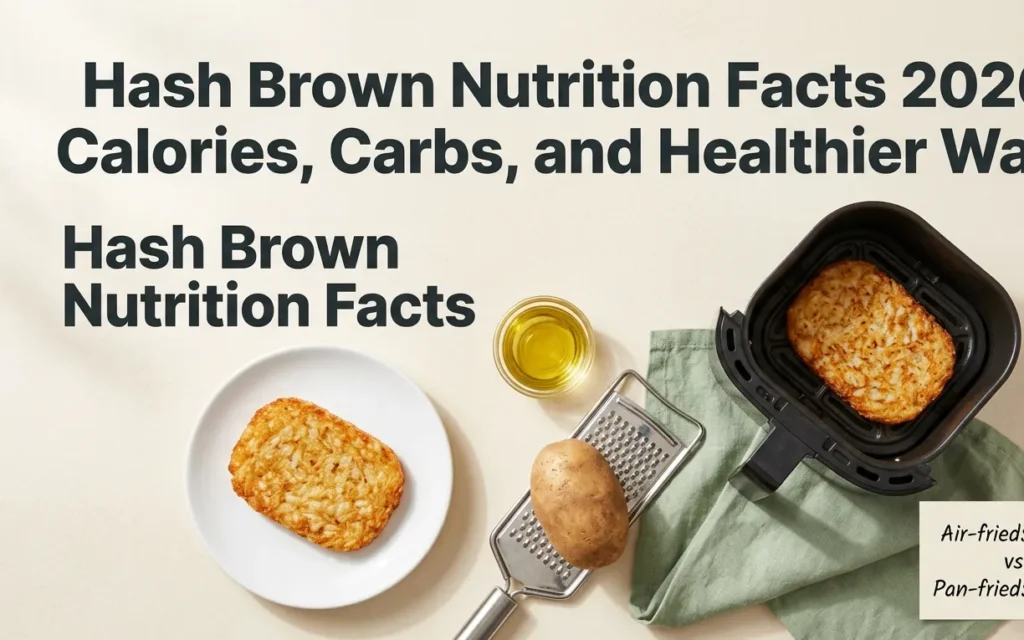
The air fryer works by circulating hot air at high speed around food placed in a perforated basket. The rapid air movement dehydrates the potato surface quickly, creating a browned, crisp exterior without submerging or pan-frying in oil. A light spray of oil applied directly to the hash brown surface before air frying provides enough fat for browning and flavor while adding only 10 to 20 calories total. The basket design allows any rendered or excess oil to drip away from the food rather than being reabsorbed.
Frozen hash browns perform well in air fryers because they already contain some oil from manufacturing, which facilitates browning without additional oil. A frozen Trader Joe’s patty air-fried from frozen at 400 degrees Fahrenheit for 8 to 10 minutes comes out crisp with no added oil. The final calorie count stays close to the package label rather than climbing with added cooking fat. Homemade fresh shredded hash browns need at least a light oil spray to prevent drying out completely in the high-speed air.
Cooking Method Nutritional Comparison (per 65g patty or equivalent)
| Cooking Method | Calories | Fat (g) | Oil Added | Final Texture |
|---|---|---|---|---|
| Air-fried (oil spray) | 95 | 4 | 1/4 tsp (1g) | Crisp exterior, tender interior |
| Baked (oven, 425°F) | 100 | 4 | 1 tsp (4g) | Less crisp, drier |
| Pan-fried (1 tsp oil, blotted) | 130 | 8 | 1 tsp (4g) absorbed + blotting | Classic crisp |
| Pan-fried (1 tbsp oil, not blotted) | 160 | 12 | Approx 10g absorbed | Very crisp, oily |
| Deep-fried | 195 | 15 | Full submersion | Uniformly crisp throughout |
Baked Hash Brown vs Fried Nutrition Comparison
Baked hash browns contain 30 to 50 fewer calories and 4 to 8 fewer grams of fat per serving compared to pan-fried hash browns because oven baking uses significantly less oil and relies on dry heat rather than oil as the primary cooking medium.
The nutritional advantage of baking comes at a textural cost. Oven-baked hash browns never achieve the same all-over crispness that pan-frying or air-frying produces. The bottom surface that contacts the hot baking sheet crisps nicely, but the top surface remains softer. Flipping halfway through baking helps but does not match the even browning of a method where the food sits in direct contact with hot oil. That textural difference is why people who try baked hash browns often go back to the pan.
The technique that bridges the gap is a hybrid method. Start hash browns in a pan with a small amount of oil to develop a crisp bottom crust, then transfer to a hot oven to finish cooking through without additional oil absorption. The initial pan contact gives the desired texture. The oven finish eliminates extended oil exposure. The result lands closer to 110 calories with the crispness of a fully pan-fried product. This approach works for both shredded and patty forms.
McDonald’s Hash Brown Nutrition Facts
A McDonald’s hash brown patty contains 150 calories, 10 grams of fat, 14 grams of carbohydrate, and 1 gram of protein, according to the company’s published nutrition information, making it nutritionally similar to a standard frozen grocery store patty pan-fried at home.
The McDonald’s hash brown is a formed potato patty that is deep-fried in a vegetable oil blend that includes canola oil, corn oil, soybean oil, and hydrogenated soybean oil. The ingredient list also includes natural beef flavor, which contains hydrolyzed wheat and hydrolyzed milk. This is a relevant detail for individuals with wheat allergies, gluten sensitivity, or dairy allergies because the hash brown appears at first glance to be a simple potato product but contains both wheat and milk derivatives.
Sodium content sits at 310 milligrams per patty, which is moderate for a fast-food breakfast item but represents roughly 13 percent of the daily sodium limit. The potato content provides approximately 2 grams of fiber and small amounts of potassium. The McDonald’s hash brown is one of the lower-calorie items on the breakfast menu, coming in below the Egg McMuffin at 310 calories and well below the sausage biscuit options. For someone eating breakfast at McDonald’s and tracking calories, a hash brown paired with black coffee keeps the meal under 200 calories.
Waffle House Hash Brown Nutrition Facts
Waffle House hash browns nutrition varies widely by preparation style, with a plain order of scattered hash browns containing approximately 200 to 250 calories and the fully loaded version with toppings climbing above 500 calories per serving.
Waffle House cooks their hash browns on a flat-top griddle with oil, and the “scattered” preparation describes shredded potatoes spread across the hot surface. The plain version delivers a larger portion than a standard frozen grocery patty, typically 4 to 5 ounces cooked, which explains the higher calorie count compared to a single frozen patty. The “smothered” option adds sautéed onions at roughly 20 calories. “Covered” adds a slice of American cheese at 60 to 80 calories. “Chunked” adds diced ham at 30 to 50 calories. “Diced” adds tomatoes at under 10 calories. “Peppered” adds jalapeños at negligible calories. “Capped” adds mushrooms at roughly 15 calories. “Topped” adds chili at 100 to 150 calories. A fully loaded Waffle House hash brown order with all eight toppings can exceed 600 calories.
The sodium content at Waffle House is considerably higher than homemade. The griddle seasoning, the cheese, the ham, and the chili all contribute sodium. A fully loaded order can deliver well over 1,500 milligrams of sodium, which is 65 percent of the daily limit.
Key Takeaway: Restaurant hash browns at McDonald’s and Waffle House land in the 150 to 250 calorie range for the basic version. The sodium and ingredient complexity increase compared to homemade. Check allergen listings carefully because restaurant hash browns often contain wheat, dairy, or both even though the potato base is allergen-free.
Are Hash Browns Healthy for Weight Loss
Hash browns can fit into a weight loss eating pattern when portion size is controlled, a lower-fat cooking method is used, and the hash brown replaces rather than accompanies other breakfast carbohydrates, but they are not a low-calorie food and require intentional planning around them.
A single air-fried hash brown patty at 95 calories with an egg and a piece of fruit creates a satisfying 300-calorie breakfast. The fiber from the potato and the protein from the egg provide satiety that supports portion control at subsequent meals. A pan-fried patty at 140 calories works within the same framework. The problem arises when hash browns become a side dish to pancakes, toast, or a biscuit, layering multiple refined carbohydrate sources onto a single plate.
The calorie density of hash browns deserves respect. Potato alone is moderately calorie-dense at roughly 0.7 calories per gram. Hash browns with absorbed oil climb to 2.0 to 2.5 calories per gram, similar to french fries and higher than roasted potatoes. Foods with higher calorie density are easier to overeat because a satisfying visual portion delivers more calories than expected. A person who weighs their hash brown portion or counts patties has a different outcome than a person who fills their plate by eye.
Hash Brown Glycemic Index and Blood Sugar
Hash browns have a high glycemic index, typically falling in the range of 70 to 85, which means the carbohydrate they contain is digested and absorbed rapidly, producing a quick rise in blood glucose that individuals with insulin resistance or diabetes may need to manage.
The glycemic index of hash browns is affected by several factors. The russet potato variety commonly used for hash browns has a naturally higher glycemic index than waxy potato varieties. Shredding increases the surface area exposed to digestive enzymes, potentially accelerating carbohydrate breakdown. Frying adds fat, which slows gastric emptying and can moderate the immediate blood glucose spike somewhat, but the effect is modest compared to the total glycemic load of the meal.
Cooling cooked potatoes increases their resistant starch content. Resistant starch is a type of carbohydrate that resists digestion in the small intestine and functions more like soluble fiber. Potatoes cooked and cooled for several hours contain measurably more resistant starch than potatoes eaten hot. This has been documented in studies published in the Journal of Nutrition. Hash browns eaten as leftovers from a batch cooked the previous day may produce a slightly lower blood glucose response than hash browns eaten immediately after cooking. The difference is not large enough to change diabetes medication dosing but is a meaningful detail for someone tracking post-meal glucose patterns.
Glycemic Index of Potato Preparations
| Potato Preparation | Approximate Glycemic Index |
|---|---|
| Russet potato, baked | 85 (high) |
| Hash browns, fried | 70 to 80 (high) |
| French fries | 65 to 75 (moderate to high) |
| Potato, boiled and cooled | 55 to 60 (moderate) |
| Potato, boiled hot | 70 to 80 (high) |
| Sweet potato, baked | 60 to 65 (moderate) |
Lowest Calorie Hash Brown Preparation Method
The lowest calorie hash brown preparation method that still produces a crisp, browned result is air-frying with a light oil spray, delivering a patty or serving at 90 to 110 calories and 4 to 6 grams of fat.
Air-frying achieves a reasonable crispness with minimal oil. You need an air fryer, a light mist of cooking spray or a half-teaspoon of oil brushed onto the hash brown surface, and a cooking temperature of 380 to 400 degrees Fahrenheit. Frozen patties air-fry in 8 to 10 minutes. Fresh shredded hash browns air-fry in 12 to 15 minutes with a shake or flip at the halfway mark. The calorie savings compared to pan-frying runs 40 to 70 calories per serving.
The second-lowest option is oven baking on parchment paper with an oil spray. Preheat a baking sheet in a 425-degree oven. Spread shredded or patty hash browns on the hot sheet. Spray lightly with oil. Bake for 15 to 20 minutes, flipping once. The calorie count lands around 100 to 110 per serving. The texture is acceptable but not as uniformly crisp as air-frying.
Numbered steps for the lowest-calorie air-fryer hash browns:
- Preheat the air fryer to 400 degrees Fahrenheit for 3 minutes
- Place frozen patty or fresh shredded hash browns in the basket in a single layer
- Spray lightly with cooking oil spray, roughly 1 second of spray per side
- Air fry for 8 to 10 minutes for frozen patties or 12 to 15 minutes for fresh shreds
- Flip halfway through cooking time
- Remove when golden brown and serve immediately without additional oil
Key Takeaway: The gap between the highest-calorie hash brown (deep-fried, 195 calories) and the lowest (air-fried, 95 calories) is 100 calories per serving. Over a year of weekly hash browns, that single choice saves roughly 5,200 calories, which is the equivalent of about 1.5 pounds of body fat from one small preparation change.
Frequently Asked Questions About Hash Brown Nutrition Facts
How many calories are in one hash brown patty?
A standard frozen hash brown patty contains 120 to 150 calories when pan-fried in oil.
The exact calorie count depends on the brand, the amount of oil used, and whether the patty is blotted after cooking.
An air-fried patty with no added oil lands closer to 100 to 120 calories.
Are hash browns healthier than french fries?
Hash browns and french fries are nutritionally similar when prepared with the same cooking method because both are made from potato and absorb comparable amounts of oil.
Hash browns are typically served in smaller portions than a standard french fry order, which can make them the lower-calorie choice at breakfast.
The health comparison depends entirely on portion size, cooking method, and what you eat alongside each.
Can you eat hash browns on a low carb diet?
Hash browns are not compatible with very low carbohydrate diets because a single patty contains 14 to 16 grams of carbohydrate.
Someone following a moderately low carbohydrate eating pattern with 100 to 150 grams of daily carbohydrate can fit a hash brown patty into their day by adjusting other carbohydrate sources.
Keto and other very low carbohydrate diets that limit intake to under 50 grams per day effectively exclude hash browns.
What is the healthiest oil to cook hash browns in?
Avocado oil and extra light olive oil are among the healthiest oils for cooking hash browns because they are high in monounsaturated fats and have smoke points above 400 degrees Fahrenheit suitable for high-heat pan-frying.
Canola oil is a neutral-flavored budget option with a favorable fatty acid profile.
Butter adds saturated fat and has a lower smoke point, making it less ideal for high-heat hash brown cooking but acceptable in moderation.
Are frozen hash browns as nutritious as fresh?
Frozen hash browns retain most of the potato’s potassium, magnesium, and fiber content, making them nutritionally comparable to fresh on those measures.
Frozen products typically contain more sodium and added ingredients like dextrose and preservatives that fresh homemade hash browns do not.
Fresh hash browns give you complete control over oil type and salt level, which is their primary nutritional advantage over frozen.
Do air fryer hash browns have less fat?
Air fryer hash browns contain 30 to 50 percent less fat than pan-fried hash browns because the air frying method uses only a light spray of oil rather than a tablespoon or more.
An air-fried patty with cooking spray delivers 4 to 6 grams of fat compared to 8 to 12 grams for pan-fried.
The air fryer’s rapid air circulation creates a crisp exterior without the oil absorption that occurs during pan-frying or deep-frying.
Hash browns are potatoes cooked with oil. Everything else is a detail. The potato brings carbohydrate, potassium, vitamin C, and a small amount of fiber. The cooking method determines how much fat and how many calories ride along. Choose your cooking method first. That single decision determines 80 percent of the nutritional outcome.
Pick the form you genuinely enjoy. There is no meaningful nutritional difference between shredded and patty hash browns when the same potato and cooking method are used. Buy the frozen brand with the shortest ingredient list if convenience matters. Make them from scratch if you want complete control over oil type and salt level. Blot them on paper towel before serving regardless of how you cook them.
You now have the numbers for every form, every method, and every major restaurant option. You know the air fryer saves you 50 calories. You know the paper towel saves you more. Make your hash brown decision with actual data instead of guessing.