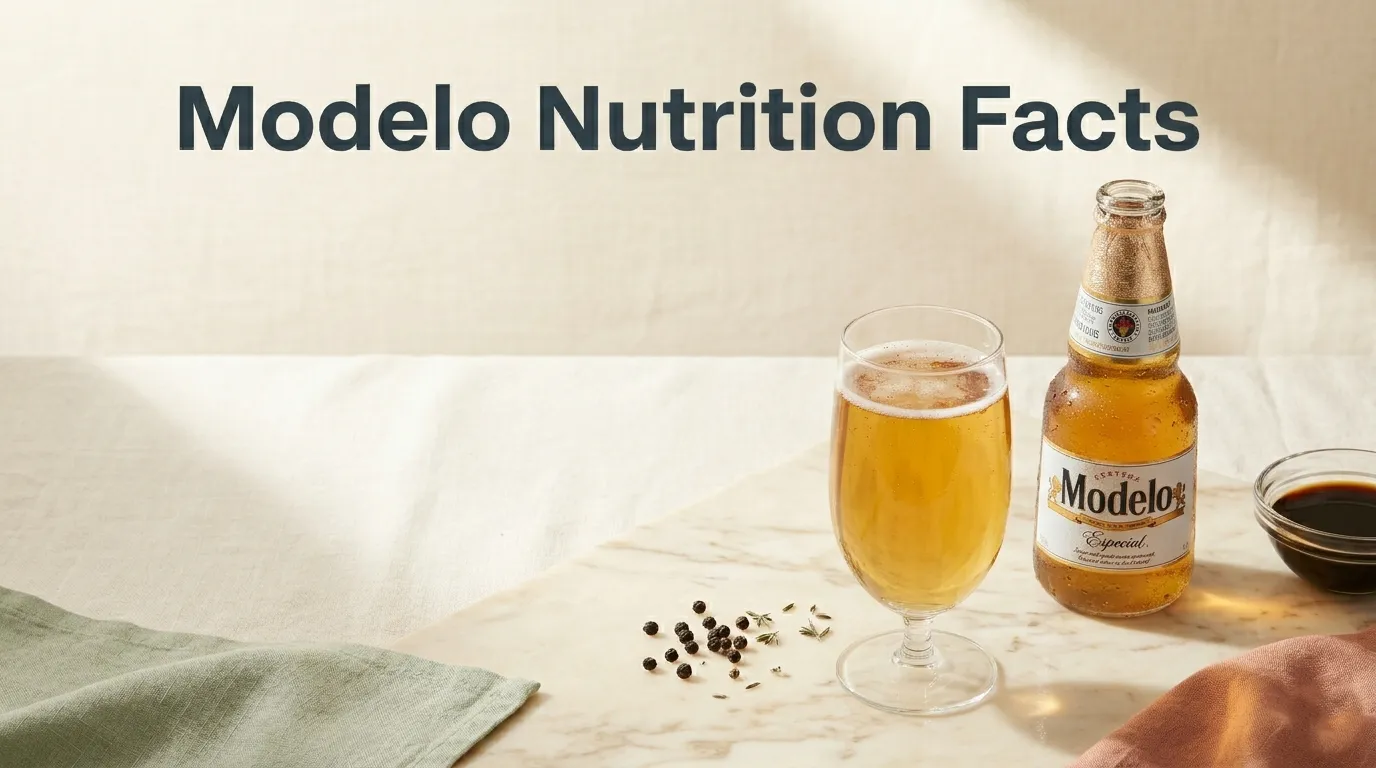
Modelo Nutrition Facts 2026: Calories, Carbs, and Full Breakdown
Modelo Especial nutrition facts reveal 144 calories and 13.6 grams of carbohydrates per 12-ounce bottle with an alcohol by volume of 4.4%. That calorie count places Modelo in the middle of the beer calorie spectrum, above light beers like Bud Light at 110 calories but below heavier craft beers that can reach 200 to 300 calories per serving.
What surprises most people is the math on a standard drink. The Dietary Guidelines for Americans 2020-2025 defines one standard drink as 12 ounces of beer at 5% ABV. Modelo Especial sits at 4.4% ABV in a 12-ounce format, which means one bottle equals roughly 1.06 standard drinks. That near-perfect one-to-one ratio makes it easier to track within the moderate drinking limits of up to 2 drinks per day for men and up to 1 for women.
This breakdown covers the complete nutritional profile of Modelo Especial across bottle, can, and draft formats. You’ll see how it stacks up against Corona, Bud Light, and Modelo Negra in direct nutritional comparisons. You’ll also learn what the ingredient list actually means, whether the gluten in barley affects you, and exactly how this beer fits into a health-conscious drinking pattern according to current dietary guidance.
Modelo Nutrition Facts
A 12-ounce serving of Modelo Especial contains 144 calories, 0 grams of fat, 0 grams of protein, 13.6 grams of total carbohydrates, and 0 grams of dietary fiber according to USDA FoodData Central reference values and manufacturer published data for the 2026 product year. The caloric content comes almost entirely from alcohol and residual carbohydrates left after fermentation.
The 144-calorie total breaks down by source. Alcohol provides approximately 7 calories per gram. At 4.4% ABV in 355 milliliters, the ethanol content calculates to roughly 13.2 grams of pure alcohol, contributing about 92 calories. The remaining 52 calories come from the 13.6 grams of residual carbohydrates at 4 calories per gram. This macro split is typical for a standard lager that has not been aggressively fermented to dryness.
Understanding beer calories requires recognizing that you’re drinking fermented grain sugar. The brewing process starts with malted barley, which contributes starch that enzymes convert to fermentable sugars during mashing. Yeast consumes most of those sugars and produces alcohol. The sugars that remain after fermentation become the carbohydrate count on the nutrition label. A longer, more complete fermentation yields a drier beer with fewer residual carbs and fewer calories.
| Nutrient | 12 fl oz (355ml) | % Daily Value |
|---|---|---|
| Calories | 144 | 7% (2,000 cal) |
| Total Fat | 0g | 0% |
| Sodium | 12mg | 1% |
| Total Carbohydrates | 13.6g | 5% |
| Dietary Fiber | 0g | 0% |
| Sugars | 0g | N/A |
| Protein | 0g | 0% |
| Alcohol (Ethanol) | 4.4% ABV | N/A |
Modelo Beer Nutrition Facts
Modelo beer nutrition facts are consistent across the core Especial lager with 144 calories and 13.6 grams of carbohydrates per 12-ounce serving, placing this Mexican lager in the standard-calorie beer category rather than the light beer or high-calorie craft beer categories. The nutritional profile reflects a traditional Vienna-style lager brewed with malted barley and adjunct grains.
Beer nutritional data is not standardized in the same way food nutrition labels are. The FDA does not require alcohol beverages to carry standard nutrition facts panels, though many manufacturers voluntarily provide this information. Modelo’s parent company Grupo Modelo publishes nutritional data through the brand website and through third-party nutrition databases. The figures cited in this article represent the most current 2026 manufacturer-provided data.
The lack of mandated nutrition labeling on alcohol creates a knowledge gap for consumers. A 2025 survey published by the Academy of Nutrition and Dietetics found that only 22% of American adults could accurately estimate the calorie content of a standard beer within a 25-calorie margin of error. Beer calories are invisible unless you actively seek them out, which is why articles like this one exist.
Beer provides no meaningful micronutrition. The B vitamins and minerals contributed by malted barley during brewing exist in trace amounts that do not meaningfully contribute to daily nutritional requirements. A 12-ounce Modelo Especial might provide 2 to 4% of the daily value for a few B vitamins, but the alcohol in the same bottle impairs the absorption and metabolism of those same vitamins. The net nutritional effect of the micronutrients is essentially zero.
Key Takeaway: Modelo Especial at 144 calories and 13.6g carbs per 12 ounces is a standard-calorie beer. It is not a light beer, not a heavy beer, and provides no meaningful nutritional value beyond the alcohol calories and carbohydrate energy.
Modelo Especial Calories
Modelo Especial calories total 144 per 12-ounce bottle or can, 96 calories per 8-ounce serving, and approximately 180 calories per 16-ounce draft pour. The calorie count scales directly with volume because the alcohol percentage and carbohydrate concentration remain constant regardless of serving size.
An 8-ounce serving is not a standard retail format but represents a common home pour or tasting portion. At 96 calories, this smaller serving provides roughly the caloric equivalent of a medium apple or a slice of bread. A 16-ounce draft pint, which is the common bar and restaurant serving size, delivers approximately 192 calories because draft pours typically use 16-ounce glasses rather than 12-ounce bottles.
A 24-ounce tall can, which has gained market share in convenience stores, contains 288 calories and 27.2 grams of carbohydrates. That single can represents 14% of a 2,000-calorie daily intake from a beverage with zero satiety value. If you’re calorie tracking, the serving size format matters as much as the per-ounce nutritional data.
Calorie accumulation from beer happens easily because alcohol does not trigger satiety hormones the way solid food does. Research published in the American Journal of Clinical Nutrition has documented that liquid calories from alcohol are additive to total daily energy intake. People do not compensate by eating less food after drinking a beer. The 144 calories in your Modelo are additional calories in your day, not replacement calories.
| Serving Size | Volume | Calories | Carbs |
|---|---|---|---|
| Half pour | 8 fl oz | 96 | 9.1g |
| Standard bottle/can | 12 fl oz | 144 | 13.6g |
| Draft pint | 16 fl oz | 192 | 18.1g |
| Tall can | 24 fl oz | 288 | 27.2g |
Modelo Carbs
Modelo Especial contains 13.6 grams of carbohydrates per 12-ounce serving, all of which come from residual unfermented sugars remaining after the brewing and fermentation process. These carbohydrates are primarily maltose, maltotriose, and dextrins that the lager yeast did not consume during fermentation.
The 13.6 grams of carbs place Modelo in a moderate carbohydrate category for beer. Light beers typically range from 2 to 6 grams per 12 ounces. Standard American lagers like Budweiser run 10 to 11 grams. Heavier craft beers and stouts can exceed 20 grams per serving. Modelo sits above the light beer threshold and below the heavy beer category.
For someone following a low-carbohydrate dietary pattern such as a ketogenic diet where daily carbohydrate intake is typically restricted to 20 to 50 grams, one Modelo Especial consumes 27% to 68% of the entire day’s carbohydrate allowance. A single beer can represent a sizable fraction of the daily carb budget on these restrictive patterns. Light beer or zero-carb spirits like vodka or tequila are more compatible choices for strict carbohydrate restriction.
The carbohydrate type matters less for blood glucose response than the presence of alcohol itself. Alcohol inhibits gluconeogenesis in the liver, which can cause blood sugar to drop several hours after drinking, particularly in people with diabetes who take insulin or sulfonylurea medications. The carbohydrates in beer provide an initial glucose input, but the alcohol can cause delayed hypoglycemia. This dual effect means people with type 2 diabetes need to account for both the carbohydrate and the alcohol when planning consumption.
Modelo Can Nutrition Facts
Modelo Especial can nutrition facts are identical to the bottle nutrition facts at 144 calories and 13.6 grams of carbohydrates per 12-ounce serving. The can format contains the same beer with the same alcohol by volume and the same nutritional profile. The packaging material does not affect the nutritional content of the beer inside.
The 12-ounce can is the most widely available retail format for Modelo Especial in 2026, sold in 6-packs, 12-packs, and 24-pack cases. The can format protects the beer from light exposure, which can cause a photochemical reaction in hop compounds that produces a skunky off-flavor. Aluminum cans provide complete light protection, making the can format technically superior to clear or green glass bottles for beer preservation.
A 12-ounce can represents 144 calories regardless of whether it’s poured into a glass or consumed directly from the can. There is no nutritional difference between can and bottle formats of the same beer at the same volume. The choice between can and bottle is a matter of packaging preference, not nutritional consequence.
Cans are also the format used for the 24-ounce tall boy single-serve option. That larger format doubles the nutritional numbers to 288 calories and 27.2 grams of carbohydrates. If you’re counting calories and you reach for a tall can, you’re consuming a full meal’s worth of energy from a beverage, and the nutritional label on the can itself is not required to tell you that.
Key Takeaway: Modelo Especial cans and bottles are nutritionally identical at 144 calories per 12 ounces. The can protects the beer better from light damage, but the nutritional profile does not change based on packaging.
Modelo Alcohol Content
Modelo Especial contains 4.4% alcohol by volume, which places it slightly below the 5% ABV standard used by the Dietary Guidelines for Americans 2020-2025 to define a standard drink. A 12-ounce Modelo Especial at 4.4% ABV delivers approximately 13.2 grams of pure ethanol, which is 1.06 standard drinks.
The alcohol content of Modelo Especial has remained consistent at 4.4% ABV across the current product formulation cycle. This ABV is typical for a mass-market Mexican lager and places Modelo in the same alcohol range as Corona Extra at 4.6% ABV and slightly above Bud Light at 4.2% ABV. The differences in alcohol content between these beers are small and nutritionally similar.
Standard drink math matters because the Dietary Guidelines define moderate drinking in terms of standard drinks, not in terms of bottles or cans. A man following the guideline of up to 2 standard drinks per day could consume roughly two 12-ounce bottles of Modelo Especial and remain within the definition of moderate drinking for that day. A woman following the guideline of up to 1 standard drink per day would exceed the moderate drinking threshold partway through a second bottle.
Alcohol is metabolized primarily in the liver through alcohol dehydrogenase and the cytochrome P450 system. The liver processes approximately one standard drink per hour in a person of average size with normal liver function. Drinking faster than this rate raises blood alcohol concentration. The calories in alcohol are metabolized differently than food calories, with some research suggesting that chronic heavy alcohol consumption leads to inefficient energy metabolism and that moderate alcohol calories may be handled differently than food calories in the body.
Modelo Ingredients
Modelo Especial ingredients according to the manufacturer include water, malted barley, non-malted cereal grains (corn), and hops. This ingredient list follows the Reinheitsgebot German beer purity tradition with the addition of corn as an adjunct grain, which is common in Mexican lager brewing.
Malted barley is barley that has been soaked, germinated, and dried. The malting process develops enzymes that convert the grain’s starch into fermentable sugars during the mashing stage of brewing. These sugars feed the yeast during fermentation. The barley also contributes color, flavor compounds, and the proteins that create beer’s foam head and body.
Corn serves as an adjunct grain in Modelo, meaning a fermentable ingredient added alongside barley. Corn lightens the body of the finished beer, contributes fermentable sugars without adding the protein that creates heavier mouthfeel, and produces a crisper, cleaner finish than an all-barley malt bill would deliver. Corn adjuncts are traditional in Mexican lager styles and are part of what distinguishes Mexican lagers from heavier European malt-forward lagers.
Hops contribute bitterness, flavor, and antimicrobial properties. The hop varieties and amounts used in Modelo Especial are proprietary to the brewery. Hops add negligible calories and carbohydrates to the finished beer because they are used in small quantities relative to the grain bill. Their primary nutritional relevance is the trace polyphenols and flavonoids they contribute, including xanthohumol, which has been studied for potential anti-inflammatory properties in laboratory research but has no established health benefit at the concentrations found in beer.
Modelo vs Corona Nutrition
Modelo Especial and Corona Extra are nearly nutritional twins with Modelo containing 144 calories and 13.6 grams of carbs per 12 ounces while Corona Extra contains 148 calories and 13.9 grams of carbs in the same serving size. The 4-calorie difference is nutritionally meaningless, and the two beers are functionally equivalent from a macro perspective.
The alcohol content differs slightly. Modelo Especial is 4.4% ABV. Corona Extra is 4.6% ABV. That 0.2% difference represents roughly half a gram more alcohol in the Corona, which accounts for the 4 extra calories. The carbohydrate counts are essentially identical, within measurement error of each other.
The ingredient lists are similar. Both beers use malted barley, corn adjuncts, and hops. Both are Mexican lagers produced by Grupo Modelo, now owned by Anheuser-Busch InBev for the Mexican domestic market and distributed by Constellation Brands in the United States. The nutritional similarity is not coincidental. These are sibling products from the same brewery family.
The practical takeaway for a consumer choosing between them is that nutrition should not be the deciding factor. The 4-calorie difference between a Modelo and a Corona is equivalent to the energy in roughly one almond or one small bite of a cracker. Choose based on taste preference, not on a nutritional distinction that does not exist in any meaningful way.
| Nutrient | Modelo Especial (12oz) | Corona Extra (12oz) |
|---|---|---|
| Calories | 144 | 148 |
| Carbohydrates | 13.6g | 13.9g |
| Protein | 0g | 0g |
| Fat | 0g | 0g |
| ABV | 4.4% | 4.6% |
Key Takeaway: Modelo Especial and Corona Extra are nutritionally identical at 144 vs 148 calories and 13.6 vs 13.9 grams of carbs. Taste preference should determine your choice, not nutrition.
Modelo vs Bud Light Nutrition
Modelo Especial contains more calories and more carbohydrates than Bud Light, which delivers 110 calories and 6.6 grams of carbs per 12-ounce serving. The 34-calorie and 7-gram carbohydrate difference per bottle adds up over multiple drinks, making Bud Light the objectively lower-calorie and lower-carbohydrate choice.
Bud Light achieves its lower numbers through a different brewing approach. Light beer production typically involves extending the mashing process to produce more fermentable sugars that yeast can convert to alcohol, using enzyme additions to break down residual dextrins, or diluting the finished beer slightly. The result is a beer with less residual sugar and fewer calories per serving at a similar alcohol content.
The alcohol content differs as well. Bud Light is 4.2% ABV versus Modelo’s 4.4% ABV. The lower alcohol in Bud Light accounts for some of the calorie savings. Alcohol provides 7 calories per gram, so a 0.2% ABV difference in a 12-ounce serving equals roughly 5 fewer calories from alcohol in the Bud Light. The remaining 29-calorie difference comes from the 7 grams of fewer residual carbohydrates.
For someone who drinks beer regularly and is monitoring calorie or carbohydrate intake, the Modelo to Bud Light switch can represent a meaningful reduction. Over a six-pack consumed across a week, switching to Bud Light saves 204 calories and 42 grams of carbohydrates. Over a year of weekly six-packs, that’s roughly 10,600 calories, the theoretical equivalent of about 3 pounds of body weight.
Modelo vs Modelo Negra Nutrition
Modelo Negra contains 173 calories and 17.3 grams of carbohydrates per 12-ounce serving, making it a noticeably heavier beer than Modelo Especial at 144 calories and 13.6 grams of carbs. The 29-calorie and 3.7-gram carbohydrate difference reflects the Negra’s darker, maltier Munich Dunkel-style formulation.
Modelo Negra is brewed with a different malt bill than Modelo Especial. The Negra uses roasted caramel malts and darker kilned barley that contribute more unfermentable sugars, more complex carbohydrates, and deeper color. These specialty malts add flavor compounds including melanoidins, which are created during the high-temperature kilning process and contribute toffee and caramel notes. Those same melanoidins add non-fermentable carbohydrates that remain in the finished beer as the extra carbs and calories.
The alcohol content of Modelo Negra is 5.4% ABV versus Modelo Especial’s 4.4% ABV. A full percentage point of additional alcohol contributes approximately 21 calories to the Negra per 12-ounce serving. The remaining 8-calorie difference comes from the additional residual carbohydrates from the darker malt bill.
For someone choosing between the two Modelo variants, the Especial is the lower-calorie, lower-carb option by a meaningful margin. The Negra provides a richer flavor experience at a higher nutritional cost. One Modelo Negra delivers about 20% more calories than one Modelo Especial, a difference that becomes substantial across multiple drinks.
Low Carb Beer Comparison Modelo
Modelo Especial at 13.6 grams of carbohydrates per 12 ounces does not qualify as a low-carb beer. True low-carb beers deliver 2 to 6 grams of carbohydrates per 12-ounce serving. The following comparison places Modelo in context across the beer carbohydrate spectrum.
Light beers dominate the low-carb category. Michelob Ultra leads with 2.6 grams of carbs and 95 calories per 12 ounces. Bud Light Next, a zero-carb beer released in 2022, contains 0 grams of carbs and 80 calories. Corona Premier delivers 2.6 grams of carbs. Miller Lite provides 3.2 grams. Bud Light sits at 6.6 grams. Modelo Especial at 13.6 grams is more than double Bud Light and more than five times Michelob Ultra.
The brewing methods that produce low-carb beers include extended fermentation time to allow yeast to consume more sugars, addition of exogenous enzymes that break down complex dextrins into fermentable simple sugars, and filtration techniques that remove residual carbohydrates. These processes add cost and complexity to brewing, which is part of why dedicated low-carb beers are branded and priced as distinct products.
Modelo does offer lighter variants in some markets, but the standard Modelo Especial is not and has never been marketed as a low-carbohydrate beer. If carbohydrate restriction is your primary nutritional concern, Modelo Especial is not the right beer for that goal. The light beer segment provides multiple options with less than half the carbohydrates.
| Beer (12 oz) | Calories | Carbs | ABV |
|---|---|---|---|
| Michelob Ultra | 95 | 2.6g | 4.2% |
| Corona Premier | 90 | 2.6g | 4.0% |
| Miller Lite | 96 | 3.2g | 4.2% |
| Bud Light | 110 | 6.6g | 4.2% |
| Corona Extra | 148 | 13.9g | 4.6% |
| Modelo Especial | 144 | 13.6g | 4.4% |
| Modelo Negra | 173 | 17.3g | 5.4% |
Is Modelo Beer Healthy
Modelo beer is not a health food, and no alcoholic beverage qualifies as healthy in a nutritional sense, but one Modelo Especial consumed occasionally within the Dietary Guidelines for Americans 2020-2025 definition of moderate drinking can fit into an overall healthy dietary pattern for adults who choose to drink. The key word is moderation, and the key number is one or fewer for women and two or fewer for men per day.
The concept of beer as a source of nutrients is largely a myth. Trace B vitamins and minerals from malted barley survive the brewing process, but the amounts in a 12-ounce serving are trivial. You would need to consume thousands of calories of beer to approach meaningful micronutrient intake, at which point the alcohol toxicity would far outweigh any theoretical nutritional benefit. Beer is not a vitamin supplement. It is an alcoholic beverage.
The documented health risks of alcohol consumption are dose-dependent and well-established. The World Health Organization International Agency for Research on Cancer classifies alcohol as a Group 1 carcinogen, placing it in the same category as tobacco and asbestos for the certainty of the cancer link. A 2023 meta-analysis published in JAMA Network Open found that any level of alcohol consumption was associated with increased cancer risk, with the risk rising linearly with intake.
The American Heart Association does not recommend that non-drinkers start drinking for heart health. Previous observational research suggesting cardiovascular benefits from moderate alcohol consumption has been increasingly questioned by methodologically stronger studies that account for confounding variables including socioeconomic status, physical activity, and overall dietary quality. The emerging scientific consensus is that the healthiest level of alcohol consumption is zero or near-zero.
Key Takeaway: Modelo Especial is an alcoholic beverage, not a health product. The safest intake level from a health perspective is none. For those who choose to drink, limiting consumption to one drink or fewer per day for women and two or fewer for men minimizes alcohol-related health risks.
Modelo Beer Weight Loss
Modelo Especial at 144 calories per 12-ounce serving can fit into a weight loss eating plan if those 144 calories are accounted for within the daily calorie budget and if consumption frequency is moderate. The challenge is that liquid alcohol calories are additive to food intake rather than substitutive, making them harder to accommodate in a calorie deficit.
A weight loss plan based on a 1,500 to 1,800 daily calorie target allocates approximately 400 to 600 calories per meal plus snacks. One Modelo Especial at 144 calories consumes roughly 8 to 10% of that daily budget. Two beers consume 16 to 19%. Three beers consume 24 to 29%. The calorie math works for one beer in a weight loss context. It becomes progressively harder with each additional drink.
Alcohol also affects food choice. Research published in the American Journal of Clinical Nutrition has demonstrated that alcohol consumption increases appetite and reduces dietary restraint. The calories from the beer itself are only one part of the weight management equation. The food choices made while drinking and the day after drinking matter as much or more than the beer calories themselves.
A registered dietitian can help determine whether and how beer fits into an individual’s weight loss plan. For someone who enjoys beer and wants to lose weight, reducing frequency, choosing smaller serving sizes, or switching to lower-calorie beer options are practical strategies. Abstaining entirely is not the only option, but reducing consumption makes creating a calorie deficit easier simply by removing a source of non-satiating liquid calories.
Moderate Drinking Guidelines Modelo
The Dietary Guidelines for Americans 2020-2025 define moderate drinking as up to 1 standard drink per day for women and up to 2 standard drinks per day for men. For Modelo Especial at 4.4% ABV, one 12-ounce bottle equals 1.06 standard drinks, which means a woman consuming one bottle is at the daily limit and a man consuming two bottles is at the daily limit.
A standard drink in the United States contains 14 grams of pure ethanol according to the CDC and NIAAA. The standard drink math varies by beverage type: 12 ounces of 5% ABV beer, 5 ounces of 12% ABV wine, or 1.5 ounces of 40% ABV distilled spirits all equal one standard drink. Modelo Especial at 4.4% ABV delivers slightly less alcohol per 12 ounces than the 5% standard, making one bottle almost exactly one standard drink.
The Dietary Guidelines emphasize that drinking less is better for health than drinking more, and that binge drinking and heavy drinking carry significant health risks regardless of the beverage type. Binge drinking is defined as 4 or more drinks on a single occasion for women and 5 or more for men. Heavy drinking is defined as 8 or more drinks per week for women and 15 or more for men.
The guidelines also state that some individuals should not drink alcohol at all, including pregnant individuals or those who may be pregnant, individuals under the legal drinking age, individuals with certain medical conditions, individuals taking medications that interact with alcohol, and individuals recovering from alcohol use disorder. These restrictions are absolute, not matters of degree or personal judgment.
Gluten in Modelo
Modelo Especial contains gluten from malted barley and is not safe for people with celiac disease or non-celiac gluten sensitivity. The barley malt that provides the fermentable sugars and the beer’s color and flavor is a gluten-containing grain, and the gluten proteins survive the brewing process into the finished beer.
Gluten is a protein composite found in wheat, barley, rye, and related grains. In people with celiac disease, gluten triggers an autoimmune response that damages the small intestinal lining, impairs nutrient absorption, and can cause symptoms including gastrointestinal distress, fatigue, and long-term nutritional deficiencies. The Celiac Disease Foundation estimates that approximately 1% of the global population has celiac disease, and a larger percentage has non-celiac gluten sensitivity.
The brewing process does reduce gluten content somewhat. Fermentation and filtration remove some gluten proteins, but the residual gluten in standard barley-based beer remains above the 20 parts per million threshold that the FDA defines as gluten-free. Research published in the Journal of Agricultural and Food Chemistry has demonstrated that most barley-based beers contain gluten levels ranging from 10 to over 100 parts per million, with lagers like Modelo typically falling in the upper portion of that range.
Gluten-free beer alternatives brewed from sorghum, rice, millet, buckwheat, or corn exist and are safe for people with celiac disease. These beers are produced without barley or wheat and are labeled as gluten-free in compliance with FDA standards. Modelo Especial is not one of these products. If you need to avoid gluten for medical reasons, Modelo is contraindicated.
Modelo Brewing Process
Modelo Especial is brewed using a traditional lager fermentation process with malted barley and corn adjuncts, bottom-fermenting lager yeast at cool temperatures, and extended cold conditioning that produces a clean, crisp beer with the nutritional profile of 144 calories and 13.6 grams of carbohydrates per serving.
The brewing process begins with mashing, where milled malted barley and corn are combined with hot water. The heat activates enzymes in the malt, primarily alpha-amylase and beta-amylase, which break down grain starch into fermentable sugars including maltose and maltotriose and unfermentable dextrins. The ratio of fermentable to unfermentable sugars produced during mashing directly determines the final carbohydrate content of the beer.
Fermentation uses a lager yeast strain, Saccharomyces pastorianus, at temperatures between 48 and 55 degrees Fahrenheit. Lager yeast ferments cleanly, producing fewer ester compounds than ale yeast and allowing the malt and hop flavors to express clearly. The yeast consumes glucose, maltose, and maltotriose sequentially, converting them to ethanol and carbon dioxide. Dextrins remain unconsumed and become the residual carbohydrates counted on the nutrition panel.
After fermentation, the beer undergoes extended cold conditioning called lagering, where it is held near freezing for several weeks. This step allows yeast and protein particles to settle, clarifies the beer, and smooths the flavor profile. The beer is then filtered, carbonated, and packaged. The filtration step removes yeast and haze-forming proteins but does not meaningfully change the calorie or carbohydrate content. The finished product is a clear, golden lager ready for bottle, can, or keg distribution.
Key Takeaway: The brewing process itself determines the nutritional profile. Fermentation time, mash temperature, and yeast strain dictate how much sugar remains as residual carbohydrates. Modelo’s numbers reflect a standard lager brewing process without the extended fermentation or enzyme additions used to make light beers.
Frequently Asked Questions About Modelo Nutrition Facts
How many calories in a 12 oz Modelo Especial?
A 12-ounce bottle or can of Modelo Especial contains 144 calories according to manufacturer published nutrition data for 2026.
The calories come almost entirely from alcohol and residual carbohydrates from the brewing process.
One bottle represents about 7% of a standard 2,000-calorie daily intake.
Is Modelo a low carb beer?
Modelo Especial is not a low-carb beer with 13.6 grams of carbohydrates per 12-ounce serving.
True low-carb beers like Michelob Ultra contain 2.6 grams of carbs, and light beers like Bud Light contain 6.6 grams.
Modelo contains more than double the carbohydrates of a light beer and is categorized as a standard-carbohydrate beer.
How much alcohol is in Modelo Especial?
Modelo Especial contains 4.4% alcohol by volume, making one 12-ounce bottle equal to 1.06 standard drinks per the Dietary Guidelines for Americans definition.
A standard drink is defined as 12 ounces of 5% ABV beer containing 14 grams of pure ethanol.
Modelo’s 4.4% ABV is slightly below the 5% reference point used in the standard drink definition.
Is Modelo healthier than Corona?
Modelo Especial and Corona Extra are nutritionally nearly identical with Modelo at 144 calories and 13.6 grams of carbs versus Corona at 148 calories and 13.9 grams of carbs per 12 ounces.
The 4-calorie difference between the two beers is nutritionally meaningless.
Neither beer is healthier in any measurable way. The choice should be based on taste preference.
Does Modelo beer have gluten?
Modelo Especial contains gluten from malted barley and is not gluten-free.
People with celiac disease or non-celiac gluten sensitivity should not consume Modelo Especial.
Gluten-free beer alternatives brewed from sorghum, rice, or millet are safe substitutions for those who need to avoid gluten.
How many Modelos equal one standard drink?
One 12-ounce bottle of Modelo Especial at 4.4% ABV equals 1.06 standard drinks per the Dietary Guidelines for Americans definition.
The beer is slightly below the 5% ABV standard drink reference but in a full 12-ounce serving, it equals essentially one standard drink.
Two bottles would count as just over 2 standard drinks.
Where Modelo Fits in Your Drinking Pattern
Modelo Especial delivers 144 calories and 13.6 grams of carbohydrates per bottle. Those numbers place it in the middle of the beer calorie spectrum, above light beers and below heavy craft offerings. One bottle fits into moderate drinking guidelines as a single standard drink. Two bottles puts a woman over the daily guideline and hits the exact limit for a man.
The nutritional profile of Modelo Especial is unremarkable among standard lagers. It’s not a health product. It’s not uniquely damaging compared to other beers. It’s an alcoholic beverage with the same calories, carbohydrates, and alcohol content range as its direct competitors. The health impact depends entirely on how many you drink and how often you drink them.
If you enjoy Modelo Especial and you’re healthy enough to drink alcohol, knowing the numbers lets you make informed choices about when and how it fits. For lower calorie and carbohydrate intake, light beer exists. For richer malt flavor, Modelo Negra delivers it with more calories attached. For the classic crisp Mexican lager experience at a moderate calorie cost, Modelo Especial is what the nutrition panel says it is.