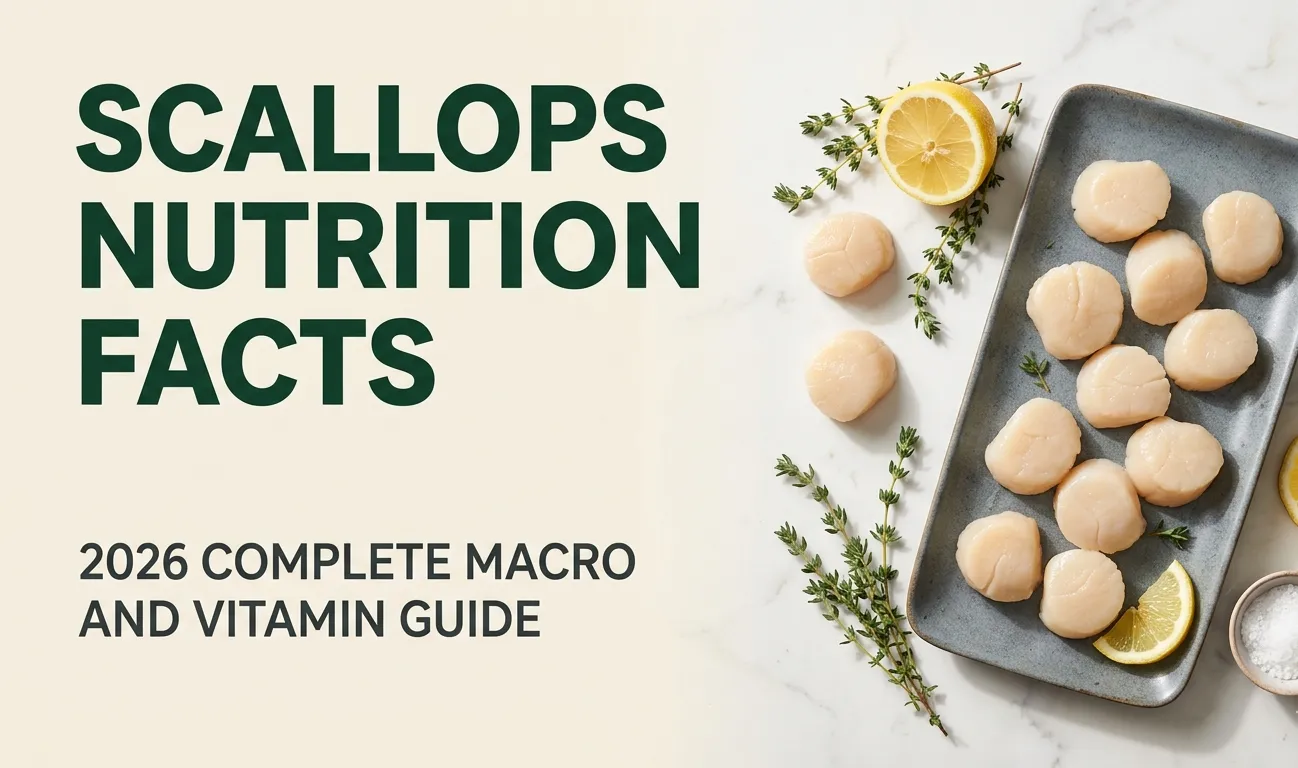
Scallops Nutrition Facts: 2026 Complete Macro and Vitamin Guide
Scallops are a lean, high-protein seafood that delivers 94 calories and 17.5 grams of complete protein per 3-ounce serving. A single serving of steamed scallops provides 75 percent of your daily vitamin B12 requirement and 39 percent of your daily selenium requirement while containing less than 1 gram of total fat. This nutritional profile places scallops among the most nutrient-dense animal proteins available.
The USDA FoodData Central database confirms that scallops belong to the bivalve mollusk family and share a nutritional pattern distinct from both finfish and crustaceans. Unlike salmon, which derives roughly half its calories from fat, scallops get approximately 75 percent of their calories from protein with minimal fat contribution. A 2024 update to the Dietary Guidelines for Americans 2020-2025 continues to recommend at least 8 ounces of seafood per week for adults, and scallops fit squarely into that recommendation.
This guide gives you the exact nutritional breakdown of scallops per standard serving, explains how sea scallops differ from bay scallops, shows you what happens to the numbers when you fry instead of sear, and tells you how to spot wet-packed scallops that can triple the sodium content. Every number comes directly from USDA FoodData Central and the NIH Office of Dietary Supplements fact sheets.
Scallops Nutrition Facts
A 3-ounce serving of steamed scallops contains 94 calories, 17.5 grams of protein, 0.7 grams of fat, 3.4 grams of carbohydrates, and zero grams of fiber, according to the USDA FoodData Central database. This serving size equals approximately 4 to 5 large sea scallops or 8 to 10 small bay scallops. The protein-to-calorie ratio is among the highest in the animal protein category.
Here is the complete macro and micronutrient breakdown for a standard 3-ounce (85-gram) serving of cooked, steamed scallops:
| Nutrient | Amount per 3 oz (85g) | % Daily Value |
|---|---|---|
| Calories | 94 kcal | 5% |
| Protein | 17.5 g | 35% |
| Total Fat | 0.7 g | 1% |
| Saturated Fat | 0.1 g | <1% |
| Cholesterol | 30 mg | 10% |
| Carbohydrates | 3.4 g | 1% |
| Fiber | 0 g | 0% |
| Sodium | 567 mg | 25% |
| Vitamin B12 | 1.8 mcg | 75% |
| Selenium | 21.7 mcg | 39% |
| Phosphorus | 284 mg | 23% |
| Zinc | 1.3 mg | 12% |
| Magnesium | 31.5 mg | 8% |
| Potassium | 314 mg | 7% |
| Iron | 0.5 mg | 3% |
| Calcium | 7.6 mg | <1% |
The standout numbers are protein, vitamin B12, and selenium. You get over a third of your daily protein needs and three-quarters of your B12 requirement in a single modest serving. The sodium number reflects USDA data for plain steamed scallops, but this figure changes dramatically depending on whether your scallops are wet-packed or dry-packed, which section 13 explains in detail.
Key Takeaway: A 3-ounce serving of scallops gives you 17.5 grams of complete protein and 75 percent of your daily B12 for under 100 calories. The protein density is the headline story.
Are Scallops Healthy?
Scallops are a healthy food choice for most people, supported by their high protein density, low fat content, and rich supply of vitamin B12 and selenium. The Dietary Guidelines for Americans 2020-2025 specifically recommends seafood as a protein source that delivers nutrients many Americans underconsume, including omega-3 fatty acids and vitamin B12. Scallops fit squarely into this recommendation as a lean, nutrient-dense option.
What makes scallops particularly health-promoting is not just what they contain but what they lack. They contain virtually no saturated fat. A 3-ounce serving has only 0.1 grams. They have zero trans fat. Their calorie count stays under 100 per serving while delivering more protein than a large egg. This combination of high nutrient return on a low calorie investment is what nutrition researchers call high nutrient density.
The cholesterol content of scallops, at 30 mg per serving, is modest compared to shrimp at 161 mg per comparable serving. Current dietary guidance from the American Heart Association focuses less on dietary cholesterol as a primary concern and more on overall dietary pattern quality, with an emphasis on replacing saturated fat sources with lean protein sources like seafood. Scallops perform well against this standard.
Quick Tip:
- Buy scallops from a reputable fishmonger and ask whether they are dry-packed. This one question can save you hundreds of milligrams of sodium per serving.
- Cook scallops simply. A hot pan with a small amount of oil preserves the nutritional profile. Heavy cream sauces and deep frying undo the lean protein advantage.
- Pair scallops with vegetables and whole grains to build a complete, nutrient-dense meal. Think seared scallops over sautéed spinach with quinoa.
Calories in Scallops
Steamed scallops contain 94 calories per 3-ounce serving, which breaks down to roughly 31 calories per ounce. A single large sea scallop (about 0.7 ounces or 20 grams) contains approximately 22 calories. This calorie count makes scallops one of the lowest-calorie animal proteins available.
The calorie distribution in scallops skews heavily toward protein. Approximately 75 percent of the calories in a plain steamed scallop come from protein. The remaining 25 percent comes from carbohydrates, with a negligible contribution from fat. This macronutrient ratio is unusual among animal proteins. Chicken breast, often cited as the gold standard for lean protein, gets about 80 percent of its calories from protein and 20 percent from fat. Scallops are even leaner.
The calorie count changes based on preparation method. Here is how different cooking methods affect the calorie content of a 3-ounce scallop serving:
| Preparation Method | Calories (3 oz) | Added Ingredients |
|---|---|---|
| Steamed (plain) | 94 | None |
| Seared (1 tsp oil) | 134 | Olive oil (40 cal) |
| Grilled (no oil) | 94 | None |
| Baked (lemon, herbs) | 100 | Trace from lemon |
| Fried (battered, deep-fried) | 190 to 230 | Flour, egg, oil |
| Scallops in butter sauce | 165 to 200 | Butter (70 to 100 cal) |
Frying scallops more than doubles the calorie count compared to steaming or grilling. A restaurant-style fried scallop entrée with six to eight scallops can easily reach 500 to 600 calories before sides, mostly from the breading and frying oil.
Scallops Protein per 100g
Scallops provide 20.5 grams of protein per 100 grams of cooked meat, according to the USDA FoodData Central database. This translates to 17.5 grams of protein per 3-ounce serving. The protein in scallops is complete, meaning it contains all nine essential amino acids in proportions the human body needs for muscle maintenance, immune function, and enzyme production.
Scallop protein is highly digestible. Animal-based proteins, including mollusk proteins, typically score near 1.0 on the Protein Digestibility-Corrected Amino Acid Score (PDCAAS), the standard measure of protein quality. This means your body absorbs and uses the amino acids from scallops efficiently. For comparison, plant proteins like beans and lentils typically score between 0.6 and 0.8, meaning you need to eat more total grams of plant protein to get the same usable amino acids.
The protein content per 100 grams places scallops in the same league as chicken breast and lean beef. Here is how scallops compare to other common protein sources by protein per 100 grams of cooked weight:
| Food (100g cooked) | Protein (g) | Calories |
|---|---|---|
| Chicken breast (skinless) | 31 g | 165 |
| Scallops (steamed) | 20.5 g | 110 |
| Shrimp (steamed) | 24 g | 99 |
| Salmon (Atlantic, cooked) | 25 g | 206 |
| Lean beef (90/10, cooked) | 26 g | 217 |
| Eggs (2 large) | 12.5 g | 155 |
| Firm tofu | 10 g | 144 |
Scallops deliver slightly less protein per 100 grams than chicken breast, but they also deliver fewer calories. The protein efficiency, meaning grams of protein per calorie, actually favors scallops. You get approximately 0.19 grams of protein per calorie from scallops compared to 0.19 grams from chicken breast, making them roughly equivalent on this metric.
Key Takeaway: Scallops pack 20.5 grams of complete, highly digestible protein per 100 grams. The protein quality matches land animal sources, and the protein-per-calorie efficiency beats fattier fish.
Scallops Cholesterol Content
A 3-ounce serving of steamed scallops contains 30 milligrams of cholesterol. This amount represents 10 percent of the daily value for cholesterol based on current FDA labeling guidance. Scallops are a low-cholesterol seafood option, particularly when compared to shrimp, which contains 161 milligrams per equivalent serving.
Dietary cholesterol’s role in blood cholesterol levels has been reassessed over the past decade. The Dietary Guidelines for Americans 2020-2025 removed the previous 300-milligram daily cholesterol limit, shifting focus to saturated fat as the primary dietary driver of blood cholesterol. The American Heart Association echoes this position, recommending reduced saturated fat intake rather than strict dietary cholesterol counting for most people. Scallops contain only 0.1 grams of saturated fat per serving, making them a heart-healthy protein choice by current standards.
Some individuals are hyper-responders to dietary cholesterol, meaning their blood cholesterol rises more noticeably when they consume cholesterol-rich foods. This trait varies genetically and affects a minority of the population. For hyper-responders, even modest cholesterol sources like scallops may warrant attention. A registered dietitian can help determine whether dietary cholesterol tracking is appropriate for your specific lipid profile and family history.
People with existing cardiovascular disease or familial hypercholesterolemia should follow the specific dietary guidance provided by their cardiologist or lipid specialist. For the general population, the cholesterol in scallops is not a concern at typical intake levels of one to three servings per week.
Scallops Sodium Content
Steamed scallops contain 567 milligrams of sodium per 3-ounce serving, which represents 25 percent of the daily value. This number comes from the USDA FoodData Central database entry for plain steamed scallops with no added salt. The natural sodium content of scallops reflects their marine origin because all seafood absorbs sodium from seawater.
The sodium figure you see on a nutrition label or in this article comes with a major caveat. The USDA measurement reflects scallops that have not been treated with sodium tripolyphosphate (STPP), a common processing additive that plumps scallops with water and significantly increases their sodium content. Wet-packed scallops, which dominate supermarket seafood counters, can contain 800 to 1,000 milligrams of sodium per serving or more. Dry-packed scallops, which are untreated, contain the natural sodium level of approximately 567 milligrams.
Here is the sodium breakdown across different scallop types:
| Scallop Type | Sodium per 3 oz (approx.) | % Daily Value |
|---|---|---|
| Dry-packed scallops (steamed) | 567 mg | 25% |
| Wet-packed scallops (STPP treated) | 800 to 1,000 mg | 35 to 43% |
| Restaurant seared (salted) | 700 to 900 mg | 30 to 39% |
| Canned scallops (packed in brine) | 1,200+ mg | 52%+ |
For context, the American Heart Association recommends a daily sodium limit of 2,300 milligrams for most adults, with an ideal limit of 1,500 milligrams for those with hypertension. A single serving of wet-packed scallops can consume over half of that ideal limit. If you follow a sodium-restricted diet, dry-packed scallops are the only sensible choice.
Key Takeaway: Wet-packed scallops can contain nearly double the sodium of dry-packed scallops. The scallop type you buy matters more for sodium intake than how you season them.
Scallops Vitamin B12
Scallops are an exceptional source of vitamin B12, delivering 1.8 micrograms per 3-ounce serving. This amount provides 75 percent of the adult Recommended Dietary Allowance of 2.4 micrograms per day, according to the NIH Office of Dietary Supplements. A single scallop entrée can nearly cover your entire daily B12 requirement.
Vitamin B12, also called cobalamin, is a water-soluble vitamin that plays a non-negotiable role in DNA synthesis, red blood cell formation, and the maintenance of the myelin sheath that insulates nerve cells. Without adequate B12, the body cannot produce healthy red blood cells. This leads to megaloblastic anemia, characterized by fatigue, weakness, and neurological symptoms including numbness and tingling in the extremities.
Scallops provide B12 in a highly bioavailable form. Animal-source B12 is bound to protein and requires stomach acid and intrinsic factor for absorption, but this system works efficiently in most healthy adults. People with pernicious anemia, atrophic gastritis, or those who have undergone gastric bypass surgery may absorb B12 poorly regardless of dietary intake. These individuals require B12 supplementation, typically in the form of cyanocobalamin or methylcobalamin injections or sublingual tablets, under medical supervision.
Vegans and strict vegetarians are the group most likely to benefit from knowing about scallops’ B12 content because plant foods do not naturally contain B12. While scallops are not a solution for someone following a vegan diet, they illustrate why seafood and animal products remain the most reliable dietary B12 sources. A 3-ounce serving of scallops provides more B12 than you would get from a standard fortified nutritional yeast serving, and in a form your body absorbs directly.
Scallops Selenium
Scallops deliver 21.7 micrograms of selenium per 3-ounce serving, which provides 39 percent of the adult Recommended Dietary Allowance of 55 micrograms per day. The NIH Office of Dietary Supplements identifies selenium as an essential trace mineral that functions primarily through its incorporation into selenoproteins, a family of proteins that includes powerful antioxidant enzymes.
Selenium’s primary role in human health centers on its function in glutathione peroxidases and thioredoxin reductases. These enzymes protect cells from oxidative damage by neutralizing reactive oxygen species. Selenium also supports thyroid hormone metabolism because the enzymes that convert the storage form of thyroid hormone (T4) into the active form (T3) are selenoproteins. Without adequate selenium, thyroid function can suffer even when iodine intake is sufficient.
The selenium content of scallops reflects the mineral content of the ocean water and seabed where they lived. Selenium levels in seafood vary by geographic origin, with colder, mineral-rich waters generally producing higher-selenium shellfish. The USDA FoodData Central figure of 21.7 mcg represents an average across sampled scallops. Individual scallops may vary by 20 to 30 percent in either direction based on harvest location.
Selenium from scallops is highly bioavailable. Food-sourced selenium, present as selenomethionine and selenocysteine in animal tissues, is absorbed at rates exceeding 80 percent. This compares favorably to inorganic selenium supplements, which have lower and more variable absorption. The Tolerable Upper Intake Level for selenium is 400 micrograms per day for adults. You would need to eat roughly 18 servings of scallops in a single day to approach that threshold, making selenium toxicity from scallops a non-issue.
Scallops Iron Content
Scallops contain 0.5 milligrams of iron per 3-ounce serving, which provides 3 percent of the daily value based on an 18-milligram reference standard. This iron content places scallops in the moderate range for seafood, below clams and oysters but comparable to cod and haddock.
The iron in scallops is heme iron, the form found in animal tissues that your body absorbs two to three times more efficiently than the non-heme iron found in plant foods. The absorption advantage matters because iron deficiency is the most common nutrient deficiency worldwide, affecting an estimated 30 percent of the global population according to the World Health Organization. For individuals with low iron stores or increased iron needs, the form of dietary iron is as important as the total amount consumed.
Scallops will not solve an iron deficiency on their own. A 3-ounce serving provides far less iron than the 18 milligrams per day recommended for menstruating adults or the 27 milligrams recommended during pregnancy. Clams deliver 23.8 milligrams of iron per 3-ounce serving, nearly 50 times more than scallops. If you are specifically seeking high-iron seafood, clams and oysters are better choices. Scallops contribute modestly to iron status as part of a varied diet.
People with hemochromatosis, a genetic condition that causes excessive iron absorption and storage, should be aware of the heme iron content in scallops. Heme iron from seafood is absorbed readily, and individuals with iron overload conditions may need to limit heme iron sources. A physician who specializes in iron metabolism disorders can provide individualized dietary guidance.
Key Takeaway: Scallops supply 0.5 mg of heme iron per serving. This contributes modestly to daily iron needs but does not replace high-iron seafood like clams if iron status is a concern.
Scallops Omega-3 Content
Scallops contain approximately 140 milligrams of combined EPA and DHA omega-3 fatty acids per 3-ounce serving. The USDA FoodData Central database records specific amounts of roughly 60 milligrams of EPA and 80 milligrams of DHA per 85-gram serving. This omega-3 content is meaningful but modest compared to fatty fish.
EPA (eicosapentaenoic acid) and DHA (docosahexaenoic acid) are long-chain omega-3 fatty acids with well-documented roles in cardiovascular health, brain function, and inflammation regulation. The American Heart Association recommends eating two servings of fish per week, with an emphasis on fatty fish that deliver at least 250 milligrams of combined EPA and DHA per day for cardiovascular benefit. Scallops fall short of that threshold on their own. A 3-ounce serving of salmon delivers roughly 1,500 to 2,000 milligrams of combined EPA and DHA, over ten times what scallops provide.
Scallops belong to the lean seafood category, which means their total fat content is low and their omega-3 content is proportionally modest. This does not make them a poor choice. It simply means you should not rely on scallops as your primary omega-3 source. They contribute to your weekly EPA and DHA intake without being the centerpiece of it.
Here is how scallops compare to other common seafood choices for omega-3 content:
| Seafood (3 oz cooked) | EPA (mg) | DHA (mg) | Total EPA+DHA (mg) |
|---|---|---|---|
| Atlantic salmon (farmed) | 690 | 1,460 | 2,150 |
| Albacore tuna (canned) | 233 | 629 | 862 |
| Shrimp | 114 | 96 | 210 |
| Scallops | 60 | 80 | 140 |
| Cod (Atlantic) | 4 | 131 | 135 |
| Clams | 117 | 124 | 241 |
Scallops sit in the same omega-3 range as cod and shrimp. They contribute to your total intake without being a standout source. Pair scallops with a fatty fish like salmon or sardines elsewhere in your week, and use scallops for their protein, B12, and selenium strengths.
Sea Scallops vs Bay Scallops Nutrition
Sea scallops and bay scallops are nutritionally similar, but their size difference changes how you count a serving. Sea scallops are larger, with a U-10 or U-20 size designation meaning 10 to 20 scallops per pound, while bay scallops are smaller at 50 to 90 per pound. The per-gram nutritional profile is nearly identical according to USDA FoodData Central data.
A single sea scallop weighs roughly 20 to 30 grams (0.7 to 1 ounce). A single bay scallop weighs roughly 5 to 8 grams. This means your portion of sea scallops might be 4 to 5 pieces for a 3-ounce serving, while the same serving of bay scallops would contain 10 to 15 pieces. The total nutrition per 3 ounces is effectively the same because both come from the same biological family.
The practical difference between sea and bay scallops is culinary, not nutritional. Sea scallops have a meatier texture and can be seared individually to develop a browned crust on each side while staying tender inside. Bay scallops are smaller and sweeter, often used in pasta dishes, chowders, or quick sautés where individual searing is impractical. The Academy of Nutrition and Dietetics notes that both types count equally toward the recommended 8 to 12 ounces of weekly seafood intake.
One distinction worth noting is that bay scallops are almost always wet-packed because their small size makes them more perishable and processors treat them with STPP to extend shelf life. Sea scallops are available in both wet and dry forms, with dry sea scallops being the premium choice at fish markets and better grocery stores. If sodium is a concern, dry sea scallops are the most reliable option.
Scallops vs Shrimp Nutrition
Scallops and shrimp are both lean, high-protein shellfish, but their nutritional profiles differ in two key areas: cholesterol and iron. Shrimp contains 161 milligrams of cholesterol per 3-ounce serving compared to scallops at 30 milligrams. Scallops contain 0.5 milligrams of iron compared to shrimp at 2.6 milligrams. The protein content is similar at 17.5 grams for scallops versus 20 grams for shrimp.
Here is a direct nutritional comparison of a 3-ounce steamed serving:
| Nutrient (3 oz steamed) | Scallops | Shrimp |
|---|---|---|
| Calories | 94 | 99 |
| Protein | 17.5 g | 20 g |
| Total Fat | 0.7 g | 0.3 g |
| Cholesterol | 30 mg | 161 mg |
| Sodium | 567 mg | 111 mg |
| Vitamin B12 | 1.8 mcg (75% DV) | 1.3 mcg (54% DV) |
| Selenium | 21.7 mcg (39% DV) | 33.7 mcg (61% DV) |
| Iron | 0.5 mg (3% DV) | 2.6 mg (14% DV) |
| Omega-3 (EPA+DHA) | 140 mg | 210 mg |
Shrimp wins on iron and selenium. Scallops win on cholesterol content and vitamin B12. Both are excellent protein sources. The choice between them depends on your specific nutritional priorities. Someone with elevated LDL cholesterol might lean toward scallops for the lower cholesterol content. Someone with low iron stores might lean toward shrimp.
A varied seafood rotation captures the strengths of both. The Dietary Guidelines for Americans 2020-2025 encourages variety within the seafood category because different species offer different nutrient profiles. Eating scallops one week and shrimp the next gives you the best of both.
Key Takeaway: Scallops have far less cholesterol than shrimp (30 mg vs. 161 mg per serving) but also less iron. Rotate between the two for balanced shellfish nutrition.
Wet vs Dry Scallops
Wet scallops are treated with sodium tripolyphosphate (STPP), a preservative that causes the scallop muscle to absorb water and sodium. Dry scallops are untreated and contain only their natural moisture and sodium. The nutritional difference between the two is substantial. Wet scallops can contain 200 to 400 milligrams more sodium per serving and deliver less actual scallop meat by weight because water has been added.
STPP treatment is widespread in the commercial scallop industry because it extends shelf life and makes scallops appear plumper and whiter. The water added during treatment also adds weight, which means you pay for water when buying wet scallops by the pound. When you cook wet scallops, they release that added water into the pan and shrink noticeably. Searing becomes difficult because the excess moisture prevents browning.
Here is a practical comparison of what wet versus dry scallops mean for your plate and your nutrition:
| Characteristic | Dry Scallops | Wet Scallops |
|---|---|---|
| Sodium per 3 oz | 567 mg | 800 to 1,000 mg |
| Actual scallop meat per lb | 16 oz | 12 to 14 oz (rest is added water) |
| Searing ability | Excellent browning | Releases water, steams instead of sears |
| Appearance (raw) | Slightly sticky, tan to beige | Slick, uniformly white, sitting in liquid |
| Shelf life | 2 to 3 days refrigerated | 5 to 7 days refrigerated |
| Price per edible ounce | Higher, but paying for meat | Lower, but paying partially for water |
To identify dry scallops, look for scallops that appear slightly sticky or tacky to the touch rather than sitting in a pool of milky liquid. Ask the fishmonger directly: “Are these dry-packed?” If the answer is anything other than a clear yes, assume they are wet-packed. Specialty seafood markets and high-end grocery stores are more likely to carry dry scallops than large supermarket chains.
For anyone on a sodium-restricted diet, wet scallops can consume a large portion of the daily sodium budget before any seasoning is added. A registered dietitian can help you incorporate scallops into a low-sodium eating plan by identifying dry-packed sources and teaching preparation methods that add flavor without salt.
Grilled Scallops Nutrition
Grilled scallops retain the nutritional profile of steamed scallops with virtually no change to the macronutrient or micronutrient content. A 3-ounce serving of grilled scallops contains the same 94 calories, 17.5 grams of protein, and 0.7 grams of fat as steamed scallops, assuming no oil or marinade is added before grilling.
What changes with grilling is the surface of the scallop. Dry heat from a grill creates browning through the Maillard reaction, which develops flavor without adding calories, fat, or sodium. The slight char that forms on properly grilled scallops does not meaningfully alter the nutritional content. The heat is high and the cooking time is short, typically 2 to 3 minutes per side, which minimizes nutrient loss.
If you brush scallops with oil before grilling to prevent sticking, the calorie and fat content increases by the amount of oil absorbed. One teaspoon of olive oil adds 40 calories and 4.5 grams of fat, mostly monounsaturated. A light oil brushing is nutritionally negligible across a full serving of four to five scallops. The same goes for dry seasoning blends. Paprika, black pepper, garlic powder, and herbs add flavor without sodium or calories.
Marinades are where grilled scallop nutrition can shift meaningfully. A typical soy sauce and brown sugar marinade adds sodium, sugar, and calories. A quarter-cup of teriyaki-style marinade can add 300 to 400 milligrams of sodium and 15 to 20 grams of sugar to a batch of scallops, with a portion of that carrying over to the finished dish. For maximum nutritional control, grill scallops with a simple olive oil brush, fresh lemon juice after cooking, and a sprinkle of herbs.
Fried Scallops vs Baked Scallops Nutrition
Fried scallops contain 190 to 230 calories per 3-ounce serving, compared to approximately 100 calories for baked scallops. The calorie difference comes entirely from the breading and oil absorbed during frying. A batter-dipped and deep-fried scallop serving also adds 10 to 15 grams of fat and 300 to 500 milligrams of sodium beyond what a baked scallop contains.
The frying process changes scallops from a lean protein to a moderate-fat, higher-calorie food. A standard breading of flour, egg, and breadcrumbs adds roughly 50 to 70 calories per serving in carbohydrates and absorbs an additional 40 to 80 calories worth of frying oil. The protein content stays the same because frying does not remove protein from the scallop, but the protein percentage of total calories drops from approximately 75 percent to roughly 30 to 40 percent because the added fat and carbohydrate calories dilute the protein density.
Baked scallops prepared with a light topping of seasoned breadcrumbs and a small amount of butter or olive oil fall between plain steamed scallops and fully fried scallops on the nutritional spectrum. A typical baked scallop dish might deliver 130 to 150 calories per serving with 3 to 6 grams of added fat. Here is a side-by-side comparison:
| Preparation (3 oz scallops) | Calories | Fat | Carbs | Sodium |
|---|---|---|---|---|
| Steamed (plain) | 94 | 0.7 g | 3.4 g | 567 mg |
| Baked (light breadcrumb topping) | 130 to 150 | 3 to 6 g | 10 to 15 g | 650 to 750 mg |
| Pan-seared (1 tsp oil) | 134 | 5.2 g | 3.4 g | 567 mg |
| Fried (battered, deep-fried) | 190 to 230 | 10 to 15 g | 15 to 22 g | 800 to 1,000 mg |
Baking and pan-searing preserve most of scallops’ nutritional strengths while adding modest fat for flavor and texture. Frying fundamentally changes the nutritional category. A fried scallop dinner with tartar sauce, fries, and coleslaw can easily exceed 800 calories and 40 grams of fat, turning a lean seafood into a high-calorie meal.
Key Takeaway: Frying scallops more than doubles the calorie count compared to baking or searing. The scallop inside stays the same, but the coating and oil change the nutritional math entirely.
Are Scallops High in Mercury?
Scallops are a low-mercury seafood choice. The FDA classifies scallops in the “Best Choices” category for mercury content, with an average mercury concentration of 0.003 parts per million (ppm). This is among the lowest mercury levels measured in commercial seafood, comparable to salmon, shrimp, and tilapia.
Mercury accumulates in the marine food chain through a process called biomagnification. Large, long-lived predatory fish like shark, swordfish, and king mackerel accumulate the most mercury because they eat smaller fish and live long enough for mercury to concentrate in their tissues. Scallops, as filter-feeding bivalves that sit near the bottom of the food chain, accumulate very little mercury. Their diet consists of phytoplankton and organic particles filtered from the water, not other fish.
The FDA’s mercury monitoring program categorizes seafood into three tiers for consumption guidance, particularly for pregnant individuals, nursing parents, and young children. Scallops fall into the safest tier. Here is how scallops compare to other seafood on mercury risk:
| Mercury Category (FDA) | Seafood Examples | Servings per Week (Adults) |
|---|---|---|
| Best Choices (lowest mercury) | Scallops, salmon, shrimp, cod, tilapia | 2 to 3 servings |
| Good Choices (moderate mercury) | Halibut, grouper, snapper, albacore tuna | 1 serving |
| Choices to Avoid (highest mercury) | Shark, swordfish, king mackerel, tilefish | Avoid |
The FDA and EPA joint advice recommends that pregnant and breastfeeding individuals eat 2 to 3 servings per week of seafood from the Best Choices category. Scallops fit squarely within that recommendation. The nutritional benefits of the protein, B12, selenium, and omega-3s in scallops outweigh the negligible mercury risk for these populations.
One important safety note for pregnancy: scallops must be cooked to an internal temperature of 145 degrees Fahrenheit (63 degrees Celsius) to eliminate the risk of foodborne illness. Raw or undercooked scallops, including ceviche and some sushi preparations, carry a risk of bacterial and viral contamination that is separate from mercury concerns. Pregnant individuals should eat only fully cooked scallops.
Frequently Asked Questions About Scallops Nutrition
How many calories are in 3 scallops?
Three large sea scallops (approximately 2 ounces or 57 grams) contain roughly 63 calories when steamed or grilled without added fat.
This serving provides about 12 grams of protein and less than 0.5 grams of fat.
The calorie count increases if the scallops are cooked in oil, butter, or breading.
Are scallops good for weight loss?
Scallops are an excellent food for weight loss because they deliver 17.5 grams of filling protein for only 94 calories per serving.
High-protein foods increase satiety and help preserve lean muscle mass during calorie restriction.
Choose steamed, grilled, or lightly seared scallops over fried or butter-drenched preparations to keep the calorie count low.
Do scallops have more protein than chicken?
Chicken breast contains more protein per 100 grams than scallops (31 grams vs. 20.5 grams), but the protein-per-calorie ratio is nearly identical.
Scallops and chicken breast both deliver roughly 0.19 grams of protein per calorie.
Both are excellent lean protein sources, and variety between them provides different micronutrient profiles.
Can I eat scallops if I have high cholesterol?
Most people with high cholesterol can eat scallops because they contain only 30 mg of cholesterol and 0.1 grams of saturated fat per serving.
Current dietary guidance from the American Heart Association emphasizes reducing saturated fat rather than strictly limiting dietary cholesterol for blood cholesterol management.
Follow the specific dietary advice provided by your physician or a registered dietitian who knows your full lipid panel and health history.
How can I tell if scallops are wet-packed or dry?
Dry scallops look slightly sticky or tacky to the touch and range in color from pale tan to light beige, with no liquid pooling around them.
Wet scallops sit in a milky white liquid, appear uniformly bright white, and feel slick rather than tacky.
Ask your fishmonger directly if the scallops are dry-packed because visual inspection alone is not always reliable.
Are scallops safe to eat during pregnancy?
Scallops are safe to eat during pregnancy when cooked to an internal temperature of 145 degrees Fahrenheit and consumed as part of the 2 to 3 weekly seafood servings recommended by the FDA.
Their low mercury content makes them one of the safest seafood choices during pregnancy.
Raw or undercooked scallops, including ceviche and some sushi, should be avoided during pregnancy due to the risk of bacterial and viral foodborne illness.
Scallops earn their place as one of the most nutrient-dense animal proteins you can put on a plate. A single 3-ounce serving gives you more than three-quarters of your daily vitamin B12, nearly 40 percent of your selenium, and 17.5 grams of complete, highly digestible protein, all for under 100 calories. The one detail that changes the nutrition math more than anything else is whether your scallops are dry-packed or wet. That single variable can swing the sodium content by 200 to 400 milligrams per serving.
If you are new to cooking scallops, start with dry sea scallops from a fishmonger you trust. Pat them completely dry with paper towels, season lightly, and sear them in a hot pan with a small amount of oil for 2 to 3 minutes per side. Serve them with a squeeze of lemon and a side of sautéed greens or a whole grain like quinoa. You will get the full nutritional benefit without the sodium, fat, and calorie load that restaurant preparations and frozen breaded scallops pile on.
Seafood variety matters across your week and across your month. Rotate scallops with salmon for omega-3s, shrimp for iron, and cod for lean versatility. Your body gets a broader spectrum of nutrients, your meals stay interesting, and you hit the 8 to 12 ounces of weekly seafood the Dietary Guidelines recommend without eating the same thing every time.