Are Carrots High in Vitamin K? The 2026 Guide to Vegetable K Content
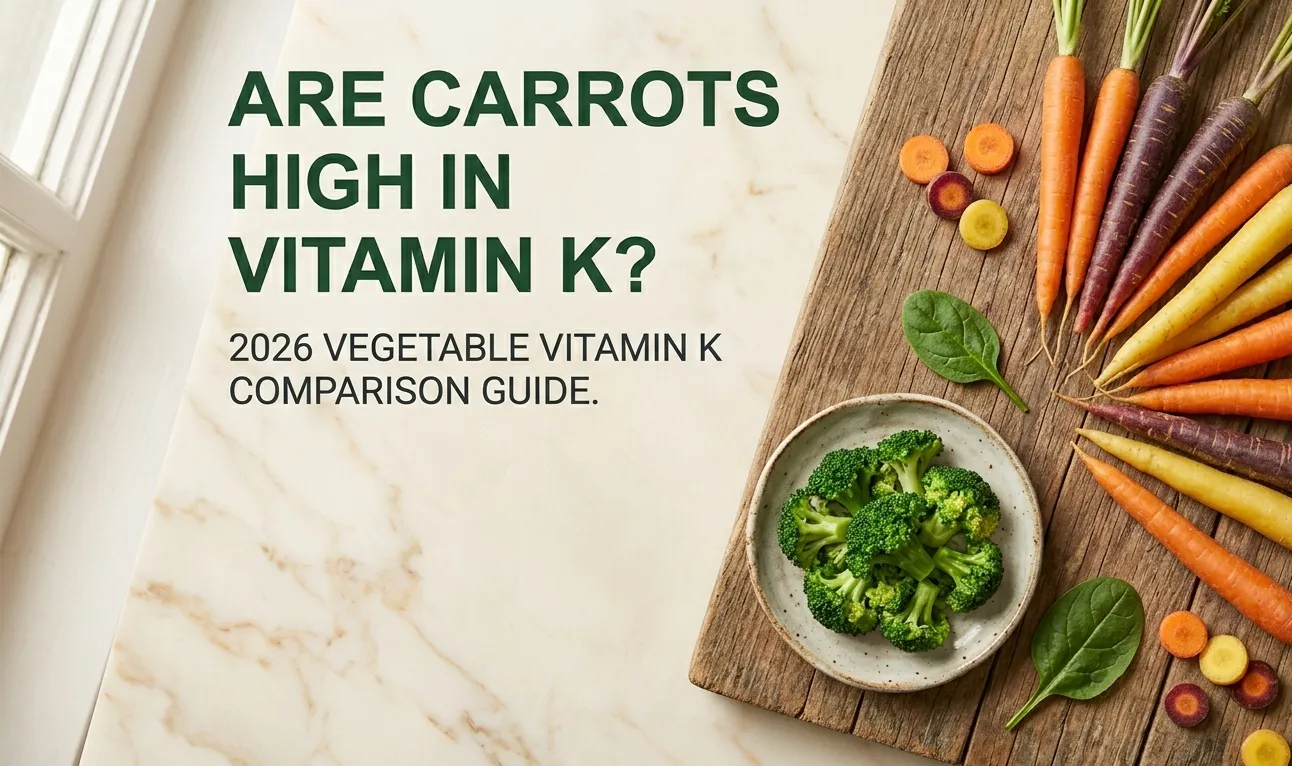
Carrots are not high in vitamin K. A medium raw carrot contains approximately 8.1 micrograms (mcg) of vitamin K, which provides only about 7 percent of the daily Adequate Intake for adult men and 9 percent for adult women. This places carrots firmly in the low vitamin K category among vegetables.
Vitamin K matters because it controls blood clotting and directs calcium into bones instead of arteries. The NIH Office of Dietary Supplements identifies vitamin K as essential for synthesizing proteins involved in coagulation and bone mineralization. A single cup of cooked kale delivers over 1,000 mcg of vitamin K, while a whole cup of raw carrots delivers just 13.2 mcg. That 75-fold difference is exactly what makes the distinction between high-K and low-K vegetables so critical for people monitoring their intake.
This article gives you exact vitamin K numbers for carrots and 14 other common vegetables, ranked from highest to lowest. You will learn what the daily vitamin K requirement actually means, how cooking changes vitamin K content, and which vegetables belong on your plate depending on whether you want to increase or keep your vitamin K intake consistent. Every number comes directly from the USDA FoodData Central database and uses standard serving sizes you will actually eat, not laboratory portions.
Are Carrots High in Vitamin K?
Carrots rank among the lowest common vegetables for vitamin K content per serving, with approximately 13.2 mcg per 100 grams raw. This amount represents about 11 percent of the adult male Adequate Intake and roughly 15 percent of the adult female Adequate Intake. Carrots belong in the same low-K category as potatoes, onions, and cucumbers, not the medium or high categories where broccoli and leafy greens sit.
The vitamin K found in carrots is exclusively vitamin K1, also called phylloquinone. This is the plant-based form of vitamin K that your body uses directly for blood clotting protein synthesis in the liver. Unlike animal products and fermented foods that contain vitamin K2 (menaquinones), carrots contain zero K2. For most people, this distinction does not matter because the body can convert some K1 into K2, but the efficiency of that conversion varies widely between individuals.
The color of carrots tells you nothing about their vitamin K content. Orange carrots get their hue from beta-carotene, not from compounds related to vitamin K. Unlike leafy greens where deep green chlorophyll correlates with higher phylloquinone levels, the pigment profile of root vegetables follows entirely different biochemical rules. A purple carrot, a yellow carrot, and an orange carrot will have roughly equivalent vitamin K content because phylloquinone synthesis in the carrot root is independent of carotenoid production.
Key Takeaway: Carrots are a low vitamin K vegetable with only 13.2 mcg per 100g. They are safe for consistent intake on warfarin and will not meaningfully contribute to meeting daily vitamin K needs.
Vitamin K Foods Ranked by Content
The vegetables you choose can deliver anywhere from under 5 mcg to over 1,000 mcg of vitamin K per serving, and the difference depends almost entirely on one factor: how green and leafy the vegetable is. The USDA FoodData Central database confirms that phylloquinone concentration tracks closely with chlorophyll content because plants use the same biochemical pathway to synthesize both compounds. Dark green leaves pack the most vitamin K. Pale roots and bulbs pack the least.
Here is how common vegetables rank by vitamin K content per standard serving:
| Vegetable | Serving Size | Vitamin K (mcg) | % DV (Men) | % DV (Women) |
|---|---|---|---|---|
| Cooked kale | 1 cup, chopped (130g) | 1,062 | 885% | 1,180% |
| Cooked spinach | 1 cup (180g) | 889 | 741% | 988% |
| Cooked Brussels sprouts | 1 cup (155g) | 219 | 182% | 243% |
| Cooked broccoli | 1 cup, chopped (156g) | 220 | 183% | 244% |
| Cooked asparagus | 1 cup (180g) | 144 | 120% | 160% |
| Raw okra | 1 cup (100g) | 31.3 | 26% | 35% |
| Cooked green beans | 1 cup (125g) | 20 | 17% | 22% |
| Cooked peas | 1 cup (160g) | 41.6 | 35% | 46% |
| Raw iceberg lettuce | 1 cup, shredded (72g) | 17.4 | 15% | 19% |
| Raw celery | 1 cup, chopped (101g) | 29.6 | 25% | 33% |
| Raw carrots | 1 cup, chopped (128g) | 16.9 | 14% | 19% |
| Cooked beets | 1 cup (170g) | 0.3 | <1% | <1% |
| Raw onions | 1 cup, chopped (160g) | 0.6 | <1% | <1% |
| Cooked pumpkin | 1 cup, mashed (245g) | 2.0 | 2% | 2% |
| Cooked potato (flesh only) | 1 medium (156g) | 3.1 | 3% | 3% |
The pattern is clear. Green vegetables dominate the top of the list. Root vegetables and bulbs sit at the bottom. The only exception in this lineup is okra, which is green but surprisingly moderate in vitamin K because its edible part is the seed pod rather than a leaf.
Key Takeaway: If you want to increase vitamin K intake, eat dark leafy greens. If you need to limit or maintain consistent vitamin K intake, root vegetables like carrots, potatoes, and beets are your safest choices.
Daily Vitamin K Requirement
The Adequate Intake for vitamin K is 120 mcg per day for adult men and 90 mcg per day for adult women, according to the National Academy of Medicine. These figures represent the amount believed to support normal blood clotting function in healthy adults. Unlike many nutrients that have a Recommended Dietary Allowance based on extensive dose-response research, vitamin K still operates under an Adequate Intake designation because the precise requirement has been harder to pin down.
Your body stores relatively little vitamin K compared to other fat-soluble vitamins. The liver holds a modest reserve that can last several days, but vitamin K turns over quickly. This explains why consistent daily intake matters more than occasional large doses. Someone who eats a spinach salad once a week but eats vitamin K-poor meals the other six days may still have adequate clotting function, but the pattern of intake oscillates more than the body would ideally prefer.
Certain groups need to pay closer attention to their vitamin K intake than the general population. These groups have either increased requirements or medical reasons to track intake closely:
- People taking warfarin (Coumadin): Warfarin works by blocking vitamin K recycling in the liver, so the amount of warfarin needed to maintain a therapeutic INR depends directly on consistent vitamin K intake. Sudden increases in dietary vitamin K can reduce warfarin effectiveness.
- People with fat malabsorption conditions: Conditions like celiac disease, cystic fibrosis, and chronic pancreatitis reduce the body’s ability to absorb vitamin K because it requires dietary fat and bile salts for absorption.
- Newborns: Infants are born with low vitamin K stores and receive a vitamin K injection at birth to prevent vitamin K deficiency bleeding, a potentially life-threatening condition.
- People on long-term antibiotics: Broad-spectrum antibiotics can kill vitamin K-producing bacteria in the gut, potentially reducing endogenous vitamin K2 production.
No Tolerable Upper Intake Level exists for vitamin K from food or supplements. The NIH Office of Dietary Supplements states that adverse effects from high intakes are not documented, which makes vitamin K one of the safest fat-soluble vitamins from a toxicity standpoint.
Key Takeaway: Most adults need between 90 and 120 mcg of vitamin K daily. One cup of cooked broccoli alone exceeds that requirement, while you would need to eat approximately 7 to 9 medium raw carrots to reach the daily AI through carrots alone.
Does Broccoli Have Vitamin K?
Broccoli is one of the highest vitamin K vegetables in the common food supply, with approximately 220 mcg of phylloquinone per one-cup serving of cooked chopped broccoli. That single serving provides 183 percent of the daily Adequate Intake for adult men and 244 percent for adult women. Broccoli belongs in the very-high category, right alongside kale, spinach, and Brussels sprouts.
The vitamin K in broccoli is concentrated in the florets and the leaves attached to the stalk. The pale inner stalk contains far less. If you tend to eat only the florets and discard the stalk, you are getting most of the vitamin K anyway. The USDA FoodData Central database confirms that 100 grams of raw broccoli contains approximately 102 mcg of vitamin K, and cooking concentrates that slightly per serving because water loss reduces volume without destroying the phylloquinone.
Broccoli’s vitamin K content matters for two completely different reasons depending on who you are. For the general healthy population, broccoli’s high vitamin K is a nutritional asset that supports bone mineralization through osteocalcin activation and may help prevent arterial calcification through matrix Gla protein activation. For the approximately 2 to 3 million Americans taking warfarin, broccoli’s high vitamin K content means it must be eaten with careful consistency. The key word is consistency, not avoidance. A person on warfarin who eats a half-cup of broccoli three times a week should keep that pattern steady rather than suddenly eating it daily or cutting it out entirely.
Quick Tip:
- If you want to maximize vitamin K absorption from broccoli, cook it with a small amount of oil or serve it with a fat-containing food like salmon or olive oil dressing. Vitamin K is fat-soluble and absorption increases in the presence of dietary fat.
- If you take warfarin and enjoy broccoli, inform your prescribing physician that it is a regular part of your diet so your dose accounts for it.
- Frozen broccoli has approximately the same vitamin K content as fresh. The blanching and freezing process does not degrade phylloquinone meaningfully.
Key Takeaway: One cup of cooked broccoli delivers over 100 percent of your daily vitamin K requirement. It is a nutritional powerhouse for bone and cardiovascular health but requires consistent intake patterns for anyone on warfarin.
Do Green Beans Have Vitamin K?
Green beans contain vitamin K, but they are not a high-K vegetable. One cup of cooked green beans provides approximately 20 mcg of phylloquinone, which is about 17 percent of the daily Adequate Intake for adult men and 22 percent for adult women. Green beans sit in the low-to-moderate range, making them a flexible vegetable for people who want some vitamin K without committing to the large doses found in leafy greens.
The reason green beans have far less vitamin K than broccoli or kale comes down to plant anatomy. Green beans are seed pods, not leaves. While the pod itself contains chlorophyll and therefore some phylloquinone, the concentration per gram is dramatically lower than it is in the photosynthetic machinery of a kale or spinach leaf. Think of green beans as a vegetable that happens to be green rather than a green vegetable in the nutritional sense.
Preparation method matters less for green beans than it does for some other vegetables. Because their starting vitamin K content is already modest, the small losses from boiling or steaming do not shift them from one category to another. Fresh, frozen, and canned green beans all have comparable vitamin K profiles, though canned green beans packed with added salt introduce sodium concerns unrelated to vitamin K. A 2021 analysis in the Journal of Food Science found that boiling green beans for 10 minutes reduced their phylloquinone content by approximately 15 percent, a negligible loss for practical purposes.
Quick Tip:
- Green beans are a practical choice for warfarin users because their low vitamin K content means normal portion variations will not disrupt INR stability the way broccoli or spinach fluctuations might.
- For people trying to increase vitamin K intake, do not rely on green beans as a primary source. They contribute modestly but will not meet your needs alone.
Are Peas High in Vitamin K?
Peas are not high in vitamin K, but they contain a moderate amount. One cup of cooked green peas delivers approximately 41.6 mcg of phylloquinone, providing 35 percent of the daily Adequate Intake for adult men and 46 percent for adult women. This places peas in the moderate category, above green beans and carrots but well below the leafy greens and cruciferous vegetables at the top of the ranking.
Green peas, like green beans, are seeds rather than leaves, which explains their middling vitamin K position. The USDA FoodData Central records that 100 grams of raw green peas contain about 26 mcg of vitamin K. Cooking concentrates that number per cup because peas lose water volume, but the absolute amount of vitamin K per individual pea remains stable. Peas are more notable nutritionally for their protein and fiber content than for their vitamin K contribution.
There is a meaningful difference between fresh or frozen green peas and split peas or dried peas used in soups. Split peas are mature seeds that have been dried and split, and their vitamin K content is lower on a per-calorie basis because the nutrient profile shifts toward starch and protein as the seed matures. If you are monitoring vitamin K for medical reasons, fresh and frozen peas are the forms to track. Split pea soup will contribute far less vitamin K per bowl than a side of fresh peas.
The population most likely to care about pea vitamin K content is parents introducing solid foods to infants and people on warfarin managing consistent intake. Peas are a common early food for babies, and their moderate vitamin K content contributes helpfully to an infant’s needs after the newborn period. For warfarin users, peas are low enough in vitamin K that they do not typically require careful portion tracking the way spinach or kale does.
Is Asparagus High in Vitamin K?
Asparagus is high in vitamin K. One cup of cooked asparagus spears provides approximately 144 mcg of phylloquinone, which equals 120 percent of the daily Adequate Intake for adult men and 160 percent for adult women. This places asparagus firmly in the high-K category, comparable to Brussels sprouts and broccoli though not as extreme as kale or spinach.
What makes asparagus interesting from a vitamin K perspective is the concentration gradient along the spear. The tightly closed tip contains more chlorophyll than the fibrous lower portion of the stalk, which means more phylloquinone. The USDA FoodData Central treats the entire spear as a uniform food, but in reality the top two inches of asparagus deliver more vitamin K per bite than the bottom two inches. If you habitually snap off and discard the woody lower portion, you are naturally selecting for the higher-K part of the vegetable.
Asparagus also contains a small amount of vitamin K2 in the form of menaquinone-7, though the quantity is minor compared to its K1 content. This is unusual for a plant food and reflects the fact that asparagus spears host a modest microbial community at the soil interface. Fermented vegetables remain the primary plant-based K2 sources, with natto (fermented soybeans) leading the list.
For anyone taking warfarin, asparagus is a vegetable to eat with awareness. A single generous serving can deliver more than an entire day’s vitamin K requirement, which means sudden changes in asparagus consumption (for example, eating it daily during its spring growing season then stopping completely) can measurably affect INR. The solution is not avoidance. It is consistent, predictable intake that allows the warfarin dose to be calibrated accordingly. A registered dietitian at an anticoagulation clinic can help you work asparagus into a consistent weekly pattern.
Are Brussels Sprouts High in Vitamin K?
Brussels sprouts are one of the highest vitamin K vegetables available. One cup of cooked Brussels sprouts delivers approximately 219 mcg of phylloquinone, providing 183 percent of the daily Adequate Intake for adult men and 243 percent for adult women. This amount is comparable to broccoli and significantly higher than asparagus, peas, or green beans.
Brussels sprouts belong to the cruciferous vegetable family alongside broccoli, kale, cabbage, and cauliflower. What unites this family nutritionally is their high concentration of glucosinolates and their consistently elevated vitamin K levels. The NIH Office of Dietary Supplements specifically lists Brussels sprouts among the top food sources of phylloquinone, alongside other dark leafy greens. The compact leaf structure of Brussels sprouts means each sprout packs multiple layers of chlorophyll-rich leaf tissue into a small volume, effectively concentrating the vitamin K.
The preparation method you choose affects how many sprouts you actually eat, which indirectly affects your vitamin K intake. Roasted Brussels sprouts tend to shrink and caramelize, making it easy to eat more sprouts per sitting than you would if they were boiled or steamed. A person who casually eats 15 roasted sprouts at dinner is consuming far more vitamin K than someone who eats 6 boiled sprouts as a side. This is not a nutritional warning. It is a portion awareness point for anyone tracking intake.
For the general population, the high vitamin K content of Brussels sprouts is a genuine health advantage. Multiple observational studies, including a 2020 analysis published in the American Journal of Clinical Nutrition, have found associations between higher dietary phylloquinone intake and lower risk of hip fracture in older adults. The mechanism appears to involve vitamin K-dependent carboxylation of osteocalcin, a protein that binds calcium to the bone matrix. Brussels sprouts deliver that benefit in a dense, available form.
How Much Vitamin K in Lettuce?
Lettuce contains vitamin K, but the amount varies dramatically by type. Iceberg lettuce sits near the bottom of the lettuce vitamin K spectrum at approximately 17.4 mcg per cup of shredded leaves, while romaine lettuce climbs to roughly 48 mcg per cup, and leaf lettuce or butterhead can reach 60 to 100 mcg per cup depending on the specific variety and the greenness of the outer leaves. The rule is consistent: the darker the lettuce leaf, the more phylloquinone it contains.
The USDA FoodData Central database breaks lettuce down by variety, and the numbers reveal why iceberg has earned its reputation as nutritionally sparse. A full cup of shredded iceberg lettuce weighs about 72 grams and contains only 17.4 mcg of vitamin K. That is roughly 14 percent of the adult male AI. Romaine, at the same serving size, delivers closer to 48 mcg because its darker leaves contain more chlorophyll and therefore more phylloquinone. Butterhead lettuce, with its soft dark green outer leaves, delivers the most among common salad lettuces.
People on warfarin are often told to avoid salads, but that advice oversimplifies the lettuce landscape. A salad made with two cups of iceberg lettuce base contributes roughly 35 mcg of vitamin K, a manageable and consistent amount. The same salad made with two cups of romaine contributes roughly 96 mcg, which is enough to matter if the romaine consumption pattern is inconsistent. The practical guidance is: choose your lettuce base and stick with it. Do not bounce between iceberg and romaine day to day if you take warfarin without adjusting for the difference.
For the general population seeking to meet vitamin K needs through food, lettuce is a contributor but not a solution by itself. You would need to eat over 5 cups of romaine lettuce daily to reach the Adequate Intake through lettuce alone. Lettuce works best as part of a varied vegetable intake that includes one or two genuinely high-K vegetables like broccoli or Brussels sprouts each week.
How Much Vitamin K Is in Celery?
Celery contains approximately 29.6 mcg of vitamin K per one-cup serving of chopped raw celery, according to USDA FoodData Central data. This places celery in the low-to-moderate range, providing about 25 percent of the daily Adequate Intake for adult men and 33 percent for adult women. Celery is not a high-K vegetable by any standard, but its content is high enough to be worth noting for anyone tracking intake closely.
Celery’s vitamin K is concentrated more in the leaves than in the stalks. The pale green inner stalks contain the least. The dark green outer stalks contain more. The leaves, which many people discard, contain the most phylloquinone per gram. If you buy celery with the leaves attached and use them in soups, stocks, or salads, you are getting more vitamin K than someone who trims them away. This pattern holds across celery’s entire nutritional profile because the leaves are where the plant’s active photosynthesis happens.
For warfarin users, celery is generally considered a safe vegetable that does not require careful portion tracking. The amount of vitamin K in a typical celery snack (two medium stalks, about 40 grams) is roughly 12 mcg, which is low enough that normal day-to-day variation will not measurably affect INR. However, celery juice is a different story. Juicing concentrates the vegetable. An 8-ounce glass of celery juice requires roughly an entire bunch of celery and could deliver 50 to 70 mcg of vitamin K depending on the juicing method and whether leaves are included. Someone who adds a daily celery juice habit without adjusting their warfarin should inform their prescribing physician.
A practical note on celery storage: phylloquinone is relatively stable in refrigerated celery. Unlike vitamin C, which degrades noticeably in cut vegetables over days, vitamin K holds up well under refrigeration for a week or more. This stability makes celery’s vitamin K contribution predictable meal to meal.
Do Beets Have Vitamin K?
Beets contain almost no vitamin K. One cup of cooked beet slices provides approximately 0.3 mcg of phylloquinone, which is less than 1 percent of the daily Adequate Intake. Beets sit at the very bottom of the vegetable vitamin K ranking, alongside onions and pumpkin, making them one of the safest choices for anyone needing to strictly limit vitamin K intake.
The near-total absence of vitamin K in beets reflects their botanical nature. Beets are root vegetables, and like most roots, their energy and nutrient storage strategy prioritizes carbohydrates and minerals over the fat-soluble vitamins that concentrate in leaves and photosynthetic tissue. Beet greens are a completely different story. While the root contains trace vitamin K, the greens are extremely high in phylloquinone, with a single cup of cooked beet greens delivering well over 600 mcg. A person who buys beets with the greens attached and eats both parts is consuming two vegetables at opposite ends of the vitamin K spectrum.
This beet root versus beet green distinction creates a practical consideration for warfarin users. Beet roots, including pickled beets and canned beets, are essentially K-free and safe for unrestricted consumption. Beet greens should be treated like kale or spinach: nutrient-dense and valuable for the general population, but high enough in vitamin K to require consistency planning for anyone on anticoagulation therapy. A registered dietitian can help map out how often beet greens can appear in a consistent warfarin diet.
For the general population, beets offer other nutrients worth prioritizing, including folate, manganese, and dietary nitrates that support blood flow, but they should not be counted toward daily vitamin K goals. If you are building a diet around meeting the 90 to 120 mcg AI, look elsewhere.
Do Onions Have Vitamin K?
Onions contain a negligible amount of vitamin K. One cup of chopped raw onions provides approximately 0.6 mcg of phylloquinone, which is less than 1 percent of the daily Adequate Intake for adults. Onions, like beets and potatoes, belong to the vitamin K trace category where the amount per serving is so small that it effectively rounds to zero for dietary tracking purposes.
All onion varieties share this low vitamin K profile. Yellow onions, white onions, red onions, sweet onions, and shallots all contain under 1 mcg of vitamin K per standard serving. Cooking does not concentrate vitamin K in onions because there is essentially none to concentrate. What cooking does do is change the serving size dynamics because cooked onions reduce dramatically in volume. A half-cup of caramelized onions still contains negligible vitamin K because the starting material had negligible vitamin K, but the calorie and sugar concentration per forkful increases because the water has been cooked out.
The USDA FoodData Central confirms this pattern across all onion types and preparations. Raw, cooked, sautéed, and dehydrated onions all share the same nutritional reality regarding vitamin K: it is essentially absent. This makes onions a universally safe vegetable for anyone on warfarin and a blank canvas for adding flavor without affecting vitamin K tracking. Green onions (scallions) are a partial exception. Their green tops contain more chlorophyll than the white bulb portion and therefore carry a small amount of vitamin K, roughly 10 to 20 mcg per quarter-cup of chopped green tops. This is still low by vegetable standards but not negligible like bulb onions.
Does Pumpkin Have Vitamin K?
Pumpkin contains very little vitamin K. One cup of cooked mashed pumpkin provides approximately 2.0 mcg of phylloquinone, which equals about 2 percent of the daily Adequate Intake for adults. Pumpkin sits in the same near-zero vitamin K category as beets, onions, and potatoes.
This low vitamin K content applies to the flesh of all winter squash varieties, not just pumpkin. Butternut squash, acorn squash, kabocha, and delicata all contain under 5 mcg of vitamin K per cup. The orange flesh signals beta-carotene content, not phylloquinone. Vitamin K follows chlorophyll, not carotenoids, so orange and yellow vegetables consistently rank low on the vitamin K scale regardless of how nutrient-dense they are in other respects. Sweet potatoes follow this same pattern: rich in vitamin A precursors, essentially devoid of vitamin K.
Pumpkin seeds are a different form of the plant and contain a modest amount of vitamin K, approximately 20 mcg per cup of whole roasted seeds. The seed’s nutrient profile is built around fat, protein, and minerals, with phylloquinone present but not dominant. A handful of pumpkin seeds as a snack contributes a few micrograms of vitamin K, but not enough to meaningfully shift daily intake. Pumpkin seed oil contains even less because phylloquinone is not efficiently extracted into the oil during pressing.
Canned pumpkin puree, the kind used for pumpkin pie and baking, follows the same nutritional pattern as fresh cooked pumpkin. The canning process does not introduce vitamin K. One cup of canned pumpkin puree (not pumpkin pie filling, which contains added sugar and spices) provides approximately the same 2.0 mcg as home-cooked fresh pumpkin. For anyone tracking vitamin K for medical reasons, canned pumpkin is a predictable, low-K ingredient.
Does Okra Have Vitamin K?
Okra contains a moderate amount of vitamin K. One cup of raw okra pods provides approximately 31.3 mcg of phylloquinone, which equals about 26 percent of the daily Adequate Intake for adult men and 35 percent for adult women. This places okra in the moderate category, higher than green beans but lower than asparagus or broccoli.
What makes okra interesting from a vitamin K perspective is that it is a green vegetable that is not a leaf. Okra pods are seed capsules, and like green beans and peas, their vitamin K content reflects their role as reproductive structures rather than photosynthetic organs. The green color comes from chlorophyll in the pod wall, but the pod is structurally different from a leaf and contains less of the photosynthetic machinery where phylloquinone concentrates.
Cooking method matters for okra in ways that go beyond vitamin K. Okra contains a mucilaginous compound that thickens stews and gumbos, and different cooking techniques affect that texture more than they affect the vitamin content. Boiling, steaming, or sautéing okra leaves its vitamin K content relatively stable, with losses under 20 percent according to most food science literature. Frying okra, a common preparation in Southern cooking, introduces oil that may actually increase the absorption of the fat-soluble vitamin K that remains, though the overall nutritional tradeoff with fried food involves considerations beyond vitamin K.
For warfarin users, okra is low enough in vitamin K that a typical serving (a half-cup of cooked okra) does not usually require dosage adjustment, but it is high enough to count as part of the consistent vegetable intake pattern. Someone who eats okra weekly as part of a regular rotation should not worry. Someone who suddenly adds daily okra to a previously okra-free diet should mention the change to their prescribing physician.
Are Potatoes High in Vitamin K?
Potatoes are not high in vitamin K. A medium baked potato with skin provides approximately 3.1 mcg of phylloquinone, which is about 3 percent of the daily Adequate Intake for adult men and 3 percent for adult women. Potatoes belong in the trace vitamin K category, and no common preparation method changes that classification meaningfully.
The vitamin K content of potatoes is concentrated in the skin, not the flesh. The USDA FoodData Central records that potato flesh alone (baked, skin removed) contains under 1 mcg of vitamin K per medium potato. The skin adds a small amount, but even with the skin, the total remains under 5 mcg. This skin-versus-flesh distribution mirrors how potatoes handle most of their micronutrients: the skin contains more fiber, more potassium, and marginally more vitamins than the white flesh, but the absolute amounts are modest because the potato’s primary nutritional contribution is carbohydrate energy.
Sweet potatoes follow a similar pattern with slightly higher numbers. A medium baked sweet potato with skin provides approximately 5 to 7 mcg of vitamin K, still firmly in the low category. The orange color of sweet potatoes signals beta-carotene content, not vitamin K, and like carrots and pumpkin, the pigment and the phylloquinone are unrelated. White potatoes and sweet potatoes are both safe, low-K vegetables for anyone monitoring vitamin K intake.
French fries and potato chips, made from potatoes and cooked in oil, do not gain meaningful vitamin K from the frying process because vegetable oils contain only trace amounts of phylloquinone. The nutritional concerns with fried potato products center on fat, sodium, and calorie density, not on vitamin K. A medium order of fast-food french fries contains roughly the same negligible vitamin K as the potato it came from.
Does Cooking Destroy Vitamin K?
Cooking does not destroy vitamin K in any practically meaningful way. Phylloquinone is relatively heat-stable compared to water-soluble vitamins like vitamin C and the B vitamins. Boiling vegetables may leach some vitamin K into the cooking water because phylloquinone is slightly water-dispersible, but the compound itself does not break down at normal cooking temperatures. The NIH Office of Dietary Supplements notes that heating does not affect vitamin K content substantially.
Different cooking methods produce different results, not because they destroy vitamin K, but because they affect how the vegetable holds onto its water content and structure. A comparison of cooking methods for leafy greens helps illustrate this:
| Cooking Method | Effect on Vitamin K Content | Practical Impact |
|---|---|---|
| Steaming | Retains over 90% of phylloquinone | No meaningful loss; water loss concentrates K per gram |
| Boiling (water discarded) | 10-20% loss into cooking water | Modest; lost K is in the water, not destroyed |
| Sautéing or stir-frying | Near-total retention | Fat in pan increases absorption of remaining K |
| Roasting | Near-total retention | Volume reduction concentrates K per serving |
| Microwaving | Retains over 95% | Minimal water contact, rapid heating preserves K |
The more important cooking effect is not on the vitamin K molecule itself but on the serving size you end up eating. Cooked spinach collapses dramatically. One cup of cooked spinach started as roughly 6 to 8 cups of raw spinach. A person who would never eat 8 cups of raw spinach in one sitting can easily eat 1 cup of cooked spinach as a side dish and consume over 800 mcg of vitamin K in the process. Cooking makes it possible to consume far more vitamin K in a single meal than you ever would from raw vegetables.
For warfarin users, this cooking concentration effect is the detail that matters. A small raw spinach salad and a serving of sautéed spinach are not equivalent in their vitamin K delivery, even though they use the same starting vegetable. The raw salad might deliver 150 mcg. The cooked side dish might deliver 800 mcg. That is the difference between a meal that fits a consistent pattern and one that unexpectedly doubles the day’s vitamin K intake. A registered dietitian can help you account for preparation method when planning consistent vitamin K intake.
Key Takeaway: Vitamin K survives cooking. What changes is how much vegetable you can eat in one sitting after the water cooks out. Cooked greens deliver substantially more vitamin K per forkful than raw greens for this reason alone.
Frequently Asked Questions About Vitamin K in Vegetables
How much vitamin K is in one raw carrot?
One medium raw carrot (about 61 grams) contains approximately 8.1 micrograms of vitamin K.
This is about 7 percent of the daily Adequate Intake for adult men and 9 percent for adult women.
Carrots rank among the lowest common vegetables for vitamin K content per individual piece.
Can I eat carrots while taking warfarin?
Yes, carrots are safe to eat while taking warfarin because their vitamin K content is very low at only 8.1 mcg per medium carrot.
Warfarin users should maintain consistent carrot intake rather than avoiding them, as normal portion variations will not meaningfully affect INR.
Sudden large changes in carrot consumption are not a concern the way sudden changes in spinach or kale consumption would be.
What vegetable has the most vitamin K?
Cooked kale has the most vitamin K among common vegetables, with one cup providing approximately 1,062 mcg of phylloquinone.
This single serving delivers 885 percent of the daily Adequate Intake for adult men.
Cooked spinach ranks second at 889 mcg per cup, followed by cooked Brussels sprouts at 219 mcg per cup.
Are cooked carrots higher or lower in vitamin K than raw?
Cooked carrots have approximately the same vitamin K content as raw carrots because phylloquinone is heat-stable.
Cooking may concentrate the vitamin K slightly per gram as water cooks out, but the absolute amount of vitamin K in the carrots does not increase.
A half-cup of cooked carrot slices and a medium raw carrot deliver comparable amounts of vitamin K.
How many carrots equal one day’s vitamin K requirement?
You would need to eat approximately 9 medium raw carrots to meet the daily Adequate Intake of 90 mcg for adult women and roughly 15 carrots to meet the 120 mcg for adult men.
This illustrates why carrots are not a meaningful source of vitamin K for meeting daily needs.
Leafy greens, broccoli, and Brussels sprouts are far more efficient ways to reach the Adequate Intake.
What foods should I avoid if I need to limit vitamin K?
If you need to limit vitamin K for medical reasons, focus on limiting dark leafy greens like kale, spinach, collards, and turnip greens, which deliver 500 to over 1,000 mcg per cup.
Cooked broccoli, Brussels sprouts, and asparagus are moderate-to-high and should be eaten with consistency rather than avoided entirely.
Root vegetables including carrots, potatoes, beets, and onions are naturally very low in vitamin K and require no restriction in normal serving sizes.
Vitamin K content in vegetables follows a simple rule that most people can remember after reading this guide once: the darker green and leafier the vegetable, the more vitamin K it contains. Carrots sit at the opposite end of that spectrum with roughly 8 mcg per piece. This predictable pattern makes it straightforward to either increase your intake for bone and cardiovascular health or keep it consistent for medication management.
If you came here because you take warfarin and wanted to know whether carrots are safe, the answer is an unambiguous yes. Carrots, potatoes, onions, beets, and pumpkin all belong on your regular rotation without special tracking. The vegetables that need consistency planning are broccoli, asparagus, Brussels sprouts, and all leafy greens. Work with your prescribing physician or a registered dietitian to find a weekly pattern that includes the vegetables you enjoy at amounts that keep your INR stable.
If you came here because you want to optimize your vitamin K intake for long-term health, now you know where to start. One cup of cooked broccoli or a generous handful of sautéed kale covers your daily requirement and then some. Carrots are not the tool for this job, but they bring their own nutritional strengths to the table with beta-carotene, fiber, and potassium. Eat them for what they offer, and look to the greens for your vitamin K.