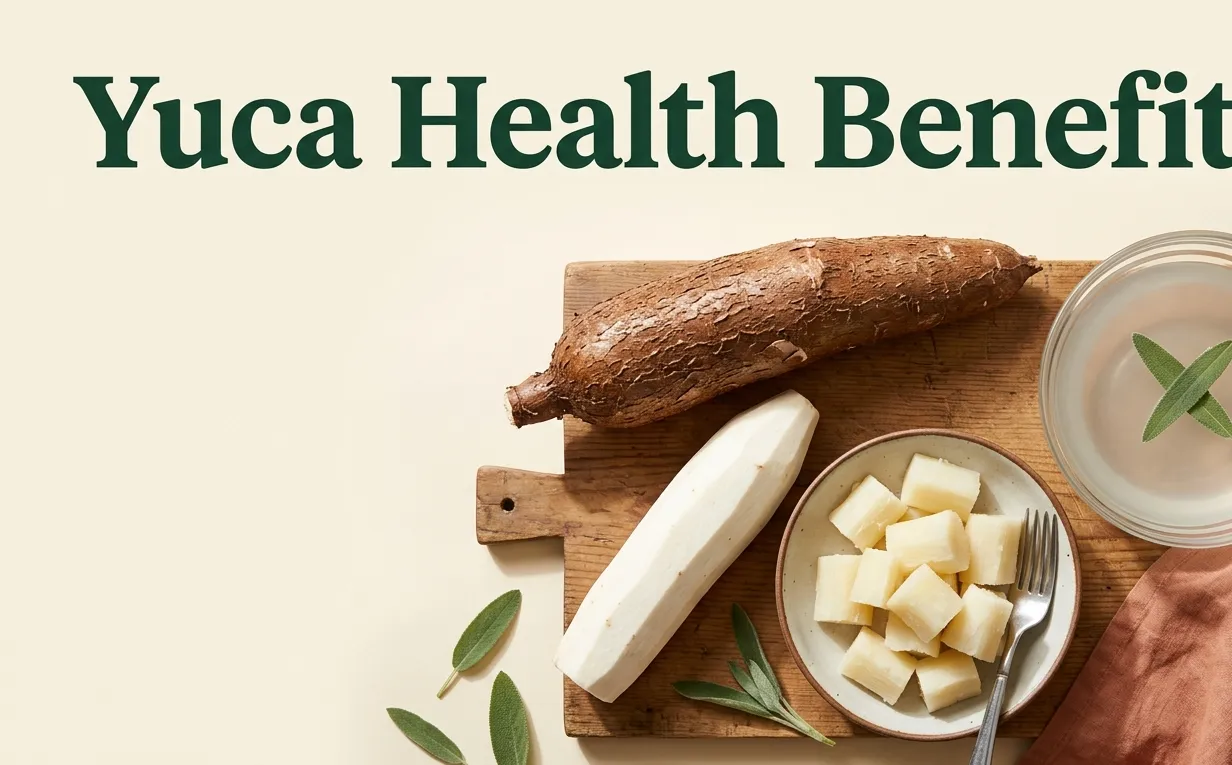
Yuca Health Benefits 2026: Nutrition, Safety, and Preparation
Yuca health benefits center on a starchy root vegetable that delivers dense carbohydrate energy, a meaningful amount of vitamin C, and a gluten-free flour alternative for the estimated 1 percent of the population with celiac disease, all with the non-negotiable requirement of proper cooking to remove naturally occurring cyanogenic glycosides that are toxic if consumed raw or inadequately processed. Yuca is not a superfood to be eaten without caution. It is a global staple crop feeding over 800 million people that happens to contain compounds requiring specific preparation knowledge before it is safe to eat.
The USDA FoodData Central database records that a 1-cup serving of cooked cassava provides 330 calories, 78 grams of carbohydrate, 3.7 grams of fiber, and 29 milligrams of vitamin C, which covers 32 percent of the daily requirement for adults. The same serving delivers 558 milligrams of potassium, more than a medium banana, and contains zero gluten, making it a viable carbohydrate base for people who cannot tolerate wheat, barley, or rye. The World Health Organization recognizes cassava as a food security crop while simultaneously issuing guidance on cyanogenic glycoside reduction because both realities coexist in this single root.
This article walks you through yuca’s genuine nutritional contributions, explains the cyanide safety issue with the specific compound names and mechanisms that matter, compares yuca head-to-head with potatoes and sweet potatoes, and gives you the exact cooking instructions that make this root safe to eat. You will finish knowing when yuca belongs on your plate and, more importantly, when it does not.
Yuca Health Benefits
Yuca health benefits are primarily energetic and nutrient-supportive rather than pharmacologically active, providing dense complex carbohydrate calories, vitamin C for immune and skin health, potassium for blood pressure regulation, and a gluten-free, grain-free carbohydrate option for people with celiac disease or gluten sensitivity. Unlike medicinal herbs that contain concentrated bioactive compounds with specific physiological effects, yuca is a staple food whose health contribution is nutritional rather than therapeutic.
The vitamin C content of cooked cassava is the single most notable micronutrient contribution. A 1-cup serving provides 29 milligrams, roughly one-third of the adult daily requirement. The NIH Office of Dietary Supplements identifies vitamin C as essential for collagen synthesis, the structural protein that maintains skin, blood vessel, and joint integrity, and as a water-soluble antioxidant that regenerates vitamin E and protects cellular components from oxidative damage. Cassava is one of the few starchy staples that contributes meaningfully to vitamin C intake, unlike rice, wheat, or corn which contain negligible amounts.
The carbohydrate in yuca is almost entirely starch, with a small fraction existing as resistant starch that increases when the cooked root cools. This carbohydrate composition makes yuca a sustained energy source, delivering calories over hours rather than the rapid blood glucose spike and crash associated with simple sugars. The fiber content, 3.7 grams per cup, supports bowel regularity and contributes to the satiety of a yuca-based meal, though it is lower than the fiber content of sweet potatoes or legumes.
| Nutrient (per 1 cup cooked cassava) | Amount | % Daily Value |
|---|---|---|
| Calories | 330 kcal | 17% |
| Carbohydrates | 78 g | 28% |
| Fiber | 3.7 g | 13% |
| Protein | 2.8 g | 6% |
| Vitamin C | 29 mg | 32% |
| Potassium | 558 mg | 12% |
| Folate | 48 mcg DFE | 12% |
| Magnesium | 43 mg | 10% |
| Manganese | 0.4 mg | 17% |
Key Takeaway: Yuca’s primary health contributions are its vitamin C content, unusual for a starchy staple, its potassium for blood pressure regulation, and its gluten-free carbohydrate base that provides sustained energy.
Health Benefits of Yuca
Health benefits of yuca extend beyond basic nutrition to include digestive health support through resistant starch formation, energy provision for high-demand metabolic states, and dietary inclusion for people with specific food restrictions including celiac disease, wheat allergy, and grain-free dietary patterns. These benefits are not unique to yuca, potatoes and sweet potatoes share several of them, but the combination of gluten-free status, vitamin C content, and cultural culinary versatility gives yuca a distinct role in a diverse dietary pattern.
The energy density of yuca makes it particularly relevant in populations where food security and caloric adequacy are the primary nutritional concerns. The FAO identifies cassava as the third most important source of calories in the tropics, after rice and maize, and its ability to grow in poor soils with minimal inputs makes it a food security crop that supports the energy needs of hundreds of millions of people. For an athlete or a person with high energy demands, yuca provides readily digestible carbohydrate that replenishes muscle glycogen after exercise without the gastrointestinal distress that some people experience with wheat-based carbohydrate sources.
The practical benefit that matters most for health-conscious consumers in high-income countries is yuca’s role as a whole-food carbohydrate alternative to refined flour products. Yuca fries, boiled yuca, and yuca flour tortillas provide the carbohydrate base of a meal while contributing fiber, vitamin C, and potassium that refined wheat flour does not. This is not a pharmacological effect. It is a dietary pattern improvement where a whole root vegetable replaces a refined grain product, and the nutritional upgrade comes from what yuca contains that white flour lacks.
Yucca Root Health Benefits
Yucca root health benefits are frequently confused with yuca health benefits in search results, and this distinction matters because yucca, the desert plant from the genus Yucca, is a completely different species from yuca or cassava, which is Manihot esculenta. The plant yucca produces saponins and steroidal compounds that are studied for potential anti-inflammatory and joint health effects, while the root vegetable yuca is a starchy carbohydrate staple with the nutritional profile described throughout this article. These are two different plants with two different chemical compositions and two different safety profiles.
Search confusion between yuca and yucca is pervasive. The spelling “yucca” with two c’s correctly refers to the desert plant whose extracts appear in some dietary supplements marketed for joint health and inflammation. The spelling “yuca” with one c correctly refers to the cassava root that you buy in the produce section, peel, boil, and eat as a starchy vegetable. Most of the top-ranking search results for “yucca root health benefits” actually describe cassava, not yucca, perpetuating a spelling error that misleads readers about which plant they are learning about.
The practical takeaway for anyone searching for health information is to check which plant the article is describing. If the article mentions cyanide, cassava, tapioca, or Manihot esculenta, it is about yuca. If it mentions saponins, steroidal saponins, desert plant, or Yucca schidigera, it is about yucca. This article addresses yuca, the edible root vegetable, and the information in this section corrects the common spelling conflation without digressing into the separate topic of yucca supplements.
Health Benefits of Yucca Root
Health benefits of yucca root is the search phrase that most commonly conflates the two plants, and addressing it directly with the clarification established in the previous section redirects readers to accurate information about the food they are actually looking for. The root vegetable discussed here is yuca, also called cassava or manioc, and it is not related to the yucca plant of the Agavaceae family.
The nutritional benefits of yuca root that a searcher using this phrase is likely looking for include the gluten-free carbohydrate provision, the vitamin C content, the potassium contribution to blood pressure regulation, and the resistant starch support for colonic health. These are real, documentable nutritional attributes of properly prepared cassava root. They are not pharmacological benefits of yucca saponins.
The Academy of Nutrition and Dietetics recognizes cassava as part of a diverse dietary pattern, particularly for populations that rely on starchy roots and tubers as carbohydrate staples. The organization’s guidance for gluten-free diets includes cassava flour and tapioca, which is purified cassava starch, as safe alternatives to wheat flour for people with celiac disease. This clinical dietary guidance is the most practically useful health benefit framework for yuca: it is a safe, nutritious carbohydrate for a population that has limited options for gluten-free whole-food starches.
Key Takeaway: The search term “yucca root health benefits” almost always refers to yuca (cassava), and the primary health benefits are gluten-free carbohydrate provision, vitamin C, potassium, and resistant starch support for digestive health.
Yuca Nutrition Facts
Yuca nutrition facts describe a high-calorie, high-carbohydrate root vegetable with modest protein, low fat, and a micronutrient profile dominated by vitamin C, potassium, and folate. The USDA FoodData Central database provides the reference values for a 1-cup serving of cooked cassava at approximately 206 grams, which delivers 330 calories, 78 grams of carbohydrate, 3.7 grams of fiber, 2.8 grams of protein, and 0.6 grams of fat.
The carbohydrate fraction is predominantly starch, with amylose and amylopectin in a ratio that determines the texture of the cooked root. Cassava starch gelatinizes at a lower temperature than potato starch, which is why yuca softens more quickly during cooking and can become gummy if overcooked. The fiber content, 3.7 grams per cup, is primarily insoluble fiber that adds bulk to stool and supports bowel regularity. The protein content is minimal and incomplete, lacking adequate methionine and tryptophan, which is why populations relying on cassava as a dietary staple must pair it with legumes, animal protein, or other amino acid sources to prevent protein-energy malnutrition.
The micronutrient profile is respectable for a root vegetable but not exceptional compared to more colorful roots like sweet potatoes or carrots. Vitamin C at 29 milligrams per cup covers roughly one-third of the daily requirement. Potassium at 558 milligrams is comparable to a medium banana. Folate at 48 micrograms of dietary folate equivalents provides 12 percent of the daily requirement and is relevant for cell division and neural tube development during pregnancy. Magnesium and manganese appear at 10 and 17 percent of daily values respectively. Yuca is not a nutrient powerhouse. It is a carbohydrate staple with a few meaningful micronutrient contributions that distinguish it from more refined carbohydrate sources.
Yuca Vitamin C
Yuca vitamin C content is the single most nutritionally distinctive feature of this root vegetable, with a 1-cup cooked serving providing 29 milligrams of ascorbic acid, covering 32 percent of the adult daily requirement. Most starchy staples, including rice, wheat, corn, and white potatoes, contain negligible vitamin C. Cassava’s vitamin C contribution is genuine and places it in a small category of starchy foods that help meet vitamin C needs without relying on fruits and vegetables.
Vitamin C functions in the body as a cofactor for prolyl hydroxylase and lysyl hydroxylase, enzymes that add hydroxyl groups to proline and lysine residues during collagen synthesis. Without vitamin C, collagen becomes structurally weak, producing the skin fragility, poor wound healing, and blood vessel fragility that characterized scurvy in historical populations deprived of fresh produce. The NIH Office of Dietary Supplements sets the RDA at 90 milligrams for adult men and 75 milligrams for adult women, with an additional 35 milligrams recommended for people who smoke due to increased oxidative stress.
The vitamin C in cassava is susceptible to degradation during cooking. Boiling cassava in large volumes of water leaches some vitamin C into the cooking liquid, which is typically discarded. Steaming preserves more vitamin C than boiling. Frying, the preparation method for yuca fries, exposes the vitamin C to high heat that degrades a portion of the content, though the interior of a thick fry retains more than the surface suggests. The 29-milligram figure from the USDA database represents the cooked, drained value after boiling, meaning the retained vitamin C after standard home preparation is still nutritionally meaningful.
Yuca Potassium
Yuca potassium provides 558 milligrams per 1-cup cooked serving, which covers 12 percent of the 4,700-milligram Adequate Intake for adults and exceeds the potassium content of a medium banana at roughly 422 milligrams. Potassium is the primary intracellular cation and functions in every cell of the body to maintain membrane potential, transmit nerve impulses, and trigger muscle contraction. The sodium-potassium ATPase pump in cell membranes continuously moves sodium out of cells and potassium in, a process that consumes roughly 20 to 30 percent of resting energy expenditure and is fundamental to human physiology.
The Dietary Guidelines for Americans 2020-2025 identify potassium as a nutrient of public health concern because inadequate intake is widespread in the United States population and is associated with elevated blood pressure and increased cardiovascular disease risk. The potassium-to-sodium ratio of the diet appears to be more predictive of blood pressure outcomes than either mineral alone, and foods like cassava that provide potassium with minimal sodium, 22 milligrams per cup, improve that ratio with every serving.
The potassium in cassava is heat-stable and remains in the root during boiling because potassium is not volatile and does not degrade at cooking temperatures. Some potassium leaches into cooking water, but the amount retained in boiled cassava is still substantial. For a person with hypertension or a family history of cardiovascular disease who is looking for dietary potassium sources beyond bananas and potatoes, yuca is a viable contributor that adds variety to a potassium-rich dietary pattern.
Key Takeaway: A cup of cooked yuca delivers more potassium than a medium banana and contributes to the potassium-sodium balance that the Dietary Guidelines identify as a public health priority for blood pressure management.
Yuca Resistant Starch
Yuca resistant starch is a fraction of the total starch that resists digestion in the small intestine and passes into the large intestine where gut bacteria ferment it into short-chain fatty acids, primarily butyrate, acetate, and propionate. These short-chain fatty acids serve as the primary energy source for colonocytes, the cells lining the colon, and butyrate in particular has been studied for its role in maintaining intestinal barrier integrity and reducing colonic inflammation. The resistant starch in cassava increases when the cooked root is cooled, a phenomenon called retrogradation that also occurs in potatoes, rice, and oats.
The resistant starch content of freshly cooked hot cassava is relatively low, estimated at 1 to 2 grams per cup. When the cooked cassava is cooled in the refrigerator for several hours, the starch retrogrades into crystalline structures that resist enzymatic digestion, and the resistant starch fraction can increase to 3 to 5 grams per cup. Reheating the cooled cassava does not fully reverse this process. A portion of the resistant starch survives reheating, meaning a batch-cooked, refrigerated, and reheated yuca retains some of the resistant starch benefit.
Resistant starch functions as a prebiotic, selectively feeding beneficial bacterial species including Bifidobacterium and Faecalibacterium prausnitzii. The short-chain fatty acids produced during fermentation lower colonic pH, which inhibits the growth of pathogenic bacteria and increases the absorption of minerals including calcium and magnesium. A 2019 study published in the Journal of Nutrition found that resistant starch supplementation increased fecal butyrate concentrations and improved insulin sensitivity in adults with metabolic syndrome, though the effect was modest and variable between individuals.
Yuca Gluten-Free
Yuca gluten-free status is a categorical certainty that makes cassava and cassava flour safe for the estimated 1 percent of the population with celiac disease and the additional 6 percent estimated to have non-celiac gluten sensitivity. Cassava contains zero gluten proteins. It is not a grain. It does not contain wheat, rye, barley, or any of their protein fractions. The Celiac Disease Foundation lists cassava flour as a safe gluten-free alternative to wheat flour for baking and cooking.
The practical value of gluten-free yuca flour extends beyond celiac disease. Many people without diagnosed gluten sensitivity choose to reduce gluten intake for perceived digestive or inflammatory benefits, and cassava flour provides a neutral-tasting, fine-textured flour that behaves more like wheat flour in baking than almond flour, coconut flour, or rice flour. Cassava flour tortillas, pancakes, and flatbreads have a texture and flexibility that other gluten-free flours struggle to replicate because cassava starch gelatinizes into a cohesive, pliable matrix when heated with water.
Cross-contamination is the practical concern for anyone with celiac disease purchasing cassava flour. Cassava itself is gluten-free, but if it is processed in a facility that also handles wheat, cross-contact can introduce gluten above the 20 parts per million threshold that the FDA considers safe for celiac disease. Certified gluten-free cassava flour is tested to verify gluten levels below this threshold. Whole fresh yuca root purchased from the produce section carries no meaningful cross-contact risk and is naturally gluten-free in its intact form.
Yuca Digestive Health
Yuca digestive health benefits come from the combination of dietary fiber, resistant starch, and the neutral, non-irritating nature of cooked cassava starch for people with sensitive digestive systems. The 3.7 grams of fiber per cup, predominantly insoluble, adds bulk to stool and reduces transit time through the colon, which is the mechanism by which fiber helps prevent constipation. The resistant starch fraction, increased by cooling cooked yuca, provides the prebiotic fermentation substrate described in the resistant starch section.
Cassava starch is generally well-tolerated by people with digestive conditions that react poorly to other carbohydrate sources. It contains no FODMAPs, the fermentable oligosaccharides, disaccharides, monosaccharides, and polyols that trigger symptoms in people with irritable bowel syndrome. Tapioca, which is purified cassava starch, is a staple in low-FODMAP diets for this reason. Whole yuca root, with its fiber and resistant starch, is a whole-food version of the same low-FODMAP carbohydrate principle.
The digestive tolerance of yuca is not universal. Some people report bloating or gas after eating large portions of cassava, likely due to the fermentation of resistant starch and fiber in the colon. This is a normal physiological response to increased fiber intake, not an intolerance specific to yuca. Starting with smaller portions, a half-cup of cooked cassava rather than a full cup, allows the gut microbiome to adapt to the increased fermentation substrate without producing excessive gas.
Yuca for Energy
Yuca for energy is the most fundamental reason this root has been a staple crop for millennia, providing 330 calories and 78 grams of complex carbohydrate per cup in a form that digests steadily and replenishes muscle and liver glycogen stores. The carbohydrate in cassava is almost entirely starch, which digestive amylases break down into glucose at a rate determined by the starch granule structure, the presence of fiber, and whether the starch has undergone retrogradation through cooling.
The energy density of yuca makes it appropriate for high-calorie-demand situations including athletic training, physical labor, pregnancy, lactation, and childhood growth. A person with high energy expenditure who needs to consume 3,000 to 4,000 calories per day can use cassava as a carbohydrate base that provides energy without the refined sugars, saturated fats, or sodium that accompany many calorie-dense processed foods. Yuca with a protein source and vegetables is a whole-food meal that supports high energy output without compromising nutritional quality.
The glycemic index of cooked cassava is moderate, generally estimated in the range of 55 to 65, though the value varies by variety, cooking method, and whether the cassava is eaten hot or cooled. Cooling cassava after cooking and eating it as part of a mixed meal with protein, fat, and additional vegetables lowers the overall glycemic response compared to eating hot, freshly boiled cassava alone. The practical energy benefit is sustained fuel delivery rather than the rapid blood glucose peak and crash that characterizes high-glycemic-index carbohydrates.
Key Takeaway: Yuca provides dense, sustained carbohydrate energy appropriate for high-energy-demand situations, with a moderate glycemic index that is further reduced by cooling and by eating cassava as part of a mixed meal.
Yuca vs Potato
Yuca vs potato compares two starchy root vegetables that share a similar calorie and carbohydrate base but differ in their vitamin, mineral, and culinary properties. A 1-cup serving of cooked cassava at 330 calories and 78 grams of carbohydrate is calorically denser than a 1-cup serving of boiled white potato at 135 calories and 31 grams of carbohydrate, primarily because cassava contains less water per gram. When matched by calorie content, the nutrient comparisons become more balanced, as shown in the table below.
Potatoes provide more potassium per serving than cassava when compared cup-for-cup, at 640 milligrams versus 558 milligrams. Cassava provides more vitamin C, at 29 milligrams versus 13 milligrams in a boiled potato with skin. Potatoes contain more fiber when the skin is eaten, at 4 grams versus 3.7 grams without skin. Neither contains significant protein or fat. Both are naturally gluten-free. Both form resistant starch when cooked and cooled.
The culinary and practical differences matter as much as the nutritional ones. Potatoes are more widely available, less expensive in most markets, and do not carry the cyanogenic glycoside safety concern that requires yuca to be properly peeled and cooked. Cassava has a denser, chewier texture and a milder flavor that absorbs sauces and seasonings well. Cassava flour produces baked goods with a texture closer to wheat flour than potato flour does. The choice between them is not a nutritional hierarchy. It is a decision based on availability, culinary application, and dietary preference.
| Nutrient (per 1 cup cooked) | Yuca (Cassava) | White Potato (with skin) |
|---|---|---|
| Calories | 330 kcal | 135 kcal |
| Carbohydrates | 78 g | 31 g |
| Fiber | 3.7 g | 4.0 g |
| Protein | 2.8 g | 3.0 g |
| Vitamin C | 29 mg (32% DV) | 13 mg (14% DV) |
| Potassium | 558 mg (12% DV) | 640 mg (14% DV) |
| Folate | 48 mcg (12% DV) | 22 mcg (6% DV) |
| Magnesium | 43 mg (10% DV) | 42 mg (10% DV) |
Yuca vs Sweet Potato
Yuca vs sweet potato compares a neutral-tasting, high-calorie root against a sweeter, more micronutrient-dense one. Sweet potatoes provide substantially more vitamin A, in the form of beta-carotene, than cassava. A cup of cooked sweet potato delivers over 200 percent of the daily vitamin A requirement, while cassava provides none. Sweet potatoes also provide more fiber per cup, 6.6 grams versus 3.7 grams, and slightly more potassium, 754 milligrams versus 558 milligrams.
Cassava wins on vitamin C, at 29 milligrams versus 5 milligrams per cup of cooked sweet potato, and on calorie density, providing more energy per gram for high-demand situations. Cassava also has a neutral flavor that makes it more versatile in savory dishes where the sweetness of sweet potato would be incongruent. A cassava flatbread or tortilla serves the same culinary function as a wheat tortilla. A sweet potato version would taste like dessert.
The nutritional comparison favors sweet potato for daily consumption by most people because the vitamin A, fiber, and antioxidant carotenoid content address nutrient gaps that are more common in Western diets than the calorie density that cassava provides. Cassava is the better choice when calorie density is the goal, when a neutral-flavored starch is needed for a recipe, or when gluten-free baking requires a flour that behaves like wheat. Eating both in rotation provides the nutritional benefits of each without relying on either as a monotonous staple.
Yuca for Weight Loss
Yuca for weight loss is not an intuitive pairing because cassava is one of the most calorie-dense root vegetables available, with 330 calories per cup. A calorie deficit is the prerequisite for weight loss, and calorie-dense foods make that deficit harder to maintain. This does not mean yuca cannot be part of a weight loss diet. It means portion awareness is more important with yuca than with lower-calorie vegetables.
The satiety contribution of yuca comes from its fiber, 3.7 grams per cup, and its resistant starch content when eaten cooled. Both slow gastric emptying and provide fermentation substrate for short-chain fatty acid production, which stimulates peptide YY and GLP-1 release from enteroendocrine cells in the colon. These satiety hormones signal the hypothalamus to reduce hunger and food intake. A cooled cassava salad with vegetables, a lean protein source, and a small amount of olive oil provides a satiating meal with a reasonable calorie load if the cassava portion is measured.
The weight loss mistake with cassava is treating it like a low-calorie vegetable and eating unlimited portions. A cup of yuca has the calorie load of roughly two and a half cups of potato or three slices of bread. A heaping plate of yuca fries, deep-fried and salted, can deliver 500 to 700 calories before protein or vegetables enter the meal. The food itself is not fattening. The portion size and preparation method determine whether yuca contributes to or undermines a calorie deficit.
Yuca Cyanide
Yuca cyanide is the safety issue that distinguishes cassava from every other root vegetable in the produce section and requires specific knowledge before eating. Cassava contains two cyanogenic glycosides, linamarin and lotaustralin, which are present in all parts of the plant and are concentrated in the peel and the outer cortex of the root. When the plant tissue is damaged by peeling, cutting, or chewing, the enzyme linamarase comes into contact with linamarin and hydrolyzes it into glucose, acetone, and hydrogen cyanide, a potent mitochondrial toxin that inhibits cytochrome c oxidase and prevents cellular oxygen utilization.
The cyanogenic glycoside concentration differs by variety and growing conditions. Sweet cassava varieties, the type sold in most grocery stores in the United States and Europe, contain lower concentrations concentrated in the peel and outer layer. Peeling and thorough boiling reduces the cyanogenic glycoside content to safe levels. Bitter cassava varieties contain higher concentrations distributed throughout the root and require peeling, soaking, grating, fermenting, and thorough cooking before they are safe to eat.
The World Health Organization recommends that cassava flour contain less than 10 milligrams of hydrogen cyanide per kilogram. Properly processed commercial cassava flour meets this standard. Home preparation of fresh sweet cassava by peeling, cutting into pieces, and boiling in ample water until fully tender reduces cyanogenic glycosides to safe levels. The boiling water should be discarded, not used for sauces or other cooking, because it contains the water-soluble cyanogenic glycosides and their breakdown products. Chronic exposure to inadequately processed cassava has been linked to konzo, a neurological condition causing irreversible spastic paralysis, and tropical ataxic neuropathy in populations where bitter cassava is a dietary staple and processing is insufficient.
Bitter vs Sweet Cassava
Bitter vs sweet cassava is the variety distinction that determines whether peeling and boiling is sufficient or whether extensive processing including soaking, fermenting, and grating is required for safety. Sweet cassava varieties contain cyanogenic glycosides primarily in the peel and the outer layer of the root, with the interior flesh containing low concentrations that drop further during peeling and boiling. Bitter cassava varieties distribute cyanogenic glycosides throughout the root at higher concentrations, and peeling alone does not remove enough to make the root safe.
Sweet cassava is the variety sold in mainstream grocery stores in North America and Europe. It has a mild flavor, cooks relatively quickly, and does not require special processing beyond peeling and boiling. The cassava sold as “yuca” in the frozen section is sweet cassava that has been peeled, cut, and frozen, requiring only final cooking. Bitter cassava is grown primarily in parts of Africa, South America, and Asia where it is processed into gari, fufu, and other fermented products that involve grating, pressing, and fermenting steps designed to release and remove cyanogenic glycosides.
The practical safety guidance for someone buying cassava in a standard United States grocery store is to purchase only whole fresh yuca with intact, unblemished skin or frozen peeled yuca from a reputable brand, peel fresh yuca completely, cut away any discolored or fibrous areas, boil in ample water until fully tender, and discard the cooking water. Bitter cassava is not sold in standard United States grocery stores and is unlikely to be encountered unless purchased from specialty importers serving specific diaspora communities.
Key Takeaway: Sweet cassava, the type sold in most grocery stores, is safe when peeled and thoroughly boiled, while bitter cassava requires extensive processing including grating, soaking, and fermenting and is not typically found in mainstream markets.
How to Cook Yuca Safely
How to cook yuca safely involves a specific sequence of steps that remove the cyanogenic glycosides concentrated in the peel and outer root layer while cooking the starchy interior to an edible tenderness. The process is not complicated, but skipping steps or cutting corners introduces unnecessary risk. The following method applies to fresh sweet cassava of the type sold in standard North American and European grocery stores.
The peel of fresh cassava is thick, fibrous, and inedible regardless of cyanide content. It must be removed completely using a sharp knife, not a vegetable peeler, because the peel is too thick and tough for a peeler to remove effectively. After peeling, the outer layer of the root, visible as a slightly pinkish or purplish ring just beneath the peel, should be cut away. This outer cortex contains the highest concentration of cyanogenic glycosides. The interior flesh should be uniformly white or cream-colored. Any gray, brown, or fibrous streaks indicate spoilage or age, and those sections should be discarded.
To cook yuca safely:
- Wash the whole cassava root under running water to remove surface soil.
- Cut the root crosswise into 3- to 4-inch sections. Cut each section lengthwise to expose the inner flesh and check for discoloration.
- Peel each section completely using a sharp chef’s knife, removing all of the thick brown skin and the pinkish layer beneath it.
- Cut the peeled cassava into evenly sized pieces, roughly 1 to 2 inches thick, for uniform cooking.
- Place the cassava pieces in a pot, cover with ample cold water by at least 2 inches, and bring to a rolling boil.
- Boil uncovered for 20 to 30 minutes until the cassava is fork-tender and the pieces have turned from opaque white to slightly translucent.
- Drain the cassava completely and discard the cooking water. Do not use the cooking water for any purpose.
- Remove the fibrous central core, visible as a stringy thread running through the center of each piece, by cutting each piece open and pulling or cutting the core out.
The cooked cassava is now ready to eat as is, to be fried into yuca fries, to be mashed, or to be added to soups and stews.
Frequently Asked Questions About Yuca Health Benefits
What is yuca and is it healthy?
Yuca, also called cassava or manioc, is a starchy root vegetable that is a staple food for over 800 million people worldwide and is healthy when properly prepared.
It provides complex carbohydrate energy, 29 milligrams of vitamin C per cup, more potassium than a banana, and is naturally gluten-free.
The key health consideration is that yuca must be peeled and thoroughly cooked to remove naturally occurring cyanogenic glycosides that are toxic if consumed raw.
Does yuca have cyanide and is it dangerous to eat?
Yes, yuca contains cyanogenic glycosides called linamarin and lotaustralin that can release hydrogen cyanide when the plant tissue is damaged, but sweet cassava varieties sold in most grocery stores are safe when properly peeled and boiled.
The cyanogenic glycosides are concentrated in the peel and outer layer of sweet cassava, and thorough boiling in water removes them to safe levels.
Discard the cooking water after boiling and never eat cassava raw.
Is yuca better for you than potatoes?
Yuca is not categorically better than potatoes. It provides more vitamin C and more calories per cup, while potatoes provide more potassium and similar fiber.
The choice depends on your nutritional priorities and the culinary application. Cassava flour is better for gluten-free baking while whole potatoes are more widely available and do not require cyanide-safety preparation steps.
Can you eat yuca if you are gluten-free?
Yes, yuca is naturally and completely gluten-free and is safe for people with celiac disease or gluten sensitivity.
Cassava flour and tapioca are both derived from yuca and are recommended by the Celiac Disease Foundation as safe alternatives to wheat flour.
Check for certified gluten-free labeling if purchasing cassava flour to ensure no cross-contamination during processing.
What is the difference between yuca and yucca?
Yuca with one c is cassava, the edible starchy root vegetable discussed in this article.
Yucca with two c’s is a completely different desert plant from the genus Yucca that produces saponin compounds and is not eaten as a root vegetable.
The spelling confusion is common, but the plants are unrelated and have different nutritional and safety profiles.
How do you cook yuca safely?
Peel the thick brown skin and the pinkish outer layer completely, cut the cassava into pieces, boil in ample water for 20 to 30 minutes until fork-tender, drain and discard the cooking water, and remove the fibrous central core before eating.
Never eat yuca raw or undercooked.
Frozen peeled yuca from the grocery store has already been peeled and only requires the final boiling step.
Yuca is a globally important staple food that provides dense carbohydrate energy, meaningful vitamin C and potassium, and a gluten-free flour alternative in a package that demands respect for its safety requirements. The cyanogenic glycosides in cassava are not a reason to fear this food. They are a reason to prepare it correctly. Peeling, boiling, and discarding the cooking water are non-negotiable steps that transform a potentially toxic raw root into a safe, nutritious staple.
Choose sweet cassava varieties from mainstream grocery stores. Avoid bitter cassava unless you know how to process it, and if you are buying cassava in a region where bitter varieties are common, follow the traditional grating, soaking, and fermenting methods that have kept cassava-eating populations safe for centuries. Pair yuca with a protein source and vegetables to create a complete meal. Use cassava flour for gluten-free baking when the certified gluten-free label is on the package.
Yuca is not a superfood. It is not a dangerous food. It is a real food with real nutritional value and a real preparation requirement that, once learned, makes it as safe and useful in your kitchen as a potato. Peel it. Boil it. Enjoy it.