Health Benefits of Parsley: 2026 Evidence-Based Guide
Yes, parsley offers genuine health benefits, particularly as one of the most nutrient-dense herbs you can eat. A 100-gram serving provides over 1,600 micrograms of vitamin K (1,367% of the daily value), 133 milligrams of vitamin C (222% DV), and 5.4 milligrams of iron (30% DV) . However, most people only eat parsley as a garnish in small amounts, so the real benefits come from using it generously as a fresh herb in larger quantities.
This 2026 guide examines the actual scientific evidence behind parsley’s health benefits. You will learn which benefits are well-established versus preliminary, how the bioactive compounds like apigenin and myristicin work in your body, and exactly how much parsley you need to eat to get meaningful effects. We also cover who should be careful with parsley, including pregnant women and people on blood thinners.
Parsley Benefits for Health: The Overall Picture
The overall health benefits of parsley come from three main factors: extremely high vitamin K content for bone health, powerful flavonoids that reduce inflammation, and a unique combination of antioxidants that may offer cancer-protective effects . Parsley is not just a garnish. It is one of the most concentrated sources of vitamin K in the plant kingdom.
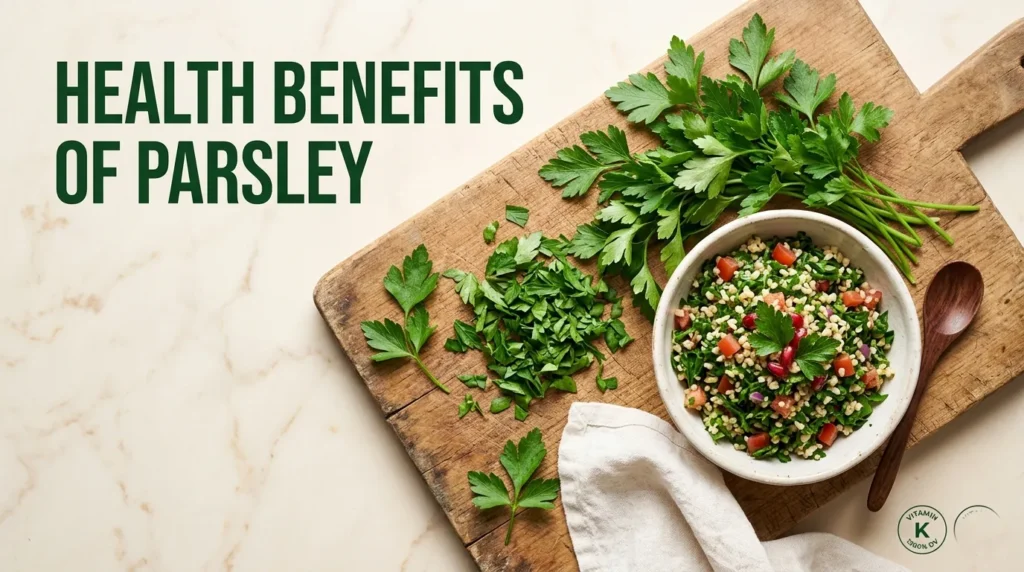
According to the USDA nutrient database, parsley contains more vitamin K per gram than kale or spinach. This vitamin K activates osteocalcin, a protein that binds calcium to your bone matrix. Without adequate vitamin K, calcium cannot properly deposit into bones regardless of how much calcium you consume.
The flavonoids in parsley, particularly apigenin, have been studied extensively in laboratory research. Apigenin has demonstrated the ability to reduce cancer cell glucose uptake, inhibit blood vessel development needed by growing tumors, and promote cancer cell death through the p53-related pathway . These findings come from cell and animal studies, not human trials, so the cancer-protective effects remain preliminary but promising.
Key Takeaway: Parsley is legitimately one of the most nutrient-dense foods you can eat, but you must eat more than a garnish-sized amount. A half-cup of fresh chopped parsley provides meaningful amounts of vitamin K, vitamin C, and iron.
Parsley Nutrition Facts and Key Bioactive Compounds
Parsley contains an impressive array of vitamins, minerals, and plant compounds that drive its health effects. The key bioactive compounds include apigenin (a flavonoid with anti-cancer properties), myristicin (a compound with diuretic and potential hallucinogenic effects at high doses), luteolin, and various carotenoids .
| Nutrient | Amount per 100g | % Daily Value | Key Function |
|---|---|---|---|
| Vitamin K (phylloquinone) | 790-1,640 mcg | 658-1,367% | Bone health, blood clotting |
| Vitamin C (ascorbic acid) | 133-358 mg | 148-398% | Immune function, antioxidant |
| Vitamin A (from beta-carotene) | 8,425 IU | 169% | Eye health, immune function |
| Iron | 5.4 mg | 30% | Oxygen transport, energy |
| Folic acid (vitamin B9) | 116-152 mcg | 29-38% | DNA synthesis, pregnancy |
| Potassium | 554 mg | 12% | Blood pressure regulation |
| Calcium | 138 mg | 11% | Bone health |
Fresh parsley is very low in calories at 36 calories per 100 grams . It contains 2.97 grams of protein, 6.33 grams of carbohydrates, and 3.3 grams of fiber per 100 grams. The fiber content matters because a cup of chopped parsley (about 60 grams) provides nearly 2 grams of fiber, which supports digestive health and blood sugar stability .
Parsley for Bone Health: Vitamin K Mechanism
The vitamin K in parsley directly supports bone health by activating osteocalcin, a protein that binds calcium to your bone matrix. Without activated osteocalcin, calcium circulates in your bloodstream but cannot be deposited into bones. Think of vitamin K as the key that unlocks the door for calcium to enter your bones.
According to the Jerusalem Post’s analysis of parsley nutrition, 100 grams of parsley contains about 1,600 micrograms of vitamin K . This is approximately 20 times the daily adequate intake for adults, which is 90-120 micrograms per day. A half-cup of chopped fresh parsley (about 30 grams) provides roughly 480 micrograms of vitamin K.
The evidence for vitamin K and bone health comes from observational studies showing that higher vitamin K intake is associated with higher bone mineral density and lower fracture risk. However, most of these studies looked at vitamin K from supplements or a combination of foods, not parsley specifically. Eating parsley as part of a varied diet certainly contributes to vitamin K intake, but you should not rely on parsley alone for bone health.
People taking blood thinners like warfarin (Coumadin) need to be very careful with parsley. The high vitamin K content can interfere with medication effectiveness. If you take blood thinners, do not dramatically increase your parsley intake without consulting your prescribing physician.
Parsley’s Anti-Inflammatory and Antioxidant Effects
The flavonoids in parsley, especially apigenin and myristicin, reduce inflammation by neutralizing free radicals and inhibiting inflammatory signaling pathways. A 2026 study on rats found that parsley aqueous extract exhibited therapeutic effects comparable to the statin drug atorvastatin for managing hypercholesterolemia, likely due to its anti-inflammatory, anti-apoptotic, and antioxidant properties .
The mechanism works at the cellular level. Free radicals are unstable molecules that damage cell membranes, DNA, and proteins. Antioxidants from parsley donate electrons to neutralize these free radicals before they cause harm. The flavonoids in parsley also inhibit the activity of NF-kB, a protein complex that controls inflammation-related gene expression.
In a 2026 rat study on hyperuricemia (high uric acid), researchers found that parsley and its flavonol constituents kaempferol and quercetin reduced serum uric acid levels and biomarkers of oxidative stress . The parsley extract lowered liver xanthine oxidoreductase activity, which is the enzyme responsible for uric acid production.
While these animal studies are promising, human clinical trials are limited. The anti-inflammatory effects observed in animals do not always translate directly to humans. However, eating parsley as part of an overall anti-inflammatory diet is safe and likely beneficial.
Key Takeaway: The antioxidant effects of parsley are well-documented in laboratory and animal research, but high-quality human trials are still needed. Eating parsley regularly as part of a varied diet is a low-risk way to increase your antioxidant intake.
Parsley for Heart Health and Blood Pressure
Parsley may support heart health through multiple mechanisms, including reducing homocysteine levels via folate content and acting as a mild diuretic to lower blood pressure. The high levels of folate (vitamin B9) in parsley help break down homocysteine, an amino acid that at high levels is associated with increased cardiovascular disease risk .
The diuretic effect of parsley comes from compounds called apiol and myristicin. Research suggests that the diuretic effect is mediated through inhibition of the sodium-potassium pump (Na+-K+ ATPase) in the kidneys . By inhibiting this pump, parsley increases sodium and water excretion, which can reduce blood volume and lower blood pressure.
A small clinical study on healthy volunteers found that parsley tea showed no effect on urine volume or urinary electrolyte excretion . This suggests that the diuretic effect may require larger amounts or different preparations than tea. The discrepancy between animal and human studies highlights the need for more research.
For heart health benefits, eating parsley as part of a Mediterranean-style diet makes sense. Parsley is a key ingredient in tabbouleh, a Lebanese salad where an average adult may consume as much as 50 grams of parsley per meal . This is a substantial amount that provides meaningful folate, potassium, and antioxidant intake.
Parsley for Skin Health and Melasma Treatment
Topical parsley preparations have shown potential for treating melasma, a condition of skin hyperpigmentation, with effects comparable to hydroquinone cream in one small study. A double-blind, randomized clinical trial of 27 patients with epidermal melasma compared topical parsley brew to 4% hydroquinone cream .
In this study, participants brewed 2.5 grams of powdered parsley in 125 mL of hot water, filtered it, and applied it to facial dark spots with cotton. The control group applied hydroquinone 4% cream nightly. The mean severity of melasma after intervention was not significantly different between the two treatment groups. However, the study was small with limited robust results.
Parsley contains vitamin C, which is known to inhibit tyrosinase, the enzyme involved in melanin production. This mechanism explains why parsley might help with hyperpigmentation. The study authors noted that larger trials are needed before recommending parsley as a standard treatment.
For home use, applying chilled parsley tea or a parsley-infused toner to hyperpigmented areas is generally safe for most people. However, perform a patch test first, and stop use if irritation occurs. Do not expect dramatic results from parsley alone. Professional treatments like hydroquinone, retinoids, or laser therapy remain the standard of care for significant hyperpigmentation.
Parsley for Kidney Health and Stone Prevention
Animal studies suggest that parsley may help prevent calcium oxalate kidney stones by inhibiting crystal nucleation and regulating urinary pH. A review of in vitro and animal studies found that parsley ethanolic extract prevented the nucleation and precipitation of calcium oxalate crystals in a rat model of stone formation .
The mechanism involves several factors. Parsley increased urinary pH to a level where calcium oxalate crystals remain dispersed rather than aggregating into stones. It also reduced urine supersaturation and urinary protein excretion, both of which contribute to stone formation. These effects were observed in rats, not humans.
However, a small clinical study in 20 healthy volunteers evaluating parsley tea’s effects on urinary composition found no effect on urine volume, pH, sodium, potassium, chloride, urea, creatinine, or citric acid content . This suggests that the amount of parsley typically consumed as tea may not be sufficient to produce measurable effects in humans.
People with a history of calcium oxalate kidney stones should not rely on parsley for prevention. Parsley is actually moderately high in oxalates, which could theoretically contribute to stone formation in susceptible individuals. If you have had kidney stones, ask your nephrologist or urologist whether increasing parsley intake is appropriate for you.
Key Takeaway: Animal research on parsley for kidney health is promising, but human studies do not show consistent benefits. Parsley is not a proven treatment or prevention strategy for kidney stones.
Parsley for Diabetes and Blood Sugar Control
Animal studies indicate that parsley extract can lower blood glucose in diabetic rats, potentially by inhibiting alpha-glucosidase, an enzyme that breaks down carbohydrates into sugar. In a rat model of streptozotocin-induced diabetes, oral administration of parsley extract lowered circulating glucose after 28 days .
The mechanism for the antidiabetic action appears to be inhibition of alpha-glucosidase. This enzyme sits in the small intestine and breaks down complex carbohydrates into simple sugars that can be absorbed. By inhibiting this enzyme, parsley slows glucose absorption, resulting in lower blood sugar spikes after meals. This is the same mechanism used by the diabetes medication acarbose.
These findings come from animal studies only. No human clinical trials have evaluated parsley for blood sugar control in people with diabetes or prediabetes. The doses used in animal studies were also much higher than what a person would typically consume as food.
If you have diabetes, eating parsley as part of a healthy diet is safe and may offer mild benefits. Do not replace prescribed diabetes medications with parsley. Talk to your endocrinologist or registered dietitian before making significant dietary changes to manage blood sugar.
Parsley During Pregnancy: Safety and Cautions
Eating parsley as a food seasoning is safe during pregnancy, but concentrated parsley supplements, parsley oil, or very large medicinal doses should be avoided because of potential emmenagogue and abortifacient effects. The FDA classifies parsley as Generally Recognized as Safe (GRAS) when used as food .
The concern comes from parsley seed oil and very high doses of parsley herb. Parsley has traditional use as an emmenagogue (to stimulate menstrual flow) and has purported abortifacient properties at high doses. These effects are likely due to myristicin and apiol compounds concentrated in parsley seeds and oil.
A typical serving of parsley as a garnish or in a salad contains about 5 to 10 grams of fresh herb. This amount is safe. A half-cup of chopped parsley in tabbouleh contains about 30 grams, which is also safe for most pregnant women. The problematic doses would be equivalent to eating cups and cups of parsley or taking parsley supplements.
That said, because safety and efficacy of high-dose parsley during pregnancy are unproven, most healthcare providers recommend avoiding amounts greater than those typically used in food. If you are pregnant, use parsley as a normal culinary herb but do not take parsley supplements, parsley oil, or consume extremely large quantities.
Frequently Asked Questions About Health Benefits of Parsley
Does parsley have health benefits if I only eat a small garnish?
A small garnish of parsley provides minimal health benefits because the active compounds are present in very low amounts. A tablespoon of chopped parsley (about 4 grams) contains only about 1.4 calories and negligible amounts of vitamins. To get meaningful benefits, you need to eat at least a half-cup (30 grams) of fresh parsley, which provides measurable vitamin K, vitamin C, and iron .
Is flat-leaf parsley healthier than curly parsley?
Flat-leaf (Italian) parsley and curly parsley have similar nutritional profiles, though flat-leaf is generally more flavorful and easier to chop. Both varieties are excellent sources of vitamins K, C, and A. Curly parsley has a milder taste, so you might eat more of it without noticing. For maximum nutrient intake, focus on quantity rather than variety.
Can parsley help with bad breath?
Yes, parsley has traditionally been used to freshen breath. The chlorophyll in parsley acts as a natural deodorizer, and chewing fresh parsley leaves can temporarily neutralize odors from foods like garlic and onions. This effect is temporary and works best when you chew the leaves immediately after eating. Parsley does not address underlying causes of chronic bad breath.
How much parsley should I eat daily for health benefits?
There is no established daily recommendation for parsley intake. Based on the nutrient data, eating a half-cup to one cup of fresh chopped parsley per day provides meaningful amounts of vitamin K, vitamin C, folate, and iron. This amount is safe for most people and can be added to salads, smoothies, tabbouleh, or used as a finishing herb on cooked dishes.
Does cooking destroy parsley’s nutrients?
Cooking parsley does reduce some water-soluble vitamins like vitamin C and folate, but it preserves fat-soluble vitamins like vitamin K and vitamin A. Adding parsley at the end of cooking or using it raw maximizes nutrient retention. Dried parsley has lower vitamin C content but still provides vitamin K and antioxidants. Fresh parsley is the most nutrient-dense form.
Can parsley interact with medications?
Yes, parsley can interact with blood thinners like warfarin (Coumadin) because of its high vitamin K content. If you take blood thinners, do not dramatically increase your parsley intake without consulting your physician. Parsley may also increase serum levels of sirolimus, an immunosuppressant medication . Always tell your healthcare providers about significant dietary changes.
Parsley is not a magic cure for any disease, but it is a genuinely nutrient-dense food that most people should eat more of. A half-cup of fresh parsley provides more vitamin K than a cup of kale, more vitamin C than an orange, and a respectable amount of iron. The evidence for cancer prevention and kidney stone treatment comes from animal studies and requires more human research. Eat parsley generously as part of an overall healthy diet, but do not expect it to replace medical treatments. Use it fresh, chop it into everything, and enjoy it for what it is: one of the most underrated herbs in your kitchen.