Wings Nutrition Facts: Full 2026 Macro Guide
A single average baked chicken wing with skin contains 86 calories, 6.4 grams of protein, 6.2 grams of fat, and zero grams of carbohydrates. Those numbers shift dramatically when you fry the wing, toss it in buffalo sauce, or dip it in ranch. The wings nutrition facts you need depend entirely on how the wing is prepared, what is on it, and how many you eat.
The USDA FoodData Central database records that a single roasted chicken wing with skin provides 23% of the Daily Value for selenium, a trace mineral that functions as an antioxidant cofactor for glutathione peroxidase enzymes. That is a genuine nutritional bright spot in a food most people file under “guilty pleasure.” But the same wing also delivers saturated fat and, when sauced, a sodium load that can exceed half your daily limit in one sitting.
You are about to see every number that matters: plain baked wings, deep-fried wings, buffalo wings dripping in cayenne pepper sauce, and the breaded boneless wings that chain restaurants sell by the basket. This is not a lecture. It is a complete, source-attributed nutrition facts breakdown written by someone who understands that you want the real data, not a vague warning about fried food.
wings nutrition facts
Wings nutrition facts vary based on cooking method, the presence of skin, and added sauces, but the baseline for one average baked bone-in chicken wing with skin is 86 calories, 6.4 grams of protein, 6.2 grams of fat, and zero grams of carbohydrates. The wing consists of two parts: the drumette and the flat. Both are dark meat with a higher fat content than chicken breast.
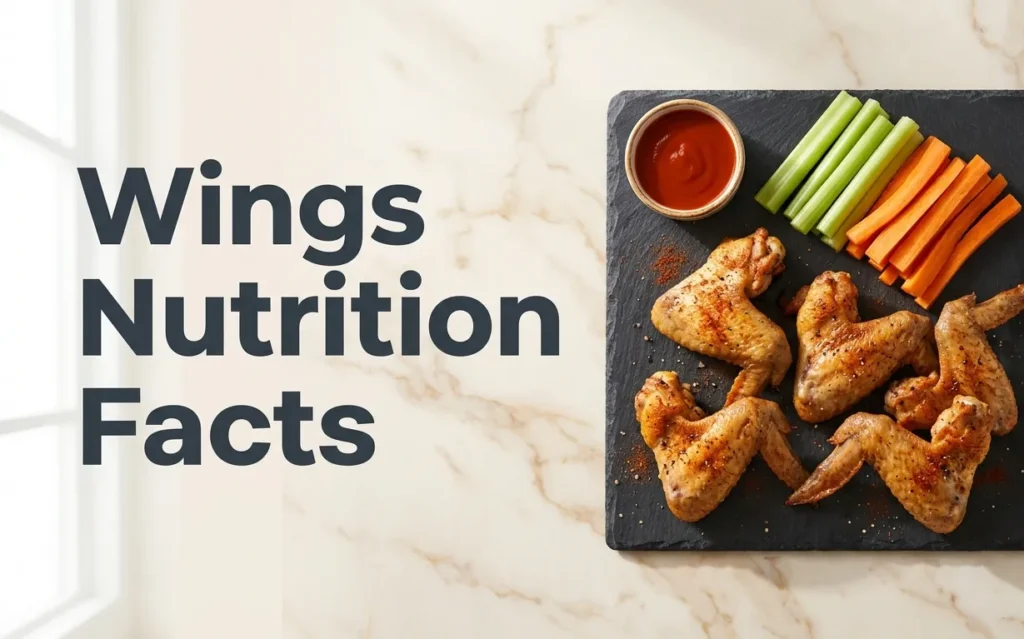
The USDA FoodData Central database provides the reference values for a roasted chicken wing with skin. A 100-gram serving of roasted chicken wing meat and skin contains 254 calories, 23.8 grams of protein, and 17.1 grams of fat. The protein-to-fat ratio is roughly 1.4 to 1. This is not a lean cut of poultry. Chicken breast delivers a ratio closer to 9 to 1. Wings are fattier by design because the skin is left on and the meat itself contains more intramuscular fat than the breast.
The serving size is the real challenge with wings. Restaurants serve them in baskets of 6, 10, or 12. A game-day spread might put 20 wings on a single plate. One wing is a modest 86 calories. Six wings is 516 calories before any sauce or dip. Ten wings is 860 calories. The math scales fast. Most people consume 8 to 12 wings in a sitting, which lands between 688 and 1,032 calories from the wings alone.
- Single baked wing (drumette and flat, 34g with skin): 86 calories, 6.4g protein, 6.2g fat, 0g carbs.
- 100g roasted wing meat and skin: 254 calories, 23.8g protein, 17.1g fat.
- 6-piece baked wings (204g total): 516 calories, 38.4g protein, 37.2g fat, 0g carbs.
- 12-piece baked wings (408g total): 1,032 calories, 76.8g protein, 74.4g fat, 0g carbs.
chicken wings calories
Chicken wings calories range from 86 per baked wing to over 140 per fried wing, depending on the cooking method and whether the skin is consumed. The calorie difference between a baked wing and a deep-fried wing is significant. Frying adds approximately 50 to 70 calories per wing from absorbed oil. A single fried wing clocks in at 130 to 150 calories.
The calorie source breakdown matters for anyone tracking macros. In a baked wing, approximately 65% of calories come from fat and 35% from protein. There are zero carbohydrate calories unless the wing is breaded. The fat content is split between saturated fat and monounsaturated fat. Chicken skin contains palmitic acid and oleic acid as the dominant fatty acids. The USDA analysis shows that a roasted wing delivers about 1.7 grams of saturated fat per piece, which is 8% of the American Heart Association’s recommended daily limit.
Restaurant fried wings absorb oil from the fryer. Peanut oil, soybean oil, or canola oil are common in commercial deep fryers. Each tablespoon of oil adds 120 calories. A wing tossed in a fryer for 8 to 10 minutes picks up roughly half a tablespoon of oil across its surface area. That is why the same anatomical wing that delivers 86 calories when baked can deliver 150 calories when fried. The skin acts like a sponge for hot oil. The crust crisps and the subcutaneous fat renders, but the total fat content rises.
| Preparation Method | Calories per Wing | Calories per 6 Pieces |
|---|---|---|
| Baked with skin | 86 | 516 |
| Deep-fried with skin | 140 | 840 |
| Air-fried with skin | 100 | 600 |
| Grilled with skin | 90 | 540 |
Key Takeaway: The calorie count of a wing nearly doubles when you switch from baking to deep frying, and most people eat 8 to 12 wings at a time, so the preparation choice can swing a meal by 400 to 600 calories.
chicken wings protein
Chicken wings protein content is 6.4 grams per average wing, meaning a 6-piece serving delivers 38.4 grams of complete animal protein with all nine essential amino acids. That is a substantial amount of protein. It is comparable to a medium chicken breast. The USDA records that a 100-gram portion of roasted wing meat and skin provides 23.8 grams of protein.
The protein quality in chicken wings is high. Animal muscle tissue contains all essential amino acids in proportions that match human physiological needs. The biological value of chicken protein is approximately 80, which puts it on par with beef and above most plant proteins. Lysine, leucine, and methionine are well represented. Leucine, in particular, triggers the mTOR pathway that stimulates muscle protein synthesis.
The catch is the protein-to-energy ratio. A baked wing gives you 6.4 grams of protein for 86 calories. That is a ratio of 1 gram of protein per 13.4 calories. Chicken breast gives you 1 gram of protein per 5.6 calories. You get the same total protein from wings and breast, but wings cost you more than twice the calories. For someone with a 1,800-calorie daily budget, that efficiency difference matters.
Athletes and people in a muscle-building phase can still use wings as a protein source. A post-game meal of 12 baked wings provides 76 grams of protein. That is a solid anabolic stimulus. The challenge is that the same plate contains 74 grams of fat and over 1,000 calories. Context matters. If the rest of the day’s meals are lean, it fits. If wings are added on top of a full eating day, the calorie surplus adds up.
- Complete protein: All 9 essential amino acids present in biologically useful ratios.
- Leucine content: Approximately 1.6g per 6-wing serving, adequate to stimulate muscle protein synthesis.
- Protein efficiency: 1g protein per 13.4 calories in baked wings vs. 1g per 5.6 calories in chicken breast.
- 6-wing serving: 38.4g protein, which covers roughly 70% of the RDA for a 150-pound adult.
chicken wings carbs
Chicken wings carbs are zero grams for plain, bone-in wings with skin, regardless of the cooking method. Chicken muscle tissue and skin contain no digestible carbohydrates. There is no glycogen storage in post-slaughter meat. This makes plain wings a zero-carb food suitable for ketogenic, carnivore, and low-carbohydrate diets.
The carbohydrate story changes entirely when the wing is sauced or breaded. Buffalo sauce, which is a mixture of cayenne pepper hot sauce and melted butter, adds negligible carbohydrates. Frank’s RedHot Original Cayenne Pepper Sauce contains zero grams of carbohydrates per teaspoon. The butter adds pure fat. Traditional buffalo wings, when properly made, remain zero-carb.
Sweet sauces flip the equation. Barbecue sauce, honey garlic glaze, sweet chili sauce, and teriyaki each add 10 to 20 grams of sugar per 2-tablespoon serving. A wing tossed in a thick sweet barbecue sauce can pick up 3 to 5 grams of carbohydrates just from the sauce coating. Six wings with a honey barbecue glaze might deliver 18 to 30 grams of carbohydrates before factoring in any dip. That is significant for someone on a strict low-carb plan.
Breading adds the largest carbohydrate load. Boneless wings are essentially chicken nuggets. They are pieces of breast meat coated in refined wheat flour batter and deep-fried. The breading on a single boneless wing adds 5 to 8 grams of carbohydrates. A 6-piece order of boneless wings with a sweet sauce can easily contain 50 to 70 grams of carbohydrates, which is more than two slices of white bread.
- Plain bone-in wings: 0g carbs.
- Traditional buffalo wings (Frank’s RedHot + butter): 0g carbs.
- Boneless breaded wings (per piece): 5 to 8g carbs.
- Honey BBQ sauced wings (6 pieces): 18 to 30g carbs from sauce alone.
- Sweet chili boneless wings (6 pieces): 50 to 70g total carbs.
chicken wings fat content
Chicken wings fat content is 6.2 grams per baked wing with skin, composed of roughly 1.7 grams of saturated fat, 2.5 grams of monounsaturated fat, and 1.4 grams of polyunsaturated fat. The exact fatty acid profile varies based on the chicken’s diet, but the USDA data shows that chicken wing fat is about 30% saturated, 40% monounsaturated, and 25% polyunsaturated.
The saturated fat in a 6-piece serving of baked wings is 10.2 grams. That is approximately 46% of the 22-gram daily limit recommended by the Dietary Guidelines for Americans 2020-2025 for a person eating 2,000 calories per day. The American Heart Association suggests an even lower target of 13 grams of saturated fat per day for optimal cardiovascular health. Six baked wings consume most of that budget.
Frying worsens the fat profile. Deep-frying adds roughly 5 to 7 grams of fat per wing, and the type of fat added depends on the fryer oil. If the restaurant uses partially hydrogenated oil, trans fats enter the equation. Most commercial kitchens in the United States have phased out trans fats due to the FDA ban, but some still use highly refined vegetable oils that degrade under repeated high-heat frying. These degraded oils contain lipid peroxidation products and polar compounds that are not present in the original oil.
The chicken skin is the primary fat reservoir. Removing the skin before eating cuts the total fat from 6.2 grams to approximately 2.5 grams per wing. The saturated fat drops from 1.7 grams to 0.8 grams. Skinless chicken wing meat is leaner but still contains more intramuscular fat than chicken breast. The flavor loss is significant, which is why most people keep the skin on and adjust elsewhere in their day.
| Fatty Acid Type | Per Baked Wing (34g) | Per 6 Baked Wings |
|---|---|---|
| Total Fat | 6.2g | 37.2g |
| Saturated Fat | 1.7g | 10.2g |
| Monounsaturated Fat | 2.5g | 15.0g |
| Polyunsaturated Fat | 1.4g | 8.4g |
| Trans Fat | 0g | 0g |
Key Takeaway: A 6-piece baked wing order uses nearly half your daily saturated fat budget, and frying makes the fat profile worse by adding degraded vegetable oils.
fried wings nutrition facts
Fried wings nutrition facts show a sharp increase in calories and fat compared to baked wings. A single deep-fried chicken wing with skin contains approximately 140 calories, 9 to 10 grams of fat, and 6 to 7 grams of protein. The calorie count jumps 60% over a baked wing. The fat content increases by 3 to 4 grams per wing, nearly all of it coming from the frying oil absorbed during cooking.
The frying process changes more than just the numbers. When chicken skin is submerged in oil at 350 to 375 degrees Fahrenheit, the water in the skin rapidly evaporates. The skin dehydrates and crisps. Oil moves into the spaces where water used to be. This oil uptake is what makes fried food calorie-dense. The crust matrix traps oil in its porous structure. A wing fried for 8 minutes absorbs more oil than a wing fried for 5 minutes.
The type of oil matters for the final fatty acid profile. A restaurant that fries in beef tallow or lard will produce a wing higher in saturated fat and cholesterol oxidation products. A chain that uses refined soybean oil will produce a wing high in omega-6 linoleic acid. Neither option is inherently worse than the other in isolation, but the omega-6 to omega-3 ratio of the modern diet is already heavily skewed. The Dietary Guidelines for Americans note that the average American consumes far more linoleic acid than alpha-linolenic acid.
Repeatedly heated frying oil generates compounds called advanced glycation end products (AGEs) and lipid peroxides. These are oxidative stress compounds. Research published in the Journal of the American College of Nutrition has found that fried foods, including fried poultry, are associated with higher inflammatory markers when consumed frequently. This is not about a single basket of wings. It is about the cumulative effect of a diet high in fried foods over years. An occasional fried wing is not a health crisis. A daily fried wing habit is a pattern that contributes to chronic disease risk.
baked wings nutrition
Baked wings nutrition is the baseline reference point. A single baked chicken wing with skin contains 86 calories, 6.4 grams of protein, and 6.2 grams of fat. Baking uses dry convective heat in an oven set to 400 to 425 degrees Fahrenheit. The skin renders its own fat, which drips away through a wire rack if you use one. No external oil is absorbed.
Baking preserves the native fatty acid profile of the chicken. The fat that remains in and on the skin is the fat that was already there: palmitic acid, oleic acid, and linoleic acid. The saturated fat content stays at 1.7 grams per wing. There is no addition of degraded frying oil. The flavor comes from the Maillard reaction on the skin surface and any dry seasonings applied before cooking.
The texture difference between baked and fried wings is real. A baked wing skin will not achieve the same glass-like shatter as a fried wing. It will be crispy but not crunchy in the same way. Baking powder, a trick borrowed from the food science world, helps. Tossing wings in a small amount of aluminum-free baking powder before baking raises the skin’s pH and accelerates the Maillard reaction. The result is a crispier baked wing that comes closer to a fried texture without the added fat.
A wire rack is the most important piece of equipment for baked wing nutrition. Placing wings directly on a foil-lined sheet pan means the skin sits in its own rendered fat as it cooks. The skin reabsorbs that fat. A wire rack elevates the wings and allows the rendered fat to drip down. The caloric difference between rack-baked and pan-baked wings is approximately 10 to 15 calories per wing. Over a dozen wings, that is 120 to 180 calories saved without any change to the recipe.
- Baked wing on a wire rack: 86 calories, fat drips away.
- Baked wing on a sheet pan: 95 to 100 calories, skin reabsorbs rendered fat.
- Seasoning only (no sauce): No added calories, sodium varies by salt used.
- Baking powder trick: 1 teaspoon per pound of wings, raises skin pH for crispier texture.
buffalo wings nutrition facts
Buffalo wings nutrition facts start with the base wing and add the buffalo sauce, which is a simple mixture of cayenne pepper hot sauce and melted butter. A single traditional buffalo wing made from a baked drumette and flat contains approximately 100 to 110 calories, 6.4 grams of protein, 8 to 9 grams of fat, and zero grams of carbohydrates. The sauce adds pure fat from butter and negligible carbohydrates from the hot sauce.
Buffalo sauce originated in Buffalo, New York, at the Anchor Bar in 1964. The original recipe is Frank’s RedHot cayenne pepper sauce combined with melted butter. There is no sugar. There is no flour thickener. There is no high-fructose corn syrup. This is what makes traditional buffalo wings a uniquely compatible food for low-carbohydrate and ketogenic diets. The caloric increase over a plain baked wing comes entirely from the butterfat.
The problem is that restaurant “buffalo wings” often deviate from the original. Chain restaurants add sugar, modified corn starch, and soybean oil to their buffalo sauce to extend shelf life and reduce cost. A wing from a major pizza chain listed as “buffalo” on the menu may contain 3 to 5 grams of added sugar per wing from the sauce alone. The USDA FoodData Central does not have a single entry for “buffalo wing” because the variation is too wide. You must read the specific restaurant’s nutrition guide or the label on the bottle.
The dipping sauce is where buffalo wings nutrition facts get complicated. Traditional accompaniments are blue cheese dressing and ranch dressing. Both are calorie-dense. Two tablespoons of blue cheese dressing add 140 calories and 14 grams of fat. Ranch dressing is similar. Celery and carrot sticks add fiber, vitamin A, and vitamin K, but the dressing quickly becomes the calorie-dominant component of the meal.
| Component | Calories | Fat | Carbs | Protein |
|---|---|---|---|---|
| 1 Baked Buffalo Wing | 105 | 8.5g | 0g | 6.4g |
| 2 Tbsp Blue Cheese Dressing | 140 | 14g | 2g | 1g |
| 2 Tbsp Ranch Dressing | 130 | 13g | 2g | 1g |
| 3 Celery Sticks | 10 | 0g | 2g | 0g |
hot wings nutrition facts
Hot wings nutrition facts are nearly identical to buffalo wings nutrition facts, with the difference being the heat level of the cayenne pepper sauce used and the potential addition of extra spices. A hot wing made with a traditional cayenne and butter sauce contains approximately 100 to 110 calories per wing, the same as a standard buffalo wing. The capsaicin in the hot peppers adds no calories. It adds only heat and a mild metabolic effect.
Capsaicin, the compound responsible for the burning sensation in cayenne and other chili peppers, has been studied for its thermogenic properties. A 2023 review published in the journal Nutrients found that capsaicin consumption is associated with a modest increase in energy expenditure of approximately 50 calories per meal. This is not a weight-loss strategy. It is a small physiological effect. Eating 12 hot wings will not burn off the 1,200 calories they contain. The metabolic boost from capsaicin is real but too small to meaningfully offset the caloric density of the wings themselves.
The term “hot wings” can also refer to wings sauced with hotter pepper varieties: habanero, ghost pepper, or Carolina reaper-based sauces. These sauces are still mostly vinegar, pepper mash, and sometimes butter. The calorie profile does not change. A ghost pepper wing and a mild buffalo wing have the same macronutrient breakdown. The difference is purely sensory and, for people with gastrointestinal sensitivity, potentially irritating.
People with gastroesophageal reflux disease (GERD) or irritable bowel syndrome (IBS) should know that capsaicin is a known trigger for esophageal discomfort and gastric irritation. The fat content of the wings combined with the capsaicin can provoke symptoms. This is not a nutritional concern. It is a digestive tolerance issue. If you have a sensitive stomach or a diagnosed upper GI condition, hot wings may cause pain that has nothing to do with their calorie count.
Key Takeaway: Hot wings and buffalo wings share the same macronutrient profile; the capsaicin adds zero calories and only a tiny metabolic bump that does not cancel out the meal’s energy density.
boneless wings nutrition facts
Boneless wings nutrition facts reveal a completely different food from traditional bone-in wings. A single boneless wing is a piece of chicken breast meat that has been battered, breaded, and deep-fried. It contains approximately 80 to 100 calories, 4 to 5 grams of protein, 5 to 6 grams of fat, and 5 to 7 grams of carbohydrates. The carbohydrate content comes entirely from the refined wheat flour breading.
Boneless wings are not wings at all. They are chicken nuggets marketed under a different name. The USDA FoodData Central categorizes them under “chicken patty” or “breaded chicken pieces.” The meat is breast, not dark meat. The protein is leaner, but the breading dilutes the protein density. A bone-in wing is 30% protein by weight. A boneless wing is 15 to 20% protein by weight because the breading adds carbohydrate mass without adding protein.
The breading changes the macronutrient profile significantly. The refined wheat flour used in commercial breading absorbs fryer oil aggressively. A breaded boneless wing fried in soybean oil absorbs 8 to 10 grams of oil during cooking. The total fat ends up higher than a bone-in fried wing even though the starting meat is leaner. The carbohydrate addition makes boneless wings incompatible with very low-carb diets. Six boneless wings add 30 to 42 grams of carbohydrates before any sauce.
Sauce adheres differently to breaded surfaces. A smooth bone-in wing skin holds less sauce volume than a rough, porous breading. A boneless wing tossed in buffalo sauce carries more sauce per piece than a traditional bone-in wing. The calorie and sodium load per wing increases accordingly. A breaded boneless wing tossed in honey barbecue sauce can easily reach 130 to 150 calories per piece.
- Boneless wing base (plain, fried): 90 calories, 5g protein, 6g fat, 6g carbs.
- Bone-in wing base (fried, plain): 140 calories, 6.5g protein, 10g fat, 0g carbs.
- Protein per 100 calories: Bone-in wing 4.6g, boneless wing 5.5g.
- Carb content: Bone-in 0g, boneless 6g per wing (from wheat flour breading).
are chicken wings healthy
Chicken wings are a mix of positive nutritional attributes, including high-quality protein and selenium, and negative attributes, including high saturated fat and, when sauced, high sodium. Whether they are healthy depends on preparation method, serving size, dipping sauce choices, and the overall dietary pattern they fit into. A baked wing served with celery and a light hand on the dressing is a reasonable food. A dozen deep-fried wings drowned in ranch and sweet barbecue sauce is a high-calorie, high-sodium, high-saturated-fat meal.
The Academy of Nutrition and Dietetics emphasizes that no single food defines a diet. The health impact of chicken wings is determined by frequency and context. A person who eats a balanced diet rich in vegetables, whole grains, and lean proteins and has wings once a month during football season is in a different risk category than a person who eats fried wings three times a week with no vegetable intake. The wings are not the variable. The overall dietary pattern is.
The selenium content is a genuine nutritional positive that most wing articles ignore. One baked wing provides 23% of the Daily Value for selenium. Selenium is a cofactor for glutathione peroxidase, an enzyme that reduces oxidative damage inside cells. The thyroid gland also requires selenium to convert thyroxine (T4) to active triiodothyronine (T3). A 6-wing serving covers more than the entire daily selenium requirement. This does not make wings a health food, but it does mean they contribute a nutrient that is deficient in many people’s diets.
The health risks of frequent wing consumption cluster around three variables: saturated fat intake, sodium intake, and the inflammatory potential of repeatedly heated frying oil. The American Heart Association recommends limiting saturated fat to 5 to 6% of total daily calories for people with elevated cardiovascular risk. That is approximately 13 grams per day. A 6-piece order of fried wings with ranch dressing can deliver 15 to 20 grams of saturated fat in a single meal. That exceeds the daily limit before eating anything else.
- Nutritional positives: Complete protein, high selenium (138% DV per 6 baked wings), zero carbs when prepared traditionally.
- Nutritional negatives: High saturated fat, very high sodium when sauced, caloric density increases sharply with frying.
- Context matters: Monthly consumption in a balanced diet is not a health concern. Multiple times weekly with fried preparation and heavy sauces is a risk pattern.
chicken wings sodium
Chicken wings sodium content starts at approximately 45 milligrams per plain baked wing with no added salt and escalates to over 400 milligrams per sauced, seasoned wing. The USDA records a roasted chicken wing with skin at 81 milligrams of sodium naturally. Seasoned and sauced versions are where the numbers climb into concerning territory for anyone managing blood pressure.
Sodium is the single largest nutritional concern with chicken wings. A plain wing is low-sodium. But nobody eats plain wings at a restaurant. The standard preparation involves a dry brine or salt-based seasoning, a salty hot sauce, and a salty dipping sauce. A buffalo wing from a national pizza chain contains 300 to 450 milligrams of sodium per wing. A 10-wing order delivers 3,000 to 4,500 milligrams of sodium before the dipping sauce.
The Dietary Guidelines for Americans 2020-2025 recommend limiting sodium intake to less than 2,300 milligrams per day. The American Heart Association suggests an ideal limit of 1,500 milligrams for optimal cardiovascular health. A single restaurant order of buffalo wings with ranch or blue cheese dressing can deliver two to three times the daily recommended limit. This is not a wing problem in isolation. It is a restaurant food problem. Chain restaurant food is systematically high in sodium because salt is the cheapest flavor delivery system.
Buffalo sauce is inherently salty. Frank’s RedHot Original contains 190 milligrams of sodium per teaspoon. A wing tossed in sauce picks up roughly half a teaspoon of sauce on its surface, adding 90 to 100 milligrams of sodium per wing just from the sauce. Ranch dressing adds 300 milligrams of sodium per two tablespoons. Blue cheese dressing is similar. The sodium stacking is relentless: salted wing, salty sauce, salty dip.
- Plain baked wing (unsalted): 45mg sodium.
- Roasted wing with salt: 81mg sodium.
- Buffalo sauced wing (restaurant): 300 to 450mg sodium.
- Blue cheese or ranch dip (2 Tbsp): 280 to 320mg sodium.
- 10 buffalo wings plus 4 Tbsp ranch dip: 3,800 to 5,100mg sodium total.
chicken wings cholesterol
Chicken wings cholesterol content is approximately 25 to 30 milligrams per baked wing with skin. A 6-wing serving contains 150 to 180 milligrams of dietary cholesterol. This is roughly half to two-thirds of the 300-milligram daily limit that was recommended in older dietary guidelines. Current guidelines, however, have shifted away from a strict numerical cholesterol limit.
The Dietary Guidelines for Americans 2020-2025 removed the specific 300-milligram daily cholesterol target that had been in place since 1968. The current guidance states that dietary cholesterol intake should be “as low as possible within a healthy eating pattern.” The reasoning comes from decades of metabolic research showing that saturated fat intake has a larger effect on blood LDL cholesterol levels than dietary cholesterol itself. The liver produces the majority of the cholesterol circulating in your blood. Dietary cholesterol contributes, but the dose-response curve is not linear.
People with familial hypercholesterolemia or type 2 diabetes are more sensitive to dietary cholesterol than the general population. For these individuals, the cholesterol in egg yolks and poultry skin may have a measurable effect on serum lipids. A 2022 study in the American Journal of Clinical Nutrition found that dietary cholesterol intake above 300 milligrams per day was associated with a modest increase in cardiovascular risk, particularly in people with pre-existing metabolic conditions. The absolute risk increase was small but statistically present.
The cholesterol in chicken wings is concentrated in the skin and the fat. Removing the skin cuts the cholesterol roughly in half. The meat itself contains cholesterol because it is animal tissue. All animal cells have cholesterol in their membranes. There is no cholesterol-free chicken wing unless it is a plant-based imitation product. People who have been advised by a registered dietitian or cardiologist to limit dietary cholesterol should account for the 150 to 180 milligrams in a 6-wing serving.
Key Takeaway: Dietary cholesterol in wings matters less for most people than the saturated fat that accompanies it, but individuals with specific lipid disorders should track the intake.
chicken wings vitamins and minerals
Chicken wings vitamins and minerals include selenium, phosphorus, niacin, vitamin B6, and zinc as the standout micronutrients. A single baked wing provides 12.7 micrograms of selenium, which is 23% of the Daily Value. Selenium functions as a cofactor for antioxidant enzymes and supports thyroid hormone conversion. A 6-wing serving provides 76.2 micrograms, exceeding the 55-microgram RDA for adults set by the NIH Office of Dietary Supplements.
Niacin, also called vitamin B3, is the second most notable micronutrient in wings. One baked wing delivers 1.8 milligrams of niacin, which is 11% of the Daily Value. Niacin is involved in over 400 enzymatic reactions in the body, primarily related to the conversion of food into cellular energy. It is a component of NAD and NADP, the coenzymes that drive mitochondrial respiration. Six wings provide 10.8 milligrams of niacin, approximately 68% of the RDA for adult men and 77% for adult women.
Phosphorus is present at 48 milligrams per wing, contributing 4% of the Daily Value. Phosphorus works with calcium to form hydroxyapatite, the mineral matrix of bone and teeth. It is abundant in all animal protein foods. Deficiency is rare in people who eat meat regularly. The phosphorus in chicken wings is highly bioavailable, unlike the phosphorus in plant foods, which is partially bound to phytic acid.
Vitamin B6, known as pyridoxine, clocks in at 0.13 milligrams per wing, or 8% of the Daily Value. B6 is necessary for neurotransmitter synthesis, hemoglobin production, and homocysteine metabolism. Zinc is present at 0.5 milligrams per wing, or 5% of the Daily Value. Zinc supports immune cell function and wound healing. These individual amounts per wing are modest, but they add up across a 6-piece serving.
| Micronutrient | Per Baked Wing | Per 6 Baked Wings | Daily Value (DV) |
|---|---|---|---|
| Selenium | 12.7 mcg (23% DV) | 76.2 mcg (139% DV) | 55 mcg |
| Niacin (B3) | 1.8 mg (11% DV) | 10.8 mg (68% DV) | 16 mg |
| Phosphorus | 48 mg (4% DV) | 288 mg (23% DV) | 1,250 mg |
| Vitamin B6 | 0.13 mg (8% DV) | 0.78 mg (46% DV) | 1.7 mg |
| Zinc | 0.5 mg (5% DV) | 3.0 mg (27% DV) | 11 mg |
wings nutrition 6 piece
A 6-piece serving of baked chicken wings with skin contains 516 calories, 38.4 grams of protein, 37.2 grams of fat, and zero grams of carbohydrates. This serving size is the standard restaurant order and the most useful reference point for meal planning. A 6-piece serving of fried wings jumps to 840 calories. A 6-piece serving of buffalo wings with blue cheese dressing approaches 1,000 calories.
The protein in a 6-wing baked serving is 38.4 grams. That is a solid protein portion for a meal. It covers roughly 70% of the daily protein needs for a 150-pound sedentary adult. For a 180-pound active person aiming for 120 grams of protein per day, the wings cover about one-third of the daily target. The protein is complete and highly digestible, scoring well on the Protein Digestibility Corrected Amino Acid Score (PDCAAS).
The fat in a 6-wing baked serving is 37.2 grams. That is a high fat load for a single meal component, especially when sides and dips are added. The saturated fat portion is 10.2 grams. The Dietary Guidelines for Americans recommend keeping saturated fat below 10% of daily calories. On a 2,000-calorie diet, that is 22 grams. Six baked wings use 46% of that budget. Six fried wings with ranch dressing can exceed the entire daily limit.
Meal context determines whether a 6-piece wing order makes sense. If the rest of the day is lean protein, vegetables, and whole grains, wings fit without issue. If the wings are an appetizer before a burger and fries, the cumulative saturated fat and calorie intake for that meal alone will likely exceed 1,500 calories and 25 grams of saturated fat. The wings are not the problem. The stacking is.
| 6-Piece Serving | Calories | Protein | Fat | Carbs |
|---|---|---|---|---|
| Baked, skin-on | 516 | 38.4g | 37.2g | 0g |
| Fried, skin-on | 840 | 39g | 60g | 0g |
| Buffalo with 2 Tbsp Ranch | 1,020 | 40g | 74g | 4g |
| Boneless, plain | 540 | 30g | 36g | 36g |
Key Takeaway: A 6-piece baked wing order is a 516-calorie, 38-gram protein meal that fits a balanced day; the same order fried with sauce and dip doubles the calories and saturated fat.
how to make wings healthier
To make wings healthier, bake them on a wire rack instead of deep-frying them, use a dry rub instead of a sodium-heavy sauce, and serve them with raw vegetables and a yogurt-based dip instead of ranch or blue cheese. These three changes cut calories by 30 to 40%, reduce sodium by 60%, and add fiber and micronutrients without sacrificing the wing experience.
Baking on a wire rack is the single highest-impact change. Elevating the wings above a sheet pan allows rendered fat to drip away rather than reabsorb into the skin. The calorie reduction is 10 to 15 per wing. Over a dozen wings, that is 120 to 180 calories saved with no change to the food itself. The rack also produces a crispier skin because hot air circulates underneath. The cooking temperature should be 425 degrees Fahrenheit for 40 to 50 minutes, flipping halfway.
A dry rub replaces sauce calories and sodium with spices that add flavor without any nutritional downside. A mixture of smoked paprika, garlic powder, onion powder, black pepper, and a small amount of cayenne delivers deep flavor with zero grams of fat, zero grams of sugar, and a fraction of the sodium of bottled buffalo sauce. If sauce is non-negotiable, make it from scratch: Frank’s RedHot plus a modest amount of melted butter. Two tablespoons of this mixture contain 90 calories and 420 milligrams of sodium. Restaurant versions are often double that sodium count.
The dipping strategy shifts the entire meal’s nutritional profile. Substituting plain Greek yogurt mixed with lemon juice, garlic, and black pepper for blue cheese dressing saves 100 calories and 200 milligrams of sodium per two-tablespoon serving. Raw celery, carrot, cucumber, and bell pepper strips add fiber, vitamin C, vitamin K, and potassium. The fiber helps with satiety, and the potassium partially offsets the sodium load from the sauce.
- Step 1: Bake on a wire rack at 425°F for 40-50 minutes. Never pan-fry or deep-fry.
- Step 2: Use a dry spice rub instead of bottled sauce to control sodium.
- Step 3: Replace ranch or blue cheese with Greek yogurt-based dip.
- Step 4: Fill half the plate with raw vegetables to add fiber and displace extra wings.
- Step 5: Limit to 6 to 8 wings and treat them as the main protein, not an appetizer.
Frequently Asked Questions About Wings Nutrition
How many calories are in 10 chicken wings?
Ten baked chicken wings with skin contain approximately 860 calories.
Ten deep-fried chicken wings contain approximately 1,400 calories.
Ten buffalo wings with ranch or blue cheese dressing dip can exceed 1,700 calories, which is nearly an entire day’s energy intake for many adults on a 2,000-calorie diet.
Are chicken wings high in protein?
Yes, chicken wings are a high-protein food, delivering 6.4 grams of complete animal protein per baked wing.
A 6-piece serving provides 38.4 grams of protein, which covers roughly 70% of the daily RDA for a 150-pound adult.
The protein is high quality and contains all nine essential amino acids, but it comes packaged with a significant amount of fat, making the protein-to-calorie ratio less efficient than lean chicken breast.
Are baked wings healthier than fried wings?
Yes, baked wings are considerably lower in calories and fat than fried wings.
A baked wing contains 86 calories and 6.2 grams of fat, while a fried wing contains approximately 140 calories and 10 grams of fat.
Baking also avoids the lipid peroxidation compounds that form in repeatedly heated frying oil, making it the objectively healthier preparation method.
How much sodium is in buffalo wings?
A single restaurant buffalo wing contains 300 to 450 milligrams of sodium.
A 10-wing order delivers 3,000 to 4,500 milligrams of sodium before adding any dipping sauce, exceeding the Dietary Guidelines for Americans recommended daily limit of 2,300 milligrams.
The sodium comes primarily from the cayenne pepper hot sauce and any added salt in the seasoning.
Do boneless wings have more carbs than bone-in wings?
Yes, boneless wings contain 5 to 7 grams of carbohydrates per piece from the refined wheat flour breading, while bone-in wings contain zero grams of carbohydrates.
A 6-piece order of boneless wings delivers 30 to 42 grams of carbohydrates before any sauce is added.
Bone-in wings, even when sauced with traditional buffalo sauce, remain carbohydrate-free.
Can I eat chicken wings on a low-carb diet?
Yes, traditional bone-in chicken wings with buffalo sauce are a zero-carbohydrate food and are fully compatible with ketogenic, carnivore, and other low-carbohydrate diets.
You must avoid breaded boneless wings, sweet barbecue sauces, honey glazes, and teriyaki sauces, all of which add significant sugar and carbohydrates.
Stick to traditional cayenne and butter buffalo sauce and check the label on bottled sauces for hidden sugars.
Chicken wings are a food of sharp contrasts. They deliver complete protein, a full day’s worth of selenium, and meaningful amounts of niacin and B6. They also deliver saturated fat, and in their restaurant form, a sodium load that can exceed your daily limit in a single sitting. The wings themselves are not the villain. The preparation method, the sauce, the dip, and the quantity are what tip them from a reasonable high-protein meal into a dietary problem.
The single most useful number to remember from this entire breakdown is 86. That is the calorie count of one baked chicken wing with skin. If you bake your wings at home on a wire rack, use a dry rub, and serve them with vegetables and a yogurt dip, a 6-wing meal is a satisfying 516-calorie plate with 38 grams of protein. If you order them fried and drenched in ranch at a restaurant, that same 6-wing order more than doubles in calories and lands north of 1,000.
You now have the exact numbers. The choice is yours. Bake them.