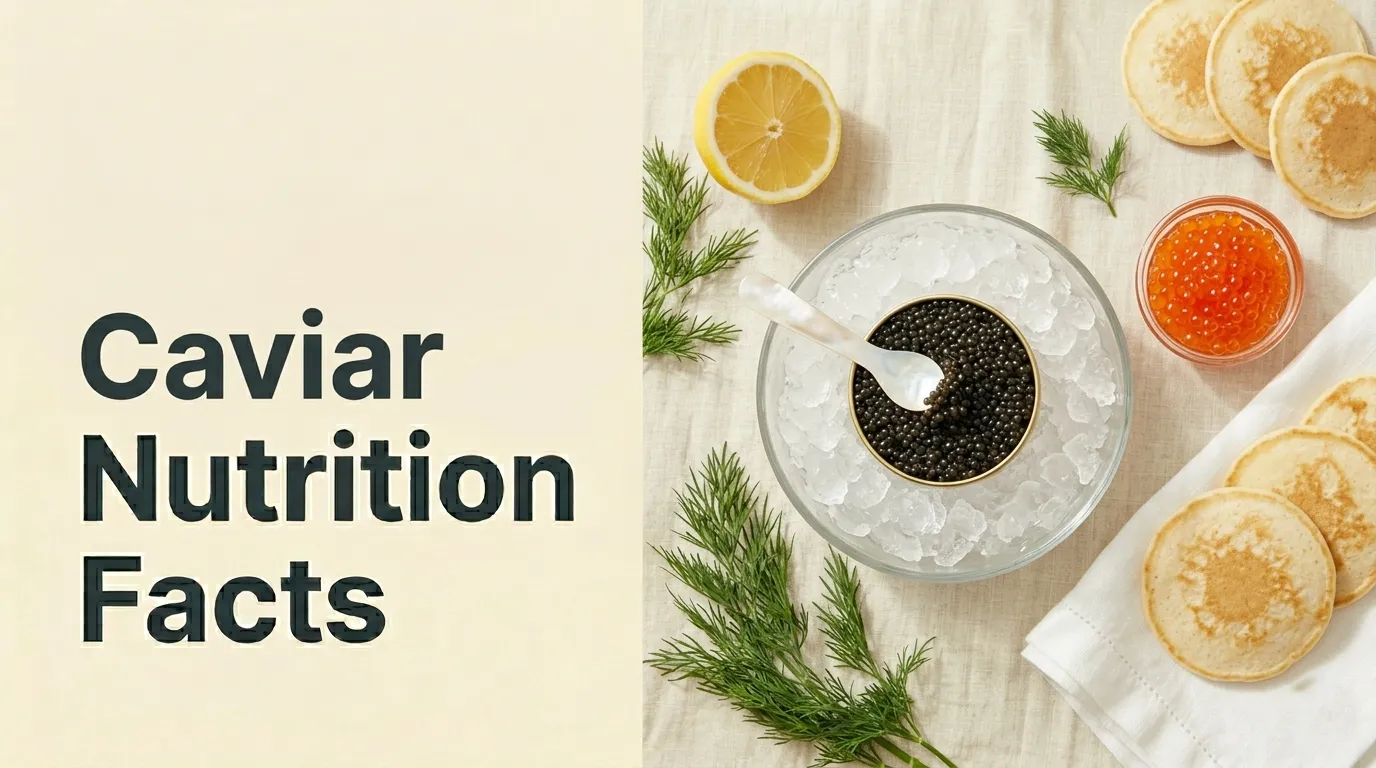
Caviar Nutrition Facts: A Complete Macro and Micronutrient Breakdown for 2026
Caviar is one of the most nutrient-dense animal foods you can eat, delivering roughly 40 calories, 4 grams of protein, and 2.5 grams of fat in a single tablespoon. The caviar nutrition facts that matter most are its exceptional concentrations of vitamin B12, selenium, iron, and long-chain omega-3 fatty acids EPA and DHA in a serving size most people would consider a garnish. A single tablespoon covers more than 100% of the daily vitamin B12 requirement and roughly 20% of the daily selenium target.
The USDA FoodData Central database records that sturgeon roe, the product legally defined as caviar, contains approximately 15.5 micrograms of vitamin B12 per 100 grams. A standard one-tablespoon serving of roughly 16 grams delivers about 2.5 micrograms, exceeding the 2.4-microgram Recommended Dietary Allowance for adults set by the NIH Office of Dietary Supplements. That level of nutrient density in a serving that small is rare among animal foods and almost nonexistent among plant foods without fortification.
This article gives you the complete nutritional breakdown of caviar, from full macro and micro tables to omega-3 fatty acid content to sodium considerations. You’ll learn how different types of roe compare, why the salt content matters more than most people realize, which groups should be cautious, and what to look for when buying a product that ranges from affordable salmon roe to luxury ossetra.
Caviar Nutrition Facts Overview
Caviar refers specifically to the salt-cured roe of sturgeon species belonging to the Acipenseridae family. Products labeled simply as “caviar” in the United States must come from sturgeon under FDA regulations. Other fish roes, including salmon roe (ikura), trout roe, whitefish roe, and lumpfish roe, are nutritionally similar but not identical and must be labeled with the species name.
A standard serving of caviar is one tablespoon, which weighs approximately 16 grams. This is roughly the amount you would spread on a blini, a cracker, or a small toast point. The nutrition profile for this serving size, based on USDA FoodData Central data for sturgeon caviar, breaks down as follows.
| Nutrient | Per 1 tbsp (16g) | Per 100g |
|---|---|---|
| Calories | 42 kcal | 264 kcal |
| Protein | 3.9 g | 24.6 g |
| Total Fat | 2.9 g | 17.9 g |
| Saturated Fat | 0.6 g | 4.1 g |
| Monounsaturated Fat | 0.7 g | 4.6 g |
| Polyunsaturated Fat | 1.2 g | 7.4 g |
| EPA (Eicosapentaenoic Acid) | 440 mg | 2,741 mg |
| DHA (Docosahexaenoic Acid) | 610 mg | 3,800 mg |
| Total Carbohydrate | 0.6 g | 4.0 g |
| Sodium | 240 mg | 1,500 mg |
| Cholesterol | 94 mg | 588 mg |
The omega-3 content is the standout feature that separates caviar from most other animal protein sources. A single tablespoon provides approximately 1,050 milligrams of combined EPA and DHA, which exceeds the 250 to 500 milligram daily target that the Dietary Guidelines for Americans 2020-2025 associates with cardiovascular benefit when consumed regularly from seafood.
The sodium content at 240 milligrams per tablespoon is moderate but worth tracking. That’s roughly 10% of the 2,300-milligram daily limit. The sodium comes from the salt-curing process, not the roe itself. Unsalted sturgeon roe would contain roughly 50 to 80 milligrams of sodium per tablespoon naturally. The remaining 160 to 190 milligrams is added salt.
Key Takeaway: One tablespoon of caviar delivers roughly 1,050 milligrams of combined EPA and DHA omega-3s, more than double the minimum daily target, plus 4 grams of protein and over 100% of the daily B12 requirement, all in 42 calories.
Caviar Calories and Serving Size Guide
Caviar is calorie-dense by weight but calorie-modest by serving size because the serving size itself is small. A tablespoon of sturgeon caviar contains roughly 42 calories. That’s fewer calories than a teaspoon of olive oil at 40 calories and comparable to a small handful of almonds at roughly 50 calories.
The serving size matters because caviar is almost never eaten by itself. The blini, toast point, crème fraîche, or butter it’s served with adds calories that can double or triple the total. A standard caviar presentation on a small buttered toast point looks like this.
| Component | Approximate Calories |
|---|---|
| 1 tbsp caviar | 42 |
| 1 small toast point | 35 |
| 1 tsp butter | 34 |
| 1 tsp crème fraîche | 20 |
| Total | 131 |
The caviar itself contributes less than a third of the total calories in the classic presentation. The butter and toast carry most of the energy load. If you’re eating caviar for the nutrition and want to minimize the calorie cost of the delivery vehicle, consider serving it on cucumber slices, endive leaves, or a plain unsalted cracker, which add fewer than 10 calories per piece.
Larger servings change the math quickly. A quarter-cup of caviar, roughly 4 tablespoons or 64 grams, delivers approximately 168 calories, 15.6 grams of protein, and 4,200 milligrams of combined EPA and DHA. That amount of omega-3s is roughly four to eight times the daily target. The same quarter-cup also delivers 960 milligrams of sodium, or about 42% of the daily limit. The omega-3 density is exceptional. The sodium load is meaningful.
Vitamins in Caviar: B12 and Beyond
Caviar is a concentrated source of several vitamins, led by vitamin B12 (cobalamin) at levels that make it one of the most B12-dense foods available. A single tablespoon provides approximately 2.5 micrograms of vitamin B12, covering more than 100% of the 2.4-microgram Recommended Dietary Allowance for adults.
Vitamin B12 functions as a cofactor for two enzymatic reactions in the body. The first is the conversion of homocysteine to methionine, which is relevant to cardiovascular health because elevated homocysteine is an independent risk factor for vascular disease. The second is the synthesis of myelin, the fatty insulation around nerve fibers. Deficiency produces megaloblastic anemia, characterized by enlarged and immature red blood cells, and neurological symptoms including peripheral neuropathy and balance disturbances.
The NIH Office of Dietary Supplements identifies adults over age 60 as a group at elevated risk for B12 deficiency because reduced stomach acid production, a condition called atrophic gastritis, impairs the release of B12 from food proteins. For these individuals, the B12 in caviar is protein-bound, not crystalline, and may be less bioavailable than the B12 in fortified foods or supplements. A physician can order a serum B12 test to determine actual status before recommending dietary adjustments or supplementation.
Caviar also provides meaningful amounts of other fat-soluble vitamins. A one-tablespoon serving delivers roughly 5 to 10 IU of vitamin D, a small contribution toward the 600 IU daily target. Vitamin A appears at roughly 90 IU per tablespoon, about 3% of the daily value. Vitamin E, primarily as alpha-tocopherol, contributes to the antioxidant activity in the roe’s lipid fraction.
Minerals in Caviar: Selenium, Iron, and Sodium
Caviar delivers a mineral profile led by selenium, iron, phosphorus, and sodium. The selenium content is particularly high because marine organisms bioaccumulate selenium from seawater and sediment. A one-tablespoon serving provides approximately 10 to 12 micrograms of selenium, covering roughly 18 to 22% of the 55-microgram Recommended Dietary Allowance for adults.
Selenium functions as a component of selenoproteins, the most studied of which is glutathione peroxidase, an enzyme that reduces hydrogen peroxide and lipid peroxides in the aqueous and lipid compartments of cells. Adequate selenium status also supports thyroid hormone activation because the deiodinase enzymes that convert thyroxine (T4) to triiodothyronine (T3) require selenium. The selenium content of caviar varies with the species, the harvest location, and the selenium content of the water the sturgeon lived in.
Iron in caviar is present as heme iron, the highly bioavailable form found in animal tissues. A tablespoon provides roughly 1.5 to 2 milligrams of iron, about 8 to 11% of the 18-milligram daily requirement for premenopausal women and roughly 20% of the 8-milligram requirement for men and postmenopausal women. The absorption efficiency of heme iron, roughly 15 to 35%, is significantly higher than the 2 to 20% absorption rate for non-heme iron from plant foods.
The sodium content deserves the most attention from a practical standpoint. At 240 milligrams per tablespoon, caviar is a moderate-sodium food, not a low-sodium food. Several servings consumed in one sitting, which is common at events or celebrations, can deliver 500 to 1,000 milligrams of sodium before the crackers and toppings are counted. People with hypertension, heart failure, or chronic kidney disease on sodium-restricted diets should factor caviar into their daily sodium budget rather than treating it as a free addition.
Key Takeaway: A tablespoon of caviar covers roughly 20% of daily selenium needs and up to 11% of iron needs as highly absorbable heme iron, but the 240 milligrams of sodium per tablespoon means the salt adds up quickly if you eat more than one serving.
Omega-3 Fatty Acids in Caviar
Caviar is one of the most concentrated dietary sources of the long-chain marine omega-3 fatty acids eicosapentaenoic acid (EPA) and docosahexaenoic acid (DHA). A single tablespoon delivers approximately 440 milligrams of EPA and 610 milligrams of DHA, for a combined total of roughly 1,050 milligrams. This exceeds the 250 to 500 milligram combined EPA and DHA daily intake that the Dietary Guidelines for Americans 2020-2025 associate with cardiovascular risk reduction.
The American Heart Association recommends 1 gram (1,000 milligrams) of combined EPA and DHA per day for people with documented coronary heart disease, preferably from fatty fish. A single tablespoon of caviar meets that target. No other food delivers that much EPA and DHA in that small a serving. Salmon, the food most people think of as omega-3-rich, provides roughly 1,500 to 2,000 milligrams of combined EPA and DHA in a 3-ounce serving. Caviar provides half that amount in one-sixteenth the serving weight.
The omega-3s in caviar are structurally incorporated into phospholipids in the roe’s cell membranes. Some evidence suggests that phospholipid-bound omega-3s may be more bioavailable than the triglyceride-bound omega-3s found in fish muscle tissue, though the difference is modest and the total dose matters more than the lipid class for most health outcomes.
The omega-3 content varies by sturgeon species and diet. Wild sturgeon roe tends to be slightly higher in EPA and DHA than farmed sturgeon roe because the wild diet includes more algae and marine invertebrates that synthesize omega-3s. However, farmed sturgeon fed omega-3-enriched diets produce roe with comparable fatty acid profiles. The difference is small enough that it doesn’t change the nutritional recommendation.
Caviar Protein Quality and Amino Acid Profile
Caviar protein is complete and highly digestible. A tablespoon provides roughly 4 grams of protein containing all nine essential amino acids in proportions adequate for human protein synthesis. The protein is primarily in the form of vitellogenin, the egg yolk precursor protein that makes up the bulk of fish roe, along with smaller amounts of structural and enzymatic proteins.
The protein quality of fish roe is high. The biological value, a measure of nitrogen retained versus nitrogen absorbed, is comparable to egg protein and milk protein, both of which are reference standards for protein quality scoring. The Protein Digestibility Corrected Amino Acid Score (PDCAAS) for fish roe has not been formally calculated and published, but based on the amino acid composition and the high digestibility of fish egg proteins, nutrition researchers estimate it at or near 1.0, the highest possible score.
The leucine content of caviar is roughly 0.3 grams per tablespoon. Leucine is the branched-chain amino acid that triggers the mTOR signaling pathway responsible for initiating muscle protein synthesis. The leucine threshold associated with maximal anabolic signaling is approximately 2.5 to 3 grams per meal for most adults. Caviar alone won’t hit that threshold in typical serving sizes, but it contributes to the total leucine content of a meal that includes other protein sources.
The practical takeaway is that caviar protein is real and high-quality, but the serving size is so small that it functions as a micronutrient and omega-3 supplement in food form rather than a primary protein source. Four grams of protein from caviar matters more for its B12, selenium, and omega-3 payload than for its contribution to daily protein intake.
Types of Caviar and Nutritional Differences
Caviar is not a single product. The nutrition profile varies by sturgeon species, harvesting method, and salt concentration. The most common types available to consumers differ in flavor, texture, color, price, and nutritional content.
| Caviar Type | Calories/Tbsp | Sodium/Tbsp | EPA+DHA/Tbsp | Notable Feature |
|---|---|---|---|---|
| Beluga (Huso huso) | 44 | 230 mg | 1,050 mg | Largest eggs, banned import in US |
| Ossetra (Acipenser gueldenstaedtii) | 42 | 240 mg | 1,020 mg | Nutty flavor, mid-sized eggs |
| Sevruga (Acipenser stellatus) | 40 | 250 mg | 980 mg | Smallest eggs, strongest flavor |
| Kaluga (Huso dauricus) | 43 | 235 mg | 1,040 mg | Hybrid sturgeon, farmed sustainably |
| American Hackleback | 41 | 260 mg | 960 mg | Wild US sturgeon, smaller eggs |
| Paddlefish (Polyodon spathula) | 40 | 255 mg | 940 mg | US freshwater, grey eggs |
| Salmon Roe (Ikura) | 38 | 280 mg | 1,200 mg | Larger eggs, higher omega-3, more sodium |
Beluga caviar from the beluga sturgeon is the most famous and the most expensive, but its import into the United States has been banned since 2005 under the Endangered Species Act. The beluga sturgeon is listed as critically endangered, and legal beluga caviar in the US market is essentially nonexistent unless sourced from farmed hybrids.
Salmon roe, labeled as ikura in Japanese cuisine, deserves special nutritional attention. It’s slightly lower in calories than sturgeon caviar at 38 calories per tablespoon but higher in both omega-3s at 1,200 milligrams of combined EPA and DHA and sodium at 280 milligrams. The eggs are larger, roughly 5 to 6 millimeters in diameter compared to 2 to 3 millimeters for sturgeon roe, and the texture is firmer with a more pronounced pop when bitten. Salmon roe is also substantially less expensive than any sturgeon caviar, making it the most practical choice for someone buying roe primarily for the omega-3 content.
Key Takeaway: Sturgeon caviar varieties are nutritionally similar to each other, with sodium and omega-3 differences of less than 10%. Salmon roe offers slightly more omega-3s at a lower price point but with more sodium and a completely different texture and flavor experience.
Caviar vs. Other Fish Roe Nutrition
Fish roe as a category includes caviar from sturgeon, salmon roe (ikura), trout roe, whitefish roe, flying fish roe (tobiko), and lumpfish roe. The nutritional profiles overlap but are not interchangeable. The differences matter for people choosing roe specifically for omega-3s, vitamin B12, or sodium management.
| Roe Type (per tbsp) | Calories | Protein | Fat | EPA+DHA | Sodium |
|---|---|---|---|---|---|
| Sturgeon Caviar | 42 | 3.9 g | 2.9 g | 1,050 mg | 240 mg |
| Salmon Roe (Ikura) | 38 | 4.1 g | 2.4 g | 1,200 mg | 280 mg |
| Trout Roe | 35 | 3.8 g | 2.0 g | 900 mg | 260 mg |
| Whitefish Roe | 30 | 3.2 g | 1.8 g | 700 mg | 290 mg |
| Flying Fish Roe (Tobiko) | 28 | 3.5 g | 1.2 g | 450 mg | 310 mg |
| Lumpfish Roe | 25 | 2.8 g | 1.0 g | 300 mg | 350 mg |
Flying fish roe, the small, crunchy, bright orange spheres commonly used on sushi rolls, is the lowest in omega-3s among common roe types. At 450 milligrams of combined EPA and DHA per tablespoon, it provides less than half the omega-3s of sturgeon caviar or salmon roe. The vibrant color is often enhanced with food coloring rather than being naturally that bright.
Lumpfish roe, the small, hard, often black-dyed roe sold in small jars as an affordable caviar substitute, provides the lowest nutritional return. At 300 milligrams of omega-3s and 25 calories per tablespoon, it’s not a nutritionally meaningful food. Lumpfish roe is primarily a texture and color garnish, not a nutrient source.
The hierarchy for nutrition is clear: sturgeon caviar and salmon roe at the top for omega-3 density, B12 content, and overall nutrient quality, followed by trout and whitefish roe as solid mid-tier options, followed by tobiko and lumpfish roe as primarily decorative rather than nutritional ingredients.
Sodium in Caviar: What You Need to Know
Sodium is the nutritional catch with caviar. The salt-curing process that preserves the roe and develops its characteristic flavor also adds 150 to 200 milligrams of sodium per tablespoon beyond the 50 to 80 milligrams naturally present in the roe. A tablespoon of sturgeon caviar at 240 milligrams of sodium uses roughly 10% of the 2,300-milligram daily limit.
The salt content varies by producer and style. Malossol caviar, from the Russian meaning “little salt,” is cured with 3 to 5% salt by weight. This is the premium style that preserves the roe without overwhelming its flavor. Standard commercial caviar may use 5 to 8% salt. Pressed caviar, a paste made from damaged or overripe eggs, can exceed 10% salt and delivers roughly 400 to 500 milligrams of sodium per tablespoon.
For someone with hypertension, the sodium adds up in the context of the full caviar presentation. Two tablespoons of caviar on buttered toast points with a glass of Champagne can deliver 800 to 1,200 milligrams of sodium in a single appetizer course. That’s roughly one-third to one-half of the daily sodium limit before any other food is eaten.
Low-sodium caviar alternatives exist but are uncommon. Some specialty producers offer “no salt added” caviar that is pasteurized instead of salt-cured. The texture and flavor differ noticeably from traditional caviar, and the shelf life is shorter, but the sodium content drops to roughly 50 to 80 milligrams per tablespoon. These products are available primarily through online specialty retailers and are not standard grocery items.
Key Takeaway: The sodium in caviar comes primarily from the salt-curing process, not the roe itself. Malossol caviar at 240 milligrams per tablespoon is the lower-sodium premium option. Salted and pressed caviars can double that figure.
Caviar Nutrition for Special Diets
Caviar fits several specific dietary patterns but is incompatible with others. Understanding where it lands helps you decide whether it’s worth the price for your particular eating approach.
For a ketogenic or very low-carbohydrate diet, caviar is an ideal food. A tablespoon contains less than 1 gram of carbohydrate, 3 grams of fat, and 4 grams of protein. The fat-to-carbohydrate ratio is essentially infinite. Caviar served on cucumber slices or endive leaves is a classic ketogenic appetizer.
For a pescatarian diet, caviar and all fish roe are included. Pescatarians eat fish and seafood but not meat or poultry. Caviar provides the B12, iron, and omega-3s that can be harder to obtain on a pescatarian diet that excludes red meat.
For a gluten-free diet, caviar itself is naturally gluten-free. The cross-contact risk comes from the serving vehicle. Crackers, blini, and toast points typically contain wheat flour. Gluten-free alternatives like rice crackers, cucumber slices, or gluten-free toast points solve this easily.
For a vegan diet, caviar is not compatible. It’s an animal product harvested from fish. Vegan caviar alternatives made from seaweed, such as kelp caviar or agar-based imitation roe, provide a similar texture and appearance but an entirely different nutritional profile with no omega-3s, no B12, and no protein unless fortified.
For a low-FODMAP diet, caviar is a low-FODMAP food. The Monash University low-FODMAP diet guidelines list fish and seafood as generally safe. The serving vehicles are where FODMAPs can enter. Wheat-based crackers contain fructans, a high-FODMAP carbohydrate. Cucumber and rice crackers are low-FODMAP alternatives.
For pregnancy, the guidance on caviar is cautious. The FDA and EPA joint seafood guidance for pregnancy recommends avoiding raw and undercooked seafood. Caviar is technically raw, salt-cured roe. However, the salt-curing process and the intact nature of the eggs mean the risk of listeria or other pathogens is lower than for raw oysters or sushi. The American College of Obstetricians and Gynecologists recommends that pregnant people discuss specific seafood choices with their obstetrician. Pasteurized caviar eliminates the raw-seafood concern entirely and is considered safe during pregnancy.
Who Should Avoid or Limit Caviar
Specific groups have medical reasons to limit or avoid caviar, and the reasons are different from the general dietary guidance that applies to most people.
People with fish or seafood allergies should avoid caviar entirely. A fish roe allergy can present as part of a broader fish allergy or as an isolated sensitivity to egg proteins found in roe. The specific allergen in fish roe is vitellogenin, the egg yolk precursor protein. Cross-reactivity between roe from different fish species is common. An allergist can perform skin prick testing or specific IgE blood testing to determine whether a fish or roe allergy is present.
People with hypertension, heart failure, or chronic kidney disease who are on strict sodium-restricted diets should limit caviar or choose unsalted pasteurized versions. Two tablespoons of standard malossol caviar deliver 480 milligrams of sodium, which is roughly 30 to 40% of the 1,200 to 1,500 milligram daily limit often prescribed for these conditions by physicians.
People with gout or hyperuricemia should limit caviar. Fish roe is moderately high in purines, the nitrogen-containing compounds that metabolize into uric acid. A tablespoon of caviar contains roughly 40 to 60 milligrams of purines. For context, high-purine foods like organ meats and anchovies contain over 200 milligrams per serving. Caviar is a moderate-purine food, not a high-purine food, but for someone with recurrent gout flares triggered by dietary purines, individual sensitivity varies. A rheumatologist can provide personalized guidance based on serum uric acid levels and flare history.
People taking monoamine oxidase inhibitors (MAOIs), a class of antidepressant medications, should avoid caviar and all aged, fermented, or cured foods. Caviar is salt-cured and can contain elevated levels of tyramine, a biogenic amine that can trigger a hypertensive crisis in people taking MAOIs. This interaction is well-documented and potentially dangerous. A psychiatrist or pharmacist can provide a complete list of tyramine-containing foods to avoid when taking these medications.
How to Select and Store Caviar
Selecting caviar is a judgment of quality, freshness, and value. The nutrition content is not the primary selection criterion because the differences across high-quality caviars are small. What varies is flavor, texture, egg integrity, and price.
When buying caviar, look for these quality indicators listed on the tin or jar label.
- Species: The specific sturgeon species or the fish type should be named, not just “caviar.”
- Country of origin: Wild or farmed location is required on the label.
- Malossol designation: Indicates low-salt curing, which preserves flavor and keeps sodium moderate.
- Harvest date or best-by date: Caviar stored properly keeps for 4 to 6 weeks refrigerated.
- CITES label: The Convention on International Trade in Endangered Species requires labeling for sturgeon caviar to confirm legal harvest.
Color and appearance matter for quality but not nutrition. High-quality sturgeon caviar has eggs that are distinct, glossy, and separate from each other. Eggs that are mushy, clumped, or releasing liquid indicate past-peak quality or poor handling. The color ranges from light grey to deep black-brown depending on the species and the sturgeon’s diet.
Storage is temperature-critical. Caviar must stay between 28 and 32 degrees Fahrenheit, which is colder than most refrigerators maintain. The best place to store caviar at home is in the coldest part of the refrigerator, typically the back of the bottom shelf, or in a bowl of crushed ice placed in the refrigerator. Never freeze caviar. Freezing ruptures the egg membranes and turns the texture to mush upon thawing.
Once opened, caviar should be consumed within 2 to 3 days. The exposure to air and the introduction of bacteria from a utensil start the degradation process. Use a non-metal spoon, ideally mother-of-pearl, horn, wood, or plastic, when serving. Metal, particularly silver, can react with the roe and impart a metallic taste. This is a flavor concern, not a food safety concern.
Key Takeaway: Buy caviar that lists the species, says “malossol” on the label, and has a visible harvest or best-by date. Store it at 28 to 32 degrees Fahrenheit, never freeze it, and eat it within 3 days of opening using a non-metal spoon.
Frequently Asked Questions About Caviar Nutrition Facts
Is caviar good for you?
Yes, caviar is nutritionally beneficial in small servings due to its high concentration of omega-3 fatty acids EPA and DHA, vitamin B12, selenium, and heme iron.
A tablespoon provides 42 calories, 4 grams of protein, and roughly 1,050 milligrams of combined EPA and DHA.
The sodium at 240 milligrams per tablespoon is the primary nutritional trade-off.
How many calories are in a tablespoon of caviar?
A tablespoon of sturgeon caviar contains approximately 42 calories.
The calories come primarily from protein at 16 calories and fat at 26 calories, with a negligible carbohydrate contribution.
The serving size is small, so the calorie load is modest unless you eat multiple tablespoons.
Is caviar high in cholesterol?
A tablespoon of caviar contains roughly 94 milligrams of cholesterol.
Current dietary guidance from the Dietary Guidelines for Americans 2020-2025 does not consider dietary cholesterol a nutrient of concern for the general population.
People with specific cholesterol hyper-response should discuss dietary cholesterol limits with their physician.
Is caviar safe to eat during pregnancy?
Pasteurized caviar is considered safe during pregnancy.
Traditional salt-cured caviar is technically raw and carries a theoretical risk, though lower than raw oysters or sushi.
The American College of Obstetricians and Gynecologists recommends that pregnant people discuss specific seafood choices with their obstetrician.
What is the difference between caviar and salmon roe?
Caviar specifically refers to salt-cured sturgeon roe, while salmon roe (ikura) comes from salmon species.
Salmon roe provides slightly more omega-3s at 1,200 milligrams per tablespoon compared to caviar at 1,050 milligrams but also slightly more sodium at 280 milligrams compared to 240 milligrams.
Salmon roe eggs are larger, firmer, and more affordable than sturgeon caviar.
Can you eat caviar every day?
Eating caviar daily is safe for most healthy adults when consumed in small servings, but the sodium at 240 milligrams per tablespoon adds up with daily consumption.
The cost of daily caviar is prohibitive for most people, making the nutrition question largely theoretical.
For the omega-3 benefits without the cost, salmon, sardines, and mackerel provide comparable EPA and DHA at a fraction of the price per serving.
What to Know Before You Buy Caviar
Caviar is a nutritional luxury. It delivers more omega-3s, B12, selenium, and heme iron per calorie than almost any other food in a serving size that fits on a teaspoon. The numbers are genuinely impressive. One tablespoon covers your entire daily B12 requirement and more than doubles the minimum omega-3 target that the Dietary Guidelines associate with cardiovascular benefit.
The catch is the salt. Malossol caviar at 240 milligrams of sodium per tablespoon is manageable if you’re mindful of the rest of your day’s sodium intake. Standard salted caviar and pressed caviar push the sodium into territory that demands more active budgeting, especially for anyone with a medical reason to restrict salt.
If you eat caviar, eat it for the experience and the nutrition together. Don’t buy lumpfish roe and expect the omega-3 content of sturgeon caviar. Don’t eat three tablespoons in one sitting and wonder why your sodium total blew past the daily limit. A single tablespoon on a cucumber slice with a squeeze of lemon is a genuinely healthy, genuinely luxurious bite. That’s what caviar is for.