Vitamin Water Nutrition Facts: 2026 Complete Label Guide
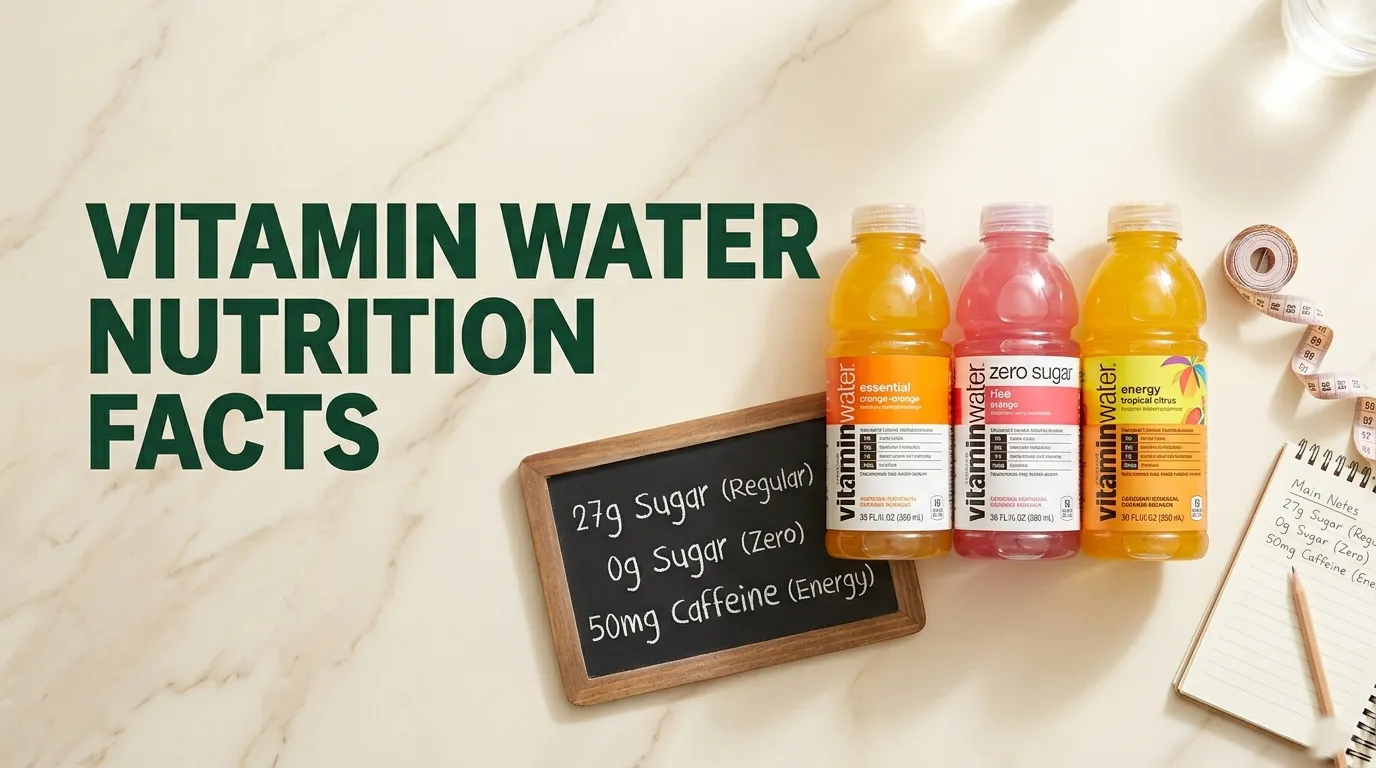
A standard 20 oz bottle of regular Vitaminwater contains 100 calories, 27 grams of added sugar, and 0 grams of fat or protein . The drink provides 200-250% of your daily Vitamin C needs and 100% of several B vitamins, plus trace amounts of electrolytes like calcium, magnesium, and potassium .
According to the American Heart Association, women should consume no more than 25 grams of added sugar per day, and men no more than 36 grams. One bottle of regular Vitaminwater contains 27 grams — exceeding a woman’s entire daily limit and providing 75% of a man’s limit. The Zero Sugar line eliminates this problem entirely, sweetening with stevia and monk fruit instead .
This guide breaks down nutrition facts for every Vitaminwater line — regular, Zero, and Energy — compares sugar content, explains what those vitamin percentages actually mean for your body, and answers whether this popular drink deserves a spot in your refrigerator.
vitamin water nutrition facts
Vitaminwater nutrition facts vary by product line, but all versions contain zero fat, zero protein, and are primarily flavored water with added vitamins and sweeteners. The regular line is sweetened with crystalline fructose and cane sugar, while the Zero line uses stevia and monk fruit extract .
Core nutritional profile comparison:
| Nutrient | Regular Vitaminwater (20 oz) | Vitaminwater Zero (20 oz) | Vitaminwater Energy (16.9 oz) |
|---|---|---|---|
| Calories | 100 | 0-5 | 90 |
| Total Fat | 0g | 0g | 0g |
| Total Carbohydrates | 27-28g | 0-1g | 22-23g |
| Total Sugar | 27g added sugar | 0g | 22-23g |
| Protein | 0g | 0g | 0g |
| Sodium | 0mg (most flavors) | 0-210mg | 0mg |
The table above shows the stark difference between product lines. The regular line delivers 100% of its calories from added sugar. The Zero line achieves sweetness without any sugar or meaningful calories. The Energy line adds caffeine (approximately 50mg) to the regular formula .
Key Takeaway: The single biggest nutritional difference between Vitaminwater lines is sugar content. Regular = 27g sugar. Zero = 0g sugar. Choose accordingly.
glaceau vitamin water nutrition facts
Glacéau (owned by Coca-Cola) manufactures Vitaminwater, and the nutrition facts on every bottle are consistent across retail channels. The Multi-V Lemonade flavor, for example, contains 50 calories per 8 fl oz serving (130 calories per full bottle) with 13g sugar per serving .
Popular flavors and their nutrition (regular line):
| Flavor | Bottle Size | Calories | Sugar | Key Vitamins |
|---|---|---|---|---|
| XXX Acai Blueberry Pomegranate | 20 oz | 100 | 26g | C 200%, B3/B6/B12 100%, Se 50% |
| Power-C Dragonfruit | 20 oz | 100 | 27g | C 200%, B6/B12 100%, Zn 25% |
| Essential Orange-Orange | 20 oz | 100 | 27g | C 250%, B3/B6/B12 100%, A/E/Zn 25% |
| Elevate Blue Raspberry Limeade | 16.9 oz | 90 | 22g | C 50%, B3/B5/B6 100%, Se 50% |
| Multi-V Lemonade | 20 oz | 130 (2.5 svgs) | 32.5g | C 100%, B3/B5/B6/B12 40% |
Note that Multi-V Lemonade’s serving size confusion (listed as 2.5 servings per bottle) means many drinkers consume 130 calories and 32.5g sugar without realizing it . Always check whether the label is per bottle or per serving.
The 2024-2025 FAO/AGRIS quality control study found that 64% of fortified beverages had at least one vitamin present below label claim, and nearly half (48.4%) had vitamin contents outside the allowed 65-150% tolerance interval . This means the vitamins listed on the label may not accurately reflect what is actually in the bottle.
Key Takeaway: Glacéau publishes consistent nutrition data across flavors, but beware of serving size tricks. Multi-V Lemonade has 2.5 servings per bottle — most people drink the whole thing.
vitamin water nutrition facts label
The Vitaminwater nutrition facts label lists calories, total carbohydrates (from sugar), added sugar grams, and % Daily Values for added vitamins and minerals. Understanding each section helps you make informed choices.
Anatomy of a Vitaminwater label (Essential Orange-Orange, 20 oz):
| Label Section | What It Shows | Amount | What It Means |
|---|---|---|---|
| Serving Size | 1 bottle | 20 fl oz (591 mL) | One container = one serving |
| Calories | Energy per bottle | 100 | 5% of 2,000 calorie diet |
| Total Carbohydrates | 27g | 27g | 10% DV |
| Total Sugars | 27g | 27g | All added sugar |
| Added Sugars | 27g | 27g | 54% DV (exceeds daily limit) |
| Vitamin C | 250% DV | 250% | Far exceeds daily need |
| Vitamin B3 (Niacin) | 100% DV | 100% | Meets daily need |
| Vitamin B6 | 100% DV | 100% | Meets daily need |
| Vitamin B12 | 100% DV | 100% | Meets daily need |
| Vitamin A | 25% DV | 25% | Contributes to daily need |
| Vitamin E | 25% DV | 25% | Contributes to daily need |
| Zinc | 25% DV | 25% | Contributes to daily need |
The added sugar line is critical. At 27g (54% DV), one bottle provides more than half the recommended daily maximum for added sugar — and exceeds the American Heart Association’s 25g daily limit for women .
The high %DV for water-soluble vitamins (B complex and C) is not harmful. These vitamins are excreted in urine when consumed in excess. However, a 2014 academic study noted that with the exception of vitamin C, “there was no discernible prevalence of inadequacy among young Canadian adults for the nutrients” most commonly found in these products . In plain English: most people already get enough of these vitamins from food.
Key Takeaway: The most important numbers on the label are Added Sugars (54% DV) and the fact that most vitamin %DVs exceed what your body actually needs.
vitamin water regular calories
Regular Vitaminwater contains 100 calories per 20 oz bottle (or 90 calories per 16.9 oz bottle for some flavors) . All of these calories come from added sugar — there is no fat, no protein, and no fiber to slow sugar absorption.
Calorie comparison across regular flavors:
| Flavor | Bottle Size | Calories | Calories from Sugar |
|---|---|---|---|
| XXX Acai Blueberry Pomegranate | 20 oz | 100 | 100 (100%) |
| Power-C Dragonfruit | 20 oz | 100 | 100 (100%) |
| Essential Orange-Orange | 20 oz | 100 | 100 (100%) |
| Elevate Blue Raspberry Limeade | 16.9 oz | 90 | 90 (100%) |
| Multi-V Lemonade (full bottle) | 20 oz | 130 | 130 (100%) |
For perspective, 100 calories represents 5% of a 2,000 calorie daily diet. While not excessive on its own, these are “empty calories” — they provide energy without any nutritional benefit beyond the added vitamins (which most people already get from food).
A 100-calorie sugar-sweetened beverage daily adds 36,500 calories per year. At 3,500 calories per pound of body fat, that is approximately 10 pounds of potential weight gain annually if not offset by reduced intake elsewhere or increased activity.
For weight management, the Zero line eliminates these calories entirely while providing similar vitamin fortification. The regular line functions as a sweet treat with vitamins added — not a health drink.
Key Takeaway: Regular Vitaminwater’s 100 calories come entirely from sugar. This is fine as an occasional treat but problematic as a daily habit.
vitamin water sugar content
Regular Vitaminwater contains 22-28 grams of added sugar per bottle, depending on flavor and size. The primary sweeteners are crystalline fructose and cane sugar . This sugar content is the single most important nutrition fact to understand.
Sugar content by flavor (full bottle):
| Flavor | Bottle Size | Added Sugar | % Daily Value (50g limit) | Teaspoon Equivalent |
|---|---|---|---|---|
| Essential Orange-Orange | 20 oz | 27g | 54% | 6.75 tsp |
| Power-C Dragonfruit | 20 oz | 27g | 54% | 6.75 tsp |
| XXX Acai Blueberry | 20 oz | 26g | 52% | 6.5 tsp |
| Elevate Blue Raspberry | 16.9 oz | 22g | 44% | 5.5 tsp |
| Multi-V Lemonade | 20 oz | 32.5g | 65% | 8.1 tsp |
How this compares to daily limits:
| Guideline | Daily Added Sugar Limit | One bottle of Essential = |
|---|---|---|
| Dietary Guidelines (10% of calories) | 50g (2,000 cal diet) | 54% of limit |
| AHA — Women | 25g | 108% of limit |
| AHA — Men | 36g | 75% of limit |
| WHO recommendation | <25g (ideal) | 108% of limit |
One bottle of regular Vitaminwater exceeds the entire daily added sugar limit for women and provides three-quarters of the limit for men.
The sugar comes from crystalline fructose, a highly refined sweetener. Unlike the fructose naturally present in whole fruit (which comes with fiber that slows absorption), crystalline fructose enters the bloodstream rapidly, causing blood sugar spikes.
People with diabetes, prediabetes, insulin resistance, or fatty liver disease should avoid regular Vitaminwater entirely and choose the Zero line instead.
Key Takeaway: Regular Vitaminwater is a sugar-sweetened beverage first and a vitamin drink second. One bottle exceeds a woman’s entire daily sugar limit.
vitamin water zero nutrition facts
Vitaminwater Zero contains 0 grams of sugar, 0-5 calories, and 0-1 gram of carbohydrates per bottle. It is sweetened with stevia leaf extract and monk fruit extract instead of crystalline fructose and cane sugar .
Zero Sugar line nutrition by flavor (20 oz bottle):
| Flavor | Calories | Sugar | Carbs | Key Vitamins |
|---|---|---|---|---|
| XXX (Acai Blueberry) | 0-5 | 0g | 0g | C 200%, B3/B5/B6/B12 100%, Se 50% |
| Squeezed (Lemonade) | 0-5 | 0g | 1g | C 50%, B3/B5/B6 100%, A/E/Biotin 25% |
| Rise (Orange) | 0-5 | 0g | 1g | C 250%, B3/B5/B6/B12 100%, A/E/Zn 25% |
| Power-C (Dragonfruit) | 0-5 | 0g | 0g | C 200%, B6/B12 100%, Zn 25%, Cr 25% |
The Zero line uses stevia leaf extract as the primary sweetener. Stevia is approximately 200-400 times sweeter than sugar but contains no calories and does not raise blood glucose . Monk fruit extract provides additional sweetness.
Sweetener comparison:
| Sweetener | Calories per gram | Glycemic impact | Aftertaste concerns |
|---|---|---|---|
| Crystalline fructose (regular) | 4 | High spike | None |
| Stevia leaf extract (Zero) | 0 | None | Bitter aftertaste for some |
| Monk fruit extract (Zero) | 0 | None | Mild, generally well tolerated |
For people managing diabetes, the Zero line is safe and will not raise blood sugar. For weight management, the Zero line eliminates the 100 empty calories found in regular Vitaminwater.
However, a 2014 academic analysis noted that product labels “promoted performance and emotional benefits related to nutrient formulations that go beyond conventional nutritional science” . In plain English: the marketing claims about what these vitamins will do for you are not supported by evidence.
Key Takeaway: Vitaminwater Zero solves the sugar problem completely. It is a much better choice than regular Vitaminwater, but the vitamin benefits are still overhyped.
vitamin water zero sugar nutrition
Vitaminwater Zero Sugar (the same as Vitaminwater Zero) contains 0g added sugar and 0-5 calories, sweetened exclusively with plant-based, zero-calorie sweeteners. The nutritional profile is dramatically different from the regular line.
Regular vs Zero Sugar side-by-side (Essential/Orange flavor):
| Nutrient | Regular Orange-Orange | Zero Sugar Rise (Orange) |
|---|---|---|
| Calories | 100 | 0-5 |
| Total Sugar | 27g | 0g |
| Added Sugar | 27g (54% DV) | 0g (0% DV) |
| Carbohydrates | 28g | 1g |
| Vitamin C | 250% DV | 250% DV |
| B Vitamins | 100% DV each | 100% DV each |
| Vitamin A/E | 25% DV | 25% DV |
| Zinc | 25% DV | 25% DV |
Which populations should choose Zero Sugar over Regular:
- People with diabetes or prediabetes (Zero Sugar has no glycemic impact)
- People trying to lose weight (saves 100 calories per bottle)
- Parents buying for children (children do not need added sugar)
- Anyone limiting added sugar for heart health or metabolic reasons
A study in Applied Physiology, Nutrition, and Metabolism found that almost every vitamin water beverage provided at least one nutrient “in excess of requirements, and most contained 3 or more nutrients at such levels” . This applies to both Regular and Zero lines — the excess vitamins are identical.
The Zero line does not magically make the vitamins necessary. It simply removes the sugar problem. For someone who enjoys the taste and wants a zero-calorie flavored beverage, Zero is a reasonable choice. For someone seeking genuine health benefits from the vitamins, plain water and a balanced diet are better.
Key Takeaway: Zero Sugar Vitaminwater eliminates the sugar concern entirely. It is a vastly better choice than regular Vitaminwater for daily consumption.
vitamin water energy nutrition facts
Vitaminwater Energy contains 90 calories and 22-23 grams of added sugar per 16.9 oz bottle, plus approximately 50mg of caffeine from guarana seed extract . This line bridges Vitaminwater and energy drinks.
Energy line nutrition (Tropical Citrus, 16.9 oz bottle):
| Nutrient | Amount | % Daily Value |
|---|---|---|
| Calories | 90 | 4.5% |
| Total Carbohydrates | 23g | 8% |
| Total Sugars | 23g | – |
| Added Sugars | 23g | 46% |
| Protein | 0g | 0% |
| Fat | 0g | 0% |
| Sodium | 0mg | 0% |
| Caffeine | ~50mg | – |
| Niacin (B3) | 80% DV | 80% |
| Vitamin C | Present (amount varies) | – |
Caffeine comparison:
| Beverage | Caffeine per serving |
|---|---|
| Vitaminwater Energy (16.9 oz) | ~50mg |
| Cup of coffee (8 oz) | 95-165mg |
| Green tea (8 oz) | 25-35mg |
| Standard energy drink (16 oz) | 150-200mg |
The caffeine in Vitaminwater Energy comes from guarana seed extract (Paullinia cupana), a plant native to the Amazon that naturally contains caffeine . This is listed as “guarana seed extract” on the ingredient label, not as isolated caffeine.
For people sensitive to caffeine, this 50mg dose is noticeable but manageable. For reference, one cup of coffee contains approximately twice that amount.
Key Takeaway: Vitaminwater Energy adds 50mg caffeine and 23g sugar to the regular formula. It is a lighter alternative to standard energy drinks but still contains significant added sugar.
vitamin water caffeine content
Only the Vitaminwater Energy line contains caffeine (approximately 50mg per 16.9 oz bottle). Regular Vitaminwater and Vitaminwater Zero contain zero caffeine .
Caffeine content by line:
| Product Line | Caffeine | Source |
|---|---|---|
| Regular Vitaminwater (all flavors) | 0mg | No caffeine |
| Vitaminwater Zero (all flavors) | 0mg | No caffeine |
| Vitaminwater Energy (Tropical Citrus) | ~50mg | Guarana seed extract |
| Vitaminwater Energy (other Energy flavors) | ~50mg | Guarana seed extract |
The caffeine in Energy comes from guarana, which contains approximately twice the caffeine concentration of coffee beans by weight. However, the total caffeine per bottle (~50mg) is less than a standard cup of coffee (95-165mg).
Who should avoid Vitaminwater Energy:
- People sensitive to caffeine (anxiety, insomnia, heart palpitations)
- Pregnant women (limit caffeine to 200mg daily — one Energy is fine, but be mindful of total intake)
- Children and adolescents (caffeine not recommended)
- People taking stimulant medications
The regular and Zero lines are caffeine-free and safe for people avoiding stimulants.
Key Takeaway: Only the Energy line has caffeine (50mg per bottle). Regular and Zero lines are caffeine-free.
vitamin water ingredients list
Vitaminwater ingredients vary by line, but all start with reverse osmosis water as the base. The regular line adds crystalline fructose and cane sugar for sweetness, while the Zero line uses stevia and monk fruit extract .
Regular line ingredients (Essential Orange-Orange):
Reverse osmosis water, crystalline fructose, less than 0.5% of: vitamins A, C, E, B3, B5, B6, B12 (beta-carotene, ascorbic acid, alpha-tocopheryl acetate, niacinamide, calcium pantothenate, pyridoxine hydrochloride, cyanocobalamin), electrolytes (calcium and magnesium lactates and potassium phosphate), zinc gluconate, cane sugar, citric acid, gum acacia, glycerol ester of rosin, natural flavors, beta-carotene (for color) .
Vitaminwater Zero ingredients (Rise Orange):
Reverse osmosis water, less than 0.5% of: natural flavors, electrolytes (calcium and potassium phosphates and calcium and magnesium lactates), vitamins A, C, E, B3, B5, B6, B12 (beta-carotene, ascorbic acid, alpha-tocopheryl acetate, niacinamide, calcium pantothenate, pyridoxine hydrochloride, cyanocobalamin), citric acid, beta carotene (for color), stevia leaf extract, phosphoric acid, monk fruit extract, zinc gluconate .
Ingredient function breakdown:
| Ingredient | Purpose |
|---|---|
| Reverse osmosis water | Purified water base |
| Crystalline fructose | Sweetener (regular line only) |
| Stevia leaf extract | Zero-calorie sweetener (Zero line) |
| Monk fruit extract | Zero-calorie sweetener (Zero line) |
| Vitamins (various forms) | Nutrient fortification |
| Electrolytes (calcium/magnesium/potassium salts) | Mineral addition for hydration marketing |
| Citric acid | Preservative, flavor |
| Natural flavors | Taste |
| Beta-carotene | Color (vitamin A precursor) |
Key Takeaway: Ingredients are generally safe. The difference between lines is primarily sweetener type — sugar (regular) vs stevia/monk fruit (Zero).
vitamin water b vitamin content
Vitaminwater is heavily fortified with B vitamins, typically providing 100% of the Daily Value for niacin (B3), pantothenic acid (B5), pyridoxine (B6), and cyanocobalamin (B12) per bottle .
B vitamin content per bottle (most flavors):
| B Vitamin | Amount per bottle | % Daily Value | Function |
|---|---|---|---|
| Niacin (B3) | Varies | 100% | Energy metabolism, DNA repair |
| Pantothenic Acid (B5) | Varies | 100% | Fatty acid synthesis |
| Pyridoxine (B6) | Varies | 100% | Amino acid metabolism, neurotransmitter synthesis |
| Cyanocobalamin (B12) | Varies | 100% | Red blood cell formation, nerve function |
| Biotin (B7) | Varies | 25% (some flavors) | Hair, skin, nail health |
Do you need these B vitamins?
The NIH Office of Dietary Supplements states that B vitamin deficiencies are rare in developed countries with varied diets. Most people get adequate B vitamins from foods like meat, eggs, dairy, legumes, and fortified grains.
A 2014 academic analysis of vitamin waters concluded: “With the exception of vitamin C, there was no discernible prevalence of inadequacy among young Canadian adults for the nutrients most commonly found in these products” . The researchers also noted that product marketing “promoted performance and emotional benefits related to nutrient formulations that go beyond conventional nutritional science” .
B vitamins are water-soluble. When you consume more than your body needs, the excess is excreted in urine. The 100% DV in Vitaminwater provides no additional benefit over getting these vitamins from food, because any amount beyond what your body can use is simply eliminated.
Key Takeaway: B vitamins are real and present at 100% DV, but most people already get enough from food. The excess is excreted — expensive urine, as nutritionists say.
vitamin water daily value percentages
Vitaminwater labels show % Daily Values ranging from 25% to 250% for various vitamins and minerals. Understanding what these percentages mean helps you interpret whether the fortification is meaningful for your health.
Typical %DV in regular Vitaminwater (Essential Orange-Orange, 20 oz):
| Nutrient | % Daily Value | Amount per bottle | Interpretation |
|---|---|---|---|
| Added Sugar | 54% | 27g | Exceeds AHA women’s daily limit |
| Vitamin C | 250% | ~150mg | Far exceeds daily need (90mg for men, 75mg for women) |
| Niacin (B3) | 100% | 16mg NE | Meets daily need (16mg NE for adults) |
| Vitamin B6 | 100% | 1.7mg | Meets daily need (1.3-1.7mg for adults) |
| Vitamin B12 | 100% | 2.4mcg | Meets daily need (2.4mcg for adults) |
| Pantothenic Acid (B5) | 100% | 5mg | Meets daily need (5mg for adults) |
| Vitamin A | 25% | 225mcg RAE | Contributes to daily need (700-900mcg) |
| Vitamin E | 25% | 3.75mg | Contributes to daily need (15mg) |
| Zinc | 25% | 3.75mg | Contributes to daily need (8-11mg) |
What 250% DV for Vitamin C means:
Your body can only absorb and use a limited amount of vitamin C at once — approximately 100-200mg. The excess is excreted. Drinking Vitaminwater provides no additional benefit over a much smaller dose from food or a basic multivitamin.
A 2024-2025 fortified beverage quality control study found that vitamin contents in these products can exceed daily needs by up to 616% of reference values, an effect “further accentuated in children” . The study concluded that these products “not only fully cover but in several cases considerably exceed daily vitamin needs.”
Key Takeaway: High %DV numbers look impressive but provide no additional health benefit over adequate intake. Your body simply excretes the excess.
is vitamin water healthy
Vitaminwater is not a health drink — it is sugar water with added vitamins for most of the regular line, and flavored water with added vitamins for the Zero line. The answer to “is it healthy” depends entirely on which line you choose and your baseline diet.
Regular Vitaminwater verdict:
| Factor | Assessment |
|---|---|
| Sugar content | Unhealthy (27g per bottle, 54% DV) |
| Vitamin benefit | Minimal for most people (already get from food) |
| Calories from sugar | 100 empty calories |
| Overall verdict | Treat, not daily drink |
Vitaminwater Zero verdict:
| Factor | Assessment |
|---|---|
| Sugar content | Healthy (0g) |
| Vitamin benefit | Minimal for most people (already get from food) |
| Calories | 0-5 — essentially zero |
| Sweeteners | Stevia and monk fruit (generally recognized as safe) |
| Overall verdict | Acceptable occasional drink, but plain water is better |
Vitaminwater Energy verdict:
| Factor | Assessment |
|---|---|
| Sugar content | Unhealthy (23g per bottle) |
| Caffeine | Mild (50mg) — safe for most adults |
| Overall verdict | Treat, not daily drink — coffee is better |
A 2014 academic analysis concluded: “In contrast with the on-package marketing of novel beverages, there is little evidence that consumers stand to benefit from the micronutrients most commonly found in these products” .
The marketing claims on Vitaminwater bottles — “elevate,” “power,” “essential” — are not supported by scientific evidence. The vitamins provide no benefit to people who already eat a balanced diet.
Key Takeaway: Regular Vitaminwater is sugar water. Zero Vitaminwater is flavored water. Neither provides meaningful health benefits beyond plain water for most people.
vitamin water electrolytes
Vitaminwater contains electrolytes — calcium, magnesium, and potassium in the form of lactates and phosphates — in both regular and Zero lines . These are added primarily for marketing as a “hydration” beverage.
Electrolyte content by line:
| Electrolyte | Regular Line | Zero Line | Function |
|---|---|---|---|
| Calcium | Present (as calcium lactate/phosphate) | Present | Muscle contraction, bone health |
| Magnesium | Present (as magnesium lactate) | Present | Muscle relaxation, nerve function |
| Potassium | Present (as potassium phosphate) | Present | Fluid balance, blood pressure |
| Sodium | 0mg (most flavors) | 0-210mg | Fluid retention, electrolyte balance |
Are these electrolytes useful for hydration?
For everyday hydration (sitting at a desk, walking around), plain water is sufficient. Your body does not need supplemental electrolytes for normal daily activities.
For exercise lasting longer than 60 minutes or heavy sweating in heat, the sodium content is the most important electrolyte to replace. Most Vitaminwater flavors contain 0mg sodium , making them ineffective as sports rehydration drinks despite marketing as “enhanced water.”
Some Zero flavors (like Rise) contain trace amounts of sodium, but the amounts are not significant compared to true sports drinks that contain 200-300mg sodium per serving.
Key Takeaway: The electrolytes in Vitaminwater are not harmful, but they are also not particularly useful for most people. Plain water hydrates just as well.
vitamin water vs plain water
Plain water is healthier and more cost-effective than Vitaminwater for daily hydration. The comparison below shows why.
Head-to-head comparison:
| Factor | Plain Water | Regular Vitaminwater | Vitaminwater Zero |
|---|---|---|---|
| Cost per gallon | $0.005 (tap) | $8-12 | $8-12 |
| Calories | 0 | 100 | 0-5 |
| Sugar | 0g | 27g | 0g |
| Added vitamins | None | 100-250% DV | 100-250% DV |
| Hydration effectiveness | Gold standard | Equal to water | Equal to water |
| Environmental impact | Minimal (tap) | Plastic bottle waste | Plastic bottle waste |
When Vitaminwater might make sense:
- Transitioning from soda to healthier options (Zero line helps reduce sugar addiction)
- Someone who genuinely will not drink plain water (any fluid is better than none)
- Occasional treat (regular line) rather than daily habit
When plain water is better:
- Daily hydration
- Weight management (no calories to account for)
- Budget consciousness
- Environmental concerns (tap water vs plastic bottles)
- Anyone who already eats a balanced diet (vitamins are unnecessary)
A 2024-2025 fortified beverage quality study noted that “owing to their regulation as foods, there are also growing quality and safety concerns” with vitamin-fortified beverages, including vitamin contents outside label claims in nearly half of tested products . Plain water has no such quality control issues.
Key Takeaway: Plain water wins on cost, health, environment, and simplicity. Vitaminwater only makes sense if you absolutely cannot stand plain water or are using Zero as a transition away from soda.
Frequently Asked Questions About Vitamin Water Nutrition Facts
How much sugar is in a bottle of Vitaminwater?
Regular Vitaminwater contains 22-28 grams of added sugar per bottle (depending on flavor and size). The primary sweeteners are crystalline fructose and cane sugar . Vitaminwater Zero contains 0 grams of sugar, sweetened with stevia and monk fruit extract .
Is Vitaminwater Zero actually sugar-free?
Yes. Vitaminwater Zero contains 0 grams of sugar and 0 grams of added sugar. It is sweetened with stevia leaf extract and monk fruit extract, both plant-derived zero-calorie sweeteners . The Zero line has 0-5 calories per bottle.
How much caffeine is in Vitaminwater Energy?
Vitaminwater Energy contains approximately 50mg of caffeine per 16.9 oz bottle, sourced from guarana seed extract . Regular Vitaminwater and Vitaminwater Zero contain 0mg caffeine.
Are the vitamins in Vitaminwater actually absorbed by your body?
Yes, water-soluble vitamins (B complex and C) are absorbed, but your body excretes any excess in urine. Most people already get adequate amounts of these vitamins from food. A 2014 academic study concluded there is “little evidence that consumers stand to benefit from the micronutrients most commonly found in these products” .
Is Vitaminwater healthier than soda?
Regular Vitaminwater (100 calories, 27g sugar) is slightly better than regular soda (150 calories, 39g sugar in 12 oz) on a per-ounce basis, but both are sugar-sweetened beverages that should be consumed occasionally . Vitaminwater Zero (0 calories, 0g sugar) is significantly healthier than regular soda and comparable to diet soda.
Can you drink Vitaminwater every day?
Regular Vitaminwater should not be consumed daily due to its 27g added sugar content — exceeding the AHA’s 25g daily limit for women in one bottle . Vitaminwater Zero can be consumed daily without sugar concerns, but plain water remains the healthier, cheaper, more environmentally friendly choice.
Vitaminwater is a masterclass in marketing. The colorful bottles, creative names (“Power-C,” “Elevate,” “Essential”), and vitamin fortification make it look like a health drink. But the nutrition facts tell a different story.
Regular Vitaminwater contains 27g of added sugar per bottle — exceeding a woman’s entire daily sugar limit. It is sugar water with vitamins added. For people already eating a balanced diet, those vitamins provide no additional benefit because your body excretes the excess.
Vitaminwater Zero solves the sugar problem completely. At 0 calories and 0 sugar, it is a much better choice than the regular line. But it is still flavored water with vitamins you probably do not need — at $2-3 per bottle.
Plain water remains the gold standard for hydration. It is free, calorie-free, sugar-free, and environmentally friendly. If you enjoy Vitaminwater Zero as an occasional flavored beverage, drink it without guilt. Just do not mistake it for a health necessity.