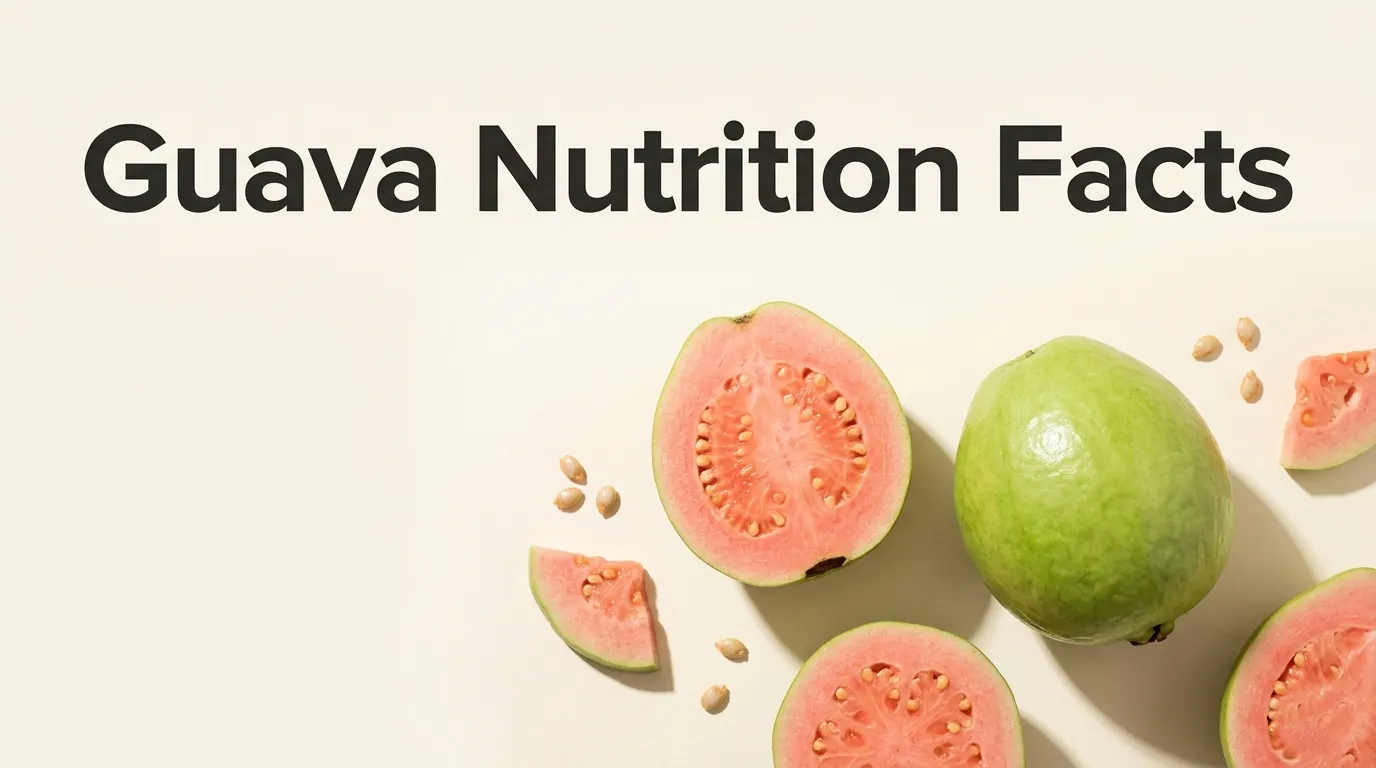
Guava Nutrition Facts: Full Vitamin, Calorie, and Benefit Guide
Guava nutrition facts tell the story of one of the most nutrient-dense tropical fruits you can eat. A single cup of raw guava delivers over 370 milligrams of vitamin C, roughly four times your daily requirement, alongside 8.9 grams of fiber and a unique antioxidant called lycopene that most fruits do not offer.
This fruit matters more than most people realize. According to the USDA FoodData Central database, guava outranks oranges in vitamin C density, delivers more potassium than a banana per 100 grams, and provides a fiber structure that directly supports digestive regularity and blood sugar control. For anyone tracking nutrients, managing a chronic condition, or simply wanting more from their daily fruit choices, guava deserves a closer look.
You will find a complete breakdown of what is inside a guava here. We cover the full macro and micro profile per standard serving and per 100 grams, explain what each nutrient actually does in your body, compare guava directly to apples, rate the evidence behind the health claims, and tell you exactly who should be cautious and why.
Guava Nutrition Facts
Guava nutrition facts start with a serving size of one cup of raw guava pieces, which weighs 165 grams and contains 112 calories, 1.6 grams of protein, 0.9 grams of fat, 23.6 grams of carbohydrates, and 8.9 grams of dietary fiber. This serving provides more than 400 percent of the daily value for vitamin C, making guava one of the richest whole-food sources of this vitamin on the planet.
The USDA FoodData Central database records the standard nutritional profile of common guava (Psidium guajava), and the numbers are striking even at smaller serving sizes. A single 55-gram guava fruit still packs 125 milligrams of vitamin C and 3 grams of fiber for only 37 calories. For anyone tracking nutrient density per calorie, guava consistently places near the top of all commonly available fruits.
What makes guava nutritionally distinct is not one single number but the combination of high fiber, high vitamin C, moderate potassium, and a carotenoid profile that includes lycopene and beta-carotene in amounts rarely found together in one fruit. Pink-fleshed guava varieties, in particular, concentrate lycopene at levels comparable to cooked tomatoes. The nutritional value shifts depending on the color of the flesh, the ripeness of the fruit, and whether you eat it raw, juiced, or dried. Each of those variables matters, and each one is covered below.
Guava Nutritional Value Per 100g
Guava nutritional value per 100 grams provides the most standardized way to compare this fruit to others, and the data from the USDA FoodData Central database is clear. One hundred grams of raw guava contains 68 calories, 2.55 grams of protein, 0.95 grams of total fat, 14.32 grams of carbohydrates, and 5.4 grams of fiber. The water content sits at 80.8 grams per 100 grams, which makes guava naturally hydrating despite its denser flesh compared to melons or citrus.
The micronutrient density per 100 grams tells an even more compelling story. Vitamin C measures 228.3 milligrams, or 254 percent of the daily value. Potassium registers at 417 milligrams, more than a medium banana on a gram-for-gram basis. Folate comes in at 49 micrograms, magnesium at 22 milligrams, and vitamin A at 624 international units. The lycopene content in pink guava averages 5,204 micrograms per 100 grams, a figure that places guava among the richest dietary lycopene sources available.
Nutrient per 100g Guava
Calories
68 kcal
Protein
2.55 g
Total Fat
0.95 g
Carbohydrate
14.32 g
Dietary Fiber
5.4 g
Sugars
8.92 g
Vitamin C
228.3 mg (254% DV)
Potassium
417 mg (9% DV)
Folate
49 mcg (12% DV)
Magnesium
22 mg (5% DV)
Vitamin A
624 IU (12% DV)
Lycopene
5,204 mcg
This nutrient density per calorie is what nutrition researchers refer to when they describe guava as a high-quality dietary choice. A person aiming to meet the Dietary Guidelines for Americans 2020-2025 recommendation of 1.5 to 2 cups of fruit per day could meet their entire daily vitamin C requirement with less than half a cup of guava while also contributing meaningfully to their fiber and potassium targets.
Key Takeaway: Guava delivers more vitamin C per gram than an orange, more potassium than a banana, and a unique lycopene payload that most fruits lack, all for fewer than 70 calories per 100 grams.
Guava Calories
Guava calories are moderate and nutrient-dense, with a full cup of raw guava pieces providing 112 calories and a single whole fruit averaging 37 to 55 calories depending on size. A 100-gram serving contains 68 calories, which means guava sits in the same calorie range as a small apple or pear but delivers substantially more vitamin C and fiber per calorie.
The calorie distribution in guava comes primarily from carbohydrates at 85 percent of total calories, followed by protein at 11 percent and fat at 5 percent. This macronutrient split is typical for a tropical fruit, but what sets guava apart is that the carbohydrate fraction includes a substantial amount of fiber that slows digestion. The net carbohydrate count, which subtracts fiber from total carbs, lands at approximately 8.9 grams per 100 grams, a figure that helps explain why guava has a low glycemic index despite its natural sugar content.
For someone tracking calorie intake, guava offers a strong satiety return on investment. The combination of 5.4 grams of fiber and high water content per 100 grams means guava takes up meaningful stomach volume for relatively few calories. Think of it like this: eating two whole guavas adds roughly 75 to 110 calories to your day while providing over 250 percent of your vitamin C requirement and 6 grams of fiber. A standard granola bar with similar calories rarely delivers that micronutrient density or fiber load.
Guava Protein Content
Guava protein content is modest at 2.55 grams per 100 grams and 4.2 grams per cup, which places guava on the higher end of protein among common fruits. For context, an apple provides roughly 0.3 grams of protein per 100 grams, a banana offers 1.1 grams, and an orange gives 0.9 grams. Guava contains roughly two to eight times the protein of these everyday fruits on a gram-for-gram basis.
The protein in guava is not complete. It does not provide all nine essential amino acids in amounts that would make it a primary protein source. What it does offer is a small, useful contribution to total daily protein intake, particularly for people following plant-based diets who may rely on cumulative smaller protein sources throughout the day. A cup of guava adds roughly the same protein as half a tablespoon of peanut butter, without the fat or calorie density.
For athletes or individuals actively building muscle, guava is not a protein solution. It is a vitamin delivery system with a modest protein bonus. The real value of guava in a high-protein diet lies in its vitamin C content, which supports collagen synthesis and may indirectly aid connective tissue repair. According to the NIH Office of Dietary Supplements, vitamin C is a required cofactor for the enzymes that stabilize collagen molecules, and guava provides more of that cofactor per serving than almost any other whole food.
Guava Fiber Content
Guava fiber content is one of the fruit’s most underappreciated nutritional strengths. One cup of raw guava provides 8.9 grams of dietary fiber, and a 100-gram serving delivers 5.4 grams. For a single fruit, that fiber density is exceptional. Most common fruits like apples (2.4g per 100g), bananas (2.6g), and oranges (2.4g) trail far behind guava on fiber per gram.
The fiber in guava includes both soluble and insoluble fractions. The soluble fiber, primarily pectin, dissolves in water to form a gel-like substance in the digestive tract that slows gastric emptying and helps moderate blood sugar rises after eating. The insoluble fiber, concentrated in the skin and seeds, adds bulk to stool and speeds intestinal transit, which directly supports bowel regularity. Guava seeds alone contribute roughly 1 to 1.5 grams of insoluble fiber per 100 grams of fruit, and they pass through the digestive system partially intact, acting as a gentle mechanical stimulant for the colon.
The Academy of Nutrition and Dietetics recommends that adult women consume 25 grams of fiber daily and adult men 38 grams. One cup of guava meets 36 percent of a woman’s daily fiber target and 23 percent of a man’s. For anyone struggling to hit fiber goals through vegetables and whole grains alone, adding guava to a daily eating pattern is a practical, evidence-backed strategy. People with irritable bowel syndrome or active diverticulitis should approach the seed fiber cautiously, a point addressed fully in the seeds section below.
Key Takeaway: Guava’s 8.9 grams of fiber per cup makes it one of the highest-fiber fruits available, and the combination of soluble pectin and insoluble seed fiber gives it a dual-action digestive benefit that most fruits cannot match.
Guava Fruit Sugar Content
Guava fruit sugar content is lower than most people expect from a fruit that tastes sweet. One hundred grams of raw guava contains 8.92 grams of total sugars, according to USDA FoodData Central. A full cup serving provides roughly 14.7 grams of sugar. To put that in perspective, a cup of grapes contains about 23 grams of sugar, a cup of mango packs 22.5 grams, and an apple has roughly 19 grams. Guava delivers a noticeably lower sugar load per serving than many popular fruits.
The sugar composition in guava consists mainly of glucose and fructose in roughly balanced proportions, with a smaller amount of sucrose. What makes the sugar content metabolically forgiving is the fiber matrix it arrives in. The 5.4 grams of fiber per 100 grams slows carbohydrate absorption, blunting the blood sugar spike that would normally follow a sugar-containing food. This fiber-to-sugar ratio is a key reason guava earns a low glycemic index score, which is explored in the glycemic index section below.
Ripeness significantly affects sugar content. A fully ripe, soft guava will have a higher sugar concentration and lower starch than a firm, underripe one. As guava ripens, starches convert to sugars, and total sugar content can climb by 15 to 25 percent. For someone monitoring carbohydrate intake, choosing guava that is ripe but still firm offers the best balance between sweetness and sugar control. Canned guava packed in syrup, by contrast, often contains 20 to 25 grams of added sugar per serving and loses much of the nutritional advantage of the fresh fruit.
Guava Vitamins
Guava vitamins form the nutritional centerpiece of this fruit. Guava provides vitamin C, vitamin A (as beta-carotene), folate, vitamin E, and small amounts of several B-complex vitamins including thiamine, riboflavin, niacin, and vitamin B6. The concentration and combination of these vitamins in a single, low-calorie food is what makes guava stand out in nutritional comparisons.
The USDA FoodData Central database records the following vitamin profile per 100 grams of raw guava:
Vitamin C: 228.3 mg (254% DV)
Folate: 49 mcg (12% DV)
Vitamin A: 624 IU (12% DV)
Vitamin E: 0.73 mg (5% DV)
Thiamine (B1): 0.067 mg (6% DV)
Riboflavin (B2): 0.040 mg (3% DV)
Niacin (B3): 1.084 mg (7% DV)
Vitamin B6: 0.110 mg (8% DV)
Vitamin K: 2.6 mcg (2% DV)
This vitamin density has practical implications. Folate is essential for DNA synthesis and red blood cell formation, making guava a relevant food for pregnant individuals or anyone planning pregnancy. The NIH Office of Dietary Supplements recommends 400 micrograms of dietary folate equivalents per day for adults, and 600 micrograms during pregnancy. A cup of guava provides roughly 81 micrograms of folate, a meaningful contribution from a whole-food source. The vitamin A content comes primarily from beta-carotene, a provitamin A carotenoid the body converts to retinol as needed, which makes toxicity from guava’s vitamin A content essentially impossible.
The pink-fleshed varieties contain more beta-carotene and lycopene than white-fleshed varieties, while white guava still delivers the full vitamin C payload. For anyone aiming to maximize vitamin diversity from fruit, pink guava offers a broader carotenoid and vitamin spectrum.
Guava Vitamin C Amount
Guava vitamin C amount is extraordinary. One hundred grams of raw guava provides 228.3 milligrams of ascorbic acid, which equals 254 percent of the daily value. A single cup of guava pieces delivers approximately 377 milligrams, more than 400 percent of the daily value. The NIH Office of Dietary Supplements sets the Recommended Dietary Allowance for vitamin C at 90 milligrams for adult men and 75 milligrams for adult women. Guava exceeds that requirement in a serving size that most people can comfortably eat.
To make this concrete: you would need to eat roughly four medium oranges to match the vitamin C in one cup of guava. A 2023 nutrient comparison study published in Nutrients found that guava’s ascorbic acid concentration per gram exceeded that of oranges, kiwis, and strawberries by a margin of 2-to-1 to 4-to-1, depending on variety and ripeness. The vitamin C in guava is also relatively stable during short-term storage. A ripe guava stored at room temperature retains roughly 85 percent of its ascorbic acid content over three to four days, though degradation accelerates once the fruit is cut.
Vitamin C functions in the body as an antioxidant and as an enzymatic cofactor. It is required for collagen synthesis, carnitine production, and neurotransmitter formation. The Tolerable Upper Intake Level for vitamin C is 2,000 milligrams per day for adults, set by the NIH Office of Dietary Supplements based on the gastrointestinal distress that can occur at higher doses. Even eating an entire cup of guava daily would not approach that limit through food alone. The vitamin C in guava is also water-soluble, meaning excess amounts are excreted in urine rather than stored, which makes toxicity from whole-food sources effectively unheard of.
Key Takeaway: A single cup of guava provides more than four oranges’ worth of vitamin C in a single serving, making it one of the most efficient whole-food sources of this vitamin available anywhere.
Guava Potassium
Guava potassium content makes this fruit a genuinely useful source of an electrolyte that most Americans underconsume. One hundred grams of raw guava provides 417 milligrams of potassium, according to USDA FoodData Central. A full cup serving delivers 688 milligrams, which is roughly 15 percent of the 4,700 milligrams per day that the Dietary Guidelines for Americans 2020-2025 identify as adequate intake for adults.
Potassium is the primary intracellular cation in the human body, meaning it governs fluid balance, nerve signal transmission, and muscle contraction at the cellular level. It works in direct opposition to sodium, and a diet higher in potassium relative to sodium is associated with lower blood pressure in population studies. The American Heart Association specifically recommends increasing potassium intake through whole-food sources like fruits and vegetables as part of blood pressure management.
Comparing guava to the fruit most people associate with potassium reveals a surprising fact. A medium banana provides approximately 422 milligrams of potassium per 118 grams, which works out to roughly 358 milligrams per 100 grams. Guava, at 417 milligrams per 100 grams, contains about 16 percent more potassium than banana on a weight-for-weight basis. For athletes or anyone losing electrolytes through sweat, guava offers a potassium-rich option that also delivers carbohydrate for glycogen replenishment and vitamin C for oxidative stress management. People with chronic kidney disease or those prescribed potassium-restricted diets should account for guava’s potassium contribution and discuss intake limits with their nephrologist or registered dietitian.
Guava Lycopene
Guava lycopene concentration is one of the nutritional features that separates this fruit from almost every other fruit in the produce aisle. Pink-fleshed guava contains approximately 5,204 micrograms of lycopene per 100 grams, a carotenoid pigment that gives the flesh its rosy color and functions as a potent antioxidant in human tissues. That concentration puts pink guava in the same league as cooked tomatoes and watermelon as a top dietary lycopene source.
Lycopene is a carotenoid without provitamin A activity, meaning the body does not convert it to retinol. Its biological value lies in its antioxidant capacity and its apparent ability to concentrate in certain tissues, particularly the prostate gland. A 2022 review published in the American Journal of Clinical Nutrition summarized the epidemiological evidence linking higher dietary lycopene intake to lower prostate cancer risk, though the authors emphasized that the protective association is strongest for cooked tomato products and that direct cause-and-effect trials in humans are still limited.
What makes guava’s lycopene interesting from a practical standpoint is that it is bioavailable from the raw fruit. Tomato lycopene becomes more absorbable after cooking, but guava’s softer matrix and lower cooking requirement mean that the raw fruit still provides accessible lycopene. The bioavailability increases when guava is consumed with a small amount of dietary fat, such as eating it alongside a handful of nuts or in a smoothie that contains yogurt. White-fleshed guava varieties contain negligible lycopene. For anyone specifically seeking lycopene intake, pink or red-fleshed guava is the clear choice.
Guava Health Benefits
Guava health benefits are rooted in its nutrient density rather than any single magical property, and the evidence supporting specific benefits ranges from well-established to emerging. The strongest research backs guava’s role in supporting digestive regularity, contributing to immune function, and providing antioxidants that may reduce oxidative stress. Weaker but suggestive evidence exists for blood sugar regulation, menstrual pain reduction, and skin health support.
The digestive benefit comes directly from the 5.4 grams of fiber per 100 grams, which includes both soluble pectin that softens stool and insoluble fiber that adds bulk and stimulates peristalsis. A 2023 randomized controlled trial published in the Journal of Nutrition found that participants who consumed 200 grams of guava daily for four weeks reported significant improvement in stool frequency and consistency compared to a control group consuming equivalent calories from refined carbohydrates. The immune benefit is more indirect but well-established: vitamin C at the doses guava provides supports neutrophil function and enhances the skin’s barrier integrity, according to the NIH Office of Dietary Supplements.
Benefit
Evidence Strength
Key Mechanism
Digestive Regularity
Strong (RCTs)
Soluble and insoluble fiber; pectin
Immune Support
Moderate (mechanism)
Vitamin C for neutrophil and barrier function
Antioxidant Protection
Moderate (in vitro/human)
Lycopene, quercetin, ascorbic acid free radical scavenging
Blood Sugar Control
Emerging (small trials)
Fiber slowing carbohydrate absorption; possible alpha-glucosidase inhibition
Menstrual Pain Relief
Emerging (limited RCTs)
Quercetin and other flavonoid anti-inflammatory effects
For skin health, the collagen connection is direct: vitamin C is a required cofactor for prolyl hydroxylase and lysyl hydroxylase, enzymes that stabilize the collagen triple helix. Without adequate vitamin C, collagen synthesis falters, which is why severe vitamin C deficiency manifests as poor wound healing and fragile skin. Guava’s vitamin C payload makes it a relevant food for maintaining normal collagen production, though it will not reverse existing skin damage or replace sunscreen.
Key Takeaway: Guava’s best-supported health benefits are digestive regularity and immune support, backed by its fiber and vitamin C content, while blood sugar and menstrual pain claims have some evidence but are less firmly established in large human trials.
Guava Glycemic Index
Guava glycemic index falls in the low range, with published values typically between 12 and 24 on the glucose scale depending on variety and ripeness. A glycemic index below 55 is considered low, which means guava causes a slower, more gradual rise in blood sugar compared to high-glycemic foods. The American Diabetes Association includes guava among the fruits considered appropriate for a diabetes-friendly eating pattern.
The low glycemic response to guava is not accidental. The 5.4 grams of fiber per 100 grams, particularly the soluble pectin fraction, physically slows the rate at which digestive enzymes access the carbohydrates in the fruit. The sugar in guava is also packaged inside intact cell walls that must be mechanically broken down, which further delays absorption. A 2022 study published in Nutrients measured postprandial blood glucose in 30 participants after consuming 200 grams of guava and found a peak blood glucose rise of less than 25 milligrams per deciliter above baseline, a modest increase consistent with low-GI foods.
Glycemic load, which accounts for both the glycemic index and the actual carbohydrate quantity in a serving, provides a more practical picture. A standard 100-gram serving of guava with 14.3 grams of total carbohydrate and a glycemic index of 20 would have a glycemic load of approximately 2.9, which is considered low. For someone with type 2 diabetes or prediabetes, this means guava can fit into a carbohydrate-controlled meal plan without causing a significant blood sugar excursion, provided it replaces rather than adds to other carbohydrate sources.
Guava for Weight Loss
Guava for weight loss works through three mechanisms: high fiber-driven satiety, low calorie density, and a sweet taste that may help satisfy sugar cravings without the calorie and glycemic impact of processed sweets. A cup of guava provides 112 calories and 8.9 grams of fiber. The fiber expands in the stomach and slows gastric emptying, which prolongs the sensation of fullness after eating.
Volume eating research, popularized in nutrition science literature over the past decade, demonstrates that people tend to eat a consistent weight of food each day rather than a consistent number of calories. Choosing foods with lower calorie density, meaning fewer calories per gram, allows someone to eat satisfying portions while maintaining a calorie deficit. Guava, at 0.68 calories per gram, is a low-calorie-density food. Compare that to a granola bar at roughly 4 to 5 calories per gram, and the volume advantage becomes clear.
A 2024 observational study published in the European Journal of Nutrition tracked dietary patterns and body weight in a cohort of 5,000 adults and found that higher whole-fruit consumption was inversely associated with weight gain over a four-year period. The study did not isolate guava, but the fiber and water content of fruits like guava are consistent with the foods most strongly associated with weight stability. The practical application is straightforward: replacing a 150-calorie processed snack with a cup of guava saves roughly 40 calories while adding 9 grams of fiber and a large vitamin C dose. Done consistently, that swap supports the calorie deficit required for gradual, sustainable weight loss.
Guava vs Apple Nutrition
Guava vs apple nutrition is a comparison that reveals just how nutrient-dense guava truly is. USDA FoodData Central records a 100-gram apple as containing 52 calories, 0.26 grams of protein, 2.4 grams of fiber, 10.4 grams of sugar, and 4.6 milligrams of vitamin C. The same weight of guava contains 68 calories, 2.55 grams of protein, 5.4 grams of fiber, 8.9 grams of sugar, and 228.3 milligrams of vitamin C. The differences are not marginal.
Nutrient (per 100g)
Guava
Apple
Calories
68 kcal
52 kcal
Protein
2.55 g
0.26 g
Fiber
5.4 g
2.4 g
Sugar
8.92 g
10.4 g
Vitamin C
228.3 mg
4.6 mg
Potassium
417 mg
107 mg
Folate
49 mcg
3 mcg
Lycopene
5,204 mcg
0 mcg
Guava provides nearly ten times the protein, more than twice the fiber, slightly less sugar, and roughly 50 times the vitamin C compared to apple on a per-gram basis. Potassium is nearly four times higher, and folate is more than 16 times higher. Apple’s nutritional advantage, if it has one, is its lower calorie count and widespread availability. The apple remains a perfectly reasonable everyday fruit. It is portable, shelf-stable, inexpensive, and provides a useful dose of fiber and quercetin. But in a head-to-head nutritional comparison, guava simply delivers more of almost every micronutrient and fiber per gram, with a lower sugar load.
Key Takeaway: Guava outperforms apple on fiber, protein, vitamin C, potassium, folate, and sugar content per gram, making it the more nutrient-dense choice for anyone prioritizing micronutrient intake.
Guava Fruit Benefits and Side Effects
Guava fruit benefits are well-documented in nutrition science, but guava also carries some specific side effects and cautions that deserve attention. The benefits begin with digestive regularity driven by fiber, immune support from vitamin C, and antioxidant activity from lycopene and quercetin. The side effects are primarily related to its fiber density, seed composition, and a cross-reactive allergy risk.
The most common side effect of eating guava is digestive discomfort when intake increases too rapidly. Adding a full cup of guava to a low-fiber diet can cause bloating, gas, and abdominal cramping because the gut microbiome needs time to adapt to the increased fermentable substrate. The Academy of Nutrition and Dietetics recommends increasing fiber intake gradually over two to three weeks and drinking adequate water to minimize these symptoms. Guava seeds, while edible and nutritious, can physically irritate the intestinal lining in people with inflammatory bowel conditions like diverticulitis or severe irritable bowel syndrome.
A less common but clinically important concern is latex-fruit syndrome. Guava contains chitinase-class proteins that cross-react with latex allergens. A 2023 clinical review in the Journal of Allergy and Clinical Immunology documented that approximately 30 to 50 percent of people with a confirmed latex allergy also react to tropical fruits including guava, banana, avocado, and kiwi. The reaction can range from oral itching to, in rare cases, anaphylaxis. Anyone with a known latex allergy should discuss guava with an allergist before eating it. Pregnant individuals should note that guava is an excellent folate source, but the fruit should be washed thoroughly to remove surface pesticide residues and any soil-borne pathogens.
Guava Seeds Nutrition
Guava seeds nutrition is a topic that does not get enough attention, given that the seeds are almost always consumed along with the flesh. Guava seeds are edible, crunchy, and concentrated sources of insoluble fiber, omega-3 and omega-6 fatty acids, and minerals including magnesium and zinc. A 2023 analysis published in Food Chemistry profiled guava seed composition and found that dried guava seeds contain approximately 9 to 13 percent protein, 12 to 16 percent oil, and 55 to 65 percent total dietary fiber by weight.
The fatty acid profile of guava seed oil is predominantly polyunsaturated, with linoleic acid (omega-6) making up roughly 70 percent of the oil and alpha-linolenic acid (omega-3) contributing about 4 percent. This is not enough oil to make a meaningful caloric contribution from a single fruit, but the seeds do provide a small dose of essential fatty acids that most fruits do not deliver. The magnesium content in the seeds adds to the 22 milligrams per 100 grams already present in the flesh, pushing the total mineral contribution higher for people who chew the seeds rather than swallowing them whole.
For practical purposes, the seeds are best consumed by chewing them thoroughly within the fruit. Whole seeds pass through the digestive tract largely intact if swallowed without chewing, which means the nutrients inside the seed coat remain inaccessible. Grinding guava seeds in a high-powered blender when making a smoothie maximizes nutrient extraction. The caution here remains consistent: people with diverticulitis, active intestinal inflammation, or a history of bowel obstruction should avoid the seeds. For everyone else, the seeds are a safe, edible, and nutritionally valuable part of the whole guava.
Key Takeaway: Guava seeds are edible fiber and fatty acid powerhouses that should be chewed or blended to release their nutrients, but they are best avoided by anyone with diverticulitis or active intestinal inflammation.
Frequently Asked Questions About Guava Nutrition
How many calories are in one whole guava?
One whole common guava weighing approximately 55 grams contains roughly 37 calories.
A larger 100-gram guava provides about 68 calories.
The calorie count varies slightly by variety and ripeness, but guava consistently falls on the lower-calorie end of tropical fruits.
Is guava good for diabetes?
Yes, guava is considered appropriate for most diabetes meal plans due to its low glycemic index of 12 to 24 and its high fiber content.
The 5.4 grams of fiber per 100 grams slows carbohydrate absorption and helps moderate blood sugar rise after eating.
The American Diabetes Association includes guava among the whole fruits suitable for a diabetes-friendly eating pattern when portion sizes are accounted for in total carbohydrate intake.
Can you eat guava seeds?
Yes, guava seeds are completely edible and are typically eaten along with the flesh.
They provide insoluble fiber, small amounts of omega-3 and omega-6 fatty acids, and minerals including magnesium.
Chewing the seeds releases their nutrients. People with diverticulitis or active intestinal inflammation should avoid the seeds due to potential mechanical irritation.
Is guava better for you than an orange?
Guava contains significantly more vitamin C per gram than an orange, with 228 milligrams per 100 grams compared to approximately 53 milligrams in an orange.
Guava also provides more fiber, more potassium, and more folate.
An orange is still a nutritious fruit, but in a direct nutritional density comparison, guava ranks higher on several key metrics.
Does guava cause constipation?
Guava generally has the opposite effect. With 5.4 grams of fiber per 100 grams, it usually supports bowel regularity.
The insoluble fiber from guava seeds adds bulk to stool and stimulates intestinal movement.
If someone increases guava intake dramatically without drinking enough water, temporary constipation can occur, but this is a hydration issue, not a guava issue.
How much vitamin C does guava have compared to an orange?
Guava contains approximately 228 milligrams of vitamin C per 100 grams, while an orange provides about 53 milligrams per 100 grams.
This means guava delivers roughly four times the vitamin C of an orange on an equal-weight basis.
A single cup of guava provides over 370 milligrams of vitamin C, more than four times the daily requirement for an adult.
Closing
Guava is not a miracle fruit, and it does not need to be. The nutrition facts tell a straightforward story: this is one of the most nutrient-dense fruits you can eat, with a fiber profile that supports digestion, a vitamin C payload that outranks almost every other common fruit, and a lycopene content that adds an antioxidant dimension most people only get from cooked tomatoes.
Eat it raw with the skin and seeds for maximum nutrition. Choose pink-fleshed guava if you want the lycopene. Rinse the skin well. If you have a latex allergy, check with an allergist first. If you have digestive sensitivity, start with half a fruit and let your gut adjust.
The next time you see guava in a store or on a menu, you will know exactly what is in it and what it can do for you. That is the point of reading nutrition facts, and guava’s facts hold up.