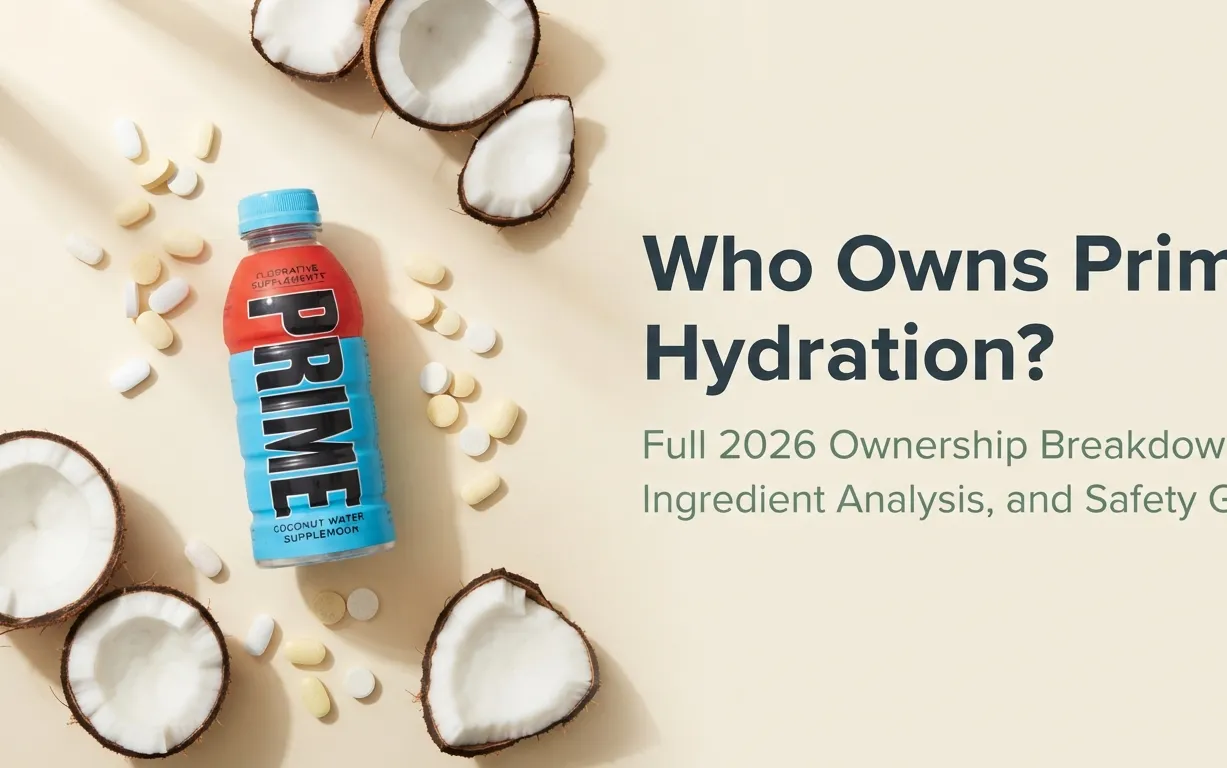
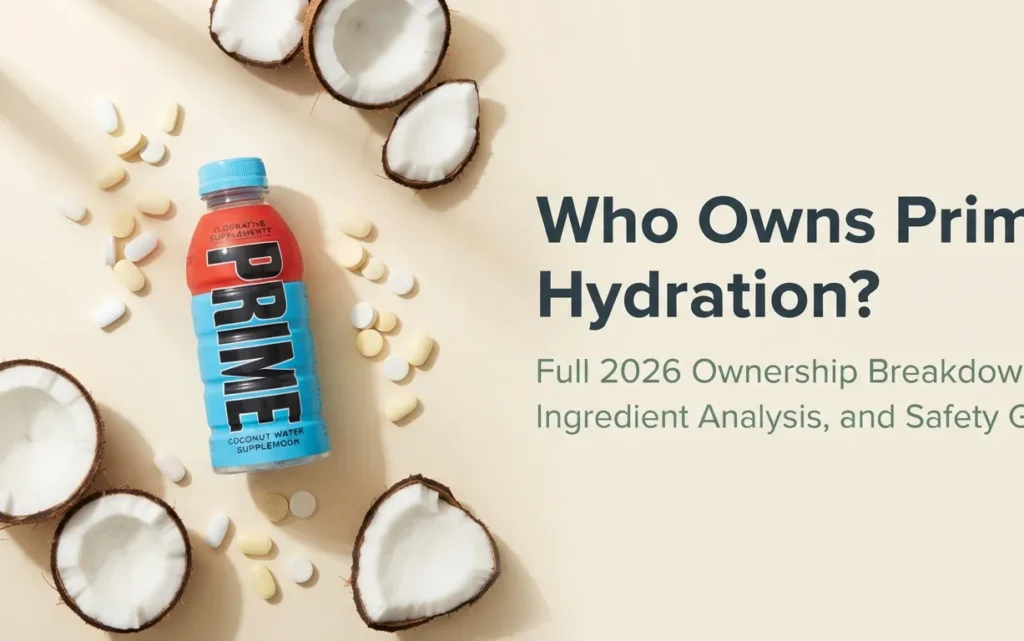
Who Owns Prime Hydration? Full 2026 Breakdown
Prime Hydration is co-owned by Logan Paul and Olajide “KSI” Olatunji through their joint brand entity Prime Hydration LLC, with manufacturing, formulation, and distribution handled by Congo Brands, a Louisville, Kentucky-based beverage company. The two YouTube personalities turned entrepreneurs are the public faces and majority stakeholders of the brand, while Congo Brands operates as the manufacturing partner and minority equity holder. This structure means the celebrity founders control the brand identity and marketing, and a seasoned beverage production company handles everything from ingredient sourcing to bottling to retail logistics.
Understanding who owns and makes Prime Hydration matters because the brand’s explosive growth since its January 2022 launch turned it into a cultural phenomenon. By 2023, Prime had reportedly surpassed $1.2 billion in retail sales, according to industry tracking data from NielsenIQ. When a beverage reaches that level of market penetration, especially one marketed to younger consumers, the ownership and manufacturing structure becomes a consumer safety and transparency question, not just a business curiosity. The FDA’s 2023 inquiry into Prime Energy’s caffeine content made this connection explicit.
This article gives you the complete ownership picture as of 2026. You will learn exactly who founded the brand, what role each entity plays in making the product, how the corporate structure works, the ingredients and nutrition facts in the bottle you are buying, the difference between Prime Hydration and Prime Energy, whether the product is safe for children, and what regulatory scrutiny has occurred. By the end, you will have the full context to decide whether this beverage belongs in your household.
Who Owns Prime Hydration
Logan Paul and KSI (Olajide Olatunji) are the co-owners and founders of Prime Hydration through their jointly held brand entity, Prime Hydration LLC. The two social media personalities conceived the brand, own the majority equity stake, control the marketing and creative direction, and serve as the public faces of the company. Their ownership is structured through a limited liability company that separates the Prime brand operations from their individual personal assets.
The partnership between Paul and KSI carries a notable backstory. The two were publicly known as rivals, having faced each other in two high-profile boxing matches in 2018 and 2019. The announcement of their business partnership in January 2022 surprised their combined audience of over 100 million followers. That surprise became a marketing asset. The origin story of rivals turning into business partners generated organic media coverage that no traditional advertising budget could replicate.
Neither Logan Paul nor KSI had prior experience in beverage formulation, manufacturing, or CPG retail distribution. Their contribution to the ownership structure is brand equity, audience reach, and marketing execution. The operational expertise comes from their manufacturing partner, which we will examine in detail. This division of labor is common in celebrity-backed consumer brands. The famous founders attract attention and build trust with their audience. The behind-the-scenes manufacturing partner handles the industrial reality of making millions of bottles.
Who Created Prime Hydration
Logan Paul and KSI created Prime Hydration as a brand concept and brought it to market in partnership with Congo Brands in January 2022. The initial product lineup consisted of five flavors of the caffeine-free Prime Hydration drink: Blue Raspberry, Grape, Ice Pop, Lemon Lime, and Orange. The creation story, as both founders have described in interviews, originated from conversations about entering the beverage market with a product that could compete against established sports drinks while carrying their personal brand credibility.
The creative direction of the brand, including the name, bottle design, flavor profiles, and marketing campaigns, was driven by Paul and KSI. They positioned Prime as a premium hydration product with cleaner ingredients than legacy sports drinks. The branding emphasizes coconut water as a natural electrolyte source, no added sugar, and a vitamin-fortified formula. This positioning targeted health-conscious consumers who had grown skeptical of traditional sports drinks containing high-fructose corn syrup and artificial colors.
Congo Brands contributed the formulation expertise, ingredient sourcing, manufacturing capacity, and retail distribution relationships. The co-founders of Congo Brands, Trey Steiger and Max Clemons, had previously developed and manufactured beverages for other influencer-backed brands, including Alani Nu, a fitness-focused energy drink and supplement company. Their experience with influencer-brand partnerships made them the operational counterpart to Paul and KSI’s audience reach. The creation of Prime Hydration was, from day one, a collaboration between celebrity marketing power and established beverage manufacturing infrastructure.
Logan Paul and KSI Prime Hydration Ownership
Logan Paul and KSI each hold substantial equity stakes in Prime Hydration LLC, with the exact ownership percentages not publicly disclosed as a private company. What is publicly known through business reporting, including coverage by Bloomberg and Forbes, is that the two founders together maintain majority ownership of the brand. Congo Brands holds a minority equity position as part of the manufacturing and distribution partnership agreement.
The financial structure rewards both founders based on the brand’s performance. Each receives a share of profits proportionate to their ownership stake. Industry analysts estimate that Prime generated over $250 million in revenue in its first full year and crossed the billion-dollar retail sales mark in 2023. Those figures, sourced from NielsenIQ retail tracking data cited in multiple business publications, suggest that Paul and KSI have each earned tens of millions of dollars from the brand beyond their existing entertainment income.
Neither founder is involved in day-to-day manufacturing operations. Their ownership role focuses on brand strategy, content creation, new product launches, and maintaining the brand’s cultural relevance. In 2024 and 2025, both founders continued to promote Prime actively across their social media platforms, at live events, and through sports marketing partnerships including the brand’s sponsorship deals with the UFC, Arsenal Football Club, and the Los Angeles Lakers. Their continued visibility is the engine that drives consumer demand. The manufacturing partner then fulfills that demand.
Key Takeaway: Prime Hydration is majority-owned by Logan Paul and KSI through Prime Hydration LLC, with minority partner Congo Brands handling manufacturing, formulation, and distribution. The celebrities own the brand and the audience relationship. The manufacturer owns the production pipeline.
Who Makes Prime Hydration Drink
Congo Brands manufactures Prime Hydration at production facilities in the United States. The Louisville, Kentucky-based company handles every aspect of physical production, from raw ingredient procurement to formulation mixing to bottling to quality control testing. When you purchase a bottle of Prime Hydration, the liquid inside was produced by Congo Brands under contract with Prime Hydration LLC.
Congo Brands is not a household name, but it is a significant player in the beverage manufacturing sector with a specific expertise. The company specializes in developing, formulating, and manufacturing beverages for influencer-backed and celebrity-founded brands. Their business model pairs manufacturing capability with celebrity marketing reach. Before Prime, Congo Brands worked with the Alani Nu brand, which was co-founded by influencer Katy Hearn. This pattern is consistent. Congo Brands provides the industrial expertise that transforms a celebrity’s brand concept into a physical product on store shelves.
The manufacturing arrangement means that Prime Hydration is a marketed brand, not a vertically integrated beverage company. Prime Hydration LLC owns the brand intellectual property, the trademarks, the marketing materials, and the customer relationships. Congo Brands owns or contracts the production facilities, the supply chain relationships, the formulation intellectual property, and the quality assurance processes. For the consumer, this distinction matters because it means the quality and safety of what is in the bottle depends on Congo Brands’ manufacturing standards.
Prime Hydration Parent Company and Corporate Structure
Prime Hydration does not have a traditional parent company in the way that Gatorade is owned by PepsiCo or Bodyarmor is owned by Coca-Cola. The brand operates as an independent entity, Prime Hydration LLC, with a corporate structure that keeps ownership concentrated between the founders and the manufacturing partner. There is no publicly traded parent corporation, no private equity majority owner, and no conglomerate holding company that controls the brand.
The LLC structure provides legal separation between the brand’s liabilities and the founders’ personal assets. It allows for profit distribution according to the ownership percentages without the disclosure requirements of a publicly traded company. This structure also means that detailed financial information, including exact revenue, profit margins, and ownership percentages, remains private. The trade-off for this privacy is that consumers cannot independently verify claims about the company’s financial performance or ownership distribution.
As of 2026, there have been no credible reports of a pending acquisition by a major beverage conglomerate. Industry speculation has periodically suggested that PepsiCo or Coca-Cola might pursue an acquisition, as Coca-Cola did with Bodyarmor in 2021 for $5.6 billion. However, no formal acquisition offers have been confirmed. The brand’s independence, combined with its retail sales volume, makes it an anomaly in an industry dominated by a few large corporations. Whether that independence persists through the late 2020s remains an open question for industry analysts.
Congo Brands Role in Prime Hydration
Congo Brands serves as the operational backbone of Prime Hydration, handling five distinct functions that turn brand concept into consumer product. The company manages product formulation, developing the specific ingredient combinations and concentrations that define each Prime flavor. It manages raw material procurement, sourcing coconut water concentrate, electrolytes, vitamins, sweeteners, and packaging materials from global suppliers. It manages manufacturing, operating or contracting production lines where the beverages are mixed, bottled, labeled, and packaged. It manages quality control, conducting the testing that ensures each batch meets safety and consistency standards. And it manages initial distribution logistics, getting finished product from manufacturing facilities to retail warehouses.
The co-founders of Congo Brands, Trey Steiger and Max Clemons, brought specific beverage industry experience to the Prime partnership. Steiger’s background includes product development for multiple supplement and beverage brands. Clemons contributed operational and supply chain expertise. Together, they built a company that could scale from concept to mass production faster than a traditional beverage startup attempting to build its own manufacturing infrastructure.
This arrangement creates interdependence. Prime Hydration LLC depends on Congo Brands for the ability to produce and deliver physical products. Congo Brands benefits financially from Prime’s sales volume and market visibility. The relationship appears stable as of 2026, with both parties continuing to expand production capacity to meet demand. However, the dependency also represents a risk. If the partnership were to dissolve, Prime Hydration LLC would need to find a new manufacturing partner capable of matching current production volume, and Congo Brands would lose its highest-revenue brand client.
Who Distributes Prime Hydration in 2026
Prime Hydration reaches consumers through a multi-channel distribution network that spans major retail chains, e-commerce platforms, and international markets. In the United States, the primary retail distributors as of 2026 include Walmart, Target, Kroger, Costco, and Sam’s Club. The brand achieved rapid retail expansion by securing shelf placement in these high-traffic chains early in its growth trajectory, a distribution feat that Congo Brands’ existing retail relationships helped facilitate.
Online distribution runs through Amazon, where Prime Hydration consistently ranks among the top-selling sports drink categories, and through the brand’s own direct-to-consumer website. The Amazon channel proved particularly important during 2022 and 2023 when retail demand frequently exceeded in-store supply, creating a secondary market where bottles sold for multiples of the retail price. By 2026, production capacity had largely caught up to demand, and the resale market has cooled.
International distribution expanded aggressively. Prime secured retail placement in the United Kingdom, Australia, Canada, and several European and Middle Eastern markets. The brand’s sponsorship of Arsenal Football Club in the English Premier League supported its UK retail expansion. Distribution partnerships vary by country, with local beverage distributors handling importation and retail placement. The international strategy means that Prime Hydration is no longer a U.S. phenomenon. It is a global beverage brand with manufacturing and distribution scaled to match that ambition.
Key Takeaway: Congo Brands makes the product, but the distribution network is a separate achievement involving major retailers like Walmart, Target, Kroger, Amazon, and international partners. The brand’s shelf availability is the result of pre-existing retail relationships that Congo Brands brought to the partnership.
Prime Hydration vs Prime Energy Differences
Prime Hydration and Prime Energy are two distinct products sold under the same Prime brand umbrella, and confusing them has real safety implications. Prime Hydration is a caffeine-free electrolyte drink sold in 16.9 fluid ounce (500ml) plastic bottles. Prime Energy is a highly caffeinated energy drink containing 200 milligrams of caffeine per 12 fluid ounce can. That caffeine dose is equivalent to approximately two cups of brewed coffee or two standard Red Bull cans, concentrated into a single serving.
The product line distinction matters because Prime Energy’s caffeine content triggered a formal FDA inquiry in 2023. The FDA’s concern centered on whether a product with 200mg of caffeine per serving, marketed by influencers with predominantly young audiences, met the agency’s safety standards for products likely to be consumed by children and adolescents. The American Academy of Pediatrics recommends that adolescents aged 12 to 18 consume no more than 100mg of caffeine per day, and that children under 12 consume none. A single can of Prime Energy contains double the AAP’s daily maximum for adolescents.
Prime Hydration and Prime Energy Comparison:
| Feature | Prime Hydration | Prime Energy |
|---|---|---|
| Container | 16.9 fl oz plastic bottle | 12 fl oz can |
| Caffeine Content | 0 mg | 200 mg |
| Calories | 20-25 | 10-15 |
| Sugar | 0g added (2-4g natural) | 0g added |
| Electrolytes | Yes (Na, K, Mg, Zn) | Yes (similar profile) |
| Vitamins | A, E, B6, B12 at 100% DV | B vitamins, similar profile |
| Target Market | General hydration | Energy boost |
| Age Appropriate | Labeled for adults | Explicitly not for children |
The packaging similarity between the two products has been a point of criticism. Both use the same Prime logo, similar color schemes, and comparable bottle and can designs. A parent or child could reasonably confuse one for the other in a refrigerator or store shelf. Reading the label carefully is essential. Prime Hydration says “Hydration” on the bottle. Prime Energy says “Energy” on the can. The caffeine content is listed in the Supplement Facts panel on the can.
Prime Hydration Ingredients and Nutrition Facts
Prime Hydration’s ingredient list starts with filtered water and coconut water concentrate as the base. The formula includes electrolytes from multiple sources: dipotassium phosphate for potassium, trimagnesium citrate for magnesium, and zinc aspartate for zinc. Sodium appears in minimal amounts at 10mg per bottle, which is notable because sodium is the primary electrolyte lost in sweat during exercise. The vitamin blend provides vitamin A (as retinyl palmitate), vitamin E (as vitamin E acetate), vitamin B6 (as pyridoxine hydrochloride), and vitamin B12 (as cyanocobalamin). Branched-chain amino acids, L-leucine, L-isoleucine, and L-valine, appear in the formula, though specific amounts are not disclosed on the label.
The sweetening system uses sucralose and acesulfame potassium, two artificial sweeteners that provide sweetness without calories. The FDA has classified both as GRAS (Generally Recognized as Safe) based on available toxicology data. The decision to use artificial sweeteners rather than sugar or stevia reflects a formulation choice. Sugar would add calories and contradict the brand’s zero-sugar positioning. Stevia can produce a bitter aftertaste that some consumers find unpleasant. Sucralose and acesulfame potassium together create a sweetness profile closer to sugar without the caloric load.
Complete Prime Hydration Nutrition Facts (1 bottle, 16.9 fl oz / 500ml, based on standard flavors):
| Nutrient | Amount per Bottle | % Daily Value |
|---|---|---|
| Calories | 20-25 | N/A |
| Total Fat | 0g | 0% |
| Sodium | 10mg | <1% |
| Total Carbohydrate | 4-5g | 1-2% |
| Total Sugars | 0g added (2-4g natural) | N/A |
| Protein | 0g (trace BCAAs) | 0% |
| Potassium | 700mg | 15% |
| Magnesium | 120mg | 30% |
| Zinc | 1.1mg | 10% |
| Vitamin A | 900mcg RAE | 100% |
| Vitamin E | 15mg | 100% |
| Vitamin B6 | 1.7mg | 100% |
| Vitamin B12 | 2.4mcg | 100% |
The 100% Daily Value for four separate vitamins in a single bottle is a formulation choice worth noting. The Dietary Guidelines for Americans 2020-2025 recommend obtaining nutrients primarily from foods rather than fortified beverages. Consuming multiple bottles per day would quickly push vitamin A and vitamin E intake above the Tolerable Upper Intake Level, particularly for vitamin A, where the UL is 3,000mcg RAE for adults. Three bottles would hit that ceiling from the beverage alone, before accounting for any food intake.
Prime Hydration Electrolyte Content Analysis
Prime Hydration’s electrolyte profile prioritizes potassium and magnesium over sodium, which is the opposite ratio found in most sports drinks designed for exercise recovery. A single bottle provides 700mg of potassium, which is 15% of the Daily Value and a meaningful contribution toward the Adequate Intake of 3,400mg for adult men and 2,600mg for adult women set by the NIH Office of Dietary Supplements. Magnesium comes in at 120mg per bottle, covering 30% of the Daily Value.
Sodium, however, sits at just 10mg per bottle. For context, the average person loses 500 to 1,500mg of sodium per liter of sweat during exercise. The American College of Sports Medicine recommends that sports drinks for prolonged exercise contain 110 to 170mg of sodium per 8 fluid ounces. Prime Hydration contains approximately 5mg of sodium per 8 fluid ounces, which is less than 5% of that recommendation. This sodium level makes Prime Hydration poorly suited for post-exercise rehydration when significant sweat losses have occurred.
The high potassium and magnesium content paired with low sodium creates a specific electrolyte profile that may be appropriate for everyday hydration but insufficient for athletic recovery. Potassium supports muscle function and helps counterbalance sodium’s effect on blood pressure. Magnesium participates in over 300 enzymatic reactions. Zinc contributes to immune function. These minerals matter for health. But the electrolyte most directly tied to fluid retention and rehydration after sweat loss is sodium, and Prime Hydration provides almost none of it.
Electrolyte Comparison: Prime Hydration vs Sports Drinks vs Water (per 16.9 fl oz / 500ml):
| Electrolyte | Prime Hydration | Gatorade Thirst Quencher | Bodyarmor | Plain Water |
|---|---|---|---|---|
| Sodium | 10mg | 270mg | 40mg | <5mg |
| Potassium | 700mg | 75mg | 700mg | <5mg |
| Magnesium | 120mg | 0mg | 30mg | <5mg |
| Zinc | 1.1mg | 0mg | 0mg | 0mg |
| Sugar | 0g added | 34g added | 28g added | 0g |
Does Prime Hydration Have Caffeine
Prime Hydration contains zero caffeine. The product is formulated as a caffeine-free hydration beverage, and the label confirms 0mg of caffeine per 16.9 fluid ounce bottle. This is the single most important safety distinction between the two Prime products. A consumer who picks up a bottle of Prime Hydration is not consuming any stimulant. A consumer who picks up a can of Prime Energy is consuming 200mg of caffeine.
The caffeine-free formulation means Prime Hydration does not pose the cardiovascular, sleep, or anxiety risks associated with caffeinated beverages. The American Academy of Pediatrics warns that caffeine consumption in children and adolescents can cause increased heart rate, elevated blood pressure, sleep disruption, anxiety, and in high doses, cardiac arrhythmia. Prime Hydration avoids all of these concerns by excluding caffeine entirely from the formula.
However, the brand confusion risk remains. Both products sit next to each other on store shelves. Both carry the Prime logo. Both use similar color palettes. A child who has seen influencers promote Prime on social media may not distinguish between the bottle and the can. Parents should be aware that the caffeine-free product and the highly caffeinated product share branding, and the responsibility falls on the purchaser to verify which product they are buying. Reading the label for “Hydration” versus “Energy” and checking the caffeine content in the Supplement Facts panel is the practical safety step.
Key Takeaway: Prime Hydration is caffeine-free. Prime Energy contains 200mg of caffeine. The two products look similar. The distinction matters especially for children and adolescents, for whom the American Academy of Pediatrics recommends zero caffeine under age 12 and no more than 100mg daily for ages 12 to 18.
Prime Hydration Sugar and Sweetener Breakdown
Prime Hydration contains zero grams of added sugar per bottle. The 2 to 4 grams of naturally occurring sugars come from the coconut water concentrate used in the formula. Coconut water naturally contains small amounts of glucose and fructose, and these trace amounts register on the nutrition label. The brand’s “zero sugar” marketing claim refers to the absence of added sugars, not the total absence of any naturally occurring carbohydrate.
The sweetness that consumers taste comes from two artificial sweeteners: sucralose and acesulfame potassium (Ace-K). Sucralose is approximately 600 times sweeter than sucrose and passes through the body largely undigested. Acesulfame potassium is approximately 200 times sweeter than sucrose and is also not metabolized for energy. Combining the two sweeteners creates a sweetness profile that food scientists describe as synergistic. Each sweetener masks the other’s off-notes. Sucralose has a slower sweetness onset and lingering finish. Ace-K hits quickly and fades fast. Together, they approximate the temporal sweetness curve of sugar.
The FDA has reviewed both sweeteners and classified them as GRAS based on available safety data. Regulatory agencies in the European Union, Canada, and Australia have reached similar conclusions. However, research on long-term artificial sweetener consumption continues to evolve. A 2022 study published in the journal Nutrients found that habitual consumption of artificially sweetened beverages was associated with alterations in gut microbiota composition in some individuals, though the clinical implications of those changes remain under investigation. The Academy of Nutrition and Dietetics position is that non-nutritive sweeteners can be part of a healthy dietary pattern when used to reduce added sugar intake, but they are not necessary for health and their use should be moderate.
Is Prime Hydration Healthy
Prime Hydration occupies a middle ground in the beverage health spectrum. It is healthier than full-sugar sports drinks containing 34 grams of added sugar per bottle, because it avoids the established health risks of excessive added sugar consumption that the Dietary Guidelines for Americans 2020-2025 and the American Heart Association have documented. It is less healthy than plain water, because it introduces artificial sweeteners, high-dose vitamin fortification, and processed ingredients that water does not contain.
The vitamin fortification at 100% Daily Value for vitamins A, E, B6, and B12 per bottle creates a nutritional trade-off. For someone with a nutrient-deficient diet, this fortification could provide meaningful supplementation. For someone who already consumes a balanced diet with adequate vitamin intake, the additional 100% DV per bottle offers no benefit and, with repeated consumption, could push vitamin A intake toward the Tolerable Upper Intake Level of 3,000mcg RAE per day. The NIH Office of Dietary Supplements notes that chronic vitamin A intake above the UL can cause liver damage, bone loss, and in pregnant individuals, birth defects.
The electrolyte profile provides meaningful potassium and magnesium, which many Americans underconsume relative to the Adequate Intake levels. The low sodium content makes it appropriate for everyday hydration but inappropriate for post-exercise rehydration when significant sweat sodium losses have occurred. The inclusion of branched-chain amino acids in undisclosed amounts adds a marketing feature with limited evidence for efficacy in a hydration beverage context. The International Society of Sports Nutrition notes that BCAAs may support muscle recovery when consumed in doses of 5 to 10 grams, but Prime Hydration does not disclose the amount included.
Prime Hydration Health Profile Assessment:
| Health Factor | Assessment | Context |
|---|---|---|
| Hydration effectiveness | Comparable to water for everyday use | Low sodium limits exercise recovery utility |
| Sugar content | Positive (0g added) | Avoids established risks of sugar-sweetened beverages |
| Artificial sweeteners | Neutral with caveats | FDA GRAS, long-term research ongoing |
| Vitamin fortification | Concerning with overconsumption | One bottle = 100% DV for 4 vitamins |
| Electrolyte profile | Mixed | Good potassium/magnesium, very low sodium |
| Caloric load | Negligible (20-25 calories) | Not a concern for weight management |
| Additive safety | Generally recognized as safe | FDA-reviewed ingredients, no novel compounds |
Is Prime Hydration Safe for Kids
Prime Hydration is marketed to and labeled for adults, and several aspects of the formulation raise concerns about regular consumption by children. The American Academy of Pediatrics recommends water and plain milk as the primary beverages for children, with 100% fruit juice limited to small amounts and sugar-sweetened beverages avoided. Prime Hydration falls outside these core recommendations. It is not water. It is not milk. It is a processed beverage with artificial sweeteners and high-dose vitamin fortification designed for adult daily values.
The vitamin content presents the clearest pediatric concern. A single bottle of Prime Hydration provides 100% of the adult Daily Value for vitamin A, vitamin E, vitamin B6, and vitamin B12. Children have lower micronutrient requirements than adults. The NIH Office of Dietary Supplements lists the vitamin A RDA for children aged 4 to 8 at 400mcg RAE per day. A single Prime Hydration bottle contains 900mcg RAE, more than double that child’s daily requirement. While acute vitamin A toxicity requires much higher doses, chronic intake above the UL of 900mcg RAE for children aged 4 to 8 is a documented concern. One bottle hits that ceiling exactly.
Beyond the vitamin levels, the artificial sweetener content raises a separate concern. The Academy of Nutrition and Dietetics acknowledges that non-nutritive sweeteners can reduce added sugar intake, but the long-term effects of regular artificial sweetener consumption during childhood are not fully characterized in the research literature. Some observational studies have suggested associations between artificially sweetened beverage consumption and altered taste preferences, though causal evidence is limited. The precautionary principle would suggest that children’s beverages should not contain ingredients for which long-term pediatric safety data are incomplete.
Prime Hydration FDA Investigation and Regulatory History
The FDA conducted an inquiry into Prime Energy in 2023, triggered by a public call from Senator Chuck Schumer and concerns raised by parents and pediatricians about the product’s 200mg caffeine content. The investigation focused on whether Prime Energy’s caffeine level, combined with its marketing to a predominantly young audience through influencer channels, violated FDA safety standards. The FDA’s current guidance considers 400mg of caffeine per day safe for healthy adults but does not establish a safe level for children and adolescents.
Prime Hydration, the caffeine-free product, was not the target of the FDA inquiry. The investigation specifically addressed Prime Energy, the caffeinated product. However, the inquiry raised broader questions about the Prime brand’s marketing practices and the potential for consumer confusion between the two products. The FDA did not issue a formal recall or ban either product. The agency’s public statements indicated that it was evaluating whether existing caffeine regulations, which primarily apply to cola-type beverages, were adequate for the new generation of highly caffeinated energy drinks.
As of 2026, Prime Energy remains on the market with its original 200mg caffeine formulation. The brand has added more prominent labeling distinguishing the two products. The Energy cans now feature caffeine content warnings more prominently than in the original packaging. The Hydration bottles continue to state “Caffeine Free” on the label. Whether these labeling changes fully address the consumer confusion concern remains a topic of discussion among pediatric health advocates and food policy researchers.
Key Takeaway: The FDA investigation targeted Prime Energy’s 200mg caffeine, not Prime Hydration. However, the investigation highlighted the importance of distinguishing between the two products. Parents should read labels carefully to confirm they are purchasing the caffeine-free Hydration product, not the caffeinated Energy product.
Prime Hydration Brand Value and Market Position
Prime Hydration established a reported brand valuation in the billions of dollars within two years of launch, a trajectory that industry analysts describe as unprecedented for a non-alcoholic beverage brand not backed by a major conglomerate. NielsenIQ retail sales data, cited across business publications including Bloomberg and The Wall Street Journal, tracked Prime’s rapid climb to over $1.2 billion in retail sales by 2023. For context, Gatorade took decades to reach comparable sales figures after its invention in 1965.
The brand’s market position as of 2026 sits in direct competition with established sports drink brands while occupying a distinct niche. Prime competes with Gatorade and Bodyarmor for shelf space and consumer attention in the sports drink category. It differentiates through the zero-sugar formulation, the celebrity founder narrative, and a premium brand aesthetic that commands a higher per-bottle price than conventional sports drinks. Retail pricing typically ranges from $2.00 to $2.50 per bottle, compared to $1.00 to $1.50 for Gatorade.
The sustainability of Prime’s market position depends on several factors. Brand fatigue is a documented risk for influencer-driven products. Consumer enthusiasm that is tied to founder relevance can decline if the founders’ cultural visibility decreases. The entry of additional celebrity-backed beverage brands fragments the same consumer attention. Against these risks, Prime’s retail distribution network, secured through Congo Brands’ relationships, provides a structural advantage that pure influencer brands without manufacturing partners lack. The product is on shelves. It sells through. The question for the back half of the 2020s is whether the brand can transition from a phenomenon to a permanent category fixture.
Frequently Asked Questions About Prime Hydration Ownership
Who actually owns Prime Hydration?
Prime Hydration is owned by Logan Paul and KSI through their jointly held company Prime Hydration LLC. The two social media personalities hold majority ownership of the brand. Congo Brands, the manufacturing and distribution partner, holds a minority equity stake.
Do Logan Paul and KSI own the whole company?
Logan Paul and KSI own the majority of Prime Hydration LLC together. They do not own 100% of the company. Congo Brands, the beverage manufacturer based in Louisville, Kentucky, holds a minority ownership position as part of the manufacturing and distribution partnership agreement.
Is Prime Hydration and Prime Energy the same company?
Prime Hydration and Prime Energy are two products sold under the same Prime brand owned by Logan Paul and KSI. Prime Hydration is caffeine-free and sold in plastic bottles. Prime Energy contains 200mg of caffeine per can and is a separate product with different safety considerations.
Who makes Prime drinks in the factory?
Congo Brands manufactures Prime drinks at production facilities in the United States. The company handles ingredient sourcing, formulation mixing, bottling, quality control, and initial distribution logistics. Congo Brands is headquartered in Louisville, Kentucky.
Is Prime Hydration safe for teenagers?
Prime Hydration contains no caffeine, so it avoids the primary safety concern associated with Prime Energy. However, a single bottle provides 100% of the adult Daily Value for vitamins A, E, B6, and B12, which exceeds the recommended intake levels for younger adolescents. The American Academy of Pediatrics recommends water and milk as primary beverages for teenagers.
Why did the FDA investigate Prime?
The FDA investigated Prime Energy in 2023 over concerns about its 200mg caffeine content, which is equivalent to two cups of coffee in one can. The investigation focused on whether a product marketed by influencers with predominantly young audiences met safety standards. Prime Hydration, the caffeine-free product, was not the target of the investigation.
Prime Hydration is a brand built on a partnership between celebrity founders who know how to capture attention and a manufacturing company that knows how to produce beverages at scale. The ownership structure gives Logan Paul and KSI control of the brand identity and marketing while Congo Brands handles the industrial reality of making and distributing millions of bottles. That division of labor works from a business standpoint. From a consumer standpoint, what matters is what is actually in the bottle.
The product itself is a zero-sugar, vitamin-fortified, electrolyte-containing beverage that hydrates comparably to water for everyday purposes. It avoids the sugar load of traditional sports drinks. It also contains artificial sweeteners and vitamin levels that warrant moderation, particularly for children and anyone already meeting their micronutrient needs through diet. The separate Prime Energy product deserves its own caution due to its 200mg caffeine content, a dose that exceeds the American Academy of Pediatrics’ daily maximum for adolescents.
Read the label. Know which Prime product you are holding. If it says “Hydration” and you are an adult who wants a flavored, zero-sugar beverage with electrolytes and vitamins, the product delivers what it claims. If you are buying for a child, or if you have any confusion between the bottle and the can, water is the option with a safety profile that requires no reading of fine print.