Can Kids Drink Prime? Safety, Ingredients, and Best Alternatives
Can kids drink Prime Hydration? The short answer is no, most children should not drink it. The American Academy of Pediatrics recommends plain water for routine hydration in children and advises against sports drinks and electrolyte beverages for everyday use. Prime Hydration was formulated for adults and contains artificial sweeteners, added electrolytes, and compounds that a child’s body does not need and, in some cases, should not have.
The confusion is understandable. Prime Hydration and Prime Energy come in nearly identical bottles. Prime Energy contains 200 milligrams of caffeine, roughly two cups of coffee, and is explicitly not for children under 18. Prime Hydration is caffeine-free, which leads parents to assume it is safe. Caffeine-free does not mean kid-appropriate. The ingredients list tells a different story when you examine it through a pediatric lens.
This guide breaks down every ingredient in Prime Hydration, explains why it is not formulated for a child’s body, compares it to water and other hydration options, and tells you exactly what to hand your child instead. You will walk away with a clear, evidence-backed answer and the confidence to make the right call at the store or in your own kitchen.
Can Kids Drink Prime Hydration
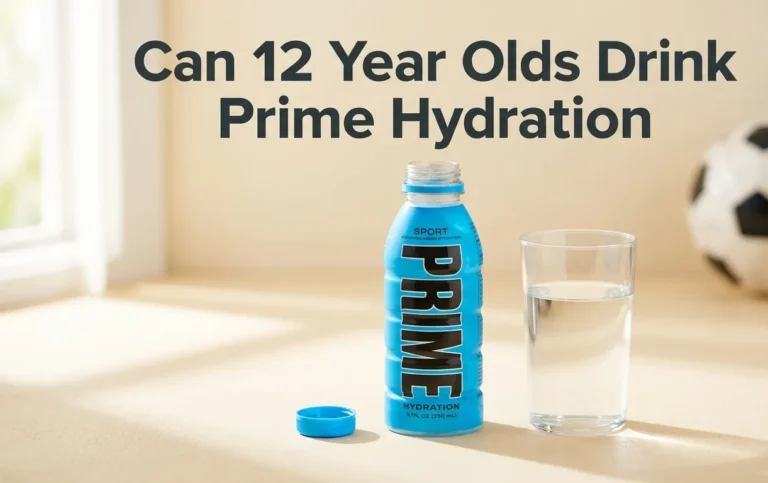
Can kids drink Prime Hydration? No, Prime Hydration is not recommended for children, particularly those under the age of 12. The product was developed as an adult hydration beverage and its electrolyte profile, artificial sweetener content, and added compounds are not aligned with pediatric hydration needs or safety guidelines established by the American Academy of Pediatrics.
The word “hydration” on the label creates a health halo that this product does not earn for children. Parents see hydration and think it must be good for their active kid. The reality is that children have smaller bodies, lower electrolyte requirements, and kidneys that process solutes differently than adult kidneys do. A 500-milliliter bottle of Prime Hydration contains 150 milligrams of potassium and 15 milligrams of magnesium that serve no physiological purpose for a child who is not losing those minerals through prolonged sweating. A child sitting in a classroom or playing at recess does not need potassium supplementation.
The Cleveland Clinic notes that healthy children get all the electrolytes they need from a balanced diet. Fruits, vegetables, dairy products, and plain water cover the hydration and mineral bases without introducing artificial sweeteners or unnecessary additives. Prime Hydration solves a problem most children simply do not have.
Can Children Drink Prime Hydration
Can children drink Prime Hydration? The answer mirrors the guidance above but gets more specific by age. Infants and toddlers should never consume this product. Children ages 4 to 8 have no nutritional reason to drink it. Children ages 9 to 13 might consume small amounts on rare occasions without immediate harm, but it should not become a regular beverage in their diet. Adolescents ages 14 and up can drink it safely in moderation, though water remains the healthier choice for everyday hydration.
The physiological reason for this age-tiered caution comes down to kidney function and body size. A child’s glomerular filtration rate, the measure of how quickly the kidneys filter blood, is proportionally lower than an adult’s until around age two and reaches full maturity in the early teenage years. Excess electrolytes that an adult kidney handles without issue represent a proportionally larger solute load for a younger child’s kidneys. The added potassium and magnesium in Prime Hydration, while modest for an adult, are not insignificant for a 50-pound body.
The NIH Office of Dietary Supplements sets the Adequate Intake for potassium at 2,300 milligrams per day for children ages 4 to 8. A single bottle of Prime Hydration provides 150 milligrams, roughly 6.5 percent of that daily total. One bottle is not going to cause potassium toxicity in a healthy child. The issue is not acute toxicity. The issue is that children are increasingly consuming multiple functional beverages throughout the day, and the cumulative electrolyte and artificial sweetener exposure from these products has not been studied in pediatric populations.
Key Takeaway: Children under 12 have no nutritional need for Prime Hydration. The electrolytes it provides are already abundant in a normal diet, and a child’s kidneys process excess solutes differently than an adult’s.
Can Kids Drink Prime Hydration Drink
Can kids drink the Prime Hydration drink specifically? This phrasing appears in searches because parents are looking at the exact product in their hand and want a yes or no. No, the Prime Hydration drink is not appropriate for routine consumption by children. The bottle you are holding may be caffeine-free, but that single fact does not make it a child-appropriate beverage.
The drink format matters. Prime Hydration comes in a 500-milliliter bottle, which is a large volume for a child. The standard recommended serving size for water for a child aged 9 to 13 is roughly 1.5 to 2 liters per day from all sources including food. One bottle of Prime Hydration represents 25 to 33 percent of a child’s total daily fluid intake. If that bottle replaces water, the child misses out on plain water’s zero-calorie, zero-additive hydration and instead consumes artificial sweeteners, added electrolytes, and flavoring agents that train the palate to expect sweetness in every beverage.
Taste preference conditioning is a documented concern in pediatric nutrition research. A 2023 study published in Nutrients found that children who regularly consumed artificially sweetened beverages showed a heightened preference for sweet tastes and were less willing to drink plain water compared to children who rarely consumed such beverages. Prime Hydration is sweetened with sucralose and acesulfame potassium. It tastes sweet. A child who drinks it regularly may begin to find water boring by comparison, and that shift in preference can persist for years.
Can Kids Drink Prime Hydration Drinks
Can kids drink Prime Hydration drinks, meaning the full product line including all flavors and varieties? No, the entire Prime Hydration line is adult-formulated and not intended for children. The flavor variations including Tropical Punch, Blue Raspberry, Ice Pop, Lemon Lime, and Meta Moon share the same core ingredient profile. Switching flavors does not change the underlying nutritional and safety considerations.
The product line confusion extends to Prime’s other offerings. Prime Energy, in nearly identical packaging, contains 200 milligrams of caffeine per can. To put that in perspective, the FDA cites 400 milligrams per day as the upper limit for healthy adults. A single can of Prime Energy is half that limit. For a child, 200 milligrams of caffeine can cause tachycardia, anxiety, nausea, and sleep disruption. The American Academy of Pediatrics states that children and adolescents should not consume caffeine. Emergency department visits related to pediatric caffeine exposure from energy drinks have risen over the past decade, and the packaging similarity between Prime Hydration and Prime Energy makes accidental ingestion a real risk.
Beyond the caffeine confusion, the “drinks” plural search suggests parents are seeing their children consume multiple bottles per week or even per day. Multiple bottles mean multiple doses of sucralose, acesulfame potassium, and added electrolytes. The Acceptable Daily Intake for sucralose set by the FDA is 5 milligrams per kilogram of body weight. A 30-kilogram child (roughly 66 pounds) would reach that limit after consuming roughly 3 bottles of Prime Hydration in a day, assuming the sucralose concentration is consistent with other artificially sweetened beverages. One bottle is well within the limit. Three bottles is not a realistic concern for most children, but the point is that cumulative exposure from multiple functional beverages has not been studied in pediatric populations, and caution is warranted.
Can 9 Year Olds Drink Prime Hydration
Can 9 year olds drink Prime Hydration? This is the most specific and common question parents ask, and the answer is no, a 9-year-old should not drink Prime Hydration. A typical 9-year-old weighs roughly 28 to 32 kilograms, or 62 to 70 pounds. Their body is small enough that the electrolyte load, artificial sweetener exposure, and behavioral conditioning around sweetened beverages all argue against regular consumption.
A 9-year-old’s daily potassium Adequate Intake is 2,500 milligrams per day for boys and 2,300 milligrams for girls, according to the NIH Office of Dietary Supplements. A bottle of Prime Hydration contributes 150 milligrams of potassium. That is not dangerous in isolation. The concern is that a 9-year-old’s diet already provides adequate potassium from foods like bananas, potatoes, milk, and vegetables. Adding potassium from a supplemented beverage is unnecessary. The same child’s magnesium requirement is 240 milligrams per day. Prime Hydration adds 15 milligrams, a trivial amount that does not justify the artificial sweeteners that come with it.
The social context matters too. Nine-year-olds are in fourth or fifth grade, an age when peer influence accelerates and branded products become status symbols. Parents report that Prime Hydration has become a schoolyard trend, with children trading bottles and collecting flavors. The brand was created by social media influencers Logan Paul and KSI, whose content is not aimed at children but whose reach extends deeply into the preteen demographic. A 9-year-old who wants Prime Hydration is likely responding to marketing, peer pressure, or the appeal of a product associated with popular creators, not to a genuine hydration need. Pediatricians and registered dietitians consistently advise that children’s beverage choices should be guided by nutrition, not branding.
Key Takeaway: A 9-year-old gets all the potassium, magnesium, and sodium they need from food and water. Prime Hydration adds nothing their body requires and introduces artificial sweeteners they are better off avoiding.
Should Kids Drink Prime Hydration
Should kids drink Prime Hydration? No, children should not drink Prime Hydration as a routine beverage. The word “should” implies a recommendation, and there is no evidence-based reason to recommend this product for pediatric hydration. Water meets every hydration need a healthy child has. For the rare situations where a child genuinely requires electrolyte replacement, such as prolonged vomiting, diarrhea, or intense athletic activity in extreme heat, pediatric-specific oral rehydration solutions are the appropriate choice, not an adult lifestyle beverage.
The Academy of Nutrition and Dietetics emphasizes that children’s fluid needs are best met with water and milk. Water should be the primary beverage throughout the day. Milk provides calcium, vitamin D, and protein. Sugary drinks and artificially sweetened drinks should be occasional at most, and for young children, they should be avoided entirely. Prime Hydration falls into the artificially sweetened category. It is not water. It is not milk. It does not fill a nutritional gap.
Parents sometimes ask about the “should” question in the context of compromise. Their child is begging for Prime. All the other kids have it. Is letting them have one bottle as a treat really that bad? One bottle is unlikely to cause harm in an otherwise healthy 12-year-old. The risk is not in the single bottle. The risk is in the normalization. When Prime Hydration becomes the go-to beverage in a child’s lunchbox, water consumption drops. When water consumption drops, the child’s baseline hydration habits shift. When those habits shift, they can persist into adolescence and adulthood. The strongest argument against kids drinking Prime Hydration is not that one bottle is dangerous. It is that water is better, and childhood is when hydration habits form.
Why Is Prime Hydration Not for Kids
Why is Prime Hydration not for kids? The product label itself states that Prime Hydration is not formulated for individuals under the age of 18. This disclaimer appears on the bottle, which means the manufacturer has chosen to include a legal safeguard against pediatric consumption. The reasons behind that disclaimer are the ingredients inside the bottle.
The first reason is the artificial sweeteners. Sucralose and acesulfame potassium provide sweetness without calories, but their long-term effects on developing bodies are not well studied. The FDA has approved both sweeteners for general use, but the Acceptable Daily Intake levels are based on adult body weights, and pediatric-specific safety data for chronic daily consumption is limited. A 2024 review published in the Journal of Pediatric Gastroenterology and Nutrition noted that while artificial sweeteners are generally recognized as safe, the evidence base for their metabolic effects in children remains thin, and the precautionary principle supports limiting exposure.
The second reason is the unnecessary electrolyte load. Healthy children maintain electrolyte balance through diet and thirst-driven water intake. Adding 150 milligrams of potassium and 15 milligrams of magnesium from a supplemented beverage does not improve hydration in a child who is not electrolyte-depleted. It simply gives the kidneys extra solutes to filter. For a child with undiagnosed kidney issues, even modest electrolyte supplementation could be problematic.
The third reason is behavioral. Artificially sweetened beverages condition a preference for sweet tastes. A child who drinks sweetened beverages throughout the day is less likely to choose water, less likely to recognize thirst as a cue for water, and more likely to carry a sweet-beverage habit into adolescence. The American Academy of Pediatrics identifies the establishment of healthy hydration habits in childhood as a priority for preventing obesity, dental caries, and disordered eating patterns.
Why Is Prime Hydration Bad for Kids
Why is Prime Hydration bad for kids? The word “bad” is stronger than “not recommended,” and it deserves a direct answer. Prime Hydration is bad for kids because it offers no nutritional benefit, introduces artificial compounds their bodies do not need, displaces water from their diet, and contributes to a food environment that normalizes functional beverages as everyday drinks.
The specific ingredients that raise concern include sucralose, which has been shown in some animal studies to alter gut microbiota composition, though human data is limited and inconsistent. Acesulfame potassium has been detected in breast milk and amniotic fluid in studies where pregnant individuals consumed it, indicating it crosses the placental barrier, though the clinical significance of this finding remains unclear. Dipotassium phosphate adds to the total dietary phosphate load, which matters for children with kidney conditions who must limit phosphorus. BCAAs are included in unspecified amounts, and while BCAAs are naturally present in protein-containing foods, isolated BCAA supplementation has not been tested for safety in children.
The displacement effect is perhaps the most concrete harm. When a child drinks a 500-milliliter bottle of Prime Hydration, they are not drinking 500 milliliters of water. If this happens once at a birthday party, it is trivial. If it happens every day at lunch, the child loses roughly 3.5 liters of water intake per week to a sweetened beverage. Over a school year, that is a lot of missed water. Water is the gold standard for hydration. Replacing it with anything less is a downgrade.
Key Takeaway: Prime Hydration is bad for kids because it replaces water, adds nothing their body needs, and introduces artificial sweeteners with limited pediatric safety data.
Prime Hydration Ingredients for Children
Prime Hydration ingredients for children must be evaluated through a pediatric lens, not an adult one. The ingredient list on a bottle of Tropical Punch Prime Hydration reads: filtered water, coconut water from concentrate, citric acid, dipotassium phosphate, trimagnesium citrate, natural flavor, sucralose, acesulfame potassium, sodium chloride, and BCAAs (L-leucine, L-isoleucine, L-valine). Each of these components has a different risk-benefit profile for a child than for an adult.
Ingredient
Function
Pediatric Concern
Filtered Water
Base
None. Safe.
Coconut Water Concentrate
Flavor, potassium source
Minimal. 4g sugar per bottle is low.
Citric Acid
Preservative, flavor
Can erode dental enamel with frequent exposure.
Dipotassium Phosphate
Potassium source
Adds unnecessary potassium and phosphate. Avoid with kidney conditions.
Trimagnesium Citrate
Magnesium source
Unnecessary for children. Avoid with kidney conditions.
Sucralose
Artificial sweetener
Limited pediatric safety data. May condition sweet taste preference.
Acesulfame Potassium
Artificial sweetener
Limited pediatric safety data. Crosses placental barrier.
Sodium Chloride
Salt, electrolyte
10mg per bottle is negligible. Not a concern.
BCAAs
Amino acids
No safety data for routine pediatric consumption. Avoid.
Coconut water from concentrate is the ingredient that gives Prime Hydration its 4 grams of natural sugar and 25 calories per bottle. In isolation, coconut water is a reasonable occasional beverage for older children. The issue is everything else in the bottle that comes with it. The sweeteners, the added electrolytes, the amino acids, and the citric acid that can erode tooth enamel with frequent sipping throughout the day. A child who drinks Prime Hydration slowly over several hours exposes their teeth to acid and sweetener repeatedly, which is worse for dental health than drinking the same beverage quickly and then rinsing with water.
Prime Hydration Nutrition Label Ingredients
Prime Hydration nutrition label ingredients tell a story that the front of the bottle does not. The front label highlights electrolytes, hydration, and coconut water. The nutrition facts panel on the back reveals the quantitative reality. Per 500-milliliter bottle, Prime Hydration provides 25 calories, 5 grams of total carbohydrate including 4 grams of sugar, and the following electrolyte amounts.
Nutrient (per 500mL bottle)
Amount
Child 4-8 Daily Need
Child 9-13 Daily Need
Sodium
10 mg
AI 1,200 mg
AI 1,500 mg
Potassium
150 mg
AI 2,300 mg
AI 2,500-3,000 mg
Magnesium
15 mg
RDA 130 mg
RDA 240 mg
The sodium content of 10 milligrams per bottle is the most telling number. A child who is genuinely dehydrated from exercise or illness and needs electrolyte replacement requires sodium, not just potassium. Oral rehydration solutions like Pedialyte contain roughly 370 milligrams of sodium per 12 ounces because sodium is the primary electrolyte lost in sweat and the key to fluid absorption in the small intestine. Prime Hydration’s 10 milligrams of sodium per 500 milliliters is too low to serve any rehydration purpose. This product is a flavored potassium drink with artificial sweeteners, not a clinically meaningful rehydration solution.
The potassium at 150 milligrams per bottle and magnesium at 15 milligrams are not harmful in isolation for a child with healthy kidneys. The problem is the cumulative message. Parents see electrolytes on the label and assume the product helps with hydration. The sodium number says otherwise. For a child who is ill and losing fluids through vomiting or diarrhea, this product is not a substitute for an oral rehydration solution. A parent who gives Prime Hydration to a dehydrated child thinking it will help is making a mistake that could delay proper rehydration.
Prime Hydration vs Prime Energy Kids
Prime Hydration vs Prime Energy is a distinction that every parent must understand because the consequences of confusing the two are serious. Prime Hydration is caffeine-free and comes in a plastic bottle. Prime Energy contains 200 milligrams of caffeine per 12-ounce can and comes in a can that looks similar to the bottle. Both products share the same logo, similar color schemes, and the same brand name. A child who grabs a can of Prime Energy thinking it is Prime Hydration ingests a massive dose of caffeine.
The FDA has not established a safe level of caffeine for children. The American Academy of Pediatrics recommends zero caffeine for children and adolescents. A 200-milligram dose of caffeine in a 30-kilogram child produces a blood concentration that is proportionally much higher than the same dose in a 70-kilogram adult. Effects can include rapid heart rate, elevated blood pressure, anxiety, insomnia, gastrointestinal distress, and in rare cases, cardiac arrhythmia.
Several news reports in 2023 and 2024 documented cases of children experiencing symptoms after consuming Prime Energy, some requiring emergency department evaluation. The similar branding between the two products is a known source of confusion. Parents should check every Prime-branded product carefully. If it is in a can, it contains caffeine and is not for children. If it is in a bottle, it is caffeine-free but still not recommended for children for the reasons discussed throughout this guide.
Product
Caffeine
Container
Kid-Safe?
Prime Hydration
0 mg
Plastic bottle
No (unnecessary ingredients)
Prime Energy
200 mg
Aluminum can
Absolutely not (caffeine toxicity risk)
Quick Tip: Check the container. Bottle equals hydration line, no caffeine. Can equals energy line, 200 milligrams of caffeine. Teach your child this distinction. It could prevent an accidental ingestion.
Key Takeaway: Prime Energy contains 200 milligrams of caffeine and should never be consumed by children. The packaging similarity to Prime Hydration creates a real risk of accidental ingestion.
When Do Kids Need Electrolyte Drinks
When do kids need electrolyte drinks? Almost never for routine daily hydration. The American Academy of Pediatrics identifies three situations where electrolyte replacement may be appropriate for children: prolonged vigorous exercise lasting more than 60 to 90 minutes, particularly in heat, illness with significant vomiting or diarrhea where fluid and electrolyte losses are substantial, and medical conditions diagnosed by a physician that require electrolyte management.
For everyday hydration including school, meals, light play, and sports practices under an hour, water is the only beverage children need. The child’s body regulates fluid and electrolyte balance through thirst, kidney function, and dietary intake. Adding an electrolyte drink to this system provides no benefit and introduces unnecessary solutes.
For athletic children who train intensely for more than 90 minutes in hot conditions, a small amount of sodium-containing fluid may help replace sweat losses. Even in this scenario, the sodium content of Prime Hydration at 10 milligrams per bottle is far too low to be useful. Gatorade contains roughly 160 milligrams of sodium per 12 ounces. An oral rehydration solution contains 370 milligrams of sodium per 12 ounces. Prime Hydration is not formulated for athletic electrolyte replacement. It is a lifestyle beverage with added potassium.
For illness with vomiting or diarrhea, the CDC and the American Academy of Pediatrics recommend oral rehydration solutions such as Pedialyte. These products are formulated with specific glucose-to-sodium ratios that maximize water absorption in the small intestine through the sodium-glucose cotransport mechanism. Prime Hydration does not have this formulation. It is not a substitute for an oral rehydration solution, and using it as one could delay recovery.
Pediatric Electrolyte Recommendations
Pediatric electrolyte recommendations are set by the NIH Office of Dietary Supplements and vary by age. These numbers provide the evidence-based benchmark that products like Prime Hydration should be measured against. A single bottle of Prime Hydration contributes a fraction of a child’s daily electrolyte needs, but those needs are already met through food.
The Adequate Intake for sodium for children ages 4 to 8 is 1,200 milligrams per day. For ages 9 to 13, it is 1,500 milligrams per day. The Adequate Intake for potassium is 2,300 milligrams per day for ages 4 to 8, 2,500 milligrams for girls ages 9 to 13, and 3,000 milligrams for boys ages 9 to 13. The Recommended Dietary Allowance for magnesium is 130 milligrams per day for ages 4 to 8 and 240 milligrams per day for ages 9 to 13.
A child who eats a banana (422 milligrams of potassium), drinks a cup of milk (366 milligrams of potassium), and eats a serving of yogurt (255 milligrams of potassium) has already consumed more potassium than five bottles of Prime Hydration. The electrolytes in Prime Hydration are redundant for any child eating a reasonably balanced diet. The product does not fill a nutritional gap. It adds marketing-driven supplementation to a system that already has what it needs.
AAP Sports Drinks Kids Recommendation
The AAP sports drinks kids recommendation is clear and has been consistent for over a decade. In a 2011 clinical report titled “Sports Drinks and Energy Drinks for Children and Adolescents: Are They Appropriate?” the American Academy of Pediatrics stated that sports drinks are unnecessary for routine hydration in children and adolescents and should be reserved for prolonged vigorous exercise. The report also stated that energy drinks containing caffeine should never be consumed by children or adolescents.
The AAP reaffirmed this guidance in subsequent publications. Sports drinks, defined as beverages containing carbohydrates and electrolytes, are distinct from energy drinks containing caffeine. The AAP’s concern with sports drinks for routine use centers on added sugar, excess calories, dental erosion, and the displacement of water and milk from the diet. While Prime Hydration is sugar-free and avoids the calorie concern, it introduces artificial sweeteners and fits the functional beverage category that the AAP warns against for routine pediatric use.
The AAP’s broader recommendation for children’s beverage intake is straightforward. Water and milk should be the primary beverages. Juice should be limited to small amounts of 100 percent fruit juice. Sugar-sweetened beverages and artificially sweetened beverages should be avoided or consumed only on rare occasions. Prime Hydration falls into the artificially sweetened category. Under the AAP’s framework, it is not a recommended beverage for children.
Can Kids Drink Gatorade vs Prime
Can kids drink Gatorade vs Prime is a comparison parents make because both products sit on the same shelf and both are marketed for hydration. Gatorade is a traditional sports drink with sugar and electrolytes. Prime Hydration is a sugar-free lifestyle drink with artificial sweeteners and electrolytes. For children, neither is recommended for routine use, but they fail for different reasons.
Gatorade contains roughly 34 grams of sugar per 20-ounce bottle, which is about 8.5 teaspoons. The Dietary Guidelines for Americans 2020-2025 recommend that children under age 2 consume zero added sugar and that children ages 2 and older limit added sugar to less than 10 percent of total calories. A single bottle of Gatorade exceeds a prudent sugar limit for a child. Gatorade Zero, the sugar-free version, swaps sugar for sucralose and acesulfame potassium, the same sweeteners used in Prime Hydration, and raises similar concerns.
Prime Hydration has less sugar than Gatorade. That is its advantage. It has more potassium and magnesium than Gatorade, which is not an advantage for a child who gets those minerals from food. It has far less sodium than Gatorade at 10 milligrams versus 160 milligrams per 12 ounces, which makes Prime Hydration less useful for actual athletic electrolyte replacement. The honest comparison is that water outperforms both products for everyday child hydration, and an oral rehydration solution outperforms both for illness-related dehydration.
Beverage
Sugar
Sodium
Potassium
Artificial Sweeteners
Kid-Appropriate for Routine Use?
Water
0g
0mg
0mg
None
Yes
Prime Hydration
4g
10mg
150mg
Yes (sucralose, Ace-K)
No
Gatorade (original)
34g (per 20oz)
270mg
75mg
No
No (excess sugar)
Gatorade Zero
0g
270mg
75mg
Yes (sucralose, Ace-K)
No
Pedialyte
9g (per 12oz)
370mg
280mg
No
Yes, for illness only
Key Takeaway: Gatorade has too much sugar. Prime Hydration has artificial sweeteners and uselessly low sodium. Water is the correct choice for everyday child hydration.
Best Hydration Drinks for Children
Best hydration drinks for children is a short list because the correct answer for most situations is the simplest one. Water is the best hydration drink for children in all routine circumstances. It is calorie-free, additive-free, inexpensive, and exactly what a child’s body is designed to drink.
The Academy of Nutrition and Dietetics and the American Academy of Pediatrics recommend the following tiered approach to children’s beverages:
Water for all routine hydration throughout the day.
Milk for calcium, vitamin D, and protein at meals.
Small amounts of 100 percent fruit juice, limited to 4 to 6 ounces per day for children ages 1 to 6 and 8 to 12 ounces for older children.
Oral rehydration solution such as Pedialyte for illness with vomiting or diarrhea.
A sports drink, consumed in small amounts, may be considered for prolonged vigorous exercise exceeding 60 to 90 minutes in heat, but water with a salty snack achieves the same electrolyte replacement.
Coconut water without added sugar is sometimes suggested as a natural alternative to sports drinks. It contains potassium and a small amount of sodium with fewer additives than commercial electrolyte drinks. It still should not replace water as a primary beverage, but it is a reasonable occasional choice for an older child who wants something flavored.
For parents who want a practical answer to give their child instead of Prime Hydration, the list is water, milk, or a homemade infusion of water with sliced fruit for natural flavor. These options hydrate without artificial sweeteners, added electrolytes, or the behavioral risks of branded functional beverages.
Frequently Asked Questions About Kids and Prime Hydration
Can my 9 year old drink Prime Hydration?
No, a 9-year-old should not drink Prime Hydration.
The American Academy of Pediatrics recommends water for routine hydration and advises against sports drinks and artificially sweetened beverages for children.
A 9-year-old gets all needed electrolytes from food and does not need the sucralose, acesulfame potassium, or added minerals in Prime Hydration.
Is Prime Hydration the same as Prime Energy?
No, Prime Hydration and Prime Energy are different products with similar branding.
Prime Hydration is caffeine-free and comes in a plastic bottle.
Prime Energy contains 200 milligrams of caffeine in a can and is dangerous for children.
What are the ingredients in Prime Hydration?
Prime Hydration contains filtered water, coconut water concentrate, citric acid, dipotassium phosphate, trimagnesium citrate, natural flavor, sucralose, acesulfame potassium, sodium chloride, and branched-chain amino acids.
The artificial sweeteners sucralose and acesulfame potassium provide sweetness without sugar but have limited pediatric safety data.
The electrolyte content includes 10 milligrams of sodium, 150 milligrams of potassium, and 15 milligrams of magnesium per bottle.
Is Prime Hydration better than Gatorade for kids?
Neither Prime Hydration nor Gatorade is recommended for routine hydration in children.
Gatorade contains too much sugar. Prime Hydration contains artificial sweeteners and electrolytes children do not need.
Water is the better choice for everyday hydration in both cases.
Why do kids want Prime so badly?
Prime Hydration is marketed by social media influencers Logan Paul and KSI, who have large followings among preteens and teenagers.
The brand has become a status symbol in schools, with children trading bottles and collecting flavors.
The appeal is social and marketing-driven, not based on hydration need.
What should kids drink instead of Prime Hydration?
Children should drink water for routine hydration throughout the day.
Milk is appropriate at meals for calcium, vitamin D, and protein.
For illness with vomiting or diarrhea, an oral rehydration solution like Pedialyte is the medically recommended choice.
Closing
Your child does not need Prime Hydration. The electrolytes it provides already arrive through a banana, a glass of milk, or a serving of vegetables at dinner. The artificial sweeteners it contains train a young palate to expect sweetness in every sip, and the marketing that makes it feel like a status symbol does not make it a health product.
Give your child water. It is what their body expects, what their kidneys handle effortlessly, and what decades of pediatric guidance recommend without caveat or compromise. If they are sick and losing fluids, reach for an oral rehydration solution, not a lifestyle drink in a colorful bottle.
You now know what is in the bottle, why it is not built for a child’s body, and exactly what to offer instead. That clarity is what parenting through the beverage aisle demands, and you have it.