
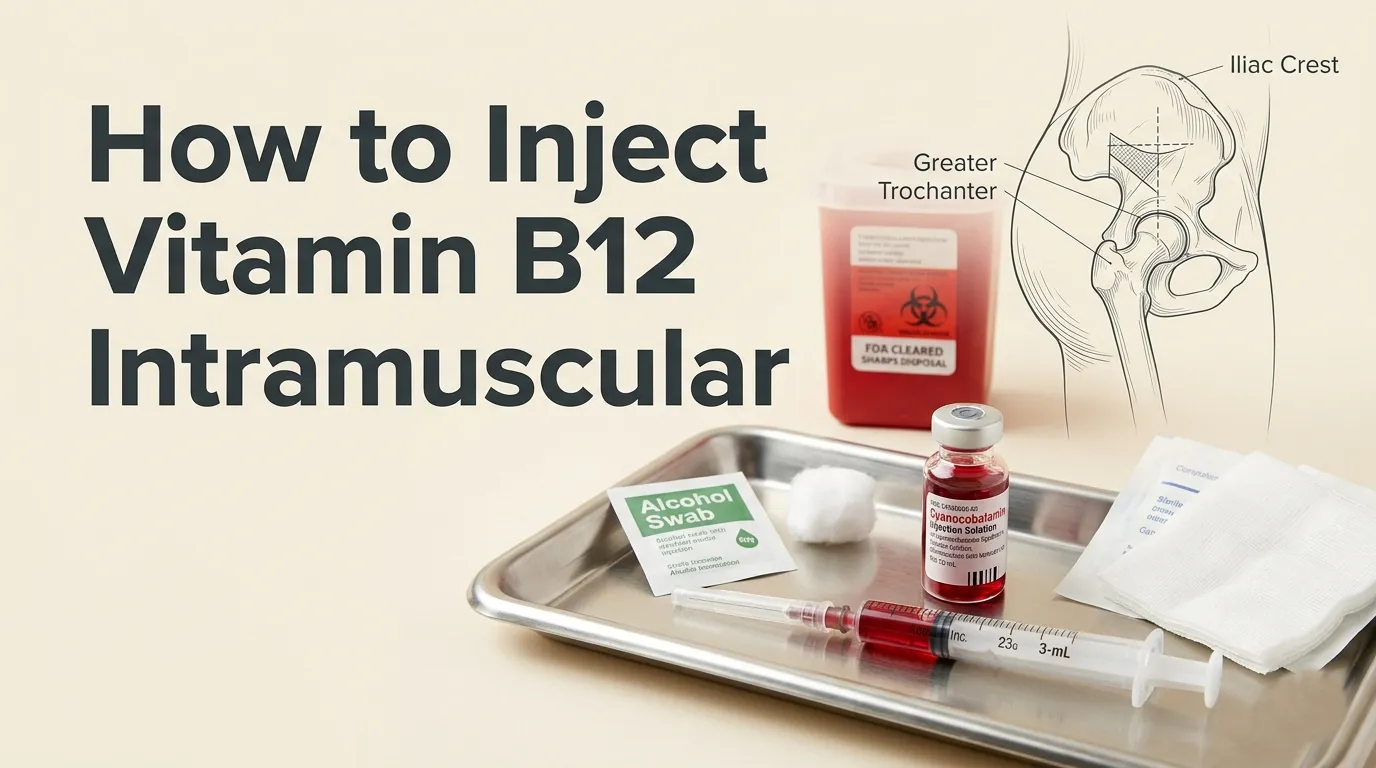
How to Inject Vitamin B12 Intramuscular: 2026 Safety Guide
Vitamin B12 is injected intramuscularly into the ventrogluteal muscle on the hip, the vastus lateralis muscle on the outer thigh, or the deltoid muscle on the upper arm, using a 1-inch to 1.5-inch needle at a 90-degree angle, and the non-negotiable first step before any self-injection is confirming with the prescribing physician that you have a documented B12 deficiency requiring injection and that you have received in-person training on the procedure from a qualified healthcare professional. This is not a do-it-yourself wellness hack. This is a medical procedure with real anatomical risks including sciatic nerve injury, intravascular injection, and infection.
The person most likely searching this topic has a legitimate medical reason. Pernicious anemia, where the body cannot produce intrinsic factor required to absorb B12 from food, affects approximately 0.1 percent of the general population and up to 2 percent of people over 60 according to the NIH Office of Dietary Supplements. Bariatric surgery patients, people with Crohn’s disease or celiac disease affecting the terminal ileum, and long-term users of metformin or proton pump inhibitors may also develop B12 deficiency that oral supplements cannot correct. For these individuals, intramuscular injection bypasses the broken absorption pathway entirely and delivers the vitamin directly into circulation via the muscle’s rich blood supply.
This article covers the exact anatomical landmarks for safe injection, the critical distinction between the ventrogluteal and dorsogluteal sites that every self-injector must understand before holding a needle, the differences between cyanocobalamin, methylcobalamin, and hydroxocobalamin injection forms that determine how long the vitamin stays in your system, and the safety protocol that the Centers for Disease Control and Prevention and the World Health Organization have established for intramuscular injections. Every anatomical instruction and safety rule in this guide is sourced to clinical injection standards, not forum anecdotes.
How to Inject Vitamin B12 Intramuscular
The standard procedure for injecting vitamin B12 intramuscularly involves cleaning the selected injection site with an alcohol swab, drawing the prescribed dose of B12 from the vial into a sterile syringe using aseptic technique, inserting the needle at a 90-degree angle into the muscle with a quick dart-like motion, aspirating briefly to confirm no blood return, injecting the solution slowly over 5 to 10 seconds, withdrawing the needle smoothly, and applying gentle pressure with a clean cotton ball without massaging the site. This sequence must be performed exactly as trained by a healthcare professional and never from written instructions alone.

The reason the needle enters at 90 degrees is anatomical. Intramuscular injection requires the medication to be deposited deep within the muscle belly, below the subcutaneous fat layer and the fascia that covers the muscle. The needle must traverse the epidermis, dermis, subcutaneous adipose tissue, and the dense connective tissue of the deep fascia before reaching muscle. A 90-degree angle provides the shortest path through these layers and ensures the needle tip reaches the intended depth. Angling the needle at 45 degrees, which is appropriate for subcutaneous injections, would deposit the B12 solution into fat rather than muscle, altering the absorption kinetics and potentially causing a sterile abscess or localized irritation.
The dart-like insertion motion is not about speed for its own sake. It reduces the pain of needle entry by minimizing the time the needle tip spends in contact with pain receptors concentrated in the dermis. Hesitating at the skin surface or pushing the needle slowly through the skin increases the duration of pain receptor activation. The insertion should be controlled and deliberate but quick through the skin layer. Once the needle is through the dermis, the remaining advance through subcutaneous fat and into muscle is less painful and can proceed at a steady, controlled pace.
After the needle is fully inserted to the hub, the plunger should be pulled back slightly for approximately 2 to 3 seconds to check for blood return. This step, called aspiration, is a safety check to confirm the needle tip is in muscle and not in a blood vessel. If blood appears in the syringe, the needle has entered a vein or artery. The needle and syringe must be withdrawn immediately, safely discarded into a sharps container, and a new sterile needle and syringe used for a second attempt at a slightly different location. Injecting B12 directly into a blood vessel is not dangerous in the same way that injecting an oil-based medication or an air bubble would be, but it wastes the dose and can cause temporary flushing and discomfort.
Key Takeaway: The 90-degree angle, the quick dart motion, and the aspiration check are not optional refinements. They are the three technical elements that determine whether the B12 reaches the muscle safely or ends up in the wrong tissue where it does not work or causes a complication.
How to Inject Vitamin B12
You inject vitamin B12 by preparing your supplies, selecting and landmarking the correct anatomical site, cleaning the site, drawing the medication, inserting the needle at 90 degrees into muscle, aspirating to rule out intravascular placement, injecting slowly, withdrawing, and disposing of the needle immediately into an FDA-cleared sharps container. Every step depends on the one before it. Skipping or rushing any step introduces risk that the procedure cannot absorb.
Preparation is the step most people undervalue. The vial must be inspected against light for any particulate matter, cloudiness, or discoloration. Cyanocobalamin injection solution should be clear and red. Any cloudiness or visible particles mean the vial is contaminated or degraded and must be discarded. The expiration date on the vial must be checked. An expired vial should never be used even if it looks normal. Hands must be washed with soap and water for at least 20 seconds and dried with a clean towel before handling any injection supplies. The work surface should be cleaned with an alcohol-based disinfectant.
The order of supply arrangement matters for maintaining sterility. The vial, alcohol swabs, syringe with needle attached, a second alcohol swab for post-injection, a cotton ball or gauze, and the sharps container should all be placed within easy reach on the cleaned surface. Once the vial’s rubber stopper is swabbed with alcohol and the needle cap is removed, the needle tip must never touch any non-sterile surface. If it does, the needle is contaminated and must be discarded into the sharps container. A new sterile needle must be attached to the syringe. This is not wasteful. This is infection prevention.
Drawing the medication requires a specific sequence. The syringe plunger is pulled back to draw air equal to the prescribed dose volume. The needle is inserted through the center of the vial’s rubber stopper, and the air is injected into the vial to equalize pressure and make withdrawal easier. The vial and syringe assembly is inverted, and the plunger is pulled back slowly past the desired dose mark, then pushed forward to the exact dose to expel any air bubbles. A small air bubble of 0.1 to 0.2 mL intentionally left in the syringe is acceptable and, in the Z-track method, is sometimes used to seal the injection track and prevent medication from leaking back into subcutaneous tissue. The CDC’s injection safety guidelines do not mandate complete air removal for intramuscular injections.
How to Give a Vitamin B12 Injection
Giving a vitamin B12 injection to another person follows the same anatomical and aseptic principles as self-injection with the added requirement of positioning the recipient correctly, communicating each step before performing it, and selecting an injection site based on their specific anatomy rather than the most convenient reach. The person administering the injection must have been trained on the specific individual they are injecting and must not attempt the procedure based solely on having read instructions.
Positioning the recipient is site-dependent. For a ventrogluteal injection, the recipient should lie on their side with the injection hip facing upward and the top knee slightly bent and resting forward. This position relaxes the gluteus medius and minimus muscles and provides stable access to the anatomical landmarks. For a vastus lateralis injection, the recipient should sit with their leg extended and supported, or lie flat with the leg relaxed. Tensing the thigh muscle during injection significantly increases pain and may alter needle depth relative to the muscle. A tense muscle grips the needle more tightly than a relaxed one, and the increased intramuscular pressure can force medication back along the needle track.
Communication matters because an unexpected needle insertion can cause the recipient to jerk or tense, increasing injury risk. The administrator should tell the recipient when the alcohol swab is about to be applied, when the needle is about to be inserted, and when the medication is about to be injected. Each step is announced before it happens. The recipient should be told to breathe normally and not to hold their breath. The quick-dart insertion should be timed with the recipient’s exhalation, which is the moment of maximum muscle relaxation.
The administrator who is not a licensed healthcare professional must have a specific, documented reason for performing the injection. Spouses, partners, or family members of patients with pernicious anemia are commonly trained by a nurse or physician to administer home B12 injections. This training must include hands-on practice under supervision, not verbal instruction alone. A physician or registered nurse must demonstrate the procedure on the actual patient, observe the family member performing a return demonstration, and confirm competence before authorizing home administration.
Quick Tip:
If you are injecting another person, place the palm of your non-dominant hand firmly on the injection site and stretch the skin taut in opposite directions. Hold this tension throughout the insertion and injection. Taut skin reduces pain by allowing the needle to pass through with less resistance and creates a straighter needle track that minimizes tissue drag during withdrawal.
Where to Inject Vitamin B12
Vitamin B12 can be injected into any of three approved intramuscular sites: the ventrogluteal muscle on the hip, the vastus lateralis muscle on the front outer thigh, or the deltoid muscle on the upper arm, with the ventrogluteal site being the safest and most strongly recommended by the World Health Organization and CDC because it is anatomically distant from major blood vessels and nerves and has the thickest layer of gluteal muscle tissue with the thinnest overlying fat layer in most adults. The choice among these three sites depends on the injector’s training, the recipient’s anatomy, and the volume of medication being injected.
The ventrogluteal site is located by placing the heel of the hand on the greater trochanter, the bony prominence at the top outer thigh, with the fingers pointing toward the recipient’s head. The index finger is placed on the anterior superior iliac spine, the front bony prominence of the hip. The middle finger is spread as far as possible along the iliac crest. The injection site is the center of the triangle formed between the index and middle fingers. This landmarking method places the needle directly into the gluteus medius muscle, safely away from the sciatic nerve which runs deep to the gluteus maximus several inches posterior to this site.
The vastus lateralis is the preferred site for self-injection because it is visible, accessible without twisting, and provides a large muscle mass with few major nerves or vessels traversing the injection zone. The site is located on the outer thigh, midway between the hip and the knee, in the middle third of the femur. The injection is given into the lateral portion of the quadriceps, not the anterior top of the thigh. The anterior quadriceps contains more nerve endings and the rectus femoris muscle is thinner than the vastus lateralis. Visualizing a line down the center of the thigh and a line down the outer side, the injection goes into the muscle between these two lines, in the middle third of the thigh length.
The deltoid site is acceptable for small injection volumes of 1 mL or less and is commonly used for vaccines. The site is located 2 to 3 finger widths below the acromion process, the bony point of the shoulder, in the center of the triangular deltoid muscle. The deltoid is thinner than the ventrogluteal or vastus lateralis muscles and requires a shorter needle, typically 5/8 to 1 inch, depending on body weight. Self-injection into the deltoid is difficult because the non-dominant arm’s deltoid must be reached across the body, which makes maintaining the correct 90-degree angle challenging.
| Injection Site | Muscle Target | Best For | Needle Length | Key Safety Landmark |
|---|---|---|---|---|
| Ventrogluteal | Gluteus medius | Safest overall, all volumes | 1 to 1.5 inches | Hand on greater trochanter, finger spread to iliac crest |
| Vastus lateralis | Vastus lateralis (outer quadriceps) | Self-injection | 1 to 1.25 inches | Middle third of outer thigh, between hip and knee |
| Deltoid | Deltoid | Small volumes (under 1 mL) | 5/8 to 1 inch | 2 to 3 finger widths below acromion process |
Key Takeaway: The ventrogluteal site is the safest injection location on the human body for intramuscular injections and the one the WHO teaches as the gold standard, yet most home injectors use the thigh because it is easier to reach, not because it is safer.
Where to Give Vitamin B12 Injection
A vitamin B12 injection should be given into the ventrogluteal muscle when a second person is available to landmark and inject, and into the vastus lateralis muscle of the outer thigh when self-administering, because these two sites provide the largest, safest muscle targets with the lowest density of major nerves and blood vessels. The decision between them is determined by who is performing the injection and the recipient’s body composition.
Body composition directly affects injection site safety and efficacy. In individuals with higher body fat percentage, the subcutaneous fat layer over the muscle may exceed the length of a standard 1-inch needle, meaning a 1.5-inch needle is required to reliably reach the muscle. If a standard needle is used and fails to reach the muscle, the injection becomes a subcutaneous injection by default, with different absorption characteristics that the prescriber may not have intended. Conversely, in very lean individuals with minimal subcutaneous fat, a 1-inch needle is sufficient for the deltoid and a 1-inch needle may be adequate for the thigh, but a 1.5-inch needle in the ventrogluteal site risks contacting the iliac bone if inserted too aggressively.
The dorsogluteal site, the upper outer quadrant of the buttock, should not be used for B12 injections by untrained individuals. This site was taught for decades as the standard gluteal injection site, but multiple studies published in the Journal of Advanced Nursing and the WHO’s best practice guidelines have demonstrated that the dorsogluteal site carries an unacceptably high risk of sciatic nerve injury due to the proximity of the nerve to the injection zone. The sciatic nerve runs deep to the gluteus maximus and passes within 2 to 3 centimeters of the dorsogluteal injection site in some individuals. A needle placed too far medially or inferiorly can directly contact, inject into, or compress the nerve, causing temporary or permanent sciatic neuropathy. The WHO formally recommends the ventrogluteal site over the dorsogluteal site for all intramuscular injections, a recommendation that applies to home B12 administration.
The site must be inspected before cleaning. Any moles, scars, bruises, infections, rashes, or areas of swelling at the intended injection location mean a different site should be selected. Rotating injection sites is necessary for anyone receiving frequent injections to prevent lipohypertrophy, the buildup of firm, rubbery scar tissue in the subcutaneous fat that can impair medication absorption. Keeping a simple log of which site was used on which date helps ensure systematic rotation between left and right sides and between the thigh and hip sites.
Where Should a Vitamin B12 Shot Be Given
A vitamin B12 shot should be given in the ventrogluteal muscle on the hip when a trained second person is available to administer the injection, or in the vastus lateralis muscle on the outer thigh when self-administering, and under no circumstances should it be given in the upper inner quadrant of the buttock where the sciatic nerve and superior gluteal artery are located. The site selection algorithm is straightforward: ventrogluteal if someone else injects you, vastus lateralis if you inject yourself, deltoid only for small volumes and with proper training, never dorsogluteal.
The dorsogluteal prohibition is worth restating because it is the most common error found in online B12 injection instructions. The classic “upper outer quadrant of the buttock” description that many people remember from nursing textbooks published before 2000 has been superseded by anatomical evidence showing that the sciatic nerve lies closer to this quadrant than previously believed. The gluteus maximus, into which the dorsogluteal injection is given, is also a thinner muscle with a more variable fat overlay than the gluteus medius targeted by the ventrogluteal approach. The WHO’s 2010 best practice guidelines for intramuscular injection explicitly state the ventrogluteal site is preferred and the dorsogluteal site should not be used for routine intramuscular injections.
For the self-injector, the vastus lateralis site on the outer thigh has the advantage of being visible without a mirror. The injector can sit comfortably, see the injection site clearly, use both hands to stabilize the syringe, and maintain the correct 90-degree angle throughout the procedure. The primary error with thigh self-injection is placing the injection too far toward the top of the thigh rather than the middle third, which moves the needle closer to the femoral nerve and vessels in the inguinal region.
Children and infants receiving B12 injections for metabolic disorders or documented deficiency require different sites and needle lengths based on age and muscle development. For children under 3 years, the vastus lateralis is the preferred site and the only site recommended by the CDC for intramuscular injections in this age group. The ventrogluteal site can be used in children over 18 months who have been walking long enough to develop the gluteal muscles. A pediatrician must determine the appropriate needle length, which is typically 5/8 to 1 inch depending on the child’s size.
How to Inject Vitamin B12 in Buttocks
The safe way to inject vitamin B12 in the buttocks area is to use the ventrogluteal site on the hip, not the dorsogluteal site on the fleshy part of the buttock, and to landmark it using the greater trochanter of the femur and the iliac crest as bony reference points that reliably locate the gluteus medius muscle away from the sciatic nerve and superior gluteal vessels. The word “buttocks” in common language includes both the gluteus maximus region that forms the visible buttock and the lateral hip where the gluteus medius lies. The injection goes into the lateral hip, not the center of the buttock cheek.
The landmarking procedure for the ventrogluteal site requires the injector to stand on the opposite side of the recipient’s body from the injection site. For a right hip injection, the injector stands on the recipient’s left side. The palm of the right hand is placed on the greater trochanter, the bony knob at the top of the femur that can be palpated by pressing into the side of the hip. The index finger is extended to touch the anterior superior iliac spine, the front bony point of the pelvis that can be felt at the front of the hip. The middle finger is spread back along the iliac crest as far as it reaches. The triangle formed by the index finger, middle finger, and the iliac crest defines the ventrogluteal injection zone. The needle enters at the center of this triangle.
A common error is placing the hand too low on the greater trochanter or failing to spread the fingers wide enough, which shifts the injection zone posteriorly toward the sciatic nerve. The landmarking hand must be positioned precisely, with the heel of the hand directly over the bony prominence of the greater trochanter, not on the soft tissue below it. If you cannot palpate the greater trochanter clearly through the soft tissue, the recipient should shift their weight slightly to the opposite side to make the bony landmarks more prominent.
The depth of needle insertion at the ventrogluteal site is generally 1 to 1.5 inches, inserted fully to the hub, because the overlying fat layer at this site is thinner than at the dorsogluteal site in most adults. The needle should be inserted perpendicular to the skin surface at a true 90-degree angle. Burying the needle to the hub ensures the medication is deposited deep within the muscle belly. After injection, the needle is withdrawn at the same 90-degree angle, pressure is applied with a clean cotton ball, and the site is not massaged. Massaging the ventrogluteal site after injection can force medication back along the needle track into subcutaneous tissue and may increase local irritation.
Key Takeaway: When someone says they inject B12 in their buttocks, they should mean the ventrogluteal hip site landmarked from the greater trochanter and iliac crest, not the upper outer quadrant of the gluteus maximus that old nursing textbooks described, because the sciatic nerve runs shockingly close to the dorsogluteal injection zone.
Is Vitamin B12 Injection IM or SubQ
Vitamin B12 injections can be given either intramuscularly or subcutaneously, and both routes are clinically effective for raising serum B12 levels, but intramuscular injection is the traditional, FDA-approved route for the standard cyanocobalamin injection formulation and produces a faster peak serum level, while subcutaneous injection is an off-label alternative that some physicians authorize for patients who prefer a shorter, thinner needle and slower, more gradual absorption. The prescription will specify the intended route. It is not the patient’s decision to switch routes independently.
The clinical studies comparing intramuscular to subcutaneous B12 injection show that both routes correct deficiency. A 2023 study published in the Journal of Clinical Medicine randomized 60 patients with B12 deficiency to either intramuscular or subcutaneous cyanocobalamin 1,000 mcg injections monthly and found that both groups achieved and maintained normal serum B12 levels at 6 and 12 months with no significant difference in final serum concentrations. The intramuscular group showed a higher peak serum level in the first week after injection, while the subcutaneous group showed a more gradual rise and fall curve. Both routes normalized methylmalonic acid and homocysteine levels.
The practical differences matter to the injector. Subcutaneous injection uses a shorter needle, typically 5/8 inch, and a thinner gauge, typically 25G to 27G, which means less pain on insertion and less muscle soreness afterward. The injection angle is 45 degrees for most people, or 90 degrees for those with sufficient subcutaneous fat, rather than the 90-degree intramuscular angle. The injection sites for subcutaneous B12 are the same as for insulin or heparin: the fatty tissue of the abdomen 2 inches from the navel, the outer upper arm, or the front of the thigh where subcutaneous fat can be pinched.
The formulation of injectable B12 matters when considering subcutaneous administration. Standard cyanocobalamin injection USP is labeled for intramuscular use, and the FDA’s approval is based on intramuscular administration data. Subcutaneous administration is an off-label use that a physician may authorize but that the manufacturer’s labeling does not specifically support. Compounding pharmacies can prepare B12 formulations specifically intended for subcutaneous administration, and some methylcobalamin formulations are labeled for subcutaneous use. The patient should never decide to change from intramuscular to subcutaneous without the prescriber’s explicit instruction and documentation of the new route.
IM vs Subcutaneous Vitamin B12
Intramuscular B12 injection deposits the vitamin directly into the rich capillary network of skeletal muscle, producing a rapid rise in serum B12 that peaks within approximately 1 to 3 hours and provides the fastest correction of severe deficiency symptoms, while subcutaneous injection deposits the vitamin into fatty tissue with a slower, more gradual absorption that results in a lower but more sustained serum level and may require more frequent dosing to achieve the same tissue saturation. The choice between these two routes is a medical decision based on deficiency severity, the specific B12 form being injected, and patient tolerance.
The physiology of muscle versus fat absorption explains the kinetic difference. Skeletal muscle is densely vascularized, with capillaries interwoven between muscle fibers. A depot of medication injected into muscle is rapidly taken up by these capillaries and enters the systemic circulation. Subcutaneous fat is sparsely vascularized compared to muscle. A depot of medication injected into fat diffuses slowly into the limited capillary network, delaying absorption. For a water-soluble vitamin like B12, which does not form a long-acting depot, the difference in absorption rate translates directly to differences in how quickly the vitamin becomes available to tissues.
The absorption rate difference has clinical implications for loading dose regimens. A patient with severe, symptomatic B12 deficiency with neurological involvement such as numbness, ataxia, or cognitive changes requires the fastest possible tissue delivery. Intramuscular injection is the standard of care in this scenario, with loading doses typically given daily or every other day for the first week. A patient with mild, asymptomatic deficiency discovered on routine screening may be equally well-managed with subcutaneous injection on a less aggressive schedule. The physician determining the route and frequency should be making this distinction based on the patient’s clinical presentation and the urgency of correction.
Self-injection preference is a legitimate factor that the prescribing physician can consider. If a patient is more likely to adhere to a subcutaneous injection schedule because they find it less painful and less intimidating, and their deficiency is mild to moderate without neurological symptoms, a physician may reasonably prescribe the subcutaneous route with appropriate monitoring. Adherence to the prescribed injection frequency matters more than the route, because a subcutaneous injection that actually happens every month is more effective than an intramuscular injection that keeps getting delayed because the patient dreads it.
Quick Tip:
If your physician has prescribed intramuscular B12 injections and you find them painful or intimidating, ask directly whether switching to the subcutaneous route with a shorter, thinner needle would be medically appropriate for your specific situation. Bring the 2023 Journal of Clinical Medicine study showing equivalent long-term outcomes to the conversation. Do not change the route on your own. The prescription label is the legal and medical authorization for how the medication is to be administered.
Vitamin B12 Injection Needle Size
The appropriate needle size for an intramuscular vitamin B12 injection is a 22-gauge to 25-gauge needle with a length of 1 inch to 1.5 inches, with the specific selection determined by the injection site and the recipient’s body composition. A 1-inch, 23-gauge needle is appropriate for the vastus lateralis in most adults with average body fat. A 1.5-inch, 22-gauge needle may be required for the ventrogluteal site in individuals with higher body fat to ensure the medication reaches the muscle. The prescribing physician or the pharmacist dispensing the injection supplies should specify the correct needle size.
The gauge number refers to the needle’s diameter, and the numbering system is inverse. A 22-gauge needle has a larger diameter than a 25-gauge needle. A larger diameter allows the viscous B12 solution to flow through the needle more easily and makes aspiration easier to perform. A smaller diameter causes less tissue trauma and less pain on insertion. For most B12 injections, a 23-gauge or 25-gauge needle provides an appropriate balance of flow characteristics and comfort. The solution is not viscous enough to require the larger 21-gauge needles used for some oil-based medications.
The needle length is the more critical parameter because it determines whether the medication reaches the muscle or remains in the subcutaneous fat. A needle that is too short for the recipient’s body composition converts an intended intramuscular injection into a subcutaneous injection without the injector knowing it. The standard 1-inch needle reaches the vastus lateralis muscle in adults of average weight. The 1.5-inch needle is recommended for the ventrogluteal site and for individuals with a body mass index over 30, where the subcutaneous fat layer over the muscle may exceed 1 inch in thickness.
The syringe size for B12 injections is typically 3 mL, which provides adequate barrel length for easy handling and plunger control. The volume of a standard B12 injection is 1 mL, so a 1 mL or 3 mL syringe is appropriate. A 3 mL syringe provides more mechanical advantage for the plunger and may be easier to handle for someone with reduced hand strength. The needle and syringe should be obtained as a single sterile unit or as separate sterile components assembled using aseptic technique. The needle must be single-use, sterile, and discarded immediately after one insertion.
| Recipient Body Type | Ventrogluteal Site | Vastus Lateralis Site | Deltoid Site |
|---|---|---|---|
| Lean adult (BMI under 25) | 1 inch, 23G to 25G | 1 inch, 23G to 25G | 5/8 to 1 inch, 23G to 25G |
| Average adult (BMI 25 to 30) | 1 to 1.5 inches, 22G to 23G | 1 inch, 23G to 25G | 1 inch, 23G to 25G |
| Higher body fat (BMI over 30) | 1.5 inches, 22G | 1 to 1.5 inches, 22G to 23G | Not recommended |
| Older adult with reduced muscle | 1 inch, 23G to 25G | 1 inch, 23G to 25G | 5/8 to 1 inch, 23G to 25G |
Key Takeaway: The most common self-injection error that leads to a failed intramuscular injection is using a needle that is too short for the individual’s body fat layer, which means the B12 never reaches muscle and the injection was subcutaneously absorbed by accident rather than by medical intent.
Cyanocobalamin vs Methylcobalamin Injection
Cyanocobalamin is the synthetic, most commonly prescribed, and most chemically stable injectable form of vitamin B12, while methylcobalamin is the natural coenzyme form that is immediately biologically active upon injection but has a shorter retention time in the body and requires more frequent administration to maintain tissue levels. The choice between them is not a simple matter of “natural is better.” It is a pharmacological decision based on retention time, cost, availability, and the specific clinical goal of treatment.
Cyanocobalamin was first synthesized in the 1940s and has been the standard injectable B12 form for decades. It contains a cyanide molecule bound to the cobalt ion at the center of the cobalamin ring structure, which gives it exceptional chemical stability and a long shelf life. After injection, the cyanide group is cleaved off, and the cobalamin is converted into methylcobalamin and adenosylcobalamin in the body. The cyanide released is in microgram quantities far below any toxic threshold for people with normal renal function. The NIH Office of Dietary Supplements states that cyanocobalamin is effective, safe, and the form used in the vast majority of clinical trials establishing B12 deficiency treatment protocols.
Methylcobalamin is one of the two active coenzyme forms of B12 in human metabolism, the form required by methionine synthase. Injecting methylcobalamin provides the biologically active molecule directly, bypassing the conversion step required for cyanocobalamin. The theoretical advantage is that individuals with impaired methylation or certain polymorphisms in conversion enzymes might respond better to the pre-formed coenzyme. The practical disadvantage is that methylcobalamin is less chemically stable, degrades more rapidly upon exposure to light, has a shorter shelf life, and is cleared from the bloodstream more quickly after injection.
The retention time difference is clinically significant. After a 1,000 mcg intramuscular injection of cyanocobalamin, serum B12 remains elevated above baseline for approximately 4 to 6 weeks in most patients with normal renal function. After a 1,000 mcg injection of methylcobalamin, serum B12 returns to baseline significantly faster, often within 2 to 4 weeks. This means methylcobalamin injections may need to be given every 2 to 3 weeks rather than monthly to maintain the same serum levels. Hydroxocobalamin, the form used preferentially in the United Kingdom and parts of Europe, has the longest retention time of all, with serum levels remaining elevated for 6 to 12 weeks after a single injection, because it binds tightly to serum proteins and is cleared slowly.
Quick Tip:
If you are prescribed methylcobalamin injections through a compounding pharmacy, ask the prescriber whether the injection frequency has been adjusted for the shorter retention time compared to cyanocobalamin. A monthly methylcobalamin schedule that was originally designed for cyanocobalamin may not maintain adequate tissue levels between injections.
Vitamin B12 Injection Dosage Frequency
The standard starting dosage frequency for intramuscular vitamin B12 injections to correct a documented deficiency is 1,000 mcg daily or every other day for the first week, followed by weekly injections for 4 weeks, and then a maintenance schedule of 1,000 mcg every 1 to 3 months depending on the underlying cause of the deficiency and the form of B12 being injected. This schedule is based on the clinical protocols used in the major randomized trials and is consistent with the guidance published by the American Society of Hematology and the British Committee for Standards in Haematology.
The loading phase exists because severely deficient tissues have depleted B12 stores that cannot be repleted with a single injection. The body stores approximately 2 to 5 milligrams of B12, primarily in the liver. A severe deficiency represents a significant depletion of these stores, and multiple loading doses are required to saturate tissue binding sites and restore liver reserves. The neurological symptoms of B12 deficiency, including peripheral neuropathy and subacute combined degeneration of the spinal cord, require aggressive initial dosing because neurological recovery is less predictable and less complete than hematological recovery.
The maintenance frequency is determined by the reason for the deficiency. A person with pernicious anemia who cannot absorb any dietary or supplemental B12 requires lifelong injections and typically receives them monthly. A person with B12 deficiency due to long-term metformin use who stops metformin may require less frequent injections or may be able to transition to oral supplementation if absorption recovers. A person who had bariatric surgery that bypassed the terminal ileum, where B12 absorption occurs, will require lifelong injections at a frequency determined by their serum B12 and methylmalonic acid monitoring.
Serum monitoring determines whether the chosen frequency is adequate. The NIH Office of Dietary Supplements recommends monitoring serum B12 and methylmalonic acid at 3 to 6 month intervals after starting injection therapy, and annually once stable maintenance is achieved. If methylmalonic acid remains elevated despite serum B12 in the normal range, functional deficiency persists at the tissue level, and the injection frequency should be increased. This is not a rare scenario. Some individuals clear injected B12 more rapidly than others due to genetic variation in renal B12 handling or differences in serum protein binding capacity.
Hydroxocobalamin Injection Retention
Hydroxocobalamin is the injectable form of vitamin B12 with the longest retention time in the human body, remaining at elevated serum levels for 6 to 12 weeks after a single 1,000 mcg intramuscular injection compared to 4 to 6 weeks for cyanocobalamin and 2 to 4 weeks for methylcobalamin, because hydroxocobalamin binds more tightly to serum transcobalamin and albumin proteins and is cleared through the kidneys at a significantly slower rate. This pharmacokinetic advantage makes it the preferred B12 form in the United Kingdom, Canada, Australia, and much of Europe.
The mechanism of prolonged retention is well-characterized. After injection, hydroxocobalamin binds to transcobalamin II, the transport protein that delivers B12 to tissues, and to haptocorrin and albumin, which serve as circulating binding reservoirs. The hydroxocobalamin-protein complex is too large to pass through the glomerular filtration barrier in the kidneys, so renal clearance is slow. Cyanocobalamin and methylcobalamin bind less avidly to these plasma proteins, resulting in a higher free fraction that is filtered and excreted more rapidly. The longer a B12 molecule stays in circulation, the more opportunity it has to be taken up by tissues, converted to active coenzyme forms, and stored in the liver.
The clinical implication is that hydroxocobalamin can maintain adequate serum B12 levels with injections every 2 to 3 months, while cyanocobalamin typically requires monthly administration and methylcobalamin may require biweekly to monthly dosing. For a patient who must travel long distances to receive injections from a healthcare provider, or for whom injection supplies are costly, the extended interval is a meaningful practical advantage. The UK’s National Health Service uses hydroxocobalamin as the standard injectable B12 specifically for this reason.
Availability in the United States is the problem. Hydroxocobalamin is FDA-approved in the US primarily as an antidote for cyanide poisoning at high doses of 5 grams, not as a standard B12 deficiency treatment at the 1,000 mcg dose. Some compounding pharmacies prepare hydroxocobalamin for injection, but it is not commercially available as a standard prescription in most US pharmacies. Patients in the US who are prescribed injectable B12 are almost always given cyanocobalamin by default unless their physician specifically arranges for hydroxocobalamin through a compounding pharmacy.
Vitamin B12 Injection Side Effects
Vitamin B12 injections are generally well-tolerated and serious side effects are rare, but recognized adverse reactions include injection site pain and erythema, temporary post-injection flushing or headache, rare allergic reactions ranging from urticaria to anaphylaxis, and the specific concern of hypokalemia in severely deficient patients beginning aggressive loading dose therapy due to the rapid uptake of potassium by newly produced red blood cells. The side effect profile must be understood before starting therapy so that expected and benign effects are not confused with warning signs of serious complications.
Injection site reactions are the most common side effect. A sterile abscess, a localized collection of inflammatory tissue at the injection site that is not infected, can occur if the B12 solution irritates the tissue or if the needle deposits medication into subcutaneous fat rather than muscle. Sterile abscesses resolve on their own over days to weeks and do not require antibiotics. A true infectious abscess, characterized by increasing redness, warmth, swelling, pain, and possibly fever, requires medical evaluation. The distinction matters because the treatment is different. Proper aseptic technique, including hand washing and single-use sterile needles, reduces infection risk to near zero.
Allergic reactions to injectable B12 are uncommon but possible. The allergy may be to the cobalamin molecule itself, which contains a cobalt ion that can trigger hypersensitivity in cobalt-sensitive individuals. More commonly, allergic reactions are to preservatives in the formulation, such as benzyl alcohol or methylparaben. Preservative-free B12 formulations are available and should be used in patients with known preservative allergies. Anaphylaxis to B12 injection is rare, with a rate estimated at less than 1 in 100,000 injections based on pharmacovigilance data, but the possibility means that the first injection should ideally be given in a clinical setting where emergency equipment is available.
Hypokalemia during B12 loading therapy is a well-documented phenomenon that is often omitted from patient-facing injection guides. When severely deficient bone marrow begins producing red blood cells rapidly in response to B12 repletion, the new cells take up potassium from the bloodstream, which can cause a transient drop in serum potassium. In most patients, this drop is mild and asymptomatic. In older adults, patients with pre-existing low potassium, and those taking diuretics, the hypokalemia can become clinically significant. Physicians managing severe B12 deficiency should monitor potassium during the first week of intensive injection therapy.
Intramuscular Injection Safety Guidelines
The non-negotiable safety guidelines for intramuscular B12 injection include single-use sterile needles and syringes for every injection, immediate disposal of used sharps into an FDA-cleared puncture-resistant sharps container, hand washing before every injection, skin preparation with 70 percent isopropyl alcohol, never recapping a used needle, never reusing a needle or syringe even on the same person, and never sharing injection supplies with another person for any reason. These rules are established by the CDC’s Standard Precautions for infection prevention and are not optional.
Needle recapping is a specific prohibition that causes injuries. The CDC’s injection safety guidelines explicitly state that used needles should never be recapped, bent, broken, or manipulated in any way. The needle should be held in one hand, the sharps container held in the other, and the needle dropped directly into the container without touching the sides. Two-handed recapping is the most common mechanism of needlestick injury among home injectors. If recapping is absolutely necessary because a sharps container is not immediately accessible, the one-handed scoop method must be used: the needle cap is placed on a flat surface, the needle is scooped into the cap using one hand, and the cap is then secured.
Sharps disposal regulations vary by jurisdiction, but the principle is universal. Used needles and syringes must be placed in a rigid, puncture-resistant container labeled for sharps disposal. Commercial sharps containers are available at pharmacies. When full, the container must be sealed and disposed of according to local regulations. Many communities have household hazardous waste collection programs that accept filled sharps containers. Throwing loose needles or an unsealed container into household trash is illegal in most jurisdictions and exposes sanitation workers to needlestick injury.
The B12 injection solution itself must be stored according to the manufacturer’s instructions. Cyanocobalamin injection USP is typically stored at room temperature, protected from light, and not frozen. A vial that has been opened or has a punctured stopper must be dated and used within 28 days unless the manufacturer specifies otherwise. Vials should not be pre-drawn into syringes for future use. The syringe is not a storage device. Medication degrades in plastic syringes over time, and bacterial contamination risk increases with every hour the solution sits at room temperature in a syringe.
To maintain B12 injection safety at home:
Check the vial expiration date before every injection. Discard expired vials.
Inspect the solution for any change in color, clarity, or visible particles. Discard if abnormal.
Wash hands with soap and water for 20 seconds and dry before handling any supplies.
Use a new sterile needle and syringe for each injection. Never reuse.
Clean the rubber vial stopper with a 70 percent alcohol swab and allow it to dry.
Clean the injection site skin with a second alcohol swab in a circular outward motion.
After injection, place the used needle and syringe directly into a sharps container without recapping.
Seal and dispose of the full sharps container according to local regulations.
Key Takeaway: The safety rules for home B12 injection are not guidelines to consider. They are the same infection prevention standards the CDC requires of hospitals, and a sharps container costs far less than treating a needlestick infection or a bloodborne pathogen exposure.
Frequently Asked Questions About Vitamin B12 Injections
Can you hit the sciatic nerve with a B12 injection?
Yes, the sciatic nerve can be hit if the injection is given into the dorsogluteal site, the upper outer quadrant of the buttock, where the nerve passes within 2 to 3 centimeters of the injection zone. A sciatic nerve injection can cause immediate, severe electric shock pain radiating down the leg, followed by temporary or permanent numbness, weakness, and foot drop. This is why the WHO and CDC recommend the ventrogluteal site, which is anatomically distant from the sciatic nerve.
What happens if a B12 injection is given subcutaneously instead of IM?
A B12 injection given subcutaneously instead of intramuscularly will still absorb and correct B12 levels, but the absorption is slower and the peak serum level is lower. There is no danger from a single accidental subcutaneous injection. The prescribing physician should be informed, and the correct needle length for the individual’s body composition should be confirmed for future injections.
How often should I inject vitamin B12?
The injection frequency is prescribed based on the underlying cause of your deficiency. Most patients on maintenance therapy inject 1,000 mcg every 4 weeks with cyanocobalamin, or every 2 to 3 months with hydroxocobalamin. Loading doses for new deficiency are more frequent, typically daily or every other day for the first week. Never change your injection frequency without your physician’s instruction and follow-up serum B12 and methylmalonic acid monitoring.
Do I need to aspirate before injecting B12?
The WHO and CDC currently do not recommend routine aspiration for intramuscular injections at the ventrogluteal or vastus lateralis sites because these sites were selected specifically for their lack of major blood vessels. If aspiration is performed, a brief 2-second pull on the plunger checking for blood return is sufficient. If blood appears, withdraw, discard the needle and syringe, and prepare a new injection.
Can I reuse a B12 injection needle if I sterilize it?
No. Sterilizing a used needle at home is not possible with consumer equipment, and even hospital-grade sterilization cannot guarantee the inside of a used needle lumen is free of biological material. Reusing a needle risks infection, tissue damage from a dulled and barbed needle tip, and injection of degraded medication residue. Single-use means one insertion, one patient, one time, then sharps disposal.
What should I do if I see blood in the syringe during a B12 injection?
Stop the injection immediately, withdraw the needle, apply pressure to the site with a cotton ball for 1 to 2 minutes, and discard the entire needle and syringe into a sharps container. Blood in the syringe means the needle tip entered a blood vessel. Prepare a new sterile needle and syringe with a fresh dose of B12 and select a different injection site at least 1 inch from the first attempt.
The most important fact about injecting vitamin B12 at home is that the procedure is safe only when the person holding the needle has been properly trained by a healthcare professional on the specific anatomical site they will use, understands why the ventrogluteal site is safer than the dorsogluteal site, knows how to select the correct needle length for their body, and follows CDC sharps safety and infection prevention rules without exception. The science of B12 deficiency, the biochemistry of the vitamin, and the pharmacology of the injection forms all matter, but they matter less than putting the needle in the right place with a sterile technique.
If you are reading this article because you have a vial of B12 and a prescription but have not received hands-on training, your next step is to schedule an appointment with the prescribing physician’s office or a visiting nurse service specifically for injection training. Ask to perform a return demonstration under observation. Ask the trainer to verify that you are landmarking the ventrogluteal or vastus lateralis site correctly. Bring the exact needle length and gauge you will use at home so the trainer can confirm it is appropriate for your body.
Millions of people safely self-administer B12 injections at home every year. They do it with proper training, with the correct supplies, on the correct schedule, and with monitoring that confirms the injections are working. The procedure itself becomes routine once the anatomy is learned and the safety steps become automatic. What you learn today about your specific injection site and needle size will stay with you for as long as you need this therapy.