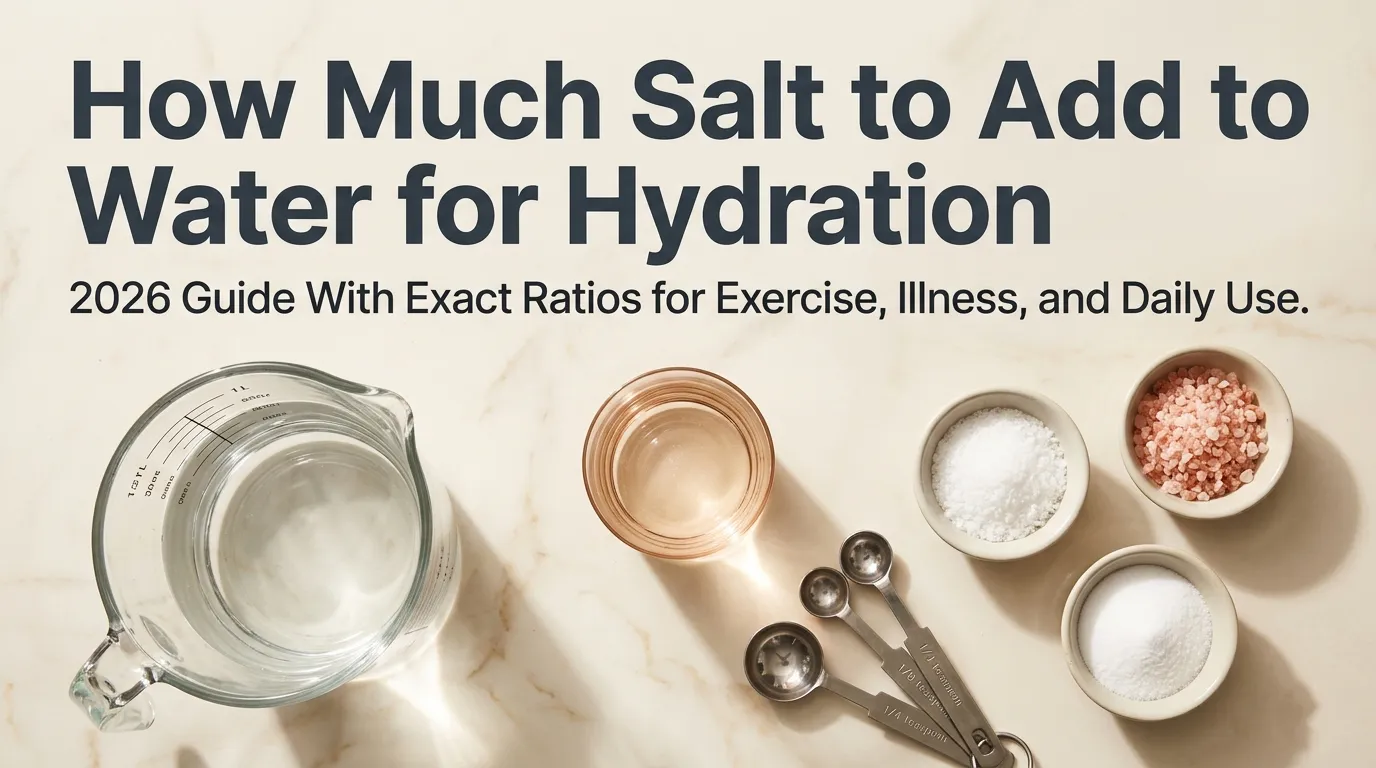
How Much Salt to Add to Water for Hydration (2026 Guide)
The right amount of salt to add to water for hydration is 1/8 to 1/4 teaspoon of salt per liter of water for exercise and daily electrolyte maintenance, which provides approximately 288 to 575 milligrams of sodium. This creates a mildly hypotonic solution that improves fluid retention compared to plain water without approaching the sodium concentration of blood or posing health risks for most adults.
This measurement is not universal. The World Health Organization oral rehydration solution uses a much higher sodium concentration for clinical dehydration. Exercise hydration uses a lower concentration for sweat replacement. The situation determines the dose. Using the wrong concentration for the wrong situation ranges from useless to harmful.
This article gives you the exact measurements for every hydration scenario, explains which salt type to use and why the differences matter less than most people think, covers when salted water is genuinely helpful versus when plain water is fine, and includes the specific pediatric guidelines that no other major article addresses.
How Much Salt to Add to Water for Hydration
The standard recommendation for everyday exercise hydration is 1/8 to 1/4 teaspoon of salt per liter (about 34 ounces) of water, providing roughly 288 to 575 milligrams of sodium. This concentration improves fluid retention compared to plain water while remaining hypotonic, meaning it has a lower solute concentration than your blood and absorbs quickly.
A practical starting point is 1/8 teaspoon, which is a small pinch. You can measure this precisely once to see what it looks like, then eyeball it. The taste should be barely detectable, not salty. If your water tastes noticeably salty, you have added too much. Properly salted hydration water tastes slightly different from plain water, perhaps faintly mineral, but not like seawater.
The reason this specific range works comes from sports science research. The American College of Sports Medicine recommends that endurance exercise hydration beverages contain 500 to 700 milligrams of sodium per liter to replace sweat losses. A homemade salt water at 1/4 teaspoon per liter falls at the lower end of this range. For exercise under 60 minutes or everyday drinking, 1/8 teaspoon is sufficient.
Fluid retention is the mechanism that makes salted water outperform plain water in certain situations. Plain water enters your bloodstream quickly but also leaves quickly through urination. The kidneys detect falling plasma osmolality as water enters and increase urine output to maintain balance. Sodium in the water reduces this diuretic response. You retain more of the water you drink.
Key Takeaway: Start with 1/8 teaspoon salt per liter of water for everyday use and increase to 1/4 teaspoon for exercise over an hour, never exceeding a barely detectable taste.
Salt to Water Ratio for Hydration
The optimal salt to water ratio for hydration is 1 gram of salt per liter of water for exercise (0.1% solution) and 3.5 grams of salt per liter for clinical rehydration using the WHO formula (0.35% solution). These two ratios serve entirely different purposes and should never be confused.
The 1 gram per liter ratio provides approximately 388 milligrams of sodium, which matches the lower end of the American College of Sports Medicine recommendation for exercise beverages. This creates a solution with an osmolality well below blood plasma, meaning water moves efficiently from your intestine into your bloodstream. The mild sodium content simply slows the kidney’s excretion response enough to improve net fluid retention.
The 3.5 grams per liter WHO ratio contains approximately 1,350 milligrams of sodium and requires glucose for safe absorption. This ratio is designed for clinical dehydration from diarrhea or vomiting where both water and electrolyte losses are severe. The glucose is not optional at this concentration. The sodium-glucose cotransport mechanism in the small intestine requires glucose to pull sodium and water across the intestinal lining. Without glucose, this salty solution would draw water into the intestine and worsen dehydration.
Here is the critical distinction:
| Purpose | Salt per Liter | Sodium per Liter | Glucose Needed | Taste |
|---|---|---|---|---|
| Everyday hydration | 1/8 tsp (0.6g) | 230 mg | No | Barely perceptible |
| Exercise hydration | 1/4 tsp (1.2g) | 460 mg | No | Faintly mineral |
| Exercise (high sweat) | 1/3 tsp (1.6g) | 620 mg | Optional | Slightly mineral |
| WHO ORS clinical | 1/2 tsp (3.5g) | 1,350 mg | Yes (20g sugar) | Noticeably salty-sweet |
Confusing the WHO ratio with the exercise ratio is the most common and most dangerous mistake people make when preparing salt water. The exercise ratio is mildly salted water. The WHO ratio is medicine. Use each only for its intended purpose.
Key Takeaway: Exercise salt water uses a 0.1% salt concentration; clinical ORS uses 0.35% with sugar; never confuse the two or use the WHO formula without glucose.
How Much Sea Salt to Add to Water for Hydration
Sea salt and standard table salt contain nearly identical sodium by weight, so you add the same amount: 1/8 to 1/4 teaspoon per liter. Sea salt’s larger, irregular crystals mean a teaspoon of sea salt often weighs slightly less than a teaspoon of finely ground table salt, which slightly reduces the sodium in a volume-based measurement.
The sodium content per gram of pure salt is consistent. Sodium chloride, whether from the ocean, a Himalayan mine, or an evaporated salt flat, contains approximately 388 milligrams of sodium per gram of salt. The differences between salt types come from trace minerals, not sodium concentration. Sea salt containing 1 percent mineral impurities provides 384 milligrams of sodium per gram instead of 388. This difference is nutritionally irrelevant.
Measuring sea salt by volume introduces variability because crystal size affects packing density. A teaspoon of finely ground sea salt weighs approximately 5 to 6 grams. A teaspoon of coarse sea salt flakes weighs approximately 3 to 4 grams because large flakes create air gaps. Your actual sodium intake from a teaspoon of coarse sea salt may be 30 to 40 percent lower than the same volume of fine table salt.
Practical guidance overcomes this variability. Measure sea salt by weight if precision matters, especially when preparing a hydration drink for a long endurance event. Use 1 gram of sea salt per liter for exercise hydration. If measuring by volume, use a slightly rounded 1/4 teaspoon of coarse sea salt or a level 1/4 teaspoon of fine sea salt per liter. The taste test remains your most reliable method. The water should not taste salty.
Key Takeaway: Sea salt adds the same sodium as table salt by weight; adjust volume measurements slightly for coarse crystals, and rely on taste to confirm you have not over-salted.
How Much Salt to Put in Water for Hydration
For an 8-ounce glass of water, you put a small pinch of salt, roughly 1/16 teaspoon, which provides approximately 115 to 144 milligrams of sodium. For a 16-ounce bottle, you put 1/8 teaspoon, roughly 230 to 288 milligrams of sodium. These single-serving measurements scale directly from the per-liter ratio.
The pinch measurement deserves explanation because “a pinch” sounds imprecise but is actually useful for everyday hydration. A culinary pinch is the amount of salt you can hold between your thumb and forefinger, approximately 1/16 teaspoon. This is the right amount for an 8-ounce glass. Two pinches for a 16-ounce bottle. Four pinches for a liter. Once you calibrate your pinch against a measuring spoon one time, you can replicate it consistently.
Precise measurement matters more for exercise hydration than for casual drinking. If you are preparing water for a 2-hour run in summer heat, use an actual measuring spoon. A slight under-dose during exercise still helps. A large over-dose tastes unpleasant and can cause stomach discomfort or, in extreme cases, contribute to hypernatremia if you consume excessive salt over many hours.
Here is the measurement chart for common water volumes:
| Water Volume | Salt Amount | Sodium Provided | Best For |
|---|---|---|---|
| 8 oz glass (240ml) | 1/16 tsp (pinch) | 115-144 mg | Everyday single glass |
| 16 oz bottle (473ml) | 1/8 tsp | 230-288 mg | Short workout, daily use |
| 1 liter (34 oz) | 1/4 tsp | 460-575 mg | Exercise over 1 hour |
| 1 liter clinical ORS | 1/2 tsp plus sugar | 1,150-1,350 mg | Diarrhea/vomiting rehydration |
| 1 gallon (3.8L) | 3/4 to 1 tsp | 1,380-2,300 mg | All-day outdoor work, endurance |
The 16-ounce bottle measurement is the most practical daily reference point. A single 1/8 teaspoon in your reusable water bottle gives you mild electrolyte support for an hour at the gym or a walk in warm weather.
Key Takeaway: A pinch per glass, an eighth teaspoon per bottle, and a quarter teaspoon per liter are the three easy measurements to remember for everyday, workout, and endurance hydration.
Best Salt to Add to Water for Hydration
The best salt to add to water for hydration is plain non-iodized fine sea salt or standard table salt because sodium chloride is what drives the hydration benefit, and both types deliver it identically. The choice between expensive pink salt and basic salt is a matter of taste preference and budget, not hydration effectiveness.
Sodium is the electrolyte that governs extracellular fluid volume. Chloride follows sodium passively and contributes to fluid balance alongside it. Every salt type on the market, from affordable store-brand table salt to artisanal fleur de sel, delivers these two ions in the same proportion. The hydration physiology does not care whether the sodium came from a Himalayan mine or the Atlantic Ocean.
Trace minerals in unrefined salts exist in quantities too small to affect hydration. Himalayan pink salt contains approximately 84 minerals and elements according to spectral analysis, but the non-sodium mineral fraction totals roughly 2 percent of the salt by weight. A liter of water with 1/4 teaspoon of Himalayan salt provides single-digit milligram amounts of potassium, magnesium, and calcium. These amounts are physiologically negligible compared to the hundreds of milligrams of these electrolytes you need daily from food.
Iodized versus non-iodized is the one salt distinction that has health implications beyond hydration. Iodized salt provides a reliable source of iodine, an essential nutrient for thyroid function. If you use iodized salt for your hydration water, you are contributing to your iodine intake. If you use non-iodized salt, you need dietary iodine from other sources such as seafood, dairy, or seaweed.
Key Takeaway: Any salt works for hydration because sodium is what matters; choose based on taste, texture preference, cost, and whether you want iodine supplementation, not based on trace mineral claims.
Is Sea Salt Better Than Table Salt for Hydration
Sea salt is not meaningfully better than table salt for hydration purposes. Both provide the sodium and chloride ions that regulate fluid balance, and the trace mineral differences between them are too small to affect how your body retains water or replenishes electrolytes.
The belief that sea salt is superior for hydration comes from several misconceptions. Sea salt does contain trace minerals that table salt lacks. Those minerals include potassium, magnesium, and calcium in amounts of roughly 1 to 50 milligrams per teaspoon. To put this in context, a banana provides about 422 milligrams of potassium. A teaspoon of sea salt provides perhaps 10 milligrams. Your hydration water is not a meaningful mineral source regardless of salt type.
Table salt undergoes refining that removes mineral impurities along with natural contaminants. It is typically treated with anti-caking agents such as calcium silicate or sodium aluminosilicate to prevent clumping. These agents are inert and present in milligram amounts that do not affect human physiology. The refinement process does not alter sodium chloride, which remains chemically identical to the sodium chloride in sea salt.
The anti-caking agent question deserves a direct answer. Some people prefer sea salt to avoid these additives. The additives are FDA-approved and considered safe. Whether you avoid them is a personal choice, not a hydration performance decision. If anti-caking agents bother you, choose a sea salt or Himalayan salt without them. Your hydration will be identical either way.
Iodine is the substantive difference. Table salt is often iodized as a public health measure to prevent iodine deficiency, which causes goiter and thyroid dysfunction. Sea salt naturally contains very little iodine. If you use sea salt for all your salt intake and do not consume dairy, seafood, or seaweed, your iodine intake may be insufficient.
Key Takeaway: Sea salt and table salt hydrate you identically; choose based on whether you want iodine from iodized salt, prefer the texture of sea salt crystals, or wish to avoid anti-caking agents.
How Much Himalayan Salt Should I Put in My Water
You should put 1/8 to 1/4 teaspoon of Himalayan pink salt per liter of water, the exact same measurement as any other salt type. Himalayan salt does not require a different ratio because its sodium content per gram is nearly identical to sea salt and table salt.
Himalayan salt is mined from the Khewra Salt Mine in Pakistan and gets its pink color from iron oxide, the same compound that gives rust its reddish hue. The iron content is approximately 0.001 percent by weight, far below levels that would affect iron nutrition. The salt is primarily sodium chloride with roughly 2 percent consisting of other minerals including potassium, magnesium, and calcium in trace amounts.
Marketing claims that Himalayan salt contains 84 minerals are technically true but nutritionally misleading. Spectral analysis can detect 84 elements in Himalayan salt at parts-per-million or parts-per-billion concentrations. Many of these elements have no known biological function in humans. The ones that do function as nutrients appear in amounts so small that a teaspoon provides less than one percent of daily needs.
The larger crystal size of many Himalayan salt products affects volume measurement. Coarse Himalayan salt crystals weigh less per teaspoon than fine table salt because the irregular crystals leave air gaps. A teaspoon of coarse Himalayan salt weighs approximately 4 grams versus 6 grams for fine table salt. This means a teaspoon of coarse pink salt delivers roughly one-third less sodium. Compensate with a slightly rounded measurement if you are using large crystals.
Key Takeaway: Himalayan salt works in the same 1/8 to 1/4 teaspoon per liter ratio; adjust slightly upward for coarse crystals, and disregard trace mineral claims as they are nutritionally negligible.
Why Salt Helps Hydration
Salt helps hydration because sodium, the primary ion in salt, holds water in the extracellular fluid compartment through osmotic force and reduces the kidneys’ diuretic response to water intake. Without sodium, the water you drink passes through your system more quickly and a greater proportion leaves as urine rather than remaining in circulation where your body needs it.
The mechanism operates through antidiuretic hormone and kidney function. When you drink plain water, your blood plasma becomes temporarily dilute. Osmoreceptors in your brain detect this falling osmolality and signal the pituitary gland to reduce ADH secretion. Less ADH means your kidneys produce more dilute urine to shed the excess water. You urinate out a portion of what you just drank. Adding sodium to water reduces the dilution effect, so ADH remains higher, and your kidneys retain more of the water you consumed.
The sodium-glucose cotransport mechanism adds a second layer of absorption efficiency in the small intestine. The SGLT1 transporter protein in intestinal cells moves one glucose molecule and two sodium ions together from the intestinal lumen into the cell. Water follows sodium passively through aquaporin channels and between cells. This is why the World Health Organization oral rehydration solution contains glucose alongside sodium. The cotransport accelerates water uptake beyond what sodium alone can achieve.
Plain water is sufficient for everyday hydration in a person eating a typical diet. The sodium in your meals provides plenty of extracellular solute to maintain fluid balance. Salted water becomes useful when you are losing both water and sodium, primarily through sweating during exercise or heat exposure, or through diarrhea and vomiting. In these situations, replacing water without sodium can dilute blood sodium concentration and lead to hyponatremia.
Key Takeaway: Sodium in water reduces your kidneys’ urine response to drinking and holds fluid in your bloodstream, which matters most when you are actively losing both water and salt through sweat or illness.
How Much Sodium in Water for Exercise
Exercise hydration requires 500 to 700 milligrams of sodium per liter of water according to the American College of Sports Medicine position stand on exercise fluid replacement. This translates to approximately 1/4 to 1/3 teaspoon of salt per liter for homemade electrolyte water.
Sweat sodium concentration varies significantly between individuals. A person who is heat-acclimatized and fit may lose 200 to 400 milligrams of sodium per liter of sweat. A person who is unacclimatized, sweating heavily, or genetically a salty sweater may lose 800 to 1,200 milligrams per liter. The 500 to 700 milligram per liter recommendation in drinking water provides a middle-ground replacement rate for most exercisers.
Duration determines whether sodium in water matters at all. Exercise under 60 minutes in moderate temperatures does not deplete sodium enough to require replacement. Plain water is adequate. Exercise over 60 minutes, particularly in heat, produces cumulative sodium loss that benefits from replacement. The longer and hotter the session, the more the sodium in your water matters.
Carbohydrate addition becomes relevant for sessions over 90 minutes. A homemade sports drink with 1/4 teaspoon salt plus 15 to 20 grams of sugar per liter (3 to 4 teaspoons) provides both sodium for fluid retention and glucose for muscle fuel plus accelerated water absorption through the sodium-glucose cotransport mechanism. This approaches the composition of commercial sports drinks at a fraction of the cost.
Quick Tip for exercise hydration:
- Under 60 minutes: plain water is fine
- 60 to 90 minutes moderate intensity: 1/8 tsp salt per liter
- 90+ minutes or high heat: 1/4 tsp salt plus 3 tsp sugar per liter
- Saltier sweaters (white residue on skin or clothing): use 1/3 tsp salt per liter
Key Takeaway: Exercise salt water needs 500 to 700 mg sodium per liter only for sessions over an hour or in high heat; shorter workouts and cooler conditions require nothing more than plain water.
Salt in Water for Dehydration Recovery
Salt in water for dehydration recovery from illness requires a different formula than exercise hydration. Clinical dehydration from diarrhea, vomiting, or fever needs the World Health Organization oral rehydration solution, which contains 3.5 grams of salt (1,350 mg sodium) and 20 grams of glucose per liter. This is not the same as exercise salt water.
Dehydration from gastroenteritis involves loss of both water and electrolytes from the intracellular and extracellular compartments. The small intestine’s ability to absorb water is compromised by inflammation. Plain water consumed during gastroenteritis absorbs poorly and can worsen electrolyte dilution. Salted water without glucose at this concentration would draw water into the intestine by osmosis and worsen diarrhea.
The glucose in the WHO formula solves both problems. Glucose enables the sodium-glucose cotransport mechanism to actively pull sodium and water across the intestinal lining even when passive water absorption is impaired. This is one of the most important and underappreciated details in hydration science. The WHO ORS formula is not just salty water. It is a specific ratio of sodium to glucose (1:1 molar ratio) that maximizes water uptake through the cotransporter.
Commercial oral rehydration solutions such as Pedialyte, DripDrop, and Liquid I.V. use variations of this principle. Some use lower sodium than the full WHO formula. Some use rice starch or other carbohydrates instead of glucose. All of them rely on the sodium-glucose cotransport mechanism. They are designed for rehydration during illness, not for everyday drinking or exercise.
Key Takeaway: Illness dehydration requires the WHO ORS formula with both salt and sugar in specific ratios; never use plain exercise salt water to treat dehydration from vomiting or diarrhea.
WHO Oral Rehydration Solution Recipe
The WHO oral rehydration solution recipe combines 6 level teaspoons of sugar (20 grams), 1/2 level teaspoon of salt (3.5 grams), and 1 liter of clean drinking water. This formula produces a solution containing 75 millimoles per liter of sodium and 75 millimoles per liter of glucose with an osmolality of 245 milliosmoles per kilogram, optimized for rapid fluid absorption during clinical dehydration.
The precision matters because the sodium-to-glucose ratio is what makes ORS work. The SGLT1 cotransporter in the intestinal lining moves one glucose molecule together with two sodium ions. The 1:1 molar ratio of glucose to sodium in the WHO formula maximizes this transport. More glucose would increase osmolality without improving sodium uptake. Less glucose would leave sodium transport capacity unused. The formula is the result of decades of optimization research.
Preparation hygiene is essential because you are using this solution when someone is already ill. Use water that has been boiled and cooled, or bottled water if safe tap water is unavailable. Measure with actual measuring spoons, not guesses. A half teaspoon of salt that is actually a heaping three-quarter teaspoon will make the solution hypertonic and potentially worsen diarrhea. The same error in reverse makes the solution ineffective.
Storage and usage guidelines prevent secondary illness. Prepared ORS should be used within 24 hours if kept at room temperature or 48 hours if refrigerated. Discard any unused solution after this window because the sugar content supports bacterial growth. Sip small amounts frequently rather than drinking large volumes at once. Adults should aim for 200 to 400 milliliters after each loose stool. A physician should evaluate anyone who cannot keep fluids down or shows signs of severe dehydration including reduced urination, dizziness, or confusion.
Key Takeaway: The WHO ORS formula is 6 teaspoons sugar, half teaspoon salt, and 1 liter safe water; measure precisely because the glucose-to-sodium ratio determines whether this medicine works or makes things worse.
Homemade Electrolyte Drink Salt Sugar Ratio
The homemade electrolyte drink salt sugar ratio for exercise is 1/4 teaspoon salt (1.2 grams) and 3 to 4 teaspoons sugar (12 to 16 grams) per liter of water. This creates a 1.2 percent carbohydrate solution with approximately 460 milligrams of sodium, which is isotonic to slightly hypotonic and suitable for endurance exercise.
The sugar serves two functions in a homemade sports drink. It provides carbohydrate fuel for working muscles during exercise lasting longer than 90 minutes. It enhances water absorption through the sodium-glucose cotransport mechanism, the same transport system the WHO formula uses but at a lower concentration appropriate for sweat replacement rather than clinical rehydration.
The carbohydrate concentration should stay at 4 to 8 percent for optimal gastric emptying and absorption. Higher sugar concentrations delay stomach emptying and can cause gastrointestinal distress during exercise. The 12 to 16 grams per liter recommendation creates a 1.2 to 1.6 percent solution, which is intentionally low to prioritize hydration speed over fuel delivery. If you want more carbohydrates for fuel, consume them separately as gels or chews alongside your electrolyte drink.
Flavoring improves palatability without affecting function. A squeeze of lemon or lime juice adds flavor and a small amount of potassium. A splash of fruit juice provides flavor, natural sugars, and trace electrolytes. Avoid commercial flavor syrups that add excessive sugar without electrolytes. The goal is a drink you will actually consume during exercise, not one that tastes unpleasant enough to discourage drinking when you need fluids most.
Quick Tip:
- Exercise under 90 min: 1/8 to 1/4 tsp salt per liter, no sugar needed
- Exercise over 90 min: 1/4 tsp salt plus 3-4 tsp sugar per liter
- Clinical dehydration: Use WHO formula (6 tsp sugar, 1/2 tsp salt per liter)
- Never substitute WHO formula strength for exercise or exercise strength for illness
Key Takeaway: For homemade sports drinks lasting over 90 minutes, combine 1/4 teaspoon salt with 3 to 4 teaspoons sugar per liter; this is far weaker and different from the WHO medical formula.
Hyponatremia Prevention Salt Water
Salt water helps prevent exercise-associated hyponatremia by providing sodium to offset dilution of blood sodium concentration that occurs when an athlete drinks excessive plain water during prolonged endurance events. The risk is real for marathon runners, ultramarathon athletes, and long-distance triathletes who drink large volumes of plain water while losing sodium through sweat.
Hyponatremia occurs when blood sodium falls below 135 millimoles per liter. Symptoms begin with bloating, nausea, and headache and can progress to confusion, seizures, and cerebral edema in severe cases. The condition is preventable. The primary prevention strategy is not overdrinking. Drinking to thirst rather than forcing fluid intake on a schedule reduces the risk. The secondary strategy is ensuring that the fluids consumed contain sodium.
Endurance athletes in events lasting four hours or longer should consume 500 to 700 milligrams of sodium per liter of fluid, which is the 1/4 to 1/3 teaspoon salt per liter range. This does not prevent hyponatremia on its own if an athlete grossly overdrinks. No sodium concentration is high enough to compensate for drinking two liters per hour when the body needs 500 milliliters. Sodium in the water is one part of a hydration strategy that includes drinking to thirst and not exceeding 400 to 800 milliliters per hour for most athletes.
Sodium supplementation beyond what is in the drink may be appropriate for very long events in heat. Salt tablets or electrolyte capsules providing 200 to 300 milligrams of sodium each, taken with water, can supplement the sodium in the drink. These should be used by athletes who have tested them in training and know their individual sweat sodium losses through prior experience or sweat testing.
Key Takeaway: Salt in water helps prevent dangerous sodium dilution in endurance athletes, but the real hyponatremia prevention strategy is drinking to thirst and not forcing excessive plain water intake.
Can You Drink Salt Water Every Day
Drinking salt water every day is safe for most healthy adults if the concentration stays at 1/8 teaspoon of salt per liter (approximately 230 milligrams of sodium) and the total daily sodium intake from all sources remains within the Dietary Guidelines for Americans 2020-2025 limit of 2,300 milligrams per day. The salt in your water counts toward your daily sodium total.
A liter of water with 1/8 teaspoon of salt provides about 230 milligrams of sodium. This is roughly 10 percent of the 2,300 milligram daily limit. If your diet already provides 2,000 to 2,500 milligrams of sodium from food, adding a liter of salted water pushes you to or slightly over the recommended limit. This small excess is unlikely to harm a healthy person with normal kidney function and normal blood pressure.
The problem arises when daily salted water combines with a high-sodium diet. The average American diet contains 3,400 milligrams of sodium daily without any salt added to water. Adding multiple liters of salted water to this baseline creates a sodium surplus that increases blood pressure over time in salt-sensitive individuals. If you add salt to your water, you should be aware of your total sodium intake from food.
Signs that you are consuming too much sodium include waking up with puffy fingers or face, feeling unusually thirsty despite drinking, and elevated blood pressure readings. These are indications to reduce salt in your water or reduce dietary sodium elsewhere. A physician can check your blood pressure and order a basic metabolic panel to measure your serum sodium if you have concerns about your sodium balance.
Key Takeaway: Daily salted water at 1/8 teaspoon per liter adds 230 milligrams of sodium to your day, which is safe within a moderate-sodium diet but requires awareness of total sodium intake from all sources.
Who Should Avoid Salt Water
People who should avoid salt water include those with hypertension, heart failure, chronic kidney disease stages 3 through 5, cirrhosis with ascites, Meniere’s disease, and individuals on physician-prescribed sodium-restricted diets. These conditions involve impaired sodium handling, and even modest additional sodium can worsen fluid retention, blood pressure, or disease progression.
Hypertension is the most common reason to avoid or strictly limit sodium in water. The American Heart Association recommends that people with hypertension limit sodium to 1,500 to 2,300 milligrams daily depending on physician guidance. Adding salted water to this budget consumes sodium capacity that could come from food. If you have hypertension, plain water is the appropriate hydration choice unless your physician specifically recommends electrolyte supplementation for a specific reason such as endurance exercise or heat exposure.
Heart failure involves impaired pumping function that leads to fluid accumulation in the lungs, legs, and abdomen. Sodium drives fluid retention. Even modest increases in sodium intake can tip a compensated heart failure patient into decompensation requiring hospitalization. If you have heart failure, you are almost certainly on a sodium-restricted diet managed by a cardiologist. Salt in your water is contraindicated unless that cardiologist tells you otherwise.
Chronic kidney disease reduces the kidneys’ ability to excrete excess sodium. As kidney function declines, sodium accumulates, blood pressure rises, and fluid retention worsens. People with CKD stages 3 to 5 should follow the sodium limits prescribed by their nephrologist. Adding salt to drinking water adds sodium that damaged kidneys cannot efficiently remove.
Pregnant people with preeclampsia or gestational hypertension should avoid additional sodium. These conditions involve disordered fluid regulation and elevated blood pressure that can endanger both the pregnant person and the fetus. An obstetrician managing a hypertensive pregnancy can provide individualized sodium guidance.
Key Takeaway: Salted water is contraindicated for people with hypertension, heart failure, kidney disease, cirrhosis, and Meniere’s disease unless the relevant specialist physician has specifically advised otherwise.
Pediatric Oral Rehydration Salt Amounts
Pediatric oral rehydration salt amounts differ from adult guidelines and should follow the American Academy of Pediatrics recommendations for oral rehydration therapy. Children require lower total sodium and lower total fluid volumes than adults, and precise measurement is more important because small children have a narrower margin of error for both dehydration and overcorrection.
The AAP recommends commercially prepared oral rehydration solutions such as Pedialyte or Infalyte for children with dehydration from gastroenteritis rather than homemade salt water. These products provide sodium at 45 to 75 millimoles per liter, which is 1,035 to 1,725 milligrams per liter, a range similar to or slightly lower than the WHO adult formula. The key difference is the precision of commercial products eliminates the measurement errors that are common and dangerous with homemade solutions for small bodies.
For children who are not dehydrated but need electrolyte support during illness with fever or mild fluid losses, diluted apple juice or other clear fluids are typically sufficient. The AAP published a 2016 trial showing that diluted apple juice followed by the child’s preferred fluids was as effective as commercial ORS for children with mild gastroenteritis and minimal dehydration. Salted water is not recommended for this purpose.
A pediatrician or family physician should evaluate any child who cannot keep fluids down, has not urinated in 6 to 8 hours, has a dry mouth and sunken eyes, or appears lethargic. These are signs of moderate to severe dehydration that may require intravenous fluids. Do not attempt to manage this level of dehydration at home with homemade salt water.
Quick Tip for parents:
- Use commercial ORS (Pedialyte, etc.) for children with vomiting or diarrhea, not homemade salt water
- Give small, frequent sips (5 to 10 ml every 5 minutes) to avoid triggering vomiting
- A pediatrician should evaluate any child with signs of dehydration including reduced urine output, dry mouth, or unusual sleepiness
- Never use adult exercise salt water ratios for children
Key Takeaway: Children’s electrolyte needs during illness should be managed with commercial pediatric ORS products at precise concentrations, not homemade salt water, due to the narrow safety margin in small bodies.
Frequently Asked Questions About Adding Salt to Water
What is the perfect salt to water ratio for hydration?
The perfect salt to water ratio for exercise hydration is 1 gram of salt per liter of water, which is approximately 1/4 teaspoon.
This provides 388 to 460 milligrams of sodium per liter, matching the lower end of the American College of Sports Medicine recommendation.
For clinical rehydration from illness, the WHO formula uses 3.5 grams of salt per liter with 20 grams of glucose, which is a different and more concentrated formula.
Does adding salt to water help you hydrate faster?
Adding salt to water helps you retain more of the fluid you drink by reducing your kidneys’ urine response to water intake.
The sodium reduces the dilution of your blood plasma, so antidiuretic hormone remains higher and less water is excreted.
The effect is moderate and most useful during exercise over an hour, in hot conditions, or when recovering from dehydration, not during everyday hydration for a person eating a normal diet.
Can I use pink Himalayan salt instead of sea salt for hydration?
Pink Himalayan salt works identically to sea salt for hydration because the sodium content per gram is nearly the same.
Use the same measurement of 1/8 to 1/4 teaspoon per liter.
The trace minerals in Himalayan salt are present in single-digit milligram amounts per serving and do not meaningfully affect hydration physiology or electrolyte balance.
How much salt should I put in my water for a workout?
For a workout lasting less than 60 minutes in moderate temperatures, plain water is sufficient and no salt is needed.
For a workout lasting 60 to 90 minutes or in warm conditions, add 1/8 teaspoon of salt per 16-ounce bottle of water.
For endurance exercise over 90 minutes, add 1/4 teaspoon of salt and 3 to 4 teaspoons of sugar per liter to replace sweat sodium losses and provide working muscle fuel.
Is drinking salt water bad for your kidneys?
Drinking salt water at the recommended 1/8 to 1/4 teaspoon per liter is not harmful to healthy kidneys.
Healthy kidneys efficiently excrete excess sodium, and this mild concentration adds only 230 to 575 milligrams of sodium per liter to your daily total.
People with chronic kidney disease stages 3 through 5 should avoid salt water because their kidneys cannot effectively remove excess sodium, and even modest increases in sodium intake can worsen fluid retention and blood pressure.
What kind of salt is best for homemade electrolyte drinks?
Any clean food-grade salt works for homemade electrolyte drinks because sodium chloride is the active ingredient that supports hydration.
Fine sea salt, Himalayan pink salt, and standard table salt all deliver equivalent sodium per gram.
Choose based on taste preference, whether you want iodine from iodized table salt, and whether you prefer to avoid anti-caking agents found in some refined salts.
Adding salt to your water makes genuine physiological sense when you are actively losing both water and sodium, which means exercise over an hour, prolonged heat exposure, or recovering from illness with diarrhea or vomiting. A quarter teaspoon per liter for exercise, a half teaspoon with six teaspoons of sugar per liter for clinical dehydration, and none at all for everyday hydration when you are eating a normal diet. The situation determines the dose.
The salt type you choose matters far less than getting the measurement right. Sea salt, Himalayan salt, and table salt all deliver the sodium your body needs to hold onto the water you drink. The trace minerals that make expensive salts pink or grey arrive in amounts too small to matter for hydration. Pick the salt you like and measure it carefully.
Plain water remains the correct choice for most people most of the time. If you add salt when you do not need it, your kidneys will simply excrete the excess while your blood pressure may quietly rise over years. Salted water is a tool for specific situations, not a daily wellness practice.