Popcorn Nutrition Facts: 2026 Complete Guide
A single cup of air-popped popcorn contains just 31 calories, 1 gram of protein, 6 grams of carbohydrates, 1 gram of fiber, and less than 0.5 grams of fat according to USDA FoodData Central records . That same cup delivers more fiber per calorie than almost any other snack food.
The gap between healthy popcorn and diet-busting popcorn is enormous. Air-popped popcorn without added butter or salt is a whole grain snack with genuine nutritional value. But movie theater popcorn, microwave butter versions, and pre-packaged kettle corn can pack 500 to 1,200 calories per large serving with enough saturated fat and sodium to rival a fast food burger meal .
This article breaks down the complete popcorn nutrition facts for every preparation method: air-popped, oil-popped, microwave, movie theater, kettle corn, and cheese-flavored varieties. You will learn how to read labels, which types work for weight loss or diabetes, and how to make popcorn that fits your health goals without sacrificing flavor.
Key Takeaway: Popcorn is neither automatically healthy nor automatically unhealthy. The preparation method and added ingredients determine the nutrition profile entirely.
Plain Popcorn Nutrition Facts: The Whole Grain Basics
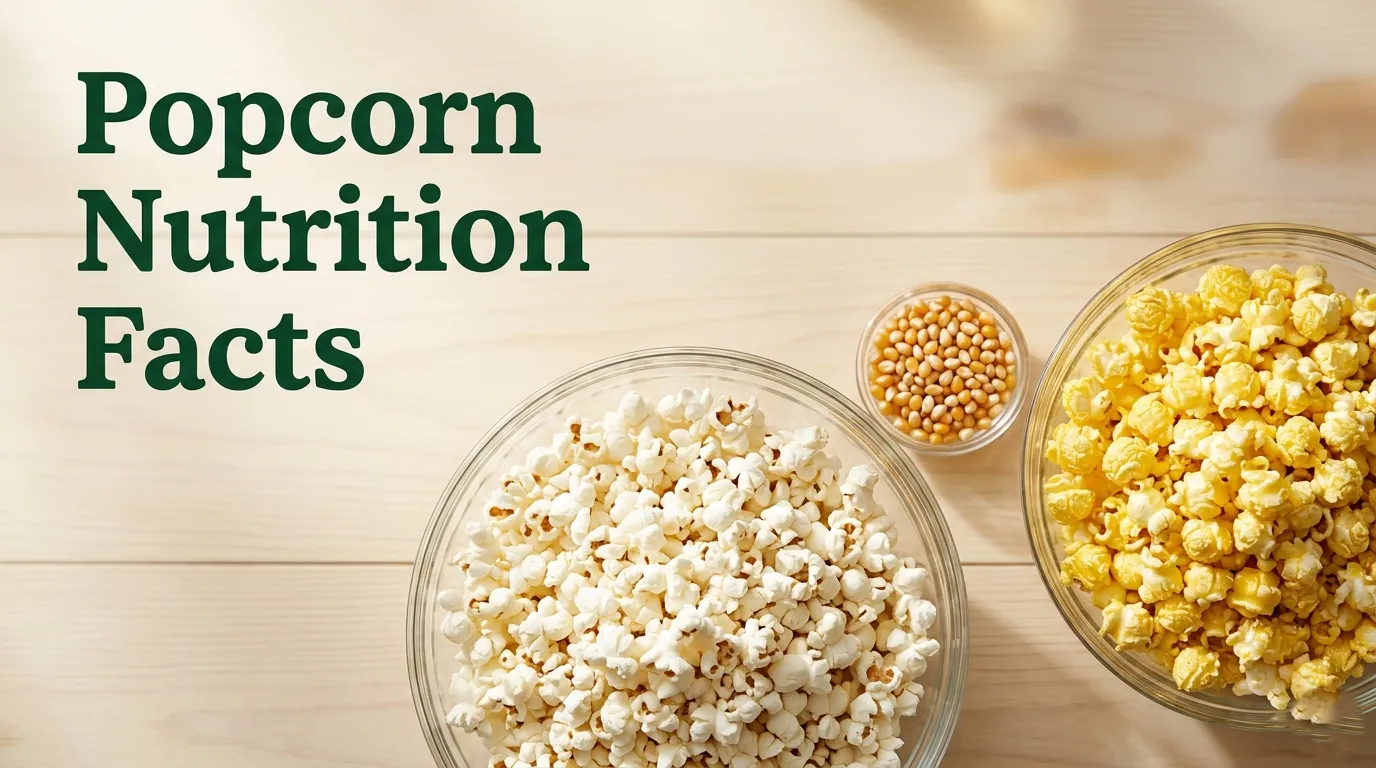
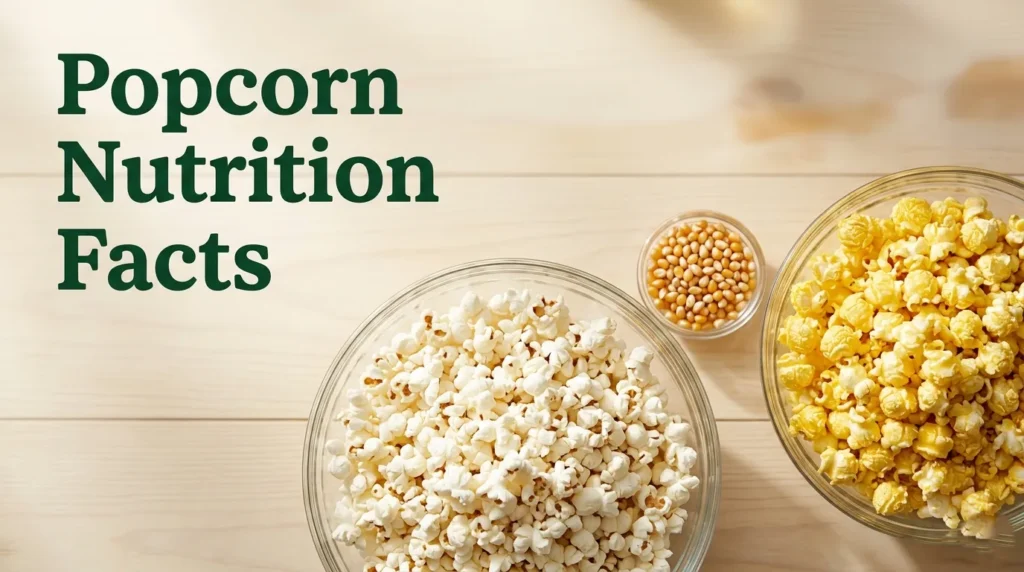
Plain, air-popped popcorn without any added oil, butter, salt, or sugar is a nutrient-dense whole grain with an impressive fiber-to-calorie ratio. According to USDA FoodData Central, one cup (8 grams) of air-popped popcorn contains 31 calories, 1.04 grams of protein, 6.22 grams of carbohydrates, 1.2 grams of fiber, and 0.36 grams of total fat .
The same serving provides 0.26 milligrams of iron (3% of the Daily Value for men, 1% for women), 12 milligrams of magnesium (3% of the Daily Value), and 26 milligrams of potassium . Popcorn also contains small amounts of B vitamins including niacin, vitamin B6, and folate.
What makes popcorn nutritionally unique is its whole grain status. Unlike refined grain snacks like pretzels or crackers, popcorn contains the entire grain kernel including the bran, germ, and endosperm. The bran provides the fiber. The germ contains B vitamins and minerals. The endosperm provides carbohydrates for energy.
| Nutrient | Amount per 1 cup (8g air-popped) | Amount per 100g | % Daily Value (per cup) |
|---|---|---|---|
| Calories | 31 | 387 | 2% |
| Protein | 1.04g | 12.94g | 2% |
| Total Fat | 0.36g | 4.54g | 0% |
| Carbohydrates | 6.22g | 77.78g | 2% |
| Dietary Fiber | 1.2g | 14.5g | 4% |
| Sugars | 0.07g | 0.87g | 0% |
| Iron | 0.26mg | 3.19mg | 1-3% |
| Magnesium | 12mg | 144mg | 3% |
| Phosphorus | 29mg | 358mg | 2% |
| Potassium | 26mg | 329mg | 1% |
| Zinc | 0.25mg | 3.08mg | 2% |
| Niacin | 0.185mg | 2.308mg | 1% |
Quick Tip: The weight difference matters. A “cup” of popcorn is light (about 8 grams). Most people eat 2 to 4 cups as a serving, which would be 62 to 124 calories for air-popped.
Key Takeaway: Plain air-popped popcorn is one of the few snack foods where you can eat a large volume for very few calories while getting meaningful fiber.
Air-Popped Popcorn Nutrition Facts: The Gold Standard
Air-popped popcorn nutrition facts represent the healthiest way to eat popcorn because the popping method requires no oil whatsoever. Hot air circulates around the kernels, creating pressure that makes them explode into fluffy pieces without added fat.
A comprehensive 2026 Verywell Health analysis ranks air-popped popcorn as the healthiest type, noting it provides fiber with the least amount of added sugar, sodium, and fat compared to other popcorn varieties . A single cup contains 30 calories, 1 gram of protein, 0.5 grams of fat, 6 grams of carbohydrates, and 1 gram of fiber . Sodium sits at just 13 milligrams per cup.
The fiber content is the standout feature. With 1.2 grams of fiber per cup, air-popped popcorn delivers about 4 percent of the daily fiber recommendation in a single serving. For comparison, you would need to eat approximately two cups of air-popped popcorn to get the same fiber as one slice of 100 percent whole wheat bread, but the popcorn has roughly one-third the calories.
Air-popped popcorn is also naturally gluten-free, making it a safe snack for people with celiac disease or gluten sensitivity . The corn kernel contains no gluten proteins, though cross-contamination is possible if processed on shared equipment with wheat products.
Key nutrients in air-popped popcorn (per cup):
- Calories: 30-31
- Fiber: 1-1.2g (4% DV)
- Protein: 1g (2% DV)
- Total fat: 0.3-0.5g (0% DV)
- Sodium: 0-13mg (0-1% DV)
- Magnesium: 10-12mg (3% DV)
- Phosphorus: 24-29mg (2% DV)
For people with hypertension watching sodium intake, air-popped popcorn made without salt contains virtually no sodium. The USDA database lists 0 to 1 milligram of sodium per cup for unsalted air-popped popcorn . This makes it one of the lowest-sodium snack options available.
Key Takeaway: Air-popped popcorn is the only preparation method that keeps all the benefits of whole grain corn without adding significant calories, fat, or sodium.
Microwave Popcorn Nutrition Facts: What the Label Really Means
Microwave popcorn nutrition facts vary widely by brand, but most standard butter-flavored microwave popcorn contains between 70 and 130 calories per cup with 3 to 5 grams of fat and 200 to 400 milligrams of sodium per serving. A typical “small bag” microwave popcorn yields approximately 4 to 5 cups popped, meaning a whole bag contains 300 to 650 calories.
According to Verywell Health’s 2026 analysis, one cup of microwaved butter-flavored popcorn provides approximately 73 calories, 1 gram of protein, 4.5 grams of total fat (2 grams saturated), 8 grams of carbohydrates, 1.5 grams of fiber, and 107 milligrams of sodium . That is per cup. A standard 3.5 ounce microwave bag contains about 10 cups of popped popcorn.
The key issue with microwave popcorn is not just the nutrition numbers but what is added to achieve the “butter” flavor. Many brands use partially hydrogenated oils (trans fats, though now largely phased out), artificial butter flavoring (diacetyl), and high amounts of sodium. Additionally, a 2021 study published in the journal Foods identified the presence of perfluoroalkyl and polyfluoroalkyl substances (PFAS) migrating from the microwave bag lining into the popcorn .
To read a microwave popcorn nutrition label correctly:
- Look at the “per cup” column, not “per bag” or “per serving (unpopped)”
- Check serving size carefully (some brands define a serving as 2 cups popped)
- Identify if “butter flavor” comes from real butter, oil, or artificial ingredients
- Compare sodium across brands (range is 90mg to 400mg per cup)
- Look for “no PFAS” or “PFAS-free” packaging claims
- Check for added sugar (some “sweet” microwave varieties have 3-5g per cup)
Quick Tip: “Light” or “94% fat-free” microwave popcorn typically has about 20 to 30 calories per cup, but check sodium levels. Some low-fat versions add extra salt to compensate for flavor loss.
Key Takeaway: Microwave popcorn is convenient but nutritionally inconsistent. The same brand’s “butter” version can have triple the fat and sodium of its “light” version.
Movie Theater Popcorn Nutrition Facts: The Calorie Bomb
Movie theater popcorn nutrition facts are startling: a medium buttered popcorn from a typical theater contains approximately 1,200 calories, 70 grams of fat, and 1,500 milligrams of sodium. That is more than half a day’s calories and more than an entire day’s sodium limit for most adults.
According to 2026 loseit.com analysis, butter-free popcorn from AMC Theatres ranges from 300 calories for a small order to 1,080 calories for a refillable tub . One cup of movie theater popcorn with added butter provides approximately 92 calories, 8 grams of fat (5 grams saturated), 4.5 grams of carbohydrates, less than 1 gram of fiber, and 106 milligrams of sodium . Most people eat well over one cup at a theater.
The primary drivers of the high calorie count are the popping oil and the added “butter” topping. Theaters typically pop kernels in coconut oil or canola oil. Coconut oil is approximately 90 percent saturated fat. The “butter” dispensed at theaters is not real butter but anhydrous butter oil (pure butterfat) mixed with artificial flavors and colors .
| Theater Popcorn Size | Approximate Cups | Calories (without butter) | Calories (with butter) | Sodium (mg) |
|---|---|---|---|---|
| Small (AMC) | 4-5 cups | 300 | 500-600 | 300-400 |
| Medium | 8-10 cups | 600 | 800-1,000 | 600-800 |
| Large | 12-15 cups | 900 | 1,200-1,500 | 900-1,200 |
| Tub/Refillable | 16-20 cups | 1,080 | 1,500-1,800 | 1,200-1,500 |
One tablespoon of movie theater butter topping adds 130 calories and 14 grams of fat (including 9 grams of saturated fat) . Most people dispense 2 to 3 tablespoons onto their popcorn, adding 260 to 390 calories before eating the first kernel.
The sodium numbers are equally concerning. A medium buttered popcorn can contain 800 to 1,200 milligrams of sodium. The American Heart Association recommends limiting sodium to 2,300 milligrams daily, with an ideal limit of 1,500 milligrams for adults with hypertension. A single movie popcorn could use up most or all of that allowance.
Quick Tip: If you are at a theater, ask for popcorn popped that day without added butter, then add a light sprinkle of salt yourself. You control the portions rather than trusting the button machine.
Key Takeaway: Movie theater popcorn is a special occasion food, not an everyday snack. One large tub can deliver more calories and fat than two fast food burgers.
Kettle Corn Nutrition Facts: The Sweet and Salty Truth
Kettle corn nutrition facts reveal a significant sugar content that distinguishes it from other popcorn types. One cup of kettle corn contains approximately 120 calories, 2 grams of protein, 4.5 grams of fat (3.5 grams saturated), 21 grams of carbohydrates, 2 grams of fiber, and 11 grams of sugar .
That sugar content is the primary difference. Plain popcorn has less than 0.1 grams of sugar per cup. Kettle corn has 11 grams per cup, equivalent to nearly 3 teaspoons of added sugar. This transforms popcorn from a savory snack into a sweet treat with a nutritional profile closer to cookies than to plain popcorn.
The ingredients in kettle corn typically include corn syrup, sugar, butter, salt, canola oil, and soy lecithin as an emulsifier . Some brands use honey or maple syrup instead of corn syrup, but the sugar content remains high. A 100-gram serving of sweetened popcorn can contain 500 to 550 calories .
| Type | Calories per cup | Sugar per cup | Fat per cup | Fiber per cup |
|---|---|---|---|---|
| Air-popped | 31 | 0g | 0.4g | 1.2g |
| Kettle corn | 120 | 11g | 4.5g | 2g |
| Caramel corn | 130-150 | 12-15g | 3-5g | 1g |
For people managing blood sugar or diabetes, kettle corn requires portion control. The combination of high sugar and moderate fat means the snack will raise blood glucose significantly more than plain popcorn. A single cup of kettle corn contains nearly the same sugar as a small chocolate chip cookie.
However, kettle corn is not universally “bad.” Compared to other sweet snacks like candy bars or ice cream, kettle corn has lower fat and some fiber. The 2026 Verywell Health analysis ranks it as the second healthiest popcorn type behind air-popped, noting that it beats cheese-flavored and movie theater options because it is typically popped with less overall fat .
Quick Tip: Look for “lightly sweetened” kettle corn brands with 5 to 7 grams of sugar per cup rather than 11 to 15 grams. Or make your own by air-popping corn and dusting with a mixture of cinnamon and a small amount of powdered sugar.
Key Takeaway: Kettle corn is dessert disguised as a snack. Enjoy it as a treat, not as your daily popcorn serving, if weight or blood sugar is a concern.
Cheese Popcorn Nutrition Facts: Flavor at a Cost
Cheese popcorn nutrition facts show moderate calorie density but concerning levels of sodium and artificial ingredients in many commercial products. One cup of cheese-flavored pre-popped popcorn contains approximately 74 calories, 1 gram of protein, 4.5 grams of total fat (1 gram saturated), 7 grams of carbohydrates, 1.5 grams of fiber, and 124 milligrams of sodium .
The fat content in cheese popcorn typically comes from vegetable oils like canola, safflower, sunflower, or corn oil. The “cheese” flavor is usually not real cheese but a combination of whey (a dairy protein), buttermilk powder, cheddar cheese solids, salt, and often artificial colors like Yellow 5 and Yellow 6 .
Some brands use annatto and turmeric for natural yellow coloring instead of artificial dyes. Check the ingredient list if you avoid synthetic food colorings.
The main nutritional concern with cheese popcorn is not calories but sodium and additives. Many cheese popcorn products contain 200 to 300 milligrams of sodium per serving, with some reaching 400 to 500 milligrams. A 2-ounce bag of cheese popcorn could contain 25 to 40 percent of the daily sodium limit before you eat anything else.
Common ingredients in commercial cheese popcorn to watch for:
- Artificial colors (Yellow 5, Yellow 6, Red 40)
- Partially hydrogenated oil (trans fat, though less common now)
- MSG (monosodium glutamate) as a flavor enhancer
- Disodium phosphate (additive for texture)
- TBHQ (preservative, can cause reactions in sensitive people)
For people with dairy allergies or lactose intolerance, cheese popcorn is not safe. Even small amounts of whey or buttermilk can trigger reactions. Look for “dairy-free cheese flavor” or “vegan cheese” popcorn made with nutritional yeast for a cheesy flavor without dairy.
Quick Tip: Make “cheesy” popcorn at home by air-popping kernels and tossing with nutritional yeast (2 tablespoons adds 40 calories and 4 grams of protein with a savory, cheesy flavor) plus a pinch of garlic powder and salt.
Key Takeaway: Cheese popcorn is better than movie theater popcorn but worse than air-popped. The flavor comes with trade-offs in sodium and artificial ingredients.
How Popcorn Preparation Methods Change the Nutrition Profile
Popcorn preparation methods dramatically alter the final nutritional profile, with the same 100 grams of kernels ranging from 382 calories (air-popped) to over 500 calories (oil-popped with butter). The popping method determines how much fat is absorbed and whether added ingredients become part of the snack.
The table below compares nutrition per 100 grams across preparation methods.
| Preparation Method | Calories | Total Fat (g) | Saturated Fat (g) | Sodium (mg) | Fiber (g) | Sugar (g) |
|---|---|---|---|---|---|---|
| Air-popped, unsalted | 382-387 | 4.2-4.5 | 0.6 | 4-8 | 15 | 0.9 |
| Oil-popped (commercial) | 500-550 | 25-35 | 12-18 | 800-1,200 | 13 | <1 |
| Microwave butter | 424-500 | 20-30 | 8-12 | 600-1,000 | 14 | <1 |
| Kettle corn | 400-450 | 12-18 | 6-10 | 300-500 | 10 | 30-40 |
| Cheese popcorn | 450-500 | 22-28 | 7-10 | 600-900 | 12 | 5-10 |
| Movie theater | 500-600 | 30-45 | 15-25 | 800-1,500 | 10 | <1 |
The calorie range is stark. Air-popped popcorn gets approximately 75 percent of its calories from carbohydrates and 20 percent from protein, with fat contributing only 5 to 10 percent. Oil-popped popcorn flips this, with fat contributing 40 to 60 percent of total calories.
Sodium differences are equally dramatic. Unsalted air-popped popcorn contains 4 to 8 milligrams of sodium per 100 grams. A 100-gram serving of movie theater popcorn (about 3.5 cups popped) contains 800 to 1,500 milligrams of sodium, 200 to 375 percent more.
The fiber content remains relatively stable across methods because fiber is inherent to the corn kernel. Air-popped popcorn has about 15 grams of fiber per 100 grams. Even oil-popped versions retain 10 to 13 grams of fiber per 100 grams. This means that regardless of preparation, popcorn is a high-fiber food relative to other snacks.
Key Takeaway: The corn kernel itself is healthy. The problem is everything added to it. Air-popping preserves the kernel’s natural nutrition while adding nothing harmful.
Is Popcorn Good for Weight Loss? Evidence and Portions
Popcorn can be excellent for weight loss when prepared without added fats and sugars because it provides high volume and fiber for very few calories. A 2026 THIP Media analysis notes that due to its high fiber content, popcorn can help you feel full and satisfied, potentially reducing overall calorie intake and aiding in weight management .
The mechanism is straightforward. One cup of air-popped popcorn contains 31 calories and 1.2 grams of fiber. The fiber absorbs water and expands in the stomach, triggering stretch receptors that signal fullness. This satiety effect can reduce the total calories consumed at a meal or prevent between-meal snacking on higher-calorie foods.
Volume eating researchers have documented that people tend to eat a consistent volume of food regardless of calorie density. Popcorn is one of the lowest-calorie-density foods available. One study found that people who ate popcorn as a pre-load before a meal consumed significantly fewer total calories compared to those who ate potato chips or no snack.
How to use popcorn for weight loss:
- Replace high-calorie snacks like chips, crackers, or cookies with air-popped popcorn
- Measure portions (3 cups of air-popped popcorn = 93 calories)
- Avoid adding butter, oil, cheese powder, or caramel coating
- Season with spices instead (cinnamon, garlic powder, paprika, black pepper)
- Drink water while eating popcorn to enhance the fiber’s satiety effect
People with binge eating tendencies should exercise caution. Because popcorn is low-calorie by volume, it is possible to eat very large amounts without immediate physical discomfort. A full large bowl of air-popped popcorn (10 cups) contains only 310 calories, which is fine as a meal but less appropriate as an addition to a full dinner.
For people on very low-calorie diets (under 1,200 calories daily), popcorn can be an efficient use of calories. Three cups provide nearly 4 grams of fiber and 3 grams of protein for under 100 calories, leaving most of the calorie budget for nutrient-dense foods.
Key Takeaway: Popcorn is a weight loss tool, not a magic solution. It works by replacing higher-calorie snacks, not by adding to them.
Popcorn for Diabetics: Blood Sugar Impact
Popcorn has a low to moderate glycemic index (GI) of approximately 55 to 65, placing it in the same range as whole wheat bread and oatmeal. This means popcorn raises blood glucose more slowly than high-GI snacks like pretzels (GI 83) or rice cakes (GI 82).
The glycemic response depends heavily on preparation. Plain air-popped popcorn with no added sugar has a lower glycemic impact than kettle corn or caramel-coated versions. The fiber content (1.2 grams per cup) helps slow carbohydrate absorption, reducing the post-meal glucose spike.
A standard serving for people with diabetes is 3 cups of air-popped popcorn, containing approximately 18 grams of carbohydrates and 3.6 grams of fiber. Net carbohydrates (carbs minus fiber) are approximately 14.4 grams per serving. This is roughly equivalent to one slice of whole grain bread or one small apple.
Blood sugar considerations for popcorn:
- Air-popped is best (lowest carb density, no added sugar)
- Measure portions (do not eat directly from the bag)
- Pair with protein (nuts, cheese stick, hard-boiled egg) to slow glucose absorption
- Avoid kettle corn, caramel corn, and sweetened varieties
- Check blood sugar 2 hours after eating to understand personal response
People using insulin should count carbohydrates accurately. One cup of air-popped popcorn contains approximately 6 grams of carbohydrates. A typical 3-cup serving contains 18 grams. This is a moderate amount that most people with diabetes can accommodate within their meal plan.
The caveat is added ingredients. Movie theater popcorn often contains sugar in the popping oil and coating. Kettle corn has 11 grams of sugar per cup. Caramel corn can have 15 to 20 grams of sugar per cup. These varieties significantly increase the glycemic impact and are not recommended for routine consumption by people with diabetes.
Quick Tip: Test your blood sugar after eating popcorn to learn your personal response. Some people with diabetes find popcorn causes less glucose elevation than expected due to the fiber content. Others may need to limit portions to 2 cups.
Key Takeaway: Plain popcorn is diabetes-friendly in moderation. Sweetened popcorn is not. Portion control matters more than the type of corn.
Popcorn Allergen and Sensitivity Information
Popcorn is naturally free from the eight major food allergens: milk, eggs, fish, crustacean shellfish, tree nuts, peanuts, wheat, and soybeans. However, commercial popcorn products frequently introduce allergens through added ingredients and cross-contamination during processing.
For people with celiac disease or gluten sensitivity, plain popcorn kernels are gluten-free because corn does not contain gluten proteins. However, a 2026 THIP Media analysis confirms popcorn is naturally gluten-free and suitable for individuals with gluten sensitivities or celiac disease . The risk comes from shared manufacturing equipment. Many popcorn facilities also process wheat-based products. Look for certified gluten-free labels if you have celiac disease.
Dairy allergies are a concern for buttered and cheese popcorn varieties. Butter, butter flavoring, whey, buttermilk, and cheese powders all contain milk proteins that can trigger allergic reactions. Even “butter flavor” microwave popcorn often contains whey or milk derivatives. People with dairy allergies should stick to plain, unflavored air-popped popcorn made at home.
Corn allergies, though rare, do exist. People with confirmed corn allergy cannot eat popcorn in any form because the allergenic proteins are present throughout the kernel. Symptoms range from mild oral allergy syndrome to anaphylaxis in severe cases.
Allergen risk by popcorn type:
- Plain air-popped (homemade): Low risk (only corn)
- Plain microwave: Low to moderate (check for soy lecithin)
- Buttered microwave: Moderate (dairy proteins common)
- Cheese popcorn: High (dairy, often artificial colors)
- Movie theater: Moderate to high (dairy in butter, potential cross-contact)
- Kettle corn: Low to moderate (dairy possible in butter)
People with soy allergies should check labels for soy lecithin, a common emulsifier in microwave popcorn and pre-popped bags. While highly refined soy lecithin is generally considered safe for most soy-allergic individuals, those with severe allergies may still react.
For individuals with multiple food allergies or eosinophilic esophagitis (EoE), plain popcorn made at home from certified allergen-free kernels in a dedicated popper is the safest option. Avoid all commercial products unless the allergen statement explicitly confirms safety.
Key Takeaway: Plain popcorn is one of the most allergy-friendly snacks available. Flavored popcorn is one of the least. The added ingredients, not the corn, cause most allergic reactions.
Frequently Asked Questions About Popcorn Nutrition
How many calories are in a cup of air-popped popcorn?
One cup of air-popped popcorn contains 31 calories according to USDA FoodData Central . This is the lowest calorie preparation method. Oil-popped or buttered varieties contain significantly more calories per cup.
Is popcorn a whole grain?
Yes. Popcorn is a whole grain because the entire kernel including the bran, germ, and endosperm is consumed. Eating whole grains like popcorn is associated with lower risk of heart disease, type 2 diabetes, and certain cancers according to the Dietary Guidelines for Americans.
Can I eat popcorn on a low-carb diet?
Air-popped popcorn contains approximately 5 grams of net carbohydrates per cup (6 grams total carbs minus 1 gram fiber). A 2-cup serving has 10 grams net carbs. This may fit into a moderate low-carb diet (50-100g carbs daily) but is too high for strict ketogenic diets (under 20g daily).
Does popcorn have any vitamins?
Popcorn contains small amounts of B vitamins including niacin (0.185mg per cup), vitamin B6 (0.013mg), and folate (2mcg). It also contains vitamin A (16 IU) and vitamin E (0.02mg alpha-tocopherol) per cup according to USDA data . These amounts are modest but contribute to overall intake.
Is microwave popcorn bad for you?
Microwave popcorn is not inherently bad, but many brands contain high amounts of sodium, saturated fat, and artificial ingredients. Some microwave bags also contain PFAS chemicals that can migrate into the food. Choose “light” or “natural” varieties with no artificial flavors, or make air-popped popcorn instead.
Can dogs eat popcorn?
Plain, air-popped popcorn without salt, butter, or oil is safe for dogs in small amounts as an occasional treat. Do not give dogs microwave popcorn, buttered popcorn, or kettle corn. The added fat and salt can cause pancreatitis or sodium poisoning. Unpopped kernels pose a choking hazard and can damage teeth.
The Bottom Line on Popcorn Nutrition
Popcorn can be one of the healthiest snacks or one of the unhealthiest. The difference is entirely in the preparation.
Air-popped popcorn without added butter, oil, or salt is a whole grain food with impressive fiber content (1.2 grams per 31 calories) and virtually no fat or sodium. It supports weight management, digestive health, and blood sugar control when eaten in appropriate portions.
Microwave popcorn, movie theater popcorn, and pre-flavored varieties are another story. These products add significant calories, saturated fat, and sodium. A single large movie theater popcorn can contain more than a day’s worth of calories and more than a day’s limit of sodium.
Make popcorn at home. Buy plain kernels. Use an air popper or pop them in a brown paper bag in the microwave without oil. Season with spices, nutritional yeast, or a light sprinkle of salt. You control the ingredients. You control the portions. And you get all the benefits of a whole grain snack without the drawbacks of processed versions.
Popcorn is not a superfood, and it is not junk food. It is corn. What you add to it determines whether it helps your health or hurts it.