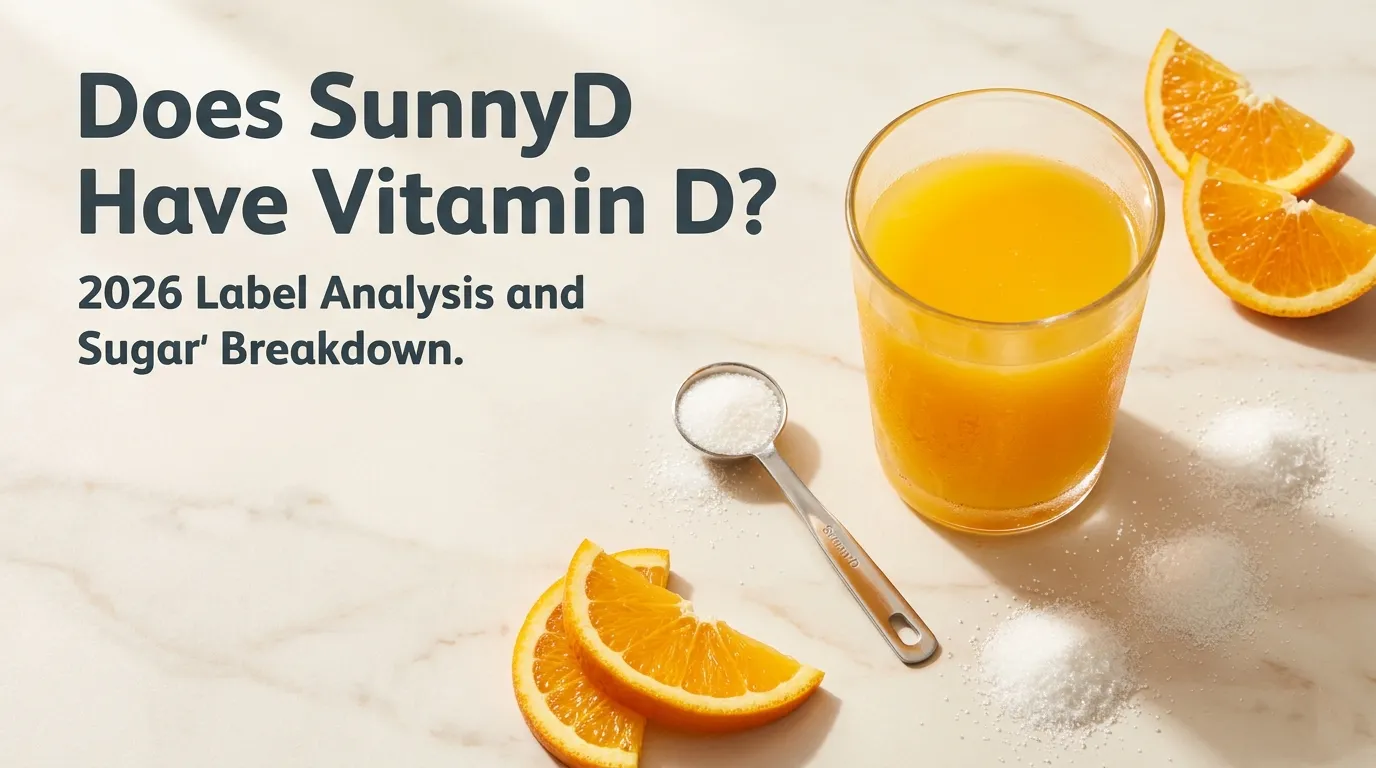
Does SunnyD Have Vitamin D in 2026? Full Label Analysis
SunnyD does contain vitamin D. Each 8-ounce serving of SunnyD Original Citrus Punch provides 2.5 micrograms, which equals 100 IU of vitamin D in the form of ergocalciferol, or vitamin D2. The name is not a complete misdirection, but the amount is small and comes with 27 grams of added sugar per serving.
That sugar number matters because it exceeds the entire daily added sugar limit the American Heart Association sets for children, which is 25 grams. If you are considering SunnyD as a source of vitamin D for yourself or your child, you need to know that one 8-ounce cup delivers only 13 percent of the daily vitamin D requirement while using up more than a full day’s sugar allowance.
This article walks you through the full ingredient list, the specific vitamin D form and amount, the sugar breakdown, what the product lacks, how it compares to orange juice and other fortified drinks, and what registered dietitians actually recommend for children’s beverages. Every claim is sourced to the product label, the NIH Office of Dietary Supplements, the American Academy of Pediatrics, or the USDA FoodData Central database.
Does SunnyD Have Vitamin D?
Yes, SunnyD does have vitamin D. The product contains 2.5 micrograms (100 IU) of added vitamin D2 per 8-fluid-ounce serving. This is a verifiable fact printed on every bottle’s Nutrition Facts panel under the vitamin D row.
The name SunnyD strongly implies sunshine and vitamin D, which is why the question persists decades after the product launched. The branding works. Many consumers assume the drink is centered around vitamin D content the way milk has long been marketed for calcium. In reality, vitamin D is a minor fortification added during manufacturing.
The drink exists because of marketing, not because of a natural connection to vitamin D. SunnyD was created in 1963 by a Florida citrus cooperative looking to sell a shelf-stable product with citrus flavoring that did not require refrigeration like real orange juice. The vitamin D addition came later as a point of differentiation. The product has always been primarily water, sweetener, and flavoring.
If you are scanning the bottle right now and want the fast answer: yes, there is vitamin D in here. The next question is whether the amount actually matters for your health.
Key Takeaway: SunnyD contains 100 IU of vitamin D2 per serving, which is real vitamin D but a small amount that represents only 13 percent of what you need each day.
SunnyD Ingredients 2026
The 2026 SunnyD Original Citrus Punch ingredient list includes water, high fructose corn syrup, and less than 2 percent of concentrated fruit juices as the base, followed by citric acid, ascorbic acid (vitamin C), modified cornstarch, natural and artificial flavors, cellulose gum, sodium benzoate, potassium sorbate, calcium disodium EDTA, Yellow 5, Yellow 6, and ergocalciferol (vitamin D2).
Water appears first, which is standard for juice drinks. The second ingredient, high fructose corn syrup, is the primary calorie and sugar source. The “less than 2%” juice concentrate blend typically includes orange, tangerine, apple, lime, and grapefruit concentrates according to the manufacturer’s published specifications. This small amount provides some flavor but negligible nutritional value from actual fruit.
The preservation system uses three compounds. Sodium benzoate and potassium sorbate inhibit mold, yeast, and bacterial growth in the acidic environment. Calcium disodium EDTA binds metal ions that would otherwise accelerate oxidation and spoilage. These preservatives are FDA-approved and considered safe at the levels used in beverages.
Here is the ingredient list grouped by function:
| Function | Ingredient |
|---|---|
| Liquid base | Water |
| Sweetener | High fructose corn syrup |
| Flavor/color | Concentrated fruit juices (orange, tangerine, apple, lime, grapefruit), natural and artificial flavors |
| Acidity regulator | Citric acid |
| Vitamin C source | Ascorbic acid |
| Thickener/stabilizer | Modified cornstarch, cellulose gum |
| Preservatives | Sodium benzoate, potassium sorbate, calcium disodium EDTA |
| Artificial colors | Yellow 5, Yellow 6 |
| Vitamin D source | Ergocalciferol (vitamin D2) |
You will notice that real fruit juice is near the bottom of this list. SunnyD is not a juice product. It is a sweetened, fortified, artificially colored citrus-flavored drink.
Key Takeaway: SunnyD is primarily water and high fructose corn syrup with a small blend of juice concentrates, preservatives, artificial colors, and synthetic vitamin fortification.
How Much Vitamin D Is in SunnyD?
One 8-fluid-ounce (240 milliliter) serving of SunnyD Original contains 2.5 micrograms of vitamin D, which converts to 100 International Units. This number comes directly from the product’s Nutrition Facts label as required by FDA food labeling regulations.
An 8-ounce serving is one measured cup. Many bottles sold at retail are larger. A 16-ounce bottle contains 5 micrograms (200 IU). A 20-ounce bottle contains approximately 6.25 micrograms (250 IU). The larger the bottle, the more vitamin D you consume, but also the more sugar.
The NIH Office of Dietary Supplements sets the Recommended Dietary Allowance for vitamin D at 15 micrograms (600 IU) per day for people ages 1 through 70 years. Adults over 70 need 20 micrograms (800 IU). Infants under 1 year need 10 micrograms (400 IU).
Here is what SunnyD provides at different serving sizes against the adult RDA of 600 IU:
| Serving Size | Vitamin D Content | Percentage of Adult RDA (600 IU) |
|---|---|---|
| 8 fl oz (1 cup) | 2.5 mcg (100 IU) | 13% |
| 16 fl oz (bottle) | 5 mcg (200 IU) | 33% |
| 20 fl oz (large bottle) | 6.25 mcg (250 IU) | 42% |
The numbers show that even a large 20-ounce bottle falls well short of the full daily vitamin D requirement. To meet the 600 IU RDA entirely from SunnyD, you would need to drink 48 ounces, which is six 8-ounce servings containing 162 grams of sugar.
Key Takeaway: A standard cup of SunnyD provides 100 IU of vitamin D, a genuine but small contribution that covers about one-eighth of your daily requirement.
SunnyD Vitamin D IU
SunnyD contains 100 IU of vitamin D per 8-ounce serving, expressed on the Nutrition Facts label as 2.5 micrograms. The FDA updated labeling regulations in 2020 to require vitamin D amounts in micrograms rather than International Units, but the IU value remains useful for comparison to supplements and older recommendations.
International Units exist because different forms of vitamin D have different biological potencies. For vitamin D, 1 microgram equals 40 IU. This conversion is standard across ergocalciferol (D2) and cholecalciferol (D3). When the SunnyD label states 2.5 micrograms, the math is straightforward: 2.5 times 40 equals 100 IU.
Most vitamin D supplements for adults come in doses of 400 IU, 1,000 IU, or 2,000 IU. A single 1,000 IU softgel provides ten times the vitamin D in one cup of SunnyD. A standard children’s vitamin D drop contains 400 IU per dose, four times the SunnyD amount.
This puts the 100 IU into practical context. If a parent gives their child SunnyD thinking it is covering vitamin D needs, that child receives a quarter of what a standard supplement provides, while also consuming 27 grams of sugar. The vitamin D content is not zero. It is simply too low to serve as a reliable primary source.
The Tolerable Upper Intake Level for vitamin D is 4,000 IU (100 micrograms) per day for people ages 9 and older. There is no realistic risk of vitamin D toxicity from SunnyD, even with excessive consumption. The sugar would cause serious problems long before the vitamin D approached the UL.
Key Takeaway: At 100 IU per cup, SunnyD provides one-tenth to one-twentieth the vitamin D of a typical supplement, making it a minimal contributor to daily needs even at larger serving sizes.
What Kind of Vitamin D Is in SunnyD?
SunnyD contains ergocalciferol, known as vitamin D2, which is a plant-derived form of vitamin D that differs chemically from the cholecalciferol (vitamin D3) found in animal products and human skin after sun exposure. The ingredient list on the bottle specifies “ergocalciferol (vitamin D2).”
The difference between D2 and D3 matters for how effectively the body raises and maintains blood levels of vitamin D. Both forms undergo conversion in the liver to 25-hydroxyvitamin D, the form measured in blood tests. Both then undergo further conversion in the kidneys to the active hormone 1,25-dihydroxyvitamin D. The difference lies in how well each form sustains circulating levels over time.
A 2020 randomized controlled trial published in the European Journal of Nutrition compared daily vitamin D2 from mushrooms to vitamin D3 supplements over 12 weeks. Both forms raised serum 25-hydroxyvitamin D levels initially. The D3 group maintained higher levels by week 12, suggesting D3 produces a more sustained increase. The NIH Office of Dietary Supplements summarizes the research by stating that vitamin D3 appears to raise and maintain serum levels somewhat more effectively than D2 at equivalent doses.
SunnyD uses D2 because it is produced from plant sterol sources. This makes the product compatible with vegan dietary patterns. The trade-off is that the D2 form, at the low 100 IU dose present, provides the less bioavailable form at a fraction of the daily requirement.
For someone with adequate vitamin D status, the D2 versus D3 distinction at this low dose makes no practical difference. For someone with a diagnosed deficiency, SunnyD is not an appropriate intervention regardless of form. A physician managing vitamin D deficiency will recommend D3 supplementation at therapeutic doses far above 100 IU.
Key Takeaway: SunnyD uses ergocalciferol (D2), the plant-based vitamin D form that raises blood levels less efficiently than the D3 form found in most supplements and animal foods.
SunnyD Vitamin D Percentage
The Nutrition Facts label on SunnyD states that one 8-ounce serving provides 13 percent of the Daily Value for vitamin D. The FDA set the Daily Value at 20 micrograms (800 IU), which is aligned with the highest RDA for any adult group, specifically adults over 70 years old.
The percentage calculation works directly from the label numbers. The 2.5 micrograms per serving divided by the 20-microgram Daily Value equals 12.5 percent, rounded to 13 percent on the label. This percentage applies whether you drink SunnyD or use any other food or beverage with the same vitamin D content.
For most adults under 70, the actual RDA is 600 IU (15 micrograms), not the 800 IU Daily Value standard. Against the 600 IU RDA, SunnyD’s 100 IU provides closer to 17 percent of the actual requirement. For children ages 1 through 18, the RDA is also 600 IU, so the same math applies. For infants under 1 year, the RDA is 400 IU (10 micrograms). One cup of SunnyD would provide 25 percent of an infant’s requirement, but SunnyD is not recommended for children under 2 due to added sugar content.
The percentage label creates a perception problem. A parent scanning the Nutrition Facts panel sees “Vitamin D 13%” and might reasonably conclude the product is a meaningful source. That number is accurate for the Daily Value standard, but it obscures the fact that 100 IU is a small amount of a nutrient that many Americans already underconsume.
If vitamin D is a genuine concern in your household, a food or beverage that provides less than 20 percent of the daily need per serving is better understood as a small contributor, not a solution.
Key Takeaway: The 13 percent Daily Value on the label is technically correct against the FDA’s 20mcg standard, but it means SunnyD provides only 100 of the 600 IU most people actually need each day.
Is SunnyD Fortified With Vitamin D?
Yes, SunnyD is a fortified beverage. The vitamin D in SunnyD is added during manufacturing as synthetic ergocalciferol. It does not occur naturally in any of the drink’s base ingredients. The water, high fructose corn syrup, and juice concentrates that make up most of the product contain essentially no naturally occurring vitamin D.
Fortification means manufacturers intentionally add nutrients that were not originally present or were present only in trace amounts. SunnyD’s vitamin D fortification follows this model precisely. The ergocalciferol is added to the beverage mix along with ascorbic acid for vitamin C fortification. Both vitamins are listed in the ingredient statement.
The fortification amount of 100 IU per serving appears to be designed for label appeal rather than nutritional adequacy. A product can claim to be “fortified with vitamin D” regardless of the amount added. There is no minimum threshold that makes a “fortified” claim meaningful. SunnyD exploits this regulatory reality. The name implies sunshine vitamin goodness. The label shows a percentage. The actual dose is small.
Milk fortification provides a useful comparison. Fluid milk in the United States is voluntarily fortified with vitamin D3 at 100 to 120 IU per cup, a nearly identical amount to SunnyD. The difference is that milk brings protein, calcium, potassium, and other naturally occurring nutrients alongside its vitamin D. SunnyD brings sugar, artificial colors, and preservatives. The fortification amount is similar. The overall nutritional package is not.
The fortification is real. The vitamin D in the bottle is measurable and accounted for on the label. The question is whether the fortification justifies the rest of the ingredient list when other fortified foods provide the same or more vitamin D with better overall nutrition.
Key Takeaway: SunnyD is legitimately fortified with 100 IU of synthetic vitamin D2 per serving, but fortification alone does not make a product a good nutritional choice when that same vitamin D comes packaged with 27 grams of sugar.
SunnyD Nutrition Facts Sugar
One 8-ounce serving of SunnyD Original contains 27 grams of total sugars, all of which qualify as added sugars according to FDA labeling standards. This represents 54 percent of the American Heart Association’s maximum recommended daily added sugar intake for adult women (25 grams for children, 36 grams for men).
The sugar comes almost entirely from high fructose corn syrup, the second ingredient listed after water. High fructose corn syrup is a liquid sweetener manufactured from corn starch. It is chemically similar to table sugar, containing roughly equal parts glucose and fructose. The body metabolizes it the same way it metabolizes any concentrated sugar source.
A 27-gram sugar serving equals approximately 6.75 teaspoons of sugar. To visualize this, picture almost seven individual sugar packets dissolved into a single 8-ounce cup. Many children and adults drink 16 or 20-ounce bottles, doubling or more the sugar load. A 16-ounce bottle contains 54 grams of sugar, which is 13.5 teaspoons.
Here is how SunnyD’s sugar content compares to other familiar beverages per 8-ounce serving:
| Beverage (8 fl oz) | Total Sugar | Added Sugar | Teaspoons Equivalent |
|---|---|---|---|
| SunnyD Original | 27g | 27g | 6.75 tsp |
| Coca-Cola | 26g | 26g | 6.5 tsp |
| 100% Orange Juice | 21g | 0g | 5.25 tsp |
| Gatorade Thirst Quencher | 21g | 21g | 5.25 tsp |
| 1% Milk | 12g | 0g | 3 tsp |
| Water | 0g | 0g | 0 tsp |
SunnyD contains more sugar per ounce than Coca-Cola. The 100% orange juice comparison is instructive because SunnyD is often perceived as a juice alternative. Real orange juice contains naturally occurring sugar without added sweeteners, plus potassium, folate, and vitamin C that occur naturally. SunnyD’s sugar is entirely added and comes without those naturally occurring nutrients.
Key Takeaway: SunnyD packs 27 grams of added sugar per cup, more than regular soda, placing it squarely in the occasional treat category rather than a daily beverage for anyone.
Does SunnyD Have Calcium?
SunnyD Original contains zero calcium. The Nutrition Facts panel lists calcium at 0 milligrams, which is 0 percent of the Daily Value. This absence matters because calcium and vitamin D work as partners in bone health.
Vitamin D’s primary physiological role is to increase calcium absorption from the intestine into the bloodstream. Without adequate calcium intake, vitamin D cannot fulfill its bone mineralization function. The body will pull calcium from bones to maintain blood calcium levels if dietary intake falls short. A beverage that provides a small amount of vitamin D but no calcium is nutritionally mismatched for bone health.
Milk, by contrast, provides approximately 300 milligrams of calcium (23 percent DV) alongside its 100 to 120 IU of vitamin D3 per cup. Fortified orange juice often includes both calcium and vitamin D in amounts similar to milk. SunnyD delivers vitamin D without its mineral partner.
Some SunnyD product variants do include calcium fortification. The SunnyD Calcium variety adds calcium phosphate to the ingredient list. If calcium fortification is important to you, check the specific product label. The original formula does not include it.
The absence of calcium reinforces the broader pattern with SunnyD. The product provides isolated nutrients added during manufacturing, not the nutrient combinations found in whole foods or thoughtfully fortified products. Vitamin D appears in the drink because it looks good on the label and aligns with the brand name. The nutrients that should accompany it are absent because they were never part of the formulation’s purpose.
Key Takeaway: SunnyD Original has no calcium, which limits any bone health benefit from its vitamin D content since vitamin D requires calcium to support bone mineralization.
Does SunnyD Have Real Orange Juice?
SunnyD contains a small amount of concentrated fruit juices, including orange juice concentrate, but these are listed as “less than 2%” of the total formula. This means the product is not a juice and cannot legally be labeled as one. The FDA classifies SunnyD as a “citrus punch” or “citrus-flavored drink.”
The “less than 2%” designation appears on the ingredient list by regulatory requirement. When an ingredient blend falls below 2 percent of the formula by weight, the manufacturer can list it collectively rather than by individual descending weight. The concentrated juices in SunnyD typically include orange, tangerine, apple, lime, and grapefruit concentrates. These provide some citrus flavor notes but negligible nutritional contribution.
Real 100 percent orange juice comes from oranges with nothing added. It contains naturally occurring vitamin C, potassium, folate, and thiamin. It has zero added sugar. The sugar on its label is the sugar that was in the whole orange. SunnyD gets its flavor from a combination of the small juice concentrate addition, citric acid for tartness, and natural and artificial flavors for the recognizable citrus taste.
The fruit juice content is low enough that SunnyD does not count toward the fruit intake recommendations in the Dietary Guidelines for Americans 2020-2025. An 8-ounce glass of 100 percent orange juice counts as one cup of fruit. SunnyD does not qualify. It counts as an added-sugar beverage in the discretionary calorie category.
Key Takeaway: SunnyD is a flavored drink with a trace of juice concentrates for taste, not a juice product, and provides none of the naturally occurring nutrients found in real orange juice.
SunnyD vs Orange Juice Vitamin D
Fortified orange juice and SunnyD both contain added vitamin D, but the type, amount, and overall nutritional context differ considerably. Some orange juice brands fortify with cholecalciferol (D3) at approximately 100 to 140 IU per cup, a similar or slightly higher amount than SunnyD’s 100 IU of D2. Other brands include higher fortification levels, up to 200 IU per cup.
The crucial difference is what surrounds the vitamin D. Orange juice provides naturally occurring vitamin C, potassium, folate, and thiamin. It contains no added sugar. Its 21 grams of sugar per 8 ounces are naturally present from whole oranges. SunnyD provides 27 grams of added sugar, artificial colors, preservatives, and no naturally occurring micronutrients beyond the two added vitamins.
The vitamin D form differs in a way that may affect how well your body uses it. The D3 used in most fortified orange juice is the same form human skin produces from sun exposure. Research reviewed by the NIH Office of Dietary Supplements indicates D3 raises and maintains serum 25-hydroxyvitamin D levels more effectively than D2 at equivalent doses. The difference is modest but measurable.
Here is a side-by-side comparison:
| Nutrient/Feature | SunnyD Original (8 oz) | Fortified 100% OJ (8 oz) |
|---|---|---|
| Vitamin D content | 100 IU (D2) | 100-200 IU (D3) |
| Vitamin D form | Ergocalciferol (D2) | Cholecalciferol (D3) |
| Vitamin C | 60mg (added) | 72mg (natural) |
| Potassium | 0mg | 443mg |
| Calcium | 0mg | Varies (fortified) |
| Total sugar | 27g (added) | 21g (natural) |
| Calories | 110 | 110 |
| Artificial colors | Yes (Yellow 5, 6) | No |
| Counts as fruit serving | No | Yes (1 cup) |
Orange juice is not a perfect food. It contains substantial natural sugar and should be consumed in moderation. One 8-ounce glass per day is the reasonable maximum for most people. But compared to SunnyD, fortified orange juice provides a similar or higher vitamin D dose using the more effective D3 form, in a package that contributes real nutrients alongside its sugar.
Key Takeaway: Fortified orange juice matches or exceeds SunnyD’s vitamin D with a more bioavailable D3 form and delivers natural nutrients without artificial colors, making it a clearly superior choice for vitamin D and overall nutrition.
Is SunnyD a Good Source of Vitamin D?
SunnyD is not a good source of vitamin D by any meaningful nutritional standard. A food or beverage qualifies as a “good source” of a nutrient under FDA labeling rules when it provides 10 to 19 percent of the Daily Value per serving. SunnyD’s 13 percent technically qualifies under this definition. But nutritional adequacy requires more than hitting a labeling threshold.
The NIH Office of Dietary Supplements identifies foods that provide 20 percent or more of the Daily Value per serving as “high” in that nutrient. SunnyD falls short of this benchmark. More practically, 100 IU represents a small fraction of the 600 to 800 IU most people need daily. Someone relying on SunnyD for vitamin D would need to drink large quantities of a high-sugar beverage to reach meaningful intake.
The concept of a “good source” also considers what accompanies the nutrient. Nutrition professionals evaluate the whole package. A food that provides 13 percent of vitamin D needs alongside 27 grams of added sugar and artificial colors is a net negative for health compared to foods that provide similar or more vitamin D without the sugar load.
Consider these actual good sources of vitamin D for comparison. Three ounces of cooked sockeye salmon provides approximately 570 IU, nearly six times SunnyD’s amount, plus protein and omega-3 fatty acids. A tablespoon of cod liver oil provides 1,360 IU. Even a single large egg yolk provides 37 IU, and it comes with protein, choline, and lutein.
Labeling definitions matter for regulatory compliance. Nutritional wisdom matters for health. SunnyD technically clears the FDA’s “good source” bar while falling dramatically short of what practical nutrition requires from a vitamin D source.
Key Takeaway: SunnyD meets the FDA’s minimum threshold to call itself a “good source” of vitamin D, but at 100 IU per serving with 27 grams of sugar, it fails as a meaningful contributor to daily vitamin D needs.
Vitamin D Fortified Drinks Comparison
Several beverage categories provide vitamin D fortification. SunnyD sits near the bottom of the list when ranked by vitamin D per calorie or vitamin D per gram of sugar. A practical comparison reveals which drinks actually help meet daily vitamin D needs.
Dairy milk is the classic fortified beverage. One cup of whole milk provides 100 to 120 IU of vitamin D3, similar to SunnyD’s 100 IU of D2. The difference is that milk delivers this with 8 grams of protein, 300 milligrams of calcium, potassium, and zero added sugar. Plant-based milks such as soy, almond, and oat are often fortified with D2 at 100 to 240 IU per cup. Check individual labels because fortification amounts vary by brand.
Ready-to-drink protein shakes and meal replacement beverages sometimes include higher vitamin D fortification. A standard Ensure or Boost contains 200 to 400 IU per serving. These products are designed for nutrition support and include protein and a full micronutrient panel, though they also contain added sugars or artificial sweeteners.
Here is how common fortified drinks compare:
| Beverage (8 oz) | Vitamin D | Form | Sugar | Calories | Protein |
|---|---|---|---|---|---|
| SunnyD Original | 100 IU | D2 | 27g added | 110 | 0g |
| Fortified OJ | 100-200 IU | D3 | 21g natural | 110 | 2g |
| Whole Milk | 100-120 IU | D3 | 12g natural | 150 | 8g |
| Fortified Soy Milk | 120-240 IU | D2 | 1-7g added | 80-100 | 7g |
| Ensure Original | 200 IU | D3 | 14g added | 220 | 9g |
| Plain Water | 0 IU | N/A | 0g | 0 | 0g |
The pattern is consistent. Other fortified beverages provide similar or more vitamin D with better overall nutritional profiles. The plant-based milk category includes options with minimal sugar that still deliver meaningful vitamin D and protein. SunnyD’s combination of low vitamin D, high added sugar, and zero protein or fat places it at the bottom of the comparison group.
Key Takeaway: Multiple fortified drinks deliver more vitamin D with less sugar and more protein than SunnyD, including standard milk and unsweetened plant milks, making SunnyD a weak choice in the fortified beverage category.
Is SunnyD Healthy for Kids?
SunnyD is not a healthy beverage for children. The American Academy of Pediatrics recommends that children consume zero added sugar before age 2 and strictly limit added sugar after age 2. One 8-ounce cup of SunnyD contains 27 grams of added sugar, which exceeds the entire daily added sugar limit the American Heart Association sets for children, which is 25 grams.
The vitamin D content at 100 IU per serving does not offset the sugar concern. Children ages 1 through 18 need 600 IU of vitamin D daily according to the NIH Office of Dietary Supplements. SunnyD provides one-sixth of this requirement in a single cup. To reach 600 IU, a child would need six cups of SunnyD containing 162 grams of sugar. No pediatrician or registered dietitian would endorse this approach.
The artificial colors in SunnyD present an additional concern for some children. Yellow 5 and Yellow 6 are synthetic dyes that the FDA has approved for food use. Some research, reviewed in a 2021 California state report on food dyes, suggests that artificial food colors may exacerbate attention and behavioral symptoms in a small percentage of children with ADHD or related sensitivities. The effect is not universal, but it warrants awareness for parents who observe behavioral changes after dyed foods.
Children’s beverages should primarily be water and plain milk according to the Academy of Nutrition and Dietetics. A small amount of 100 percent fruit juice, limited to 4 to 6 ounces daily for children under 6, can fit into a healthy pattern. SunnyD does not fall into any of these recommended categories. It belongs in the occasional treat category alongside soda and other sugar-sweetened beverages.
Quick Tip for parents:
- Water and milk are the daily drink staples for children
- 100 percent orange juice provides real nutrients with vitamin D3 fortification as a secondary bonus
- If your child likes SunnyD’s taste, treat it the way you treat dessert, not as a hydration or vitamin source
- A children’s vitamin D supplement provides 400 IU in a single unflavored drop without any sugar
Key Takeaway: SunnyD’s 27 grams of sugar in a single 8-ounce cup exceeds the daily added sugar limit for children and the 100 IU of vitamin D does not justify it; water, milk, and small amounts of real juice are the evidence-based choices.
SunnyD Artificial Colors
SunnyD Original contains Yellow 5 and Yellow 6, two synthetic food dyes that give the beverage its bright orange color. Without these dyes, SunnyD would appear much paler because the small amount of juice concentrate cannot produce the vibrant orange consumers expect from a citrus drink.
Yellow 5 and Yellow 6 are azo dyes, named for their nitrogen-containing chemical structure. The FDA has evaluated these dyes multiple times and maintains that they are safe at the levels used in food products. They are among the most widely used food colorings in the United States, appearing in everything from sports drinks to breakfast cereals to snack chips.
The safety debate centers on behavioral effects in children. A landmark 2007 study published in The Lancet found that a mixture of artificial food colors, including Yellow 5 and Yellow 6, increased hyperactive behavior in children from a general population sample, not only those with diagnosed ADHD. A 2021 report from the California Office of Environmental Health Hazard Assessment concluded that current federal safe intake levels for synthetic food dyes may not adequately protect children with behavioral sensitivities.
Some parents choose to avoid artificial colors entirely as a precaution. The European Union requires a warning label on foods containing Yellow 5 and Yellow 6 stating that they “may have an adverse effect on activity and attention in children.” The United States does not require such labeling.
If artificial colors are a concern in your household, SunnyD is easy to identify as a product that contains them. The bright, consistent orange color is a visual cue. Alternatives like 100 percent orange juice achieve their color naturally from carotenoids present in the fruit.
Key Takeaway: SunnyD’s orange color comes from synthetic Yellow 5 and Yellow 6 dyes, which some research suggests may affect behavior in sensitive children, making natural alternatives preferable for families who wish to avoid artificial colors.
Healthier Alternatives to SunnyD
Healthier alternatives to SunnyD include water, milk, unsweetened fortified plant milks, 100 percent orange juice in small portions, and infused water with citrus slices for flavor. Each option provides better nutrition with less sugar and no artificial colors.
Water is always the baseline. It hydrates perfectly with zero calories, zero sugar, and zero additives. For children and adults who find plain water boring, citrus-infused water offers a bridge. Adding orange, lemon, or lime slices to a water pitcher provides flavor without sweeteners. This gives the citrus experience without any of SunnyD’s drawbacks.
Fortified 100 percent orange juice is the closest direct swap for SunnyD. It provides 100 to 200 IU of vitamin D3, natural vitamin C, potassium, and folate. The 21 grams of sugar per cup are naturally occurring. Portion control matters. One 4 to 6-ounce serving for children and 8 ounces for adults is appropriate. This small glass matches or exceeds SunnyD’s vitamin D while providing real food nutrients.
Milk and fortified unsweetened plant milks offer vitamin D with protein and calcium. An 8-ounce glass of milk provides 100 to 120 IU of D3, 8 grams of protein, and 300 milligrams of calcium. Unsweetened soy milk provides similar nutrition with a plant base and typically higher vitamin D fortification. These options support bone health in ways SunnyD cannot because they supply calcium alongside vitamin D.
Here is a practical swap guide:
| Instead of SunnyD (8 oz) | Try This | What You Get |
|---|---|---|
| Original Citrus Punch | 100% Fortified OJ (4-6 oz) | Natural vitamin C, potassium, D3, no dyes, less sugar |
| Any SunnyD variety | Water with citrus slices | Hydration, zero sugar, zero artificial ingredients |
| SunnyD as calcium source | Fortified unsweetened soy milk | 240 IU D2, 300mg calcium, 7g protein, 1g sugar |
| SunnyD for kids’ lunches | Plain water or milk | Hydration or protein plus calcium, no sugar spike |
The core lesson from this entire analysis is simple. If you want vitamin D, choose foods and beverages that provide it alongside real nutrition rather than a flood of added sugar. SunnyD is not poison. It is a sweetened, artificially colored beverage that happens to have a small vitamin D addition. Treat it the way you treat any sugary drink: as an occasional discretionary choice, never as a health product.
Frequently Asked Questions About SunnyD and Vitamin D
Does SunnyD actually give you vitamin D?
SunnyD does provide 100 IU of vitamin D2 per 8-ounce serving, which your body absorbs and converts to its active form.
The amount is small at roughly one-sixth of the daily requirement for most people.
The issue is not that the vitamin D is fake, but that it comes packaged with 27 grams of added sugar that outweighs the nutritional benefit.
Why is it called SunnyD if it has barely any vitamin D?
SunnyD was named for marketing purposes, not nutritional accuracy.
The “Sunny” references the citrus flavor and sunshine, while the “D” was added as a point of differentiation when the product launched.
The name successfully creates an association with sunshine vitamin D despite the product containing only a small fortified amount.
Is SunnyD just as good as orange juice for vitamin D?
Fortified orange juice is a better choice than SunnyD for vitamin D because it often uses the more bioavailable vitamin D3 form and provides naturally occurring nutrients including vitamin C, potassium, and folate.
SunnyD’s vitamin D content is similar to some fortified orange juice brands but comes with added sugar and artificial colors that orange juice does not contain.
Orange juice in 4 to 8-ounce portions is the nutritionally superior choice.
Can kids get their daily vitamin D from SunnyD?
Kids cannot reasonably get their daily 600 IU of vitamin D from SunnyD because reaching that amount would require six cups containing 162 grams of sugar.
A single cup already exceeds the 25-gram daily added sugar limit the American Heart Association sets for children.
A standard children’s vitamin D supplement provides 400 IU in a sugar-free drop, and milk plus safe sun exposure cover the rest.
Does SunnyD have vitamin D3 or D2?
SunnyD contains vitamin D2, listed on the ingredient label as ergocalciferol.
Vitamin D2 is the plant-derived form of vitamin D, which research suggests raises blood levels somewhat less effectively than the D3 form found in animal products and most supplements.
The D2 form was chosen because it can be produced synthetically from plant sterols at lower cost.
How much sugar is in one bottle of SunnyD?
A 16-ounce bottle of SunnyD contains 54 grams of sugar, equal to 13.5 teaspoons.
An 8-ounce serving contains 27 grams of sugar.
A 20-ounce bottle contains approximately 67 grams of sugar, which is nearly three times the American Heart Association daily added sugar limit for children.
SunnyD does contain vitamin D. That fact is printed clearly on every bottle. The question this article answers honestly is whether that vitamin D makes SunnyD a worthwhile beverage for your family. It does not. The 100 IU of vitamin D2 per cup provides a genuine but minimal contribution to daily needs. The 27 grams of added sugar, artificial colors, and complete absence of calcium, potassium, or protein make SunnyD an occasional treat at best.
If you are standing in a grocery aisle trying to decide whether to buy SunnyD for vitamin D, the evidence points you elsewhere. Fortified milk, unsweetened plant milks, small portions of 100 percent orange juice, and fatty fish provide vitamin D with real nutritional support. If your child genuinely likes SunnyD’s taste, treat it the way you treat soda. Occasional use. Small portions. Never as a health drink.
Vitamin D matters for bone health, immune function, and overall wellness. The foods and beverages you choose to meet your needs should support those goals without undermining them. You can do better than SunnyD, and now you know exactly why.