
Vitamin D3 K2 Benefits: The Complete Evidence Breakdown for 2026
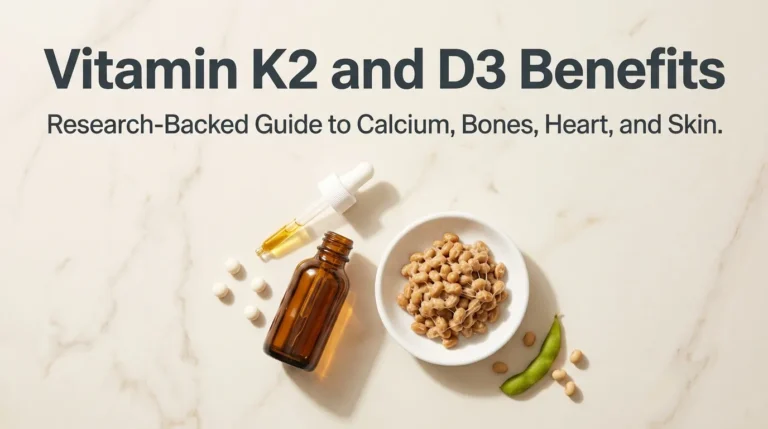
Taking vitamin D3 (cholecalciferol) together with vitamin K2 (menaquinone) creates a biochemical partnership that directs calcium precisely where your body needs it, into the skeleton and teeth, and away from the soft tissues where it can cause harm, like the arteries and kidneys. The primary benefits of this combination include increased bone mineral density, a reduced rate of osteoporotic fracture, and, based on a growing body of observational research, a potential reduction in arterial stiffness and vascular calcification. This is not a case of two vitamins doing unrelated good things in the same pill; they are sequential cofactors in the exact same calcium trafficking pathway.
The calcium paradox is the reason this combination matters enough to deserve a dedicated article. Millions of people take high-dose vitamin D3 supplements to correct a deficiency, which increases intestinal calcium absorption. Without adequate vitamin K2 to activate the proteins that bind and direct that absorbed calcium, the mineral can deposit in the medial layer of artery walls instead of the bone matrix. The NIH Office of Dietary Supplements identifies vitamin D as a nutrient of public health concern, and the population-wide insufficiency of vitamin K2, which has no established Adequate Intake separate from K1, creates a silent mismatch that the combination supplement is designed to solve.
You will leave this article understanding the gamma-carboxylation mechanism that activates osteocalcin, the difference between MK-4 and MK-7 that most articles blur together, exactly how many micrograms of K2 sit in a serving of gouda versus an egg yolk, the specific dosage ratios that clinical studies have tested, and the one medication interaction that makes this combination dangerous rather than beneficial. No supplement hype. Just the biochemistry, the named studies, and the numbers.
k2 d3 vitamin benefits overview
The combined benefits of vitamin D3 and K2 center on three physiological targets: increased bone mineral density through the activation of the calcium-binding protein osteocalcin, reduced arterial calcification through the activation of matrix Gla protein, and improved dental remineralization through the same osteocalcin-driven mechanism that deposits calcium into dentin. The combination is not a wellness trend. It is a targeted nutritional strategy that addresses the specific downstream consequences of the widespread vitamin D insufficiency that affects roughly 35% of US adults, per data from the National Health and Nutrition Examination Survey.

Vitamin D3’s job in this partnership is straightforward and well-understood. When you take cholecalciferol, your liver hydroxylates it into 25-hydroxyvitamin D, and your kidneys convert a portion of that into the active hormone calcitriol (1,25-dihydroxyvitamin D). Calcitriol binds to the vitamin D receptor in the nucleus of intestinal cells, triggering the transcription of calcium transport proteins that pull calcium from the food you eat across the gut lining and into the bloodstream. This is the “calcium absorption” part of the story, and it is where most people’s understanding stops. But calcium in the blood is only halfway to the bone. It still needs to be physically bound to the bone matrix, and that step requires vitamin K2.
Vitamin K2 activates the protein osteocalcin, which is secreted by osteoblast cells in the bone. Osteocalcin contains three specific glutamic acid amino acid residues. Vitamin K2 acts as a cofactor for the enzyme gamma-glutamyl carboxylase, which adds a carboxyl group to each of those glutamic acid residues, transforming them into gamma-carboxyglutamic acid, or Gla residues. These Gla residues have a strong negative charge that chelates positively charged calcium ions, physically binding them to the hydroxyapatite crystal lattice of the bone. Without K2, osteocalcin remains undercarboxylated, which means it floats around in the blood unable to grab calcium, and the calcium you absorbed thanks to your D3 supplement has nowhere productive to go.
Key Takeaway: D3 gets calcium into your blood; K2 gets it out of your blood and into your bones by activating the specific protein that physically grabs calcium and attaches it to the skeleton.
how vitamin d3 and k2 work together
Vitamin D3 and K2 work together by sequentially managing the absorption, transport, and terminal deposition of calcium, with D3 driving the synthesis of calcium transport proteins in the gut and K2 driving the carboxylation of the Gla proteins that determine where calcium ultimately lands. Think of D3 as the shipping department that brings raw calcium material into the bloodstream, and K2 as the receiving and distribution manager who decides which warehouse shelves, the bones or the arteries, get the delivery. Without the distribution manager, the shipping department accidentally fills the hallways with boxes.
The specific Gla proteins that K2 activates have distinct tissue distributions and functions. Osteocalcin is produced exclusively by osteoblasts in bone and odontoblasts in teeth. When carboxylated by K2, it binds calcium directly to the hydroxyapatite mineral matrix. Matrix Gla protein (MGP) is produced by vascular smooth muscle cells in the walls of arteries. When carboxylated by K2, MGP becomes a potent inhibitor of vascular calcification, actively preventing calcium phosphate crystals from nucleating in the elastic fibers of the arterial wall. These two proteins represent the positive and negative regulatory arms of K2’s function: osteocalcin puts calcium into the right place, and MGP keeps it out of the wrong place.
The clinical evidence for this synergy comes from both observational and interventional studies. The Rotterdam Study, a large prospective cohort study published in the Journal of Nutrition in 2004, followed over 4,800 older adults and found that those with the highest dietary menaquinone intake had a 50% lower risk of coronary heart disease mortality and a 50% lower risk of severe aortic calcification compared to those with the lowest intake over a 7 to 10 year follow-up period. A 2015 randomized controlled trial published in Osteoporosis International gave postmenopausal women either a placebo or 180 mcg of MK-7 daily for three years, alongside their existing vitamin D and calcium intake. The MK-7 group showed a slowing of bone mineral density loss at the lumbar spine and femoral neck compared to the placebo group, and their undercarboxylated osteocalcin ratio dropped, confirming the mechanism was operational.
vitamin d3 and k2 benefits for bones
The combination of vitamin D3 and K2 increases bone mineral density and reduces fracture risk by ensuring that absorbed calcium is actually incorporated into the skeleton rather than remaining in circulation. A 2022 systematic review published in Nutrients analyzed 16 clinical trials and found that co-supplementation with D3 and K2 was more effective at improving lumbar spine bone mineral density than D3 supplementation alone, though the effect size varied based on baseline vitamin D status and the form of K2 used.
The cellular mechanism in bone tissue is precise. Osteoblast cells synthesize and secrete a precursor protein called pro-osteocalcin. This protein contains three glutamic acid residues at positions 17, 21, and 24 on the polypeptide chain. The enzyme gamma-glutamyl carboxylase, with vitamin K2 hydroquinone as its cofactor, removes a hydrogen atom from each glutamic acid residue and adds a carbon dioxide molecule, converting glutamate to gamma-carboxyglutamate. This post-translational modification gives osteocalcin a high affinity for the calcium ions on the surface of hydroxyapatite crystals, the mineral form of calcium phosphate that gives bone its compressive strength. When D3 supplementation increases the calcium available in the bloodstream, and K2 simultaneously activates the osteocalcin to bind it, the net effect is higher bone mass.
The clinical population that benefits most from this bone-directed synergy is postmenopausal women. The decline in estrogen after menopause removes an inhibitory signal on osteoclast activity, accelerating bone resorption. The simultaneous age-related decline in vitamin D synthesis in the skin and the typically low dietary K2 intake in Western populations create a perfect storm of increased calcium mobilization from bone and decreased calcium deposition into bone. A 2019 study in the journal Menopause found that postmenopausal women with osteoporosis who took 5,000 IU of D3 plus 180 mcg of MK-7 daily for 12 months showed a 1.5% increase in lumbar spine bone density compared to a 0.3% decline in the placebo group. These numbers are modest in absolute terms, but they represent a medically meaningful reduction in the trajectory of bone loss.
vitamin d3 and k2 benefits for heart
The primary cardiovascular benefit of vitamin K2 is the activation of matrix Gla protein (MGP) , which is the most potent naturally occurring inhibitor of vascular calcification yet identified in human physiology. When vascular smooth muscle cells in the arterial wall experience oxidative stress, inflammation, or exposure to elevated calcium and phosphate concentrations, they can undergo an osteogenic phenotypic switch, meaning they start behaving like bone-forming cells and deposit calcium phosphate crystals into the arterial media. Carboxylated MGP binds to these nascent calcium crystals and prevents them from growing into macroscopic calcifications that stiffen the artery and increase cardiac afterload.
Vitamin D3 without K2 may theoretically worsen arterial calcification if calcium intake is high. This is the calcium paradox in its cardiovascular context. A 2011 study published in the Journal of the American Society of Nephrology showed that rats fed a high-calcium, high-phosphate diet along with high-dose vitamin D developed extensive arterial calcification, but the addition of vitamin K2 significantly reduced the calcification burden. Human data is less dramatic but directionally consistent. The Rotterdam Study found that the highest tertile of dietary menaquinone intake was associated with a 57% reduction in coronary artery calcification, as measured by electron-beam CT, compared to the lowest tertile.
The important caveat is that human cardiovascular outcome trials with K2 are almost entirely observational, not randomized and placebo-controlled. Observational studies show an association between K2 intake and reduced calcification, but they cannot prove that K2 supplementation causes the reduction because people who eat high-K2 diets, rich in fermented foods and aged cheeses, may have other lifestyle factors that protect their arteries. The randomized controlled trials that do exist have used intermediate endpoints like arterial stiffness measured by pulse wave velocity, not hard endpoints like heart attack or cardiovascular death. A 2015 randomized trial in Thrombosis and Haemostasis gave 244 postmenopausal women 180 mcg of MK-7 or placebo for three years and found that the MK-7 group had a measure of reduced arterial stiffness in the subgroup of women with the highest baseline stiffness. The evidence for K2’s cardiovascular benefit is promising and mechanistically plausible, but it is not yet at the level of proof that would earn an FDA health claim.
Key Takeaway: K2’s heart benefit is grounded in the real biochemistry of matrix Gla protein, but the human evidence is still climbing the ladder from association to causation; the bone data is stronger.
vitamin d3 and k2 benefits for teeth
Vitamin D3 and K2 support dental health by promoting the remineralization of dentin, the calcified tissue beneath the enamel, through the same osteocalcin-dependent mechanism that deposits calcium into bone. Odontoblasts, the cells that line the pulp chamber of teeth, synthesize osteocalcin under the control of calcitriol, the active form of vitamin D. K2 then carboxylates that osteocalcin, enabling it to bind calcium and phosphate ions from the blood into the dentin matrix. This process can slow the progression of cavities that have penetrated through the enamel into the dentin layer.
The concept of dental remineralization via systemic nutrition, rather than topical fluoride, is controversial in mainstream dentistry. Saliva contains calcium and phosphate ions that can remineralize early enamel lesions if the oral pH remains above 5.5. The role of D3 and K2 is not to replace salivary remineralization but to ensure that the dentin beneath the enamel remains adequately mineralized through systemic nutrient delivery. A 2020 review in the journal Nutrients proposed that adequate vitamin D and K2 status may reduce the risk of dental caries by enhancing the immune response to cariogenic bacteria through the production of antimicrobial peptides like cathelicidin, a D3-dependent immune factor, while simultaneously supporting the structural integrity of the dentin through K2-dependent carboxylation.
The genetic condition that proves K2’s role in tooth development is Keutel syndrome, a rare autosomal recessive disorder caused by a loss-of-function mutation in the matrix Gla protein gene. Children with Keutel syndrome exhibit abnormal calcification of cartilage, midface hypoplasia, and hearing loss. In mouse models where the MGP gene is knocked out, the animals die shortly after birth from aortic rupture due to massive arterial calcification. In the teeth of these knockout mice, the cementum, the calcified layer covering the tooth root, is hypomineralized and poorly attached to the dentin. This extreme genetic example illustrates what MGP does when it is working: it ensures that calcification happens in the right places, including the tooth root surface, and not in the arteries.
vitamin k2 mk4 vs mk7
The decision between MK-4 and MK-7 forms of vitamin K2 has practical implications for dosing frequency, tissue distribution, and food sourcing. MK-4 (menaquinone-4) has a short plasma half-life of approximately 1 to 2 hours and is found almost exclusively in animal products like liver, egg yolk, and full-fat dairy. MK-7 (menaquinone-7) has a half-life of 2 to 3 days and is found in fermented foods, most famously natto, a Japanese fermented soybean product. The half-life difference determines whether you need to dose the vitamin once daily or multiple times per day.
The following table breaks down the comparison.
| Property | MK-4 (Menaquinone-4) | MK-7 (Menaquinone-7) |
|---|---|---|
| Half-life in plasma | 1 to 2 hours | 2 to 3 days |
| Tissue distribution | Accumulates in brain, pancreas, and arteries | Accumulates primarily in liver, then redistributes |
| Primary food source | Chicken liver, egg yolk, gouda cheese | Natto (fermented soybeans) |
| Typical supplemental dose | 1,500 to 45,000 mcg per day | 45 to 200 mcg per day |
| Conversion source | Synthesized in the body from phylloquinone (K1) | Produced by bacterial fermentation |
| Dosing frequency | Multiple times daily for steady state | Once daily maintains steady serum levels |
MK-4’s short half-life means that a single daily dose may not maintain consistent carboxylation of osteocalcin throughout a 24-hour period. Research from the Netherlands, led by Dr. Cees Vermeer at Maastricht University, established that MK-7’s long half-life allows once-daily dosing to achieve a steady state of carboxylated osteocalcin and matrix Gla protein. This pharmacokinetic advantage is why most commercial D3 plus K2 supplements use MK-7. MK-4, however, has unique tissue distribution properties. It concentrates in the brain, where it may support sphingolipid synthesis in myelin sheaths, and in the pancreas, where it may influence insulin secretion. The two forms are not redundant; they fill different biological niches. A comprehensive approach would ideally include dietary MK-4 from animal foods and supplemental MK-7 for sustained carboxylation.
vitamin d2 and k2 benefits comparison
Vitamin D2 (ergocalciferol) combined with K2 provides a less effective calcium metabolism synergy than vitamin D3 (cholecalciferol) combined with K2 because ergocalciferol has a shorter half-life in circulation and generates a lower peak serum 25-hydroxyvitamin D level per International Unit compared to cholecalciferol. The K2 side of the equation remains unchanged regardless of which D form is used; the menaquinone molecule activates osteocalcin and MGP identically whether the vitamin D was sourced from yeast or lanolin. The weakness is entirely on the D2 side.
The inferiority of D2 relative to D3 is well-documented. A 2012 study by Heaney et al. in the Journal of Clinical Endocrinology and Metabolism demonstrated that cholecalciferol is 87% more effective at raising and maintaining serum 25-hydroxyvitamin D levels than an equivalent dose of ergocalciferol. D2 is cleared from the bloodstream faster, has a lower binding affinity for the vitamin D binding protein, and is less efficiently converted to the active calcitriol form in the kidneys. When a vegan takes a D2 plus K2 combination, the K2 is performing its carboxylation function correctly, but the D2 may not be providing the sustained elevation in intestinal calcium absorption that the K2 is waiting for.
For strict vegans who cannot take animal-derived D3, a D2 plus K2 supplement is still better than no vitamin D at all, but the dosing strategy matters. Because D2 is cleared faster, a daily dose is necessary, and the International Unit count may need to be higher than the 600 IU RDA to achieve the same serum level that a D3 dose would produce. A physician can order a 25-hydroxyvitamin D test to confirm that the D2 dose is achieving a serum level above 30 ng/mL. Separately, there is now a commercially available vegan D3 derived from lichen, which provides cholecalciferol without animal sourcing. This lichen D3, combined with MK-7 from natto fermentation, gives a vegan the same pharmacokinetic advantage as an animal-derived D3 plus K2 supplement.
Key Takeaway: D2 plus K2 works on the K2 side but hobbles the partnership with a weaker D molecule; vegan D3 from lichen plus MK-7 is the optimal plant-based combination.
vitamin k2 food sources list
Vitamin K2 in the diet comes from fermented foods, organ meats, and full-fat dairy products from pasture-raised animals. The concentration of menaquinone in these foods varies by the bacterial strains used in fermentation and the animal’s diet. Natto, a fermented soybean product consumed in Japan, is the single richest dietary source by a margin so wide it makes every other food look like a rounding error.
The following table shows the specific K2 content of common foods per 100 grams and per typical serving size.
| Food Source | K2 per 100g | Serving Size | K2 per Serving | Primary Form |
|---|---|---|---|---|
| Natto (fermented soybeans) | 1,000 mcg | 40g (1.5 oz) | 400 mcg | MK-7 |
| Goose liver pate | 369 mcg | 28g (1 oz) | 103 mcg | MK-4 |
| Gouda cheese, aged | 75 mcg | 28g (1 oz) | 21 mcg | MK-4 through MK-9 |
| Brie cheese | 56 mcg | 28g (1 oz) | 16 mcg | MK-4 through MK-9 |
| Egg yolk, pasture-raised | 30 mcg | 1 large yolk (17g) | 5 mcg | MK-4 |
| Chicken liver, cooked | 14 mcg | 28g (1 oz) | 4 mcg | MK-4 |
| Butter, grass-fed | 15 mcg | 14g (1 tbsp) | 2 mcg | MK-4 |
| Cheddar cheese | 10 mcg | 28g (1 oz) | 3 mcg | MK-4 through MK-9 |
The Adequate Intake for total vitamin K is 120 mcg for men and 90 mcg for women, per the Dietary Guidelines for Americans 2020-2025. This AI does not differentiate between K1 and K2. A single 40-gram serving of natto provides 400 mcg of MK-7, which is over three times the total AI for vitamin K from a single food, demonstrating how concentrated this source is. Most Western diets, which do not include natto, provide roughly 10 to 45 mcg of K2 per day, almost entirely as MK-4 from animal products. This dietary gap is the nutritional rationale for supplementation, particularly for people who do not eat organ meats, fermented soy, or aged cheeses regularly.
calcium and vitamin d3 k2 synergy
Calcium, vitamin D3, and vitamin K2 form a three-nutrient axis where each molecule performs a sequential, non-redundant function in the process of bone mineralization. Calcium is the mineral substrate, the literal building block of bone. D3 is the absorption facilitator, pulling calcium from the small intestine into the bloodstream. K2 is the deposition director, activating the proteins that bind the absorbed calcium to the bone matrix. Remove any one of the three, and the system fails at a different step: no calcium means nothing to build bone with, no D3 means calcium passes through the gut unabsorbed, and no K2 means absorbed calcium circulates without being directed to the skeleton.
The clinical implications of this synergy are most apparent in osteoporosis treatment. Many postmenopausal women are prescribed calcium and vitamin D supplements by their primary care provider but never receive a corresponding K2 recommendation. A 2023 review in the journal Nutrients analyzed the calcium-D3-K2 axis and concluded that K2 deficiency may explain some of the heterogeneity in fracture risk reduction seen in calcium plus D3 trials. If a woman takes calcium and D3 but has low K2 status, the absorbed calcium may not be fully utilized for bone mineralization, and a fraction of it may be deposited in the arterial walls instead. The authors recommended that future calcium-D3 osteoporosis trials include K2 status as a baseline variable.
The practical dietary strategy is to consume calcium-rich foods, ensure adequate vitamin D status through sun exposure or supplementation, and include K2 sources like aged cheese, egg yolks, or natto in the same meals. The fat that naturally accompanies cheese and egg yolks also aids in the absorption of the fat-soluble D3 and K2 molecules. A calcium-rich breakfast of yogurt, an egg, and a D3 plus K2 supplement with that meal hits all three nutrient targets in one digestive window, maximizing the chance that the calcium, D3, and K2 physically meet in the intestinal lumen and the bloodstream for their coordinated function.
vitamin d3 and k2 dosage guide
The optimal dosage of vitamin D3 and K2 depends on your baseline vitamin D status, your dietary K2 intake, your age, and whether you have diagnosed osteopenia, osteoporosis, or cardiovascular calcification. A standard maintenance dose for a healthy adult with a serum 25-hydroxyvitamin D level above 30 ng/mL is 1,000 to 2,000 IU of D3 and 45 to 100 mcg of MK-7 daily. For someone with a documented deficiency below 20 ng/mL, a physician may prescribe 5,000 IU of D3 daily for 8 to 12 weeks, which is often paired with 180 mcg of MK-7 to handle the increased calcium absorption.
The ratio of D3 to K2 in a supplement is not standardized by any regulatory body. The market has settled on common combinations: 1,000 IU D3 with 45 mcg K2, 2,500 IU D3 with 100 mcg K2, and 5,000 IU D3 with 180 mcg K2. The K2 dose scales roughly with the D3 dose because the amount of osteocalcin requiring carboxylation is finite, and the higher the D3 dose, the more calcium enters the bloodstream, and the more MGP needs to be activated to prevent soft tissue calcification.
The NIH Office of Dietary Supplements sets the Tolerable Upper Intake Level (UL) for vitamin D at 4,000 IU per day for adults. Doses above this threshold should only be taken under medical supervision with periodic 25-hydroxyvitamin D and serum calcium monitoring. Vitamin K2 has no established UL, and adverse effects from high doses have not been documented in healthy individuals. The absence of a UL does not mean unlimited dosing is harmless. Warfarin users are the exception, and even small amounts of supplemental K2 can destabilize their anticoagulation therapy.
Quick Tip:
- If you take 1,000 to 2,000 IU of D3, aim for 45 to 100 mcg of MK-7.
- If you take 5,000 IU of D3, consider 180 mcg of MK-7 and confirm your D3 dose is medically indicated.
- Always take with a meal containing fat for optimal absorption of both fat-soluble vitamins.
Key Takeaway: The D3 to K2 ratio is not an exact science, but pairing 100 mcg of MK-7 with every 2,500 IU of D3 is a reasonable heuristic that matches the doses used in most positive clinical trials.
vitamin d3 and k2 for osteoporosis
Vitamin D3 and K2 co-supplementation for osteoporosis aims to simultaneously increase calcium absorption and direct that calcium specifically into the skeleton, addressing both the supply and the distribution sides of bone metabolism. The National Osteoporosis Foundation currently recommends calcium and vitamin D for osteoporosis prevention and treatment. Vitamin K2 is not yet included in the standard guidelines, but the evidence base for its inclusion is strengthening each year.
The clinical trial evidence for K2 in osteoporosis has historically used high-dose MK-4. In Japan, 45,000 mcg of MK-4 per day is an approved pharmaceutical treatment for osteoporosis, and multiple Japanese randomized controlled trials have shown a reduction in vertebral fracture incidence with this regimen. The mechanism for this high-dose effect may be different from the low-dose carboxylation pathway. At pharmacologic doses, MK-4 may also act as a ligand for the steroid and xenobiotic receptor, influencing gene transcription for bone matrix proteins independently of its role as a gamma-carboxylation cofactor. This dual mechanism explains why Japanese osteoporosis protocols use MK-4 at doses hundreds of times higher than the MK-7 doses used for carboxylation.
For the typical Western adult with osteopenia or osteoporosis, the practical approach is to discuss K2 with the specialist managing the bone density diagnosis. An endocrinologist or rheumatologist can review the DEXA scan results, order a serum 25-hydroxyvitamin D test, and determine whether adding K2 at 180 mcg of MK-7 or a higher MK-4 dose is appropriate alongside the standard calcium and D3 regimen. A registered dietitian can simultaneously assess dietary K2 intake and recommend food-based sources like aged cheese and natto that can complement or partially replace supplementation.
vitamin k2 and arterial calcification
Vitamin K2 inhibits arterial calcification by activating matrix Gla protein, which binds to calcium phosphate crystals in the vessel wall and prevents them from growing into the hardened calcium deposits that stiffen arteries and raise systolic blood pressure. This mechanism is not a theory. MGP knockout mice die within weeks of birth from massive aortic calcification, providing the strongest possible animal-model evidence that MGP is required for vascular calcium homeostasis. In humans, the presence of undercarboxylated MGP in the blood is a biomarker of vitamin K insufficiency at the tissue level, and elevated uncarboxylated MGP is associated with higher arterial calcification scores on CT imaging.
The Rotterdam Study is the foundational human evidence for the K2-arterial health connection. Among 4,807 older Dutch adults followed for 7 to 10 years, those in the highest tertile of dietary menaquinone intake had a relative risk of coronary heart disease mortality of 0.43 compared to the lowest tertile, meaning a 57% reduction after adjusting for traditional cardiovascular risk factors. The association was specific to menaquinone (K2). Phylloquinone (K1) intake showed no protective association, likely because K1 is preferentially used by the liver for clotting factor synthesis rather than being distributed to extrahepatic tissues for MGP carboxylation.
The limitation that every honest article must acknowledge is that no large randomized controlled trial has yet demonstrated that K2 supplementation reduces heart attacks or cardiovascular death. The existing RCTs have used intermediate endpoints like arterial stiffness and progression of coronary calcium scores. A 2015 trial in Thrombosis and Haemostasis showed that 180 mcg of MK-7 daily for three years reduced arterial stiffness in a subgroup of postmenopausal women with the stiffest arteries at baseline. This is encouraging but not definitive. A large cardiovascular outcomes trial with K2 is logistically challenging because the event rate reduction, if real, would require thousands of participants followed for five to ten years, and no pharmaceutical company holds a patent on menaquinone to fund such a trial.
d3 k2 supplement side effects
The combination of vitamin D3 and K2 at standard over-the-counter doses is well-tolerated with a low side effect profile. The most common adverse events reported in clinical trials of D3 plus K2 are mild gastrointestinal symptoms including nausea and stomach discomfort, which are typically attributed to the carrier oil in the softgel rather than the vitamins themselves. There is no documented risk of hypercalcemia from the combination at D3 doses below 4,000 IU per day when K2 is present, because K2 does not increase calcium absorption; it only redirects the calcium that D3 absorbs.
The theoretical safety concern that requires specific mention is that high-dose D3 supplementation without adequate K2 could theoretically increase the risk of soft tissue calcification by increasing calcium absorption without ensuring its proper distribution. This concern is based on animal models and the known physiology of MGP, not on documented cases of harm in human supplement users. There are no case reports in the medical literature of a person developing arterial calcification from taking a standard D3 supplement without K2. The risk is a matter of physiological first principles and long-term plausibility, not documented acute toxicity.
Vitamin K2 itself has no known toxicity. A comprehensive review of vitamin K safety published in Food and Chemical Toxicology in 2006 concluded that no tolerable upper intake level could be established because adverse effects from high-dose menaquinone intake had never been observed. This is consistent with the biochemistry: K2 is a cofactor for a single carboxylation reaction, and the enzyme it activates has a finite rate. Once all available osteocalcin and MGP are carboxylated, additional K2 has no further substrate to act on and is excreted via the bile. The only established danger of vitamin K is not from K2 but from high-dose K1 in the context of warfarin anticoagulation.
who should not take vitamin d3 and k2
The absolute contraindication for vitamin D3 and K2 supplementation is the concurrent use of warfarin (Coumadin) , the most commonly prescribed vitamin K antagonist anticoagulant. Warfarin works by inhibiting the enzyme vitamin K epoxide reductase, which recycles oxidized vitamin K back to its active reduced form. This inhibition depletes the liver of active vitamin K and prevents the synthesis of functional clotting factors II, VII, IX, and X. Supplemental K2, even at 45 mcg, can partially overcome this inhibition and destabilize the International Normalized Ratio, the blood test used to dose warfarin, increasing the risk of either bleeding or clotting depending on the direction of the shift.
The warning extends to all anticoagulants, but with an important distinction. Warfarin directly targets the vitamin K cycle. The direct oral anticoagulants, apixaban (Eliquis), rivaroxaban (Xarelto), dabigatran (Pradaxa), and edoxaban (Savaysa), inhibit specific clotting factors rather than the vitamin K recycling enzyme. These DOACs do not interact with vitamin K intake. Someone on Eliquis can take K2 without destabilizing their anticoagulation. The medication type must be confirmed by the prescribing physician before any K2 supplement is added.
Additional groups who should exercise caution include people with hyperparathyroidism, where calcium metabolism is already dysregulated, people with sarcoidosis or other granulomatous diseases that can produce excess calcitriol independent of renal regulation, and pregnant women taking high-dose vitamin D above the RDA without specific obstetrical guidance. A woman in her first trimester taking 5,000 IU of D3 daily without a documented deficiency should discuss the dose with her obstetrician. The K2 component poses no specific pregnancy risk, but the combined supplement implies a high D3 intake that warrants professional confirmation.
Frequently Asked Questions About Vitamin D3 K2 Benefits
What are the benefits of taking D3 and K2 together?
The primary benefit of taking D3 and K2 together is that D3 increases calcium absorption from the gut, and K2 activates the proteins osteocalcin and matrix Gla protein to direct that calcium into bones and teeth rather than allowing it to deposit in arteries.
This combination improves bone mineral density and, based on observational research, may reduce arterial calcification over time.
Without K2, the calcium absorbed thanks to D3 can remain in circulation rather than being incorporated into the skeleton.
How much K2 should I take with 5000 IU of D3?
A daily dose of 180 mcg of MK-7 is the amount most commonly paired with 5,000 IU of D3 in clinical studies of postmenopausal women.
A 5,000 IU dose of D3 exceeds the 4,000 IU Tolerable Upper Intake Level and should only be taken if a physician has documented a deficiency and prescribed that specific dose.
For maintenance dosing of 1,000 to 2,000 IU, 45 to 100 mcg of MK-7 is appropriate.
Can you get enough K2 from food alone?
You can get enough K2 from food if you regularly consume natto, which provides 400 mcg of MK-7 per 40-gram serving, or a combination of aged cheese, egg yolks, and organ meats.
Most Western diets that exclude natto provide only 10 to 45 mcg of K2 per day, which is likely insufficient for full osteocalcin carboxylation.
A single serving of natto per week is enough to dramatically improve K2 status without daily supplementation.
Is MK-7 better than MK-4 for bones?
MK-7 is better suited for once-daily bone-directed supplementation because its 2 to 3-day half-life maintains steady carboxylation of osteocalcin around the clock.
MK-4 has a 1 to 2-hour half-life and requires multiple daily doses, but at very high pharmacologic doses of 45,000 mcg per day, it is an approved osteoporosis treatment in Japan.
For a daily over-the-counter bone health supplement, MK-7 at 100 to 180 mcg is the practical choice.
Does K2 remove calcium from arteries?
There is no evidence that K2 actively removes calcium that has already been deposited in arteries.
K2 activates matrix Gla protein, which inhibits new calcium phosphate crystal formation in the vessel wall, potentially slowing the progression of existing calcification rather than reversing it.
The notion of “decalcifying arteries” with K2 is an oversimplification; the mechanism is prevention and inhibition, not reversal.
Can I take D3 and K2 while on blood thinners?
If you take warfarin (Coumadin), you must not take K2 without explicit approval from your prescribing physician, as K2 can destabilize your INR and increase bleeding or clotting risk.
If you take a direct oral anticoagulant like Eliquis, Xarelto, or Pradaxa, K2 does not interfere with the drug’s mechanism and is generally considered safe.
Always name your specific anticoagulant to your physician when discussing any supplement, not just K2.
The D3 and K2 partnership is one of the most biochemically coherent nutrient synergies in nutritional science. D3 opens the calcium gate in your intestine. K2 tells the calcium where to go once it is through. The gate without the traffic controller leaves calcium wandering, and the traffic controller without the gate has no traffic to direct.
If you take D3, consider K2. If you eat natto once a week, you are already covered. If your plate has never seen a fermented soybean and your D3 supplement is sitting in your daily pill organizer alone, you have an easy upgrade to make.
Walk down the supplement aisle, find the combination bottle with cholecalciferol and menaquinone-7, and make sure there is fat in your next meal when you swallow it.