
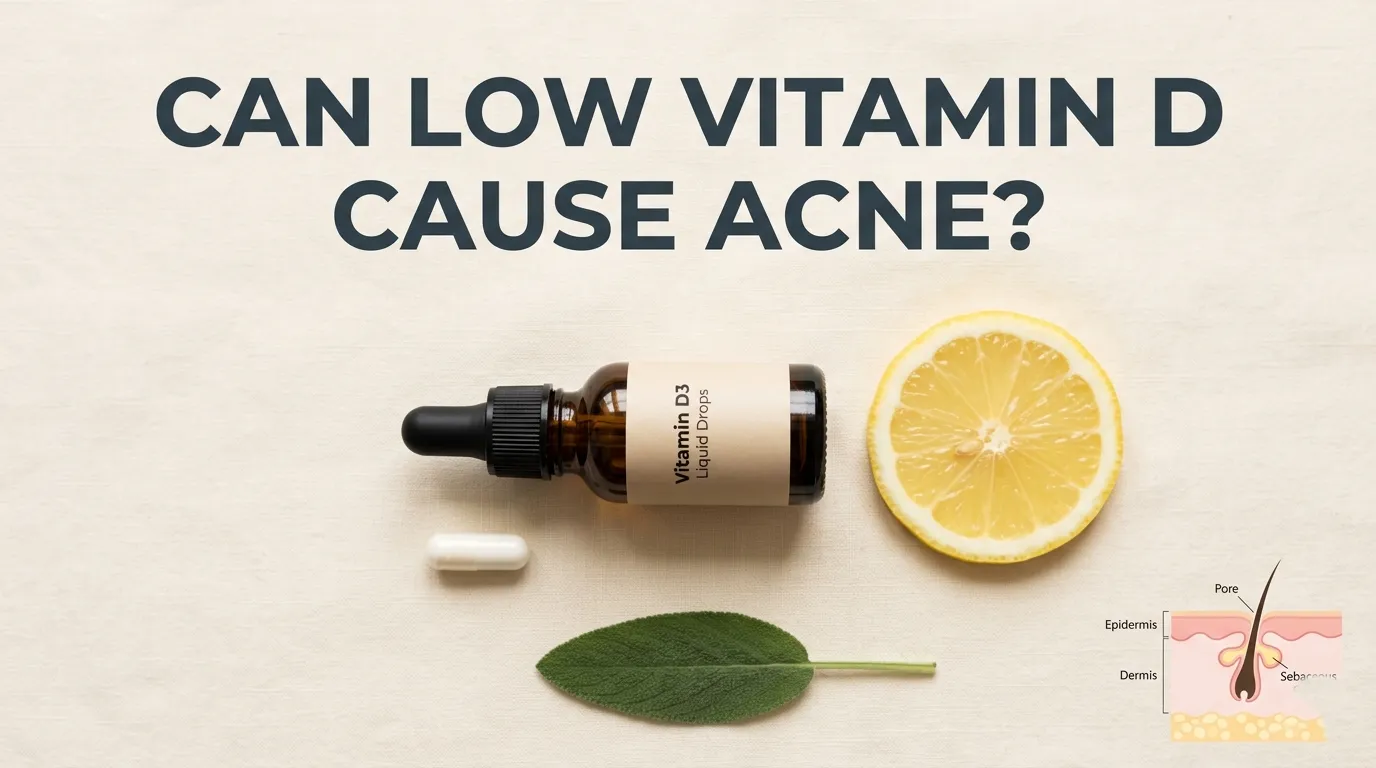
Can Low Vitamin D Cause Acne? 2026 Research Findings
Can low vitamin D cause acne is a question with a firm answer: yes, research suggests a deficiency is strongly correlated with inflammatory acne, particularly nodular and cystic types. The mechanism involves a breakdown in your skin’s immune defense and cellular regulation.
The NIH Office of Dietary Supplements defines deficiency as a 25-hydroxyvitamin D blood level below 20 ng/mL. At these low levels, your sebaceous glands lose a critical signal that controls healthy oil production and bacterial balance.
This article breaks down the exact science linking the vitamin D receptor to acne, the specific lab test you need, and the differences between taking D3 orally versus applying it topically. You will finish with a clear protocol for what to buy, how much to take, and how to avoid the hidden iodine trap that makes some supplements worsen your skin.
Can Low Vitamin D Cause Acne
Can low vitamin D cause acne is answered by the biology of the vitamin D receptor (VDR). These receptors are highly expressed on sebocytes, the oil-producing cells of your skin, and on your immune cells.

When vitamin D levels are adequate, the active hormone calcitriol binds to these receptors. This binding triggers the production of cathelicidin, an antimicrobial peptide (AMP) that acts like a natural antibiotic.
Cathelicidin, specifically the LL-37 peptide, is lethal to Cutibacterium acnes, the bacteria that colonizes clogged pores and drives the inflammation of acne. If you are deficient, your skin’s production of this natural antibiotic plummets.
Without this immune surveillance, the bacterial overgrowth triggers a vicious cycle of inflammation. Your pores become a battleground, and the lack of vitamin D means the skin cannot properly regulate the inflammatory cytokine response to the bacteria.
Key Takeaway: Low vitamin D disarms your skin’s immune system by suppressing cathelicidin, leaving you unable to fight acne-causing bacteria effectively.
Does Vitamin D Deficiency Cause Acne
Does vitamin D deficiency cause acne is a question where the distinction between “cause” and “contributor” matters. Deficiency is rarely the sole cause, but it is a powerful accelerant.
Acne vulgaris is a multifactorial disease involving genetics, hormones, pore-clogging, bacteria, and inflammation. Vitamin D deficiency intersects with the final two stages: bacterial proliferation and inflammatory response.
A 2016 study published in Dermato-Endocrinology found that individuals with acne had significantly lower serum 25-hydroxyvitamin D levels than controls. A striking 48 percent of acne patients in the study were deficient.
When these patients were supplemented with 1,000 IU of cholecalciferol daily, their inflammatory acne lesions improved. The study established a direct clinical link, not just a correlational theory.
- It is not a root cause: A perfectly sufficient D level will not stop acne caused by a high-glycemic diet.
- It is a deficiency of immune regulation: It removes the skin’s ability to manage the inflammation caused by other triggers.
- Clinical observation: Dermatologists often note severe deficiencies in patients with sudden-onset, treatment-resistant cystic acne.
Vitamin D Deficiency Skin Symptoms
Vitamin D deficiency skin symptoms extend beyond acne, which can help you identify if a lack of this hormone is a systemic problem for you. The skin’s outer layer relies on vitamin D for controlled growth.
When D levels drop, the skin can become hyperkeratotic. This means keratinocytes overproduce and do not slough off properly, leading to rough, scaly patches.
This is mechanically similar to what happens inside a pore. The hyperproliferation of keratinocytes is the very first step in the formation of a microcomedone, the precursor to every blackhead and whitehead.
If you have acne combined with very dry, rough skin on your arms or legs (keratosis pilaris), this is a strong clinical clue. It suggests a systemic vitamin D and vitamin A regulatory issue affecting your follicular health.
- Hyperkeratosis: Rough, scaly patches that feel like sandpaper.
- Proliferation Defect: Keratinocytes divide chaotically, blocking the follicular opening.
- Systemic Clue: Acne combined with dry, bumpy skin elsewhere on the body is a red flag for deficiency.
- Co-factor link: Vitamin A works synergistically with vitamin D to control keratinocyte differentiation.
Key Takeaway: Vitamin D deficiency creates a “traffic jam” of sticky, overproduced skin cells that physically clog the pore, forming the foundation of the acne lesion.
Vitamin D Receptor Acne
Vitamin D receptor acne research focuses on the VDR, a nuclear transcription factor that controls how your sebaceous gland behaves. The VDR is essentially the lock that calcitriol turns.
When the key (calcitriol) does not turn the lock (VDR) due to a vitamin D deficiency, the sebocyte cell does not mature properly. It continues to produce a lipid profile that is more comedogenic, meaning it is stickier and more likely to clog a pore.
Correct VDR signaling alters the composition of sebum. Specifically, it normalizes the lipid mixture, reducing the inflammatory fatty acids that irritate the follicle wall.
The VDR also directly suppresses the expression of inflammatory cytokines like IL-6 and IL-8. A non-activated VDR leads to a hyper-inflammatory state inside the pore even before it ruptures.
- Normalized Lipid Synthesis: Active VDR shifts sebum production away from sticky, acne-causing lipids.
- Anti-Inflammatory Signaling: The VDR-calcitriol complex directly blocks the production of interleukin-6 and interleukin-8.
- Keratinocyte Gatekeeping: It prevents the cells lining the pore from over-multiplying and forming a blockage.
- Why It Matters: You can have normal serum D levels but dysfunctional VDRs if you lack the magnesium needed to activate them.
Vitamin D for Hormonal Acne
Vitamin D for hormonal acne is a targeted strategy because vitamin D acts as a steroid hormone that can mitigate the effects of androgens on the skin. Hormonal acne is driven by fluctuations in testosterone and DHEA.
These androgens signal the sebaceous gland to go into overdrive, producing excess oil. The vitamin D receptor, when activated, appears to act as a brake on this oil production.
Vitamin D helps regulate the insulin-like growth factor (IGF-1) pathway. High IGF-1 is a master switch for hormonal acne, stimulating sebum production and androgen synthesis.
A 2022 review highlighted that vitamin D supplementation significantly lowered the levels of free testosterone and inflammatory markers in women with PCOS. This hormonal and inflammatory regulation is precisely what targets the deep, painful cystic acne along the jawline.
- Anti-Androgen Effect: Calcitriol inhibits the growth-promoting effects of androgens on the sebaceous gland.
- IGF-1 Modulation: Helps normalize the insulin pathway that triggers excess sebum.
- Cystic Acne Focus: The evidence is strongest for inflammatory, nodular lesions often resistant to topical washes.
- PCOS Link: Low D is extremely common in PCOS; correcting it can improve both metabolic and dermatologic symptoms.
Key Takeaway: Vitamin D functions as an anti-androgenic steroid in the skin. For hormonal jawline acne, correcting a D deficiency removes a critical driver of uncontrolled oil production.
Calcitriol Acne
Calcitriol acne therapy refers to the use of the active, hormonal form of vitamin D, either as a topical cream or as the final metabolic product of oral supplementation. Calcitriol is 1,25-dihydroxyvitamin D.
This is the steroid hormone that binds directly to the VDR with 1,000 times the affinity of standard cholecalciferol. It works much faster but is far more potent.
In dermatology, topical calcitriol ointments are sometimes used off-label for stubborn inflammatory skin conditions. The goal is to deliver a high dose directly to the immune cells in the skin.
Taking large doses of oral D3 eventually leads to calcitriol production, but this is a tightly regulated process. Your kidneys carefully control the final conversion, making oral toxicity extremely difficult unless you take enormous, irresponsible doses.
- Topical Calcitriol: A prescription-strength, localized immunomodulator.
- Oral Conversion: Oral cholecalciferol must be hydroxylated in the liver and then the kidney before it becomes active calcitriol.
- Local Control: Calcitriol directly down-regulates the Toll-like receptors on macrophages that trigger the inflammatory cascade.
- Efficacy: A 2021 pilot study showed significant lesion reduction using topical calcitriol on inflammatory acne without systemic side effects.
Does Vitamin D3 Cause Acne
Does vitamin D3 cause acne is a concern rooted in the specific type of supplement, not the vitamin itself. Pure, high-quality cholecalciferol does not cause acne.
However, many low-quality or whole-food-derived supplements contain hidden triggers. The most common culprit is iodine, which can create “iodide acne.”
Fish liver oils, particularly cod liver oil, are a natural source of vitamin D. They can also be naturally high in iodine, which is excreted through the sebaceous glands and can cause an acute, pustular breakout.
Another mechanism is an allergy or sensitivity to the carrier oil or the lanolin source. Lanolin, derived from sheep wool, is used to synthesize many D3 supplements and is a potential allergen for some individuals.
- Pure D3: Does not cause acne through a biochemical pathway.
- Iodine Content: Check if your “natural” D3 is derived from cod liver oil or Icelandic fish oil. This is a hidden breakout trigger.
- Allergens: Lanolin (wool) allergy can cause dermatitis and follicular inflammation around the hairline and face.
- Solution: Look for vegan D3 derived from lichen, which carries no risk of iodine or lanolin contamination.
Key Takeaway: If you broke out after starting vitamin D, the cause is likely the iodine or lanolin in a fish-based or wool-based supplement, not the cholecalciferol molecule.
Does Vitamin D Cause Breakouts
Does vitamin D cause breakouts when taken correctly is a no. The most common mistake leading to a breakout is using a vitamin D supplement without its essential co-factors.
Vitamin D metabolism consumes magnesium at a rapid rate. If you are borderline deficient in magnesium and start taking D3, you can precipitate a functional magnesium deficiency.
Magnesium deficiency is a known driver of oily skin and inflammation. It leads to the degradation of collagen and an increase in oxidative stress in the follicle.
Without magnesium, the body cannot convert the inactive cholecalciferol into its active hormone form. The supplement just sits in your system inert, while the low magnesium state continues to irritate your skin.
- Biochemical Block: Magnesium is a required co-factor for the enzymatic step that makes D biologically active.
- Sebum Quality: Low magnesium shifts the lipid profile of the sebum toward inflammatory free fatty acids.
- Gut-Skin Axis: Magnesium acts as an osmotic laxative. Constipation from a poor diet can be worsened by vitamin D’s effect on calcium absorption, affecting the gut-skin axis.
- The Fix: Always balance high-dose D3 with 200-400 mg of bioavailable magnesium (glycinate or malate).
Vitamin D Skin Purging
Vitamin D skin purging is not a true purge in the retinoid sense. High-dose vitamin D does not increase cellular turnover speed, which is the mechanism of retinoid-induced purging.
However, vitamin D can cause a rapid shift in the skin’s microbiome and immune response. As cathelicidin production ramps up, the skin begins attacking deep-seated bacterial colonies.
This can create an “inflammatory flare” as the immune system suddenly recognizes and fights off low-grade infections within the pores. It resembles a purge but is actually an immune correction.
The critical distinction is timing and pain. A retinoid purge often resolves with continued use. If a “purge” from a D3 supplement is painful and cystic, it could actually be an iodide-induced reaction from a low-quality supplement.
- Mechanism: This is an immune flare from antimicrobial peptides activating, not a cellular turnover purge.
- Iodide Acne: Presents as sudden, monomorphic pustules. Stop the fish-based supplement immediately.
- True Healing: A real vitamin D response involves a gradual calming of redness over 4-8 weeks, not an explosion of pus.
- Action: If a breakout starts within days of a new D3 pill, check for iodine in the ingredients.
How Much Vitamin D for Acne
How much vitamin D for acne is a titration question, not a one-size-fits-all number. You must start with a blood test.
The standard maintenance dose of 600 to 800 IU is often insufficient to correct a clinical deficiency linked to acne. Doses used in the successful 2016 Dermato-Endocrinology study were 1,000 IU daily.
Most functional dermatologists aim for a serum 25-hydroxyvitamin D level between 40 and 60 ng/mL, which is the sweet spot for hormonal and immune regulation. This often requires 2,000 to 5,000 IU daily.
You should never self-prescribe doses above the Tolerable Upper Intake Level of 4,000 IU for extended periods without a physician monitoring your serum calcium and 25-hydroxy D levels.
To find your correct dose:
- Get Tested: Ask a physician for a 25-hydroxyvitamin D serum test. Do not guess.
- Target the Sweet Spot: Aim for a blood level of 40-60 ng/mL.
- Start Conservatively: Begin with 2,000 IU of D3 daily with a fatty meal.
- Re-test: Check your blood levels again after 8 to 12 weeks to adjust the dosage.
Topical Vitamin D for Acne
Topical vitamin D for acne offers a targeted, localized approach that bypasses the liver. While less common than retinoids, topical vitamin D analogs are a legitimate dermatological tool.
The most common prescription form is calcipotriol, a synthetic analog of calcitriol. It is typically used for psoriasis, but it is increasingly studied for acne.
Applying a vitamin D analog directly to a cyst delivers a potent anti-inflammatory and antimicrobial signal right to the affected pore. It helps normalize the hyperproliferation of keratinocytes that causes the blockage.
The advantage of the topical route is zero risk of systemic toxicity or elevated blood calcium. The disadvantage is that it can be irritating to sensitive facial skin, and almost all effective formulations are prescription-only.
- Calcipotriol: The standard prescription analog.
- Keratinocyte Regulation: Directly slows down the rapid, chaotic cell growth that clogs the pore.
- No Systemic Absorption: Avoids the metabolism issues of oral supplements.
- Availability: A compounded topical requires a prescription from a board-certified dermatologist.
Key Takeaway: Oral D3 fixes the systemic deficiency driving the acne. Topical calcipotriol is a targeted weapon against stubborn, inflamed lesions that refuse to heal.
Best Vitamin D Supplement for Acne
The best vitamin D supplement for acne is an oral liquid or capsule of pure cholecalciferol (D3) dissolved in a clean carrier oil like MCT or olive oil, combined with vitamin K2.
Choose a product labeled “Vegan D3” (lichen-derived) or “Pure Lanolin-Derived D3” that explicitly states it is free of fish liver oils. This ensures you avoid the iodine contamination risk.
The D3 form is biologically superior to D2 (ergocalciferol). A 2020 randomized controlled trial confirmed that D3 is substantially more effective at raising serum 25-hydroxyvitamin D levels than D2.
The pairing with vitamin K2 is crucial for long-term high-dose use. Vitamin D increases the absorption of calcium, and vitamin K2 directs that calcium into the bones and teeth, preventing it from depositing in soft tissues like the kidneys or arteries.
- Form: Cholecalciferol (D3), not ergocalciferol (D2).
- Source: Lichen (vegan) or pure, non-fish lanolin.
- Carrier Oil: MCT, olive, or avocado oil (pure, no soy).
- Synergist: Always pair with 200mg magnesium glycinate and 100mcg vitamin K2 (MK-7).
Magnesium and Vitamin D Acne
Magnesium and vitamin D acne management is a partnership. Magnesium is the first domino that must be standing for the vitamin D you take to work.
Every step of vitamin D metabolism, from the conversion in the liver to the final signaling in the cell, requires magnesium as an enzymatic co-factor. If you are one of the estimated 50 percent of the population with a subclinical magnesium deficit, your D3 pills are essentially useless.
Magnesium deficiency alone is an acne driver. It elevates the inflammatory response in the skin and promotes insulin resistance, which directly stimulates the ovaries and adrenal glands to produce more androgens.
Taking a 400 mg dose of magnesium glycinate before bed complements your morning vitamin D3. The glycinate form is the most bioavailable for correcting a deficiency and the least likely to cause the gastric distress associated with magnesium citrate.
- Co-Factor Role: Magnesium is required for the liver enzyme (25-hydroxylase) to convert D3 into its circulating form.
- Insulin Sensitivity: Magnesium improves insulin sensitivity, naturally lowering the androgen production that fuels hormonal acne.
- PMS Acne: Magnesium is a muscle relaxant and nervous system regulator, which is effective against the stress-induced component of pre-menstrual breakouts.
- Best Pairing: D3 taken in the morning for cellular activity, Magnesium Glycinate taken at night for repair and relaxation.
Frequently Asked Questions About Low Vitamin D and Acne
Can low vitamin D levels cause cystic acne?
Yes, low vitamin D levels are strongly correlated with cystic acne, which is a severe, inflammatory type of acne.
The active form of vitamin D, calcitriol, is a potent anti-inflammatory hormone that tames the immune overreaction in the pore.
When levels are low, the inflammation is unregulated, allowing small clogs to become deep, painful cysts.
Is vitamin D3 or D2 better for hormonal acne?
Vitamin D3 (cholecalciferol) is significantly better for hormonal acne than vitamin D2.
D3 is the form your skin naturally produces from sunlight and is far more effective at raising your blood levels.
Always choose a D3 supplement for its superior bioavailability and longer half-life in the body.
How much vitamin D should I take to clear my skin?
You should take enough vitamin D to reach a serum level of 40 to 60 ng/mL, which requires a blood test.
This often requires a daily dose of 2,000 to 5,000 IU of cholecalciferol (D3).
A physician can help you start with a base dose and retest your blood after 8 to 12 weeks to find your precise maintenance dose.
Can taking vitamin D cause a skin purge?
No, high-quality vitamin D does not cause a true “retinoid-style” skin purge by increasing cell turnover.
A sudden acne flare from a new D supplement is almost always a reaction to iodine in a fish-derived supplement.
A genuine immune response can sometimes inflame deep-seated bacteria, but this is not standard purging.
What kind of vitamin D supplement is best for acne-prone skin?
A vegan, lichen-derived vitamin D3 in an MCT or olive oil capsule is the best form for acne-prone skin.
This avoids the hidden iodine in fish liver oils and the potential allergens in lanolin.
Always look for a product that combines D3 with Vitamin K2 to support healthy calcium metabolism.
Can too much vitamin D cause breakouts?
Pure vitamin D toxicity is extremely rare and does not cause acne directly.
A true overdose causes hypercalcemia, leading to nausea and kidney strain, not pimples.
The more common “breakout” trigger is an allergy to a filler in the pill or the iodine contamination from a fish oil source.
The link between the vitamin D receptor on your immune cells and the painful, inflamed acne on your jawline is not a myth. It is a biological pathway that breaks down when your serum 25-hydroxyvitamin D drops below 30 ng/mL. Your pores lose their antimicrobial shield, and your sebaceous glands lose their hormonal brake. The result is a skin environment that turns every hormonal fluctuation into a cyst.
Before you spend another dollar on a cream, spend it on the specific blood test that tells you the truth. Walk into your next dermatologist appointment with the question about your serum level, not just a list of your failed topicals. Check the label on your supplement for hidden iodine, look for pure cholecalciferol, and always pair it with the magnesium your body needs to use it.
Correcting a vitamin D deficiency is not a magic bullet, but it is a non-negotiable foundation. You cannot have healthy skin if your immune system is running on empty. You now know the exact mechanism, the right lab test, and the difference between a supplement that will clear your skin and one that will make it worse.