Why Take Vitamin D with K2 in 2026: Real Benefits
INTRO:
You take vitamin D with K2 because vitamin D increases calcium absorption while vitamin K2 directs that calcium into your bones and away from your arteries. Without K2, the extra calcium vitamin D pulls into your bloodstream may deposit in soft tissues where you do not want it.
This pairing is not a wellness trend. It is a specific biochemical solution to a documented problem called the calcium paradox. The National Institutes of Health Office of Dietary Supplements confirms that vitamin D’s primary job is boosting calcium absorption from your gut. A 2017 study published in the Journal of Bone and Mineral Research estimated that over 90 percent of the population has suboptimal vitamin K2 intake, meaning most people consuming supplemental vitamin D are not providing the cofactor needed to handle the calcium it absorbs.
This article explains the exact mechanism behind the D3 and K2 partnership. You will learn the difference between MK-4 and MK-7, what the research actually says about heart and bone benefits, how to dose the pair correctly, and the critical interaction with warfarin that no supplement label will adequately warn you about.
Why Take Vitamin D with K2
You take vitamin D with K2 to prevent the calcium that vitamin D absorbs from depositing in your arterial walls and instead route it into your skeleton where it strengthens bone. This one sentence captures the entire clinical rationale for the combination.
The mechanism operates through two vitamin K-dependent proteins. Osteocalcin is a protein secreted by osteoblasts, your bone-building cells. It needs vitamin K2 to undergo a chemical process called carboxylation. Once carboxylated, osteocalcin binds calcium ions and pulls them into the bone matrix. Without enough K2, osteocalcin remains undercarboxylated and floats around without locking calcium into bone. The second protein is matrix Gla protein (MGP) , produced by smooth muscle cells in your artery walls. MGP is the most potent inhibitor of vascular calcification currently known. Activated MGP attaches to calcium crystals forming in arterial tissue and stops them from growing. Inactive MGP cannot do this job. The result is that calcium quietly accumulates in arterial plaque, contributing to arterial stiffness. Vitamin K2 activates both of these proteins. Vitamin D increases the calcium load in your system. The pairing makes physiological sense because D brings the bricks and K2 tells the foreman exactly where to place them.
The Cleveland Clinic’s cardiology and endocrinology specialists increasingly recognize this calcium-partitioning function as a relevant consideration for patients on long-term high-dose vitamin D supplementation. This is not fringe biochemistry. It is established vitamin K biology applied to a modern supplementation pattern.
Why Take Vitamin D3 with K2
Taking vitamin D3 specifically with K2 matters because cholecalciferol (D3) is the form your skin produces from sunlight and it is more effective at raising and maintaining serum vitamin D levels than ergocalciferol (D2). The form of D you supplement interacts with K2’s activation of calcium-regulating proteins.
The NIH Office of Dietary Supplements states that vitamin D3 is approximately 87 percent more potent at raising serum 25-hydroxyvitamin D levels compared to vitamin D2. If you are going to supplement with a form that strongly increases calcium absorption, the argument for pairing it with the vitamin that manages calcium distribution becomes stronger. D3 does not cause calcification on its own. Your body has regulatory systems to handle calcium. The concern, and it is a concern based on plausible mechanism rather than definitive causation trials, is that sustained high-dose D3 supplementation without adequate K2 status leaves more carboxylation-dependent proteins inactive over years of exposure.
A 2015 randomized controlled trial published in the journal Thrombosis and Haemostasis demonstrated that vitamin K2 supplementation significantly reduced arterial stiffness in a group of postmenopausal women over three years. The group receiving K2 maintained arterial flexibility while the placebo group showed the expected age-related stiffening. This study did not test the D3 plus K2 combination directly. It tested K2’s cardiovascular effect in isolation, which strengthens the case that K2 has independent arterial benefits that logically complement D3’s calcium-absorbing function.
Vitamin D3 K2 Benefits
The documented benefits of the vitamin D3 and K2 combination fall into two primary categories: improved bone mineral density and reduced vascular calcification. A third, more preliminary benefit area is improved insulin sensitivity and metabolic health, though the evidence here is emerging rather than established.
Bone density is the stronger evidence base. A 2013 study in the Journal of Bone and Mineral Research examined vitamin K2’s effect on bone in postmenopausal women and found that menaquinone-7 (MK-7) supplementation over three years significantly slowed the decline in lumbar spine bone mineral density compared to placebo. The women taking MK-7 also had higher carboxylated osteocalcin levels, confirming the mechanism was active. Vitamin D is a well-established bone nutrient. Combining D3 for calcium absorption with K2 for calcium incorporation into bone targets two separate steps of the bone-building process. Cardiovascular protection is where the mechanism is cleanest but the long-term outcome data is still accumulating. The Rotterdam Study, a large prospective cohort study published in the Journal of Nutrition in 2004, found that higher dietary intake of vitamin K2 was associated with a lower risk of coronary heart disease and aortic calcification. The association was dose-dependent and strongest for MK-7. Vitamin K1, from green vegetables, did not show the same protective association, suggesting the menaquinone forms specifically are the active players in vascular health.
Insulin sensitivity is the emerging frontier. A 2018 meta-analysis in the American Journal of Clinical Nutrition found that vitamin K2 supplementation improved insulin sensitivity in some but not all trials. The heterogeneity in results suggests certain populations, those with existing insulin resistance, may benefit more than metabolically healthy individuals. This is not yet a reason to take K2. It is a signal worth watching as research continues.
| Benefit Area | Strength of Evidence | Primary Mechanism |
|---|---|---|
| Bone mineral density maintenance | Well-established | Osteocalcin carboxylation |
| Vascular calcification inhibition | Well-established (mechanism), Moderate (outcomes) | Matrix Gla protein activation |
| Insulin sensitivity improvement | Emerging, inconsistent | Modulation of adipokines and inflammation |
| Fracture risk reduction | Moderate, conflicting | Combined effects of D and K on bone quality |
Key Takeaway: The strongest evidence for D3 plus K2 is in keeping calcium in your bones and out of your arteries. The insulin sensitivity angle is interesting but not proven enough to drive a purchasing decision.
Does Vitamin D Need K2
Vitamin D does not strictly need K2 to perform its core functions, but supplementing D without K2 over long periods may create a suboptimal state of calcium distribution that K2 could correct. This distinction between “need” and “optimal” is where most online arguments miss the point.
Your body can absorb and use vitamin D without vitamin K2. People did this for decades before K2 supplements became widely available. The calcium their vitamin D absorbed was managed by whatever endogenous K2 their bodies could produce or extract from dietary sources like cheese, egg yolks, and fermented foods. The problem is that modern diets are remarkably low in vitamin K2. The shift away from organ meats, fermented foods, and pasture-raised animal products has stripped K2 from the typical Western plate. A person eating a standard American diet likely consumes less than 50 mcg of K2 daily, far below what traditional diets provided. When that same person starts taking 2,000 or 5,000 IU of vitamin D daily, the calcium influx increases while the calcium-directing capacity remains low. This is the gap that concern is built on, not a direct toxicity from D itself.
The European Food Safety Authority has approved health claims for vitamin K2 stating that it contributes to the maintenance of normal bones. No equivalent claim exists requiring K2 to be paired with vitamin D. The “need” question is ultimately a risk calculation. Long-term high-dose D3 without K2 has not been proven to cause arterial calcification in randomized controlled trials. The trials that would answer this definitively are decades-long and expensive. In the absence of definitive proof, the mechanistic plausibility and low risk of K2 supplementation lead many clinicians to recommend the pairing.
Why Take Vitamin D3 and K2 Together
Taking vitamin D3 and K2 together targets a complete calcium metabolism loop. D3 increases calcium absorption from your gut. K2 activates osteocalcin to deposit that calcium into bone. K2 activates MGP to prevent that calcium from sticking in arteries. Together they cover the full journey of calcium from plate to skeleton.
This is not a case of two supplements with additive effects. This is two vitamins with complementary functions that fill each other’s physiological gaps. Think of it like a shipping and receiving department. Vitamin D is the team unloading calcium from the truck into the warehouse. Vitamin K2 is the inventory manager telling the forklift drivers which shelves to put it on. Without the inventory manager, the warehouse floor fills up with misplaced pallets. In your body, those misplaced pallets are calcium deposits in soft tissue. A 2019 study published in Nutrients directly examined combined D3 and K2 supplementation in postmenopausal women. The combination group showed greater increases in bone mineral density at the lumbar spine than the D3-only group over two years. This is the exact experimental design that tests the synergy hypothesis, and it supported what the mechanism predicted.
The combination also addresses a practical dietary reality. Vitamin D and vitamin K2 do not naturally occur together in foods. Fatty fish give you D3. Fermented soybeans give you K2. No single meal delivers both in abundance. Supplementation is the only practical way to consistently hit both targets at the doses studied in bone and cardiovascular research.
Vitamin D and K2 Calcium
Vitamin D and K2 together form a biological calcium control system. Vitamin D increases the synthesis of calcium-binding proteins in your intestine that pull calcium from food into your bloodstream. K2 activates the proteins that pull calcium out of your bloodstream and into the correct tissues.
The calcium paradox describes a phenomenon first observed in osteoporosis patients. These individuals lose calcium from their bones while simultaneously accumulating calcium in their aortas. Calcium is leaving the skeleton and depositing in arteries at the same time. This cannot be a simple deficiency state. A shortage of calcium would not cause excess calcium in blood vessels. The paradox points to a misdistribution problem, not an intake problem. Vitamin K2 resolves the paradox mechanistically. By activating MGP in arterial walls, it blocks vascular calcification. By activating osteocalcin in bone, it facilitates skeletal mineralization. Both actions occur simultaneously from the same K2 dose.
The American Heart Association has not yet issued formal guidelines on K2 supplementation for cardiovascular prevention. Their 2023 scientific statement on vascular calcification acknowledged the role of matrix Gla protein as a critical inhibitor but stopped short of recommending population-wide K2 supplementation pending larger outcome trials. This is the responsible scientific position. It does not undermine the mechanism. It reflects the standard of evidence the AHA requires before issuing formal guidance. You can accept the mechanism while acknowledging that the definitive outcome trials are still in progress.
Key Takeaway: The calcium paradox, bone loss with simultaneous artery calcification, is the problem D3 and K2 together were designed to solve, and the biochemical mechanism for how they do it is well understood.
What Is K2 with Vitamin D
Vitamin K2 with vitamin D is a combination supplement pairing cholecalciferol, the active vitamin D form, with menaquinone, the vitamin K form that activates calcium-regulating proteins throughout the body. This is not vitamin K1, the clotting vitamin found in leafy greens. K2 is functionally distinct.
The K2 family includes multiple menaquinone subtypes labeled by the length of their side chain. MK-4 has a four-unit side chain and is found primarily in animal products like liver, egg yolks, and butter. MK-7 has a seven-unit side chain and is found in fermented foods, most famously natto. The longer side chain of MK-7 gives it a significantly longer half-life in the body, roughly three days versus one to two hours for MK-4. This pharmacokinetic difference dictates dosing schedules. MK-4 must be dosed multiple times daily to maintain steady levels. MK-7 can be taken once daily. Most commercial D3 plus K2 products use MK-7 for this practical reason.
The distinction between K1 and K2 confuses many first-time buyers. Vitamin K1 (phylloquinone) is the primary dietary form found in spinach, kale, and broccoli. Your body uses K1 primarily for activating clotting factors in the liver. Very little dietary K1 is converted to K2 in human tissues. To get K2’s effects on osteocalcin and MGP, you need to consume K2 directly or convert it from K1 through bacterial fermentation in the gut, a conversion that is inefficient and highly variable between individuals. The K2 in supplements is typically synthesized from plant-based sources or produced through fermentation, making it distinct from K1 in both origin and function.
| Vitamin K Form | Primary Food Sources | Half-Life | Primary Function | Supplement Dose Range |
|---|---|---|---|---|
| K1 (phylloquinone) | Spinach, kale, broccoli | 1 to 2 hours | Liver clotting factor activation | 100 to 1,000 mcg |
| K2 MK-4 (menaquinone-4) | Liver, egg yolks, butter | 1 to 2 hours | Tissue-specific protein activation | 1,500 to 45,000 mcg (divided doses) |
| K2 MK-7 (menaquinone-7) | Natto, hard cheeses | 2 to 3 days | Osteocalcin and MGP activation | 45 to 360 mcg (once daily) |
Why Vitamin K2 with D3
Vitamin K2 is taken with D3 because D3 increases the production of the very proteins that K2 then needs to activate. Vitamin D stimulates the transcription of the osteocalcin gene, telling your bone cells to produce more osteocalcin protein. That newly produced osteocalcin sits inactive until K2 carboxylates it.
This transcriptional upregulation means that high-dose vitamin D supplementation actually increases your body’s demand for vitamin K2. You are making more of the protein that requires K2 as an activator. If K2 status was borderline before supplementation, the increased osteocalcin production can push it into functional insufficiency. This is not a theoretical concern. Research published in the Journal of Nutrition in 2012 demonstrated that vitamin D supplementation increases the concentration of undercarboxylated osteocalcin, the inactive form, in people with low vitamin K status. Their bodies responded to D by making more osteocalcin. The protein appeared, but without enough K2 to activate it, it remained nonfunctional.
This is the most direct answer to “why K2 with D3.” The D3 increases your body’s need for K2 by upregulating the proteins K2 activates. You are creating demand without supplying the rate-limiting cofactor. The pairing is not about avoiding toxicity. It is about ensuring that the biological machinery D3 sets in motion has the resources to finish the job.
Should You Take Vitamin K2 with D3
You should consider taking vitamin K2 with D3 if you supplement more than 2,000 IU of vitamin D daily, if your diet is low in fermented foods and organ meats, or if you have a family history of osteoporosis or cardiovascular disease. For someone taking 600 to 1,000 IU daily and eating a varied diet, the necessity is less clear.
The decision has an economic and practical dimension. K2 adds cost to a D3 supplement. A basic D3 capsule might cost five cents per day. A D3 plus K2 softgel from a reputable manufacturer might cost twenty to thirty cents. Over a year, the difference is roughly fifty to ninety dollars. Is that worth it for someone with low cardiovascular risk, good bone density, and a diet that includes cheese and eggs regularly? The evidence does not clearly say yes. Is it worth it for a postmenopausal woman with a family history of osteoporosis, taking 4,000 IU of D3 daily based on a physician’s recommendation after a low serum vitamin D test? The evidence leans toward yes.
The Academy of Nutrition and Dietetics emphasizes that supplementation should be individualized. Blanket recommendations to “everyone” lack the nuance that clinical nutrition requires. A registered dietitian can review your dietary pattern, your supplement regimen, and your personal risk factors to help you decide whether K2 belongs in your daily lineup. If you choose to add K2, the MK-7 form at 100 to 180 mcg daily is the dose range with the most human trial support for both bone and cardiovascular endpoints.
Key Takeaway: If you take high-dose vitamin D, eat a standard Western diet, or have bone and heart health concerns, adding K2 is a low-risk, mechanistically sound choice. If you take a maintenance dose of D and eat fermented foods, you may not need it.
Vitamin K2 MK7 vs MK4
Choose MK-7 for once-daily supplementation focused on bone and cardiovascular health because its three-day half-life maintains steady blood levels with a single morning dose. Choose MK-4 only if you are targeting tissue-specific effects under clinical guidance and can manage divided dosing three to four times daily.
The pharmacokinetic difference between these two menaquinones is the deciding factor for most consumers. MK-4 absorbs quickly and disappears quickly. Within an hour of taking an oral MK-4 dose, plasma levels spike. Within two to three hours, they are back to baseline. This means the proteins MK-4 activates receive only a brief activation window each day unless you dose multiple times. MK-7 stays elevated for days, providing continuous carboxylation capacity for osteocalcin and MGP. A 2013 study published in Thrombosis and Haemostasis directly compared MK-4 and MK-7 and found that MK-7 was significantly more effective at carboxylating osteocalcin over a 24-hour period at a fraction of the dose. The MK-7 group achieved higher carboxylation levels with 180 mcg daily than the MK-4 group did with doses orders of magnitude higher.
MK-4 is not inferior in all contexts. It is the primary menaquinone found in human brain tissue and may have specific roles in neural function that MK-7 does not replicate as effectively. MK-4 is also the form used in pharmaceutical doses in Japan for osteoporosis treatment, prescribed at 45,000 mcg (45 mg) daily. This is a medical intervention, not a supplement dose, and it operates through mechanisms distinct from carboxylation at that pharmacological level. For the person standing in a supplement aisle, holding a bottle of D3 plus K2, the K2 form inside is almost certainly MK-7. This is the appropriate choice for the reasons described.
D3 K2 Dosage
A common effective dosage range for the D3 and K2 combination is 2,000 to 5,000 IU of vitamin D3 paired with 100 to 180 mcg of vitamin K2 as MK-7 taken once daily with a meal containing fat. This range reflects the most frequently studied doses in bone and cardiovascular research.
The vitamin D dose should be based on your serum 25-hydroxyvitamin D level, not on a guess. The NIH Office of Dietary Supplements defines optimal vitamin D status as a serum level between 20 and 50 ng/mL. Many functional medicine practitioners aim for 40 to 60 ng/mL. A blood test is the only way to know whether 2,000 IU or 5,000 IU is the right dose for you. The Tolerable Upper Intake Level (UL) for vitamin D is 4,000 IU (100 mcg) per day for adults. Doses above 4,000 IU should only be taken under medical supervision with periodic serum vitamin D and calcium monitoring. Hypercalcemia from vitamin D toxicity is rare but serious.
The K2 dose is less individualized. Most clinical trials showing bone and vascular benefits used MK-7 at doses between 100 and 360 mcg daily. The lower end of that range, 100 to 180 mcg, is sufficient to carboxylate the majority of circulating osteocalcin in most people. There is no established UL for vitamin K2. The NIH Office of Dietary Supplements notes that no adverse effects have been reported from high intakes of vitamin K from food or supplements in healthy individuals, which is why no UL has been set. The primary safety concern is not toxicity but drug interaction, covered in detail later in this article.
| Supplement Goal | Vitamin D3 Dose (Daily) | Vitamin K2 MK-7 Dose (Daily) |
|---|---|---|
| Maintenance, adequate sun exposure | 600 to 1,000 IU | 45 to 50 mcg |
| Deficiency correction (per physician) | 2,000 to 5,000 IU | 100 to 180 mcg |
| Bone density support, postmenopausal | 2,000 to 4,000 IU | 180 mcg |
| Cardiovascular calcification concern | 2,000 to 4,000 IU | 180 to 360 mcg |
Doses above 4,000 IU vitamin D exceed the UL. Medical supervision and serum monitoring are required.
Vitamin D3 and K2 Food Sources
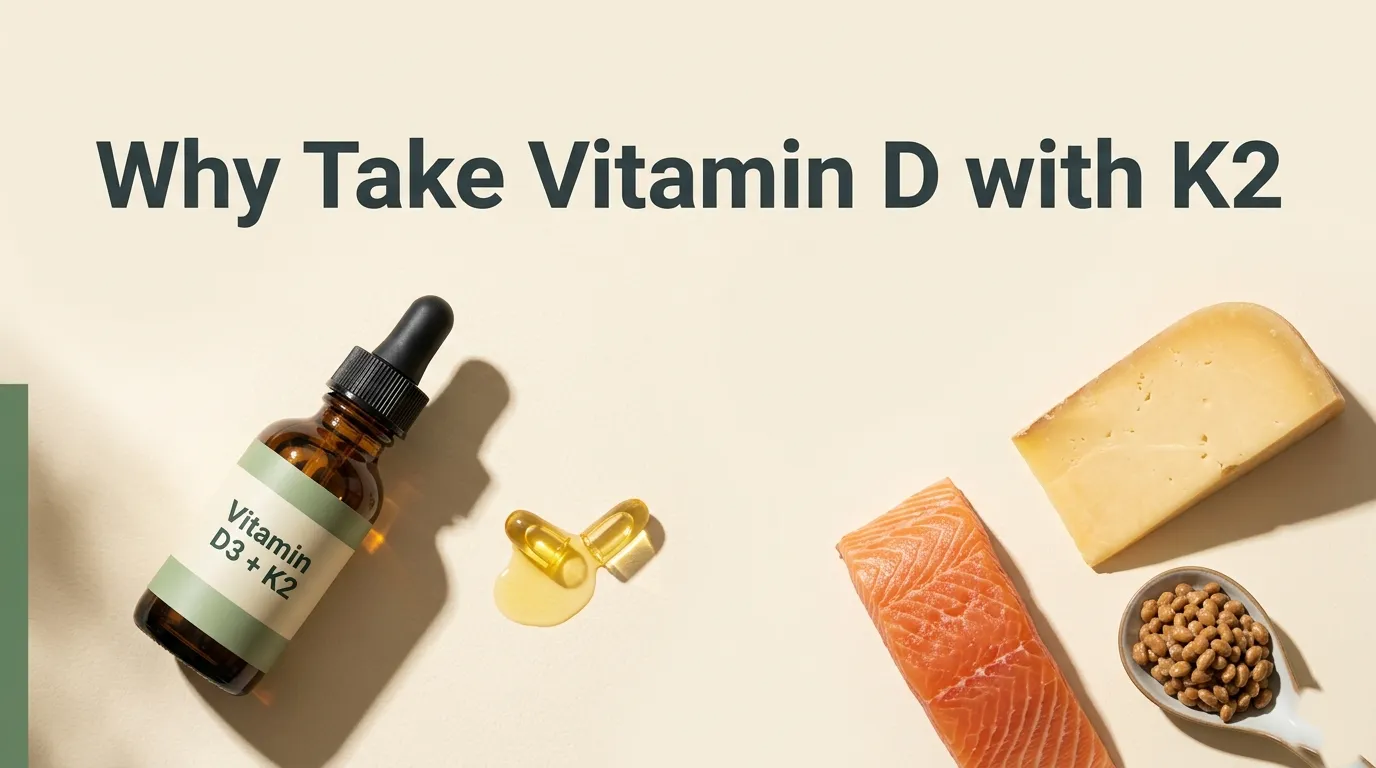
Vitamin D3 and K2 are not found together in significant amounts in any common food, which is precisely why supplementation is so widely discussed. Fatty fish deliver D3. Fermented foods deliver K2. Your dinner plate will rarely contain both in one meal.
For vitamin D3, the best natural sources are wild-caught salmon (526 IU per 100 grams), farmed salmon (250 IU per 100 grams), sardines canned in oil, and cod liver oil, which provides 1,360 IU per tablespoon and is the single most concentrated dietary source. Egg yolks contribute roughly 40 IU per yolk. Mushrooms exposed to UV light provide D2, not D3, and are less effective at raising serum levels. For vitamin K2 MK-7, natto, a Japanese fermented soybean dish, is overwhelmingly the richest source at 939 mcg per 100 grams. No other common food comes close. Hard cheeses like Gouda and Brie provide 50 to 75 mcg per 100 grams as MK-4 primarily, not MK-7. Goose liver pate delivers 369 mcg of MK-4 per 100 grams. Egg yolks, dark chicken meat, and butter contain small amounts of MK-4.
The practical challenge is clear. To get 120 mcg of K2 from food daily, you would need to eat natto, which most Western palates reject, or consume several hundred grams of hard cheese, which carries its own saturated fat and calorie considerations. A 2017 survey published in the journal Nutrients estimated that median vitamin K2 intake in Western populations is below 40 mcg daily. The foods that once supplied K2, organ meats, fermented dairy, and pastured animal fats, have largely disappeared from the modern diet. Food alone can meet your K2 needs. It is simply that most people are not eating those foods.
Best D3 K2 Supplement
The best D3 and K2 supplement contains cholecalciferol (D3) and menaquinone-7 (MK-7) in an oil-based delivery system, manufactured by a company that provides third-party potency testing, and packaged in a dark glass or opaque bottle to protect the fat-soluble vitamins from light degradation.
When evaluating a D3 plus K2 product, the label should specify both the form and the dose of each vitamin. It should read “Vitamin D3 (as cholecalciferol)” and “Vitamin K2 (as menaquinone-7)” or “(as MK-7).” If the label only says “Vitamin K” without specifying the form, assume it is K1 or an unspecified K2 mix and choose a different product. The delivery system matters for absorption. Both D3 and K2 are fat-soluble. Dry tablets without an oil carrier will have lower bioavailability. Softgels containing olive oil, coconut oil, or medium-chain triglyceride oil as the base are preferable. A 2010 study in the Journal of the Academy of Nutrition and Dietetics confirmed that taking vitamin D with a fat-containing meal increased absorption by 32 percent compared to a fat-free meal. An oil-based softgel solves this problem before it even leaves the capsule.
Third-party testing is the minimum quality standard. Look for a seal from USP, NSF International, or ConsumerLab on the label. These organizations verify that the product contains what the label claims in the stated amounts and is free from harmful contaminants. Supplements are not pre-market approved by the FDA for potency or purity. Third-party certification fills that regulatory gap.
Numbered Sequence to Choose a Quality D3 and K2 Supplement:
- Verify the K2 form on the Supplement Facts panel. It must say “menaquinone-7” or “MK-7.”
- Confirm the D3 form is listed as “cholecalciferol,” not “ergocalciferol” (D2).
- Check that the product uses an oil-based softgel or liquid delivery system, not a dry tablet.
- Look for a third-party certification seal: USP, NSF, or ConsumerLab.
- Store the bottle in a cool, dark place. Heat and light degrade fat-soluble vitamins.
Signs of Vitamin K2 Deficiency
Vitamin K2 deficiency has no acute, named disease state like scurvy for vitamin C or rickets for vitamin D. Instead, it manifests silently over years through the gradual accumulation of undercarboxylated osteocalcin and matrix Gla protein, measurable in blood, and eventually through increased vascular calcification and declining bone density.
The lack of an acute deficiency syndrome is why K2 deficiency has been underrecognized for decades. You do not wake up one morning with a “K2 deficiency headache.” The problem accumulates subclinically. Functional markers exist if your physician knows to order them. A high percentage of undercarboxylated osteocalcin in serum indicates that the osteocalcin your bones are producing is not being activated. This test is not part of a standard blood panel. An endocrinologist or a physician specializing in bone health can order it. In practice, K2 deficiency is assessed by dietary pattern analysis. A person who rarely or never consumes fermented foods, organ meats, aged cheeses, or egg yolks from pasture-raised chickens is highly likely to have low K2 status. When such a person also has a low bone mineral density scan or a high coronary artery calcium score, the K2 question becomes clinically relevant.
The populations at highest risk for low K2 status are people following highly processed Western diets, vegans (unless consuming natto regularly), individuals on long-term broad-spectrum antibiotics that disrupt gut bacterial K2 synthesis, and people with fat malabsorption conditions like cystic fibrosis, Crohn’s disease, or post-gastric bypass. If you are in one of these groups and take vitamin D, the case for considering K2 supplementation is stronger.
Key Takeaway: K2 deficiency is silent, cumulative, and undiagnosed in most people because the standard blood panel does not measure it. The strongest clue is your diet pattern combined with your bone density and vascular health over time.
Vitamin K2 and Warfarin
Vitamin K2 directly antagonizes warfarin (Coumadin) because warfarin works by blocking vitamin K recycling, which prevents the liver from activating clotting factors. Any additional vitamin K intake, from food or supplements, can reduce warfarin’s effectiveness and increase clotting risk.
The mechanism is a direct pharmacological interference. Warfarin inhibits the enzyme vitamin K epoxide reductase, which recycles oxidized vitamin K back to its active reduced form. Without active vitamin K, the liver cannot carboxylate clotting factors II, VII, IX, and X. These factors remain inactive, and the blood’s ability to clot decreases. Adding vitamin K2 to a warfarin regimen provides new active vitamin K that the drug cannot fully block, potentially restoring clotting factor activation. This can lead to therapeutic failure and an increased risk of thrombosis. Warfarin patients are typically counseled to maintain consistent dietary vitamin K intake rather than eliminate it. The goal is stable intake so that the warfarin dose can be calibrated to produce the target International Normalized Ratio (INR). Adding a supplement introduces a variable that destabilizes that calibration.
A physician can adjust warfarin dosage to accommodate vitamin K supplementation, but this requires careful INR monitoring during the transition period. The physician must know the exact amount of K2 being supplemented daily. The patient must be consistent and never skip doses or double up. A cardiologist or the physician managing the anticoagulation therapy is the only person qualified to make this decision. If you are taking warfarin and considering vitamin K2, bring the exact supplement bottle to your next appointment. Ask your physician whether the specific K2 dose can be incorporated into your regimen safely. Do not self-manage this interaction.
Quick Tip:
- Warfarin patients must consult their prescribing physician before adding any vitamin K supplement.
- Bring the exact supplement label to the appointment so the physician knows the K2 form and dose.
- Never start or stop vitamin K2 while on warfarin without concurrent INR monitoring.
- Newer anticoagulants (apixaban, rivaroxaban) work through a different mechanism and do not interact with vitamin K in the same way.
FAQ Section
Frequently Asked Questions About Vitamin D and K2
Can I get enough vitamin K2 from food?
Yes, you can get enough vitamin K2 from food if you regularly eat natto, hard aged cheeses, goose liver pate, and egg yolks from pasture-raised hens.
Natto alone provides over 900 mcg of K2 MK-7 per 100-gram serving, far exceeding the 100 to 180 mcg dose used in most bone health studies.
Most Western diets do not include these foods consistently, which is why dietary K2 intake is estimated to be well below 50 mcg daily for the average person.
Is it safe to take vitamin D3 without K2?
Yes, it is safe to take vitamin D3 without K2 at maintenance doses of 600 to 2,000 IU daily, especially if your diet includes some K2-rich foods.
The concern about taking D3 without K2 is based on long-term, high-dose supplementation exceeding 4,000 IU daily combined with low dietary K2 intake over many years.
No direct clinical trial has proven that D3 alone causes arterial calcification in the absence of K2, but the mechanistic rationale for pairing them is strong enough that many clinicians recommend it.
What is the best time of day to take vitamin D3 and K2?
Take vitamin D3 and K2 with your largest meal of the day that contains some dietary fat.
Both vitamins are fat-soluble, and their absorption increases when consumed with fat from food.
A morning or midday meal is often the most consistent and habit-forming time, but the fat content of the meal matters more than the clock time.
How much K2 should I take with 5,000 IU of vitamin D3?
With 5,000 IU of vitamin D3, a vitamin K2 MK-7 dose of 100 to 180 mcg daily is a reasonable pairing based on the doses used in clinical trials.
The 5,000 IU vitamin D dose exceeds the Tolerable Upper Intake Level of 4,000 IU and should only be taken under physician supervision with periodic serum vitamin D testing.
The K2 dose does not need to increase proportionally with D3 because a plateau effect exists where higher K2 doses do not significantly increase osteocalcin carboxylation beyond what 180 mcg achieves.
Will vitamin K2 cause blood clots?
No, vitamin K2 does not cause abnormal blood clotting in healthy individuals who are not taking anticoagulant medications.
Unlike vitamin K1, which is preferentially used by the liver for clotting factor activation, K2 is distributed to extrahepatic tissues like bone and arteries where it activates proteins unrelated to coagulation.
There is no Tolerable Upper Intake Level set for vitamin K2 because no toxicity or clotting risk has been identified at any dose studied in humans.
Does vitamin K2 lower blood pressure?
Vitamin K2 does not directly lower blood pressure, but it may reduce arterial stiffness over time by inhibiting vascular calcification.
A 2015 randomized controlled trial in postmenopausal women showed that three years of MK-7 supplementation reduced arterial stiffness, which can indirectly support healthier blood pressure.
This is not an acute effect and should not replace prescribed antihypertensive medications.
CLOSING:
The D3 and K2 pairing is not marketing noise. It is a specific solution to a specific biological problem. Vitamin D increases your calcium absorption. Vitamin K2 tells that calcium where to go. Without K2, the extra calcium sits in a distribution queue with no routing instructions. Over years, that matters.
What you do with this information depends on your current D3 dose, your diet, and your bone and cardiovascular risk factors. If you take a maintenance dose of vitamin D and eat a diet that includes fermented foods and aged cheese, you are likely covered. If you take 4,000 IU or more, eat a standard Western diet, and have a family history of osteoporosis or heart disease, adding 100 to 180 mcg of MK-7 daily is a low-risk, mechanistically sound decision.
The one exception is non-negotiable. If you take warfarin, you do not add vitamin K2 on your own. You bring the supplement bottle to your physician and let them adjust your protocol. For everyone else, the evidence points to a pairing that makes biochemical sense, has human trial support, and fills a genuine gap in the modern food supply.