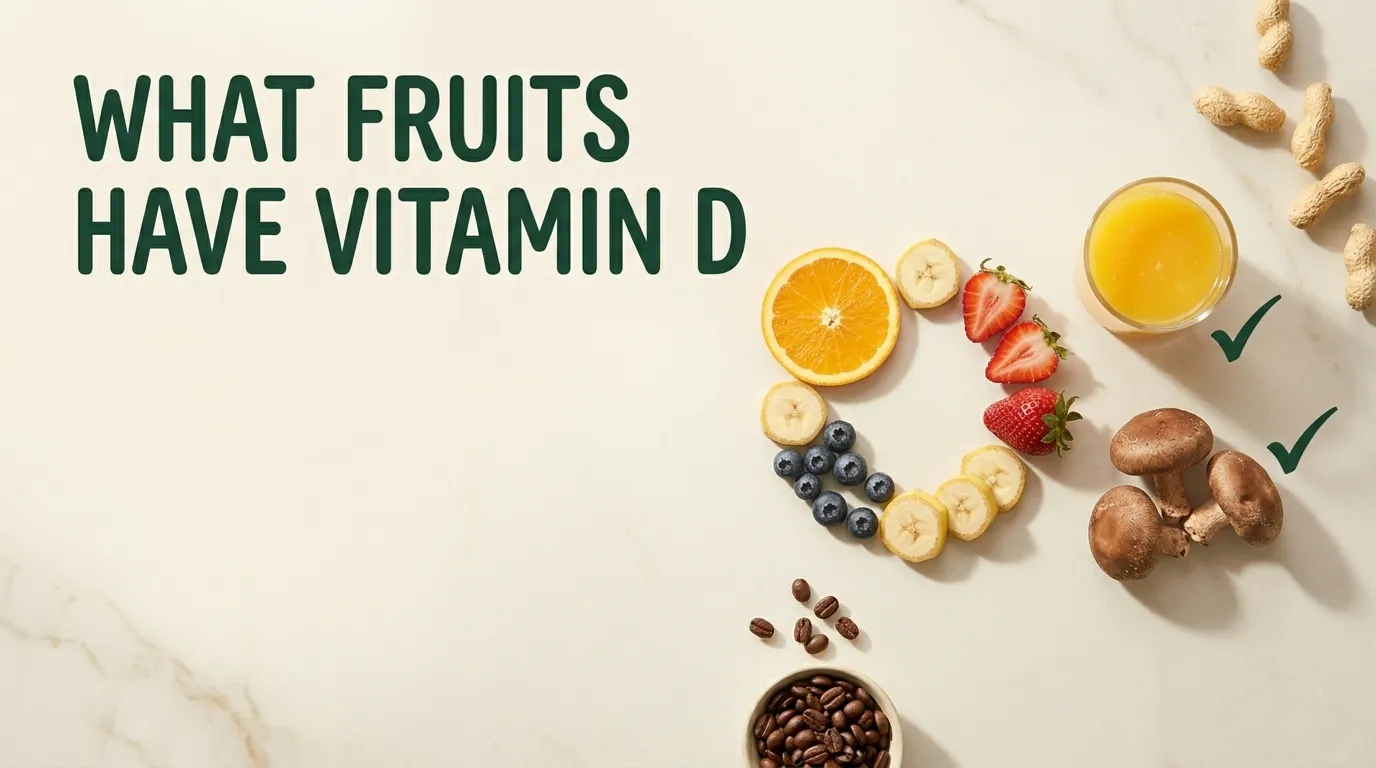
What Fruits Have Vitamin D? Truth About Fruit & D 2026
The short answer is none. No fruit naturally contains vitamin D. This includes apples, oranges, bananas, berries, melons, and tropical fruits like mangoes and pineapples. The USDA FoodData Central database records zero International Units (IU) of vitamin D for every unfortified fruit entry.
This matters because vitamin D deficiency affects approximately 35 percent of adults in the United States, according to the National Institutes of Health (NIH) Office of Dietary Supplements. Vitamin D supports calcium absorption for bone health, immune system function, and muscle performance. Many people assume a fruit-rich diet covers all their vitamin needs. For vitamin D, that assumption is incorrect.
This guide explains why fruits lack vitamin D, which fortified fruit products can help, how certain fruits support vitamin D activation, and where to find real dietary vitamin D. You will learn the difference between vitamin D2 and D3, how much you actually need, and whether you should consider supplements.
what fruits have vitamin D
No naturally occurring fruit contains measurable amounts of vitamin D. The USDA National Nutrient Database confirms zero vitamin D content in apples, oranges, bananas, strawberries, blueberries, grapes, peaches, pears, kiwis, mangoes, pineapples, watermelons, cantaloupe, honeydew, cherries, plums, nectarines, apricots, figs, dates, and all berries.
| Fruit (1 medium piece unless noted) | Natural Vitamin D Content | Notes |
|---|---|---|
| Apple | 0 IU | No detectable vitamin D |
| Banana | 0 IU | No detectable vitamin D |
| Orange | 0 IU | No detectable vitamin D |
| Strawberries (1 cup) | 0 IU | No detectable vitamin D |
| Blueberries (1 cup) | 0 IU | No detectable vitamin D |
| Mango | 0 IU | No detectable vitamin D |
| Watermelon (1 wedge) | 0 IU | No detectable vitamin D |
This table reflects raw, whole, unfortified fruits. Cooking, freezing, or drying does not create vitamin D where none existed. The nutrient simply is not present in the plant kingdom outside of UV-exposed mushrooms (which are fungi, not fruits).
People following fruit-heavy diets like fruitarianism should understand that their diet provides zero natural vitamin D. This creates a genuine risk of deficiency without supplementation or significant sun exposure.
Key Takeaway: No unfortified fruit contains vitamin D. Zero. This is not a matter of eating more of a certain fruit — the nutrient is biochemically absent.
which fruits have vitamin D
The same answer applies to all fruit varieties. No type of fruit — citrus, tropical, stone fruit, berries, melons, or pomes — contains natural vitamin D. A search for “which fruits have vitamin D” returns fortified products, not fruits with natural content.
The FatSecret nutrition database shows vitamin D values as dashes or zeros across all fruit entries. A medium apple provides 0 IU. A medium banana provides 0 IU. A cup of strawberries provides 0 IU. This pattern holds internationally.
Some online sources list “fortified orange juice” when asked which fruits have vitamin D. This is misleading. Fortified means vitamin D was added during processing. The oranges themselves contain no vitamin D. The juice only contains vitamin D because the manufacturer added it.
If you see a fruit product claiming vitamin D content, check the label. Look for the word “fortified” or “enriched.” Check the ingredient list for added vitamin D (often listed as cholecalciferol or ergocalciferol). Without these additions, the vitamin D content is zero.
Key Takeaway: When someone asks “which fruits have vitamin D,” the honest answer is none. Fortified fruit products are processed foods with added vitamins, not natural fruit sources.
what fruits contain vitamin D naturally
Fruits do not contain vitamin D naturally because plants lack the biochemical pathway to synthesize it. Vitamin D is produced in animals (including humans) through a multi-step process that starts with cholesterol and requires UVB light exposure. Plants and fruits do not have this metabolic machinery.
Why plants cannot make vitamin D:
- Animals convert 7-dehydrocholesterol in skin to pre-vitamin D3 when exposed to UVB light
- This converts to cholecalciferol (vitamin D3) through a heat-dependent process
- The liver then converts cholecalciferol to 25-hydroxyvitamin D (calcidiol)
- The kidneys perform the final activation to 1,25-dihydroxyvitamin D (calcitriol)
Plants produce a different compound, ergosterol, which can be converted to ergocalciferol (vitamin D2) when exposed to UV light. This occurs in fungi and some algae, but not in flowering plants that produce fruits.
Mushrooms are the only plant-like organism that produces measurable vitamin D (as D2). They are fungi, not fruits. A Portobello mushroom exposed to UV light during growth can contain 400-800 IU of vitamin D2 per 100 grams. But a mushroom is not a fruit. It belongs to a completely different biological kingdom.
Key Takeaway: Fruits naturally contain zero vitamin D because plants lack the biochemical pathway to produce this animal-specific vitamin. Mushrooms (fungi) can produce vitamin D2, but they are not fruits.
why fruits don’t contain vitamin D
The evolutionary reason fruits lack vitamin D comes down to how plants and animals obtain energy and regulate calcium differently. Animals need vitamin D to absorb calcium from food into the bloodstream. Plants do not have blood or a digestive system. They absorb calcium directly from soil through their roots without needing vitamin D as a middleman.
Vitamin D functions as a hormone in animals. It binds to vitamin D receptors (VDRs) in the small intestine, triggering production of proteins that transport calcium across intestinal cells into the blood. Without this process, dietary calcium mostly passes through unabsorbed.
Plants have no VDRs. They have no small intestine. They have no blood calcium to regulate. The entire vitamin D system simply does not exist in the plant kingdom.
A useful analogy: Asking for vitamin D from a fruit is like asking for chlorophyll from a steak. Each biological kingdom produces the molecules it needs for its own survival. Plants make chlorophyll for photosynthesis. Animals make vitamin D for calcium regulation. Neither makes the other’s signature compound.
Quick Tip:
- Plants need chlorophyll (for photosynthesis) — animals do not make this
- Animals need vitamin D (for calcium absorption) — plants do not make this
- Mushrooms (fungi) are the exception — they make vitamin D2 when exposed to UV light
Key Takeaway: Fruits do not contain vitamin D because plants evolved a completely different calcium management system that does not require this animal hormone.
vitamin d fortified orange juice
Fortified orange juice is the only common fruit-derived product that provides meaningful vitamin D. According to the USDA FoodData Central database, one cup (8 fluid ounces) of fortified orange juice typically contains 100 IU of vitamin D. This represents approximately 15 percent of the daily recommended intake for adults.
Not all orange juice is fortified. Standard orange juice contains zero vitamin D. You must look for cartons labeled “fortified with vitamin D” or “enriched with vitamin D.” The added form is usually vitamin D3 (cholecalciferol), which is the same form produced in human skin.
Fortified orange juice nutrition comparison (8 oz serving):
| Product Type | Vitamin D (IU) | Added Sugar (g) | Notes |
|---|---|---|---|
| Fresh-squeezed orange juice | 0 | 0 (natural sugars only) | No fortification |
| Standard commercial OJ | 0 | 0-5 (if no added sugar) | No fortification |
| Fortified orange juice | 100 | 0-5 | Check label for fortification |
| Fortified calcium + D OJ | 100 | 0-5 | Often marketed for bone health |
People who choose fortified orange juice for vitamin D should watch for added sugars. Some fortified products contain high fructose corn syrup or added cane sugar. The American Heart Association recommends limiting added sugar to 25g per day for women and 36g for men.
Key Takeaway: Fortified orange juice provides approximately 100 IU of vitamin D per cup — useful but not sufficient as your only source. Always check the label for both fortification and added sugar.
do bananas have vitamin D
Bananas do not contain vitamin D. A medium banana (approximately 118 grams) contains 0 IU of vitamin D according to USDA data. This applies to all banana varieties including Cavendish, plantains, red bananas, and baby bananas.
However, bananas play a different role in vitamin D nutrition. They are an excellent source of magnesium. One medium banana provides approximately 32 mg of magnesium, or 8 percent of the daily recommended intake for adults. Magnesium is required to convert vitamin D into its active form in the body.
How magnesium supports vitamin D:
| Step | Process | Requires |
|---|---|---|
| 1 | Sunlight or diet provides vitamin D precursor | UVB or dietary intake |
| 2 | Liver converts to 25-hydroxyvitamin D | Magnesium-dependent enzyme |
| 3 | Kidneys convert to active 1,25-dihydroxyvitamin D | Magnesium-dependent enzyme |
| 4 | Vitamin D binds to receptors throughout body | Magnesium for receptor function |
Without adequate magnesium, supplemental or dietary vitamin D remains in its inactive storage form. Research published in the American Journal of Clinical Nutrition found that people with higher magnesium intake had lower risk of vitamin D deficiency, regardless of their vitamin D intake.
Bananas also provide potassium, which works alongside vitamin D to support bone density. But again — the banana itself contains no vitamin D. Think of bananas as vitamin D helpers, not vitamin D sources.
Key Takeaway: Bananas contain zero vitamin D but provide magnesium needed to activate vitamin D in your body. Eat them alongside real vitamin D sources like fatty fish or eggs.
fruits that help absorb vitamin D
Certain fruits support vitamin D absorption through their fat, magnesium, or vitamin C content. Vitamin D is fat-soluble, meaning it requires dietary fat to move from your digestive tract into your bloodstream. Fruits with healthy fats can help, though most fruits are very low in fat.
Fruits that support vitamin D absorption:
| Fruit | Key Nutrient | How It Helps Vitamin D |
|---|---|---|
| Avocado | Monounsaturated fat (15g per fruit) | Provides fat for vitamin D absorption |
| Olives | Monounsaturated fat (4g per 10 olives) | Provides fat for absorption |
| Coconut (meat/milk) | Medium-chain triglycerides (MCTs) | Fat source for absorption |
| Banana | Magnesium (32mg) | Activates vitamin D in liver and kidneys |
| Kiwi | Vitamin C (70mg) | Supports immune function alongside vitamin D |
| Citrus fruits | Vitamin C (70mg per orange) | May enhance vitamin D receptor activity |
Avocados deserve special mention. One whole avocado contains approximately 15 grams of monounsaturated fat. Adding avocado to a meal that includes a vitamin D source (like salmon or eggs) can significantly improve how much vitamin D your body absorbs.
The mechanism works like this: Vitamin D dissolves into fat droplets in your stomach. These droplets trigger release of bile salts and pancreatic enzymes. Your small intestine then absorbs the dissolved vitamin D along with the fat. Without fat in the meal, much of the vitamin D passes through unabsorbed.
This is why drinking fortified orange juice alone (which has little to no fat) may not be optimal. Add a few walnuts (12g fat per ounce) or half an avocado to your breakfast if you rely on fortified juice for vitamin D.
Key Takeaway: Avocados, olives, and coconut provide the fat needed to absorb vitamin D from food or supplements. Bananas and kiwis provide magnesium and vitamin C that support activation and function.
best natural vitamin D sources
Since fruits provide no natural vitamin D, you need other food sources. The best natural sources are animal-based because they contain cholecalciferol (vitamin D3), the same form your skin produces from sunlight. D3 is more bioavailable and raises blood levels more effectively than plant-based D2.
Top natural vitamin D sources ranked by IU per serving:
| Food | Serving Size | Vitamin D (IU) | % Daily Value (600 IU RDA) |
|---|---|---|---|
| Cod liver oil | 1 tablespoon | 1,360 | 227% |
| Wild Atlantic salmon | 3.5 oz (100g) | 600-1,000 | 100-167% |
| Mackerel | 3.5 oz (100g) | 360-650 | 60-108% |
| Canned sardines | 3.5 oz (100g) | 200-300 | 33-50% |
| UV-exposed mushrooms | 3.5 oz (100g) | 400-800 (as D2) | 67-133% |
| Egg yolk (pasture-raised) | 1 large yolk | 40-150 | 7-25% |
| Beef liver | 3 oz (85g) | 50-100 | 8-17% |
| Fortified milk (cow or plant) | 1 cup | 100-120 | 17-20% |
| Fortified orange juice | 1 cup | 100 | 17% |
Wild salmon contains significantly more vitamin D than farmed salmon. A 2021 study found wild sockeye salmon averaged 988 IU per 3.5 oz serving, while farmed Atlantic salmon averaged 245 IU. The difference comes from diet — wild salmon eat vitamin D-rich crustaceans and plankton.
Eggs from pasture-raised hens contain 3 to 4 times more vitamin D than eggs from caged hens. Hens exposed to sunlight produce eggs with higher D3 content. Look for “pasture-raised” on the carton, not just “free-range” or “cage-free,” which have weaker outdoor access standards.
Key Takeaway: Fatty fish (salmon, mackerel, sardines) and cod liver oil are the most potent natural vitamin D sources. UV-exposed mushrooms work for vegans but provide the less effective D2 form.
vitamin d2 vs d3 in food sources
The difference between vitamin D2 and D3 matters for how much your body actually uses. D3 (cholecalciferol) comes from animal sources and human skin synthesis. D2 (ergocalciferol) comes from UV-exposed mushrooms and some fortified plant foods.
Multiple randomized controlled trials have compared D2 and D3 head-to-head. The consistent finding: D3 raises and maintains serum 25-hydroxyvitamin D levels approximately two to three times more effectively than the same amount of D2.
Comparison of D2 vs D3:
| Characteristic | Vitamin D2 (Ergocalciferol) | Vitamin D3 (Cholecalciferol) |
|---|---|---|
| Source | UV-exposed mushrooms, fungi, some fortified foods | Animal fats, fish, egg yolks, human skin |
| Food examples | Shiitake mushrooms, fortified plant milks | Salmon, sardines, cod liver oil, egg yolks |
| Form in body | Requires conversion to active form | Same form as human-produced vitamin D |
| Binding protein affinity | Lower — faster clearance from blood | Higher — longer half-life in blood |
| Potency per IU | Lower (approximately 1/3 to 1/2 as effective) | Reference standard |
| Typical food content (per serving) | Variable, up to 1,600 IU in dried UV-exposed shiitake | 400-1,000 IU in wild salmon |
People following strict vegan diets cannot consume D3 from animal sources. Their options are:
- UV-exposed mushrooms (natural D2)
- Fortified plant milks and cereals (usually D2)
- Lichen-derived D3 supplements (vegan, though rare in fortified foods)
The NIH Office of Dietary Supplements notes that vitamin D2 from mushrooms appears to have similar bioavailability to D3 when both are consumed in single doses. However, most research shows D3 has a longer duration of action and better maintains stable blood levels with daily intake.
Quick Tip: If you rely on plant sources for vitamin D, choose UV-exposed mushrooms over fortified products. Dry them yourself or buy dried shiitake mushrooms labeled “UV-treated.” One ounce of dried UV-exposed shiitake can contain over 1,000 IU of D2.
Key Takeaway: Vitamin D3 from animal sources is more potent and longer-lasting in your body than D2 from plants. Vegans should consider lichen-derived D3 supplements or rely on blood testing to confirm D2 sources are working.
mushrooms vitamin d content
Mushrooms are not fruits, but they are the only plant-like source of natural vitamin D. When exposed to ultraviolet (UV) light, mushrooms produce vitamin D2 (ergocalciferol) through the same photochemical reaction that produces D3 in human skin.
Vitamin D content in mushrooms (per 100g raw unless noted):
| Mushroom Type | Growing Condition | Vitamin D2 (IU) | Notes |
|---|---|---|---|
| Shiitake, fresh | Standard indoor | 0-100 | Low without UV exposure |
| Shiitake, dried | Standard indoor | 100-200 | Drying concentrates but doesn’t create D |
| Shiitake, fresh | UV-exposed | 400-800 | Significant D after UV treatment |
| Shiitake, dried | UV-exposed before drying | 1,000-1,600 | Highest natural plant D source |
| Portobello | UV-exposed | 400-800 | Common in commercial UV-treated brands |
| White button | UV-exposed | 200-400 | Lowest, but still meaningful |
You can increase the vitamin D content of mushrooms at home. Place fresh mushrooms gill-side up in direct sunlight for 30 to 60 minutes. This UV exposure converts the mushrooms’ ergosterol to ergocalciferol (D2). One study found that 60 minutes of midday sun exposure increased vitamin D content in mushrooms from negligible to 400-800 IU per 100 grams.
A practical tip for mushroom consumers: Buy white button or cremini mushrooms (the cheapest options). Spread them on a baking sheet in a single layer. Leave them in direct sunlight for one hour. Cook immediately or refrigerate for up to three days. This home treatment costs nothing and transforms a low-D mushroom into a meaningful D2 source.
Key Takeaway: UV-exposed mushrooms are the only significant natural vitamin D source from the plant/fungi kingdom. One cup of sun-treated shiitake mushrooms provides 400-800 IU of D2.
vitamin d deficiency symptoms
Vitamin D deficiency produces symptoms that are often subtle at first but worsen over time. According to the Cleveland Clinic, the most common deficiency signs involve bone pain and muscle weakness. Because vitamin D is required for calcium absorption, deficiency directly affects the skeleton.
Common vitamin D deficiency symptoms by body system:
| Body System | Symptom | Mechanism |
|---|---|---|
| Skeletal (adults) | Bone pain (especially lower back, legs, ribs) | Inadequate calcium absorption leads to bone softening (osteomalacia) |
| Skeletal (adults) | Increased fracture risk | Low bone density from chronic deficiency |
| Skeletal (children) | Rickets — bowed legs, delayed growth, soft skull | Severe deficiency causes bone deformities |
| Muscular | Muscle weakness, especially proximal (thighs, shoulders) | Vitamin D receptors on muscle cells require D for function |
| Muscular | Muscle aches, cramping | Impaired calcium handling in muscle tissue |
| General | Fatigue, low energy | Metabolic and mitochondrial effects unclear |
| Mood | Depression or low mood (research ongoing) | Vitamin D receptors in brain regions regulating mood |
People at higher risk for deficiency include:
- Older adults (skin produces less D with age)
- People with darker skin tones (melanin reduces UVB absorption)
- Those who live at northern latitudes (above 37 degrees N, below 37 degrees S)
- People who wear full-body covering clothing
- Individuals with malabsorption disorders (celiac, Crohn’s, ulcerative colitis)
- People who have had gastric bypass surgery
- Those with chronic kidney or liver disease (impairs activation)
- Vegans and vegetarians who avoid animal sources and don’t supplement
A physician can diagnose vitamin D deficiency with a blood test for 25-hydroxyvitamin D. The NIH classifies levels below 20 ng/mL (50 nmol/L) as deficient. Levels between 21-29 ng/mL are insufficient (subclinical deficiency). Optimal levels are often cited as 30-50 ng/mL, though some experts recommend 40-60 ng/mL.
Key Takeaway: Unexplained bone pain, muscle weakness, and fatigue are classic deficiency signs. A simple blood test for 25-hydroxyvitamin D is the only way to know your status.
how much vitamin d per day by age
The Recommended Dietary Allowance (RDA) for vitamin D varies by age. These values from the NIH Office of Dietary Supplements represent the amount needed to maintain bone health and calcium metabolism in healthy people. The RDA assumes minimal sun exposure.
Vitamin D RDA by age group:
| Age Group | RDA (IU per day) | RDA (mcg per day) |
|---|---|---|
| Infants 0-12 months | 400 IU | 10 mcg |
| Children 1-18 years | 600 IU | 15 mcg |
| Adults 19-70 years | 600 IU | 15 mcg |
| Adults over 70 years | 800 IU | 20 mcg |
| Pregnancy (any age) | 600 IU | 15 mcg |
| Breastfeeding | 600 IU | 15 mcg |
These RDAs assume you are getting zero vitamin D from sun exposure. If you spend time outdoors with skin exposed, your body produces its own D3. However, many factors reduce skin production:
- Sunscreen with SPF 15+ blocks 99% of vitamin D synthesis
- Winter sunlight at northern latitudes (above 37 degrees) produces little to no vitamin D
- Darker skin requires 3-5 times longer sun exposure to produce the same amount as lighter skin
- Age reduces production capacity — a 70-year-old produces 75% less than a 20-year-old from the same sun exposure
The Tolerable Upper Intake Level (UL) for adults is 4,000 IU (100 mcg) per day. This is the maximum amount considered safe without medical supervision. Doses above this increase risk of toxicity, which causes hypercalcemia (dangerously high blood calcium). Symptoms include nausea, vomiting, weakness, frequent urination, and kidney stones.
People with certain medical conditions should not take high-dose vitamin D without specific physician guidance. These include primary hyperparathyroidism, granulomatous diseases (sarcoidosis, tuberculosis, lymphoma), and some kidney disorders.
Key Takeaway: Most adults need 600-800 IU of vitamin D daily from food or supplements if they have limited sun exposure. Do not exceed 4,000 IU per day without physician supervision.
can you get enough vitamin d from food alone
Most people cannot get enough vitamin D from food alone. The NIH reports that very few foods naturally contain vitamin D, and even fortified foods provide only modest amounts. Achieving the RDA of 600 IU from food requires intentional selection of vitamin D-rich options daily.
Sample meal plan to reach 600 IU from food:
| Meal | Food Choice | Vitamin D (IU) |
|---|---|---|
| Breakfast | 2 large pasture-raised eggs + 8 oz fortified milk | 80 + 100 = 180 IU |
| Lunch | 3 oz canned sardines on whole grain crackers | 250 IU |
| Dinner | 3 oz wild salmon (half a standard fillet) | 500 IU |
| Total | 930 IU |
This plan works, but most people do not eat sardines or salmon daily. A more realistic food-only approach:
| Meal | Food Choice | Vitamin D (IU) |
|---|---|---|
| Breakfast | 8 oz fortified orange juice + 2 eggs | 100 + 80 = 180 IU |
| Lunch | Fortified cereal (1 cup) + 8 oz fortified milk | 60 + 100 = 160 IU |
| Dinner | 4 oz farmed salmon | 250 IU |
| Total | 590 IU |
This barely meets the RDA. Note that farmed salmon contains less D than wild salmon, so this plan relies on wild salmon or supplementation to reliably reach 600 IU.
Research consistently shows that people who do not take supplements or eat fatty fish regularly are at risk for deficiency. A study in the American Journal of Clinical Nutrition found that among adults not taking supplements, over 40 percent had serum 25-hydroxyvitamin D levels below 20 ng/mL in winter months.
Key Takeaway: Reaching the vitamin D RDA from food alone is possible but requires eating fatty fish most days. For most people, a combination of fortified foods, fatty fish several times per week, and supplementation is more practical.
who should take vitamin d supplements
Based on NIH guidelines and clinical consensus, several groups should consider vitamin D supplementation because dietary sources and sun exposure are unlikely to meet their needs.
Groups who should consider vitamin D supplements:
| Group | Reason | Typical Recommended Dose |
|---|---|---|
| Breastfed infants | Breast milk is low in D (25 IU per liter or less) | 400 IU daily (AAP recommendation) |
| Older adults (70+) | Skin produces 75% less D; higher RDA of 800 IU | 800-1,000 IU daily |
| People with darker skin | Melanin reduces UVB absorption by 90%+ | 1,000-2,000 IU daily |
| Northern latitude residents (above 37°N) | No meaningful UVB November-February | 1,000-2,000 IU daily |
| People who wear full coverage clothing | Little to no skin exposure to sunlight | 1,000-2,000 IU daily |
| Individuals with malabsorption disorders | Cannot absorb dietary or supplemental D efficiently | Physician-determined (often higher doses) |
| Vegans and strict vegetarians | No natural D3 sources; D2 options limited | 1,000-2,000 IU D3 (lichen-derived) |
| People with obesity (BMI 30+) | D is sequestered in fat tissue, reducing bioavailability | 2-3x standard dosing may be needed |
The NIH does not recommend routine universal supplementation for all adults. However, many experts argue that given the low cost and high safety margin of vitamin D supplements (up to 4,000 IU daily is safe for most), widespread supplementation is reasonable for people with risk factors.
Before starting any supplement, consider this step-by-step approach:
How to determine if you need vitamin D supplements:
- Take a 25-hydroxyvitamin D blood test through your physician or a mail-in lab service
- Review your results: below 20 ng/mL is deficient, 21-29 ng/mL is insufficient
- If deficient or insufficient, discuss dosing with your physician
- For maintenance without testing, most experts recommend 800-2,000 IU daily for adults with risk factors
- Retest after 3 months of consistent supplementation to confirm levels have normalized
People with certain medical conditions should not take vitamin D supplements without specific physician guidance: sarcoidosis, tuberculosis, lymphoma, primary hyperparathyroidism, and some kidney disorders.
Key Takeaway: Breastfed infants, older adults, people with darker skin, northern residents, and vegans are the highest priority groups for vitamin D supplementation.
vitamin d food sources comparison table
This comprehensive table compares all meaningful vitamin D sources, including fruits (fortified only), animal products, fungi, and fortified plant foods.
Complete vitamin D food sources (per standard serving):
| Food Category | Specific Food | Serving Size | Vitamin D (IU) | Form | Bioavailability |
|---|---|---|---|---|---|
| Fruit (natural) | Any fruit | 1 medium piece | 0 | None | N/A |
| Fruit (fortified) | Orange juice | 8 oz (240 mL) | 100 | D3 or D2 | Good |
| Fatty fish | Wild salmon | 3.5 oz (100g) | 600-1,000 | D3 | Excellent |
| Fatty fish | Mackerel | 3.5 oz (100g) | 360-650 | D3 | Excellent |
| Fatty fish | Canned sardines | 3.5 oz (100g) | 200-300 | D3 | Excellent |
| Fatty fish | Canned tuna (light) | 3 oz (85g) | 40-80 | D3 | Good |
| Fish oil | Cod liver oil | 1 tsp (5 mL) | 450 | D3 | Excellent |
| Eggs | Pasture-raised yolk | 1 large yolk | 40-150 | D3 | Good |
| Eggs | Conventional yolk | 1 large yolk | 40-80 | D3 | Good |
| Organ meat | Beef liver | 3 oz (85g) | 50-100 | D3 | Good |
| Fungi | UV-exposed shiitake | 3.5 oz (100g) | 400-800 | D2 | Fair-Good |
| Fungi | UV-exposed portobello | 3.5 oz (100g) | 400-800 | D2 | Fair-Good |
| Fungi | Standard white button | 3.5 oz (100g) | 0-100 | D2 (minimal) | Poor |
| Fortified dairy | Cow’s milk | 8 oz (240 mL) | 100-120 | D3 | Good |
| Fortified plant milk | Soy/almond/oat milk | 8 oz (240 mL) | 100-120 | D2 (often) | Fair |
| Fortified cereal | Breakfast cereal | 1 cup | 40-100 | D2 or D3 | Fair |
Bioavailability ranking: Excellent > Good > Fair > Poor. Note that natural D3 from fatty fish is consistently more effective at raising blood levels than fortified or D2 sources.
Groups following vegan diets should prioritize:
- UV-exposed mushrooms (for natural D2)
- Fortified plant milks (check labels for D content — varies by brand)
- Lichen-derived D3 supplements (vegan and more effective than D2)
Key Takeaway: Fatty fish, cod liver oil, and UV-exposed mushrooms are the most potent natural sources. Fortified products provide useful amounts but should not be your only source unless you carefully plan your intake.
Frequently Asked Questions About Vitamin D and Fruit
What fruits are high in vitamin D naturally?
No fruits are naturally high in vitamin D. Apples, oranges, bananas, berries, melons, and all other common fruits contain zero vitamin D. The only fruit-derived product with vitamin D is fortified orange juice, which has added vitamin D during processing.
Does orange juice have vitamin D?
Some orange juice has vitamin D, but only if it is labeled “fortified” or “enriched.” Fresh-squeezed and standard commercial orange juice contains zero vitamin D. Fortified orange juice typically provides 100 IU per 8-ounce cup, which is approximately 15 percent of the daily recommended intake for adults.
Do bananas contain vitamin D?
Bananas do not contain vitamin D. A medium banana provides 0 IU of vitamin D. However, bananas are a good source of magnesium (32 mg per banana), which your body needs to activate vitamin D. Eat bananas alongside real vitamin D sources to support absorption and activation.
Can you get enough vitamin D from fruit and sunlight?
You cannot get enough vitamin D from fruit because fruits naturally contain zero vitamin D. Sunlight is an excellent source for many people, but factors like latitude, season, skin tone, sunscreen use, and age affect production. During winter months at northern latitudes, sun exposure produces little to no vitamin D, making food sources or supplements necessary.
Is vitamin D2 from plants as good as D3 from animals?
No, vitamin D3 (cholecalciferol) from animal sources is more effective than vitamin D2 (ergocalciferol) from plants. Randomized controlled trials show that D3 raises and maintains blood levels approximately two to three times better than the same amount of D2. Vegans can consider lichen-derived D3 supplements, which are plant-based and as effective as animal D3.
Should vegans take vitamin D supplements?
Most vegans should consider vitamin D supplements. The only natural plant-based source is UV-exposed mushrooms (providing D2, which is less effective). Fortified plant milks and cereals provide some D but often insufficient amounts. The NIH recommends vegans consider D3 supplements derived from lichen, which provide the more bioavailable cholecalciferol form without animal products.
If you eat fruit hoping to get vitamin D, you are not getting any. That is the plain truth. Fruits naturally contain zero vitamin D, and this will not change regardless of how many oranges, bananas, or berries you eat.
The good news is that you have other options. Fatty fish like salmon, mackerel, and sardines provide abundant D3. UV-exposed mushrooms offer a plant-based D2 source. Fortified orange juice and plant milks can help. And for many people, a simple vitamin D supplement of 800 to 2,000 IU daily is safe, inexpensive, and highly effective.
The single best step you can take is getting a blood test for 25-hydroxyvitamin D. Stop guessing. Know your number. Then eat the right foods or supplement accordingly. Your bones, muscles, and immune system will thank you.