
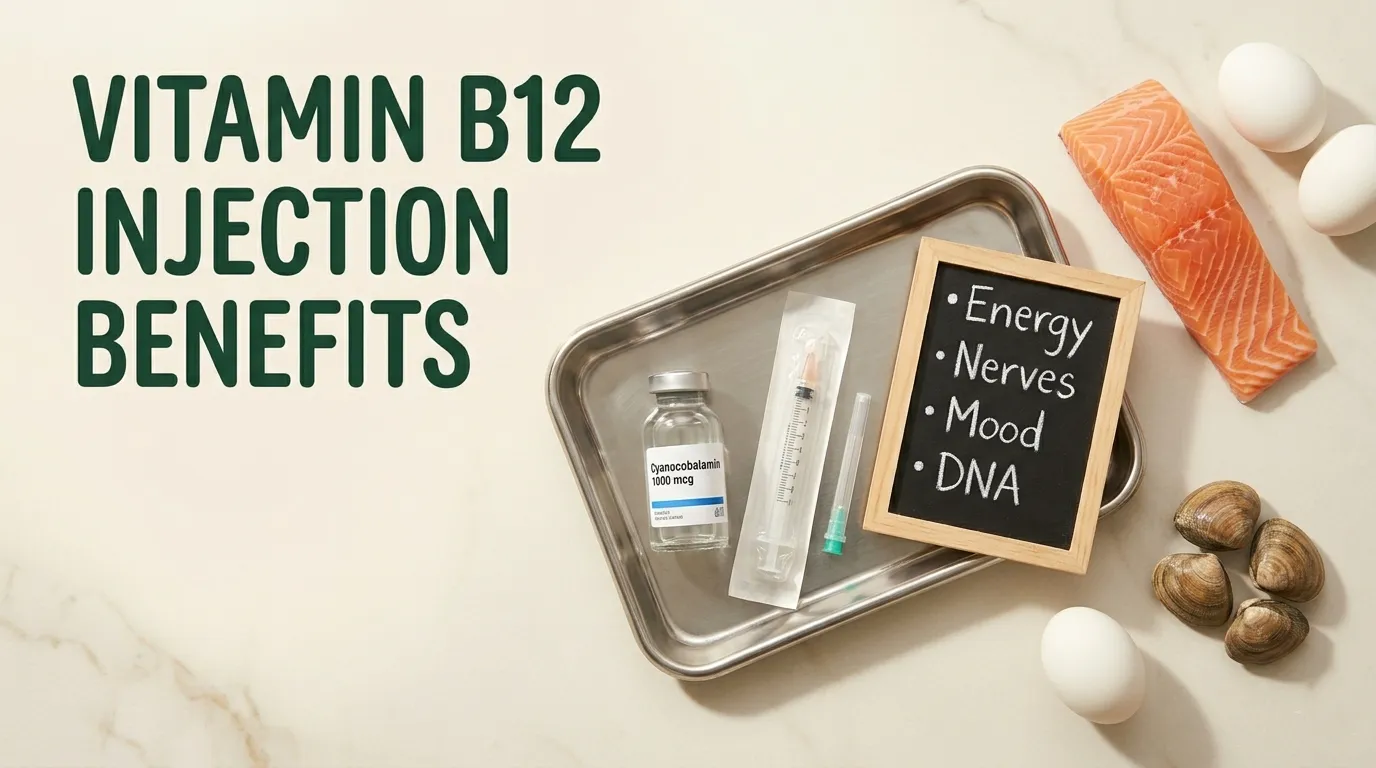
Vitamin B12 Injection Benefits: Evidence Guide 2026
Vitamin B12 injections provide clear benefits for people with confirmed B12 deficiency, including improved energy, nerve function, mood, and cognitive health. For people with normal B12 levels, however, research shows injections offer no measurable benefits over placebo for energy, athletic performance, or weight loss.
A 2025 systematic review and meta-analysis published in PubMed included over 6,000 participants and found no statistically significant difference in effectiveness between injection, oral, and sublingual B12 administration routes . This matters because B12 injections are more expensive, invasive, and time-consuming than pills or sublingual drops that cost pennies per day.
This guide covers every claimed benefit of vitamin B12 injections with evidence ratings, explains who actually needs injections versus oral supplements, compares all administration forms, and provides specific guidance on deficiency symptoms and safe dosing.
vitamin b12 injection benefits
Vitamin B12 injections offer several documented benefits for people with confirmed deficiency. These include reversal of fatigue, improvement of neurological symptoms, mood regulation, and prevention of long-term nerve damage.
Documented benefits for B12-deficient individuals:
| Benefit | Mechanism | Evidence Strength |
|---|---|---|
| Increased energy | Corrects megaloblastic anemia, improving oxygen delivery | Well-established |
| Reduced fatigue | Restores normal red blood cell production | Well-established |
| Improved nerve function | Supports myelin sheath maintenance and repair | Well-established |
| Mood improvement | Supports serotonin and dopamine synthesis | Well-established |
| Cognitive clarity | Normalizes homocysteine metabolism | Well-established |
| Prevention of nerve damage | Maintains myelin integrity long-term | Well-established |
The NIH Office of Dietary Supplements states that vitamin B12 is essential for DNA synthesis, red blood cell formation, and neurological function. When deficiency causes these systems to malfunction, restoring B12 levels reverses the resulting symptoms .
For people with normal B12 levels, however, additional B12 does not enhance these functions beyond normal baseline. Think of B12 like gasoline in a car. If your tank is near empty, filling it restores normal function. If your tank is already full, adding more gasoline does not make the car run better.
Key Takeaway: B12 injections reliably improve energy, mood, and nerve function only if you are deficient. For people with normal levels, injections provide no measurable benefit over placebo.
benefits of vitamin b12 injections
The benefits of vitamin B12 injections fall into three categories: hematologic (blood-related), neurologic, and metabolic. Each category addresses specific deficiency-driven problems.
Hematologic benefits (blood system):
B12 is required for red blood cell maturation. Without enough B12, red blood cells remain large and immature (megaloblastic anemia). These cells carry oxygen poorly, causing fatigue, weakness, shortness of breath, and pale skin. Injections rapidly correct this by providing the raw material for normal cell division in bone marrow. According to the NIH, people with pernicious anemia cannot absorb oral B12 due to lack of intrinsic factor, making injections their only effective treatment option .
Neurologic benefits (nerve system):
B12 maintains the myelin sheath that insulates nerves. Deficiency causes demyelination, leading to numbness and tingling in hands and feet (peripheral neuropathy), balance problems, and memory impairment. The Pharmacy Times reports that B12 deficiency is associated with increased risk of cognitive decline, and B12 supplementation can support neurological health through methylation-dependent epigenetic mechanisms .
Metabolic benefits (energy production):
B12 converts homocysteine to methionine, an amino acid involved in numerous metabolic pathways. Elevated homocysteine is a risk marker for cardiovascular disease and cognitive decline. The 2025 meta-analysis found that B12 supplementation significantly reduces homocysteine levels across all administration routes .
A useful analogy: B12 is the key that unlocks your body’s ability to use certain nutrients. Without the key, those nutrients accumulate (homocysteine) or go unused (iron for red blood cells). Injections provide the key directly, bypassing any locks (absorption problems) in your digestive system.
Key Takeaway: Injections provide hematologic, neurologic, and metabolic benefits specifically by correcting the underlying deficiency that impairs these systems.
does b12 injection give you energy
A B12 injection gives you energy only if you are deficient. For people with normal B12 levels, injections provide no energy boost beyond placebo.
The Mayo Clinic states plainly: “Unless you have low vitamin B12 levels in your body, vitamin B12 shots aren’t likely to give you more energy or improve your performance” . This is because B12 does not act like a stimulant. It does not contain caffeine or any compound that directly increases alertness or metabolic rate.
How B12 affects energy (in deficient people):
| B12 Status | Energy Effect | Mechanism |
|---|---|---|
| Deficient | Significant improvement | Corrects anemia, restores oxygen delivery |
| Borderline | Mild to moderate improvement | Normalizes red blood cell production |
| Normal | No improvement beyond placebo | No deficiency to correct |
A randomized controlled trial of professional singers with mild vocal symptoms (but no B12 deficiency) found that B12 injections produced no meaningful improvement compared to placebo injections. The study specifically excluded anyone with known or suspected B12 deficiency .
If you feel tired but have normal B12 levels, your fatigue has another cause. Common causes include iron deficiency, vitamin D deficiency, thyroid disorders, sleep apnea, depression, or simply insufficient sleep. A physician can help identify the actual cause rather than treating with unnecessary B12 injections.
Key Takeaway: B12 injections correct fatigue caused by B12 deficiency. They do not act as a general energy stimulant for people with normal levels.
vitamin b12 injections for fatigue
Vitamin B12 injections are highly effective for fatigue caused by confirmed B12 deficiency. Fatigue is often the first and most noticeable symptom of deficiency-related megaloblastic anemia.
Signs that your fatigue may be B12-related:
- Fatigue accompanied by pale or jaundiced (yellowish) skin
- Shortness of breath with minimal exertion
- Heart palpitations or feeling your heart race
- Numbness, tingling, or “pins and needles” in hands or feet
- Sore, red, smooth tongue (glossitis)
- Difficulty walking or balance problems
The NIH notes that the body stores 1,000 to 2,000 times the amount of B12 typically consumed in a single day. For this reason, deficiency symptoms can take several years to appear after absorption problems begin .
If your physician confirms B12 deficiency through serum B12 testing (levels below 200 pg/mL per NIH guidelines) , injections typically produce noticeable improvement in fatigue within days to weeks. A common clinical protocol involves weekly injections for four weeks followed by monthly maintenance.
However, the 2025 meta-analysis found that high-dose oral B12 (1000-2000 mcg daily) is equally effective at raising serum B12 levels and resolving fatigue . This means that for many deficient people, expensive injections may not be necessary. Your physician can help determine which route is appropriate for your specific situation and absorption capacity.
Key Takeaway: B12 injections effectively treat fatigue in confirmed deficiency, but high-dose oral supplements may work just as well for many people.
vitamin b12 injections for weight loss
Vitamin B12 injections do not cause weight loss. The Mayo Clinic states: “There’s no solid proof that vitamin B-12 shots help you lose weight” .
Why B12 does not cause weight loss:
| Claimed Mechanism | Actual Evidence |
|---|---|
| Boosts metabolism | B12 is involved in metabolism, but supplementation in non-deficient people does not increase metabolic rate |
| Burns fat | No evidence that B12 directly increases fat oxidation |
| Increases exercise energy | Only effective if fatigue was caused by B12 deficiency |
| Suppresses appetite | No evidence for appetite effects |
Some weight loss clinics promote B12 injections as “fat burners” or “metabolism boosters.” The B12 injection itself is not causing weight loss in these settings. Instead, patients receiving B12 injections are typically also receiving dietary counseling, exercise guidance, and sometimes other medications.
The only indirect way B12 could support weight management is by correcting deficiency-related fatigue, making exercise feel more achievable. If you were too tired to exercise due to B12 deficiency, restoring normal levels might increase your physical activity. But this is not weight loss caused by B12 — it is weight loss enabled by treating the underlying medical issue.
The metformin connection: People with type 2 diabetes taking metformin are at risk for B12 deficiency, as metformin interferes with absorption. If a person on metformin experiences fatigue and reduces activity, correcting B12 deficiency might help them exercise more. But again, this is treating a medication side effect, not a direct weight loss effect of B12 .
Key Takeaway: B12 injections do not cause weight loss. Promotions claiming otherwise are not supported by medical evidence.
b12 shot benefits metabolism
B12 plays a role in metabolism at the cellular level, but B12 shots do not meaningfully boost metabolic rate in people with normal B12 levels.
What B12 actually does in metabolism:
B12 is a cofactor for two enzymes in humans. The first, methionine synthase, converts homocysteine to methionine. The second, methylmalonyl-CoA mutase, converts methylmalonyl-CoA to succinyl-CoA, a step in the breakdown of certain fatty acids and amino acids. These are essential biochemical reactions.
What B12 does NOT do:
- Increase resting metabolic rate
- Cause the body to burn more calories at rest
- Override calorie balance (calories in vs calories out)
The confusion comes from conflating “B12 is involved in metabolism” with “B12 increases metabolism.” Your car’s spark plugs are involved in combustion. Replacing working spark plugs with new ones does not make the engine produce more power. Similarly, providing additional B12 to a body that already has enough does not increase the rate of metabolic reactions.
A commercial clinic page claims B12 “helps you metabolize fat and protein” and “when your metabolism is working efficiently, your body will burn fat for fuel” . While B12 is indeed involved in these processes, this statement implies that extra B12 increases their efficiency. This is not supported by evidence. The body operates these metabolic pathways at the necessary rate based on hormonal signals and energy demands, not based on B12 availability once sufficiency is achieved.
Key Takeaway: B12 is necessary for normal metabolism, but extra B12 does not boost metabolic rate. Only B12-deficient people will experience any metabolic improvement from supplementation.
b12 injections for brain fog
B12 injections can improve brain fog and cognitive symptoms in people with confirmed B12 deficiency. For people with normal B12 levels, research does not support cognitive benefits.
Cognitive symptoms of B12 deficiency:
- Memory lapses and forgetfulness
- Difficulty concentrating or “brain fog”
- Confusion or disorientation
- Slowed thinking and processing
- Mood changes including depression and irritability
The Pharmacy Times reports that B12 deficiency is associated with increased risk of cognitive decline and memory impairment. B12 supports cognitive health through methylation-dependent epigenetic mechanisms that influence gene expression in the brain .
How B12 affects brain function:
| B12 Status | Cognitive Effect | Mechanism |
|---|---|---|
| Deficient | Significant improvement | Restores myelin, normalizes homocysteine |
| Normal | No improvement | No cognitive deficit to correct |
Research cited by Pharmacy Times indicates that B12 can positively alter DNA and histone methylation patterns, potentially mitigating neuroinflammation. One study found that B12 helped normalize serum levels of the CCL11 gene, which is associated with age-related cognitive decline . However, these mechanisms are relevant to treating deficiency-related impairment, not enhancing normal cognition.
If you experience brain fog but have normal B12 levels, consider other common causes: poor sleep, chronic stress, depression, anxiety, thyroid disorders, long COVID, or medication side effects. A physician can help identify the actual cause rather than treating with unnecessary injections.
Key Takeaway: B12 injections clear brain fog caused by B12 deficiency. They do not enhance normal cognitive function or treat brain fog from other causes.
vitamin b12 shot benefits mood
Vitamin B12 shots can improve mood in people with B12 deficiency because B12 is required for synthesis of serotonin and dopamine, neurotransmitters that regulate mood.
Mood-related deficiency symptoms:
- Depression or low mood
- Irritability and mood swings
- Anxiety
- Apathy or lack of motivation
B12 supports the synthesis of serotonin (often called the “feel-good hormone”) and dopamine (involved in motivation and pleasure). When B12 levels are low, neurotransmitter production can be impaired, potentially contributing to mood disturbances .
The NIH lists depression and confusion among the symptoms of B12 deficiency. However, the agency also notes that these symptoms can have many causes, and B12 supplementation is specifically indicated only when deficiency is confirmed .
A 2025 meta-analysis confirmed that B12 supplementation reduces homocysteine levels, and elevated homocysteine has been associated with depression in some observational studies . However, the direction of causation is not fully established — depression may also lead to poor dietary intake.
Important nuance: If you have depression with normal B12 levels, B12 injections are not an evidence-based treatment. Antidepressant medications, therapy, and lifestyle interventions have strong evidence for treating depression regardless of B12 status. Do not replace proven depression treatments with B12 injections without discussing with your physician.
Key Takeaway: B12 injections improve mood in deficient individuals by supporting neurotransmitter synthesis. For people with normal B12 levels and depression, B12 is not a proven treatment.
b12 for nerve health
Vitamin B12 is essential for nerve health because it maintains the myelin sheath that insulates nerve fibers. B12 deficiency causes progressive nerve damage that can become permanent if not corrected.
Neurological consequences of B12 deficiency:
- Peripheral neuropathy (numbness, tingling in hands and feet)
- Balance problems and unsteady gait
- Impaired coordination
- Vibration sense loss
- Falls in older adults
The NIH explains that B12 deficiency can cause neurological damage even in people who do not have megaloblastic anemia. This means nerve symptoms can appear before blood abnormalities are detectable on standard complete blood count testing .
Why injections may be preferred for neurological symptoms:
| Consideration | Injection | Oral Supplement |
|---|---|---|
| Absorption guarantee | 100% (bypasses digestive system) | Variable (depends on intrinsic factor) |
| Speed of correction | Rapid (days to weeks) | Slower (weeks to months) |
| Best for severe deficiency | Yes | May be adequate |
| Best for pernicious anemia | Required (no intrinsic factor) | Not effective |
The Pharmacy Times reports that B12 deficiency leads to increased risk of memory loss and cognitive impairment. B12 supports nerve health through multiple mechanisms including myelin maintenance and methylation-dependent epigenetic regulation .
Once neurological symptoms appear, prompt treatment is essential. While some nerve damage can reverse with B12 repletion, prolonged deficiency can cause permanent neuropathy. A physician monitoring treatment can assess symptom improvement and adjust dosing accordingly.
Key Takeaway: B12 injections can reverse early nerve damage from deficiency, but delayed treatment risks permanent neurological impairment.
who needs b12 injections
B12 injections are medically necessary for specific groups who cannot absorb B12 through their digestive system. For most other deficient people, high-dose oral supplements work equally well.
Groups who typically need injections:
| Group | Reason | Alternative? |
|---|---|---|
| Pernicious anemia | Autoimmune destruction of intrinsic factor | No — injections required |
| Gastric bypass surgery | Removal or bypass of B12 absorption site | Possibly high-dose oral |
| Severe atrophic gastritis | Insufficient stomach acid and intrinsic factor | Possibly high-dose oral |
| Extensive small bowel resection | Loss of absorption surface area | Injections preferred |
The NIH explains that people with pernicious anemia cannot produce intrinsic factor, the protein required to absorb B12 from food and standard supplements. For these individuals, injections that bypass the digestive system are necessary. In some cases, very high dose oral B12 (1000-2000 mcg) may be effective, but this should be determined by a physician .
Groups who may benefit from injections but do not strictly require them:
- Older adults with reduced stomach acid production
- People with Crohn’s or celiac disease affecting the terminal ileum
- Vegans with deficiency who prefer injections over daily pills
- People with severe deficiency wanting rapid correction
The 2025 meta-analysis found that oral and sublingual B12 are equally effective as intramuscular injections for raising serum B12 levels and reducing homocysteine . This means many people currently receiving injections could switch to much less expensive oral supplements.
If you are paying out of pocket for B12 injections at a wellness clinic, ask your physician whether high-dose oral B12 (1000-2000 mcg daily) would work for your situation. The cost difference is dramatic: injections often cost $25-75 each, while oral supplements cost pennies per day.
Key Takeaway: Only people with pernicious anemia or similar absorption disorders absolutely require injections. Most others can use effective, cheaper oral supplements.
b12 deficiency symptoms
B12 deficiency produces a characteristic set of symptoms affecting blood, nerves, and cognition. Recognizing these symptoms early prevents permanent damage.
Comprehensive deficiency symptom list by body system:
| Body System | Symptoms | Mechanism |
|---|---|---|
| Blood (hematologic) | Fatigue, weakness, pale skin, shortness of breath, heart palpitations | Megaloblastic anemia — immature red blood cells carry oxygen poorly |
| Nerves (neurologic) | Numbness/tingling in hands/feet, balance problems, difficulty walking, tremor | Myelin degeneration — nerve insulation deteriorates |
| Brain (cognitive) | Memory loss, confusion, depression, irritability, brain fog | Impaired neurotransmitter synthesis, elevated homocysteine |
| Mouth | Sore, red, smooth tongue (glossitis), mouth ulcers | Rapid cell turnover impaired |
| Vision | Blurred vision (rare, late stage) | Optic nerve damage |
The NIH defines B12 deficiency as serum B12 below 200 pg/mL (148 pmol/L). Levels between 200-300 pg/mL are considered borderline. However, some people develop deficiency symptoms at levels above 200 pg/mL, particularly neurological symptoms .
Groups at highest risk for deficiency:
- Older adults (reduced stomach acid and intrinsic factor production)
- Vegans and strict vegetarians (no natural dietary sources)
- People with pernicious anemia (autoimmune condition)
- Those with Crohn’s, celiac, or other malabsorption disorders
- Gastric bypass patients
- People on long-term metformin (for diabetes)
- People on long-term proton pump inhibitors (for acid reflux)
The NIH estimates that 3% to 43% of older adults have B12 deficiency, depending on the population studied and deficiency definition used .
Key Takeaway: Unexplained fatigue combined with numbness/tingling or balance problems strongly suggests B12 deficiency. A simple blood test provides the answer.
vitamin b12 injection vs oral
Vitamin B12 injections and high-dose oral supplements are equally effective for raising B12 levels in most people, according to a 2025 meta-analysis of over 6,000 participants .
Comparison of B12 administration routes:
| Characteristic | Intramuscular Injection | Oral Tablet | Sublingual | Intranasal Spray |
|---|---|---|---|---|
| Absorption route | Direct to bloodstream | Digestive tract | Under tongue | Nasal mucosa |
| Requires intrinsic factor | No | Yes (for standard doses) | Yes | No |
| Bioavailability | 100% | ~1-2% of oral dose | ~1-2% | High |
| Typical clinical dose | 1000 mcg | 1000-2000 mcg daily | 1000-2000 mcg daily | 500-1000 mcg weekly |
| Cost per month | $50-300 | $2-10 | $5-15 | $30-100 |
| Convenience | Clinic visit required | Daily pill | Daily drop | Weekly spray |
The meta-analysis found no statistically significant difference between oral, sublingual, and intramuscular administration for improving cobalamin status (p = 0.270) or reducing homocysteine levels (p = 0.485) .
When injections are still preferred:
- Pernicious anemia (no intrinsic factor — oral may not work even at high doses)
- Severe malabsorption (Crohn’s, short bowel syndrome)
- Patients unable or unwilling to take daily oral medication
- Rapid correction needed for severe neurological symptoms
A 2025 intranasal B12 study in elderly patients found that both a loading dose regimen (daily for 14 days then weekly) and a no-loading-dose regimen (every 3 days) effectively replenished B12 levels within 90 days .
Key Takeaway: For most people, oral or sublingual B12 works as well as injections at much lower cost. Injections are reserved for those who cannot absorb oral forms.
b12 shot vs sublingual
Sublingual B12 (dissolved under the tongue) and B12 shots are equally effective at raising serum B12 levels, based on the 2025 meta-analysis that found no significant difference between routes .
Why sublingual works:
Sublingual administration bypasses the need for intrinsic factor because B12 absorbs directly through the rich capillary network under the tongue. This makes sublingual an excellent option for people with mild to moderate absorption problems who do not have complete intrinsic factor failure (pernicious anemia).
Sublingual vs injection comparison:
| Factor | Sublingual | Injection |
|---|---|---|
| Effectiveness | Equal (per 2025 meta-analysis) | Equal |
| Convenience | At home, 30 seconds | Clinic visit required |
| Pain | None | Needle injection |
| Cost | $5-15/month | $50-300/month |
| Absorption bypass | Bypasses stomach, not intrinsic factor | Complete bypass |
| Works for pernicious anemia? | Possibly with very high doses | Yes |
A 2003 study cited by Pharmacy Times found that patients switched from injections to oral B12 maintained normal serum levels with no one requiring a return to injections . This suggests that many people receiving injections could successfully transition to sublingual or oral forms.
How to use sublingual B12 correctly:
- Place tablet or drop under your tongue
- Allow it to dissolve completely (2-5 minutes)
- Do not swallow or eat/drink for 5-10 minutes afterward
- Use daily for best results
The Pharmacy Times notes that oral and sublingual B12 tablets are available over the counter in doses from 500 to 5000 mcg, giving patients flexibility in choosing a maintenance regimen .
Key Takeaway: Sublingual B12 offers the same clinical benefits as injections for most people, without needles, clinic visits, or high costs.
vitamin b12 injection side effects
Vitamin B12 injections are very safe, with few side effects. No Tolerable Upper Intake Level (UL) has been established because B12 has extremely low toxicity.
Common side effects (mild, temporary):
- Pain, redness, or swelling at injection site
- Mild diarrhea
- Headache
- Dizziness
Rare side effects:
- Hypokalemia (low potassium) — occurs when new red blood cell production consumes potassium
- Acne or skin rash (more common with cyanocobalamin form)
- Peripheral edema (swelling in limbs)
Serious side effects (extremely rare, seek medical attention):
- Signs of allergic reaction: hives, difficulty breathing, swelling of face/lips/tongue
- Chest pain or irregular heartbeat
- Muscle weakness or cramping (possible hypokalemia)
The Mayo Clinic notes that “getting large amounts of vitamin B-12 through vitamin B-12 shots is not likely to harm your health” . Because B12 is water-soluble, excess is excreted in urine rather than stored to toxic levels.
Who should use caution with B12 injections:
- People with cobalt allergy (cyanocobalamin contains cobalt)
- Those with Leber’s disease (hereditary optic nerve atrophy) — B12 can worsen symptoms
- People with kidney disease (monitor potassium levels due to hypokalemia risk)
The NIH recommends that anyone considering B12 injections discuss their medical history and current medications with a physician first, as B12 may interact with certain drugs .
Key Takeaway: B12 injections are very safe with minimal side effects. Serious adverse events are extremely rare.
how often to get b12 injections
The frequency of B12 injections depends on the reason for treatment, deficiency severity, and individual response. Standard protocols range from weekly to every three months.
Typical B12 injection schedules:
| Clinical Situation | Induction Phase | Maintenance Phase |
|---|---|---|
| Severe deficiency with neurological symptoms | 1000 mcg every other day for 2 weeks | 1000 mcg every 1-2 months |
| Moderate deficiency (no neurological symptoms) | 1000 mcg weekly for 4 weeks | 1000 mcg monthly |
| Mild deficiency or prevention | None needed | 1000 mcg every 2-3 months |
| Pernicious anemia (lifelong) | Weekly for 4 weeks | Monthly indefinitely |
A common clinical protocol cited by Pharmacy Times involves 1000 mcg injections monthly for maintenance after initial loading doses .
Intranasal alternative schedule:
A 2024 randomized controlled trial in elderly patients tested two intranasal B12 regimens:
- Loading dose: daily for 14 days, then weekly
- No loading dose: every 3 days for 90 days
Both regimens effectively normalized B12 levels, with the loading dose producing faster initial correction .
How to determine your needed frequency:
- Get baseline serum B12, MMA, and homocysteine levels
- Begin treatment per physician protocol
- Retest after 3 months of consistent treatment
- Adjust dose or frequency based on follow-up levels
- For maintenance, retest annually or as symptoms warrant
The Ubie clinical guidance notes that after initial correction, many people can transition to high-dose oral B12 (1000-2000 mcg daily) rather than continuing monthly injections, unless they have pernicious anemia or complete absorption failure .
Key Takeaway: Most people need weekly injections for 4 weeks then monthly maintenance. Your physician will adjust based on follow-up blood tests.
Frequently Asked Questions About Vitamin B12 Injection Benefits
Do B12 injections give you energy if you’re not deficient?
No. B12 injections only improve energy in people with confirmed B12 deficiency. For people with normal B12 levels, research shows no energy benefit beyond placebo. The Mayo Clinic states that unless you have low B12 levels, injections are not likely to give you more energy .
How soon do you feel benefits from a B12 shot?
If you are deficient, you may notice improved energy and reduced fatigue within 24 to 72 hours. Complete correction of anemia takes several weeks. Neurological symptoms like numbness and tingling may take months to resolve, and some nerve damage can become permanent if deficiency was prolonged.
Are B12 injections better than pills for absorption?
Injections provide 100% bioavailability because they bypass the digestive system entirely. However, a 2025 meta-analysis found no significant difference in clinical outcomes between injections, oral pills, and sublingual drops. High-dose oral B12 (1000-2000 mcg daily) is equally effective for most people .
How often should you get vitamin B12 injections?
Standard protocols use weekly injections for 4 weeks (induction), then monthly injections for maintenance. People with pernicious anemia typically need lifelong monthly injections. Your physician will adjust frequency based on follow-up blood tests measuring serum B12 and methylmalonic acid levels.
Can B12 injections help with weight loss?
No. The Mayo Clinic states there is no solid proof that vitamin B12 shots help you lose weight . B12 is involved in metabolism, but extra B12 does not increase metabolic rate in people with normal levels. Weight loss claims from B12 injection clinics are not supported by medical evidence.
Who should not get B12 injections?
People with cobalt allergy (cyanocobalamin contains cobalt) should avoid cyanocobalamin injections. Those with Leber’s disease (hereditary optic nerve atrophy) should not take B12 as it can worsen symptoms. Always tell your physician about all medical conditions and medications before starting B12 injections.
If you have confirmed B12 deficiency, injections can be life-restoring. They will reverse your fatigue, protect your nerves, clear your brain fog, and support your mood. These are real benefits supported by decades of medical research.
But if your B12 levels are normal, injections will not give you energy, burn fat, or enhance your cognition. The evidence is clear: B12 corrects deficiency. It does not enhance normal function. Before spending money on injections, get a simple blood test. Know your level. Then make an informed decision with your physician.
For most people with mild deficiency or risk factors, high-dose oral or sublingual B12 works just as well as injections at a fraction of the cost. The 2025 meta-analysis confirms this. You have options. Choose the one that fits your body, your budget, and your medical needs.